AI Interview Assistant:What It Is and How It Works

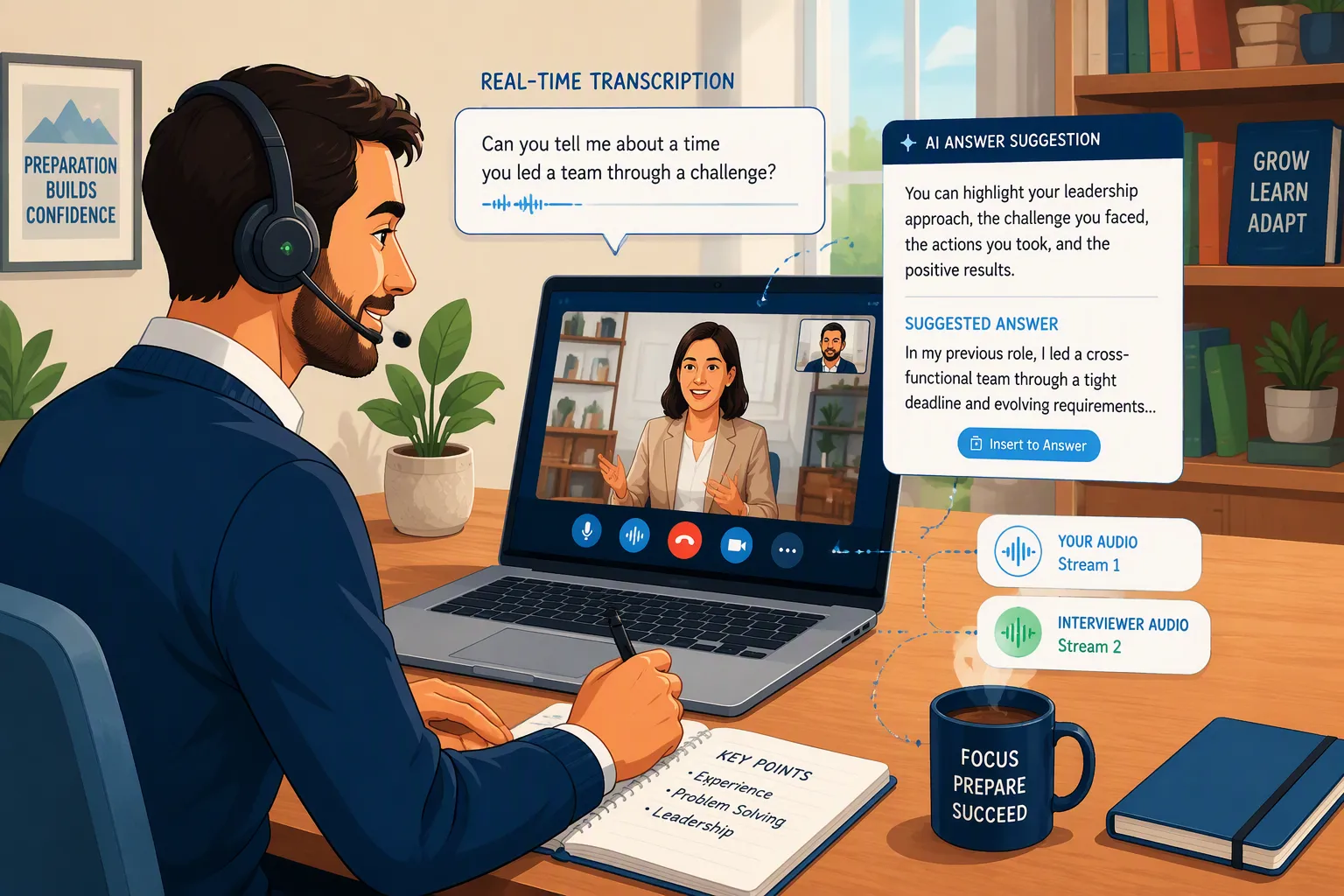
What is an AI interview assistant? An AI interview assistant is an AI-powered tool designed to help job seekers prepare for interviews, understand interview questions, organize stronger answers, and, with some products, receive support while an interview is actually happening.
That's the short definition.
The longer answer is a little more interesting, because AI interview assistant has become a surprisingly broad term.
Some products are essentially AI interview coaches. You use them before the real interview to practice questions and improve weak answers.
Some analyze your resume and job description, then generate questions based on the role you're applying for.
Others specialize in coding and technical interviews.
And a newer category works as a real-time AI interview assistant, following the conversation and providing relevant guidance while the interview is taking place.
So two products can both call themselves AI interview assistants while solving very different problems.
The easiest way I think about it is this:
An AI interview assistant is software built specifically to use AI somewhere in the candidate's interview workflow — before, during, or after the interview.
Linkjob AI is one example. It combines interview preparation with a real-time AI Interview Copilot that can use information such as your resume, job description, and interview context to provide more relevant guidance.
And that last part — context — is where a dedicated interview assistant starts becoming different from simply opening ChatGPT and typing, “Help me with my interview.”
Key Takeaways
An AI interview assistant can help before an interview with practice and feedback, or during an interview with real-time guidance.
Different tools focus on different use cases, including mock interviews, behavioral questions, live interview support, and coding interviews.
Useful AI interview assistants usually combine the interview question with context such as your resume, job description, target role, and previous experience.
Linkjob AI is one example that combines interview context with real-time interview assistance.
How Does an AI Interview Assistant Work?
There isn't one mysterious piece of technology called an “AI interview assistant.”
Most products combine technologies that already exist: large language models, speech recognition, resume analysis, job-description analysis, and sometimes screen or coding context.
What matters is how those pieces are put together around an interview.
Imagine you're preparing for a product manager position.
You provide your resume and the job description. Now the assistant has some idea of your experience, the responsibilities of the role, and the skills the employer appears to care about.
Maybe you've worked on B2B SaaS products.
Maybe the job description repeatedly mentions experimentation, stakeholder management, and product strategy.
That context gives the AI a much better starting point.
Then a question arrives:
“Tell me about a time you had to influence someone without direct authority.”
The AI doesn't just see a random sentence.
It can recognize that this is probably a behavioral question testing influence, communication, and stakeholder management.
It can then combine that interpretation with information about the candidate and suggest a useful direction for the answer.
That's essentially what happens:
Stage | What the AI Does | Example |
|---|---|---|
Context | Understands information about the candidate and role | Resume + job description |
Question | Receives or hears the interview question | “Tell me about a conflict at work.” |
Interpretation | Identifies what the interviewer may be testing | Communication and conflict resolution |
Guidance | Generates a useful answer structure or feedback | Situation → action → result |
The ability to write an answer isn't actually the most interesting part anymore.
General-purpose AI can already write good interview answers.
The more useful part is getting from:
question → relevant context → usable guidance
without requiring the candidate to explain everything from scratch every time.
Why Context Matters in an AI Interview Assistant
Ask a general AI:
“How should I answer ‘Tell me about yourself’?”
and you'll probably get a perfectly reasonable response.
The problem is that the AI has no idea who “yourself” is.
Are you a new graduate?
A product manager?
A finance professional?
A backend engineer with ten years of experience?
Someone changing careers?
The question stays exactly the same.
A good answer doesn't.
Take another common interview question:
“Tell me about the most difficult project you've worked on.”
For a junior software engineer, a useful example might come from an internship or an early-career technical challenge.
For an engineering manager, the interviewer may expect something involving scale, architecture, leadership, or coordinating multiple teams.
Same words.
Completely different answer.
This is why specialized AI interview assistants tend to put so much emphasis on resumes, job descriptions, and role context.
With Linkjob AI Interview Assistant, for example, candidates can provide information about their background and target job before the interview.
That doesn't mean the AI suddenly knows everything about you.
It simply means it isn't starting every question as a stranger.
And that usually produces much more useful guidance than a generic answer template.
Key Features and Use Cases of an AI Interview Assistant
This is where the category starts getting broad.
Someone searching for an AI interview assistant might have an interview next week and want to practice.
Someone else might be preparing for a technical round.
Another candidate may already have an interview tomorrow and be looking for real-time help.
All three are technically looking for the same category of product.
Using an AI Interview Assistant Before an Interview
Preparation is still one of the most common use cases.
You tell the AI what role you're interviewing for, and it can generate questions that are more relevant than a generic list of “50 Common Interview Questions.”
A product manager may get questions about prioritization, metrics, stakeholder conflict, and product sense.
A finance candidate might see questions about valuation, accounting, markets, or previous deals.
A software engineer may encounter algorithms, debugging, system design, and technical behavioral questions.
A good mock interview also doesn't have to stop after your first answer.
It can ask:
“Why?”
“What happened next?”
“What would you do differently?”
That matters because real interviews rarely feel like someone reading questions from a spreadsheet.
Interviewers react to what you say.
That's part of what makes an AI Mock Interview useful for preparation.

An AI mock interview can combine role-specific practice questions with feedback on your answers.
Getting Feedback on Interview Answers
This is one of the areas where AI can make solo practice much more useful.
When you're practicing alone, you have an obvious problem:
you're the person giving the answer and the person deciding whether it was good.
It's surprisingly easy to repeat the same weak answer until it starts sounding normal.
An AI interview assistant can point out that you never really answered the question, that your story is too long, or that you spent two minutes explaining the background and twenty seconds explaining what you actually did.
For a behavioral answer, it might notice that the result is missing entirely.
That's useful feedback.
Not because AI replaces a professional interview coach, but because it gives you another perspective when you're practicing by yourself.
Using an AI Interview Assistant During an Interview
This is the newer side of the category.
A real-time AI interview assistant is designed to help while the conversation is happening.
That changes what matters.
During practice, waiting several seconds for a thoughtful response isn't a big problem.
During a real interview, it is.
Suppose the interviewer asks:
“Why are you leaving your current company?”
There is usually a natural moment where you pause and think.
A real-time assistant can use that moment to help identify a useful structure:
what you learned → what you want next → why this opportunity fits
That may be far more useful than receiving a polished 400-word answer.
During a live interview, you don't need another article to read.
You need enough information to get moving.
Types of AI Interview Assistants
Not every AI interview assistant is designed for the same part of the hiring process.
This is probably the simplest way to separate them:
Type | When It's Used | Main Purpose | Typical Use Case |
|---|---|---|---|
AI Mock Interview Assistant | Before the interview | Practice and feedback | Preparing for behavioral questions |
Real-Time AI Interview Assistant | During the interview | Live question understanding and guidance | Structuring an unexpected answer |
AI Coding Interview Assistant | Technical preparation or interviews | Coding and technical reasoning | Algorithms, debugging, system design |
AI Interview Coach | Mostly before or after interviews | Improve overall interview performance | Reviewing and improving weak answers |
The boundaries aren't strict.
A single product can sit in more than one category.
For example, Linkjob AI includes AI mock interview practice, a real-time Interview Copilot, and a separate Coding Interview Copilot for technical interviews.
So I wouldn't get too hung up on what a company calls its product.
Look at when and how it's supposed to help you.
That's usually much more revealing.
What Is a Real-Time AI Interview Assistant?
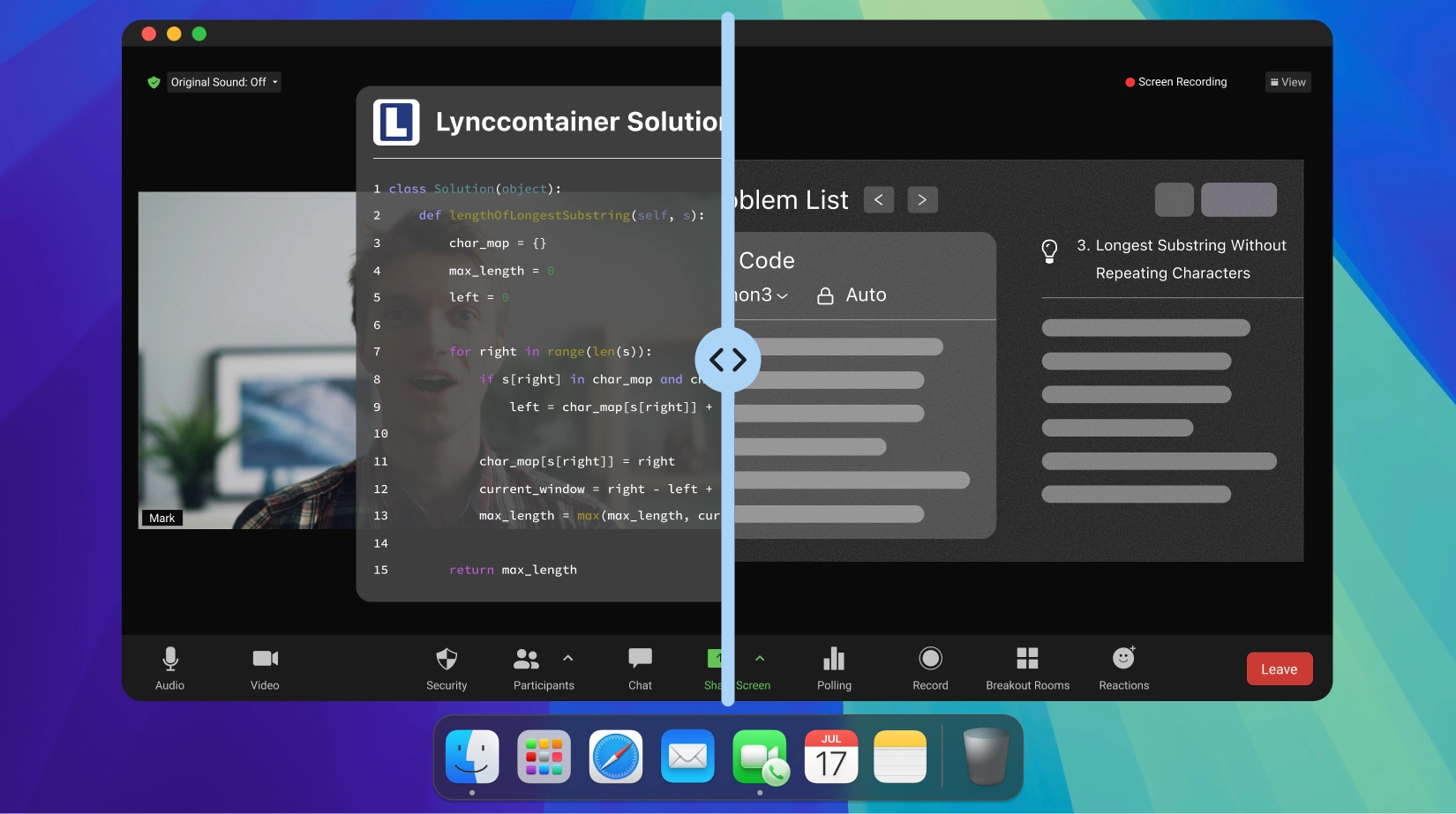
A real-time AI interview assistant follows an interview closely enough to provide useful guidance while the conversation is still happening.
That's very different from an AI tool you use the night before.
Imagine the interviewer asks:
“Tell me about a time a project didn't go according to plan.”
The assistant first needs to understand the question.
But that's only part of the job.
Depending on the role, the interviewer may actually be testing ownership, adaptability, judgment, communication, or how the candidate behaves when things go wrong.
Then the AI has to turn that interpretation into something useful quickly enough that the candidate can still use it.
That's why real-time tools tend to care much more about response speed, answer length, and interface design than ordinary interview-practice tools.
Nobody wants to sit silently reading a miniature blog post while the interviewer waits.
A few strong talking points can be more useful than a complete script.
Linkjob AI is an example of a real-time AI interview assistant designed around live interview questions and candidate context.
See How a Real-Time AI Interview Assistant Works
This is one of those things that's easier to understand by watching it.
The short Linkjob AI demo below shows how an Interview Copilot can fit into a live interview workflow.
AI Interview Assistant vs. ChatGPT
This is probably the first comparison most people make.
If ChatGPT can already answer interview questions, why use a dedicated AI interview assistant?
For basic interview preparation, you may not need one.
You can upload your resume, paste in a job description, ask ChatGPT to behave like a hiring manager, and start practicing.
That works.
The main difference is the workflow built around the AI.
AI Interview Assistant | ChatGPT | |
|---|---|---|
Main purpose | Built specifically around interviews | General-purpose AI assistant |
Resume and job context | Often part of the interview setup | Usually added manually |
Mock interviews | Can be a dedicated workflow | Possible through prompting |
Interview feedback | Often structured for interview performance | Depends on the prompt |
Real-time interview support | Available in some products | Not the standard workflow |
Coding interview support | Dedicated modes in some products | General coding assistance |
Answer presentation | Can be optimized for quick interview use | Standard chatbot conversation |
The difference isn't necessarily:
“An AI interview assistant is smarter than ChatGPT.”
It's closer to:
“The product has been designed around the interview workflow.”
That's a much more useful distinction.
The underlying model is only one part of the product.
Context, interface, response format, and how much manual setup is required can matter just as much.
AI Interview Assistant vs. AI Interview Copilot
These terms overlap a lot.
AI interview assistant is the broader category.
If AI helps you practice questions three days before an interview, it's an AI interview assistant.
If it reviews your answer afterward, the same term still works.
AI interview copilot usually implies something more active and closer to the live interview.
The word “copilot” suggests that the AI is there alongside the candidate while something is happening.
That's why real-time products often use that term.
Linkjob AI, for example, calls its live feature an Interview Copilot, while it still fits comfortably inside the broader category of AI interview assistant.
There's no formal industry rule here.
I would pay much more attention to what a product actually does than whether its landing page says “assistant,” “copilot,” or “coach.”
How AI Interview Assistants Help With Behavioral Interviews
Behavioral questions look simple until someone asks one unexpectedly.
“Tell me about a time you failed.”
There's no complicated technical concept to understand.
The hard part is memory.
Which example should you use?
How much context does the interviewer need?
What did you actually do?
What was the result?
How do you explain what you learned without turning the answer into a five-minute story?
Most candidates already have the raw material.
They've dealt with difficult projects, disagreements, mistakes, successes, and situations where they had to persuade someone.
The challenge is pulling out the right memory and turning it into a clear answer under pressure.
That's where AI can be surprisingly useful.
If the assistant already has some understanding of your background, it can help connect the question with a relevant experience and suggest a simple structure.
For many behavioral questions, that's enough.
You don't always want an AI writing an entire speech.
Sometimes the most useful assistance is simply:
“Use this story, emphasize this part, and get to the result faster.”
How AI Interview Assistants Work for Coding Interviews
This is where I would stop treating every AI interview assistant as interchangeable.
Coding interviews create a different problem.
The assistant may need to reason about code, understand algorithms, identify edge cases, explain time complexity, debug a broken solution, or discuss system architecture.
That's a very different workload from helping someone answer why they want a job.
Compare:
“Tell me about a conflict with your manager.”
with:
“How would you reduce the time complexity of this solution?”
Both are interview questions.
The AI capabilities required are clearly different.
This is why technical interview products often have separate workflows.
Linkjob AI's Coding Interview Copilot, for example, focuses on coding questions, algorithms, debugging, system design, and technical reasoning.
If you're interviewing for software engineering jobs, this is something I'd check early.
A tool can produce excellent behavioral answers and still be mediocre at code.
A Simple AI Interview Assistant Example
Suppose I'm interviewing for a senior product manager role.
Before the interview, I provide my resume and the job description.
The interviewer asks:
“Tell me about a product you launched that didn't perform as expected.”
A generic AI can explain how someone might answer that question.
It might suggest STAR.
It might tell me to talk about what went wrong and what I learned.
That's fine.
But an interview assistant with context can potentially do something more useful.
It can connect the question with a relevant project in the candidate's background and help organize the answer around:
what we expected → what happened → what I discovered → what I changed → what I learned
That's the difference I'm interested in.
The AI isn't valuable simply because it can generate fluent English.
It's valuable when it can connect the right question, the right candidate context, and the right moment.
That's a much better way to understand the category.
What Are the Benefits of an AI Interview Assistant?
The biggest benefit isn't necessarily “getting better answers.”
I think it's reducing cognitive load.
An interview forces you to do a ridiculous number of things at once.
You need to listen closely enough to understand the question.
Remember a relevant experience.
Figure out what the interviewer is actually testing.
Structure the answer.
Speak clearly.
Watch how the interviewer reacts.
And somehow avoid spending the entire conversation wondering whether you're doing badly.
An AI interview assistant can take a little of that mental load away.
Before the interview, it can make practice more targeted.
During the interview, a real-time assistant can help with recall and structure.
After practice, it can show you which answers still need work.
That doesn't mean the AI should do all the thinking.
Actually, the more clearly you understand your own experience, the more useful the assistant usually becomes.
It has better material to work with.
What Are the Limitations of AI Interview Assistants?
There are several.
The first is obvious: AI can be wrong.
This is particularly important in technical interviews. An answer can sound extremely confident and still contain a mistake.
Second, AI-generated answers can become generic.
If you provide almost no personal context and expect a deeply personalized response, the model doesn't have much to work with.
Third, too much AI can become distracting.
This matters especially during a live interview.
If you're paying so much attention to the assistant that you stop listening to the interviewer, the tool has made the interview harder rather than easier.
There is also the question of interview rules.
Employers and assessment platforms can have different policies around outside assistance. Candidates should understand the rules for the specific interview or assessment rather than assuming every situation is the same.
The technology being available and the technology being permitted are two separate questions.
How to Choose an AI Interview Assistant
I'd start with the problem rather than the feature list.
Where do your interviews usually go wrong?
If you freeze because you haven't practiced enough, a mock interview tool may be the best place to start.
If you know your stories but your answers always become long and messy, look for strong feedback and answer structuring.
If you're applying for software engineering roles, technical capability needs to be near the top of your list.
If your problem happens during the live conversation — you understand the question but suddenly can't organize your thoughts — then a real-time AI interview assistant becomes much more relevant.
After that, look at personalization.
Can the assistant use your resume?
Does it understand the job description?
Can you tell it what kind of answers you prefer?
Then look at the actual experience.
For a live assistant, a shorter answer can easily be better than a longer one.
A faster response can sometimes matter more than a theoretically smarter model.
And an interface with fewer controls can be better than a dashboard full of impressive features.
The interview is already demanding enough.
Your assistant shouldn't become another thing you have to manage.
Do You Need an AI Interview Assistant?
Not everyone does.
If you have one interview coming up, know your own experience well, and just want to practice a few common questions, a general AI chatbot may be completely sufficient.
There's no reason to make a simple problem complicated.
A dedicated AI interview assistant becomes more useful when the interview process itself becomes more demanding.
Maybe you're applying to several companies.
Maybe you're interviewing in a second language.
Maybe behavioral storytelling is difficult for you.
Maybe you're preparing for several technical rounds.
Maybe you want repeated role-specific mock interviews.
Or maybe the problem isn't preparation at all.
It's those moments during the actual interview where your mind suddenly goes blank.
That's where specialization starts to matter.
So, What Is an AI Interview Assistant?
An AI interview assistant is an AI-powered tool designed specifically to help candidates prepare for job interviews, understand interview questions, improve answers, practice realistic conversations, or receive guidance during a live interview.
Some are mainly interview coaches.
Some focus on mock interviews.
Some specialize in coding.
Others, such as Linkjob AI Interview Copilot, focus on real-time interview support.
The technology behind these products will keep changing.
Models will get faster.
Speech recognition will improve.
AI assistants will probably understand more context with less manual setup.
But the reason people use them is much simpler.
Interviews force you to listen, remember, think, organize, and speak at the same time.
An AI interview assistant is essentially an attempt to make some of that easier.
Frequently Asked Questions About AI Interview Assistants
What is an AI interview assistant?
An AI interview assistant is software that uses artificial intelligence to help candidates prepare for job interviews, understand questions, structure answers, practice responses, receive feedback, or get guidance during a live interview.
How does an AI interview assistant work?
An AI interview assistant typically combines an AI model with context such as your resume, job description, target role, and interview question. It then uses that information to generate relevant practice, feedback, answer structures, or real-time suggestions.
What are the key features of an AI interview assistant?
Features vary by product, but common capabilities include personalized interview questions, resume and job-description context, answer feedback, mock interviews, real-time guidance, and technical or coding interview support.
What can an AI interview assistant be used for?
AI interview assistants can be used before interviews for preparation and practice, during interviews for real-time guidance, and after practice sessions to review answers and identify areas for improvement.
Can an AI interview assistant help during a real interview?
Some can. These are generally called real-time AI interview assistants or AI interview copilots. They are designed to understand interview questions and provide useful guidance while the conversation is happening.
Is an AI interview assistant different from ChatGPT?
Yes, although they may use similar AI models. ChatGPT is a general-purpose assistant, while an AI interview assistant is built around interview-specific workflows such as resumes, job descriptions, mock interviews, answer feedback, coding questions, and real-time interview support.
What is the difference between an AI interview assistant and an AI interview copilot?
AI interview assistant is the broader term. AI interview copilot usually refers to a more active assistant that works alongside the candidate, particularly during a live interview.
There is no strict industry definition, so it's better to compare what products actually do rather than relying on the name.
Can an AI interview assistant use my resume?
Many can. Resume and job-description context can help the AI generate more relevant interview questions and suggestions.
Linkjob AI, for example, allows candidates to provide interview context so its guidance can better reflect their experience and target role.
Can AI interview assistants help with coding interviews?
Some can, but technical capabilities vary significantly. For coding interviews, look specifically for support for algorithms, code reasoning, debugging, system design, and technical explanations.
What is a real-time AI interview assistant?
A real-time AI interview assistant follows an interview while it is happening and provides guidance quickly enough to be useful during the conversation.
This is different from an AI mock interview tool, which is mainly intended for preparation.
Is an AI interview assistant worth using?
It depends on what you need. A general-purpose AI tool may be enough for occasional interview practice. A dedicated AI interview assistant becomes more useful when you want personalized preparation, structured feedback, technical interview support, repeated mock interviews, or real-time guidance.
Is Linkjob AI an AI interview assistant?
Yes. Linkjob AI is an AI interview assistant that covers both interview preparation and real-time interview support. Its Interview Copilot focuses on live interview guidance, while its Mock Interview and Coding Interview Copilot cover preparation and technical interview scenarios.