Plum Assessment Cheat and Guide: How to Beat the Plum Discovery Survey and Unlock a Top Talent Match

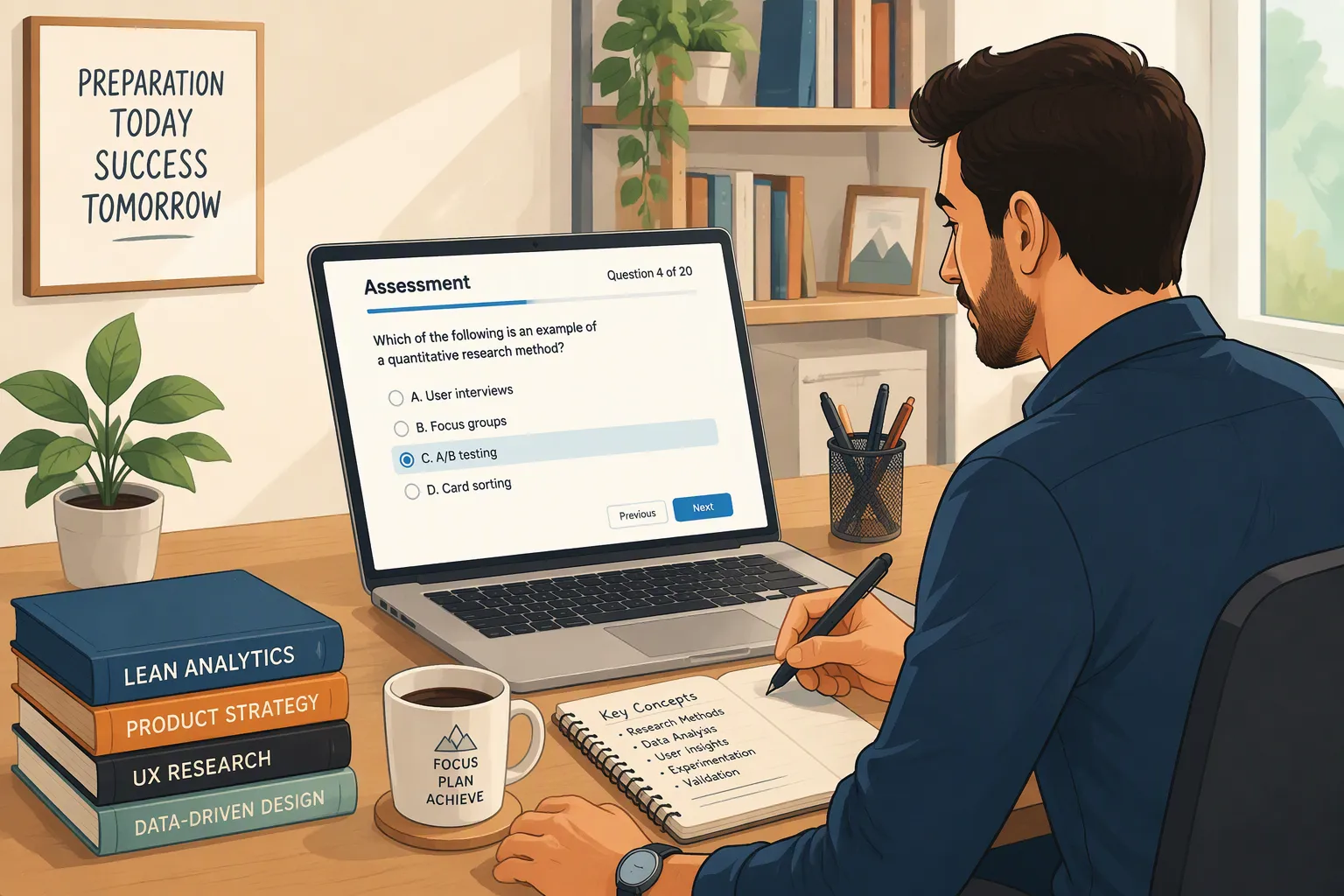
The first time I received a Plum Assessment invitation—officially called the Plum Discovery Survey—after applying for a rotational analyst program at Scotiabank, I made the mistake that thousands of applicants make every recruitment cycle. Because the welcome email told me there was "no time limit" and "no right or wrong answers," I treated it like a casual 20-minute personality quiz. I tried to make myself sound good on every single screen, guessed on two of the hardest visual grid puzzles in Section 4, and clicked submit.
Ten minutes later, I discovered two brutal truths about how Plum actually works. First, because I tried to pick whichever statement sounded the most impressive on every screen without tracking how those statements were cross-paired behind the scenes, Plum's algorithm flattened my scores across its 10 Talents—leaving me with a mediocre Match Score for the role. Second, I found out that Plum locks your Discovery Survey results for 365 days. When I applied to another major employer using Plum three months later, I was not allowed to take a fresh test; I was forced to reuse that same flawed profile for an entire year.
Once my one-year retake window finally opened, I studied the entire psychometric architecture behind the Plum Measurement Model (now part of the Phenom talent ecosystem following its 2026 acquisition). In this complete Plum Assessment cheat and guide, I am going to share my personal experience with all five sections of the Plum Discovery Survey, how the 4-layer feed-forward network calculates your 10 Talents, why trying to "fake good" triggers the dreaded Flat Profile penalty, how to solve the Raven's Progressive Matrices in Sections 2 and 4 with 100% accuracy, and how I use Linkjob AI in both Desktop Floating Window Mode and Dual-Device Mode to lock in a top-percentile Plum Profile safely.
What Is the Plum Assessment (Plum Discovery Survey) and Why Is the Stakes So High?
Plum is an Industrial/Organizational (I/O) psychology assessment platform used by major enterprise employers—most famously Scotiabank, Citibank (Citi), Bloomberg, Deloitte, Whirlpool, and Magna—to evaluate candidates based on durable soft skills and fluid intelligence rather than traditional resume keywords.
Before you click the link to secure.plum.io, there are three structural rules about the platform that you need to understand.
1. The 365-Day (One-Year) Profile Lock Rule
Unlike almost every other pre-employment test where each job application gives you a fresh attempt, you can only complete the Plum Discovery Survey once every 365 days.
The moment you submit your survey, your answers are permanently bound to your personal Plum Profile for the next 12 months. If you apply to five different roles at Scotiabank, Citi, and Bloomberg over the next six months, you simply share your existing Plum Profile with each employer. You only become eligible to type RETAKE inside your account settings (My Plum -> Account -> Settings) exactly one year after your previous submission. That means you get one single shot per year to build an elite profile.
2. You See Your Top 3 Talents, But Only the Employer Sees Your "Talent Match Score"
When you finish the assessment, Plum sends you a candidate report highlighting your Top 3 Talents along with descriptive bullet points about your workplace "Drivers" (activities that energize you) and "Drainers" (activities that exhaust you).
However, the recruiter sees a completely different dashboard. For every open job requisition, the hiring manager configures custom Match Criteria weighting the specific Talents required for that role. Plum's engine compares your full 10-Talent distribution and cognitive problem-solving percentile against the employer's benchmark to generate a numerical Talent Match Score, a Culture Fit Score, and a Leadership Potential Score that determine whether you get invited to an interview.
3. The 10 Plum Talents Measured by the Survey
Every single click you make across the five sections feeds into your ranking across ten core workplace Talents:
Adaptation: Adjusting quickly to changing priorities, ambiguity, and unexpected obstacles without losing composure.
Communication: Expressing complex ideas clearly and actively listening to understand others' viewpoints.
Conflict Resolution: Bringing people together to reconcile disagreements diplomatically.
Decision Making: Analyzing unfamiliar data and making high-quality, evidence-based calls.
Embracing Diversity (Embracing Differences): Understanding and working effectively with people from varied backgrounds, perspectives, and working styles.
Execution: Setting concrete goals, monitoring progress, improving processes, and delivering on time.
Innovation: Generating creative, original solutions to novel business problems.
Managing Others: Directing, motivating, and developing a team toward shared targets.
Persuasion: Convincing stakeholders to adopt your recommendation, direction, or initiative.
Teamwork: Cooperating seamlessly and prioritizing group success over individual credit.
Section-by-Section Breakdown: What Happens Inside All 5 Sections of the Plum Discovery Survey
Although the Plum Discovery Survey is untimed and takes most candidates around 25 to 30 minutes to complete, it alternates deliberately between forced-choice personality blocks, visual cognitive puzzles, and situational judgment scenarios to prevent you from getting into a comfortable rhythm.
1. Section 1: Personality Priorities & Preferences (Forced-Choice Statements)
In Section 1, you face roughly 20 screens, each presenting a triad of three workplace statements—for example:
"I enjoy coming up with unconventional ways to solve old problems."
"I make sure every detail of a project plan is organized before starting."
"I go out of my way to make sure new teammates feel included."
On every screen, you must pick one statement that is Most Like You and one statement that is Least Like You. All three statements are intentionally designed to sound equally positive (or, on some screens, equally unpleasant). Even more importantly, you will see the exact same statement show up multiple times later in Section 1, paired against two completely different statements, so the algorithm can test whether your priorities are mathematically consistent.
2. Section 2: Problem Solving Part 1 (Raven's Progressive Matrices)
Right after Section 1, the survey switches gears into pure fluid intelligence. Section 2 presents roughly 7 visual grid puzzles based on Raven's Progressive Matrices ("Next in Series").
You are shown a sequence of 3x3 or 4x4 pattern grids where dots, shaded squares, lines, or geometric shapes move, rotate, or cancel each other out from step to step, with the final grid replaced by a question mark (?). You must click the correct missing grid from 5 options below. You do not drag and drop the piece—you simply click the matching option and press Next.
3. Section 3: Personality Descriptors ("You" Adjective Grid)
Section 3 returns to personality measurement, but changes the format from full sentences to a multi-word descriptor grid. On each screen, you are given a list of adjectives (such as Analytical, Assertive, Diplomatic, Imaginative, Methodical, Supportive) and you must select 3 words that are Most Like You and 3 words that are Least Like You before the Next button unlocks.
4. Section 4: Problem Solving Part 2 (Advanced Visual Sequence Puzzles)
Section 4 presents a second round of roughly 7 Raven's Progressive Matrices puzzles, and this is where candidates regularly hit a wall. In Plum's own Help Center documentation, the company admits that Section 4 contains intentionally high-difficulty puzzles designed to stretch the score distribution and separate top-percentile analytical thinkers from the general database of 80,000+ calibrated profiles.
In Section 4, a single puzzle often combines two or three simultaneous rules—for instance, one diagonal loses two black squares moving outward from the center while the opposite diagonal gains two black squares moving inward, or shapes rotate 90 degrees clockwise while inverting colors on every odd step.
5. Section 5: Social Intelligence (Workplace Situational Judgment Test / SJT)
The final section presents roughly 7 detailed workplace scenarios describing interpersonal friction, missed deadlines, unethical requests, or cross-functional miscommunication. Below each scenario, you are given a list of possible actions and must select one response as Least Effective (in the left column) and one response as Most Effective (in the right column).
How Plum Detects Cheating and Faking: 4 Traps That Ruin Your Talent Match Score
When people ask if you can cheat on the Plum Assessment, they usually assume that because there is no countdown timer and no mandatory webcam inside secure.plum.io, anything goes. In reality, Plum relies on a 4-layer feed-forward psychometric network that neutralizes traditional "faking" and sloppy shortcuts.
1. The Ipsative "Flat Profile" Penalty (Why Trying to Sound Good Everywhere Fails)
In Plum's official documentation on whether candidates can cheat the Discovery Survey, the platform reveals its primary defense: ipsative forced-choice cross-pairing.
Because every screen in Sections 1 and 3 forces you to concede that one positive behavior is Least Like You whenever you claim another is Most Like You, it is mathematically impossible to get high scores in all 10 Talents. When candidates try to "game" the test on the fly—picking an Innovation statement on Screen 2, an Execution statement over Innovation on Screen 5, and a Teamwork statement over Execution on Screen 9—they violate transitivity (A > B > C > A).
Instead of crashing or throwing an error message, Plum's feed-forward network averages out those contradictions and produces what Plum calls "flatter, less representative scores within Talents." A flat profile means all 10 of your Talents hover around the 45th to 55th percentile. Because employers configure their role Match Criteria to look for candidates who spike above the 80th+ percentile in 3 or 4 core Talents, a flat profile guarantees you will never rank at the top of the recruiter's shortlist.
2. The Hidden Cognitive Multiplier Inside Your Soft-Skill Talents
The second trap that catches candidates off guard is assuming that Sections 2 and 4 (the 14 visual grid puzzles) only affect a standalone "problem-solving score."
Inside Plum's 4-layer Measurement Model, each of the 10 Talents is a combined product of your personality priorities AND your cognitive problem-solving percentile. Specifically, Talents like Decision Making, Innovation, Execution, and Adaptation are heavily weighted by how many Raven's Matrices you solve correctly in Sections 2 and 4. If you guess on three hard grid puzzles in Section 4, your Decision Making and Innovation Talent scores will be capped even if you prioritized them heavily in Sections 1 and 3.
3. The "All-the-Way-Back" Review Screen Trap
At the very end of Section 5, Plum asks if you would like to review your responses before submitting. Many candidates click "Review" thinking they can just jump back to check one puzzle in Section 4.
However, Plum's interface has a rigid quirk: clicking review sends you all the way back to Question 1 of Section 1, and forces you to click Next through every single screen of the entire 5-section assessment again before you can submit. Even worse, second-guessing and randomly changing a few personality answers during that review walkthrough often introduces the exact transitivity contradictions that flatten your Talent spikes.
4. Browser Extension Conflicts and Enterprise Video Interview Wrappers
Plum's web application relies heavily on clean JavaScript execution to register multi-column radio selections and matrix clicks, and Plum explicitly notes that third-party browser extensions or add-ons injected into the browser DOM can break button states (causing the infamous "I can't click Next" or "I can't select a puzzle piece" bug). Furthermore, employers like Scotiabank frequently pair the Plum Discovery Survey with a mandatory one-way recorded video interview inside the same application workflow.
How I Use Linkjob AI Safely on the Plum Assessment (Web Floating Window vs. Dual-Device Mode)
Because you only get one attempt at the Plum Discovery Survey every 365 days, you cannot afford to guess on the multi-rule Raven's Matrices in Sections 2 and 4, and you cannot afford to accidentally contradict your priority hierarchy across Sections 1, 3, and 5.
To make sure I nail every single visual puzzle and maintain a razor-sharp, role-aligned Talent hierarchy from Question 1 to the final screen, I use an AI interview assistant that runs completely outside the browser DOM (so it never interferes with Plum's JavaScript buttons or triggers browser extension bugs). Based on my hands-on experience, here is how I use the tool across its two operating modes.
1. Mode 1: Desktop Floating Window Mode (For Standard Web-Page Plum Assessments)
So here is how it works when your Plum Discovery Survey runs on a standard web page in Google Chrome, Edge, or Safari. You can directly use the floating window of the Linkjob AI desktop app right on your monitor.
Here is what makes the desktop floating window so effective during the five Plum sections:
Instant Raven's Matrix Recognition (Sections 2 & 4): When a complex 3x3 or 4x4 sequence puzzle appears on screen, the floating window analyzes the row, column, and diagonal transformation rules visually and highlights which of the 5 option tiles (
1through5) completes the pattern—eliminating guesswork on the hardest Section 4 items.Consistent Role-Aligned Priority Mapping (Sections 1 & 3): By telling the app which role I am targeting before starting (for example, Investment Banking / Sales & Trading vs. Software Engineering vs. Wealth Management / Consulting), it keeps track of the exact Top 4 Talents I need to spike and tells me which statement or adjective to mark as Most Like Me and Least Like Me on every screen without ever creating a self-contradictory "flat profile."
Situational Judgment Calibration (Section 5): For all 7 workplace scenarios, it immediately identifies both the Least Effective trap option and the Most Effective high-EQ response.
When using the desktop floating window on a web-based test, there are only two rules you need to watch out for:
Finish all relevant settings before the test starts: Set up your target job track, resume context, and floating window placement before you launch the
secure.plum.iotab. Avoid clicking the app's Settings button during the test so your focus stays cleanly inside the survey flow.Do NOT use
Cmd + \orCtrl + \to toggle the app during the test: Never trigger global keyboard hooks while an assessment tab is active. Leave the floating window open in a comfortable spot on your screen—all other features work normally.
2. Mode 2: Dual-Device Mode (For Extra Security, Video Steps, or Lockdown Browsers)
If you want extra security—or if your employer embeds the assessment inside a monitored portal, requires a lockdown browser, or follows the Plum survey immediately with a recorded one-way video interview—you will need its Dual-Device Mode.
Under Dual-Device Mode, the Linkjob desktop app only runs silently in the background on my computer with zero on-screen floating windows, and all real-time puzzle solutions, Most/Least selections, and video interview scripts display directly on my phone.
This mode is my favorite setup whenever an application includes both the Plum survey and a video step (like Scotiabank's digital interview round):
100% Untouched Desktop Screen: Your computer monitor shows nothing except the official browser window, and you never touch a single shortcut key.
Seamless Transition to One-Way Video Prompts: When you move from the Plum survey to the recorded video interview questions, you can prop your phone right below your webcam lens and read tailored, role-specific talking points aligned with the exact Top 3 Talents that your Plum Profile just generated.
You can choose between the Desktop Floating Window Mode and Dual-Device Mode based on your own scenario and preference.
Role-by-Role Blueprint: Which Talents to Prioritize for Banking, Tech, Consulting, and Management
Because nobody can score high on all 10 Plum Talents due to the forced-choice trade-offs, the secret to getting an 85%+ Talent Match Score is committing to a 4-Talent Priority Hierarchy that matches your target job family—and consciously sacrificing 2 or 3 low-relevance Talents as your "Least Like Me" picks across Sections 1 and 3.
Using a real-time AI interview assistant to hold this hierarchy steady across all 20+ triads and adjective grids makes the execution effortless. Here are the exact Talent blueprints I use for the four biggest job families that rely on Plum.
1. Investment Banking, Sales & Trading, Finance, and Accounting (Citi, Scotiabank GBM, Bloomberg)
High-stakes financial and quantitative roles weight analytical speed, delivery discipline, and pressure tolerance above all else.
Top Talents to Spike (
Most Like Me): Execution, Decision Making, Adaptation, and Innovation (for quant/markets) or Persuasion (for institutional sales/advisory).Safe Trade-Off Talents (
Least Like Me): When forced to choose between two positive statements, sacrifice Managing Others (for entry-level analyst/intern roles where you have zero direct reports) or Conflict Resolution so that Execution and Decision Making stay above the 85th percentile.
2. Software Engineering, Data Science, Product, and R&D (Tech & Automotive Tracks)
Technical engineering and product tracks prioritize structured problem-solving, creative architecture, and agile iteration.
Top Talents to Spike (
Most Like Me): Innovation, Decision Making, Execution, and Adaptation (or Teamwork for agile squad roles).Safe Trade-Off Talents (
Least Like Me): Concede statements tied to Persuasion (cold-selling ideas) and Managing Others (for IC developer roles) whenever they go head-to-head against Innovation, Decision Making, or Execution.
3. Wealth Management, Commercial Banking, Sales, and Client Success
Client-facing revenue and relationship tracks flip the priority matrix toward social influence and empathy.
Top Talents to Spike (
Most Like Me): Communication, Persuasion, Embracing Diversity, and Execution.Safe Trade-Off Talents (
Least Like Me): Sacrifice abstract Innovation (inventing brand-new unvalidated processes from scratch) when it competes against serving clients, building rapport, or following proven execution playbooks.
4. Management Trainee, HR Leadership, and Operations Management
Rotational leadership and people-management programs look for candidates who can align diverse teams and drive results through others.
Top Talents to Spike (
Most Like Me): Managing Others, Communication, Conflict Resolution, and Decision Making (or Execution).Safe Trade-Off Talents (
Least Like Me): Concede solo, heads-down individual contributor preferences when they compete against coaching teammates, delegating work, or resolving cross-team bottlenecks.
How to Solve the Hardest Section 2 & Section 4 Raven's Matrices (4 Visual Rules)
Eventhough Linkjob AI solves the visual grid puzzles in real time, knowing the four underlying pattern rules that Plum uses to construct its 14 Raven's Progressive Matrices will let you verify every choice in seconds:
Rule 1: Independent Diagonal Counter-Movement: Plum loves 6x6 or 4x4 grids of small squares where the main diagonal (top-left to bottom-right) and the anti-diagonal (top-right to bottom-left) follow opposite arithmetic rules—for example, the main diagonal loses 2 black squares from the center outward on each step, while the anti-diagonal gains 2 black squares from the center outward. Track each diagonal separately rather than staring at the whole grid.
Rule 2: Modulo-N Shape Rotation + Stepwise Translation: A symbol in the corner of the grid shifts one corner clockwise on each step while rotating 45 or 90 degrees counter-clockwise around its own axis.
Rule 3: Row/Column XOR Cancellation (Overlap Elimination): In 3x3 matrix grids, combining Grid 1 and Grid 2 in a row produces Grid 3 by keeping only the line segments that appear in Grid 1 or Grid 2, while erasing any line segments that appear in both (or vice versa).
Rule 4: Alternating Parity Flip (Odd vs. Even Frames): In 5-frame horizontal sequences, Frames 1, 3, and 5 follow one progression rule, while Frames 2 and 4 (and the missing Frame 6) follow a secondary inverted rule. Whenever Frame 2 looks completely different from Frame 1, compare Frame 1 directly to Frame 3 and Frame 2 directly to Frame 4.
Real-World Worked Examples: How I Answer Sections 1, 3, and 5 Without Flattening My Profile
To show you how forced-choice trade-offs and situational judgment scoring actually play out on screen, here are three worked examples modeled directly on the hardest screen types in the Plum Discovery Survey.
1. Worked Example 1: Section 1 Forced-Choice Statement Triad (When All 3 Sound Positive)
The Triad on Screen:
Statement A: "I am energized by brainstorming unconventional concepts that challenge standard procedures." (Maps to Innovation)
Statement B: "I keep detailed checklists to ensure deliverables never miss a deadline." (Maps to Execution)
Statement C: "I step in quickly to mediate when two teammates have different opinions." (Maps to Conflict Resolution)Why Candidates Fail Here: An applicant interviewing for a Scotiabank Global Banking & Markets Analyst role might think "Innovation sounds smart" on this screen and pick A as Most Like Me, then two screens later pick an Execution statement over an Innovation statement. That contradiction flattens both Talents.
How I Solve It: If my target blueprint is Execution > Decision Making > Adaptation > Innovation, I immediately select Statement B as Most Like Me (locking in Execution at the top of the hierarchy) and Statement C as Least Like Me (sacrificing Conflict Resolution so Innovation stays intact as a secondary strength).
2. Worked Example 2: Section 3 Adjective Descriptor Grid (3 Most / 3 Least)
The Grid on Screen: You are shown 10 adjectives—Methodical, Outgoing, Inventive, Diplomatic, Assertive, Patient, Analytical, Adaptable, Empathetic, Persuasive—and must choose 3 Most Like You and 3 Least Like You.
How I Solve It for a Technical / Quantitative Track: I select Analytical (Decision Making), Methodical (Execution), and Inventive (Innovation) as my 3 Most Like Me, and I select Outgoing, Persuasive, and Diplomatic as my 3 Least Like Me. Notice that even though Outgoing and Diplomatic are positive words in everyday life, consistently placing them in the "Least" column on a technical track forces Plum's ipsative network to push my Execution, Decision Making, and Innovation bars into the 90th+ percentile.
3. Worked Example 3: Section 5 Social Intelligence (SJT Most Effective vs. Least Effective)
The Scenario on Screen: You are two days away from presenting a client deliverable with a cross-functional colleague, Jordan. Jordan emails you their half of the slide deck late at night, and you realize several of their financial projections contain formula errors that contradict the client's raw data.
The 4 Response Options:
Option 1: Rewrite Jordan's slides yourself overnight without telling them so the deck is accurate and you avoid an awkward conversation.
Option 2: Forward Jordan's flawed slides to your project manager immediately so leadership knows why the deck might be delayed.
Option 3: Contact Jordan first thing in the morning, point out the specific data discrepancies constructively, and offer to review the corrected formulas together before the client meeting.
Option 4: Present your half of the deck and let Jordan explain their own numbers to the client during the meeting.The Exact Scoring Selection: Mark Option 4 (or Option 2) as Least Effective because letting flawed data reach a client or blindsiding a teammate destroys trust and team accountability. Mark Option 3 as Most Effective because Plum's Social Intelligence rubric consistently rewards direct peer-to-peer communication, psychological safety, and collaborative problem resolution before escalating to management.
Top Questions Candidates Ask About the Plum Assessment (FAQ)
1. Is the Plum Discovery Survey timed, and does completion speed affect my score?
No. The Plum Discovery Survey is completely untimed, and Plum explicitly confirms in its Help Center that there is no record of how long you took to complete the assessment and that completion time has zero impact on your Talent scores. Most candidates finish in 20 to 30 minutes, and you can even pause and resume across multiple sessions before the employer's submission deadline.
2. Can I retake the Plum Assessment if I get a bad profile or apply to a different company?
No—not for 365 days. You are only allowed to take the Plum Discovery Survey once every 12 months. Every employer that uses Plum over the next year will receive the exact same Plum Talent Profile generated from your single sitting, evaluated against their specific role Match Criteria. That is why getting your first sitting right with Linkjob AI is critical.
3. Does the Plum Assessment turn on my webcam or track my screen?
The standalone Plum Discovery Survey hosted on secure.plum.io does not activate your webcam or microphone (and requires no speakers or audio). However, browser extensions injected into your browser can cause technical glitches with Plum's interactive buttons, and many employers (like Scotiabank) immediately follow the Plum survey with a mandatory one-way recorded video interview step.
4. Why do some candidates get rejected right after the Plum Assessment even though Plum says there are "no wrong answers"?
While there are no "wrong" answers on a single personality triad in isolation, there are three ways to fail a Plum screening: missing multiple visual matrix puzzles in Sections 2 and 4 (which tanks your cognitive multiplier on Decision Making, Innovation, and Execution), giving inconsistent forced-choice answers that flatten all 10 of your Talent scores toward the average, or spiking Talents that are the exact opposite of the employer's role Match Criteria.
5. What should I screenshot if an employer (like Scotiabank) asks for my Plum Profile in my application?
Some campus and early-career applications ask you to upload a PDF or screenshot of your completed Plum Profile alongside your video interview. After submitting the Discovery Survey, log in to secure.plum.io, open your Plum Profile page showing your Top 3 Talents and their summary descriptions (plus your registered email/name header if requested by the recruiter), and save a clean full-page screenshot or PDF export.
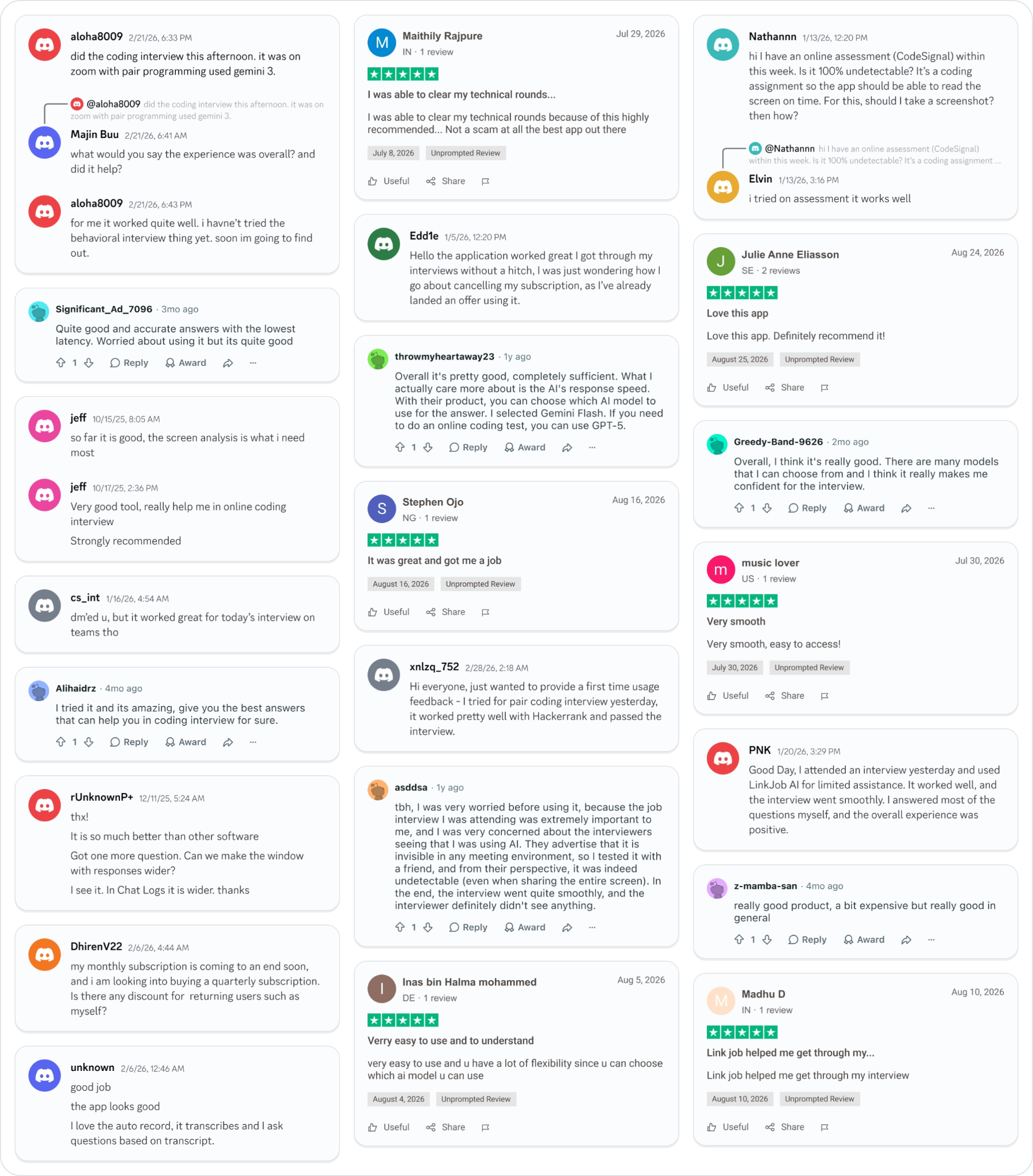
Why People Choose Linkjob AI
Smoother interviews, coding challenges cleared, and job offers landed. See how users describe their experience with Linkjob AI—in their own words.

© Copyright 2026 Linkjob AI - All Rights Reserved.