Accenture HackerRank Questions My Honest ExperienceMy Accenture HackerRank Online Assessment Questions (And How I Passed in 2026)

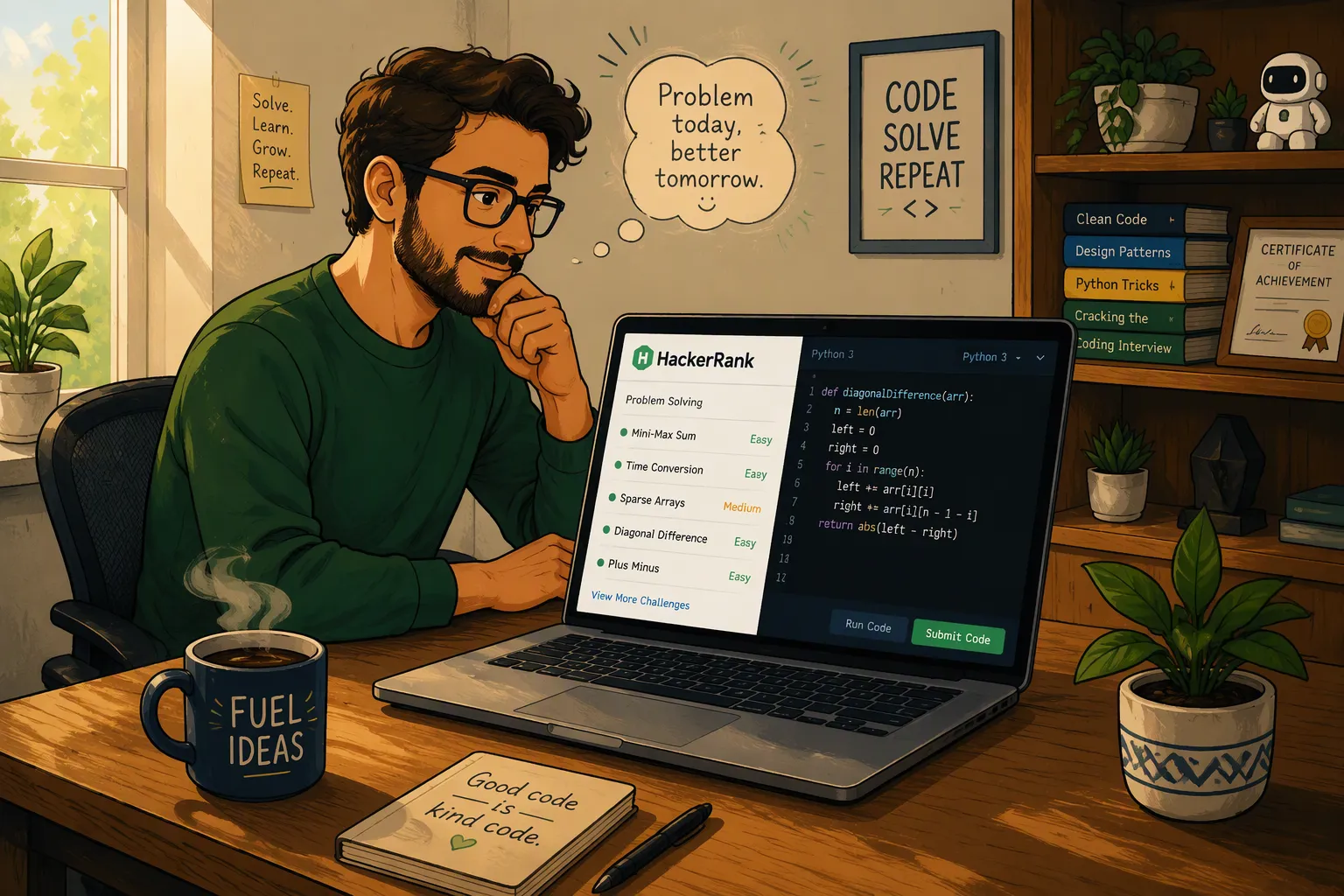
When I got my Accenture HackerRank online assessment link after applying for a Software Engineering / Technology Analyst role, I noticed right away how tight the clock was. Unlike companies that give you 90 minutes to leisurely debug two problems, my Accenture coding window gave me just 45 to 60 minutes to clear two coding problems—plus a strict hidden test-case suite where returning the wrong sentinel value (0 instead of -1 on an empty array) or obeying standard mathematical operator precedence instead of left-to-right scanning fails half the test cases instantly.
During my test session, I got a Binary String Bitwise Evaluator problem, a Minimum Resource / Prefix-Sum Subarray problem, and a set of SQL and pseudocode multiple-choice questions (MCQs). On the first problem, I initially parsed the 'A' (AND), 'B' (OR), and 'C' (XOR) operators using standard bitwise precedence (AND before XOR before OR), which passed the first sample test case and failed the second. Checking the specification with an AI interview assistant immediately showed me that Accenture's grader requires strict left-to-right sequential evaluation, which let me fix the loop in 30 seconds and finish both coding problems with 18 minutes to spare.
In this complete guide, I am sharing my Accenture HackerRank online assessment questions along with the full 2025–2026 Accenture question bank I compiled from fellow Technology Analyst, Associate Software Engineer (ASE), Advanced Associate Software Engineer (AASE), Experienced Custom Software Engineer, and Data Engineering candidates. I will walk you through the exact working Python and SQL solutions, the pseudocode and MCQ traps, how HackerRank's proctoring and Code Playback catch shortcuts, and how I use Linkjob AI in both Desktop Floating Window Mode and Dual-Device Mode to pass every test case safely without triggering a single warning.
What My Accenture HackerRank Assessment Looked Like (And the 4 Role Tracks)
Accenture is one of the largest technology employers in the world, and it routes candidates through different HackerRank assessment templates depending on whether you applied for an early-career analyst/engineer role, an experienced backend/full-stack role, or a data/cloud role.
1. Track 1: Technology Analyst, Associate SWE (ASE) & Advanced ASE (AASE) — 45 to 60 Minutes
This is Accenture's highest-volume coding assessment for campus, new grad, and entry-level software engineering applicants.
Format and Timer: Typically 2 coding questions in 45 minutes (or 2 coding questions + 10 to 15 technical/pseudocode MCQs in 60 to 75 minutes).
Difficulty and Tier Cutoff: Question 1 is an Easy-to-Medium implementation problem focused on string parsing, bitwise operations, or custom digit/array rules. Question 2 is a Medium separator testing dynamic programming, prefix sums, base conversion, or greedy sorting. Crucially, clearing 1 out of 2 coding questions usually qualifies you only for the standard entry tier, whereas clearing both coding questions (
2/2) with 100% hidden test cases is what unlocks the higher-compensation Advanced App Engineering / AASE interview track.
2. Track 2: Experienced Custom Software Engineer (Java / Spring Boot / Python / Full-Stack)
If you applied for a mid-level or senior Custom Software Engineering role across North America, Europe, or India delivery centers, your HackerRank link typically runs 60 to 90 minutes and includes:
2 Algorithmic / Backend Coding Questions: Focused on sliding-window rate limiting, subarray sum optimization (
n <= 10^5), string transformation, or interval scheduling.1 Relational SQL Question: Writing
JOIN,GROUP BY,HAVING, and window-function (DENSE_RANK()) queries over client project billing, consultant utilization, and department tables.10 to 15 Stack-Specific MCQs: Covering Java OOP (
equals/hashCode,ConcurrentHashMap, Spring Dependency Injection), REST API status codes and idempotency, and microservice patterns.
3. Track 3: Data Engineer, Data Analyst & AI/ML Engineer Track
For data and AI roles, the 60-to-90-minute HackerRank test combines 2 SQL coding problems (handling NULL values in LEFT JOIN rollups, rolling revenue averages, and ranking top performers per practice), 1 Python data-processing problem, and 10+ MCQs on database normalization (1NF, 2NF, 3NF, BCNF), ETL partitioning, and probability/statistics.
4. Track 4: Pseudocode, Bitwise Tracing & Cloud/Network MCQ Module
Many Accenture assessments include a timed MCQ block containing tricky pseudocode tracing snippets where bitwise operators (^, &, |, <<, >>) and recursive calls are nested inside for loops. One wrong mental bit-shift costs you the question, which is why having a fast verification workflow is essential.
Real Interview Questions. Real Candidates. Continuously Updated
Our interview questions come from real job interviews taken by candidates using Linkjob AI. Based on actual interview experiences and continuously updated with new questions
My Real Accenture HackerRank Coding & SQL Questions (With Full Working Solutions)
Below are the exact coding and SQL questions from my test session and the highest-frequency confirmed prompts in Accenture's 2026 question pool, complete with the sentinel return-value traps that fail most candidates on hidden test cases.
1. Question 1: Binary String Bitwise Operations Evaluator (operations_binary_string)
This is one of Accenture's most famous coding prompts, and its operator-precedence trap catches thousands of test-takers every year.
The Problem Prompt: You are given a string
srepresenting a binary expression where odd indices contain operator letters and even indices contain binary digits ('0'or'1'):'A'denotes the bitwise AND operation (&).'B'denotes the bitwise OR operation (|).'C'denotes the bitwise XOR operation (^).
Evaluate the string strictly sequentially from left to right (ignoring standard operator precedence) and return the final integer result (0or1). If the input string isNoneor empty, return-1.
Walkthrough Example: For
s = "1C0C1C1A0B1":Start with
res = 1.1 C 0(1 ^ 0) ->1.1 C 1(1 ^ 1) ->0.0 C 1(0 ^ 1) ->1.1 A 0(1 & 0) ->0.0 B 1(0 | 1) ->1. Final output:1.
My Clean O(n) Python Implementation:
def operations_binary_string(s: str | None) -> int:
    if s is None or len(s) == 0:
        return -1

    res = int(s[0])
    # Step by 2 across operator-operand pairs from left to right
    for i in range(1, len(s) - 1, 2):
        op = s[i]
        operand = int(s[i + 1])
        if op == "A":
            res = res & operand
        elif op == "B":
            res = res | operand
        elif op == "C":
            res = res ^ operand

    return res
2. Question 2: Minimum Warehouses / Rat Count House (calculate_min_houses)
This problem tests whether you read the exact sentinel return codes (-1 vs. 0) required by Accenture's automated test runner.
The Problem Prompt: Given two positive integers
r(number of units/rats) andunit(amount of resource/food consumed by each unit), along with an integer arrayarrof lengthnrepresenting the amount of resource available in each house/warehouse from index0ton - 1, determine the minimum number of sequential houses (starting from index0) required to supply at leastr * unittotal resource.The Two Hidden Return-Code Traps:
If
arrisNoneor empty (len(arr) == 0), you must return-1.If the sum of all elements in
arris still less thanr * unit(insufficient total supply), you must return0! Candidates who return-1for both cases fail 4 hidden test cases immediately.
My Clean O(n) Solution:
def calculate_min_houses(r: int, unit: int, arr: list[int] | None) -> int:
    if arr is None or len(arr) == 0:
        return -1

    total_required = r * unit
    if total_required == 0:
        return 0

    accumulated = 0
    for idx, amount in enumerate(arr):
        accumulated += amount
        if accumulated >= total_required:
            return idx + 1  # 1-based count of houses used

    # Total supply across all houses is insufficient
    return 0
3. Question 3: DectoNBase Base-N Notation Converter & Move Hyphens to Front
Accenture frequently pairs a base-conversion problem or a custom string-rearrangement problem as one of the two coding slots.
Part A (
dec_to_n_basefor Base1 < n <= 36): Convert a positive decimal integernuminto its Base-nstring representation using digits'0'-'9'for remainders0..9and uppercase letters'A'-'Z'for remainders10..35(for example,num = 718, n = 12yields"4BA"because718 = 4*144 + 11*12 + 10):
def dec_to_n_base(n: int, num: int) -> str:
    if n <= 1 or n > 36:
        return ""
    if num == 0:
        return "0"

    alphabet = "0123456789ABCDEFGHIJKLMNOPQRSTUVWXYZ"
    remainders = []

    while num > 0:
        num, rem = divmod(num, n)
        remainders.append(alphabet[rem])

    return "".join(reversed(remainders))
Part B (
move_hyphen— Moving All Hyphens to the Front While Preserving Order): Given a strings, move all'-'characters to the beginning of the string while preserving the relative order of all non-hyphen characters, or return""(orNone) ifsisNone:
def move_hyphen(s: str | None) -> str | None:
    if s is None:
        return None
    hyphen_count = s.count("-")
    without_hyphens = s.replace("-", "")
    return ("-" * hyphen_count) + without_hyphens
4. Question 4 (Medium-Hard Separator for AASE & Experienced SWE): Subarray Sum Equals K & Minimum Jumps DP
On the second coding problem for Advanced ASE and Experienced SWE tracks, Accenture steps up the input size to n <= 100,000 so that O(n^2) nested loops fail with a Time Limit Exceeded (TLE) error.
Part A (Count Contiguous Project Sprints With Net Variance Equal to
KinO(n)Time): Given an integer arraynums(containing positive, zero, and negative numbers) and a target integerk, return the number of contiguous subarrays that sum tokusing a prefix-sum frequency dictionary:
from collections import defaultdict

def count_subarrays_equal_k(nums: list[int], k: int) -> int:
    prefix_freq = defaultdict(int)
    prefix_freq[0] = 1
    running_sum = 0
    total_count = 0

    for x in nums:
        running_sum += x
        total_count += prefix_freq[running_sum - k]
        prefix_freq[running_sum] += 1

    return total_count
Part B (Minimum Network Hops to Reach Final Server in
O(n)Greedy BFS): Given an arraymax_reachwheremax_reach[i]is the maximum jump length from serveri, return the minimum number of jumps to reach indexn - 1, or-1if unreachable:
def min_server_hops(max_reach: list[int]) -> int:
    n = len(max_reach)
    if n <= 1:
        return 0
    if max_reach[0] == 0:
        return -1

    jumps = 0
    curr_level_end = 0
    farthest = 0

    for i in range(n - 1):
        if i > farthest:
            return -1
        farthest = max(farthest, i + max_reach[i])
        if i == curr_level_end:
            jumps += 1
            curr_level_end = farthest
            if curr_level_end >= n - 1:
                return jumps

    return jumps if curr_level_end >= n - 1 else -1
5. Question 5 (Accenture SQL Classic): Consultant Utilization & Top Billable Performers Per Practice
If your Accenture HackerRank assessment includes SQL, expect a multi-table query combining LEFT JOIN, COALESCE, and DENSE_RANK().
The Problem Prompt: You have a
consultantstable (consultant_id,full_name,practice_area) and aproject_logstable (log_id,consultant_id,billable_hours,log_date). Write a SQL query to return, for eachpractice_area, the top 2 consultants by totalbillable_hoursin 2026 (including consultants with0hours as0, and including all ties for 1st or 2nd place), ordered bypractice_areaascending andtotal_billable_hoursdescending.My Clean SQL Solution:
WITH practice_totals AS (
    SELECT
        c.practice_area,
        c.consultant_id,
        c.full_name,
        COALESCE(SUM(p.billable_hours), 0) AS total_billable_hours
    FROM consultants c
    LEFT JOIN project_logs p
        ON c.consultant_id = p.consultant_id
       AND p.log_date >= '2026-01-01'
       AND p.log_date < '2027-01-01'
    GROUP BY c.practice_area, c.consultant_id, c.full_name
),
ranked_consultants AS (
    SELECT
        practice_area,
        consultant_id,
        full_name,
        total_billable_hours,
        DENSE_RANK() OVER (
            PARTITION BY practice_area
            ORDER BY total_billable_hours DESC
        ) AS rnk
    FROM practice_totals
)
SELECT
    practice_area,
    consultant_id,
    full_name,
    total_billable_hours
FROM ranked_consultants
WHERE rnk <= 2
ORDER BY practice_area ASC, total_billable_hours DESC, consultant_id ASC;
6. Question 6: Password Validator & Autobiographical Number Checker
Two more frequent Accenture coding prompts are check_password and find_auto_count.
Part A (
check_password— 5 Mandatory Rules): Return1if the stringsis a valid password and0otherwise. A valid password must have length>= 4, at least one numeric digit (0-9), at least one uppercase letter (A-Z), must not contain any space' 'or slash'/', and must not start with a digit:
def check_password(s: str | None) -> int:
    if not s or len(s) < 4:
        return 0
    if s[0].isdigit():
        return 0

    has_digit = False
    has_upper = False

    for ch in s:
        if ch == " " or ch == "/":
            return 0
        if ch.isdigit():
            has_digit = True
        elif ch.isupper():
            has_upper = True

    return 1 if (has_digit and has_upper) else 0
Part B (
find_auto_count— Autobiographical Number Distinct Digit Count): An autobiographical number is a stringnwhere the digit at indexiequals the exact count of how many times the digitiappears inn(for example,"1210"has one0, two1s, one2, and zero3s). Ifnis autobiographical, return the count of distinct digits inn; otherwise return0:
def find_auto_count(n: str | None) -> int:
    if not n:
        return 0
    length = len(n)
    if length > 10:
        return 0

    freq = [0] * 10
    for ch in n:
        freq[int(ch)] += 1

    for i in range(length):
        if int(n[i]) != freq[i]:
            return 0

    return len(set(n))
8 More Confirmed Problems in Accenture's 2026 HackerRank Pool (With Working Code)
When I compared notes with other applicants who took the Accenture coding assessment over the past few months, these eight additional problems kept rotating through the question bank:
large_small_sum(arr)(Second-Largest Even-Index + Second-Smallest Odd-Index Sum): Given an integer arrayarr, return the sum of the second-largest element from even indices (0, 2, 4...) and the second-smallest element from odd indices (1, 3, 5...), or return0ifarris empty orlen(arr) <= 3:
def large_small_sum(arr: list[int] | None) -> int:
    if not arr or len(arr) <= 3:
        return 0
    even_vals = sorted(set(arr[0::2]), reverse=True)
    odd_vals = sorted(set(arr[1::2]))
    if len(even_vals) < 2 or len(odd_vals) < 2:
        return 0
    return even_vals[1] + odd_vals[1]
number_of_carries(num1, num2)(Addition Carry Operation Counter): Count how many times a carry-over (>= 10) occurs when adding two non-negative integersnum1andnum2digit-by-digit from right to left:
def number_of_carries(num1: int, num2: int) -> int:
    carry = 0
    carry_count = 0
    while num1 > 0 or num2 > 0:
        total = (num1 % 10) + (num2 % 10) + carry
        if total >= 10:
            carry = 1
            carry_count += 1
        else:
            carry = 0
        num1 //= 10
        num2 //= 10
    return carry_count
max_exponents(a, b)(Number With the Highest Power of 2 Factor): Given an inclusive range[a, b], return the integer in[a, b]that contains the highest exponent of2in its prime factorization (using(x & -x)to isolate the highest power of 2 dividingxinO(1)time!).replace_character(s, ch1, ch2)(Simultaneous Two-Character Swap): Swap every occurrence ofch1withch2and every occurrence ofch2withch1in a single pass.difference_of_sum(n, m): Return the absolute difference between the sum of all numbers in1..mnot divisible bynand the sum of all numbers in1..mdivisible byn.product_smallest_pair(sum_limit, arr): Sortarrascending and returnarr[0] * arr[1]ifarr[0] + arr[1] <= sum_limit, or0(and-1iflen(arr) < 2).Coin Change / Minimum Denominations (1D Dynamic Programming): Compute the minimum coins required to reach
amountinO(amount * len(coins))time.Longest Common Subsequence / Edit Distance (2D Dynamic Programming): Classic string alignment DP appearing on the Advanced ASE (AASE) Question 2 slot.
Inside the Accenture Pseudocode & Technical MCQs: 4 High-Frequency Traps
If your Accenture assessment includes the MCQ and pseudocode block, watch out for these four recurring question patterns:
1. Bitwise XOR (^) and Shift (<<, >>) Pseudocode Loops
Accenture's pseudocode questions love expressions like a = a ^ b, if ((a & (a - 1)) == 0), and c = (a >> 1) + (b << 1). Keep two fast rules in mind:
x ^ x == 0andx ^ 0 == x.x & (x - 1)clears the lowest set1-bit ofx(so(x & (x - 1)) == 0checks whether positive integerxis a power of 2!).
2. Database Normalization (2NF vs. 3NF vs. BCNF)
In the database MCQ section:
1NF: Atomic column values (no repeating comma-separated lists in a cell).
2NF: In 1NF + no partial dependency (no non-prime attribute depends on only part of a composite primary key).
3NF: In 2NF + no transitive dependency (no non-prime attribute depends on another non-prime attribute).
3. Java / OOP Polymorphism (Compile-Time vs. Runtime Binding)
When a question shows Parent p = new Child(); in Java or C++/C#, remember that instance methods (virtual methods) are resolved at runtime based on the actual object (Child), whereas static methods, private methods, and member variables/fields are resolved at compile time based on the reference type (Parent)!
4. Large-Small Sum & Odd-Even Index Array Traps
Several Accenture array prompts and MCQs ask for the sum of the second-largest element at even positions (0, 2, 4...) and the second-smallest element at odd positions (1, 3, 5...). Always check whether len(arr) <= 3 (which returns 0) and whether duplicates should be deduplicated before finding the second-largest/smallest value!
How HackerRank Detects Cheating on the Accenture OA in 2026
Accenture processes hundreds of thousands of assessments globally and relies heavily on automated proctoring flags to filter out compromised submissions. Before you consider switching browser tabs or pasting code from an external window, understand the four detection layers running on HackerRank.
1. Default Copy/Paste Tracking and Keystroke Code Playback
Even when an Accenture HackerRank session does not turn on your webcam, Copy/Paste Tracking and Keystroke Code Playback are active by default on 100% of assessments.
Whenever you paste code from your system clipboard into the HackerRank editor, the platform highlights the pasted block in red on the recruiter's dashboard and logs the event on your Code Playback timeline. If an Accenture reviewer sees a 35-line function appear in a single keystroke frame without any incremental typing, your test score is invalidated immediately.
2. Tab Proctoring and Window Focus Telemetry (blur / visibilitychange)
When Tab Proctoring is active, the browser page listens continuously for DOM focus-loss events (window.onblur and document.visibilitychange). Clicking outside the browser window, switching tabs to look up ASCII codes or SQL syntax, or pressing a global OS shortcut that steals focus from your browser increments your violation counter and records the exact number of seconds you spent away from the test tab.
3. Webcam Proctor Mode and Multiple-Monitor Detection
On webcam-proctored Accenture assessments:
Webcam Snapshot AI: The browser captures periodic webcam frames and flags missing faces, extra people in the background, or repeated off-screen gaze shifts.
Multiple-Monitor Detection: HackerRank queries your browser's display API to detect secondary monitors. Always physically unplug any external HDMI or DisplayPort monitor before opening your assessment link.
Focus-Stealing Hotkey Traps: Pressing global keyboard shortcuts mid-test to toggle poorly built screen overlays frequently triggers focus-loss logs or causes the window to flash during screen checks.
4. AST Plagiarism Detection and Hidden Prompt Watermarks
HackerRank converts your submitted code into an Abstract Syntax Tree (AST) and compares its structure against prior candidate submissions. Furthermore, HackerRank's Secure Mode embeds invisible Unicode characters or hidden prompt instructions inside the problem statement so candidates who blindly copy-paste the prompt into an external window produce watermarked variable names in their code.
How I Use Linkjob AI Safely on the Accenture HackerRank OA (Floating Window vs. Dual-Device Mode)
Because Accenture's coding questions have strict sentinel return codes (-1 vs. 0) and custom evaluation rules (like left-to-right bitwise scanning) under a fast 45-to-60-minute timer, I needed a way to immediately verify the exact problem specification and pseudocode bit-shifts without switching browser tabs, copying text to my clipboard, or pressing focus-stealing shortcut keys.
That is why I used an AI interview assistant to read the problem constraints directly on screen and show me the verified solution so I could type the code naturally into the HackerRank editor myself. Depending on whether your Accenture test runs in a standard web browser window or under strict webcam/lockdown proctoring, here is how I set up the two modes.
1. Mode 1: Desktop Floating Window Mode (For Standard Web-Page Assessments)
So here is how it works when your Accenture HackerRank test runs on a standard web page. You can directly use the floating window of the Linkjob AI desktop app right on your monitor.
The moment a coding prompt, SQL schema, or pseudocode MCQ appears on screen, the floating window analyzes the problem requirements, highlights the exact boundary return rules, and displays the clean solution right next to your code editor—with zero clipboard interaction and zero tab switching.
When using the desktop floating window on a web-based test, there are only two strict rules to watch out for:
Finish all relevant settings before the test starts: Select your preferred programming language (Python 3, Java, C++, or SQL), position the floating window near your code editor panel, and verify all preferences before you open the HackerRank link. Avoid clicking the app's Settings button during the test so your mouse focus never leaves the browser page.
Do NOT use
Cmd + \orCtrl + \to toggle the app during the test: Because HackerRank monitors global keyboard hooks and window focus changes, never pressCmd + \orCtrl + \once your assessment timer starts. Just leave the floating window open in place—all other features work normally.
2. Mode 2: Dual-Device Mode (For Extra Security, Webcam Proctoring, or Lockdown Browsers)
If you want extra security—or if your Accenture assessment runs under strict webcam Proctor Mode, Secure Mode, or requires a desktop lockdown client—you will need its Dual-Device Mode.
Under Dual-Device Mode, the Linkjob desktop app only runs silently in the background on my laptop with zero visible floating window or on-screen overlay, and all real-time code solutions, pseudocode traces, and SQL queries display directly on my phone.
Here is why Dual-Device Mode is my favorite setup whenever webcam proctoring or a lockdown browser is active:
100% Clean Laptop Display: Even if the platform captures full-screen snapshots or scans for active desktop overlays, your computer monitor shows nothing except the official assessment interface.
Natural Eye Alignment and Spotless Keystroke Playback: By propping my phone right below my laptop webcam, my eyes stay pointed straight toward the camera while I read the solution on my phone and type the code into HackerRank line by line at my normal typing pace—creating a 100% organic Code Playback log with zero clipboard pastes and zero focus switches.
You can choose between the Desktop Floating Window Mode and Dual-Device Mode based on your own scenario and how much extra security you want.
My 45-Minute Pacing Strategy to Unlock the Advanced Tier (2/2 Coding Pass)
Even when a real-time AI interview assistant gives you the verified Python or Java code immediately, how you pace your 45-to-60-minute window and how you type your code into the editor determines whether you unlock the top hiring tier:
Minutes 0 to 12 (Problem 1 — String / Bitwise / Array Warmup): Read the empty-input sentinel rule carefully (
return -1vsreturn 0), type theO(n)solution in logical steps, click "Run Code" to verify the sample output, and test one custom empty/boundary input before clicking Submit.Minutes 12 to 32 (Problem 2 — Medium DP / Prefix-Sum / Base-N Separator): Type your helper logic first, run the sample test cases midway through implementation so your Code Playback timeline shows normal iterative testing, and verify that large inputs (
n = 10^5) useO(n)orO(n log n)logic.Minutes 32 to 45 (SQL & Pseudocode MCQs): Use the remaining time to methodically verify every bitwise pseudocode trace and SQL
LEFT JOIN/DENSE_RANK()query before submitting.
Top Questions Candidates Ask About the Accenture HackerRank Assessment (FAQ)
1. How many questions and how much time are on the Accenture HackerRank assessment in 2026?
For Technology Analyst, ASE, and AASE tracks, the coding round typically gives you 45 minutes to solve 2 coding questions (or 60 to 75 minutes when bundled with 10 to 15 technical/pseudocode MCQs). Experienced Custom Software Engineering and Data Engineering tracks typically last 60 to 90 minutes with 2 to 3 coding/SQL questions and stack-specific MCQs.
2. What score do I need on the Accenture coding round to get the Advanced (AASE) role?
While clearing 1 out of 2 coding questions (plus passing the MCQ cutoff) is often enough to advance in the standard Associate Software Engineer (ASE) pipeline, passing both coding questions (2/2) with 100% of hidden test cases cleared is the primary benchmark required to unlock the higher-compensated Advanced Associate Software Engineer (AASE) / Advanced App Engineering track.
3. Which programming languages are allowed on the Accenture coding assessment?
You can typically choose between Python 3, Java, C++, C, and C#. Unless your specific experienced-hire track locks the editor to Java or C#, Python 3 is the fastest language for Accenture's string-parsing, base-conversion, and hash-map problems because you can write clean, bug-free solutions in 15 to 25 lines of code.
4. Can HackerRank detect if I switch tabs or copy-paste code during the Accenture OA?
Yes. HackerRank enables Copy/Paste Tracking and Keystroke Code Playback by default on every assessment, and records browser focus loss (blur and visibilitychange) whenever Tab Proctoring is active. Pasting external code blocks or pressing focus-stealing shortcut keys will flag your recruiter report. Never copy-paste code, never press Cmd + \ or Ctrl + \ during a web-based test, or use Dual-Device Mode so all answers display on your phone while you type naturally into the editor.
5. What happens after you pass the Accenture HackerRank Online Assessment?
Candidates who clear the coding and technical assessment typically move on to the Communication Assessment (an automated spoken-English fluency and listening round) followed within 1 to 2 weeks by the Final Technical + HR / Managerial Interview (a 30-to-45-minute live virtual interview covering your resume projects, OOP/DBMS fundamentals, scenario-based teamwork questions, and cloud/digital transformation awareness).
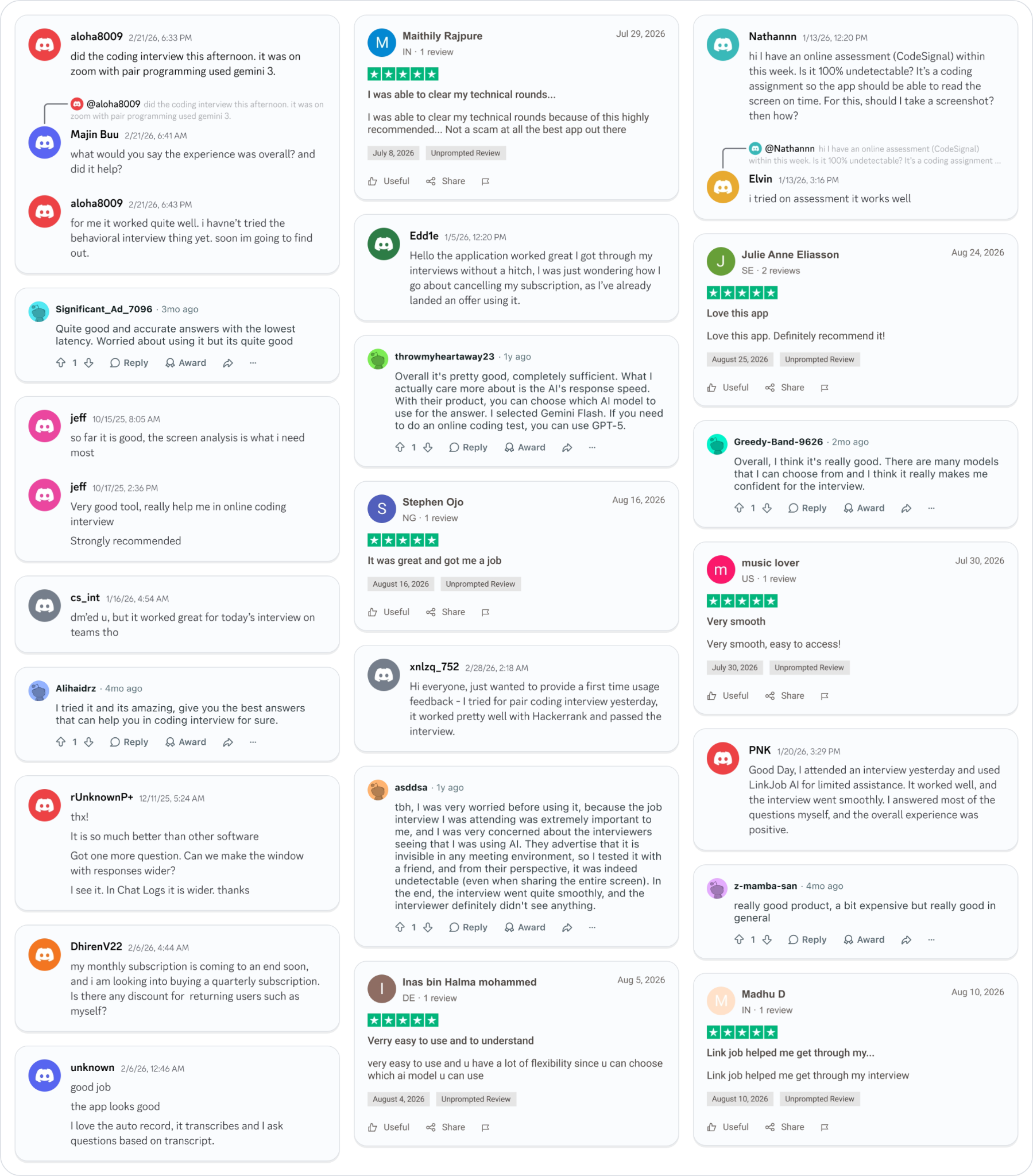
Why People Choose Linkjob AI
Smoother interviews, coding challenges cleared, and job offers landed. See how users describe their experience with Linkjob AI—in their own words.

© Copyright 2026 Linkjob AI - All Rights Reserved.