How I Passed the Apple Machine Learning Interview: My 2026 Experience

I finally finished my Apple machine learning interview, and I wanted to write everything down while I still remember the details, especially because I found the preparation phase unnecessarily confusing.
The first thing I did after getting the interview was pretty predictable. I opened LeetCode, then Reddit, then Glassdoor, then somehow ended up with another ten tabs searching variations of “Apple MLE interview,” “Apple machine learning interview questions,” “Apple ML system design,” and “Apple MLE LeetCode.”
The problem was that almost none of the experiences looked the same.
One person got pretty normal coding questions. Another person had a computer vision-heavy round. Someone else got statistics and probability. Some candidates talked about system design and ML infrastructure, while others said their hiring manager spent most of the call drilling into one project on their resume.
I initially assumed the online information was just messy. After going through the process myself, I think the real explanation is simpler: Apple's machine learning interviews are extremely team-specific.
That is probably the single most important thing I learned.
A current Apple Search MLE role is about personalized query understanding and on-device search. Another team works on foundation-model inference. Siri roles care about speech, multimodal models and personal context. Apple's current ML infrastructure also spans on-device execution and large server-side foundation models. Those are very different engineering problems, so it makes sense that two people with the exact same “Machine Learning Engineer” title can get very different interviews.
My own loop touched coding, classical ML, NLP, probability, statistics and system design. One of the rounds started with decision trees and somehow ended with renewal theory, which probably gives you an idea of how predictable the process was.
Key Takeaways From My Apple Machine Learning Interview
LeetCode mattered, but LeetCode alone would not have been enough. I had to implement things, explain trade-offs and deal with ML-specific coding rather than only standard DSA.
My past projects mattered much more than I expected. Anything technical on the resume was fair game for a deep follow-up.
The ML questions often started with something basic and became difficult because the interviewer kept asking “why?” or changing the assumptions.
If I went through the Apple machine learning interview again, I would spend much more time preparing for the exact team instead of trying to study every possible MLE topic.
I’m really grateful to Linkjob.ai for helping me pass my interview, which is why I’m sharing my apple machine learning interview questions here. Having an undetectable AI interview tool during the interview indeed provides a significant edge.
My Apple Machine Learning Interview Process
My process started with a hiring-manager conversation. After that I had a technical screen that mixed coding with an informal ML discussion, and then the longer interview loop.
The overall process I went through looked roughly like this:
Round | What I Was Asked |
|---|---|
Hiring Manager | Background, past ML projects, role fit |
Technical Screen | Coding + ML fundamentals |
Onsite 1 | ML design / NLP |
Onsite 2 | Graph coding |
Onsite 3 | Coding + data-structure fundamentals |
Onsite 4 | ML + probability / statistics / math |
Onsite 5 | ML/data system design |
I wouldn't assume your process will match this exactly. Current Apple MLE candidate data shows the same variability I saw while preparing. A recent Apple interview guide built from candidate reports describes a typical loop as roughly five to seven rounds, but explicitly notes that Apple has one of the least standardized MLE processes in Big Tech because the individual team has so much influence over the questions.
That turned out to be completely consistent with my experience.
My First Apple Machine Learning Coding Question
The first coding problem I got was actually fairly recognizable once I understood what was being asked.
I was given a matrix containing three types of cells. A 0 represented a village, a 1 represented a well, and -1 represented a wall that couldn't be crossed. The goal was to figure out the shortest route or distance from each village to its nearest well.
My first instinct was to think about running BFS separately from each village, but that would obviously repeat a lot of work. Once I flipped the perspective and started BFS simultaneously from all of the wells, it became a classic multi-source BFS problem.
I remember being weirdly relieved when I recognized the pattern. I had spent the previous few days convincing myself Apple was going to open with some horrible DP problem, and instead I got something I could reason about fairly cleanly.
The interviewer still expected working code, though. I had to run through test cases, explain what happened around walls, and talk about complexity. That part mattered more than simply naming BFS.
Once the coding portion ended, the interview switched into ML almost immediately.
There wasn't a dramatic “now we begin the machine learning section.” We just started talking about things like XGBoost and Word2Vec, and the conversation moved wherever my answers took it.
That became a recurring theme in the rest of the loop.
The ML Discussion Was Much Less Structured Than My Notes
Before the interview, I had made one of those beautifully organized ML revision documents where every topic had a definition, assumptions, advantages and disadvantages.
Very satisfying.
Not particularly representative of the interview.
The interviewer might start by asking something simple about boosting, but if I said something like “each learner is trying to correct the errors made by the previous ensemble,” the next question would immediately become more specific. Why does gradient boosting work? What exactly is being optimized? How do you control overfitting? Why would I choose XGBoost instead of a neural network for this particular dataset?
Word2Vec was similar. Giving the textbook difference between CBOW and Skip-gram was only enough to start the conversation. Then came questions about why these learned representations capture semantic relationships, how negative sampling works, and what happens with infrequent words.
After that first technical conversation, I stopped preparing ML as a collection of definitions.
Instead, I started asking myself:
If I tell the interviewer I would use this method, can I defend that decision for another five minutes?
That was much closer to the actual Apple machine learning interview.
My ML Design Round: Design a Fake-News Detection System
One of my onsite interviews was an ML design round. The prompt was roughly:
Design a fake-news detection system for Facebook.
Yes, Facebook.
In an Apple interview.
I didn't ask.
The interesting part wasn't the company name anyway. The interviewer wanted me to think through the whole ML problem: what method I would use, how I would get labels, how I would evaluate the system, and what I would do to improve it.
My first instinct was obviously to start talking about NLP models, but the conversation became much more interesting once we got into labeling.
What actually counts as fake news? Are we labeling the article, an individual claim, or the source? What happens when two annotators disagree? What do we do with satire? What if an article is mostly accurate but contains one misleading claim?
Once you start asking those questions, evaluation gets messy pretty quickly too.
Accuracy clearly isn't enough if the positive class is relatively rare, so we started discussing precision and recall. Then the interviewer pushed further: which error matters more? Is a false positive worse than a false negative? What happens if the system confidently labels legitimate reporting as misinformation?
That was the point where the question stopped feeling like “pick an NLP model” and started feeling like an actual product problem.
I liked this round because there wasn't a single magical architecture I was supposed to guess. The interviewer kept changing the angle and asking me to make my assumptions explicit.
Looking back, I think that was much more important than naming the fanciest transformer I knew.
One of My Coding Questions Is Still Fuzzy
There was another graph question during the longer loop, and I'm going to be slightly annoying here because I genuinely don't remember the complete prompt anymore.
It involved a directed graph, every node contained an integer value, and the objective involved finding some maximum-value result across the graph.
I remember talking about traversal and how the graph structure affected the solution. I remember the follow-up discussion.
I do not remember the full wording well enough to recreate the exact problem.
I'm deliberately leaving it that way instead of pretending I have photographic memory several days later. This is actually something I wish more interview writeups did. When someone publishes ten perfectly reconstructed paragraphs of prompts three months after an interview, I always wonder how much of it has been reverse-engineered afterward.
What I do remember is that the interviewer cared about the reasoning around the graph more than some obscure trick.
Another Coding Round Was Much More Basic Than I Expected
One of my other coding conversations involved topological sorting using BFS, basically Kahn's algorithm.
That felt surprisingly standard.
Then the interviewer moved into a discussion of min heaps versus max heaps and their operations and time complexity.
This was a good reminder that Apple doesn't necessarily need to give you a LeetCode Hard to see whether your fundamentals are solid.
Everyone says they understand heaps.
Then somebody asks what insertion costs, what peeking costs, what extraction costs, and why heap construction can be linear rather than simply n × log n.
That's usually where “I know heaps” becomes a real discussion.
There are plenty of public Apple MLE reports showing the same thing. One candidate described a 45-minute Apple ML Engineer technical screen containing Best Time to Buy and Sell Stock II followed by Reverse Linked List II.
So I would absolutely still prepare normal DSA.
I just wouldn't assume it's the only type of coding Apple can ask.
The ML + Math Round Was the Weirdest One
This was probably the round I remember most clearly because the topic progression became slightly absurd.
It started normally enough with decision trees and boosting. We discussed the mechanics of tree splits, and at some point the interviewer asked about the computational cost of evaluating splits in a regression tree.
We ended up talking about using the variance identity
Var(X) = E[X²] - E[X]²
and maintaining the relevant statistics so the candidate split calculations can be updated efficiently while scanning the data instead of recomputing everything from scratch.
So far, this was still comfortably inside my definition of “ML + Math.”
Then the interviewer switched to probability.
The question was roughly:
If I roll a fair die
ntimes, how would you compute the probability that the total sum is exactlyM?
I wrote a dynamic programming solution.
After that, we discussed how I could optimize it.
Still okay.
Then the conversation moved into the Central Limit Theorem.
Then how you might prove it.
Then moment-generating functions.
At some point I remember thinking, how did we get here from decision trees?
Somehow We Ended Up Talking About Renewal Theory
The interviewer then changed the dice setup again.
Instead of fixing the number of rolls, imagine you keep rolling and accumulating the sum until it passes some very large value M.
Now the problem started looking like a renewal process.
For a fair six-sided die, the expected increment is 3.5. We discussed the long-run renewal rate, which gives 1 / 3.5 = 2/7, and Blackwell's renewal theorem came up in the conversation.
We also talked about thinking about the same problem through a recurrence or a Markov-style formulation.
I'm writing that very calmly now.
My actual internal reaction during the interview was more like:
Okay, apparently we're doing renewal theory now. Sure.
That was probably the moment where I stopped trying to guess what the label “ML + Math” meant.
I came out of the round not knowing whether I had done well or badly. There were parts I handled comfortably and parts where I definitely needed more time than I wanted.
That uncertainty is something interview guides don't really talk about enough.
Sometimes you finish a round and genuinely have no idea.
My Apple ML System Design Round
The system design prompt was approximately:
Design a data-logging system for a search product.
The idea was that users perform searches and then produce behavioral signals: they click results, navigate, maybe move through several pages, and those events need to be logged for some combination of analytics, feedback and future ML training.
I started by thinking about the obvious pipeline: event generation, ingestion, queues, processing, storage and the consumers downstream.
Then the interviewer asked what happens during a traffic peak if there aren't enough machines.
I gave the normal answers around buffering, queues, autoscaling and backpressure, but I could tell from the follow-up questions that the interviewer was trying to push me toward something more specific.
I think they were interested in how repeated user events were being loaded and aggregated in real time, and how the aggregation layer and load balancing fit together.
I'm still not 100% sure.
This was definitely the round I felt worst about afterward.
I remember replaying the question later and thinking of several things I would structure differently if I answered it again.
But that is also part of a real interview loop. I don't think I had one interview where I came out believing every answer was perfect.
The Biggest Lesson: Apple MLE Is Extremely Team-Specific
If someone asked me for one piece of preparation advice now, it would be to stop thinking about “Apple MLE” as one job.
Read the exact posting.
Apple currently has ML teams working on personalized search and query understanding, Siri speech and multimodal systems, foundation-model inference, search safety, on-device models and many other areas.
Those roles shouldn't produce the same interviews.
If I were interviewing with a Camera or Vision team, I would go much deeper on computer vision, image processing and model evaluation.
For Search, I would focus on embeddings, retrieval, ranking and query understanding.
For Siri, I'd expect NLP, speech, multimodal systems, inference and privacy.
For foundation-model infrastructure, I'd spend much more time on inference systems, GPUs, memory, batching and low-latency serving.
This is also reflected in very recent candidate data. A current Apple MLE interview guide based on candidate experiences explicitly says Apple has one of the least standardized MLE loops among large tech companies, with interviewers tailoring the process heavily toward the team's technical domain.
I learned that later than I should have.
Other Apple Machine Learning Interview Questions I Found While Preparing
I went pretty deep into candidate reports before my interview, and there are several that I still think are worth knowing because they show how broad Apple's definition of “coding” can be.
One older Apple ML intern candidate was asked to implement K-means from scratch. After finishing it, the interviewer immediately asked how the implementation could be parallelized to make it faster. The same interview also covered supervised versus unsupervised learning.
I love that question because it captures the Apple MLE flavor pretty well. The first part checks whether you understand the algorithm. The follow-up checks whether you can turn the algorithm into engineering.
Another candidate had a much more conventional 45-minute ML Engineer technical round: Best Time to Buy and Sell Stock II followed by Reverse Linked List II.
Then there's a completely different kind of Apple MLE report where the interview was split between past projects and programming. That candidate was asked Python-style questions including a missing-value problem and longest consecutive sequence, then later got a much broader engineering-manager discussion covering data flow, batch versus streaming, dataset size, LSTM/RNN/ANN choices, multimodal systems, pipeline monitoring, MongoDB, EDA and cloud versus local execution.
Another candidate in the same Apple MLE discussion reported being asked a rapid series of ML/AI fundamentals:
gradient descent, RAG, LLM packages and tooling, prompt engineering versus fine-tuning, LDA versus PCA, how PCA works, randomization and seeds, and covariance versus correlation.
That was followed by two more traditional SWE questions: a root-to-leaf target-sum problem on a binary tree and merge intervals.
That's why I don't think there's much value in asking whether Apple MLE is “more ML” or “more software engineering.”
The answer seems to be:
yes.
Recent 2026 Apple MLE Questions Get Even More Team-Specific
Some of the 2026 candidate reports are even more useful because they show where Apple interviews are going now.
A Senior Apple MLE candidate had a round literally labeled “Python Coding.” They prepared for ordinary DSA and instead got two computer-vision evaluation problems: implement Intersection over Union (IoU) from bounding boxes and then compute mean average precision (mAP) across predictions and annotations.
That is exactly the kind of thing that would completely change how I prepare depending on the team.
Another recent Apple MLE candidate was asked to:
Design an on-device video super-resolution model.
That candidate specifically recommended reviewing image processing, computer vision and deep learning because the round went much deeper into that domain than generic Big Tech coding.
A Camera-team candidate similarly reported less emphasis on generic LeetCode and much more on imaging and real engineering trade-offs. Questions included how diffusion models could be used for image denoising, why diffusion models are slow, and what the Fourier transform means physically.
If I saw those reports before interviewing with a Camera team, I would prepare very differently.
Apple-Specific Questions I Would Practice If I Did It Again
There are also several questions I would practice even if I couldn't prove that every one was asked verbatim in an interview, because they're extremely good representations of Apple's ML constraints.
One would be something like:
You need to deploy a real-time computer-vision model on an iPhone. The PyTorch model is around 150MB and inference currently takes 200ms. You need something closer to 30 FPS. What would you change?
I would want to be comfortable discussing quantization, pruning, distillation, architecture changes, memory use and hardware-aware optimization rather than simply saying “use a smaller model.”
This is especially relevant now because Apple's current Core AI framework is explicitly designed around model execution on Apple Silicon. Apple documents on-device inference, model specialization, memory control and model-size/performance optimization through techniques such as quantization and palettization.
Another question I'd practice is:
Design a privacy-preserving federated learning system to improve Siri's language understanding across millions of devices without centralizing users' raw data.
That forces you to think about partial device availability, different hardware generations, communication cost, aggregation, privacy guarantees and resource-aware scheduling.
Whether or not I got exactly that question, it makes sense as Apple preparation because privacy and on-device computation are central to how Apple describes its own AI architecture. Apple's current Foundation Models span both on-device models and server-side models running on Private Cloud Compute, with privacy treated as a core design requirement.
On-Device ML Matters More at Apple Than I Initially Realized
Before preparing for Apple, my default ML system-design answer was very cloud-heavy.
Collect the data, build a training pipeline, deploy a service, scale inference, add monitoring.
Fine.
But at Apple, one of the first questions worth asking is:
Does this actually need to leave the device?
Apple's current Core AI stack is explicitly built to run deep-learning models locally on Apple silicon across CPU, GPU and Neural Engine resources. Apple also emphasizes privacy, low latency and offline capability as major benefits of local inference.
That changes the design discussion.
Now you care about model size.
Memory.
Power.
Thermals.
Latency.
Hardware acceleration.
Offline behavior.
Privacy.
And maybe the “best” model isn't the one with the best raw offline accuracy.
It's the model that actually delivers the best user experience under those constraints.
That is a very Apple way of thinking about machine learning.
One Apple Video I'd Actually Watch Before the Interview
I watched a lot of interview-prep videos while preparing.
Most of them repeated the same question lists.
The Apple material itself was much more useful for understanding how Apple currently thinks about machine learning.
The WWDC26 Machine Learning & AI Group Lab has Apple engineers discussing things like when to use on-device Foundation Models versus Private Cloud Compute, Core AI, MLX and evaluation-driven development.
There's also a dedicated WWDC26 session on Core AI model authoring and optimization, covering compression, profiling and custom model optimization for Apple silicon.
Watch Dive into Core AI Model Authoring and Optimization
I wouldn't watch these because I expect the interviewer to quote WWDC.
I'd watch them because the terminology Apple engineers use starts feeling normal.
That helps a lot when system design becomes Apple-specific.
Behavioral Questions Were More Technical Than I Expected
One thing I noticed from other Apple candidate experiences is that the hiring-manager rounds don't always feel like traditional HR behavioral interviews.
A candidate interviewing for an Apple ML/agent-related role described a hiring-manager interview that mixed project discussion with behavioral questions and even a discussion about how they read research papers.
One question was roughly:
If you were going to open a new store in a new location, how would you prepare?
The candidate was also asked whether they regularly read research papers. They explained that they usually scan papers at a high level first and only go deep when needed, and that public benchmark performance can be very different from what happens on real production data.
The interviewer then asked for examples.
I actually like that question.
It isn't testing whether you can recite a paper title.
It's testing how you think about research versus reality.
For a machine learning engineer, that distinction matters.
I Would Prepare My Resume Much More Deeply
If I did the interview again, this would probably be my biggest practical change.
Anything on the resume can become a technical interview.
Suppose I write:
Reduced inference latency by 40%.
I should be ready for:
How did I measure the 40%?
What hardware?
Average or percentile latency?
What was the original bottleneck?
What optimization actually changed it?
Did accuracy drop?
Did memory usage increase?
Could I have quantized the model?
Why didn't I?
Would the same approach work on an iPhone?
What part of that project did I personally own?
Apple candidate reports repeatedly show project deep dives, and current Apple MLE interview guidance compiled from recent candidates specifically emphasizes being able to quantify the impact of past ML work and explain architecture, metrics and trade-offs clearly.
The project you've actually built is one of the few interview topics where you should know more than the interviewer.
I wouldn't waste that advantage.
I Would Review More Statistics Too
My math round made this obvious.
I had spent plenty of time reviewing ML models but less time revisiting the mathematical foundation underneath them.
If I went through Apple MLE again, I would make sure I was comfortable discussing expectation, variance, conditional probability, Bayes, common distributions, CLT, MLE/MAP, confidence intervals and some basic stochastic processes.
Do I think every Apple MLE candidate needs Blackwell's renewal theorem?
No.
Absolutely not.
I hadn't thought about it in years.
But an interviewer can keep pushing a familiar topic until they reach the edge of your knowledge.
That's the real reason I'd refresh the math.
Not because I expect the same theorem.
Because I want to stay functional when the conversation gets one layer deeper than I expected.
What I Think I Did Best
Strangely, the answer I'm happiest with wasn't the one I solved fastest.
It was a moment where my original approach had a problem.
The interviewer pointed it out, and instead of trying to defend the answer because I'd already spent ten minutes on it, I basically said:
Yeah, you're right. Under that constraint I'm relying on an assumption that no longer holds. Let me change how I'm structuring this.
That changed the tone immediately.
The problem became collaborative again.
That mindset helped me a lot throughout the loop.
I stopped thinking of follow-up questions as:
My answer was wrong.
and started thinking of them as:
Version 1 → new requirement → version 2.
That is a much healthier way to handle technical interviews.
What I Would Do Differently Before Another Apple Machine Learning Interview
The first thing I would do is ask the recruiter something very direct:
Should I expect general data-structures-and-algorithms coding, or is the coding round likely to be tied to the team's ML domain?
After seeing a 2026 “Python Coding” round turn into IoU and mAP, I think that's a completely reasonable question.
Second, I'd read the job description line by line and let it shape my preparation.
If it's a vision role, I'd go deep on CV and metrics.
If it's search, I'd review retrieval, ranking and embeddings.
If it's on-device ML, model efficiency becomes central.
If it's foundation-model inference, I'd care much more about serving, memory, batching and latency.
Third, I'd implement more ML concepts from scratch.
Not fifty algorithms.
Just enough that I couldn't hide behind sklearn.
K-means.
Logistic regression.
Cosine similarity.
Basic metrics.
Maybe a small decision tree.
And fourth, I'd review statistics more seriously.
Because apparently you can start with boosting and end with renewal theory.
Lesson learned.
So, How Did I Pass the Apple Machine Learning Interview?
I definitely didn't answer everything perfectly.
There were questions where I took too long.
There were follow-ups where I knew the interviewer was pushing me toward something I wasn't seeing.
The system-design round in particular was one I replayed afterward and came up with a better answer about an hour too late.
But I think the thing that helped was that I could usually keep reasoning once the conversation moved away from the exact topic I'd prepared.
Coding turned into ML.
ML turned into math.
Math turned into probability.
A system-design question turned into a discussion about real-time aggregation and load.
That is probably the best summary I can give of the Apple machine learning interview.
I went into the process trying to prepare for “Apple Machine Learning.”
If I had to do it again, I would prepare for something much more specific:
the machine learning problems the exact Apple team interviewing me actually works on.
That sounds like a small difference.
It really isn't.
FAQ About My Apple Machine Learning Interview
How hard was the Apple machine learning interview?
Mine was hard mostly because of the breadth and the follow-ups.
Many of the questions started from familiar topics, but the interviewer would keep pushing until we reached a much deeper technical discussion.
The ML + math round was probably the hardest for me because it moved from decision trees and boosting into probability, CLT, moment-generating functions and renewal-process reasoning.
Does Apple ask LeetCode questions for machine learning engineers?
Yes.
Candidate reports include ordinary coding questions such as Best Time to Buy and Sell Stock II, Reverse Linked List II, root-to-leaf target sum, merge intervals and other DSA problems.
But I would not assume every coding round is standard LeetCode.
Does Apple ask ML-specific coding questions?
Definitely.
One Apple ML internship candidate was asked to implement K-means and then explain how to parallelize it. A recent Senior Apple MLE candidate had a “Python Coding” round involving IoU and mean average precision for object detection.
That was one of the biggest reasons I stopped treating “coding round” as synonymous with LeetCode.
Does Apple ask machine learning fundamentals?
Yes.
Reported topics include gradient descent, RAG, prompt engineering versus fine-tuning, PCA, LDA, covariance versus correlation, random seeds, RNNs, LSTMs and data-pipeline questions.
My advice would be to prepare to explain when and why you'd use something, not just its definition.
Does Apple ask ML system design?
Yes, although the exact design questions vary heavily by team.
Recent candidate data includes on-device video super-resolution design, while Apple-specific roles span search, on-device inference, Siri and foundation-model systems.
Does Apple ask computer vision questions?
If you're interviewing with a vision or camera-related team, absolutely.
Recent Apple MLE candidates have reported IoU, mAP, diffusion-based denoising, Fourier transforms and on-device video super resolution.
Does Apple ask math in machine learning interviews?
It can.
My loop included a dedicated ML + Math conversation covering decision trees, boosting, probability DP, the Central Limit Theorem, moment-generating functions and renewal-process reasoning.
How mathematical your interview becomes is likely to depend heavily on the team and interviewer.
Should I study on-device ML before an Apple interview?
I would, especially if your team is anywhere near consumer-device ML.
Apple's current ML stack strongly emphasizes local model execution, Apple Silicon, privacy, inference memory and model optimization.
Even if the exact team isn't a Core AI team, understanding those trade-offs makes Apple-specific ML system design much easier.
Are Apple machine learning interviews team-specific?
Very.
This was the biggest lesson from my process, and current candidate reports say the same thing. Apple MLE interviews can shift dramatically between computer vision, search, speech, on-device inference and ML infrastructure depending on the team.
What surprised me most about the Apple machine learning interview?
Probably how quickly a normal question could become something completely different.
One of my rounds started with decision trees and eventually reached renewal theory.
I don't think any generic “Top 50 Apple MLE Questions” list would've prepared me for that specific path.
See Also
Insights From My 2026 AI Interview Experience And Questions
Outcomes After One Week With An AI Interview Tool
Effective Strategies For Using AI Interview Assistants Successfully
Why People Choose Linkjob AI
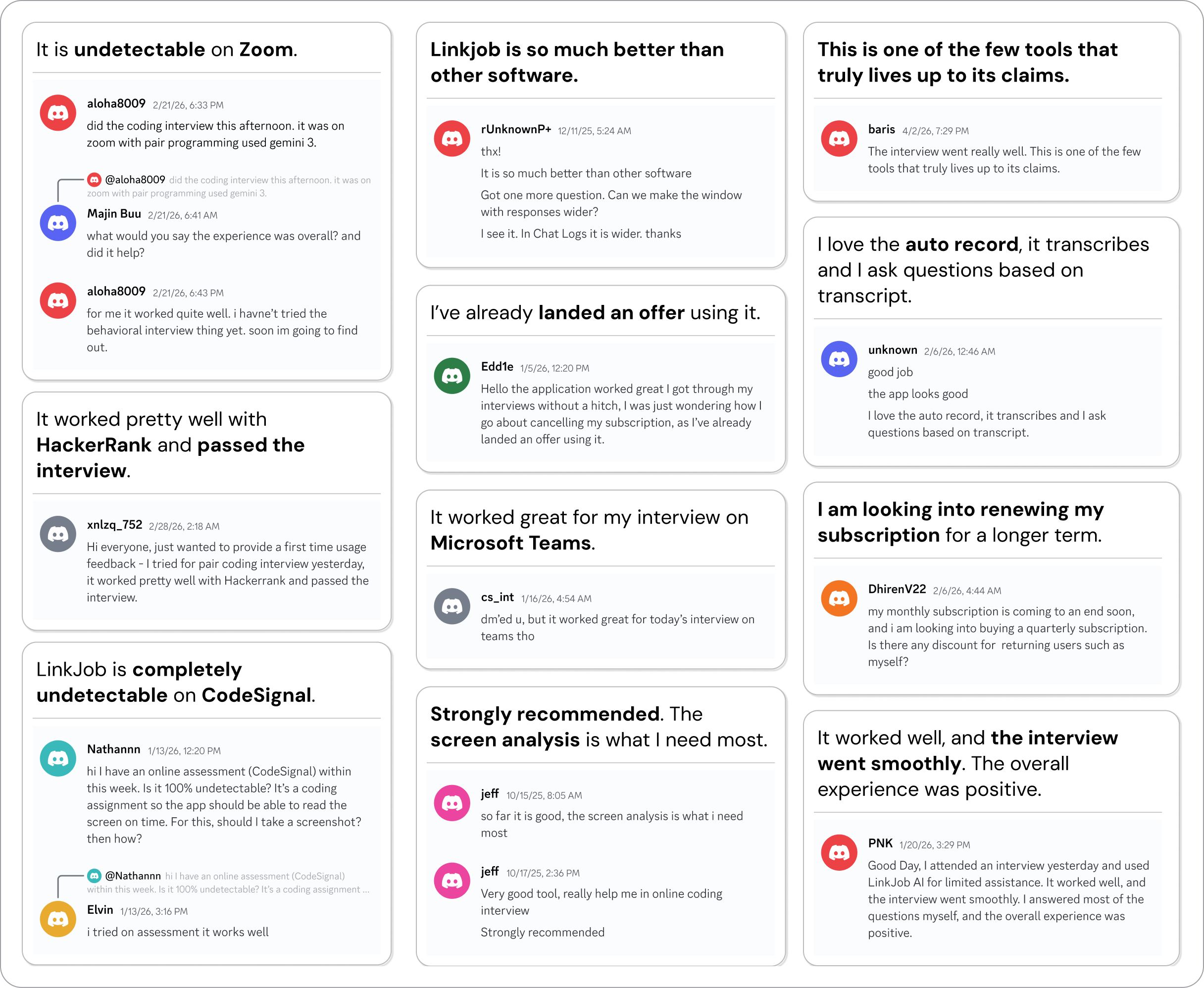
Smoother interviews, coding challenges cleared, and job offers landed. See how users describe their experience with Linkjob AI—in their own words.
© Copyright 2026 Linkjob AI - All Rights Reserved.