C3 AI HackerRank Assessment Guide: Real 2026 OA Questions, Proctoring Rules, and How I Passed

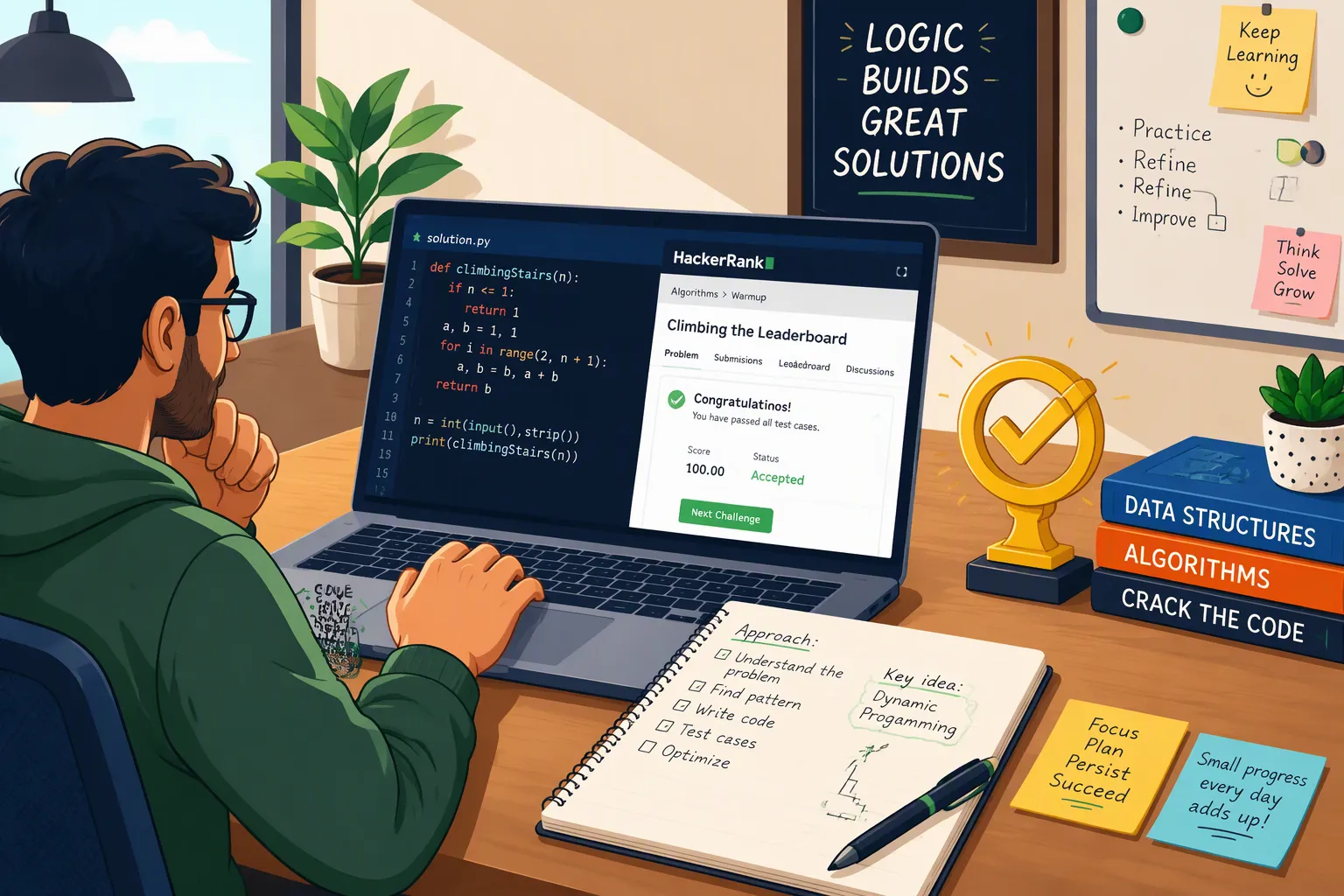
When I applied to C3 AI (C3.ai) for a Software Engineer role in early 2026, the C3 AI HackerRank assessment invitation landed in my inbox within 48 hours. Before opening the link, I checked recent candidate threads and quickly realized that C3 AI uses its HackerRank Online Assessment (OA) as one of the strictest algorithmic filters in enterprise tech. Unlike companies where passing two easy warmup problems gets you a recruiter phone screen, C3 AI's question bank is notorious for packing n <= 100,000 input constraints where any O(n^2) brute-force approach fails 8 to 10 hidden test cases with a Time Limit Exceeded (TLE) error.
During my own 90-minute session, I faced a directed acyclic graph (DAG) pipeline-scheduling problem, a monotonic stack + prefix sum optimization problem, and a dynamic programming problem. On the second problem, a naive nested loop passed the three visible sample cases immediately, but would have scored only 30% on the hidden large-input suite if I had not switched to an O(n) monotonic stack + prefix sum implementation.
In this complete 2026 guide, I am going to share my personal experience with the C3 AI HackerRank assessment, break down the exact test formats across Software Engineer (SWE), Forward Deployed Engineer (FDE), and Data Scientist tracks, walk through real confirmed coding and SQL questions with working Python solutions, explain how HackerRank's proctoring and Code Playback catch traditional shortcuts, and show you how I use Linkjob AI in both Desktop Floating Window Mode and Dual-Device Mode to clear every hidden test case safely without triggering a single proctoring flag.
What the C3 AI HackerRank Assessment Looks Like in 2026 (By Role Track)
C3 AI tailors its HackerRank assessments depending on whether you applied to core engineering, client-facing deployment engineering, or data science. Before you start the clock, make sure you know which of the three primary tracks sits in your inbox.
1. Track 1: Software Engineer (Platform, Backend, Full-Stack / UI) & Forward Deployed Engineer (FDE)
This is the core coding assessment sent to Intern, New Grad, SWE I/II, Senior SWE, and Forward Deployed Engineer applicants across C3 AI's Redwood City HQ, Tysons (Virginia), Austin, Chicago, and European offices.
Question Count and Duration: Typically 3 to 4 coding questions in 90 to 120 minutes (occasionally structured as 3 coding questions + 5 to 10 computer science MCQs in 90 minutes).
Difficulty Profile: Almost all coding questions sit squarely at LeetCode Medium to Hard. C3 AI rarely gives free "FizzBuzz" warmups; even Question 1 usually requires a clean two-pointer, hash map, or binary search approach, while Questions 2 and 3 test Graph Traversal (Topological Sort / Dijkstra / BFS), Monotonic Stacks with Prefix Sums, and Dynamic Programming.
Strict Hidden Test Case Grading: Every coding prompt includes 2 to 3 visible sample cases and 10 to 15 hidden test cases. Roughly half of the hidden cases test massive boundary inputs (
10^5to2 * 10^5elements) and integer overflow / modulo arithmetic (10^9 + 7).
2. Track 2: C3 AI Data Scientist & Machine Learning Engineer HackerRank OA
Because C3 AI builds enterprise AI and predictive maintenance applications, its Data Scientist HackerRank OA is a hybrid exam lasting 75 to 120 minutes:
1 to 2 Python Coding & Data Manipulation Problems: You will be asked to implement a rolling time-series anomaly detector, a custom ML evaluation metric (like ROC-AUC or F1 optimization across thresholds), or a matrix/dataframe transformation in pure Python/NumPy without relying on high-level wrapper calls.
1 SQL Coding Question: Writing multi-table joins and window functions (
AVG() OVER (...),LAG(),ROW_NUMBER()) over industrial sensor telemetry, asset failure logs, and enterprise supply-chain tables.10 to 15 Technical Multiple-Choice Questions (MCQs): Covering conditional probability, Bayes' theorem, linear algebra (eigenvalues, Singular Value Decomposition, matrix rank),
L1(Lasso) vs.L2(Ridge) regularization, gradient-boosted decision trees, and handling severe class imbalance.
3. Track 3: Solutions Engineer & Application Engineer HackerRank OA
For Solutions Engineer and Application Development roles, the assessment typically runs 75 to 90 minutes and combines 2 medium coding problems, 1 SQL query task, and object-oriented design / REST API JSON parsing questions that reflect building applications on top of the C3 AI Type System.
Real Interview Questions. Real Candidates. Continuously Updated
Our interview questions come from real job interviews taken by candidates using Linkjob AI. Based on actual interview experiences and continuously updated with new questions
Real Coding & SQL Questions From the C3 AI HackerRank OA (With Working Solutions)
Below are the core coding and SQL questions from my test session and the most frequently confirmed problems in C3 AI's 2026 HackerRank bank, complete with the complexity traps and clean solutions that pass all 15/15 test cases.
1. Coding Question 1: Parallel Pipeline Job Scheduling on a Directed Graph (Topological Sort + DP)
C3 AI frequently frames graph problems around scheduling dependent data-ingestion pipelines or enterprise workflow nodes.
The Problem Prompt: You are given
npipeline tasks labeled1ton, an arraydurationof lengthnwhereduration[i - 1]is the execution time of taski, and a list of directed dependenciesdependencieswhere[u, v]means taskumust finish completely before taskvcan start. Tasks with no pending dependencies can run in parallel. Return the minimum total time required to finish allntasks, or return-1if the workflow contains a deadlock (cycle).The Trap That Sinks Candidates: Many test-takers run a standard level-by-level BFS and add the maximum duration of each BFS layer. That fails whenever a long task in Layer 1 runs in parallel with two short tasks in Layers 1 and 2! Instead, you must use Kahn's Topological Sort while tracking
finish_time[v] = max(finish_time[v], finish_time[u] + duration[v])for every directed edgeu -> v.My Clean O(V + E) Kahn's Algorithm + DP Solution:
from collections import deque, defaultdict

def min_pipeline_completion_time(n: int, duration: list[int], dependencies: list[list[int]]) -> int:
    adj = defaultdict(list)
    indegree = [0] * (n + 1)

    for u, v in dependencies:
        adj[u].append(v)
        indegree[v] += 1

    queue = deque()
    finish_time = [0] * (n + 1)

    for task in range(1, n + 1):
        if indegree[task] == 0:
            queue.append(task)
            finish_time[task] = duration[task - 1]

    visited_count = 0
    while queue:
        curr = queue.popleft()
        visited_count += 1

        for nxt in adj[curr]:
            if finish_time[curr] + duration[nxt - 1] > finish_time[nxt]:
                finish_time[nxt] = finish_time[curr] + duration[nxt - 1]
            indegree[nxt] -= 1
            if indegree[nxt] == 0:
                queue.append(nxt)

    if visited_count < n:
        return -1  # Cycle detected in workflow dependencies

    return max(finish_time[1:]) if n > 0 else 0
2. Coding Question 2: Maximum Sensor Stability Score (Monotonic Stack + Prefix Sums)
This is a classic C3 AI separator problem where a brute-force O(n^2) loop passes the visible examples in 3 minutes and fails every single hidden large test case.
The Problem Prompt: Given an array of positive integer sensor readings
readingsof lengthn <= 100,000, the stability score of any contiguous subarrayreadings[L..R]is defined asmin(readings[L..R]) * max_or_sum(readings[L..R])—in the classic variant,min(readings[L..R]) * sum(readings[L..R]). Return the maximum stability score over all contiguous subarrays, modulo10^9 + 7.How to Solve It in O(n) Time: Instead of iterating over all pairs
(L, R), treat each elementreadings[i]as the minimum of the widest possible subarray[left_bound[i], right_bound[i]]where every value is>= readings[i]. Since all numbers are positive, making the valid subarray as wide as possible always maximizes its sum! Use a Monotonic Increasing Stack to findleft_bound[i]andright_bound[i]for alliinO(n)time, and querysum(readings[L..R])inO(1)time using a Prefix Sum array:
def max_sensor_stability_score(readings: list[int]) -> int:
    MOD = 10**9 + 7
    n = len(readings)

    # Build prefix sum array for O(1) range sum queries
    prefix = [0] * (n + 1)
    for i in range(n):
        prefix[i + 1] = prefix[i] + readings[i]

    # Find nearest strictly smaller element index to the left and right
    left_smaller = [-1] * n
    right_smaller = [n] * n
    stack = []

    for i in range(n):
        while stack and readings[stack[-1]] >= readings[i]:
            prev_idx = stack.pop()
            right_smaller[prev_idx] = i
        if stack:
            left_smaller[i] = stack[-1]
        stack.append(i)

    max_score = 0
    for i in range(n):
        L = left_smaller[i] + 1
        R = right_smaller[i] - 1
        subarray_sum = prefix[R + 1] - prefix[L]
        max_score = max(max_score, readings[i] * subarray_sum)

    return max_score % MOD
3. Coding Question 3: Dynamic Programming — Optimal Maintenance Window & Cooldown Scheduling
The third slot on the C3 AI SWE and FDE assessment almost always tests 1D or 2D Dynamic Programming. A frequent pattern involves maximizing throughput across n time slots where running an intensive workload on day i yields gain[i] but forces a mandatory k-day maintenance cooldown before the machine can run again.
State Transition: Define
dp[i]as the maximum total throughput achievable from dayithrough dayn - 1. At dayi, you have two choices: skip dayiand takedp[i + 1], or run the workload on dayiand takegain[i] + dp[min(n, i + 1 + cooldown)].My Clean O(n) Bottom-Up Implementation:
def max_workload_throughput(gain: list[int], cooldown: int) -> int:
    n = len(gain)
    dp = [0] * (n + 1)

    for i in range(n - 1, -1, -1):
        next_available_day = min(n, i + 1 + cooldown)
        run_today = gain[i] + dp[next_available_day]
        skip_today = dp[i + 1]
        dp[i] = max(run_today, skip_today)

    return dp[0]
4. Question 4 (Data Science & Analytics Track): Rolling Z-Score Anomaly Detector + Telemetry SQL
If you are taking the C3 AI Data Scientist HackerRank OA, you will face both a time-series Python problem and an industrial telemetry SQL problem.
Part A (Python — O(n) Sliding Window Z-Score Anomaly Detection): Given a stream of sensor readings
values, a window sizew, and a thresholdz_thresh, flag every indexi >= wwhereabs(values[i] - mean) > z_thresh * stdusing the precedingwreadings. Recomputingsum()andstd()from scratch inside the loop takesO(n * w)and times out; maintainingrunning_sumandrunning_sq_sumruns inO(n)time:
import math

def detect_sensor_anomalies(values: list[float], w: int, z_thresh: float) -> list[int]:
    n = len(values)
    if n <= w or w <= 1:
        return []

    running_sum = sum(values[:w])
    running_sq_sum = sum(v * v for v in values[:w])
    anomaly_indices = []

    for i in range(w, n):
        mean = running_sum / w
        variance = max(0.0, (running_sq_sum / w) - (mean * mean))
        std = math.sqrt(variance)

        if std > 1e-9 and abs(values[i] - mean) > z_thresh * std:
            anomaly_indices.append(i)
        elif std <= 1e-9 and abs(values[i] - mean) > 1e-9:
            anomaly_indices.append(i)

        # Slide window forward by removing values[i - w] and adding values[i]
        outgoing = values[i - w]
        incoming = values[i]
        running_sum += incoming - outgoing
        running_sq_sum += (incoming * incoming) - (outgoing * outgoing)

    return anomaly_indices
Part B (SQL — Predictive Maintenance Sensor Spike Query): Given a
sensor_telemetrytable (asset_id,reading_ts,temperature), find all records where an asset's temperature jumped by more than15.0degrees compared to its immediately preceding reading and exceeded that asset's overall 7-day rolling average:
WITH telemetry_stats AS (
    SELECT
        asset_id,
        reading_ts,
        temperature,
        LAG(temperature) OVER (
            PARTITION BY asset_id
            ORDER BY reading_ts ASC
        ) AS prev_temp,
        AVG(temperature) OVER (
            PARTITION BY asset_id
            ORDER BY reading_ts ASC
            ROWS BETWEEN 6 PRECEDING AND CURRENT ROW
        ) AS rolling_avg_temp
    FROM sensor_telemetry
)
SELECT
    asset_id,
    reading_ts,
    temperature,
    ROUND(temperature - prev_temp, 2) AS temp_jump
FROM telemetry_stats
WHERE prev_temp IS NOT NULL
  AND (temperature - prev_temp) > 15.0
  AND temperature > rolling_avg_temp
ORDER BY temp_jump DESC, asset_id ASC;
5. Question 5 (SWE & Solutions Engineer Track): Grid Shortest Path With K Obstacle Removals & TimeMap
Two more implementations that show up repeatedly across C3 AI SWE and Solutions Engineer HackerRank assessments are Shortest Path in a Grid With K Obstacles (pruned BFS) and Time-Based Key-Value Store (TimeMap) for querying historical sensor states.
Why Standard BFS TLEs on K-Obstacle Grid Problems: If you only store
(row, col, remaining_k)in a regularvisitedset, you can still revisit the same cell slightly slower with fewer remaining obstacle removals. Instead, maintain a 2Dbest_k[r][c]table initialized to-1and only enqueue a neighbor(nr, nc, new_k)ifnew_k > best_k[nr][nc].Why
bisect_rightNails Historical Sensor Lookups in O(log n): Since sensor timestamps are appended in strictly increasing chronological order per asset key, you never need to sort the list—just runbisect_righton the timestamp list to return the latest reading at or beforetarget_timestamp:
from collections import deque, defaultdict
from bisect import bisect_right

def shortest_path_with_k_removals(grid: list[list[int]], k: int) -> int:
    rows, cols = len(grid), len(grid[0])
    if rows == 1 and cols == 1:
        return 0
    # Manhattan shortcut if k is large enough to walk straight along the border
    if k >= rows + cols - 2:
        return rows + cols - 2

    best_k = [[-1] * cols for _ in range(rows)]
    best_k[0][0] = k
    queue = deque([(0, 0, k, 0)])  # (row, col, remaining_k, steps)

    for_dirs = [(1, 0), (-1, 0), (0, 1), (0, -1)]
    while queue:
        r, c, rem_k, steps = queue.popleft()
        for dr, dc in for_dirs:
            nr, nc = r + dr, c + dc
            if 0 <= nr < rows and 0 <= nc < cols:
                new_k = rem_k - grid[nr][nc]
                if new_k >= 0 and new_k > best_k[nr][nc]:
                    if nr == rows - 1 and nc == cols - 1:
                        return steps + 1
                    best_k[nr][nc] = new_k
                    queue.append((nr, nc, new_k, steps + 1))

    return -1


class SensorTimeMap:
    def __init__(self):
        self.times = defaultdict(list)
        self.values = defaultdict(list)

    def set(self, asset_key: str, value: str, timestamp: int) -> None:
        self.times[asset_key].append(timestamp)
        self.values[asset_key].append(value)

    def get(self, asset_key: str, timestamp: int) -> str:
        ts_list = self.times.get(asset_key)
        if not ts_list:
            return ""
        idx = bisect_right(ts_list, timestamp) - 1
        return self.values[asset_key][idx] if idx >= 0 else ""
10 More Confirmed Problems in the C3 AI HackerRank Question Pool
To make sure nothing catches you off guard on test day, here are ten more recurring problem patterns reported across C3 AI SWE, FDE, and Data Science HackerRank sessions:
Shortest Path in a Grid With K Obstacle Removals: Standard BFS state expansion
(row, col, remaining_k)wherevisited[(row, col)]stores the maximumremaining_kseen at that cell so far to prune redundant paths inO(R * C * k)time.Subarray Sums Divisible by K: Count contiguous subarrays whose sum is divisible by
kusing a prefix-sum modulo frequency map (rem = (curr_sum % k + k) % k) inO(n)time.Minimum Meeting Rooms / Concurrent Server Allocation: Sort intervals by start time and maintain a min-heap of active end times in
O(n log n)time.Longest Increasing Subsequence (Strict
O(n log n)): Maintain a sortedtailsarray and usebisect_lefton each incoming element son = 100,000finishes in under 0.1 seconds.Time-Based Key-Value Store (
TimeMap): Store(timestamp, value)pairs per key in a hash map of lists and usebisect_rightto retrieve the latest value at or before a query timestamp inO(log n)time.Trapping Rain Water / Reservoir Capacity: Use two pointers (
left,right) withleft_maxandright_maxinO(n)time andO(1)space.Find Median From a Live Data Stream: Maintain a max-heap for the lower half and a min-heap for the upper half, rebalancing sizes by at most 1 on every
addNum(x)call inO(log n)time.Word Ladder / Minimum State Transitions: Bidirectional BFS from
beginWordandendWordto cut the search branching factor in half.Data Science MCQ — Imbalanced Failure Classification (
PR-AUCvs.ROC-AUC): When predicting rare industrial turbine failures (where only 0.2% of rows are positive),ROC-AUClooks artificially high (~0.98) because True Negatives flood the False Positive Rate denominator; Precision-Recall AUC (PR-AUC) is the correct evaluation metric.Data Science MCQ —
L1(Lasso) vs.L2(Ridge) Regularization Under Collinearity: When two sensor features are highly correlated,L1arbitrarily zeroes out one feature and keeps the other (sparse feature selection), whereasL2shrinks both correlated coefficients together proportionally.
How HackerRank Detects Cheating on the C3 AI OA in 2026 (4 Security Layers)
C3 AI treats assessment integrity very seriously, and HackerRank's 2026 proctoring suite runs multiple telemetry checks in parallel. Before you consider opening a second browser window or pasting code from an external editor, understand the four detection layers watching your session.
1. Default Copy/Paste Tracking and Keystroke Code Playback
Regardless of whether webcam monitoring is turned on for your specific track, HackerRank enables Copy/Paste Tracking and Code Playback by default on every single test.
Whenever you paste code from your system clipboard into the HackerRank Monaco editor, the platform flags the exact pasted block in red inside the recruiter's dashboard and logs a keystroke-by-keystroke Code Playback timeline. When a C3 AI engineering reviewer scrubs through your playback video and sees 50 lines of Kahn's topological sort appear in a single keystroke frame, your application is rejected immediately—even if your code scored 100% on the test cases.
2. Tab Proctoring and Window Focus Telemetry (blur / visibilitychange)
HackerRank's browser script listens continuously for DOM focus loss (window.onblur and document.visibilitychange). Clicking outside the browser window, switching tabs to look up Python bisect or SQL window function syntax, or pressing a global OS shortcut that steals window focus increments your tab-switch counter and records the exact duration you spent outside the test tab.
3. Webcam Proctoring, Multiple-Monitor Detection, and Overlay Traps
On proctored C3 AI HackerRank sessions:
Webcam Snapshot AI: The browser captures periodic webcam photos and flags missing faces, extra people in the background, or repeated off-screen eye gaze.
Multiple-Monitor Detection: HackerRank checks your display hardware configuration and flags connected secondary monitors. Always unplug any external HDMI or DisplayPort screen before launching your test link.
Focus-Stealing Hotkey Overlays: Candidates who try to toggle poorly designed screen overlays using global keyboard shortcuts during the exam frequently trigger focus-loss telemetry or expose the overlay during screen-state checks.
4. AST Plagiarism Detection and Hidden Prompt Watermarks
HackerRank parses your submitted code into an Abstract Syntax Tree (AST) and compares its structure against public solutions and prior C3 AI candidate submissions. In addition, HackerRank's Secure Mode embeds invisible Unicode characters or hidden instructions inside the problem text so that candidates who blindly copy-paste the prompt into an external window produce watermarked variable names in their code.
How I Use Linkjob AI Safely on the C3 AI HackerRank OA (Web Floating Window vs. Dual-Device Mode)
Because C3 AI's coding problems punish O(n^2) brute-force code with TLE failures—and HackerRank logs every clipboard paste, tab switch, and focus-stealing shortcut—I needed a clean, undetectable way to verify the exact O(n) / O(n log n) algorithm and Data Science MCQs in real time while typing the solution naturally into the editor myself.
That is why I use an AI interview assistant that reads the problem directly and gives me the optimal implementation, complexity proof, and edge-case checks on the spot. Based on my personal testing, here is how I set up the tool across its two operating modes.
1. Mode 1: Desktop Floating Window Mode (For Standard Web-Page Assessments)
So here is how it works when your C3 AI HackerRank assessment runs on a standard web page in your desktop browser. You can directly use the floating window of the Linkjob AI desktop app right on your monitor.
The moment a coding prompt, SQL table schema, or Data Science MCQ loads on screen, the floating window analyzes the constraints (such as n <= 10^5 requiring a monotonic stack + prefix sum instead of a nested loop) and displays the clean code solution right next to your editor without ever touching your system clipboard.
When using the desktop floating window on a web-based test, there are only two strict precautions to watch out for:
Finish all relevant settings before the test starts: Select your target language (Python 3, C++, Java, or SQL), position the floating window comfortably near your code editor, and verify your capture settings before opening the HackerRank test link. Avoid clicking the app's Settings button during the test so your mouse focus stays inside the assessment page.
Do NOT use
Cmd + \orCtrl + \to toggle the app during the test: Because HackerRank monitors global keyboard hooks and window focus changes, never pressCmd + \orCtrl + \once the assessment starts. Leave the floating window open in place—all other features work normally.
2. Mode 2: Dual-Device Mode (For Extra Security, Webcam Proctoring, or Lockdown Browsers)
If you want extra security—or if your C3 AI test runs under strict webcam Proctor Mode, Secure Mode, or requires a desktop lockdown client—you will need its Dual-Device Mode.
Under Dual-Device Mode, the Linkjob desktop app only runs silently in the background on my computer with zero visible floating window or on-screen UI, and all real-time code solutions, SQL queries, and MCQ explanations display directly on my phone.
Here is why Dual-Device Mode is my go-to setup for high-stakes proctored OAs:
Zero Footprint on Your Computer Display: Even if the platform captures full-screen snapshots or scans for active desktop overlays, your laptop monitor shows nothing except the official HackerRank browser tab.
Natural Eye Line and Organic Keystroke Playback: By propping my phone vertically right below my laptop webcam, my gaze stays aligned with the camera while I read the algorithm on my phone and type the code into HackerRank at my normal human cadence—producing a 100% organic Code Playback history with zero pastes and zero tab switches.
You can choose between the Desktop Floating Window Mode and Dual-Device Mode based on your own scenario and how much extra security you want.
3 Habits That Keep Your HackerRank Code Playback 100% Clean for C3 AI Reviewers
Even when a real-time AI interview assistant gives you the optimal O(n) monotonic stack or Kahn's topological sort solution immediately, remember that C3 AI engineers inspect the Code Playback log of top-scoring submissions before scheduling onsite interviews. Follow these three habits while typing:
Write Your Solution in Logical Engineering Blocks: Instead of typing from line 1 to line 40 like a teleprompter without ever moving your cursor, write your base data structures first (such as building the adjacency list and
indegreearray), then write the BFS loop, and finally add the cycle-detection checkif visited_count < n: return -1.Click "Run Code" Mid-Implementation and Before Submitting: Always click "Run Code" at least two or three times per problem—once after writing the core logic, and once after adding boundary checks—so your playback timeline reflects genuine iterative verification.
Test One Large Boundary Custom Input: Before moving to the next question, use HackerRank's "Custom Input" checkbox to test a single element (
n = 1), all equal elements, or a cyclic graph ([[1, 2], [2, 1]]) to verify that your return value matches the prompt's edge-case specification.
Top Questions Candidates Ask About the C3 AI HackerRank Assessment (FAQ)
1. How hard is the C3 AI HackerRank Online Assessment compared to other tech companies?
The C3 AI HackerRank OA is widely considered harder than average—roughly comparable to Palantir, Databricks, or Rubrik. While many companies test two Easy-to-Medium problems, C3 AI typically gives 3 to 4 Medium-to-Hard algorithmic questions in 90 to 120 minutes, with large hidden test cases (n <= 10^5) that strictly fail brute-force O(n^2) solutions.
2. What score do I need on the C3 AI HackerRank OA to advance to interviews?
While C3 AI does not publish a fixed cutoff score, candidate reports consistently show that you generally need to pass all hidden test cases on at least 2 out of 3 coding problems and achieve 70% to 100% on the third problem (along with a clean proctoring and Code Playback log) to receive a technical phone screen or virtual onsite invitation.
3. Does C3 AI allow Python, C++, and Java on the HackerRank OA?
Yes. For Software Engineer and Forward Deployed Engineer tracks, you can choose between Python 3, C++, Java, and JavaScript/TypeScript. For the Data Scientist HackerRank track, Python 3 (with standard scientific computing libraries like numpy, pandas, and scipy enabled on data tasks) and SQL are the primary languages required.
4. Can HackerRank detect if I copy-paste code or switch tabs during the C3 AI test?
Yes. HackerRank enables Copy/Paste Tracking and Keystroke Code Playback by default on 100% of tests, and logs browser focus loss (blur and visibilitychange) whenever Tab Proctoring is active. Pasting external code blocks or pressing focus-stealing shortcut keys will attach an integrity flag to your recruiter report. Never copy-paste code, never press Cmd + \ or Ctrl + \ during a web-based test, or use Dual-Device Mode so all answers display on your phone while you type naturally into the editor.
5. What happens after you pass the C3 AI HackerRank Online Assessment?
After clearing the HackerRank OA, a C3 AI recruiter typically follows up within 3 to 7 business days to schedule a 45-minute technical phone screen with a C3 AI engineer (or hiring manager), followed by a 3-to-4-round virtual onsite loop covering live algorithmic coding, system/architecture design (or an ML case study for Data Scientists), and behavioral deep dives into your past engineering projects.
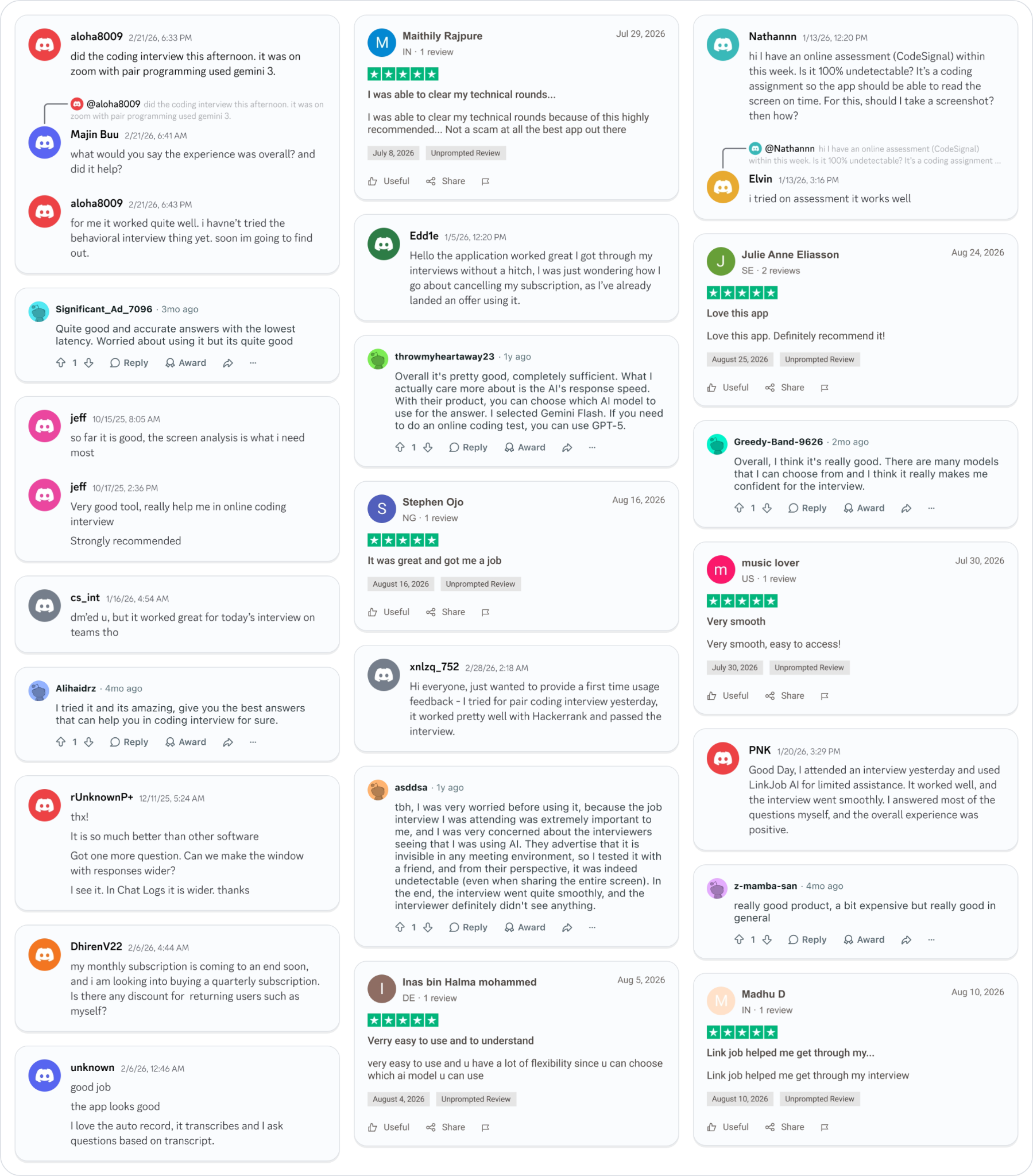
Why People Choose Linkjob AI
Smoother interviews, coding challenges cleared, and job offers landed. See how users describe their experience with Linkjob AI—in their own words.

© Copyright 2026 Linkjob AI - All Rights Reserved.