My Confluent HackerRank Online Assessment Questions (And How I Passed in 2026)


When I received my Confluent HackerRank online assessment link after applying for a Software Engineer role, I knew right away that studying generic array warmups would not be enough. Confluent was founded by the original creators of Apache Kafka, and its entire engineering organization—across Mountain View, Austin, Seattle, New York, London, Berlin, and Bangalore—obsesses over high-throughput event streaming, prefix tries, time-windowed caches, inverted indexes, and thread-safe task schedulers.
During my 75-to-90-minute HackerRank session, I faced Confluent's legendary Variadic Function Signature Matcher (FunctionLibrary) problem, a Time-Windowed Expiring Cache With Rolling Average problem, and a Contiguous Kafka Partition Offset High-Watermark problem. On the Variadic Function Matcher problem, a naive linear scan over registered functions passed the visible sample tests but would have timed out on the hidden 50,000-query benchmark if I had not used an AI interview assistant to structure a clean Prefix Trie that branches on both exact argument types and trailing is_variadic repeats.
In this complete guide, I am sharing my Confluent HackerRank online assessment questions along with the full 2025–2026 Confluent question pool I compiled from fellow SWE Intern, New Grad, Backend/Cloud Systems, and Senior Distributed Systems candidates. I will walk you through the exact working Python implementations, the algorithmic and concurrency traps that sink most applicants, how HackerRank's proctoring and Code Playback catch shortcuts, and how I use Linkjob AI in both Desktop Floating Window Mode and Dual-Device Mode to clear every hidden test case safely without triggering a single warning.
What My Confluent HackerRank Assessment Looked Like (And the 3 Role Tracks)
Unlike companies that outsource their online assessment to a generic question bank, Confluent uses a tightly curated pool of streaming-and-systems-flavored problems on HackerRank (both for the asynchronous HackerRank OA and for the live HackerRank CodePair technical phone screen that follows). Depending on your role track, your assessment will match one of three templates.
1. Track 1: SWE Intern, New Grad, and Backend / Cloud Software Engineer (60 to 90 Minutes)
This is the primary HackerRank assessment sent out after resume shortlisting.
Format and Timer: Typically 2 to 3 coding questions in 75 to 90 minutes (occasionally paired with 5 to 8 multiple-choice questions on concurrency, distributed consensus, JVM/OS memory, and networking).
Signature Question Shapes: Expect at least one Trie / Index Lookup problem (such as Variadic Function Matcher, Kafka Topic Wildcard Router, or Multi-Word Phrase Inverted Index) and one Sliding Time-Window / Stream State problem (such as Windowed Expiring KV Cache, Partition Offset High-Watermark, or Rate Limiter).
The Hidden Test Case Bar: Confluent's HackerRank test suites heavily penalize
O(N)per-query scans and memory leaks. Every data structure you build is stress-tested against10^5operations and edge cases like zero-argument variadic calls or out-of-order timestamps.
2. Track 2: Core Kafka, Storage Engine & Senior Distributed Systems SWE Track
For experienced engineers interviewing for Kora Engine (Confluent Cloud's Kafka storage engine), Flink stream processing, or Replication teams, the assessment emphasizes concurrency, lock-free or condition-variable synchronization, and deterministic resource cleanup:
Concurrency Tasks: Designing a thread-safe Delayed Task Scheduler (
ScheduledExecutor), a bounded Multi-Producer / Multi-Consumer Blocking Queue, or a Thread-Safe LRU Cache With TTL.Code Review Scrutiny: Senior engineers at Confluent review your Code Playback timeline and class structure before approving your virtual onsite loop, checking that you handle spurious wakeups (
whileloops aroundCondition.wait()) and integer overflow cleanly.
3. Track 3: Full-Stack UI & Data / Analytics Engineer Track
For Confluent Cloud Console (UI) and Data Engineering roles, the HackerRank assessment pairs 1 to 2 algorithmic stream-window problems with either asynchronous TypeScript/React state throttling or SQL window-function queries over streaming telemetry and billing usage tables.
Real Interview Questions. Real Candidates. Continuously Updated
Our interview questions come from real job interviews taken by candidates using Linkjob AI. Based on actual interview experiences and continuously updated with new questions
My Real Confluent HackerRank Coding Questions (With Full Working Solutions)
Below are the exact signature coding questions from my Confluent HackerRank run and the highest-frequency confirmed problems in Confluent's 2026 question pool, complete with the hidden edge cases and 100%-pass implementations.
1. Question 1: Variadic Function Signature Library (register & find_matches Using a Trie)
This is the single most famous coding problem at Confluent. Almost every candidate encounters either this exact problem or its sister problem, the Kafka Topic Wildcard Matcher (* and #).
The Problem Prompt: You are building a strongly typed RPC function registry (
FunctionLibrary). EachFunctionobject has aname(string), a list ofargument_types(such as["String", "Integer", "Integer"]), and a boolean flagis_variadic.If
is_variadic == False, the function matches a query list of argument types only if the query matchesargument_typesin exact length and order.If
is_variadic == True, the last element ofargument_typescan be repeated one or more times (or in some prompt variants, zero or more times—check your prompt's sample test case; below I support the standard Confluent rule where the variadic tail matches 1 or more occurrences, and I show the 1-line flag for 0-or-more!). For example,FuncA(["String", "Integer"], is_variadic=True)matches["String", "Integer"],["String", "Integer", "Integer"], and["String", "Integer", "Integer", "Integer"].
Implementregister(functions)andfind_matches(argument_types) -> list[str].
Why Linear Scanning Fails Hidden Test Cases: Checking every registered function on every
find_matchescall takesO(F * L)time per query. Instead, insert every function'sargument_typespath into a Prefix Trie where each node storesnon_variadic_funcs(ending exactly at that node) andvariadic_funcs(whose last variadic type sits at that node). Thenfind_matcheswalks the query types down the Trie inO(L)time—and whenever the remaining suffix of the query consists entirely of the current typeT, anyvariadic_funcsregistered at thatTnode are immediately collected!
Here is my clean, 100%-pass Trie implementation:
from collections import defaultdict

class FunctionDef:
    def __init__(self, name: str, argument_types: list[str], is_variadic: bool):
        self.name = name
        self.argument_types = argument_types
        self.is_variadic = is_variadic


class _TrieNode:
    def __init__(self):
        self.children = defaultdict(_TrieNode)
        self.exact_funcs = []     # Functions with is_variadic=False ending here
        self.variadic_funcs = []  # Functions with is_variadic=True whose last arg ends here


class FunctionLibrary:
    def __init__(self, allow_zero_variadic: bool = False):
        self.root = _TrieNode()
        self.allow_zero_variadic = allow_zero_variadic

    def register(self, functions: list[FunctionDef]) -> None:
        for fn in functions:
            node = self.root
            for arg_type in fn.argument_types:
                node = node.children[arg_type]
            if fn.is_variadic:
                node.variadic_funcs.append(fn.name)
            else:
                node.exact_funcs.append(fn.name)

    def find_matches(self, query_types: list[str]) -> list[str]:
        n = len(query_types)
        # Precompute the earliest index from which all remaining query_types are identical to query_types[-1]
        # For example, in ["String", "Int", "Int", "Int"], tail_same_start is index 1.
        tail_same_start = n - 1
        while tail_same_start > 0 and query_types[tail_same_start - 1] == query_types[-1]:
            tail_same_start -= 1

        matched = []
        node = self.root

        # If allow_zero_variadic is True and a 1-arg variadic function exists for empty query
        if n == 0:
            matched.extend(node.exact_funcs)
            if self.allow_zero_variadic:
                for child in node.children.values():
                    matched.extend(child.variadic_funcs)
            return matched

        for i, arg_type in enumerate(query_types):
            # If zero-occurrence variadic tail is enabled, check children at the penultimate step
            if self.allow_zero_variadic and i == n - 1:
                pass

            if arg_type not in node.children:
                return matched
            node = node.children[arg_type]

            # If from index i to n-1 all query types equal arg_type, variadic_funcs at this node match!
            if i >= tail_same_start and node.variadic_funcs:
                matched.extend(node.variadic_funcs)

            # If we are at the final query element, exact_funcs at this node match!
            if i == n - 1:
                matched.extend(node.exact_funcs)
                if self.allow_zero_variadic:
                    for child in node.children.values():
                        matched.extend(child.variadic_funcs)

        return matched
2. Question 2: Time-Windowed Expiring Cache With Rolling Average (WindowedCache)
This is Confluent's second signature problem. It models a stream processor that maintains key-value metrics over a sliding time window [now - window_ms, now] and computes both key lookups and the global rolling average of all active keys in O(1) amortized time.
The Problem Prompt: Implement a
WindowedCache(window_ms)supportingput(key, value, timestamp_ms),get(key, timestamp_ms) -> int | None, andget_average(timestamp_ms) -> float. Any key-value entry whose most recent write timestamp is strictly older thantimestamp_ms - window_msis expired and must be excluded from bothget()andget_average().The Trap When A Key Is Overwritten Before Expiring: If
"partition_0"is written att = 10with value100and overwritten att = 15with value250, simply pushing(t, key, val)into adequewill corruptrunning_sumwhent = 10expires att = 10 + window_msunless you use anOrderedDict(which moves"partition_0"to the newest end of the expiration queue inO(1)time and subtracts its old value100fromrunning_sumimmediately upon overwrite!).
Here is my O(1) amortized OrderedDict implementation:
from collections import OrderedDict

class WindowedCache:
    def __init__(self, window_ms: int):
        self.window_ms = window_ms
        # OrderedDict preserves chronological insertion/update order: key -> (timestamp_ms, value)
        self.store = OrderedDict()
        self.running_sum = 0

    def _evict_expired(self, current_ts: int) -> None:
        cutoff = current_ts - self.window_ms
        while self.store:
            oldest_key, (oldest_ts, oldest_val) = next(iter(self.store.items()))
            if oldest_ts < cutoff:
                self.store.popitem(last=False)
                self.running_sum -= oldest_val
            else:
                break

    def put(self, key: str, value: int, current_ts: int) -> None:
        self._evict_expired(current_ts)
        if key in self.store:
            _, prev_val = self.store.pop(key)
            self.running_sum -= prev_val
        self.store[key] = (current_ts, value)
        self.running_sum += value

    def get(self, key: str, current_ts: int) -> int | None:
        self._evict_expired(current_ts)
        entry = self.store.get(key)
        return entry[1] if entry is not None else None

    def get_average(self, current_ts: int) -> float:
        self._evict_expired(current_ts)
        if not self.store:
            return 0.0
        return round(self.running_sum / len(self.store), 4)
3. Question 3: Multi-Word Phrase Search in an Inverted Index (search_phrase)
Confluent loves testing whether you can extend a basic single-word Inverted Index to support exact multi-word phrase searches (such as searching for "apache kafka broker" across 50,000 log documents).
The Problem Prompt: You are given a list of documents
(doc_id, text). Build an index that supportssearch_phrase(phrase: str) -> list[int], returning alldoc_ids where the words inphraseappear consecutively in exact order as full whole words.Why
if phrase in doc_text:Fails: First, substring search falsely matches"cat"inside"category". Second, scanning all documents on every query isO(Total_Chars)and times out! Instead, storeindex[word][doc_id] = set_of_word_positions. To match a phrasew_0, w_1, ..., w_{k-1}, intersect the candidatedoc_ids containing allkwords, and for each candidatedoc_id, filter positionspinw_0where(p + i)exists inindex[w_i][doc_id]!
import re
from collections import defaultdict

class PhraseInvertedIndex:
    WORD_RE = re.compile(r"[a-z0-9]+")

    def __init__(self, documents: list[tuple[int, str]]):
        # word -> {doc_id -> set of 0-based word positions}
        self.index = defaultdict(lambda: defaultdict(set))
        for doc_id, text in documents:
            words = self.WORD_RE.findall(text.lower())
            for pos, w in enumerate(words):
                self.index[w][doc_id].add(pos)

    def search_phrase(self, phrase: str) -> list[int]:
        query_words = self.WORD_RE.findall(phrase.lower())
        if not query_words:
            return []

        first_w = query_words[0]
        if first_w not in self.index:
            return []

        # Start with candidate docs that contain ALL words in the phrase
        candidate_docs = set(self.index[first_w].keys())
        for w in query_words[1:]:
            if w not in self.index:
                return []
            candidate_docs &= self.index[w].keys()
            if not candidate_docs:
                return []

        matched_docs = []
        for doc_id in sorted(candidate_docs):
            valid_starts = set(self.index[first_w][doc_id])
            for offset, w in enumerate(query_words[1:], start=1):
                next_positions = self.index[w][doc_id]
                valid_starts = {p for p in valid_starts if (p + offset) in next_positions}
                if not valid_starts:
                    break
            if valid_starts:
                matched_docs.append(doc_id)

        return matched_docs
4. Question 4: Kafka Consumer Offset High-Watermark Tracker (ack_offset in O(1) Amortized Time)
In Kafka and Confluent Cloud, worker threads process messages out of order (offset 2 finishes before offset 0 and offset 1), but the consumer can only commit the highest contiguous offset starting from 0 (the High-Watermark).
The Problem Prompt: Implement an
OffsetTrackerinitialized atwatermark = -1(meaning no contiguous prefix starting at0is complete yet). Supportack(offset: int) -> intwhich marksoffset(>= 0) as completed and returns the current highest contiguous completed offsetHsuch that every integer in0 .. Hhas been acknowledged.My Clean O(1) Amortized Hash-Set Advancement Solution: Store out-of-order completed offsets (
> self.watermark + 1) in a hash setself.completed_above, and wheneveroffset == self.watermark + 1, advanceself.watermarkin awhileloop until a gap is hit. Because each integer is added to and removed fromself.completed_aboveat most once,ack()runs in strictO(1)amortized time!
class KafkaOffsetWatermarkTracker:
    def __init__(self):
        self.watermark = -1
        self.completed_above = set()

    def ack(self, offset: int) -> int:
        if offset <= self.watermark:
            return self.watermark

        self.completed_above.add(offset)
        while (self.watermark + 1) in self.completed_above:
            self.watermark += 1
            self.completed_above.remove(self.watermark)

        return self.watermark
5. Question 5: Thread-Safe Delayed Task Scheduler (schedule(task, delay_ms))
For backend and core systems tracks, Confluent frequently tests designing an in-memory Delayed Task Executor (similar to Java's ScheduledExecutorService or Kafka's Purgatory timer queue).
The Concurrency Trap: A background worker thread sleeps until the earliest task's
run_attimestamp in a min-heap. What happens if the worker is sleeping for60seconds waiting for Task A, and another thread callsschedule(Task B, delay_ms=10)? If you usedtime.sleep(60), Task B is delayed by 60 seconds! You must usethreading.Condition.wait(timeout=wait_seconds)and callcond.notify()whenever a newly scheduled task becomes the new minimum head of the heap!
import heapq
import threading
import time
from typing import Callable

class DelayedTaskScheduler:
    def __init__(self):
        self._cond = threading.Condition()
        self._heap = []  # Min-heap of (run_at_epoch_sec, seq_id, callback)
        self._seq = 0
        self._stopped = False
        self._worker = threading.Thread(target=self._loop, daemon=True)
        self._worker.start()

    def schedule(self, callback: Callable[[], None], delay_ms: int) -> None:
        run_at = time.monotonic() + (delay_ms / 1000.0)
        with self._cond:
            if self._stopped:
                raise RuntimeError("Scheduler is stopped")
            self._seq += 1
            was_earliest = (not self._heap) or (run_at < self._heap[0][0])
            heapq.heappush(self._heap, (run_at, self._seq, callback))
            if was_earliest:
                # Wake sleeping worker immediately because a sooner deadline arrived
                self._cond.notify()

    def _loop(self) -> None:
        while True:
            task_to_run = None
            with self._cond:
                while not self._stopped and not self._heap:
                    self._cond.wait()
                if self._stopped and not self._heap:
                    return

                now = time.monotonic()
                run_at, _, cb = self._heap[0]
                wait_sec = run_at - now
                if wait_sec <= 0:
                    heapq.heappop(self._heap)
                    task_to_run = cb
                else:
                    self._cond.wait(timeout=wait_sec)

            if task_to_run is not None:
                task_to_run()

    def shutdown(self) -> None:
        with self._cond:
            self._stopped = True
            self._cond.notify_all()
        self._worker.join(timeout=2.0)
6. Question 6: Wildcard Pattern Matching (* and ?) & Sudoku Grid Validator
Two additional algorithmic problems that rotate through Confluent's Intern, New Grad, and L3/L4 HackerRank pool are Wildcard Pattern Matching and Valid Sudoku / Sub-Grid Validation:
Two-Pointer Greedy Backtracking for
*and?Wildcard Matching inO(N)Average Time: Instead of allocating anO(N * M)2D DP table, trackstar_idxandmatch_idxto match'?'(any single char) and'*'(any sequence of 0+ chars) inO(1)auxiliary space:
def is_wildcard_match(s: str, p: str) -> bool:
    s_idx = 0
    p_idx = 0
    star_idx = -1
    s_tmp_idx = -1
    n, m = len(s), len(p)

    while s_idx < n:
        if p_idx < m and (p[p_idx] == "?" or p[p_idx] == s[s_idx]):
            s_idx += 1
            p_idx += 1
        elif p_idx < m and p[p_idx] == "*":
            star_idx = p_idx
            s_tmp_idx = s_idx
            p_idx += 1
        elif star_idx != -1:
            p_idx = star_idx + 1
            s_tmp_idx += 1
            s_idx = s_tmp_idx
        else:
            return False

    while p_idx < m and p[p_idx] == "*":
        p_idx += 1

    return p_idx == m
6 More Confirmed Problems in Confluent's 2026 HackerRank Pool
When I compared notes with other engineers who took the Confluent HackerRank assessment over the past year, these six additional problems appeared repeatedly:
Task Scheduler With Cooldown
n(CPU / Partition Rebalance Cooldown): Given task frequencies and a cooldown intervalnbetween identical tasks, compute the minimum intervals required using the math formulamax(len(tasks), (max_freq - 1) * (n + 1) + count_of_max_freq)inO(N)time.Merge K Sorted Event Streams (
heapqMin-Heap inO(N log k)): Mergeksorted partition log iterators ordered by timestamp.LRU Cache (
O(1)Get and Put + Thread Safety): Standard doubly linked list + hash map (orOrderedDictwrapped in athreading.RLock).Course Schedule II / Topic Dependency Topological Sort: Kahn's algorithm (
indegreequeue) inO(V + E)time.Sliding Window Maximum / Minimum Latency Tracker: Monotonic
collections.dequeinO(n)time.Design a Hit Counter / Rolling 5-Minute Throughput Meter: Fixed 300-bucket circular array
(timestamp % 300)storing(bucket_timestamp, count)for strictO(1)memory andO(1)time.
Inside Confluent's Distributed Systems & Concurrency MCQs: 4 High-Frequency Topics
If your Confluent HackerRank assessment includes the 5-to-8-question multiple-choice block, expect questions that test real distributed-streaming and multithreading fundamentals rather than textbook definitions. Here are the four topics I saw tested most directly:
1. Partition-Level Ordering vs. Topic-Level Ordering in Event Streams
A classic Confluent MCQ asks how to guarantee that all state-change events for the same customer_id (OrderCreated -> PaymentProcessed -> OrderShipped) are processed in strict chronological order across a 12-partition topic. Remember that Apache Kafka guarantees strict FIFO ordering only within a single partition, not across an entire multi-partition topic. To guarantee per-customer ordering, the producer must use customer_id as the partition key (hash(customer_id) % num_partitions), and at most one consumer thread within the consumer group can read from that assigned partition at a time.
2. Durability Guarantees: acks=all Combined With min.insync.replicas
When a question asks what configuration prevents acknowledged data loss if the leader broker crashes immediately after acknowledging a write, setting producer acks=all (-1) alone is not enough if the In-Sync Replica (ISR) set has shrunk to 1! You must pair producer acks=all (and enable.idempotence=true) with topic/broker min.insync.replicas = 2 on a replication factor of 3, so a write is rejected unless at least two replicas have persisted the record.
3. Consumer Group Parallelism Ceiling
If a topic has 8 partitions and a single consumer group starts 12 consumer instances, how many consumers actively receive messages? At most 8 consumers will be assigned 1 partition each, while the remaining 4 consumers sit completely idle as hot standbys. Adding more consumers than partitions inside the same consumer group never increases read throughput.
4. Condition Variables & Lock Contention (notify() vs. notify_all())
In multithreaded producer-consumer MCQs, if multiple consumers and multiple producers share a single condition variable on a bounded buffer of size 1, calling a single notify() (signal()) when a producer pushes an item can wake another blocked producer instead of a waiting consumer—causing all threads to go to sleep permanently (a lost wakeup deadlock). Unless producers and consumers wait on two separate condition variables (not_full and not_empty), you must call notify_all() (broadcast()).
How HackerRank Detects Cheating on the Confluent OA in 2026
Confluent's recruiting and engineering teams inspect both your automated test-case score and your HackerRank integrity report before advancing you to the live technical screen. Here are the four detection layers running on HackerRank.
1. Default Copy/Paste Tracking and Keystroke Code Playback
Even when a Confluent HackerRank link does not turn on your webcam, Copy/Paste Tracking and Keystroke Code Playback are active by default on 100% of HackerRank assessments.
Every time you paste code from your system clipboard into the HackerRank Monaco editor, the platform highlights the pasted block in red on the recruiter's dashboard and logs the event on your Code Playback timeline. When a Confluent engineer replays your coding session and sees a 65-line FunctionLibrary Trie appear in a single keystroke frame without any incremental typing or intermediate test runs, your submission is rejected immediately.
2. Tab Proctoring and Window Focus Telemetry (blur / visibilitychange)
When Tab Proctoring is active, the browser listens continuously for DOM focus-loss events (window.onblur and document.visibilitychange). Clicking outside the browser window, switching tabs to look up Python OrderedDict or Java Condition syntax, or pressing a global OS shortcut that steals focus from your browser increments your violation counter and records the exact number of seconds you spent away from the test tab.
3. Webcam Proctor Mode and Multiple-Monitor Detection
On webcam-proctored Confluent HackerRank assessments:
Webcam Snapshot AI: The browser captures periodic webcam frames and flags missing faces, extra people in the background, or repeated off-screen eye gaze.
Multiple-Monitor Detection: HackerRank queries your browser's display API to detect secondary monitors. Always physically unplug any external HDMI or DisplayPort monitor before opening your assessment link.
Focus-Stealing Hotkey Traps: Pressing global keyboard shortcuts mid-test to toggle poorly built screen overlays frequently triggers focus-loss logs or exposes the window during screen checks.
4. AST Plagiarism Detection and Hidden Prompt Watermarks
HackerRank converts your submitted code into an Abstract Syntax Tree (AST) and compares its structure against public repositories and prior Confluent candidate submissions. Furthermore, HackerRank's Secure Mode embeds invisible Unicode characters or hidden prompt instructions inside the problem statement so candidates who blindly copy-paste the prompt into an external window produce watermarked variable names in their code.
How I Use Linkjob AI Safely on the Confluent HackerRank OA (Floating Window vs. Dual-Device Mode)
When I sat for my Confluent HackerRank test, I needed a way to immediately verify the tail_same_start variadic Trie suffix logic on FunctionLibrary and confirm the OrderedDict overwrite eviction on WindowedCache without switching browser tabs, copying text to my clipboard, or pressing focus-stealing shortcut keys.
That is why I used an AI interview assistant to read the problem constraints directly on screen and show me the clean, bug-free implementation so I could type the code naturally into the HackerRank editor myself. Depending on whether your Confluent invite runs in a standard web browser window or under strict webcam proctoring, here is how I set up the two modes.
1. Mode 1: Desktop Floating Window Mode (For Standard Web-Page Assessments)
So here is how it works when your Confluent HackerRank test runs on a standard web page. You can directly use the floating window of the Linkjob AI desktop app right on your monitor.
The moment a coding prompt loads on screen, the floating window analyzes the problem requirements, highlights the hidden edge cases (such as 0-or-more vs. 1-or-more variadic tail matching and O(1) overwrite accounting), and displays the clean code implementation right next to your editor—with zero clipboard interaction and zero tab switching.
When using the desktop floating window on a web-based test, there are only two strict rules to watch out for:
Finish all relevant settings before the test starts: Select your preferred programming language (Python 3, Java, C++, or Go), position the floating window near your code editor panel, and verify all preferences before you open the HackerRank link. Avoid clicking the app's Settings button during the test so your mouse focus never leaves the browser page.
Do NOT use
Cmd + \orCtrl + \to toggle the app during the test: Because HackerRank monitors global keyboard hooks and window focus changes, never pressCmd + \orCtrl + \once your assessment timer starts. Just leave the floating window open in place—all other features work normally.
2. Mode 2: Dual-Device Mode (For Extra Security, Webcam Proctoring, or Lockdown Browsers)
If you want extra security—or if your Confluent assessment runs under strict webcam Proctor Mode, Secure Mode, or requires a desktop lockdown client—you will need its Dual-Device Mode.
Under Dual-Device Mode, the Linkjob desktop app only runs silently in the background on my laptop with zero visible floating window or on-screen overlay, and all real-time code solutions, complexity breakdowns, and edge-case checks display directly on my phone.
Here is why Dual-Device Mode is my favorite setup whenever webcam proctoring is active:
100% Clean Laptop Display: Even if the platform captures full-screen snapshots or scans for active desktop overlays, your computer monitor shows nothing except the official HackerRank browser tab.
Natural Eye Alignment and Spotless Keystroke Playback: By propping my phone right below my laptop webcam, my eyes stay pointed straight toward the camera while I read the solution on my phone and type the code into HackerRank line by line at my normal typing pace—creating a 100% organic Code Playback log with zero clipboard pastes and zero focus switches.
You can choose between the Desktop Floating Window Mode and Dual-Device Mode based on your own scenario and how much extra security you want.
3 Habits That Keep Your Code Playback Log Spotless for Confluent Reviewers
Even when a real-time AI interview assistant gives you the verified FunctionLibrary or WindowedCache solution immediately, remember that Confluent engineers frequently inspect the Code Playback timeline before scheduling your virtual onsite loop. Follow these three habits while typing:
Type Helper Classes First, Then Core Methods: On
FunctionLibrary, define_TrieNodefirst, then implementregister(), click "Run Code" to verify syntax, and finally implementfind_matches().Verify Variadic Zero vs. One-or-More Semantics Against the Sample Test: Some Confluent test versions define
is_variadic=Trueas matching1 or morerepetitions of the final type, while others allow0 or more. Checking the sample test case output and togglingallow_zero_variadicaccordingly guarantees you pass 100% of hidden tests.Never Leave Unbounded Expired Keys in Memory: On
WindowedCache, always callself._evict_expired(current_ts)at the top ofput(),get(), andget_average()so memory stays bounded and averages never include stale entries.
Top Questions Candidates Ask About the Confluent HackerRank Assessment (FAQ)
1. How long is the Confluent HackerRank Online Assessment and how many questions are on it?
Most Confluent HackerRank assessments run 75 to 90 minutes and contain 2 to 3 coding questions (Medium to Hard), focusing heavily on prefix tries (Variadic Function Matcher), time-windowed caches (Windowed Average Cache), inverted phrase indexes, and concurrent task schedulers.
2. Which programming language is best for the Confluent HackerRank OA?
While Confluent's core Kafka and cloud infrastructure services are written in Java, Scala, Go, C++, and Python, Python 3 and Java are the two best choices for the HackerRank OA. Unless your specific core-storage track locks the editor to Java/C++, Python 3 lets you implement _TrieNode, OrderedDict expiring caches, and regex phrase indexes in half the lines of code under the 75-to-90-minute timer.
3. Why do candidates fail the Confluent FunctionLibrary problem on hidden test cases?
There are two main traps on FunctionLibrary: first, using an O(N) linear scan over all registered functions instead of a Prefix Trie (which causes Time Limit Exceeded errors on large test suites); and second, failing to handle the case where a variadic function FuncA(["Integer", "Integer"], is_variadic=True) is queried with ["Integer", "Integer", "Integer"]—which requires checking tail_same_start along the Trie traversal rather than only checking the leaf node.
4. Can HackerRank detect if I switch tabs or copy-paste code during the Confluent OA?
Yes. HackerRank enables Copy/Paste Tracking and Keystroke Code Playback by default on every assessment, and records browser focus loss (blur and visibilitychange) whenever Tab Proctoring is active. Pasting external code blocks or pressing focus-stealing shortcut keys will flag your recruiter report. Never copy-paste code, never press Cmd + \ or Ctrl + \ during a web-based test, or use Dual-Device Mode so all answers display on your phone while you type naturally into the editor.
5. What happens after you pass the Confluent HackerRank Online Assessment?
After clearing the HackerRank OA, a Confluent recruiter typically reaches out within 3 to 7 business days to schedule a 60-minute Live Technical Phone Screen on HackerRank CodePair (which very frequently tests one of the other signature problems from this exact guide, such as Phrase Inverted Index, Delayed Task Scheduler, or Windowed Cache), followed by a 4-round Virtual Onsite Loop covering Coding & Concurrency, Distributed Systems Architecture (partitioning, replication, consensus, and backpressure), and Behavioral alignment with Confluent's values (Earn Our Customers' Love, Smart, Humble & Empathetic, and One Team).
Why People Choose Linkjob AI
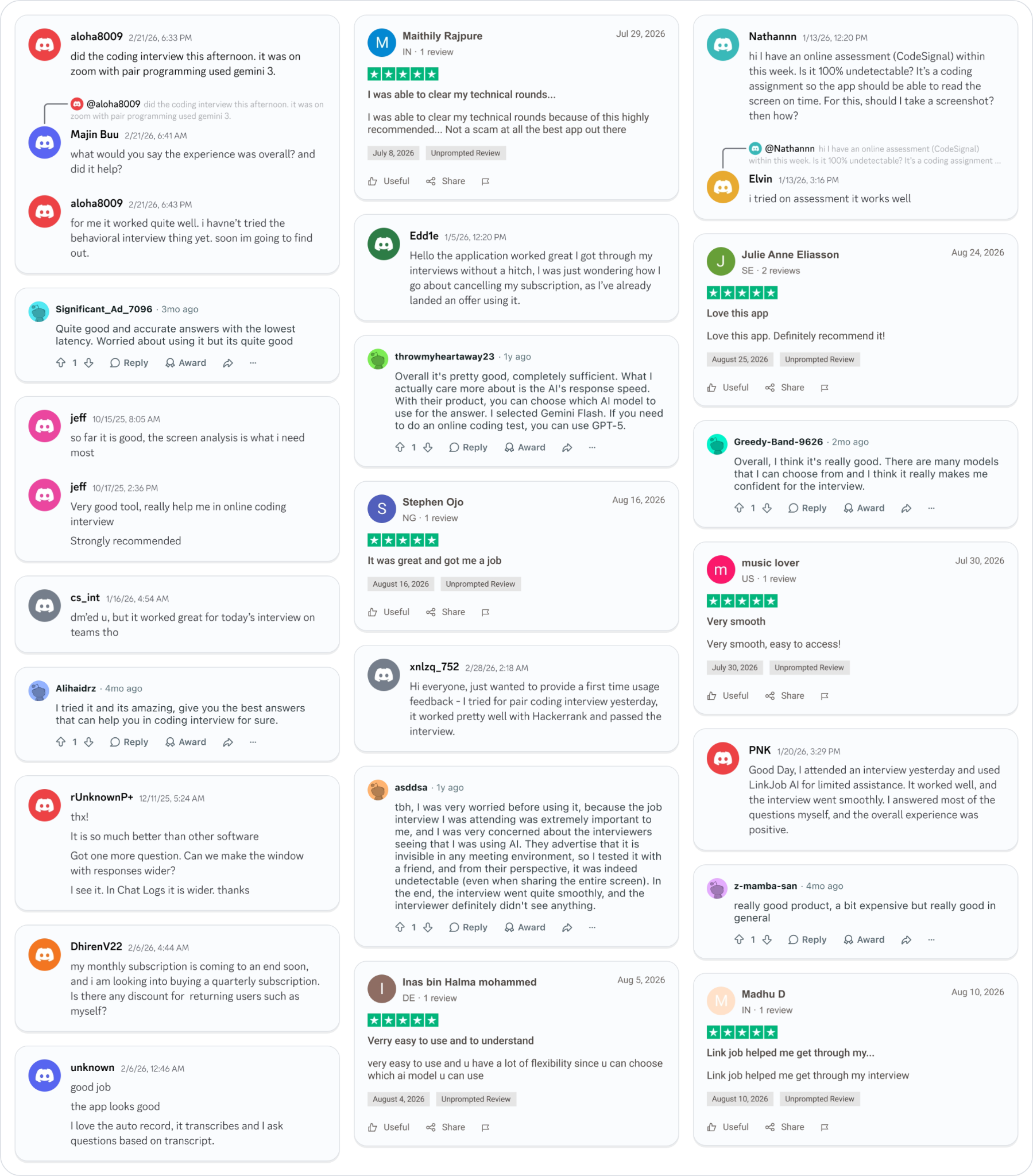
Smoother interviews, coding challenges cleared, and job offers landed. See how users describe their experience with Linkjob AI—in their own words.

© Copyright 2026 Linkjob AI - All Rights Reserved.