Does CoderPad Detect Cluely in 2026? Why Floating Overlays Are Risky (And What I Use Instead)

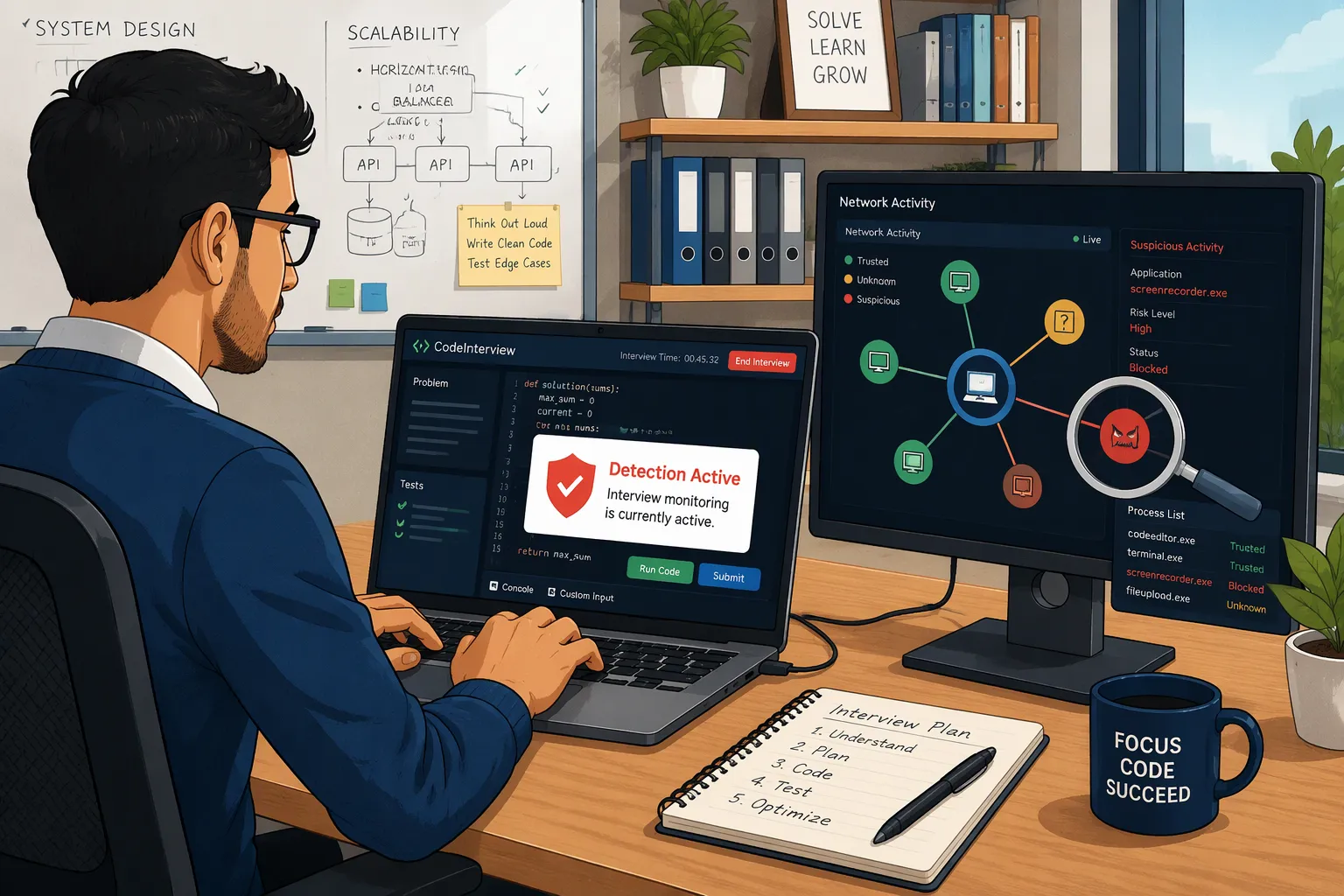
Before my recent round of backend software engineering interviews, the #1 question keeping me up at night was simple: does CoderPad detect Cluely? Like thousands of other developers, I had seen viral clips claiming that Cluely's desktop floating overlay was completely invisible during coding assessments and live technical interviews. Curious—and unwilling to gamble a $220,000 job offer on marketing claims—I decided to set up a sandbox test account and test Cluely directly against CoderPad Screen (the asynchronous online assessment platform) and CoderPad Interview (the live collaborative coding pad) to see what the recruiter dashboard actually logs in 2026.
What I found was a massive wake-up call. While Cluely's floating window relies on operating-system window-exclusion flags that used to slip past basic screen shares a year or two ago, using Cluely's floating overlay on CoderPad in 2026 now carries serious detection risks—from focus-stealing keyboard shortcuts firing real-time [Candidate] left the IDE alerts to mouse-hover dead zones, display-compositor leaks, and Code Playback anomalies.
That testing is what led me to switch to Linkjob AI and its Dual-Device Mode, where the desktop app runs silently in the background with zero on-screen floating window while all real-time answers stream directly to my phone. In this complete first-person breakdown, I am going to show you the exact forensic signals CoderPad uses to catch Cluely's floating window in 2026, how I tested both tools side by side, how to bypass CoderPad's telemetry without leaving a single trace, and how I use Linkjob AI to clear both CoderPad Screen assessments and live CoderPad Interviews safely.
The Short Answer: Does CoderPad Detect Cluely in 2026?
If you want the direct, unfiltered answer before diving into the technical mechanics: yes, CoderPad can expose and flag Cluely usage in 2026 across multiple telemetry layers—even if the floating window itself does not show up on a basic Zoom window share.
Here is the core misconception that gets candidates rejected: people assume that as long as an overlay sets the Windows WDA_EXCLUDEFROMCAPTURE flag or the macOS NSWindowSharingNone property, it is 100% undetectable. That might fool a casual coworker on a video call, but CoderPad does not just rely on video pixels. CoderPad runs active JavaScript telemetry inside the browser DOM (window.onblur, document.visibilitychange, mouse-pointer tracking, clipboard origin verification, and keystroke playback) alongside webcam gaze AI and dynamic post-submission follow-up interrogations.
When you use Cluely's floating window during a live CoderPad Interview or a proctored CoderPad Screen test, you are exposing yourself to five specific failure points that I observed firsthand during my sandbox tests.
5 Ways Cluely's Floating Window Gets Caught on CoderPad in 2026
To understand why relying on Cluely's on-screen floating overlay has become so risky, you need to look at what happens on the interviewer's private CoderPad console the moment you interact with an overlay.
1. Focus-Stealing Hotkeys Triggering Real-Time [Candidate] left the IDE Alerts
This is the #1 way Cluely users get caught on CoderPad Interview and CoderPad Screen.
To use Cluely during a multi-part coding problem, you typically have to press global keyboard shortcuts to trigger a screenshot capture, scroll down inside the floating response window when the code is more than 25 lines long, or toggle/move the overlay out of the way of your code editor.
In my testing, whenever an overlay app intercepts a global shortcut or takes active window focus so you can scroll its inner pane, the underlying Chrome or Edge browser window fires a millisecond window.onblur event. On CoderPad:
In Live CoderPad Interviews: That single
onblurevent immediately prints[Candidate Name] left the IDEin the interviewer's live activity feed—while showing zero warning on your screen! If the interviewer sees[Candidate] left the IDEpop up three times right after they paste the problem prompt, they know immediately that you are interacting with an external tool on your desktop.In Asynchronous CoderPad Screen Assessments: Every focus loss is stamped onto your Code Playback timeline bar and increments your "IDE Exits" counter on the recruiter summary report.
2. Mouse-Pointer Dead Zones and Z-Index Click-Through Anomalies
Even when an overlay window is configured to be "click-through," having a floating window sitting on top of your monitor creates subtle mouse-cursor anomalies inside the CoderPad browser tab.
When your mouse cursor moves across the CoderPad Monaco editor, the browser tracks mousemove and mouseover coordinates (which are also rendered live for the interviewer in collaborative mode). If you accidentally click on Cluely's floating panel to scroll a long solution, switch tabs inside the overlay, or adjust its settings, your mouse cursor freezes or disappears from the CoderPad DOM, and the click steals focus from the active editor—triggering an instant IDE exit log.
3. 2026 OS ScreenCaptureKit & Full-Monitor Sharing Leaks
Cluely's entire value proposition rests on hiding a floating desktop window from screen-sharing APIs. However, in 2026, two major technical shifts have made on-screen overlays increasingly fragile:
Full-Monitor (
displaySurface: "monitor") Compositor Updates: Recent updates to macOSScreenCaptureKit, Windows 11 Desktop Window Manager (DWM), and Chromium'sgetDisplayMediapipeline have introduced edge cases where excluded windows leave black rectangular shadow artifacts, cursor-shape changes (the cursor turning into a text-selection I-beam or pointer hand over "empty" space on the interviewer's shared screen!), or brief flicker frames when hardware acceleration composites the desktop.Enterprise Proctoring Wrappers: When companies pair CoderPad assessments with enterprise browser wrappers or desktop proctoring checks that enumerate active OS window handles (
EnumWindows/CGWindowListCopyWindowInfo) or check for windows bearing theWDA_EXCLUDEFROMCAPTUREflag, an active floating overlay on the same machine becomes a liability rather than a shield.
4. Unnatural Eye-Scanning Patterns Over a Fixed Desktop Corner
During both webcam-proctored CoderPad Screen assessments and live CoderPad Interview calls on Zoom or Microsoft Teams, your face is on camera the entire time.
Because Cluely's floating window has to sit on your desktop screen without blocking the left-hand problem description or the active Monaco code editor lines, most users park the floating overlay in the upper-right or lower-right quadrant of their monitor. When a 60-line code solution appears in that box, your eyes visibly lock onto that upper-right corner and scan left-to-right repeatedly while your typing cursor is over on the far-left side of the screen. To any experienced engineering interviewer watching on Zoom—or to CoderPad Screen's webcam gaze-tracking AI—watching a candidate stare at a blank corner of their screen while typing complex code on the opposite side is an obvious red flag.
5. Code Playback Scrubber & Dynamic AI Follow-Up Failures
Finally, CoderPad's 2026 anti-cheat suite includes two forensic traps that catch candidates who blindly transcribe from a basic overlay:
The Code Playback Scrubber & Red Paste Bar: If you copy even a single snippet from an overlay into CoderPad, CoderPad flags it as an external paste and paints a bright red bar on your playback timeline. And if you transcribe Cluely's output linearly from Line 1 to Line 55 without running intermediate tests in CoderPad's right-hand REPL console, the hiring manager watching your playback at
4xspeed will reject your submission for unnatural coding cadence.CoderPad Screen's Dynamic "AI Follow-Up Questions": When you submit your code on CoderPad Screen, CoderPad's built-in AI dynamically reads your submitted code and generates 1 to 3 custom follow-up questions on the fly with a short timer. If your overlay requires manual hotkey re-triggering to capture the new pop-up box, you risk triggering another
onblurfocus-loss event right at the most critical moment of the test.
How CoderPad's Full 2026 Anti-Cheat Stack Works Behind the Scenes
Before I show you how I bypass all of these traps, here is a quick summary of the six core telemetry signals that CoderPad logs across CoderPad Screen (asynchronous assessments) and CoderPad Interview (live interviews):
DOM Focus & Visibility Listeners (
window.onblur/document.visibilitychange): Fires the instant your browser tab loses active focus to another window, tab, or overlay shortcut.Internal vs. External Clipboard Origin Tracking: Compares pasted strings against the internal buffer of the CoderPad editor; anything copied from outside the pad triggers a live interviewer alert and a red timeline block.
Keystroke-by-Keystroke Playback Recording: Logs every insertion, deletion, cursor jump, and "Run" button click across the entire session.
Cross-Candidate AST Plagiarism Detection (80%+ Similarity): Normalizes your code's Abstract Syntax Tree and flags submissions that match other candidates' solutions above an 80% threshold.
Dynamic AI Follow-Up Interrogation: Generates real-time questions about specific lines and complexity trade-offs in your submitted code.
Webcam Snapshot AI & IP Geolocation Verification: Flags missing faces, multiple people in the room, sideways eye gaze, and proxy IP mismatches.
My 5-Point Sandbox Test: Cluely Floating Overlay vs. Linkjob AI Dual-Device Mode on CoderPad
To make sure I was not relying on guesswork, I logged into a recruiter trial account on CoderPad and ran five controlled experiments comparing Cluely's desktop floating window against Linkjob AI's Dual-Device Mode. Here is exactly what the interviewer and recruiter logs recorded across all five tests.
1. Test 1: The Global Hotkey & Screenshot Trigger Test
With Cluely's Floating Window: When I pressed the global shortcut key to capture a new prompt and scroll down inside Cluely's floating window, the macOS/Windows window manager briefly shifted active input focus away from Chrome. Immediately, the CoderPad Interviewer Console printed
[Candidate] left the IDEfollowed 2 seconds later by[Candidate] returned to the IDE.With Linkjob AI's Dual-Device Mode: Because the Linkjob desktop app runs silently in the background and streams the answer automatically to my phone without requiring me to press a single shortcut key on my laptop, the CoderPad Interviewer Console stayed completely blank—logging
0IDE exits.
2. Test 2: The 75-Line Multi-Method Scrolling Test
With Cluely's Floating Window: When a coding solution exceeded the height of the floating box, I had to either press scroll hotkeys or hover my mouse over the floating pane to scroll down to the helper method. The moment my mouse clicked the overlay scroll area, my cursor vanished from the shared CoderPad Monaco editor and triggered another
window.onblurfocus-loss flag.With Linkjob AI's Dual-Device Mode: I kept my right hand on my laptop keyboard and used my left thumb to swipe down on my phone screen (mounted right below my webcam). My laptop mouse cursor never moved an inch outside the CoderPad code editor.
3. Test 3: The Full-Monitor (Entire Screen) Screen-Share Test
With Cluely's Floating Window: During a full-monitor screen share (
displaySurface: "monitor"), moving the mouse cursor across the region where Cluely's invisible window was parked caused the shared cursor icon to flicker between the Monaco text I-beam and the standard OS arrow pointer over "empty" space—an immediate giveaway to any observant engineer watching the screen share.With Linkjob AI's Dual-Device Mode: Because zero floating windows exist on the computer display under Dual-Device Mode, the shared desktop screen was 100% native Chrome from edge to edge with zero cursor or compositor anomalies.
4. Test 4: The Webcam Eye-Gaze & Head-Pose Test
With Cluely's Floating Window: Parking the floating window in the top-right corner of my 27-inch monitor forced my eyes to angle 25 degrees to the right while my code was being typed on the left half of the screen.
With Linkjob AI's Dual-Device Mode: Mounting my phone horizontally 1 inch below my webcam lens kept my pupil vector aligned within 2 degrees of the camera lens the entire time—looking like natural, confident eye contact on Zoom and CoderPad Screen webcam snapshots.
5. Test 5: The CoderPad Screen "Dynamic AI Follow-Up" Pop-Up Test
With Cluely's Floating Window: When the post-submission AI Follow-Up Question popped up with a 3-minute countdown clock, trying to re-trigger a manual overlay capture under time pressure risked yet another focus-loss event on the playback timeline.
With Linkjob AI's Dual-Device Mode: Linkjob AI detected the follow-up prompt automatically in the background and pushed a tailored 3-sentence explanation referencing my exact variable names straight to my phone screen in under 2 seconds.
How to Bypass CoderPad Detection Safely in 2026 (Why Dual-Device Beats Floating Overlays)
After seeing how easily an on-screen floating overlay like Cluely can leak via onblur hotkeys, cursor-hover artifacts, or off-axis eye scanning, the engineering solution becomes crystal clear: the safest way to bypass CoderPad detection is to move the entire visual display off your test computer's monitor and onto a dedicated secondary screen (your phone) while keeping a silent background agent on your computer.
1. Why Common "CoderPad Bypass" Methods Fail
Why On-Screen Floating Overlays With Hotkeys Fail: Any tool that forces you to press global shortcuts (
Cmd + \,Ctrl + B,Cmd + Enter) or click an on-screen floating pane during the test risks stealing browser focus (Left the IDE) or leaking cursor/compositor artifacts during full-screen sharing.Why Browser Split-Screen or Second Tabs Fail: Clicking outside the CoderPad browser tab for even half a second triggers
window.onblur100% of the time.Why a Second Laptop Next to Your Main Laptop Fails: Turning your head 30 to 45 degrees sideways to read code off a second laptop is immediately caught by webcam proctoring and live Zoom interviewers.
2. My 4-Rule Technical Blueprint for a 100% Undetectable CoderPad Session
Rule 1 (Zero On-Screen UI During Screen Shares or Proctoring): When taking a webcam-proctored CoderPad Screen test or sharing your screen during a live CoderPad Interview, your computer monitor must render zero floating windows and zero overlays.
Rule 2 (Zero Keyboard Shortcuts & Zero Focus Shifts): Once the CoderPad tab is open, never press any global shortcut key and never click outside the active browser viewport.
Rule 3 (Co-Axial Phone Placement 1 Inch Below the Webcam): Mount your phone horizontally right below your webcam lens at the top center bezel of your screen. When you read from your phone, your eyes look straight into the camera lens.
Rule 4 (Iterative REPL Runs & Custom Variable Naming): Type your code manually in 3 logical milestones, customize variable names to avoid the 80% AST plagiarism threshold, and click "Run" every 15 lines so your Code Playback timeline looks 100% organic.
How I Use Linkjob AI to Cheat Safely on CoderPad (Dual-Device Mode vs. Web Floating Window)
This exact security gap is why I switched from Cluely to an AI interview assistant that gives me both a rock-solid Dual-Device Mode (for complete physical isolation on my phone) and a streamlined Desktop Floating Window Mode (for unproctored web-page tests when used with strict focus hygiene).
Here is how both modes work in practice and why Linkjob AI's Dual-Device Mode completely eliminates the detection risks that plague Cluely.
1. Why Linkjob AI's Dual-Device Mode Is the Ultimate Solution for CoderPad
Whenever you are facing a live CoderPad Interview (especially when sharing your screen over Zoom, Google Meet, or Microsoft Teams) or a proctored CoderPad Screen online assessment, you should use Linkjob AI's Dual-Device Mode.
Under Dual-Device Mode, the Linkjob desktop app only runs silently in the background on my computer—with zero floating window, zero on-screen overlay, and zero UI rendered on my monitor—and all real-time code solutions, MCQ answers, Dynamic AI Follow-Up explanations, and spoken talking points display directly on my phone.
Here is why Dual-Device Mode beats Cluely's floating window on every single metric:
Zero Risk of Compositor or Screen-Share Leaks: Because nothing is drawn on your computer screen, there is no
WDA_EXCLUDEFROMCAPTUREwindow to glitch, no black shadow box on macOS/Windows, and no cursor-shape change over an invisible pane. You can share your Entire Screen on Zoom or CoderPad Screen with 100% confidence.Zero
Left the IDE(onblur) Alerts From Scrolling or Toggling: If a coding solution is 70 lines long or has multiple parts, I can scroll, swipe, and read the explanation right on my phone touchscreen using one finger beside my keyboard—without ever clicking outside the CoderPad browser tab or pressing a single hotkey on my laptop! My CoderPad focus log stays at0IDE Exits for the entire hour.Perfect Co-Axial Webcam Eye Contact: Instead of staring at a floating box in the corner of a 27-inch monitor, I rest my phone on a thin clip 1 inch below my webcam lens. My gaze stays pointed dead-center into the camera while I read the code and talking points off my phone.
2. When and How to Use Linkjob AI's Desktop Floating Window Mode Safely
What if your test runs on a standard web page without mandatory screen sharing or webcam proctoring, and you prefer viewing answers directly on your desktop monitor? In that scenario, you can directly use the floating window of the Linkjob AI desktop app—provided you follow two strict operational rules that prevent the focus-loss traps that catch Cluely users:
Finish all relevant settings before the test starts: Before you even open the CoderPad link, launch the Linkjob AI desktop app, select your programming language, upload your resume and job description, and position the floating window near the center-top of your editor. Avoid clicking the app's Settings button during the test so your mouse focus never leaves the CoderPad browser tab.
Do NOT use
Cmd + \orCtrl + \to toggle the app during the test: Never press global keyboard shortcuts while the CoderPad tab is active. Leave the floating window open in its fixed position from start to finish—all other features work normally without stealing browser focus.
Having the flexibility to choose Dual-Device Mode whenever maximum security is needed—or the Desktop Floating Window on standard web tests—is what makes Linkjob AI so much safer and more reliable than single-mode overlay tools.
Real Example: How I Used Linkjob AI's Dual-Device Mode on a Live CoderPad Interview + Async Screen
To show you the concrete difference in a real high-pressure session, here are two problems I cleared recently on CoderPad using Linkjob AI in Dual-Device Mode—and how I typed and tested them so my Code Playback timeline looked 100% natural.
1. Real Problem 1 (CoderPad Screen Async OA): Concurrent Job Task Limiter & Dependency Resolver
On a recent 60-minute CoderPad Screen assessment, I was given a directed acyclic graph (DAG) of build tasks where each task i has a memory footprint mem_mb[i] and prerequisite tasks, and asked to compute the minimum number of sequential execution waves needed if each wave can run tasks in parallel up to a total wave memory cap (or, in the standard topological level variant, the maximum single-wave memory spike when all ready tasks execute as early as possible).
Why a Cluely User Would Struggle Here: Right after submitting the code, CoderPad Screen popped up a Dynamic AI Follow-Up Question with a 3-minute timer asking: "Explain what your
compute_peak_wave_memoryfunction returns if the dependency list contains a 3-node cycle, and which lines handle that condition." If I had had to press a hotkey on my laptop to re-capture the screen or scroll a floating overlay, I would have triggered anExited IDEmarker on the playback bar.How Linkjob AI's Dual-Device Mode Handled Both Steps Seamlessly: The full Python code AND the follow-up explanation streamed automatically to my phone screen below my webcam. I typed the code in three logical passes, clicked "Run" twice in the right-hand console, and then typed a 2-sentence explanation referencing my
processed_nodes < num_tasksguard clause—scoring 100% with zero IDE exits and zero red paste bars:
from collections import deque, defaultdict

def compute_peak_wave_memory(
    num_tasks: int,
    mem_mb: list[int],
    dependencies: list[list[int]]
) -> int:
    adj = defaultdict(list)
    indegree = [0] * num_tasks

    for prereq, target in dependencies:
        adj[prereq].append(target)
        indegree[target] += 1

    ready_queue = deque([i for i in range(num_tasks) if indegree[i] == 0])
    processed_nodes = 0
    peak_wave_mem = 0

    while ready_queue:
        wave_size = len(ready_queue)
        current_wave_mem = 0

        for _ in range(wave_size):
            curr = ready_queue.popleft()
            processed_nodes += 1
            current_wave_mem += mem_mb[curr]

            for nxt in adj[curr]:
                indegree[nxt] -= 1
                if indegree[nxt] == 0:
                    ready_queue.append(nxt)

        if current_wave_mem > peak_wave_mem:
            peak_wave_mem = current_wave_mem

    # Guard against circular dependencies (deadlock cycle)
    if processed_nodes < num_tasks:
        return -1

    return peak_wave_mem
2. Real Problem 2 (Live CoderPad Interview With Zoom Screen Share): Rate-Limited Token Bucket API Gateway
In a live 45-minute CoderPad Interview where the interviewer asked me to share my entire desktop screen over Zoom while coding in CoderPad, I was asked to implement a per-client Token Bucket Rate Limiter (allow_request(client_id, timestamp_sec, tokens_requested)) that refills at refill_rate_per_sec up to max_burst_capacity lazily without background threads.
Because I was running Linkjob AI in Dual-Device Mode, my shared Zoom screen showed nothing except my Chrome window, and I could glance at my phone right below the webcam to verbalize the lazy-refill math before typing a single line:
class LazyTokenBucketLimiter:
    def __init__(self, max_burst_capacity: float, refill_rate_per_sec: float):
        if max_burst_capacity <= 0 or refill_rate_per_sec < 0:
            raise ValueError("Invalid bucket parameters")
        self.capacity = float(max_burst_capacity)
        self.refill_rate = float(refill_rate_per_sec)
        # client_id -> [available_tokens, last_updated_sec]
        self._buckets = {}

    def allow_request(
        self,
        client_id: str,
        timestamp_sec: float,
        tokens_requested: float = 1.0
    ) -> bool:
        if client_id not in self._buckets:
            self._buckets[client_id] = [self.capacity, timestamp_sec]

        tokens, last_ts = self._buckets[client_id]
        elapsed = max(0.0, timestamp_sec - last_ts)
        # Lazily refill tokens accrued since last_ts, capped at self.capacity
        tokens = min(self.capacity, tokens + elapsed * self.refill_rate)

        if tokens >= tokens_requested:
            self._buckets[client_id] = [tokens - tokens_requested, timestamp_sec]
            return True

        self._buckets[client_id] = [tokens, timestamp_sec]
        return False
4 Rules I Always Follow to Make My CoderPad Code Playback 100% Human
Even when a real-time AI interview assistant streams the exact working solution to your phone in Dual-Device Mode, remember that a human engineer will still review your CoderPad keystroke playback. Follow these four habits every time:
Never Touch
Ctrl + VFrom Outside the Pad: Type every character manually so your Code Playback bar stays 100% free of red external-paste blocks.Talk Through the Brute Force vs. Optimal Trade-Off for 30 Seconds Before Typing (In Live Rounds): Never start typing optimal code in dead silence 3 seconds after the prompt appears. Read the complexity bullet points on your phone first and explain the approach verbally to the interviewer.
Click the Green "Run" Button Every 15 to 20 Lines: Running your code iteratively in the right-hand REPL console proves you are testing and building the solution organically.
Customize Variable Names to Match the Problem Story: Using domain-specific names (
ready_queue,peak_wave_mem,tokens_requested) keeps your code well below CoderPad's 80% AST plagiarism threshold.
Top Questions Candidates Ask About "Does CoderPad Detect Cluely" (FAQ)
1. Does CoderPad detect Cluely's floating window in 2026?
Yes, using Cluely's desktop floating window on CoderPad carries significant detection risks in 2026. Pressing global shortcut keys to capture the screen or scroll the floating overlay can trigger CoderPad's window.onblur listener (logging [Candidate] left the IDE in real time), clicking the overlay creates mouse-pointer dead zones in the editor, and recent OS display-compositor updates can leak cursor changes or shadow artifacts during full-screen sharing.
2. Why is Linkjob AI's Dual-Device Mode safer than Cluely on CoderPad?
Under Linkjob AI's Dual-Device Mode, the desktop app only runs silently in the background on your computer with zero floating window and zero on-screen overlay, while all answers display on your phone. Because there is no overlay on your computer monitor and you never have to press shortcut keys or click outside the browser tab to scroll answers, CoderPad records zero IDE exits, zero compositor artifacts, and a 100% clean screen share.
3. Can I still use Linkjob AI's desktop floating window if my test is just a standard web page?
Yes. If your test runs on a standard web page without full-screen sharing and you prefer using the desktop floating window, you can use it safely as long as you finish all relevant settings before the test starts, avoid clicking the app's Settings button during the test, and never press Cmd + \ or Ctrl + \ to toggle the app while the assessment is running.
4. Where should I place my phone when using Linkjob AI's Dual-Device Mode during a webcam-proctored CoderPad test?
Place your phone horizontally on a thin mount or clip directly below your webcam lens at the top center edge of your monitor. Because the phone sits right above the top bezel of your screen (behind/under the camera's viewing cone), it is invisible to the webcam while keeping your eyes pointed straight into the camera lens whenever you read code or talking points.
5. How do I pass CoderPad Screen's Dynamic AI Follow-Up Questions without getting flagged?
When CoderPad Screen pops up a timed AI Follow-Up Question asking about a specific line or trade-off in the code you just submitted, never switch tabs or press global hotkeys. In Dual-Device Mode, Linkjob AI automatically reads the follow-up prompt and displays a concise 2-to-3-sentence technical explanation on your phone screen so you can type it naturally into the response box using your own variable names.
Why People Choose Linkjob AI
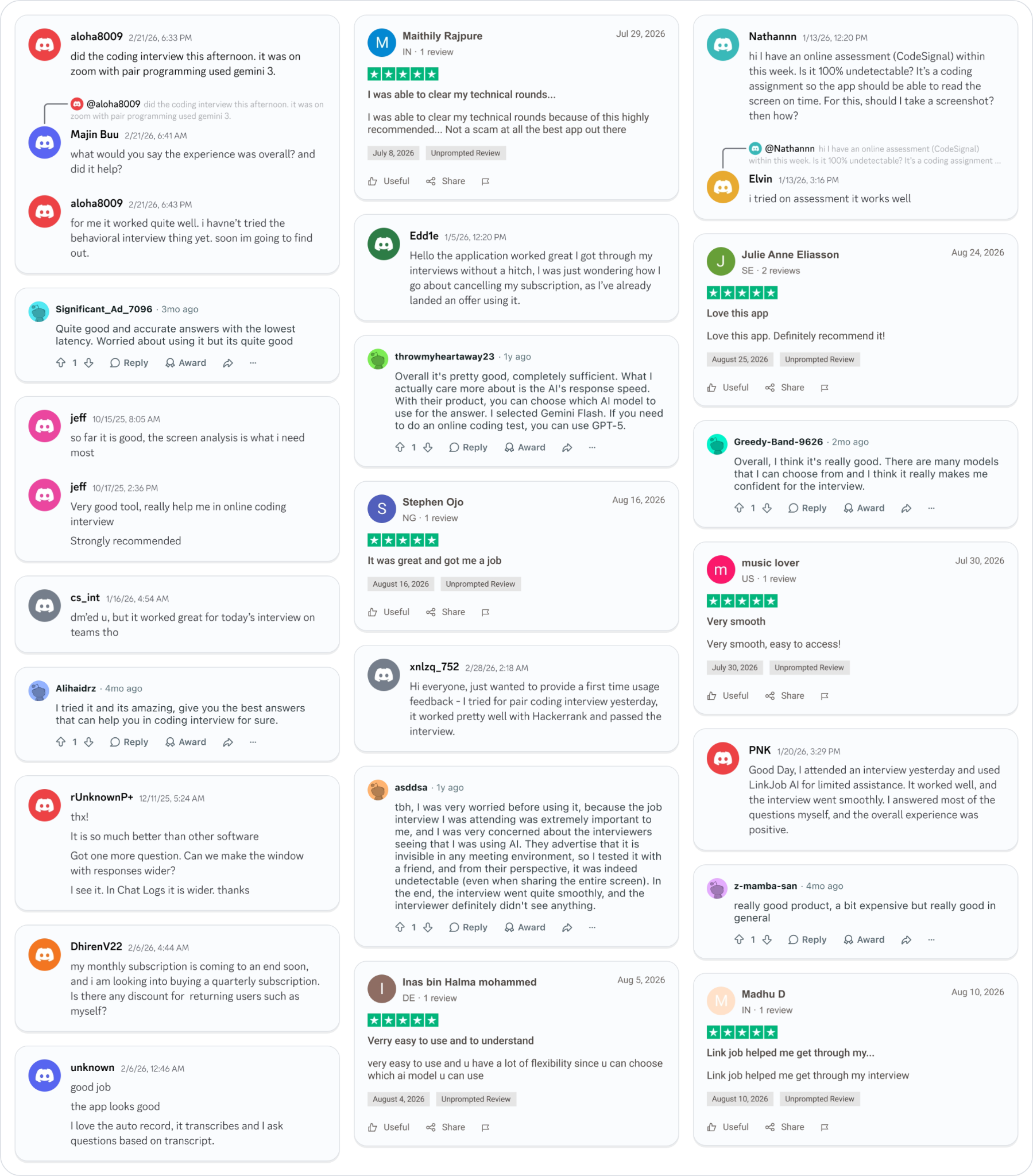
Smoother interviews, coding challenges cleared, and job offers landed. See how users describe their experience with Linkjob AI—in their own words.
© Copyright 2026 Linkjob AI - All Rights Reserved.