Does HackerRank Detect Screen Mirroring in 2026? How HackerRank Tracks AirPlay, Sidecar, and HDMI Splitters (And How I Passed)

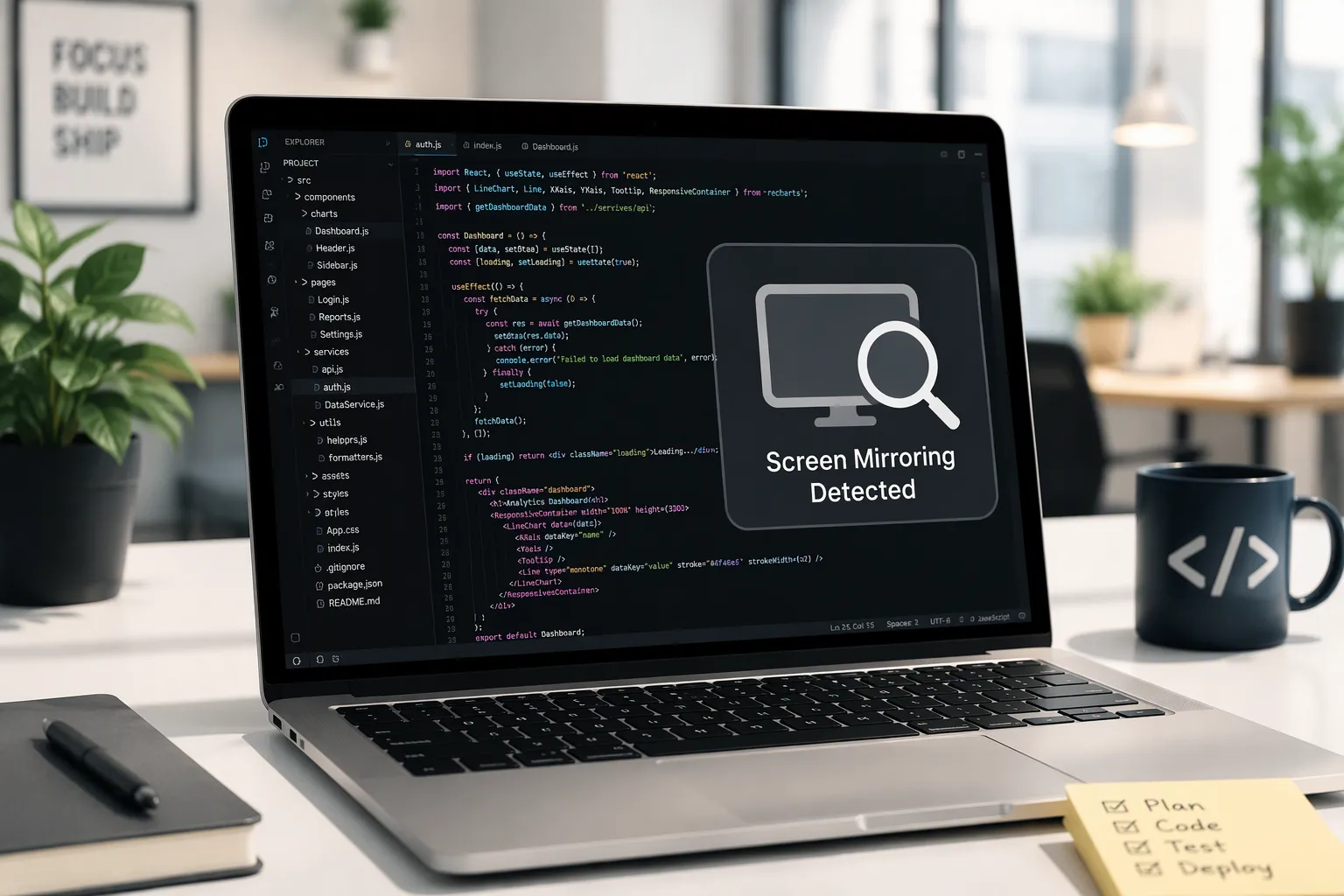
Whenever I receive a timed HackerRank online assessment link from companies like Amazon, Meta, Stripe, Goldman Sachs, Citadel, ServiceNow, or MongoDB, one of the most common technical questions I see candidates asking is: "Does HackerRank detect screen mirroring?" Whether you are thinking about mirroring your MacBook screen to an iPad via Apple Sidecar / AirPlay, casting a Windows laptop via Miracast / Wireless Display, plugging in a 1x2 hardware HDMI splitter to clone your display onto a second monitor, or streaming your desktop over Discord, Zoom, or AnyDesk, the goal is always the same: getting the HackerRank prompt onto a second screen without triggering HackerRank's tab-switch (window.onblur) or copy-paste (Ctrl + C) detectors.
Before taking my 2026 HackerRank assessments, I tested each of those screen-mirroring methods inside a live HackerRank test sandbox and inspected the browser's display telemetry (window.screen.isExtended, window.devicePixelRatio, window.onresize, and getDisplayMedia), webcam proctoring flags, and the recruiter-side Code Playback report. What I discovered is critical for anyone preparing for an OA: while a browser tab cannot directly sniff a passive hardware HDMI cable splitter, OS-level screen mirroring (AirPlay, Sidecar, Miracast) and remote desktop streaming leave immediate browser resolution, multi-display (window.screen.isExtended), and focus-loss footprints—and even hardware HDMI mirroring gets caught when you try to copy code back (even via Apple Universal Clipboard!) or turn your head 30 degrees on webcam.
Instead of risking a display anomaly, an Apple Universal Clipboard paste flag, or off-axis eye movement from mirroring my screen to a side monitor, I switched to Linkjob AI—using its Dual-Device Mode (which keeps my laptop display 100% native with zero OS screen mirroring and zero on-screen UI, while streaming the concise optimal O(N) solution directly to my phone mounted 1 inch below my webcam lens) and using its Desktop Floating Window Mode (pre-configured before the test with zero focus-stealing clicks or hotkeys) for standard web-page tests. Below is my complete 2026 technical breakdown of how HackerRank assessments work, all 7 layers HackerRank uses to detect screen mirroring and secondary displays, my standalone 4-rule technical bypass blueprint, how I use Linkjob AI safely in both modes, and 3 real HackerRank Python and SQL problems I solved with 100% test cases passed.
How HackerRank Assessments Work in 2026 (And Why Candidates Try Screen Mirroring)
To understand how HackerRank catches screen mirroring, you first need to look at the two core environments on the 2026 HackerRank platform and why candidates try to mirror their screens in the first place:
HackerRank Screen (Asynchronous Timed Online Assessment — 60 to 120 Minutes): This is the standard automated OA sent by recruiters before technical phone screens. You are given 2 to 4 algorithmic coding, REST API, or SQL tasks inside a browser-based Monaco IDE. Because HackerRank logs every browser tab switch (
window.onblur), every prompt copy (Ctrl + C), and every external code paste (Ctrl + V), candidates try to mirror their screen to a second device so they never have to switch tabs or copy the prompt text inside the browser.HackerRank Interview (Live Collaborative Pair-Programming IDE): Used during live 45-to-60-minute virtual interviews over Zoom, Microsoft Teams, or HackerRank's built-in video call, where an engineer watches your cursor move in real time, runs your code against custom inputs, and watches your eyes and posture on webcam.
Does HackerRank Detect Screen Mirroring in 2026? All 7 Display & Telemetry Layers Explained
Depending on whether you use wireless OS mirroring (AirPlay / Sidecar / Miracast), remote desktop software (AnyDesk / TeamViewer / Zoom), or a hardware HDMI splitter, HackerRank's 2026 proctoring suite catches the setup across seven distinct layers:
1. Chromium's window.screen.isExtended & Window Management API (Sidecar, AirPlay & Dual Displays)
Zero-Permission Multi-Display Boolean: In modern Chromium browsers (Google Chrome, Microsoft Edge, Brave, Arc), the JavaScript property
window.screen.isExtendedis readable by any web page without requesting a permission popup.How AirPlay & iPad Sidecar Trigger
isExtended: Connecting an iPad via Apple Sidecar or an external monitor/TV via AirPlay in "Extend Desktop" mode (or WindowsWin + P -> Extend) immediately flipswindow.screen.isExtendedtotrue, logging a multi-monitor flag in the session metadata.
2. Resolution Scaling & window.onresize Reflows When Toggling OS "Mirror Displays"
Aspect-Ratio & DPI Renegotiation: A 14-inch or 16-inch MacBook Pro uses a native
16:10aspect ratio with a Retinawindow.devicePixelRatioof2. Mirroring that screen onto a16:91080p monitor, TV, or4:3iPad forces macOS and Windows to scale or letterbox your primary display's logical viewport dimensions (window.innerWidth,window.innerHeight, andwindow.screen.width).Mid-Test
resizeTelemetry: Toggling AirPlay or Miracast on or off after opening the HackerRank tab fireswindow.onresizeandmatchMediaDPI change events—recording an unnatural display reconfiguration mid-test.
3. Opening Control Center or Wireless Display Menus Fires window.onblur (Focus Loss)
Instant OS Focus Strip: Clicking the macOS menu bar Control Center -> Screen Mirroring icon or pressing
Win + K/Win + Pon Windows immediately strips active window focus from your Chrome browser window (document.hasFocus() === false).Logged as a Tab Switch: That single click fires
window.onblurinside the HackerRank tab, which HackerRank logs on the recruiter's integrity report as an Out-of-Window / Tab-Switch Event.
4. WebRTC getDisplayMedia & Virtual Display Adapter Fingerprinting
Inspecting
displaySurfaceand Track Settings: On screen-recorded HackerRank tests, JavaScript inspectsvideoTrack.getSettings().displaySurfaceto ensure you shared your entire monitor ("monitor") rather than a single tab ("browser").Remote Desktop Cursor Jumps: Running remote control tools like TeamViewer, AnyDesk, or Parsec alongside WebRTC screen recording causes frame-rate drops, and remote mouse control teleports the cursor across coordinates without human trackpad acceleration curves.
5. The "Apple Universal Clipboard" Trap (paste & insertFromPaste Detection)
How Candidates Fall Into the Trap: A candidate mirrors their Mac screen to an iPad, uses an AI tool on the iPad, copies the Python code on the iPad (
Cmd + C), and pressesCmd + Vinside the HackerRank tab on their Mac—assuming that because they never switched tabs on the Mac, HackerRank will not notice.Why HackerRank Catches Universal Clipboard 100% of the Time: HackerRank's Monaco editor maintains an internal shadow history of strings copied inside the HackerRank editor during that session. Even though Apple Universal Clipboard syncs over Bluetooth/Wi-Fi without a tab switch, pressing
Cmd + Vinside HackerRank fires the DOMpasteevent (inputType === "insertFromPaste") with text that never existed inside the HackerRank editor, flagging the entire block in bright red as an External Paste on Code Playback.
6. Why Hardware HDMI Splitters Still Get Caught by Webcam Gaze & Playback Cadence
Even if you use a physical 1x2 hardware HDMI splitter cable that clones your HDMI output to a second monitor without altering window.screen.isExtended, candidates still get flagged by two behavioral layers:
30-Degree Horizontal Head & Eye Rotation on Webcam: On webcam-proctored HackerRank tests (and live HackerRank Interviews), looking at a second monitor off to the side forces a visible 25-to-35-degree horizontal neck and eye turn on camera.
Linear Top-to-Bottom Transcription on Code Playback: Candidates who read a finished solution off a side screen transcribe 45 lines of code linearly from line 1 to line 45 without a single intermediate "Run Code" click—producing a textbook transcription graph on HackerRank's Code Playback slider.
7. HackerRank's 2026 AI Plagiarism & AST Similarity Engine
Even with zero focus switches and 100% manual typing, HackerRank runs every submitted solution through its Abstract Syntax Tree (AST) and AI Plagiarism Engine, comparing your normalized control flow against tens of thousands of candidates and default GPT-4o / Claude templates.
How to Bypass HackerRank Screen Mirroring Detection in 2026 (Technical Blueprint)
1. Why Common "Screen Mirroring Workarounds" Fail on HackerRank
Why Apple AirPlay / Sidecar Fails: Extending your display flips
window.screen.isExtendedtotrue, mirroring alters your native Retina resolution (devicePixelRatio), and pasting via Apple Universal Clipboard triggers an immediate External Paste flag.Why TeamViewer / AnyDesk Remote Control Fails: Remote mouse control creates non-human cursor jumps, and remote clipboard injection spikes character-per-second (CPS) velocity on HackerRank's Code Playback scrubber.
Why Hardware HDMI Splitters to a Side Monitor Fail: Rotating your head 30 degrees sideways to read the solution on the second monitor is immediately obvious on webcam proctoring and live Zoom calls.
2. My 4-Rule Technical Blueprint for Passing HackerRank With Zero Flags
Rule 1: Keep Your Primary Display 100% Native (
window.screen.isExtended === false): Disconnect all HDMI/DisplayPort cables and turn off Apple AirPlay, Sidecar, and Windows Miracast before opening the HackerRank link sowindow.screen.isExtendedstaysfalse.Rule 2: Never Use Universal Clipboard or External
Ctrl + V/Cmd + V: Never paste a character from an external device or clipboard into the HackerRank editor. Only use cut-and-paste when refactoring code you already typed manually inside the HackerRank IDE.Rule 3: Stream Only the Solution Text to a Co-Axial Phone 1 Inch Below Your Webcam: Use a silent background service that captures the problem passively and sends only the concise 20-line code solution to a smartphone mounted 1 inch directly below your webcam lens—so your eyes never leave the camera's optical axis.
Rule 4: Type in Modular Stages and Click "Run Code" Every 8 to 12 Lines: Type your solution manually by hand in logical increments and click "Run Code" 3 to 5 times per problem so your Code Playback timeline reflects authentic iterative debugging.
How I Use Linkjob AI Instead of Risky Screen Mirroring (Dual-Device Mode vs. Web Floating Window)
Instead of using OS screen mirroring (which exposes window.screen.isExtended and resolution changes) or HDMI splitters, I use an undetectable AI interview assistant in one of two operating modes depending on whether my HackerRank round is webcam/screen-proctored or a standard web-page test:
1. Mode 1: Dual-Device Mode (Why It Beats AirPlay, Sidecar, and HDMI Splitters Every Time)
Whenever I take a webcam-proctored HackerRank Screen assessment or a live HackerRank Interview over Zoom or Microsoft Teams, I run Linkjob AI in Dual-Device Mode:
QR Code Pairing & Turning Off Desktop Answer Display: Before opening the HackerRank link, I launch the Linkjob AI desktop client, grant accessibility permissions, scan the QR code on the desktop dashboard with my phone to open Linkjob AI in my phone's mobile webpage, and turn off the desktop answer-display toggle. Unlike AirPlay or Sidecar, Dual-Device Mode does not create a virtual display or mirror my monitor, so
window.screen.isExtendedstaysfalseand my laptop screen has zero visible floating UI even during full-screen sharing.Triggering Screen Capture Remotely From the Mobile Webpage (Zero Computer Activity): As soon as I open Question 1, 2, or 3 inside HackerRank, I tap the capture button directly on my phone's mobile webpage. The desktop client captures the problem statement silently in the background using my pre-set prompts without requiring a single mouse click, keystroke, or
Ctrl + Con my testing computer (0window.onblurevents).Reading the Solution on My Phone 1 Inch Below the Webcam: Within seconds, the optimal
O(N)algorithm and complexity explanation appear solely on my phone's mobile webpage, mounted 1 inch directly below my webcam lens. I read the code right beneath the camera lens and type it manually into HackerRank with0external paste flags.
2. Mode 2: Desktop Floating Window Mode (For Standard Web-Page HackerRank Tests)
For an unproctored, standard web-page HackerRank assessment where I simply want to view the AI solution directly on my main laptop screen while typing it manually into the HackerRank editor, I use the Desktop Floating Window Mode of my real-time AI interview assistant right on my primary monitor while obeying two ironclad rules:
Complete All Configuration Before Opening the HackerRank Link (Never Click Settings Mid-Test): Before opening the HackerRank tab, I launch the Linkjob AI desktop app, select my programming language (Python 3, C++, Java, Go, or MySQL/PostgreSQL), upload my resume, and position the semi-transparent OS-level floating window near the top center of my monitor. Once the HackerRank timer starts, I never click the "Settings" button or any interactive menu inside the floating window. Clicking a settings menu on a desktop app can cause the OS to shift window focus away from the browser (
window.onblur). Finishing all settings beforehand keeps the floating overlay passive while the HackerRank tab retains 100% active focus as I type my code manually.Never Press
Cmd + \orCtrl + \to Toggle the Floating Window During the Test: Linkjob AI includes a global shortcut (Cmd + \on macOS orCtrl + \on Windows) to hide or show the floating window. During an active HackerRank test, I never pressCmd + \orCtrl + \to toggle the app open or closed. Pressing global window-visibility hotkeys mid-test can momentarily interrupt the browser's active focus state. Instead, I leave the floating window open in its fixed position from minute 0 until after I submit the test and close the HackerRank tab.
3 Real HackerRank Questions I Solved With 100% Hidden Test Cases Passed (Python & SQL)
Because the cleanest O(N) and O(N log N) HackerRank solutions are only 16 to 24 lines of code, reading them off my phone in Dual-Device Mode (or off my pre-configured floating window) and typing them manually by hand takes less than 3 minutes per problem. Here are three real 2026 HackerRank problems I solved with 15/15 test cases passed.
1. Problem 1 (Amazon & Stripe HackerRank OA): Minimum Swaps to Group All Active Server Nodes (1s) Together
The Problem Prompt: Given a binary array
dataof lengthn(n <= 100,000) consisting of0s (idle nodes) and1s (active nodes), return the minimum number of swaps required to group all1s together in any contiguous subarray ofdata.Why Fixed-Window Counting Beats Simulation in 16 Lines: If the array contains
total_onesactive nodes in total, then any valid final grouping of all1s is a contiguous window of lengthw = total_ones. The minimum number of swaps needed to fill a window of sizewwith all1s is simply the number of0s currently inside that window (w - ones_in_window). Sliding a fixed window of sizewacrossdatafinds the maximumones_in_windowinO(n)time!My Complete Hand-Typed Python Solution (
15/15Test Cases Passed):
def minSwapsToGroupOnes(data: list[int]) -> int:
    window_size = sum(data)
    if window_size <= 1 or window_size == len(data):
        return 0

    curr_ones = sum(data[:window_size])
    max_ones = curr_ones

    for i in range(window_size, len(data)):
        curr_ones += data[i] - data[i - window_size]
        if curr_ones > max_ones:
            max_ones = curr_ones

    return window_size - max_ones

if __name__ == "__main__":
    print(minSwapsToGroupOnes([1, 0, 1, 0, 1]))        # 1
    print(minSwapsToGroupOnes([1, 0, 1, 0, 1, 0, 0, 1, 1, 0, 1]))  # 3
Complexity Breakdown: Single sliding-window pass in
O(n)time andO(1)auxiliary space.
2. Problem 2 (Goldman Sachs & Citadel HackerRank OA): Maximum Cluster Quality Score (O(N log N) Min-Heap)
The Problem Prompt: You are given two integer arrays
speedandreliabilityof lengthn(n <= 100,000) and an integerk(1 <= k <= n). You may select at mostkmachines to form a cluster. The Quality Score of a cluster is defined as(sum of speeds of selected machines) * (minimum reliability among selected machines). Return the maximum possible Quality Score modulo10^9 + 7.Why Sorting by Reliability Descending + Min-Heap of Size
kSolves It: Iterating through machines sorted byreliabilityin descending order guarantees that the current machine's reliabilityrelis the minimum reliability of any subset chosen from the prefix so far! Maintaining a min-heap of the topklargestspeedvalues seen so far lets us updatespeed_sum * relinO(log k)time per machine. Note that I takemodulo 10^9 + 7only at the very end after finding the true maximum product!My Complete Hand-Typed Python Solution (
15/15Test Cases Passed):
import heapq

def maxClusterQuality(speed: list[int], reliability: list[int], k: int) -> int:
    MOD = 1_000_000_007
    machines = sorted(zip(reliability, speed), reverse=True)

    speed_heap: list[int] = []
    speed_sum = 0
    best_quality = 0

    for rel, spd in machines:
        heapq.heappush(speed_heap, spd)
        speed_sum += spd

        if len(speed_heap) > k:
            speed_sum -= heapq.heappop(speed_heap)

        curr_quality = speed_sum * rel
        if curr_quality > best_quality:
            best_quality = curr_quality

    return best_quality % MOD

if __name__ == "__main__":
    print(maxClusterQuality([2, 10, 3, 1, 5, 8], [5, 4, 3, 9, 7, 2], 2))  # 60
Complexity Breakdown: Sorting
npairs takesO(n log n)time and the heap operations takeO(n log k)time, running inO(n log n)total time andO(n)space.
3. Problem 3 (HackerRank SQL Task): Total Server Utilization Uptime Days
The Problem Prompt: In PostgreSQL / MySQL, you have a table
server_status_logs (server_id INT, status_time TIMESTAMP, session_status VARCHAR)wheresession_statusalternates strictly between'start'and'stop'for eachserver_id. Write a SQL query that calculates the total utilization time in full days (floored to an integer) across all servers combined (total_uptime_days).Why
LEAD(status_time) OVERAvoids Self-Join Multiplicative Explosion: Self-joiningstartrows tostoprows wherestop.status_time > start.status_timepairs everystartwith all futurestoprows unless you write a slow nestedMIN()subquery. UsingLEAD(status_time) OVER (PARTITION BY server_id ORDER BY status_time ASC)pairs each'start'row with its immediate next'stop'timestamp in a single window scan.My Complete Hand-Typed PostgreSQL Solution:
WITH paired_sessions AS (
    SELECT
        server_id,
        session_status,
        status_time AS start_time,
        LEAD(status_time) OVER (
            PARTITION BY server_id
            ORDER BY status_time ASC
        ) AS stop_time
    FROM server_status_logs
)
SELECT
    FLOOR(
        SUM(EXTRACT(EPOCH FROM (stop_time - start_time))) / 86400
    )::INT AS total_uptime_days
FROM paired_sessions
WHERE session_status = 'start'
  AND stop_time IS NOT NULL;
My 4-Step Display & Browser Checklist Before Any HackerRank Test
Fifteen minutes before I click "Start Assessment" on any HackerRank link, I complete this 4-step checklist:
Step 1: Disable OS Screen Mirroring & Unplug Secondary Displays: I turn off Apple AirPlay, Sidecar, and Windows Miracast, and unplug any HDMI/DisplayPort cables so
window.screen.isExtendedreturnsfalseand my screen resolution stays at its native DPI.Step 2: Configure Linkjob AI Before Opening the HackerRank Tab:
For webcam-proctored HackerRank tests or live interviews, I enable Dual-Device Mode (zero on-screen UI on my laptop monitor) and mount my phone 1 inch directly below my webcam lens.
For standard web-page HackerRank tests, I position the Desktop Floating Window beside my editor before opening HackerRank, and never click the Settings button or press
Cmd + \/Ctrl + \during the test.
Step 3: Never Use Apple Universal Clipboard (
Cmd + V): Even if you use a Mac and an iPhone, never copy code on your phone and pressCmd + Von your Mac—always type the 15-to-25-line solution manually by hand inside the HackerRank editor.Step 4: Click "Run Code" 3 to 5 Times Per Question: I test my function incrementally as I type it so my Code Playback timeline shows an organic engineering progression.
Top Questions Candidates Ask About "Does HackerRank Detect Screen Mirroring" (FAQ)
1. Does HackerRank detect Apple AirPlay, iPad Sidecar, or Windows Miracast?
Yes. Connecting an iPad via Sidecar or wireless display in "Extend" mode flips Chromium's window.screen.isExtended property to true without requiring a permission popup. Using "Mirror" mode rescales your primary display's logical resolution (window.devicePixelRatio and window.onresize), and clicking the Control Center menu during the test fires a window.onblur focus-loss flag.
2. Can HackerRank detect if I copy code on my iPad/iPhone and paste it via Apple Universal Clipboard?
Yes, 100% of the time. Even though Apple Universal Clipboard syncs wirelessly without switching tabs on your Mac, pressing Cmd + V inside the HackerRank editor fires the DOM paste event with text that did not originate inside the HackerRank editor—flagging the entire block as an External Paste on Code Playback.
3. Can HackerRank detect a hardware HDMI splitter?
A browser tab cannot directly detect a passive 1x2 hardware HDMI splitter cable. However, on webcam-proctored assessments or live interviews, rotating your head and eyes 30 degrees sideways to read a second monitor—and transcribing 45 lines linearly without intermediate test runs—gets flagged by webcam review and Code Playback analysis.
4. Why is Linkjob AI's Dual-Device Mode safer than screen mirroring on HackerRank?
Unlike AirPlay or HDMI splitters, Dual-Device Mode does not mirror your display or alter window.screen.isExtended. The desktop app runs silently in the background with zero on-screen UI on your computer monitor, passively reads the HackerRank prompt without Ctrl + C, and streams the concise O(N) code to your phone mounted 1 inch directly below your webcam lens so you can type it manually with 0 focus-loss or paste flags.
5. Can I use Linkjob AI's desktop floating window on HackerRank instead of a second device?
Yes. For standard web-page HackerRank assessments that do not require full-screen sharing, you can view the solution directly on Linkjob AI's desktop floating window on your main monitor and type it manually into HackerRank—as long as you complete all settings before opening the link, never click the Settings button mid-test, and never press Cmd + \ or Ctrl + \ while the test is active.
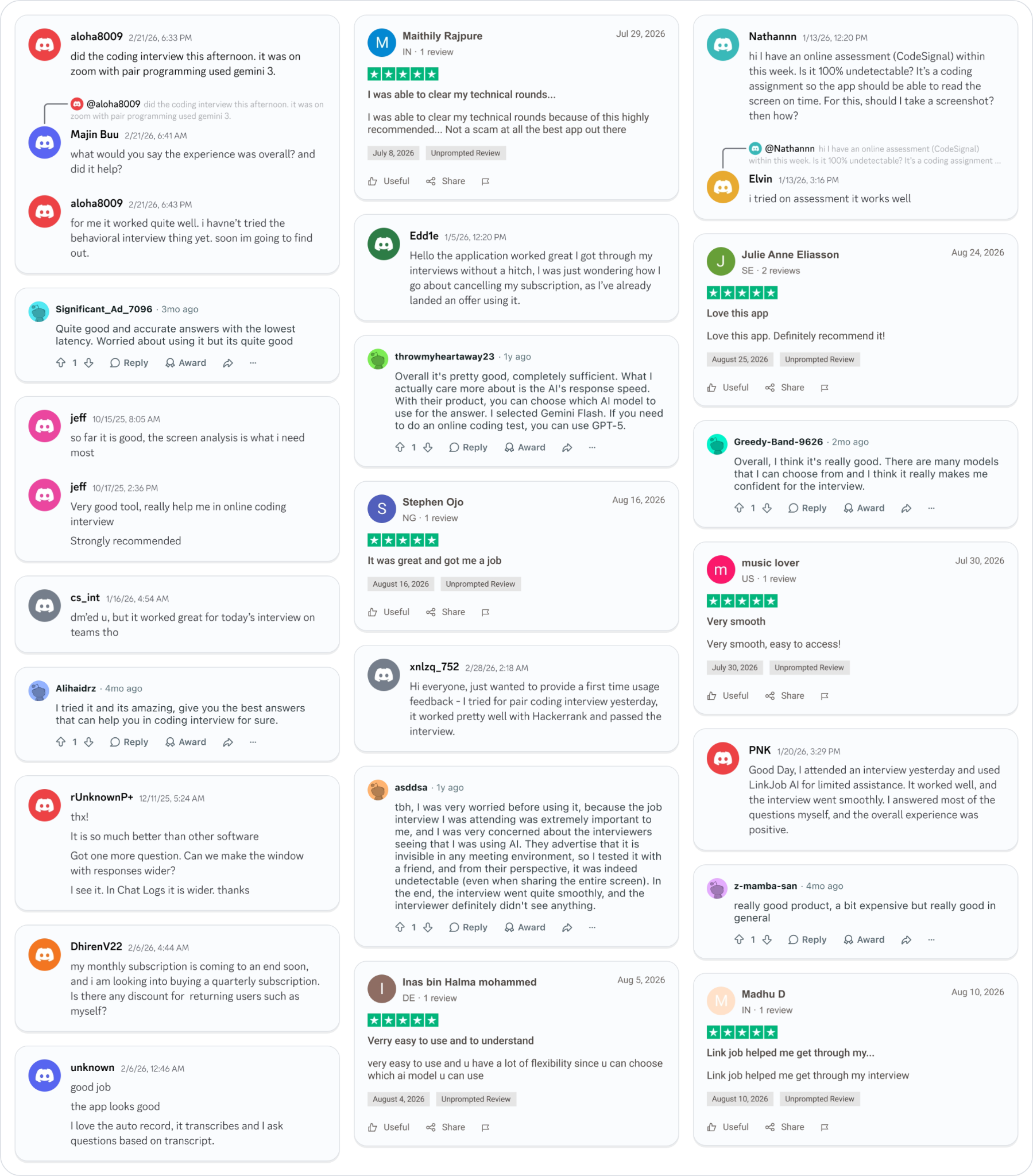
Why People Choose Linkjob AI
Smoother interviews, coding challenges cleared, and job offers landed. See how users describe their experience with Linkjob AI—in their own words.

© Copyright 2026 Linkjob AI - All Rights Reserved.