My 2026 Personal Journey through Goldman Sachs HireVue


My Goldman Sachs HireVue for a general engineering position consisted of 6 questions, with 45 seconds to prepare and two minutes to respond to each — the entire session took about 30 minutes. The questions were primarily behavioral and situational, covering topics like professional ethics, teamwork, handling competing priorities, and overcoming challenging goals, with a final engineering-specific question on data structures and algorithms. I'm really grateful for the Linkjob AI Interview tool for helping me pass my interview, which is why I'm sharing my HireVue questions and experience here. Having an undetectable AI assistant during the interview indeed provides a significant edge.
This article is part of the Goldman Sachs interview series. If you're interested in other articles in this series, feel free to read:Goldman Sachs HackerRank Test, Goldman Sachs CoderPad Questions, Goldman Sachs Summer Analyst Interview.
Goldman Sachs HireVue Question Bank
1. Walk me through your resume
2. You have a sense that one of your team members feels that their contributions are being dismissed or undervalued by other members of your team. How would you respond to this situation?
What specific steps would you take to help your team member?
How might you prompt other team members to be inclusive of the team member?
3. In the middle of a project, a new team member is added to our team, what would you do to make them feel more welcome?
What specific steps would you take to integrate your new team member?
What would be your thought process for determining what to do?
How might you prompt other team members to be inclusive of the new team member?
4. Tell me about a time you had to do something repeatedly until you got it right. What was it, and what did you learn from your earlier, unsuccessful attempts?
What steps, if any, did you take to learn more about the topic to help improve?
What resources did you use, if any, to aid your development?
5. You need to learn how to do something that’s more complex than your typical projects. How do you go about acquiring the additional skills you need?
What steps, if any, would you take to learn more about the topic?
What resources would you use to aid your development?
6. What is something you’re interested in, and what do you intend to do to become more of an expert on that subject?
Why do you want to learn about this topic?
What steps, if any, do you take to learn more about the subject?
What resources do you use to aid your development?
7. Tell me about a time you changed your decision based on newly introduced information. How did you weigh your options between changing and not changing your mind?
How did you get the new information?
8. A client has emailed you a question and you don't know what the answer is. What would be your thought process for determining what to do?
How would you respond to the client?
How do you think your response would be received?
9. Tell me about a time you remained motivated on an important project even after facing several setbacks. How did you deal with the setbacks?
What motivated you to persist?
Which setback was the most difficult to overcome?
10. Can you please provide an example of when and how you've utilized the skillset you applied to?
Please provide this example in a workplace setting.
11. You are in charge of a team where all team members come from different places, how will you organize them to work together?
12. Tell me about a time that your project or work was affected by something that you were not able to control.
13. (Describe how you will react/Tell me about a time) when an unexpected issue happens during your project.
The Goldman Sachs HireVue is the very first stage of Goldman Sachs' recruiting process. Passing it is your gateway to the rest of the pipeline:
Stage 1: HireVue — Recorded video interview (you are here)
Stage 2: First Round Interviews — interviews with analysts, associates, or VPs. Mix of behavioral and technical questions.
Stage 3: Superday — 4-6 back-to-back interviews with various team members, from analysts to managing directors.
For a full breakdown of the entire Goldman Sachs interview process, visit this Goldman Sachs interview guide.
Goldman Sachs Initial Preparation Steps
Understanding HireVue Format
Understanding the HireVue structure is the first step to clearing it. Based on real candidate reports — including my own experience and verified accounts from other applicants — the Goldman Sachs HireVue consistently follows the same format: 5 behavioral questions and 1 role-specific technical question, with 45 seconds to prepare and 2 minutes to respond to each.
The behavioral questions tend to cluster around five core themes Goldman Sachs screens for across all divisions: Resume walkthrough, Professional ethics & client conflict, Teamwork & accountability, Resilience & goal achievement and Prioritization & trade-offs.
The 6th question is role-specific. For engineering positions, this tends to be a technical question around your skillset and how it applies to the role — for example, the importance of data structures and algorithms in problem-solving, or how your experience would enable you to make an impact in areas like liquidity management and financial resource allocation.
The Viral Reddit Guide to the GS HireVue
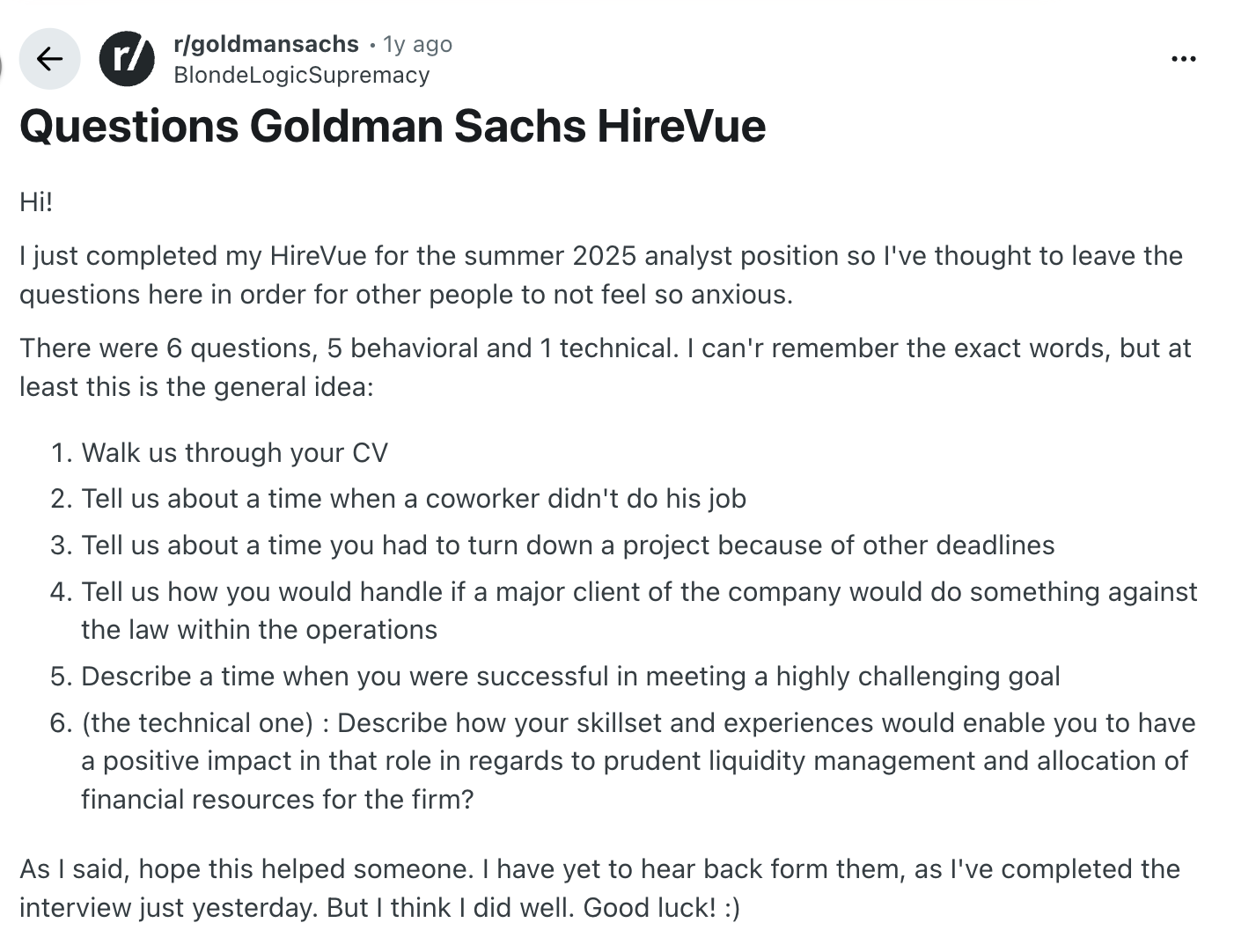
Key insight: The behavioral questions are consistent across divisions and recruiting cycles — multiple candidates from different years have reported nearly identical questions. This means preparing structured STAR-format answers for these five themes gives you reliable coverage going into your HireVue.
Reviewing Role Requirements
Before recording, I conducted a deep dive into the specific division I applied for, as Goldman Sachs tailors its HireVue criteria based on the role’s unique demands. I moved beyond generic "finance" answers and focused on the following pillars:
Division-Specific Technical Depth:
Investment Banking/Global Markets: I focused on demonstrating a firm grasp of financial modeling, valuation techniques, and current market trends
Engineering: I prioritized showing logic-driven problem-solving skills, particularly in data structures and algorithms, which are often the core of technical screenings at firms of this caliber
Asset Management/Operations: I prepared to demonstrate situational judgment and the ability to manage complex, deadline-driven workflows
The "Goldman Competency" Balance: The firm evaluates candidates on a blend of technical proficiency and behavioral alignment. I ensured my responses demonstrated rigor—such as accounting for edge cases or policy nuances—while maintaining code readability in my explanations of technical projects.
Professional Delivery: I practiced maintaining confident body language and steady verbal communication, knowing that the AI evaluates speech clarity and tone consistency alongside the actual content of the answer
Researching Goldman Sachs
Company Insights and Values
To stand out, I looked beyond the mission statement to understand how Goldman Sachs applies its values in high-stakes environments. The firm prioritizes a culture of Teamwork, Innovation, and Integrity, with a specific current emphasis on bridging generational gaps and driving cultural change through leadership buy-in. I structured my behavioral answers to reflect these three pillars:
Core Value / Mission Component | Practical Application in Interview |
|---|---|
Client Service & Partnership | Highlighting how you build trust-based, long-term relationships to deliver tailored solutions |
Integrity & Excellence | Demonstrating a commitment to the highest ethical standards and consistent, top-tier performance |
Innovation & Teamwork | Showing how you use technology and collaboration to solve complex problems and drive firm growth |
Don't just list these values; weave them into your stories. For example, when answering a conflict question, emphasize Integrity and Partnership by explaining how you prioritized firm policy and client trust over a quick win
Staying Updated on Financial News
I made it a habit to spend 15–20 minutes each morning on financial news, specifically looking for Goldman Sachs mentions. The sources I found most useful:
News: The Wall Street Journal, Financial Times, Bloomberg
Deeper reads: The Economist, Goldman Sachs' own Briefings newsletter and research publications (many are publicly available)
Podcasts: Odd Lots (Bloomberg), Acquired, The Journal (WSJ)
YouTube: Mergers & Inquisitions, The Plain Bagel for finance concept refreshers
The goal wasn't to memorize headlines — it was to be able to speak naturally about one or two recent developments. During my interview, I referenced Goldman's ongoing AI integration and their strategic focus on wealth management growth, which felt far more convincing than generic answers about "wanting to work in finance."
Motivation Narrative
Your "Why Goldman Sachs?" answer is arguably the most important response in the entire HireVue. Every bank hears "I want to work with the best people on the most complex deals" — that's not enough.
What actually works is specificity: a deal Goldman advised on that you followed closely, a business line you want to be part of and why, or a moment where Goldman's work intersected with something you care about. I connected my interest in how they use technology across their capital markets operations with my own background, which made the story feel personal rather than rehearsed.
Tip: Write your motivation story out in full, then cut it down to its sharpest two-minute version. If you can't explain why Goldman specifically in 90 seconds, keep refining.
Practice and Preparation Techniques
Using Practice Questions
Practicing with real interview questions made the biggest difference.The questions I encountered were:
Behavioral: "Tell me about a time when you were working on a project with someone who was not completing his or her part of the project."
Role specific(Engineering)What do you think is the importance of the data structure and algorithm in problem-solving? Give examples.
Tip: I built a bank of 15–20 answers, practiced them daily, and recorded myself on video. Watching the recordings was uncomfortable but genuinely useful — I caught filler words, noticed when I was rushing, and could see exactly where my eye contact drifted.
Out Loud Response Practice
Speaking answers out loud felt awkward at first, but it's the single most important preparation habit getting comfortable with the Hirevue format. There's a significant difference between knowing what you want to say and being able to say it fluently under pressure with a camera running.
I did three types of practice:
Solo recording sessions — just me, my laptop camera, and a timer. Cold runs with no notes.
Mock interviews with an AI interview assistant — they asked the questions, I answered, we gave each other feedback afterward.
AI mock interview tools — useful for getting objective feedback on pacing and filler word frequency when no friend is available.
Here’s a quick checklist I used for out loud practice:
Speak clearly and at a steady pace.
Maintain eye contact with the webcam.
Use confident body language.
Avoid filler words like “um” or “like.”
Dress professionally, even for practice.
Concise Answer Structuring
The two-minute limit is a gift in disguise — it forces discipline. The candidates who struggle are usually the ones who ramble through context and never get to the result. I used two frameworks:
Framework | Steps | Best Use Case |
|---|---|---|
CAR | Context, Action, Result | Technical or achievement-based |
STAR | Situation, Task, Action, Result | Behavioral questions |
A practical rule I followed: spend no more than 20% of your time on setup (context/situation), 60% on what you actually did, and 20% on the outcome and what you learned. Most people get this backwards — they over-explain the situation and rush through the result, which is the part that matters most.
Callout: Practice each answer until you can deliver it in under two minutes without sounding rushed. If you're consistently hitting 2:30, cut your setup — not your result.
Goldman Sachs HireVue Experience
Navigating Question Types
The Goldman Sachs HireVue question bank above covers the most commonly reported questions across multiple recruiting cycles — and preparing structured answers for each of them will put you ahead of most candidates walking in cold.
But here's the reality: Goldman Sachs almost always includes 1–2 questions you won't find in any question bank. These are situational or role-specific prompts that are either rotated in periodically or tailored to your specific division. No matter how thoroughly you prepare, there is always a moment in the HireVue where a question appears on screen that you've never seen before — and you have 45 seconds to figure out what to say.
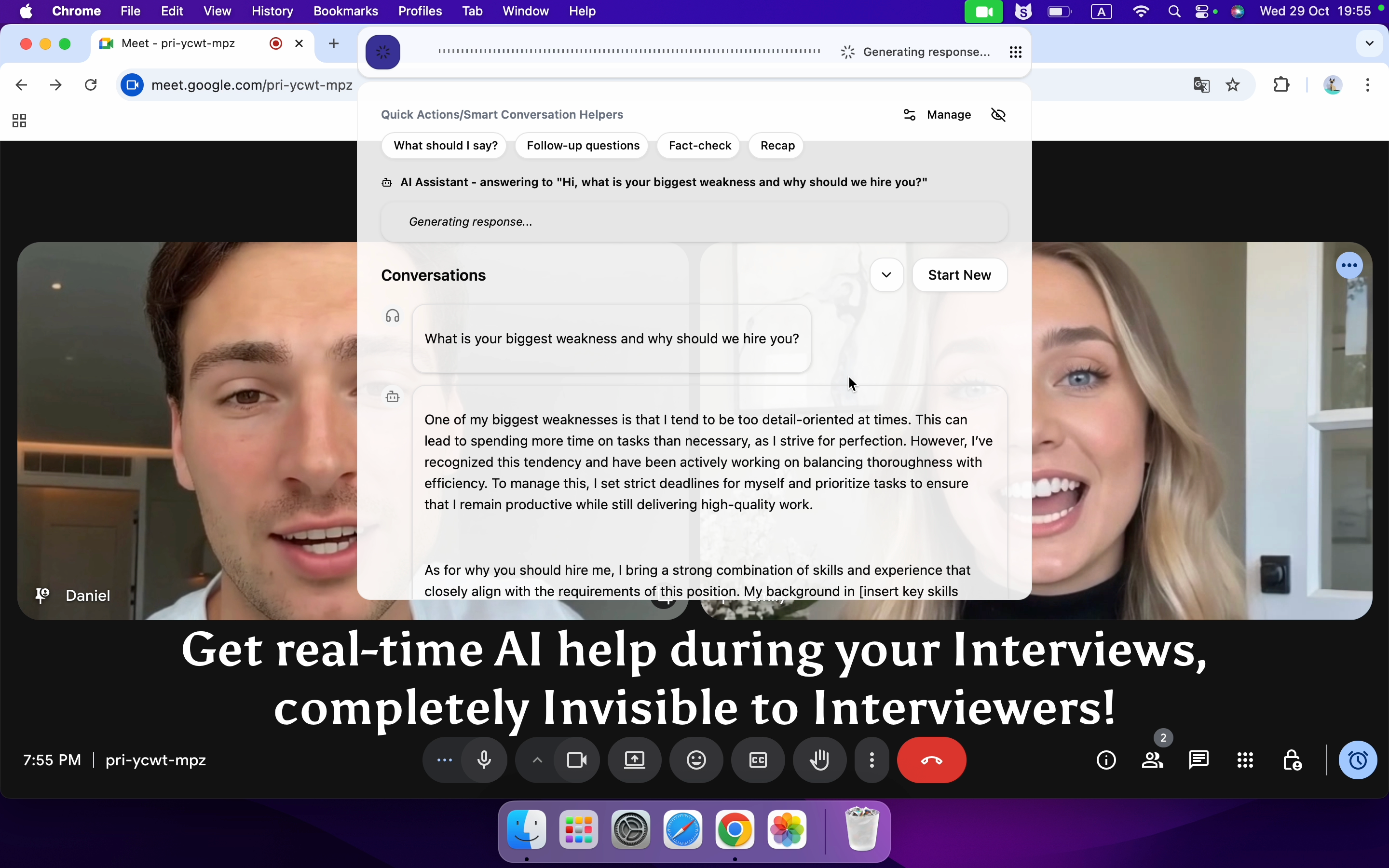
That's exactly the moment where preparation alone isn't enough.Linkjob.ai's AI interview assistant worked great for this moment — I got through the interview without a hitch. The detection question was something I genuinely worried about beforehand, but it's completely undetectable by HireVue's system. It didn't trigger any detection on their end, and when that unexpected question hit, it gave me real-time talking points that felt natural and completely my own.
Managing Time and Nerves
To handle the ticking clock, I spent the 30-second prep time organizing my thoughts into three key bullet points. I found that taking deep breaths and practicing aloud helped me sound natural rather than robotic on camera
Tip: Your environment matters. A neutral, well-lit background (natural light from the front if possible), a quiet room, and a stable internet connection are table stakes. Technical issues or distracting backgrounds create a bad first impression before you've said a word.
Next Steps After HireVue
After submitting, Goldman Sachs typically takes one to two weeks to follow up. If selected, the pipeline moves to First Round Interviews, then Superday — and the format shifts entirely from recorded responses to live, back-to-back conversations with division professionals.
The HireVue is just the filter. What gets you through the rest is a different kind of readiness — so don't go quiet in the waiting period.
Note: Don't stop preparing after your HireVue. Use the waiting to refresh your technical knowledge, revisit deals or projects you want to talk about, and practice conversational delivery rather than scripted answers — because Superday is a completely different test.
Looking back at my own experience, three things made the biggest difference: knowing Goldman Sachs specifically enough to speak about it with conviction, having practiced enough that my delivery felt natural rather than rehearsed, and walking in with a clear and honest motivation story that was genuinely mine. Beyond that — dress professionally, keep natural eye contact with the webcam, and trust that authenticity comes through even on a recorded screen. Goldman's evaluators have seen thousands of polished, scripted answers. A real one stands out.
FAQ
How did I prepare for the Goldman Sachs HireVue interview?
I made a list of common questions and practiced my answers out loud. I recorded myself to check my tone and body language. I also researched the company’s values and recent news.
What should I wear for the HireVue interview?
I always dress in business professional attire. A suit or blazer works best. Looking sharp helps me feel confident and shows respect for the company.
How do I handle nerves during the interview?
I take deep breaths and remind myself that practice builds confidence. I listen to music before starting. I focus on speaking clearly and keeping eye contact with the webcam.
Can I retake questions if I make a mistake?
Usually, HireVue does not allow retakes. I take a few seconds to organize my thoughts before answering. If I stumble, I keep going and finish strong.
What happens after the HireVue interview?
I wait for feedback from Goldman Sachs. If I get selected, I move to the Superday round. I review my experiences and practice my answers again to prepare for the next step.
See Also
Insights From My Bloomberg New Grad Interview Experience
Diverse Questions Faced During My McKinsey Interview
My Successful Journey Through Palantir's New Grad Interview