My 2026 Goldman Sachs Superday Experience and Real Questions


From my experience, the best way to succeed in a Goldman Sachs Superday interview is to focus on three things.
First, I keep up with market trends and current news. Second, I practice answering questions clearly and logically, and I prepare for detailed questions about my resume. Lastly, I turn my past experiences into a strong story and link them to the role I want.
I'm incredibly grateful to Linkjob AI for helping me ace my Goldman Sachs Superday interview. That's why I've accepted this invitation to share my interview experience here, including the timeline and actual interview questions.
I'll also share how I used invisible interview AI assistant to prepare for the interview and leverage its assistance during the live interview to secure my success. Having an undetectable AI interview copilot truly gave me a massive advantage.
Understanding Goldman Sachs Superday
Goldman Sachs Superday Structure and Format
When I first learned about the Goldman Sachs Superday, I wanted to know exactly what to expect. The process involves multiple interviews back-to-back. I sat down with bankers from different levels, and each interview lasted about 30-45 minutes. The focus is not just on technical skills. Interviewers want to hear my thoughts on market trends and investment ideas. They ask about recent market moves and portfolio basics. I prepared to discuss how macroeconomic trends connect to specific investment opportunities.
Multiple interviews (3-4 rounds)
Each interview lasts around 30-45 minutes
Emphasizes resilience under pressure
Focus on market sense and investment ideas
Assessing logical thinking skills
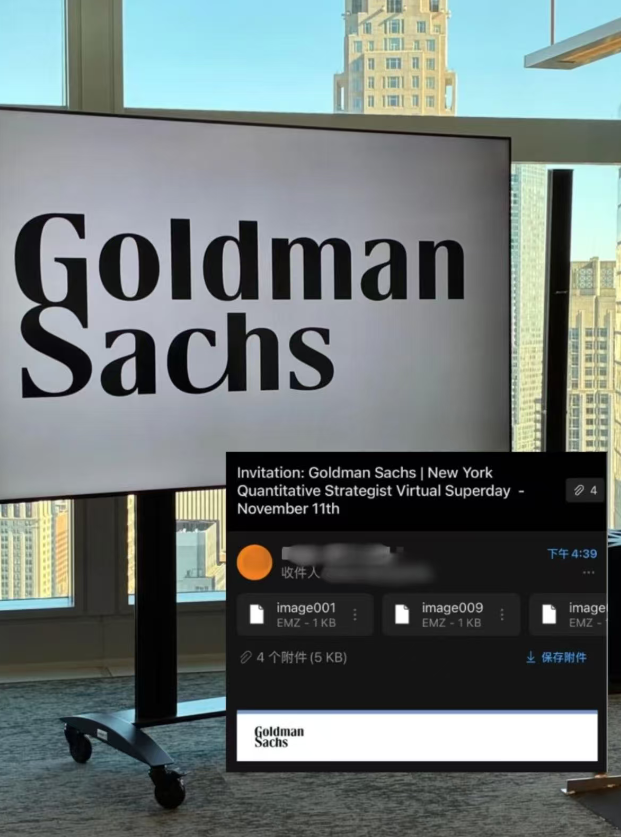
Goldman Sachs Superday Interview Experience and Questions
Timeline
Online Application: Late August
HireVue Video Interview: Triggered approximately one week after submission
Technical First Interview: Two weeks after passing HireVue
Superday: Mid-to-late October
Offer Issuance: 3-5 days after final interview
Technical Interview Questions
SDE Technical questions
Technical questions can feel intimidating, but I found that preparation makes them manageable. During the interview, I was asked the following questions:
Question1:Leetcode20

My response is as follows:
Core Concept: Stack (Last-In-First-Out / LIFO)
This problem tests your ability to handle "nested symmetry."
How it works:
Initialize an empty Stack.
Iterate through the string:
If it's an opening bracket (
(,[,{), push it onto the stack.If it's a closing bracket, check if the stack is empty. If not, pop the top element and see if it matches the current closing bracket.
If the stack is empty or the brackets don't match, return
false.
Final Check: After the loop, the stack must be empty (ensuring no unmatched opening brackets remain).
Complexity:
Time: O(n) — Single pass through the string.
Space: O(n) — In the worst case, the stack stores all characters (e.g.,
"(((((").
Interview Tip: Use a Map to store the bracket pairs. This makes the code cleaner and easily extensible if new types of brackets (like
< >) are added.
Question2:Leetcode121

My response is as follows:
Core Concept: Greedy Algorithm / One-Pass DP
The key constraint is that you must buy before you can sell (you cannot move backward in time).
How it works:
Maintain two variables:
minPrice(initialize to Infinity) andmaxProfit(initialize to 0).Iterate through the
pricesarray:Update
minPriceif the current price is the lowest seen so far.Calculate the potential profit if you sold today:
currentPrice - minPrice.Update
maxProfitif this potential profit is higher than the previous maximum.
Complexity:
Time: O(n) — Single pass.
Space: O(1) — Only two variables are used regardless of input size.
Interview Tip: This is a simplified version of Dynamic Programming. The state transition is essentially: Profit[i] = max(Profit[i-1], CurrentPrice - MinPrice).
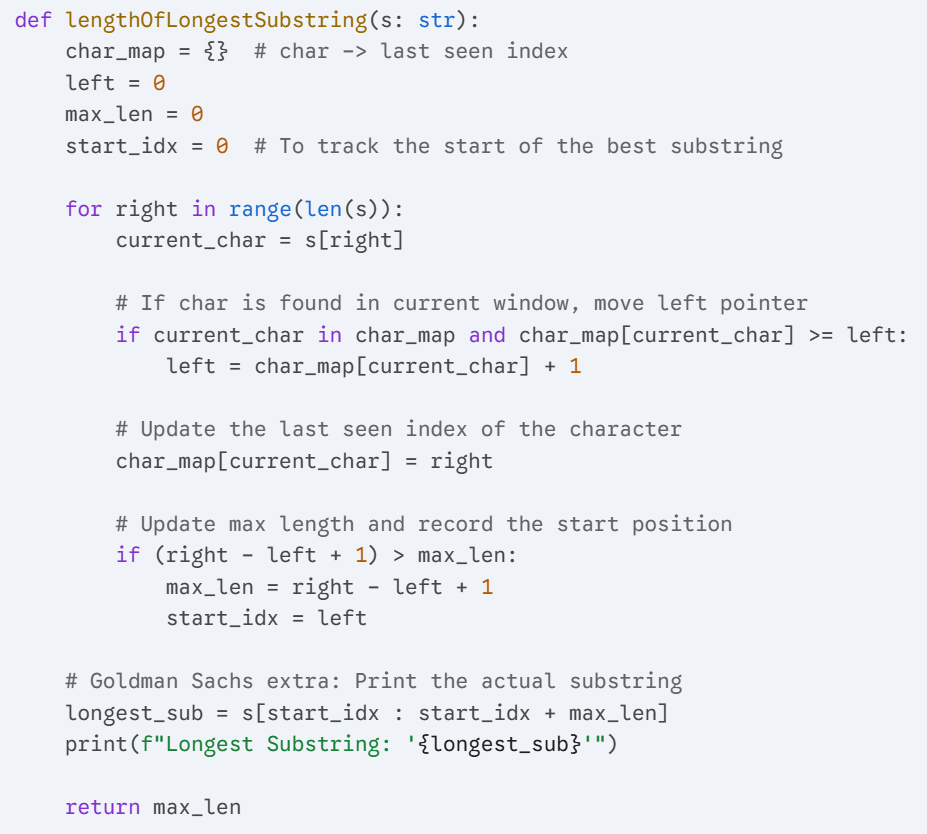
Question3:leetcode3
Longest Substring Without Repeating Characters
My response is as follows:
Core Concept: Sliding Window with Hash Map
The goal is to maintain a "window" using two pointers that expands and contracts to ensure no characters are repeated within it.
How it works:
Use a
rightpointer to iterate through the string and expand the window.Use a Hash Map to store characters and their most recent index.
If you encounter a character that is already in the map, and its stored index is within the current window (
index >= left), move theleftpointer toindex + 1.Update the maximum length at each step: maxLength = max(maxLength, right - left + 1).
Complexity:
Time: O(n)— Each character is visited once.
Space: O(min(m, n)) — m is the size of the character set (e.g., 128 for ASCII).
Interview Tip: Mention that using a Map to "jump" the
leftpointer is more efficient than a Set-based approach, which would require incrementingleftone by one.
Interview questions from other positions
The following questions are actual Goldman Sachs Superday interview questions I collected online from other positions.
Tell me the logical relationships among the three financial statements.
How to calculate Net Working Capital and Free Cash Flow?
How does D&A affect the three financial statements?
What does WACC mean?
Walk me through a DCF.
How to calculate convexity and duration?
What is the relationship between bond prices and interest rates?
How does inflation affect our clients?
I practiced common financial problem-solving scenarios. During interviews, I break down complex concepts and clearly articulate my decision-making process with logical precision.
Interviewers care more about how I approach a problem than whether I get the perfect answer right away.
Callout: If I get stuck, talk through my thought process. Interviewers want to see how I think, not just the final answer.
I sincerely thank Linkjob AI for its invaluable assistance during Goldman Sachs Superday. Here, I share how I leveraged Interview AI to navigate the interview process with real-time support, ultimately successfully completing the entire interview journey.
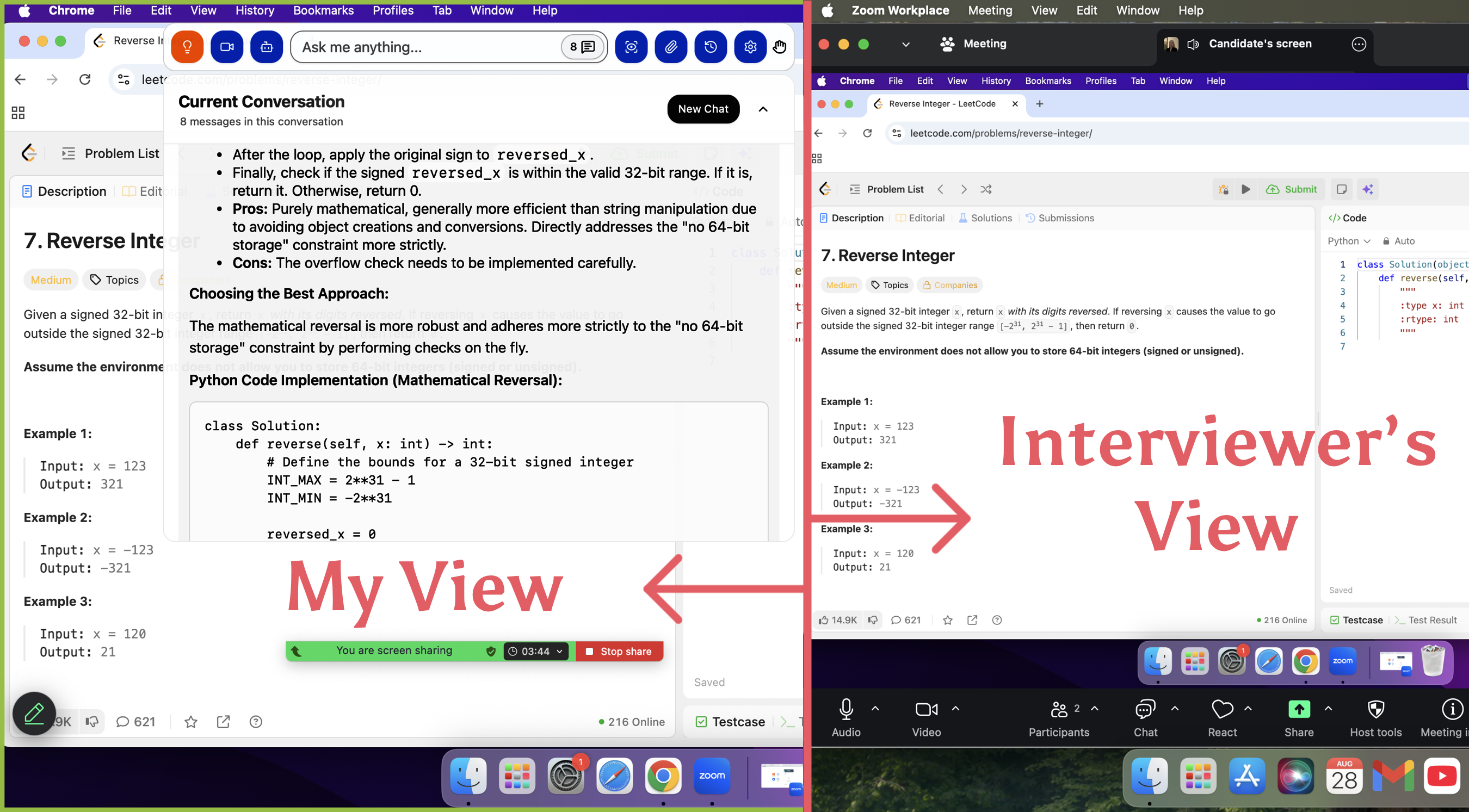
During my virtual interview, I utilized Linkjob AI as a real-time assistance tool. Throughout the assessment process, it automatically recognized questions it heard and instantly provided answers. As Linkjob AI is a completely invisible desktop application, it did not interfere with the testing platform or trigger any detection mechanisms. It simply offered clear thinking when time pressure was highest, enabling me to remain calm and steady throughout the entire testing process.
Behavioral Interview Questions
Behavioral questions are a crucial part of Goldman Sachs Superday. I applied for a SDE position, and the following are the behavioral questions I was asked during the interview.
1.Why Goldman Sachs?
Core Structure: Company → Platform → Me
You can further understand it as:Why choose Goldman Sachs → Why choose this platform/business → Why me
For example:
There are three main reasons why Goldman Sachs stands out to me.
First, at the firm level, Goldman is defined by its consistently high standards. What really differentiates the firm is the emphasis on intellectual rigor, ownership, and long-term thinking. From my conversations with people here, it’s clear that individuals are expected not just to execute, but to truly understand the problem and take responsibility for the outcome. That culture is something I strongly value.
Second, from a platform perspective, Goldman’s strength in [your division] is particularly compelling. The firm is involved in some of the most complex and high-impact work in the industry, which creates a steep learning curve and exposure that’s hard to replicate elsewhere. I’m motivated by challenging environments, and I want to start my career where excellence is the baseline expectation.
Finally, on a personal level, I believe I’m a strong fit for Goldman’s culture. I work well under pressure, enjoy tackling ambiguous problems, and value teamwork and accountability. I’m confident that Goldman is the place where I can grow quickly while also contributing meaningfully to the team.
2.Why this team?
Core Structure: Team → Work → Me
You can further understand it as:What does this team do → Why does their approach appeal to me → Why do I fit
For example:
I’m interested in this team for three main reasons.
First, this team is closely connected to the business and decision-making process, with work that directly impacts outcomes rather than being purely technical. That level of exposure and responsibility is something I’m actively looking for early in my career.
Second, I’m intentionally seeking a role that emphasizes analysis, judgment, and communication over coding. I enjoy structuring complex problems, drawing insights from both quantitative and qualitative information, and clearly communicating those insights to different stakeholders, which aligns well with this team’s work.
Finally, I believe my background is a strong fit for this team. I bring solid analytical skills, work well in fast-paced, collaborative environments, and take ownership of my work. I’m confident this is a team where I can learn quickly and add real value.
3.Tell me about a time you failed.
Core Structure: Situation → Failure → Pressure Response → Learning / Impact
20 seconds: Background & Failure (non-critical, non-fatal)
20 seconds: How you handled it under pressure
20 seconds: What you learned & subsequent improvements
For example:
One experience that stands out was during a team project with a tight deadline.
I underestimated the time required for the initial analysis, which caused us to miss an internal milestone. That was clearly a failure on my part, and it created pressure for the rest of the team.
Instead of avoiding the issue, I took ownership immediately. I informed the team, reprioritized the work, and adjusted my schedule to make up for lost time. Under the tighter timeline, I focused on the most critical analysis first and communicated progress more frequently to reduce uncertainty.
In the end, we delivered the final output on time and met expectations. More importantly, the experience taught me how to stay calm under pressure, take responsibility early, and manage risk through better planning and communication. Since then, I’ve been much more disciplined about timelines and contingency planning.
4.Please describe an experience where you demonstrated leadership skills.
Core Structure: Context → Challenge → Action → Outcome → Leadership takeaway
15–20 seconds: Context & Challenges
25 seconds: Your Specific Leadership Action (Most Important)
10–15 seconds: Outcomes & Leadership Demonstration
For example:
One experience that demonstrates my leadership skills was during a team project with a tight deadline and unclear direction.
At the start, responsibilities were not clearly defined, and progress was slower than expected. I stepped in to align the team by clarifying the objective, breaking the work into specific tasks, and assigning ownership based on each person’s strengths.
Throughout the project, I made sure communication stayed consistent, especially under time pressure. I checked in regularly, removed blockers where possible, and adjusted priorities when needed to keep everyone focused on the most critical deliverables.
As a result, we delivered the project on time and met all expectations. More importantly, the team worked more efficiently and stayed aligned despite the pressure. This experience reinforced my view of leadership as creating clarity, accountability, and momentum rather than relying on formal authority.
5.Tell me about the challenges you have faced in team collaboration.
Core Structure: Context → Challenge → Action → Result → Teamwork takeaway
15–20 seconds: Background & Challenges in Teamwork
25 seconds: How you communicate, coordinate, and resolve conflicts
15 seconds: Outcomes & How you became a better team player
For example:
One challenge I faced in team collaboration was working with a group that had very different working styles under a tight deadline.
Some team members focused heavily on details, while others prioritized speed, which initially led to misalignment and frustration. This slowed progress and created tension within the team.
To address this, I focused on improving alignment rather than pushing my own approach. I helped clarify shared goals, suggested clear timelines, and encouraged open communication so expectations were transparent. I also adjusted my own working style to bridge the gap between speed and accuracy.
As a result, collaboration became much smoother, and we delivered the project on time. This experience taught me that strong teamwork often means listening actively, adapting your approach, and helping the team move forward together.
At the same time, these are some of the more common behavioral interview questions.
What are your strengths and weaknesses?
Tell me about your experience at a previous employer.
How would you counsel an under-performing peer ahead of a performance review?
Describe a situation where you encountered a team member who was not performing their duties adequately on a project.
Why should we hire you?
I asked friends and family to do mock interviews with me. I also recorded myself to catch any awkward pauses or unclear answers. I wanted to make sure I could explain my thoughts clearly, even when I felt nervous.
Tip: Practicing with someone else helps me get used to thinking on my feet. It also makes my answers sound less rehearsed.
Structuring Clear, Concise Answers
Structure matters as much as content. Interviewers want to hear clear, logical answers. I used two main frameworks to organize my responses:
STAR Framework: I broke down each answer into Situation, Task, Action, and Result. This helped me stay focused and avoid rambling.
PEAL Framework: I started with my main Point, gave Evidence, added some Analysis, and then Linked it back to the question.
Many candidates struggle because they give unstructured answers under pressure. I didn’t want to fall into that trap. I practiced using these frameworks until they felt natural. I noticed that my answers became more concise and confident.
Note: Using a framework like STAR or PEAL keeps my answers relevant and easy to follow. It also shows that I can think in a structured way, which is important for any finance role.
What interviewers actually care about
I found that interviewers at the goldman sachs superday look for more than just knowledge. They want to see real-time thinking and structured answers. I referenced recent initiatives and cultural values of Goldman Sachs in my stories. I tried to reflect partnership and integrity in every answer. Reliability and clear thinking matter most during high-pressure moments.
Tip: Always connect the answers to the firm's core values. Show how I fit into their culture.
Adapting to Different Interviewers
Each interviewer has a unique style. Some ask about technical skills, while others focus on my story or teamwork. I tailor my responses based on their areas of interest. I aligned my stories with key competencies and recent firm initiatives. I made sure my answers reflected the qualities Goldman Sachs values, like integrity and partnership
Some Interview Tips
Ultimate Professionalism:
Goldman Sachs places immense emphasis on professionalism. During interviews, not only should you wear a full business suit, but your responses must also be logically coherent. Avoid excessive verbal fillers (such as “Um,” “Like”).
Project Details:
If your resume mentions a specific model (e.g., Random Forest or Neural Networks), interviewers will probe deeply into the specifics. They may even request you to handwrite the simplified logic of a core formula.
Macroeconomic Awareness:
Even for technical roles, Goldman Sachs expects candidates to demonstrate sensitivity to macroeconomic trends. Before the interview, review financial news from the WSJ or FT and prepare your perspective on inflation or interest rate movements.
Researching the Role and Team before Goldman Sachs Superday
Why This Team and Division
During my Goldman Sachs Super Day interview, the interviewer asked me, “Why this team?”. I looked at what made each division unique.I carefully studied the department's unique qualities, reflecting on what drew me to join their team. I realized that rapport matters just as much as qualifications. Interviewers want to see if I am a good fit for them. I selected a department aligned with my interests and strengths. I made sure to demonstrate my understanding of the competitive hiring process and why I'm the right person for the job.
I focused on likeability and team fit.
I matched my skills to the division’s work.
I showed I understood the competitive landscape.
Connecting Experience to the Role
I spent time reviewing my resume. I wanted to connect my past experiences to the team’s daily work. I thought about projects where I showed leadership or teamwork. I practiced talking about how those moments built skills that matter at Goldman Sachs. I prepared answers for common questions. I also came up with thoughtful questions to ask the interviewers.
I am thoroughly familiar with every detail of my resume and am prepared for any in-depth questioning about my past experiences.
Staying Current on Industry Trends
It is crucial to keep a close eye on market trends. I followed news about Goldman Sachs Asset Management and their focus on economic growth projections. I read about John Tousley’s outlook on the economy. He talked about positive growth signs, even when others felt pessimistic. This gave me talking points for interviews. I could discuss how the team’s strategy fits with the bigger picture.
Tip: Bring up recent projects or market outlooks in my answers. It shows I care about the team’s work and understand their goals.
Personal Practice Methods for Goldman Sachs Superday
Mock Interviews and Feedback
Mock interviews played a huge role in my preparation. I used the STAR and PEAL frameworks to keep my answers clear and structured. After each session, I asked for detailed feedback. I also practiced deal case studies to get comfortable with real scenarios.
Practicing with others helped me think on my feet.
Feedback improved my tone, pacing, and answer quality.
Case studies built my confidence for high-pressure moments.
Staying Authentic and Confident
Authenticity matters as much as preparation. I made sure to keep a steady and positive tone during interviews. I smiled and made eye contact to show I was approachable. I used the STAR framework to organize my thoughts and stay on track. I also practiced adaptability. If an interviewer asked something unexpected, I stayed calm and adjusted my answer.
Here’s what worked best for me when getting ready for the goldman sachs superday:
I listened closely to every question and asked for clarification when needed.
I used the STAR method to keep my answers clear.
I practiced both behavioral and technical questions until I felt confident.
I stayed updated on market news and researched the team.
I brought a positive attitude and stayed true to my story.
FAQ
How did I manage stress before Superday?
I took deep breaths and reminded myself to focus on one question at a time. I listened to music and went for a short walk. Staying calm helped me think clearly and show confidence.
What resources did I use for technical prep?
I practiced coding problems on LeetCode and reviewed finance basics on Investopedia. I also watched YouTube videos about common interview questions. These tools made my prep easier and more effective.
How did I handle unexpected questions?
I paused, repeated the question, and gave myself a moment to think. I used the STAR framework to organize my answer. If I didn’t know something, I admitted it and explained how I would find the solution.
What should I wear for Superday?
I wore a classic suit with a white shirt and simple tie. I made sure my outfit looked professional and comfortable. First impressions matter, so I kept my look clean and polished.
How did I follow up after the interview?
I sent a thank-you email within 24 hours. I mentioned something specific from our conversation and expressed my excitement about the role. This showed my appreciation and kept me top of mind.
See Also
Essential Tips for Capital One Data Analyst Assessments
Insights from My 2026 Bloomberg New Grad Interview Experience
Diverse Questions Faced During My McKinsey Interview Journey
© Copyright 2025 Linkjob.ai - All Rights Reserved.