My 2026 Google L4 Interview Experience and Real Questions


I recently passed the Google L4 interview. It took nearly two months from submitting my resume to securing the offer, with such long gaps between each stage that I often assumed I'd been rejected. But with the help of LinkJob, an AI assistant for technical interviews, I successfully made it through. I've documented my entire journey and the actual questions I encountered, hoping it can help you.
Key Takeaways
Focus on practical problem-solving skills. Google L4 interviews emphasize real-world challenges over memorizing coding patterns.
Communicate clearly during interviews. Explain your thought process and engage with the interviewer to showcase your reasoning.
Prepare for behavioral questions using honest stories. Use the STAR method to highlight your experiences and growth.
Practice coding efficiently in one programming language. This helps you solve problems quickly and accurately during technical interviews.
Stay calm and adaptable. Expect unexpected questions and maintain a steady preparation routine to build confidence.
Google L4 Interview Process
Interview Stages and Timeline
The timeline is roughly as follows: Internal referral → Resume screening → Phone call with recruiter → 1st round technical phone interview → 4 rounds of online/onsite interviews → Hiring Committee review → Offer.
The entire process took about two months, with the recruiter communicating promptly and professionally throughout.
All rounds were conducted on Google Meet, with code written in shared documents. I used LinkJob to assist with coding and organize my thought process. It remains undetected by Google interviewers and Google Meet, allowing me to use it with complete confidence.
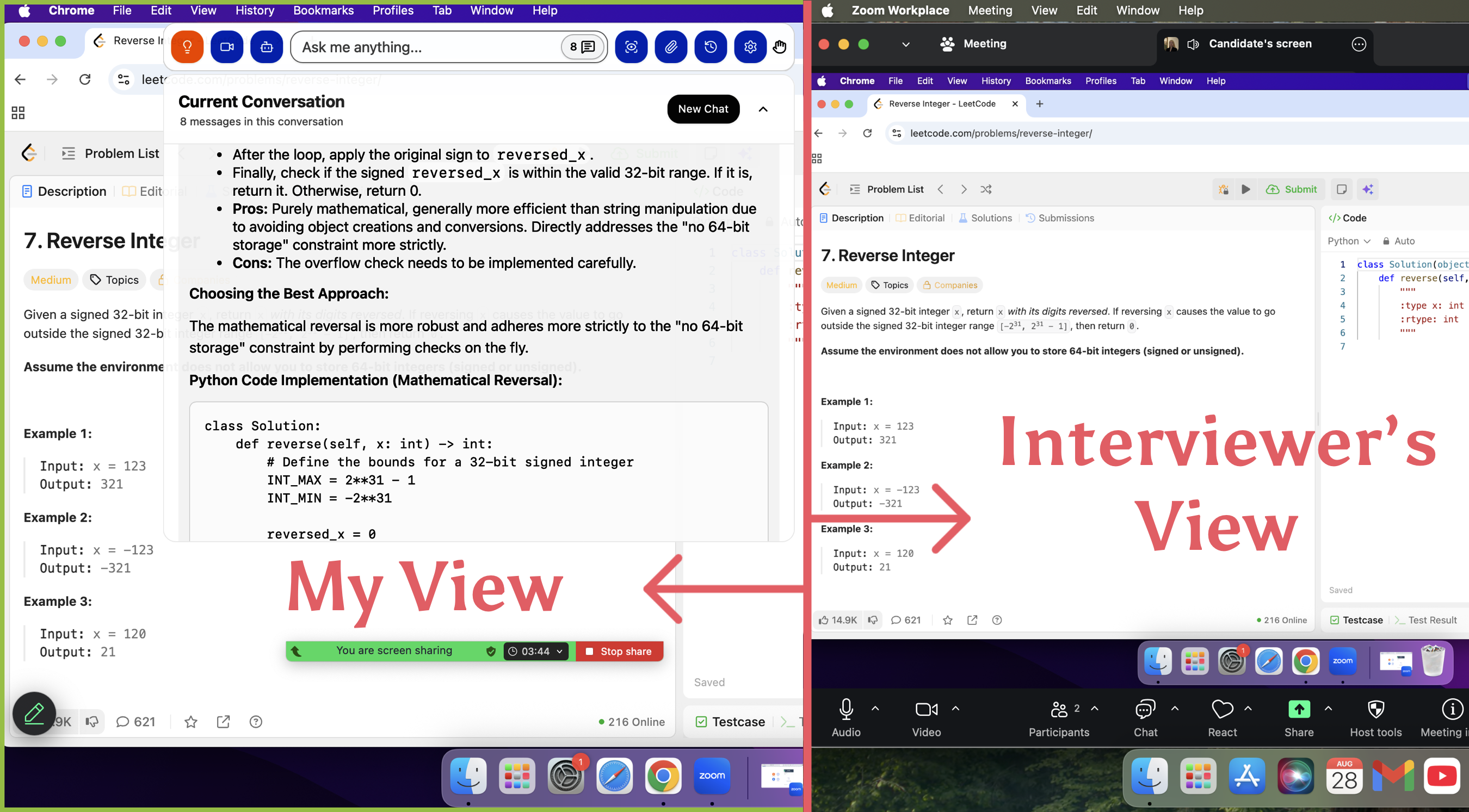
Key Focus Areas for Each Interview Round:
Phone Interview (45 minutes): One moderately difficult algorithmic problem, primarily assessing data structures and boundary condition handling. Interviewers emphasize communication of problem-solving approach and code clarity.
Onsite Rounds (45 minutes each):
- Coding: This is the core component. Topics span binary trees, graphs, greedy algorithms, dynamic programming, etc. Candidates must not only write correct code but also analyze time/space complexity and discuss optimization approaches.
- System Design: Design a medium-scale system. Interviewers will guide discussions on requirements analysis, API design, data storage, and scalability. Key focus areas include scalability trade-offs, consistency considerations, and rationale for technology choices.
- Googleness & Leadership: This round does not directly test technical skills. Instead, it evaluates collaboration abilities, persistence in solving complex problems, and resilience in facing setbacks through past work experiences. Preparing project stories that demonstrate your influence is crucial.
Core Assessment Content
When I started the google l4 interview process, I noticed the focus shifted from memorizing patterns to making practical engineering choices. As a google l4 engineer, I had to show my technical skills and problem-solving abilities. The interview process tested how I broke down complex problems and optimized solutions. I needed to communicate my thoughts clearly and work well with others. The process also checked if I aligned with google's values, especially during the Googliness round.
Here’s what the core assessment covers:
Technical skills: Coding interviews with algorithms and data structures.
Problem-solving abilities: Breaking down tough problems and finding the best solutions.
Communication skills: Explaining my ideas and collaborating with teammates.
Alignment with google's values: Sharing teamwork and personal experiences.
Some parts of the process challenged me. I had to define the scope of open-ended questions and discuss trade-offs between solutions. Calculating time and space complexities became important. The interview process often changed constraints, so I adapted quickly. Writing error-free code and communicating my thought process mattered a lot.
Google L4 Interview Rounds and Questions
Technical Phone Screening Interview
During this round, I had a brief chat with the interviewer. He asked me to elaborate on a project mentioned in my resume, followed by two algorithmic questions. These primarily tested optimal algorithms, string manipulation, and dynamic programming. I provided optimal solutions for both and performed dry runs.
Here are the questions I encountered and my approach to solving them:
“Remove all consecutive duplicates from a string” (LC 1047). I solved it using a single pass and a vector.
“Russian nesting doll envelopes problem” (LC 354). I solved it using LIS (Longest Increasing Subsequence) + binary search.
Technical Interview Rounds
I've participated in three virtual onsite interviews, two of which were coding-focused. Interviewers place great emphasis on communication skills—such as clarifying ambiguous parts of the problem and proactively explaining your reasoning even without an optimal solution.Below are the problems I encountered and my follow-up questions.
Question: Given a graph of cities, two individuals A and B residing in different cities travel to the same destination. Determine the minimum total cost required to reach the destination.
I used binary search for the answer and then DFS/BFS to verify feasibility. You could also use a union-find set to find the minimum value, or apply Dijkstra's algorithm using shortest path concepts to calculate the minimum.
Question: Write a function `fn(value: int)` that takes an integer as input and stores it in a data stream. After each insertion, it must return a tuple from the data stream satisfying: `abs(x-y) <= distance && abs(y-z) <= distance && abs(z-x) <= distance`. If no such tuple exists, return `None`.
Initially, I considered dynamic programming but quickly realized it wasn't optimal. The interviewer suggested treating the data stream as a number line. Then I thought of sorting the data stream after each insertion and using linear scanning to find subarrays of length 3 where the absolute difference between the first and last elements is less than or equal to the distance. To avoid sorting, I proposed an optimized solution using a monotonic stack and a temporary stack to maintain the sorted order of the data stream during insertions. The interviewer also acknowledged this approach. I felt I performed quite well in this round.
Question: Given a list of words, return the list of ambigrams.
This problem was straightforward. I iterated through each word and used a double-pointer method to convert each character into a bidirectional character. The interviewer was satisfied and followed up with another question.
Follow up: Given a list of words, find the list of interesting words.
I converted the input list into a set to speed up the search, then solved the problem using an optimized approach.
Google's technical interviews consist almost entirely of unfamiliar problems, requiring the ability to quickly recognize which high-frequency question has been repackaged. I fed all the questions to LinkJob, which provided accurate answers extremely rapidly.
Googlyness
During this round, I didn't solve any problems but engaged in conversation with the interviewer—it felt more like a behavioral questionnaire (BQ). As long as you familiarize yourself with Google's culture and values beforehand and prepare relevant experiences and stories, you'll be fine. Use the STAR method to clearly describe your experiences, helping the interviewer better understand your capabilities and performance. Below are the questions I encountered in this round:
Tell me about the last time you failed, and what happened?
Tell me about a time you created something from nothing.
Approach to Questions
I learned that the best way to tackle google l4 interview questions is to stay calm and methodical. Here’s my approach:
I always asked clarification questions before starting the solution. This made sure I understood the problem.
I outlined requirements and assumptions and communicated them with the interviewer.
I chose the right data structures and algorithms for each problem and explained any trade-offs.
I wrote clean, efficient code with minimal mistakes. I avoided over-complicating my answers.
I talked through my thought process as I coded. This kept the interviewer engaged and showed my reasoning.
I clearly stated the time and space complexity of my solution using Big-O notation.
Tip: Don’t ignore your production experience, but remember that the google l4 interview focuses on coding questions and behavioral questions. The interviewers want to see how you solve problems, not just hear war stories.
I avoided common mistakes . I didn’t give textbook answers unless the interviewer asked for them. I focused on maintainability and clarity in my code. I made sure to hit the rubric and show my understanding of the problem.
If you want to succeed in google l4 interviews, practice coding questions, behavioral questions, and system design questions. Prepare honest stories for the behavioral round. Communicate clearly and stay confident. The google l4 interview rewards those who can solve real-world problems and fit google’s culture.
Google L4 Interview Preparation
Preparation Resources
When I started my google l4 interview prep, I felt overwhelmed by the amount of material out there. I decided to break my prep into three focused months. Here’s what worked for me:
Algorithm Practice: I primarily use LeetCode, focusing on mastering Google's high-frequency problems and solution templates for various question types. However, I believe what matters more than the quantity of problems solved is: Practicing clear expression of thought processes.Writing clean, bug-free code. Becoming proficient in complexity analysis.
System Design: I recommend Grokking the System Design Interview and the book Designing and Implementing Information Systems. Regularly reflect on common system architectures and practice sketching block diagrams on a whiteboard.
Behavioral Interviews: Prepare several core project stories using the STAR method in advance. Ensure you can clearly demonstrate your contributions and problem-solving abilities with data-backed evidence.
Study Plan
I built a study plan that kept my prep on track. I set weekly goals and tracked my progress. I spent the first month reviewing algorithms, the second month on hands-on coding practice, and the third month simulating interviews. I made sure to mix in system design and behavioral prep each week. I didn’t just grind problems—I reflected on mistakes and improved my approach.
Tip: Don’t skip mock interviews. Practicing with friends or ai tools can reveal blind spots in your prep.
Mindset for L4
The google l4 interview prep can feel like a marathon. I learned that random applications and rushed prep lead to burnout and even panic attacks. I froze once during an interview when I got an unexpected question. That moment taught me to expect the unexpected and stay calm. I focused on steady, consistent prep instead of cramming. I reminded myself that every mistake was a chance to learn. If you keep a growth mindset and trust your prep, you’ll walk into your google l4 interview ready for anything.
Looking back, I learned a few big lessons from my google interview. I realized that clear communication, quick adaptation, and understanding company culture matter a lot.
Google interviews are incredibly long. Every time I wonder if I'll move on to the next step, I feel anxious and convinced I'm going to fail. Plus, most online information highlights how high the chances are of getting rejected at each stage (including the team match).
I felt every Google interviewer genuinely listened to my ideas and thought process, and I believe they understood them. This was very different from my experiences interviewing at some proprietary trading shops and investment banking quant roles... (I felt those interviewers didn't want to hear my reasoning—they just wanted me to give the standard answer, but mine usually diverged significantly from the expected response).
FAQ
How should I prepare for the DSA round?
I practice coding problems daily. I use mock interviews with friends. I focus on writing clean code and explaining my thought process. I review common algorithms and data structures. I track my progress with a checklist.
What is the best way to approach system design questions?
I start by asking clarifying questions. I outline requirements and assumptions. I use a simple diagram or table to organize my thoughts. I discuss trade-offs and scalability. I keep my explanation clear and concise.
How do I handle behavioral questions in the Googliness round?
I share honest stories from my experience. I use the STAR method: Situation, Task, Action, Result. I focus on what I learned and how I grew. I stay positive and show how I fit google’s culture.
What should I do if I get stuck during an interview?
I pause and take a deep breath. I ask the interviewer for hints or clarification. I explain my current thinking. I try to break the problem into smaller parts. I stay calm and keep moving forward.
See Also
Insights From My 2026 Dell Interview Process And Queries
Exploring My 2026 Bloomberg New Graduate Interview Journey
Key Questions And Answers From My 2026 Oracle Interview
© Copyright 2025 Linkjob.ai - All Rights Reserved.