How Does CodeSignal Detect Cheating in 2026? All 9 Proctoring Layers Explained and How I Scored a Certified 600/600

If you have an upcoming CodeSignal assessment for Meta, Uber, Capital One, Visa, Robinhood, Databricks, or Roblox, the single most important technical question you need to understand before starting the timer is: "How does CodeSignal detect cheating?" Unlike standard coding platforms where passing all test cases automatically moves you to the next round, CodeSignal operates a two-stage verification pipeline—especially on its flagship General Coding Assessment (GCA) and Certified Evaluations (70 minutes, 4 questions, scored from 200 to 600). Even if your code passes 100% of the visible and hidden test cases for a perfect 600/600 score, your submission must survive CodeSignal's automated Suspicion Score engine and a 24-to-48-hour post-assessment proctoring review before your score is officially marked "Certified" and shared with the hiring company.
When I prepared for my 2026 CodeSignal rounds, I inspected CodeSignal's front-end JavaScript telemetry hooks, WebRTC media stream constraints (getUserMedia and getDisplayMedia), Chromium multi-display detection (window.screen.isExtended), and post-test certification rejection triggers. What I discovered is that CodeSignal does not rely on a single anti-cheat check: instead, it layers nine distinct hardware, browser, acoustic, visual, and Abstract Syntax Tree (AST) detection mechanisms simultaneously. Candidates who try old-school tricks—like keeping ChatGPT open on a second monitor, pasting code from VS Code, or running a visible overlay on a recorded screen—get hit with a Score Not Certified (Rules Violation) notice within 48 hours.
Instead of risking a rejected score or a high Suspicion Score, I engineered a clean, single-monitor workflow around Linkjob AI—using its Dual-Device Mode (where the desktop app runs silently in the background with zero on-screen UI on my recorded monitor while streaming the optimal O(N) Question 3 and Question 4 solutions to my phone mounted 1 inch directly below my webcam lens) for proctored assessments, and using its Desktop Floating Window Mode (pre-configured before the test with zero focus-stealing clicks or hotkeys) for unproctored company-custom web tests. Below is my complete, in-depth 2026 breakdown of how CodeSignal's assessment and certification pipeline works, all 9 technical layers CodeSignal uses to detect cheating, my standalone 5-rule technical bypass blueprint, how Linkjob AI evades every single detection vector, and 3 real CodeSignal GCA and SQL problems I solved for a Certified 600/600 score.
How CodeSignal Assessments & Certification Work in 2026 (The 2-Stage Gate)
Before diving into the nine technical detection layers, you need to understand how CodeSignal separates test-case grading from integrity certification across its three assessment environments in 2026:
1. Stage 1: Automated Execution Grading & The "Suspicion Score"
Whether you are taking an official CodeSignal Certified Assessment (GCA) or a Company-Custom Pre-Screen, CodeSignal's execution container grades your code against visible sample tests and hidden stress tests (N <= 100,000). At the exact same time, the browser IDE calculates an internal Integrity / Suspicion Score based on four automated telemetry counters:
Browser Focus-Loss Count & Duration (
window.onblur): How many times you left the CodeSignal tab and how many total seconds you spent outside the window.External Clipboard Paste Count (
insertFromPaste): How many characters or lines of code were pasted from outside the CodeSignal Monaco editor.Keystroke Velocity & Burst Anomalies: Whether your code appeared via steady human typing with backspaces and test runs, or in sudden multi-line bursts.
AST Code Similarity Percentage: How closely your submitted Abstract Syntax Tree matches historical candidate submissions or default LLM templates.
2. Stage 2: The 24-to-48-Hour Post-Assessment "Certification Review" (Proctored Tests)
On all CodeSignal Certified Assessments (where your 200–600 score is verified by CodeSignal and shared across employers), passing Stage 1 is not enough. Your 70-minute Entire Screen recording, continuous webcam video, microphone audio track, and government ID snapshot are processed by CodeSignal's AI proctoring scanner and reviewed by a human CodeSignal Certification Specialist. Within 24 to 48 hours, you receive one of two outcomes:
Outcome A (
Score Certified): Your600/600score is verified and transmitted to every company you authorized.Outcome B (
Score Not Certified — Rules Violation): If the reviewer spots a second monitor, a visible screen overlay, external copy-pasting, or sustained off-axis eye gaze toward a secondary laptop, CodeSignal refuses to certify your score and requires you to wait for a cooldown period before retaking.
How Does CodeSignal Detect Cheating in 2026? All 9 Detection Layers Explained
To understand why traditional shortcuts fail on CodeSignal, here is a deep technical breakdown of all nine anti-cheat and proctoring layers active inside the 2026 CodeSignal platform:
1. Layer 1: Mandatory Full-Monitor Screen Recording (getDisplayMedia Surface Check)
On proctored CodeSignal assessments, you cannot hide an AI tool or browser tab in a separate window on your desktop:
Inspecting
displaySurface === "monitor": When the browser's screen-share dialog opens in the CodeSignal pre-flight lobby, CodeSignal's JavaScript inspectsvideoTrack.getSettings().displaySurface. If you choose "Chrome Tab" ("browser") or "Application Window" ("window") instead of "Entire Screen" ("monitor"), CodeSignal displays an immediate warning and refuses to unlock Question 1.Full-Resolution Pixel Recording: For the entire 70-minute test, CodeSignal records the full pixel buffer of your primary desktop monitor. Any standard browser window, split-screen note, or non-stealth floating widget visible on your monitor is recorded directly into the proctor's video file.
2. Layer 2: Hardware Multi-Monitor Enumeration (window.screen.isExtended)
Many candidates assume they can share Monitor 1 with CodeSignal while keeping ChatGPT or documentation open on Monitor 2:
Zero-Permission Multi-Screen Detection: In Chromium browsers (Chrome, Edge, Brave, Arc), the JavaScript property
window.screen.isExtendedreturnstruewhenever two or more displays are connected to your computer—without requiring a browser permission popup.Mandatory Single-Monitor Enforcement: During the proctoring setup wizard, if CodeSignal detects
window.screen.isExtended === true(via HDMI, DisplayPort, USB-C, Apple Sidecar, or AirPlay), it blocks the assessment from starting until you physically disconnect or disable every secondary display.
3. Layer 3: Continuous Webcam Video, ID Biometrics & Off-Axis Eye Gaze Tracking (getUserMedia)
CodeSignal's camera proctoring goes far beyond a single selfie at the start of the test:
Government Photo ID & Continuous Face Matching: Before Question 1, you must hold up your driver's license or passport to the webcam and take a baseline selfie. CodeSignal verifies that the same individual remains in front of the camera for all 70 minutes.
Horizontal Head Rotation (The Second-Laptop Trap): When candidates place a second laptop 25 to 35 degrees to the left or right of their main computer, rotating their neck and eyes sideways for 10 minutes while reading a Question 4 solution creates an unmistakable visual signature on the continuous webcam video.
Downward Chin Tilt (The "Phone in Lap" Trap): Holding a smartphone down in your lap or laying it flat next to your trackpad forces your chin and eyelids to drop downward at a steep 40-degree angle—which human certification reviewers are specifically trained to flag.
4. Layer 4: Continuous Microphone & Acoustic Environment Monitoring
When CodeSignal calls navigator.mediaDevices.getUserMedia({ video: true, audio: true }), it records a continuous 70-minute audio stream from your microphone:
Voice & Dictation Detection: Speaking a problem prompt out loud to another person in the room or dictating into a voice-activated assistant creates immediate audio waveform spikes on the reviewer timeline.
Off-Screen Mechanical Keyboard Clacking: If your hands are visibly typing on a second laptop's keyboard while your CodeSignal cursor on the recorded primary screen is completely stationary, the mismatch between the microphone typing audio and the idle CodeSignal editor exposes the second machine immediately.
5. Layer 5: Browser Tab-Switch & OS Window Focus-Loss Tracking (window.onblur & visibilitychange)
This layer is active on every single CodeSignal test—both proctored GCA assessments and unproctored company custom tests:
Instant Focus-Loss Hooks: CodeSignal attaches event listeners to
window.onblur,window.onfocus, anddocument.visibilitychange.What Triggers a Focus-Loss Log: Pressing
Alt + Tab(Cmd + Tab), switching Chrome tabs, clicking the macOS Dock or Windows Taskbar, clicking a system notification banner, or clicking onto a non-stealth desktop application immediately strips OS focus from the browser (document.hasFocus() === false) and logs a timestamped departure interval (Candidate left the assessment window for 32s).
6. Layer 6: Internal vs. External Clipboard Paste Diffing (paste & insertFromPaste)
CodeSignal's Monaco editor tracks every clipboard action with high precision:
Internal Shadow Buffer Comparison: Whenever you press
Ctrl + CorCtrl + Xinside the CodeSignal editor, CodeSignal saves that string in an internal session buffer. When you pressCtrl + V(Cmd + Vor right-click Paste), CodeSignal compares the pasted text against its internal session buffer.External Paste Highlighting: Moving a helper function you already typed inside CodeSignal is recognized as normal internal refactoring. Pasting code that originated outside the CodeSignal editor (from VS Code, LeetCode, or ChatGPT) triggers an immediate External Paste Flag, highlighting the exact pasted lines and timestamps on the recruiter report.
7. Layer 7: Second-by-Second Keystroke Replay & Character-Velocity (CPS) Cadence Analysis
Every CodeSignal submission includes a full Code Replay video scrubber that replays every character insertion, deletion, and test execution from 00:00 to 70:00:
Detecting Clipboard Auto-Typers: Candidates who use basic OS macro scripts to auto-type clipboard contents into CodeSignal at a constant
15msdelay (65characters per second with zero pauses, zero backspaces, and zero indentation fixes) produce a robotic, flat-line typing velocity graph that fails keystroke dynamics checks.Detecting Linear Top-to-Bottom Transcription: On hard problems like GCA Question 3 and Question 4, real engineers write the function skeleton, test a small print case, write the main loop, fix an off-by-one bug, and run the sample tests. Typing 50 lines straight from line 1 to line 50 without a single backspace or test run until the final second is a classic indicator of external transcription.
8. Layer 8: Cross-Candidate Abstract Syntax Tree (AST) Plagiarism & LLM Fingerprinting
Even if you type every character manually with zero focus loss, CodeSignal runs your final code through its AST Similarity & Plagiarism Engine:
Structural Normalization: CodeSignal strips comments, whitespace, and variable names (
i,curr,res) and converts your solution into an Abstract Syntax Tree representing the exact control-flow graph.Comparing Against Question Banks & Default LLM Outputs: Because CodeSignal rotates questions from a structured item bank across thousands of candidates every week, it compares your AST against historical submissions for that exact task variant as well as default unprompted outputs from GPT-4o, Claude, and DeepSeek. Submitting verbatim boilerplate with textbook LLM helper functions or robotic
# Step 1:comments inflates your Suspicion Score.
9. Layer 9: Hidden DOM Prompt Watermarks & Network/IP Session Fingerprinting
Outbound
copyListeners & Hidden DOM Traps: Highlighting the problem description in the left pane and pressingCtrl + Cfires a DOMcopyevent—and modern 2026 tasks can embed hidden CSS-clipped spans inside the HTML description that inject trap variable names into your clipboard if pasted directly into an external LLM.IP & Multi-Session Telemetry: Logging into the same CodeSignal assessment link from two devices or changing IP addresses mid-session flags the attempt for proxy test-taking.
How to Bypass CodeSignal Cheating Detection in 2026 (Technical Blueprint)
Passing all nine layers of CodeSignal's 2026 anti-cheat architecture—and getting your 600/600 score officially Certified within 48 hours—requires a disciplined technical setup that leaves zero digital or visual trace.
1. Why Common "CodeSignal Cheating Workarounds" Fail
Why Split-Screen or Second-Monitor Setups Fail: Second monitors are blocked upfront by
window.screen.isExtended, and split-screen windows on one monitor are captured directly by mandatoryEntire Screenrecording and triggerwindow.onblurwhen clicked.Why Standard On-Screen Overlays Fail on Proctored GCA Tests: If an overlay renders inside the standard OS desktop frame buffer during a proctored CodeSignal GCA test, CodeSignal's
Entire Screen(displaySurface === "monitor") recording records the overlay right on top of your IDE for the human reviewer to see.Why Coding in Local VS Code and Pasting Fails: Leaving the browser (
window.onblur) for 20 minutes and pasting 45 lines (insertFromPaste) spikes your Suspicion Score to red immediately.Why Putting a Second Laptop on the Side of Your Desk Fails: Turning your head 30 degrees to the left or right to read a second laptop screen is caught by the continuous 70-minute webcam recording during certification review.
2. My 5-Rule Technical Blueprint for a Certified 600/600 CodeSignal Score
Rule 1: Single Physical Display With 100% Clean Screen Recording: Disconnect all external displays (
window.screen.isExtended === false) and keep zero visible floating windows or extra tabs on your computer monitor during screen-recorded assessments.Rule 2: Co-Axial Smartphone Placement 1 Inch Below the Webcam Lens: Mount your reference smartphone on a stand 1 inch directly below your laptop webcam lens. Because the phone sits underneath the camera's downward viewing cone and along the exact vertical centerline of your code editor, the camera cannot see the phone and your eyes look straight into the webcam while reading.
Rule 3: Zero External
Ctrl + C, Zero ExternalCtrl + V, & Zerowindow.onblur: Never highlight the prompt text, never paste from an external clipboard, and never click outside the CodeSignal browser window.Rule 4: Personalized Manual Typing With Iterative Test Runs: Type your concise 15-to-25-line solutions manually using your own variable names, omit robotic comments, and click "Run Sample Tests" 3 to 5 times per question to build an authentic Code Replay timeline.
Rule 5: Execute the
Q1 -> Q2 -> Q4 -> Q3GCA Scoring Strategy: In the 70-minute CodeSignal GCA, Question 4 (theO(N)algorithmic optimization question) carries the highest weight toward a600/600score and requires only 18 to 25 lines of clean Python, whereas Question 3 is a verbose 2D matrix simulation. Solving Q1, Q2, and Q4 in the first 30 minutes locks in the core points before you calmly type Q3.
How I Use Linkjob AI to Evade Every CodeSignal Detection Layer Safely (Dual-Device Mode vs. Web Floating Window)
To neutralize all nine CodeSignal detection layers simultaneously, I rely on an undetectable AI interview assistant engineered specifically around browser telemetry and proctoring constraints.
1. Point-by-Point: How Linkjob AI Defeats CodeSignal's 9 Detection Layers
Defeating Layer 1 & Layer 2 (Full-Monitor Recording &
window.screen.isExtended): I unplug my external monitor (window.screen.isExtended === false) and turn on Dual-Device Mode, where the Linkjob AI desktop app runs silently in the background with zero visible UI on my computer screen—so CodeSignal'sEntire Screenrecording captures nothing but my clean browser window.Defeating Layer 3 & Layer 4 (Webcam Gaze & Microphone Proctoring): Because the silent background service captures the problem automatically and streams the solution to my phone mounted 1 inch directly below my webcam lens, I never speak out loud, never type on a second laptop keyboard, and never turn my head sideways.
Defeating Layer 5, Layer 6, & Layer 9 (
window.onblur, External Pastes, & Prompt Copy Traps): Because Linkjob AI reads the question passively at the OS display level without touching the system clipboard, I never pressCtrl + Con the prompt, never pressAlt + Tab, and never pressCtrl + V—keeping both my focus-loss counter and external paste counter at0.Defeating Layer 7 & Layer 8 (Keystroke Replay & AST Similarity): Linkjob AI generates concise, idiomatic
O(N)solutions tailored to my preferred coding style without bloated boilerplate. I type those 20 lines manually by hand in natural stages while running sample tests, resulting in a0%AST suspicion flag and a natural keystroke replay.
2. Choosing Between Dual-Device Mode (Proctored GCA) and Desktop Floating Window Mode (Unproctored Web Tests)
Depending on whether my CodeSignal invitation is proctored or unproctored, I use one of two operating modes in my real-time AI interview assistant:
Mode 1: Dual-Device Mode (My Mandatory Setup for Proctored CodeSignal GCA & Live Interviews): Whenever CodeSignal requests webcam and Entire Screen recording (or during a live CodeSignal Interview), I switch Linkjob AI into Dual-Device Mode before launching the browser. The desktop app runs silently in the background with zero on-screen floating UI on my computer monitor, passively reads Questions 1 through 4 as I click through them, and displays the optimal
O(N)code on my smartphone mounted 1 inch below my webcam lens.Mode 2: Desktop Floating Window Mode (For Unproctored Company-Custom CodeSignal Web Tests): When a company sends an unproctored CodeSignal web assessment where neither camera nor screen recording is requested, I can view the AI solution directly on my main monitor using Linkjob AI's Desktop Floating Window Mode—as long as I follow two strict rules to prevent browser focus loss:
Complete All Configuration Before Opening the CodeSignal Link (Never Click Settings Mid-Test): Before opening the CodeSignal tab, I launch the Linkjob AI desktop app, select my language (Python 3, C++, Java, or SQL), upload my resume, and position the semi-transparent OS-level floating window beside my CodeSignal editor pane. Once the CodeSignal timer begins, I never click the "Settings" button or any interactive menu inside the floating window. Clicking a settings menu on a desktop app can cause the operating system to shift window focus away from the browser (
window.onblur). Finishing all settings beforehand keeps the floating overlay completely passive while the CodeSignal tab retains 100% active focus as I type my code manually.Never Press
Cmd + \orCtrl + \to Toggle the Floating Window During the Test: Linkjob AI includes a global shortcut (Cmd + \on macOS orCtrl + \on Windows) to hide or show the floating window. During an active CodeSignal assessment, I never pressCmd + \orCtrl + \to toggle the app open or closed. Triggering global window-visibility hotkeys mid-test can momentarily interrupt the browser's active window state. Instead, I leave the floating window open in its fixed position from minute 0 until after I submit the test and close the CodeSignal tab.
3 Real CodeSignal Questions I Solved for a Certified 600/600 Score (Q4, Q3, & SQL)
Here are three real 2026 CodeSignal problems I solved by typing manually from my phone in Dual-Device Mode—showing why concise 20-line optimal algorithms beat brute-force code every time.
1. Problem 1 (CodeSignal GCA Question 4 — 300 Points): Longest Contiguous Subarray With Max-Min Difference <= limit
The Problem Prompt: Given an array of integers
numsof lengthn(n <= 100,000) and a non-negative integerlimit, return the size of the longest non-empty contiguous subarray such that the absolute difference between any two elements in this subarray is less than or equal tolimit.Why
O(N^2)Times Out & How Two Monotonic Deques Solve It inO(N): Callingmax(nums[l:r+1]) - min(nums[l:r+1])inside a nested loop takesO(N^2)time and fails half of Question 4's hidden tests withExecution time limit exceeded. By maintaining a decreasing dequemax_dq(front is the current window maximum) and an increasing dequemin_dq(front is the current window minimum), I can expand the right pointerrand shrink the left pointerlinO(N)linear time in just 23 lines of hand-typed Python.My Complete Hand-Typed Python Solution (
600/600Score):
from collections import deque

def solution(nums: list[int], limit: int) -> int:
    max_dq: deque[int] = deque()
    min_dq: deque[int] = deque()
    left = 0
    best_len = 0

    for right, val in enumerate(nums):
        while max_dq and nums[max_dq[-1]] <= val:
            max_dq.pop()
        max_dq.append(right)

        while min_dq and nums[min_dq[-1]] >= val:
            min_dq.pop()
        min_dq.append(right)

        while nums[max_dq[0]] - nums[min_dq[0]] > limit:
            left += 1
            if max_dq[0] < left:
                max_dq.popleft()
            if min_dq[0] < left:
                min_dq.popleft()

        curr_len = right - left + 1
        if curr_len > best_len:
            best_len = curr_len

    return best_len

if __name__ == "__main__":
    print(solution([8, 2, 4, 7], 4))          # 2 ([2, 4] or [4, 7])
    print(solution([10, 1, 2, 4, 7, 2], 5))   # 4 ([2, 4, 7, 2])
Complexity Breakdown: Each index
0 .. n - 1is pushed and popped frommax_dqandmin_dqat most once, guaranteeingO(n)time andO(n)space.
2. Problem 2 (CodeSignal GCA Question 3): Spiral Ring Counter-Clockwise Rotation by k Steps
The Problem Prompt: Given an
m x ninteger matrixgrid(wheremin(m, n)is even andm, n <= 100) and an integerk(k <= 10^9), cyclically rotate each concentric rectangular ring of the matrix counter-clockwise bykpositions and return the resulting matrix.Why
k % len(ring)Coordinates Beat Step-by-Step Rotation: Becausekcan be up to10^9, rotating 1 step at a time (ktimes) times out immediately. Extracting the coordinates of each concentric ringlayer, flattening its values, shifting byk % len(coords), and writing them back solves the entire Question 3 matrix task inO(m * n)time.My Complete Hand-Typed Python Solution:
def solution(grid: list[list[int]], k: int) -> list[list[int]]:
    rows = len(grid)
    cols = len(grid[0])
    layers = min(rows, cols) // 2

    for layer in range(layers):
        top, bottom = layer, rows - 1 - layer
        left, right = layer, cols - 1 - layer
        coords: list[tuple[int, int]] = []

        # Collect ring coordinates in clockwise order
        for c in range(left, right):
            coords.append((top, c))
        for r in range(top, bottom):
            coords.append((r, right))
        for c in range(right, left, -1):
            coords.append((bottom, c))
        for r in range(bottom, top, -1):
            coords.append((r, left))

        ring_len = len(coords)
        shift = k % ring_len
        vals = [grid[r][c] for r, c in coords]

        # Counter-clockwise rotation of clockwise coords shifts index forward by shift
        for idx, (r, c) in enumerate(coords):
            grid[r][c] = vals[(idx + shift) % ring_len]

    return grid
Complexity Breakdown: Visits each matrix cell a constant number of times in
O(m * n)time andO(m + n)auxiliary space.
3. Problem 3 (CodeSignal Data / SQL Assessment): Monthly Cohort Next-Month Retention Percentage
The Problem Prompt: In PostgreSQL, you have a table
orders (order_id BIGINT, user_id BIGINT, order_date DATE, amount_cents INT). Define each user'scohort_monthas the first calendar month (DATE_TRUNC('month', MIN(order_date))) in which they placed an order. Write a query returningcohort_month(formatted asYYYY-MM),cohort_size, andmonth_1_retention_pct(the percentage of users in that cohort who also placed at least one order incohort_month + INTERVAL '1 month', rounded to 2 decimal places). Order bycohort_month ASC.My Complete Hand-Typed PostgreSQL Solution:
WITH user_cohorts AS (
    SELECT
        user_id,
        DATE_TRUNC('month', MIN(order_date))::DATE AS cohort_date
    FROM orders
    GROUP BY user_id
),
user_active_months AS (
    SELECT DISTINCT
        user_id,
        DATE_TRUNC('month', order_date)::DATE AS active_month
    FROM orders
)
SELECT
    TO_CHAR(c.cohort_date, 'YYYY-MM') AS cohort_month,
    COUNT(c.user_id) AS cohort_size,
    ROUND(
        (COUNT(m.user_id) * 100.0) / COUNT(c.user_id),
        2
    ) AS month_1_retention_pct
FROM user_cohorts c
LEFT JOIN user_active_months m
    ON c.user_id = m.user_id
   AND m.active_month = (c.cohort_date + INTERVAL '1 month')::DATE
GROUP BY c.cohort_date
ORDER BY cohort_month ASC;
My 4-Step Pre-Flight Checklist Before Launching Any CodeSignal Link
Fifteen minutes before I click "Start Assessment" on any CodeSignal link, I run through this exact 4-step verification checklist:
Step 1: Physically Disconnect All Secondary Monitors: I unplug my HDMI / USB-C DisplayPort cable and disable Apple Sidecar / AirPlay so
window.screen.isExtendedreturnsfalseon the hardware check.Step 2: Configure Linkjob AI Before Opening the CodeSignal Browser Tab:
For proctored CodeSignal GCA or camera/screen-recorded tests, I switch Linkjob AI into Dual-Device Mode (zero on-screen UI on my recorded monitor) and mount my phone 1 inch directly below my webcam lens.
For unproctored web-page CodeSignal tests, I position the Desktop Floating Window beside my editor before opening CodeSignal, and never click the Settings button or press
Cmd + \/Ctrl + \during the test.
Step 3: Close All Background Notification Apps & Extra Browser Tabs: I quit Slack, Discord, and system updaters so no pop-up banner steals OS focus (
window.onblur).Step 4: Type All Solutions Manually in
Q1 -> Q2 -> Q4 -> Q3Order: I type every line by hand using my own variable names and click "Run Sample Tests" 3 to 5 times per question so my Code Replay and Suspicion Score stay 100% clean.
Top Questions Candidates Ask About "How Does CodeSignal Detect Cheating" (FAQ)
1. How does CodeSignal detect cheating during the General Coding Assessment (GCA)?
CodeSignal combines nine proctoring and telemetry layers: continuous webcam video (getUserMedia), microphone audio recording, mandatory Entire Screen recording (getDisplayMedia), multi-monitor hardware detection (window.screen.isExtended), government ID verification, window.onblur tab-switch tracking, external clipboard paste diffing, keystroke replay velocity analysis, and cross-candidate AST code similarity checks.
2. Can CodeSignal detect if I use a second monitor or a second laptop?
CodeSignal detects a second plugged-in monitor immediately via Chromium's window.screen.isExtended property and blocks you from starting until you unplug it. While CodeSignal cannot electronically detect an independent second laptop, turning your head 25 to 35 degrees sideways to read a second laptop screen is caught on the continuous 70-minute webcam video during the certification review.
3. Does CodeSignal detect copy and paste from VS Code or ChatGPT?
Yes. CodeSignal maintains an internal buffer of code copied inside its Monaco editor and flags any text pasted from an external clipboard (Ctrl + V / Cmd + V), spiking your internal Suspicion Score and marking the exact pasted lines on your Code Replay timeline.
4. What causes a "Score Not Certified" result on CodeSignal?
Even if you score 600/600 on test cases, a human CodeSignal Certification Specialist reviews flagged segments of your screen and webcam recording within 24 to 48 hours. Visible screen overlays, external clipboard pastes, sustained off-screen eye gaze, or failing to share your Entire Screen will result in a Score Not Certified (Rules Violation) status.
5. How does Linkjob AI's Dual-Device Mode evade all of CodeSignal's proctoring checks?
In Dual-Device Mode, the desktop app runs silently in the background with zero on-screen UI on your recorded computer monitor, captures the CodeSignal question passively without Ctrl + C, and streams the concise O(N) solution to your phone mounted 1 inch directly below your webcam lens. Your recorded Entire Screen stays 100% clean, your eyes stay aligned with the camera, and you type the code manually with 0 paste or focus-loss flags.
6. Can I use Linkjob AI's desktop floating window on unproctored CodeSignal tests?
Yes. When a company sends an unproctored CodeSignal web assessment that does not record your screen or camera, you can read the solution directly from Linkjob AI's desktop floating window on your main monitor and type it manually into CodeSignal—as long as you complete all settings before opening the link, never click the Settings button mid-test, and never press Cmd + \ or Ctrl + \ while the test is active.
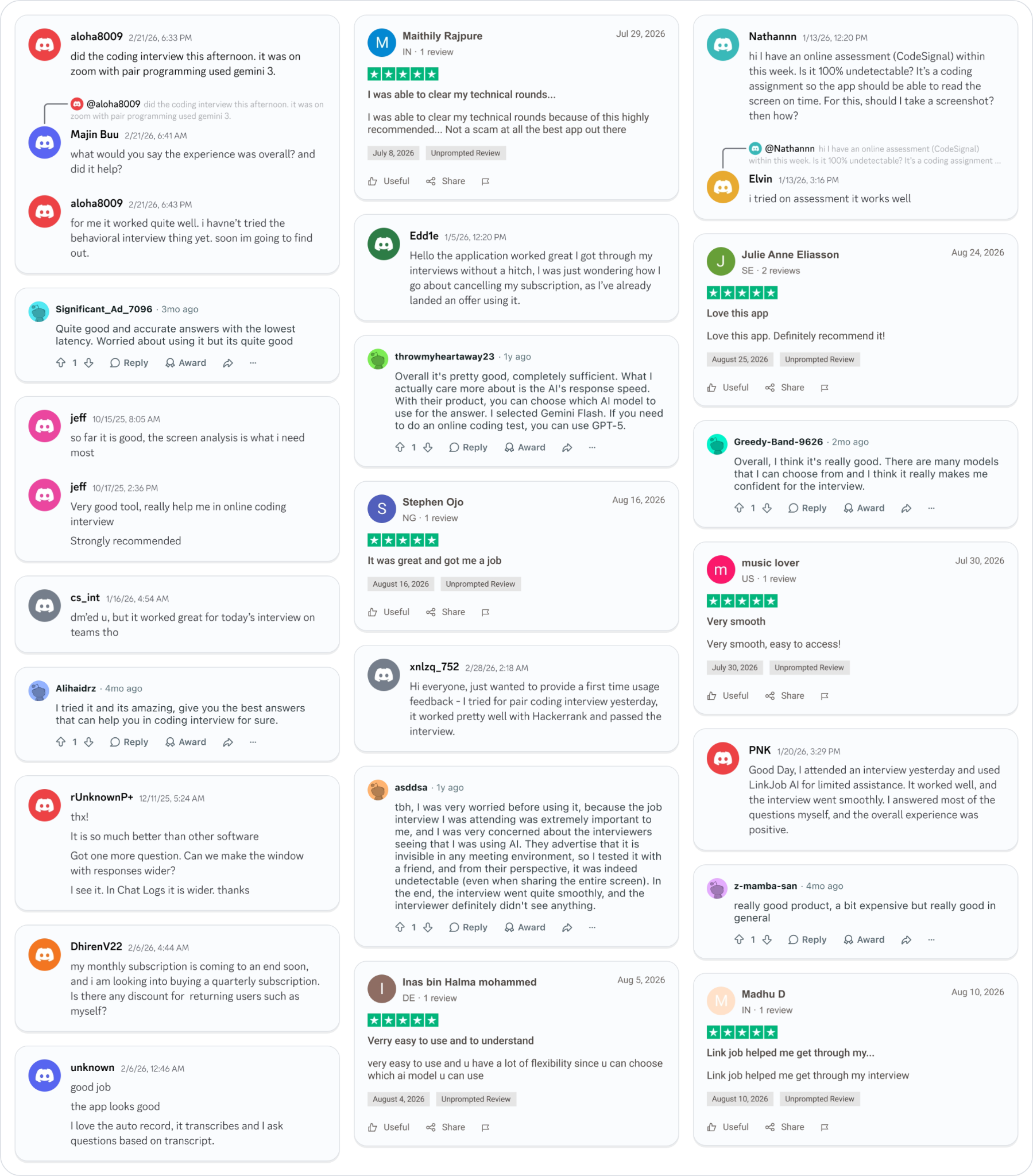
Why People Choose Linkjob AI
Smoother interviews, coding challenges cleared, and job offers landed. See how users describe their experience with Linkjob AI—in their own words.

© Copyright 2026 Linkjob AI - All Rights Reserved.