How I Passed the Citadel Software Engineer Interview: My 2026 Experience


I just finished the Citadel software engineer interview process, and now that I’ve had a little time to think about it, I figured I’d write down what actually helped and what I wasted way too much time worrying about.
When I first got the interview email, I did what I assume everyone does.
I opened LeetCode.
Then I opened Reddit.
Then Glassdoor.
Then another Reddit tab.
At some point I had like 20 tabs open with titles like “Citadel SWE interview,” “Citadel tagged LeetCode,” “Citadel system design,” and “how screwed am I if I don’t know C++.”
The annoying part was that nobody seemed to have the same interview.
One person said it was basically LeetCode medium/hard.
Another person said they got system design.
Someone else had to implement an actual small system.
Some people had an OA. Some apparently skipped it entirely.
I thought people were just remembering things badly until I actually went through the process.
They're not.
There really is a lot of variance.
Citadel's own current campus engineering guide says the first round is a 45-minute interview covering coding, DSA, problem-solving and behavioral/background questions, and that the next round usually consists of three more 45-minute interviews. But recent 2026 candidates are reporting different combinations around that core structure, including candidates being sent directly into interviews without an OA.
So take everything below as my experience, not “this is exactly what Citadel will ask you.”
That would've saved me a lot of stress before mine.
TL;DR
If you don't want to read the whole thing:
I did a lot of LeetCode, but the most useful prep ended up being talking through problems, implementing things from scratch, reviewing my resume properly, and getting comfortable when the interviewer changed the requirements halfway through.
Also: don't panic if your interview doesn't look like the Citadel interview someone described online.
Mine didn't either.
How My Citadel Software Engineer Interview Started
I didn't feel ready when I got the interview.
I don't think anyone ever does for Citadel.
The first thing I noticed was that it wasn't immediately:
“Here's a LeetCode hard. Go.”
We spent a few minutes talking about my background.
Nothing crazy.
What I'd worked on.
What I was interested in.
Why Citadel.
One of my projects came up and I gave the polished 30-second version I'd prepared.
Then the interviewer asked one follow-up.
Then another.
And suddenly I realized this person actually wanted to know how the thing worked, not hear my résumé summary.
That sounds obvious now.
It didn't feel obvious when I'd spent the previous week doing graph problems.
At one point I mentioned that we'd improved latency in one of my projects.
The immediate question was basically:
How did you measure it?
Then:
What was causing the latency?
And then we were talking about implementation choices I hadn't thought about in months.
This was probably the first moment where I thought:
oh, okay, this interview is going to be different.
Citadel actually tells candidates to prepare for questions about internships, technical interests and projects, so in hindsight I should have expected this.
I just didn't expect the interviewer to go that deep that quickly.
Then We Got to the Coding Question
The coding question itself didn't initially look insane.
That's another thing that surprised me.
I had spent days preparing myself psychologically for some ridiculous DP problem that would require a mathematical insight from 1743.
Instead, I understood the problem.
I had an approach.
And because I was nervous, I immediately wanted to code it.
The interviewer stopped me with a question about one of my assumptions.
Very glad he did.
My original approach worked for the version of the problem I'd invented in my head, not necessarily the version he'd actually asked.
So I clarified a couple things, talked through a simple solution first, and then coded.
The first solution wasn't the end.
That was basically the beginning.
After I had something working, I got questions along the lines of:
What's the complexity?
Fine.
Then:
Can you improve this part?
Okay.
Then another constraint got added.
Now my original data structure wasn't ideal anymore.
That's where the interview got harder.
Not because I suddenly needed some obscure algorithm, but because I had to modify something I'd already mentally decided was “done.”
From what I've seen afterward, this is pretty consistent with other people's 2026 experiences. One candidate described their interviewer explaining the problem and test case, then adding more pieces after the first part was finished. Another described the questions as roughly medium to hard, but “more involved and thorough” than a standard LeetCode problem.
That description feels pretty accurate to me.
The Thing I Was Doing Wrong in My Prep
Before the interview, my LeetCode practice looked like this:
read question → solve question → Accepted → next question.
That's not really what happened in the interview.
The interview felt more like:
read question → explain question → clarify → propose something → defend it → code it → test it → interviewer changes something → fix it → discuss another approach.
That sounds like a small distinction.
It's not.
After the first round, I changed how I practiced.
I stopped counting the number of questions I'd solved.
For some problems, I'd spend 40 minutes on one question even if I knew the solution.
I'd explain it out loud.
I'd ask myself stupid interviewer questions.
Why this data structure?
Why isn't this a tree?
What happens with duplicate input?
What breaks if I need this to be thread-safe?
What if I have 100x more data?
Could I trade memory for speed here?
Honestly it felt slightly unhinged talking to myself in my room.
But it helped way more than doing ten more mediums silently.
The Second Round Was Where It Got Real
The later technical interviews were more tiring than the first one.
Citadel currently describes the campus second round as usually three 45-minute interviews, which was roughly the format I had in mind going in.
The hardest thing wasn't necessarily that interview #3 contained harder computer science than interview #1.
It was having to reset your brain each time.
One interviewer cared a lot about implementation.
Another kept pulling on design decisions.
Another spent longer on my background than I expected.
This is also why I wouldn't trust anyone who tells you:
“Citadel second round is three LeetCodes.”
Maybe theirs was.
Recent candidates have reported everything from algorithmic questions to open-ended system design. One July 2026 candidate described designing a car-rental system and implementing part of it in Python; another interview involved designing and implementing a broker system in C++ while discussing trade-offs.
I didn't get those exact problems.
But the design something, then make it real style is worth preparing for.
Also, I’d definitely recommend Linkjob AI as an AI interview tool. If you need to take a coding assessment, you can give their product a try.
One of My Rounds Barely Felt Like LeetCode
This was probably the round I was least prepared for.
The prompt was more open-ended.
There wasn't an obvious:
Input: array of integers
Output: integer
kind of setup.
I had to figure out what objects or structures I wanted first.
I remember sitting there thinking:
I really wish this were a graph question right now.
Which is funny because two weeks earlier I would've complained if someone gave me a graph hard.
I started by asking more questions.
Then I sketched the main pieces.
The interviewer kept asking what various operations would cost.
Eventually I had to implement some of it.
This is where all those “system design vs OOD vs LeetCode?” Reddit posts suddenly made sense.
The boundaries aren't clean.
Sometimes the question is small enough that “system design” just means:
Can you turn vague requirements into a sensible design and then actually code the important part?
That's a very different skill from drawing Kafka and Redis boxes.
My Resume Almost Screwed Me More Than LeetCode Did
If I could send one message back to myself before the interview, it would probably be:
Read your own résumé, idiot.
I knew what was on it, obviously.
But I knew it at the level you need when talking to a recruiter.
Not at the level you need when another engineer decides to spend ten minutes on one sentence.
If you write something like:
Improved throughput by 35%.
you should know where 35% came from.
Really.
Was it a benchmark?
Production?
Average?
P95?
What changed?
What trade-off did that improvement introduce?
What would've happened at 10x scale?
Why did you choose the solution you chose?
I had one moment where I could feel myself giving a vague answer to something that I had supposedly built.
That's an awful feeling.
I recovered, but after that round I went back through every technical bullet and basically tried to destroy it.
If I couldn't explain it properly, I reviewed the project until I could.
I Also Overprepared Finance
Before the interview, I thought “Citadel” meant I needed to suddenly learn finance.
I read about order books.
Market makers.
Bid/ask.
Various trading concepts.
Some of that was useful.
Mostly because Citadel engineers do work on trading, risk, market-data and investment infrastructure, so basic vocabulary makes the environment less alien. Citadel's own engineering careers page talks about engineers rapidly building and deploying systems that power its strategies.
But I definitely didn't need to become a quant.
Nobody suddenly asked me to derive Black-Scholes.
For SWE, I would've been better off spending some of that extra time on computer-systems fundamentals.
Systems Stuff I Was Glad I Reviewed
A few days before my later rounds, I did a quick pass through stuff I hadn't touched properly since school.
Threads vs processes.
Locks.
Race conditions.
Deadlocks.
Caches.
Basic networking.
Memory.
Nothing insanely deep.
Just enough that if an interviewer changed a problem and said:
“What if multiple threads are using this?”
I wouldn't stare at them like they'd changed languages.
This wasn't paranoia either. Current candidate discussions around the 2026 SWE process mention system design, multithreading and OS fundamentals as things worth knowing, particularly because the interview style seems interviewer-dependent.
I wouldn't spend three weeks reading an OS textbook unless you're interviewing for a very systems-heavy role.
But I also wouldn't show up knowing only LeetCode patterns.
Why Citadel Was Weirdly Hard for Me to Answer
The behavioral question I disliked most was probably the easiest one:
Why Citadel?
I had a terrible answer at first.
Something like:
“I'm interested in solving challenging problems with talented people in a fast-paced environment.”
Which says absolutely nothing.
You could say that about OpenAI, Jane Street, Google, SpaceX, a random Series A startup or an escape room.
What helped was actually looking at how Citadel describes engineering.
Their own material talks a lot about engineers working close to real business problems, rapid production feedback, ownership and impact.
That gave me a real answer.
I like engineering environments where you can actually see whether something you built mattered.
That was something I could connect to my previous work.
Once I started from that, the answer stopped sounding memorized.
One Citadel Video I Actually Found Useful
Most of the interview videos I found online were just people recycling the same question lists.
Citadel's own engineering page was more useful for this part.
They have short videos from engineers including Anita and Daniel talking about their actual work and growth at the firm. Daniel, for example, works on infrastructure and analytics for Fixed Income and Macro.
Not because it'll tell you the coding question.
It won't.
It just gives you much better material for figuring out whether you actually have an answer to “Why Citadel?”
I Stopped Trying to Hide When I Was Stuck
This might have been the biggest mindset change.
At the beginning, every time I didn't know the next step immediately, I felt like I'd failed.
So I'd go quiet.
And think.
And think.
Which is terrible in an interview because the interviewer has no idea whether you're thinking productively or your brain has completely shut down.
Later I started saying what I was stuck on.
For example:
“This gets the lookup where I want it, but now updates are more expensive. I'm trying to decide whether it's worth maintaining another index.”
Now the interviewer knows something.
They can challenge it.
They can give a hint.
You can actually have a conversation.
Citadel basically tells candidates to do this. Their official guide explicitly says to share your thought process, discuss trade-offs, say when you hit a setback and take hints if you need them.
I read that before the interview.
It took me actually getting stuck to understand why they say it.
I Didn't Use C++ Just Because It Was Citadel
I worried about this for an embarrassing amount of time.
Citadel.
Quant firm.
Performance.
Surely I should interview in C++, right?
No.
I used the language I could think fastest in.
Citadel's current intern application actually asks candidates to choose their preferred interview languages, and current engineering listings mention Java, C++ and Python depending on the position.
If C++ is your best language, use C++.
If you haven't thought about iterator invalidation since sophomore year and you're only choosing C++ because you think the interviewer will respect you more, I would reconsider.
You're already solving a hard problem.
You don't need the programming language to become another hard problem.
What I Actually Did the Week Before
My prep became much simpler near the end.
I did a couple coding problems each day, but I cared more about doing them properly than doing a lot.
I did at least one problem out loud.
I reviewed one or two resume projects.
I spent some time on systems fundamentals.
I practiced “Why Citadel?” until it sounded like something I would actually say.
And I stopped reading new interview reports the night before.
This last part was surprisingly important.
Every new Reddit post just introduced another thing I hadn't studied.
Someone got DP.
Panic.
Someone got system design.
Panic.
Someone got C++ internals.
Panic.
Someone got an easy medium.
Now I was confused and panicking.
At some point you have to accept that you don't know which interviewer you're getting.
That's especially true this year. One active 2026 SWE intern thread has candidates reporting first rounds ranging from medium/medium-hard LeetCode-style questions to open-ended design problems where they implemented functions, and even variation around whether AI tools were permitted by the interviewer.
So I stopped trying to prepare for the question.
I prepared to deal with a technical conversation.
What I Think Actually Got Me Through
I don't think it was one brilliant coding solution.
There wasn't a moment where I wrote some genius one-liner and the interviewer started clapping.
I made mistakes.
I needed hints.
I had one solution that I changed halfway through.
I definitely had answers I thought of better versions of five minutes after the call ended.
What I think helped was that when something changed, I could keep going.
If an interviewer questioned my design, I didn't treat that as:
“My design was wrong.”
I treated it as:
“Okay, now we have a new requirement.”
That sounds small, but I think it's a huge part of these interviews.
Citadel's own engineering process emphasizes problem-solving, trade-offs, collaboration and working through the boundaries of what you know rather than trick questions.
That matches my impression pretty closely.
The Part Nobody Warned Me About: The Fatigue
Three technical interviews don't sound crazy when you see them written down.
45 minutes.
Break.
45 minutes.
Break.
45 minutes.
I've done longer exams.
But technical interviews are weirdly exhausting because you're “on” the entire time.
You're coding.
Explaining.
Listening.
Watching the interviewer's reaction.
Trying not to interpret every “hmm” as a rejection.
By the last interview, I could feel myself wanting to skip things.
I almost forgot to test an edge case that I would've caught immediately in the morning.
If you make it to the longer rounds, stamina matters.
I'd actually recommend doing two mock interviews back-to-back once before your real one.
Not because that's fun.
It isn't.
But I'd rather discover that my brain turns into soup after 50 minutes before Citadel discovers it.
Would I Grind Citadel-Tagged LeetCode Again?
Yes.
But much less obsessively.
The tags are useful.
They give you a sense of the difficulty.
They get you comfortable with the kinds of data structures that might come up.
What they don't do is recreate the interview.
Recent people going through the process are pretty explicit about this. Some still get recognizable medium/hard LeetCode-style questions; others are getting OOD/system-style questions and implementations.
If I had 30 hours to prepare, I would not spend all 30 on tagged questions.
I'd rather do:
maybe 15–18 hours of DSA,
then implementation/design,
systems fundamentals,
my resume,
and a few proper mocks.
You can adjust that depending on your background.
But 100% LeetCode would've been the wrong split for me.
The Night Before My Citadel Interview
I did almost nothing useful.
Which was probably the most useful thing I did.
I reviewed a couple notes.
Looked at my resume.
Did one medium just so I didn't feel rusty.
Then stopped.
At that point, trying to learn another algorithm would've mostly been anxiety disguised as preparation.
The thing I reminded myself before going to sleep was:
I don't have to know the final answer immediately.
I just have to keep making progress.
That ended up being a pretty good summary of the actual interview too.
So, How Did I Pass the Citadel Software Engineer Interview?
I was good enough at LeetCode.
Not magical.
Good enough.
But I also knew my projects.
I could talk through my reasoning.
I could change my solution.
I had reviewed enough systems stuff not to panic when questions moved outside pure algorithms.
And eventually I stopped trying to prove that I knew everything.
That last one probably helped more than I expected.
If you're interviewing soon, I'd spend less time trying to predict the exact Citadel question and more time making sure that whatever problem you get, the interviewer can see you think.
Because the thing that surprised me most about the Citadel software engineer interview was this:
I thought they were going to test whether I could find the answer.
A lot of the time, they seemed more interested in what I did after I found the first answer.
That's the part I'd prepare for.
FAQ: Citadel Software Engineer Interview
How difficult is the Citadel software engineer interview?
Mine was difficult, mostly because of the depth and follow-ups rather than every question being an impossible LeetCode hard.
Current candidates report a pretty wide range from medium/medium-hard algorithm questions to open-ended design and implementation problems.
Does Citadel ask LeetCode questions?
Yes. I would absolutely prepare DSA and LeetCode-style questions.
But I wouldn't stop there. Recent 2026 candidates also report implementation, OOD, system-design and systems-fundamental questions.
What is the Citadel software engineer interview process?
Citadel's current campus guide describes a 45-minute first interview followed by a second round that usually contains three 45-minute interviews. A team-specific leadership interview can follow before final matching.
Your exact process can vary. Several current 2026 candidates have reported going directly into technical interviews without first completing an OA.
Should I study system design for Citadel?
I would.
Not necessarily “design YouTube for a billion users” system design, especially for an intern or new-grad interview.
I'd focus on smaller engineering-design problems where you have to clarify requirements, select data structures, define interfaces and implement part of your design.
Do I need C++ for a Citadel interview?
Not automatically.
Citadel currently lets SWE intern applicants provide preferred interview languages, while engineering roles commonly reference C++, Python and Java.
I'd use the language I'm strongest in unless the particular position clearly requires something else.
Does Citadel ask about your resume?
They did in my process, and I underestimated this part badly.
Citadel's own engineering guide also says interviewers may discuss technical interests, internships and school projects.
Know the architecture, decisions, numbers and trade-offs behind anything technical you've put on your resume.
What should I prepare most for the Citadel SWE interview?
If I did it again, I'd prepare DSA first, but I'd also make sure I could implement data structures, work through small design problems, explain basic systems concepts and defend my own projects in detail.
See Also
My Journey to Success in the Palantir SWE Interview
Leveraging AI to Ace My Microsoft Teams Interview
Exploring My Experience with Technical Support Engineer Interviews
Diverse Questions Faced During My McKinsey Interview Process
Insights from My Prompt Engineering Interview and Key Questions
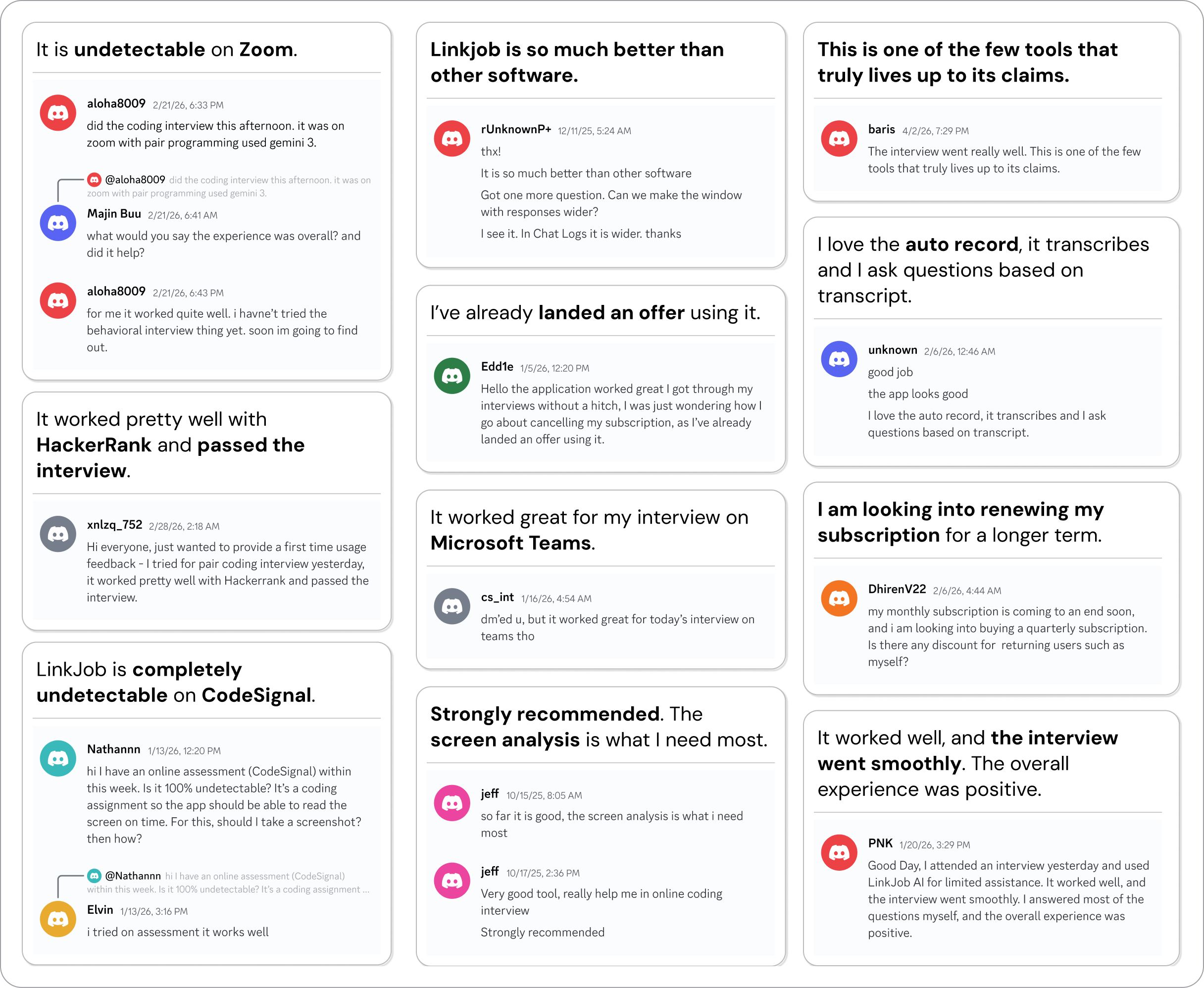
Why People Choose Linkjob AI
Smoother interviews, coding challenges cleared, and job offers landed. See how users describe their experience with Linkjob AI—in their own words.

© Copyright 2026 Linkjob AI - All Rights Reserved.