My HRT Quant Interview Experience and Prep Tips


I recently passed the HRT interview and found that the core of the HRT Quant interview focuses on three key areas:
Whether my mathematical foundation is solid enough, especially in probability theory (must be familiar with Bayesian theory, conditional probability, and stochastic processes), mathematical modeling (optimization, differential equations, numerical methods), and quantitative strategies (clear understanding of the logic behind classic strategies like mean reversion and momentum);
My ability to apply theory to practice—such as pricing using Black-Scholes or Monte Carlo methods, or explaining how Greeks are used in risk management.
Programming skills (C++/Python) must extend beyond basic coding to rapidly implement models and validate computations.
Interviewers place particular emphasis on your thought process: questions might involve a classic probability problem (like the coin-tossing problem), asking you to derive an option pricing model on the spot, or designing a simple statistical arbitrage strategy. The focus isn't solely on whether your final answer is correct, but how you break down the problem, construct the mathematical model, and verify the results' validity.
Overall, this interview demanded exceptional proficiency in statistical and quantitative strategies, as well as mental calculation and programming skills. Fortunately, with the assistance of LinkJob, an AI interview assistant, I successfully achieved strong results in all three rounds of interviews.
I've compiled some typical problems along with corresponding approaches, including step-by-step processes and practical application examples.
Key Takeaways
Understand the interview process: Familiarize yourself with each stage, from application screening to final round interviews, to reduce anxiety and prepare effectively.
Practice mental math and coding: Quick calculations and programming skills are crucial. Use online resources and coding platforms to sharpen these abilities.
Prepare for various question types: Expect technical, behavioral, and brainteaser questions. Practice explaining your thought process clearly during problem-solving.
HRT Quant Interview Process
Here’s how the interview process usually goes for hrt:
1. Online Assessment / Take-home Test
During the initial screening phase, candidates typically complete an online coding test or a timed take-home project.
This stage primarily evaluates fundamental programming skills, particularly proficiency in Python or C++, as well as the ability to solve practical problems.
2. Phone Interviews (Multiple Rounds)
If you pass the initial screening, you'll proceed to one to three rounds of technical phone interviews. Each round lasts approximately 30-60 minutes and is led by a Quant or Developer from HRT. This is the core of the interview process, intensively testing your knowledge of mathematics, probability, statistics, and algorithms.
3. Virtual Onsite (Super Day)
The final “Super Day” serves as the ultimate challenge, where you'll undergo back-to-back interviews with 4-6 interviewers within a single day. The interviews will delve deeper, assessing not only technical skills but also your communication abilities, mental agility, and cultural fit with the team.
Online Assessment
The online assessment is fast-paced. You get a mix of mental math, pattern recognition, and logic puzzles. For quant roles, you might see:
Assessment Type | Description |
|---|---|
Mental Math Drills | Fast arithmetic calculations without a calculator. |
Pattern/Sequence Recognition | Tests of logical reasoning to identify patterns or sequences. |
Logic&Brain Teasers | Word problems or brainteasers requiring probabilistic reasoning. |
Cognitive Games | Gamified assessments measuring memory and strategic thinking. |
Programming Challenges | Basic coding ability tests for certain roles. |
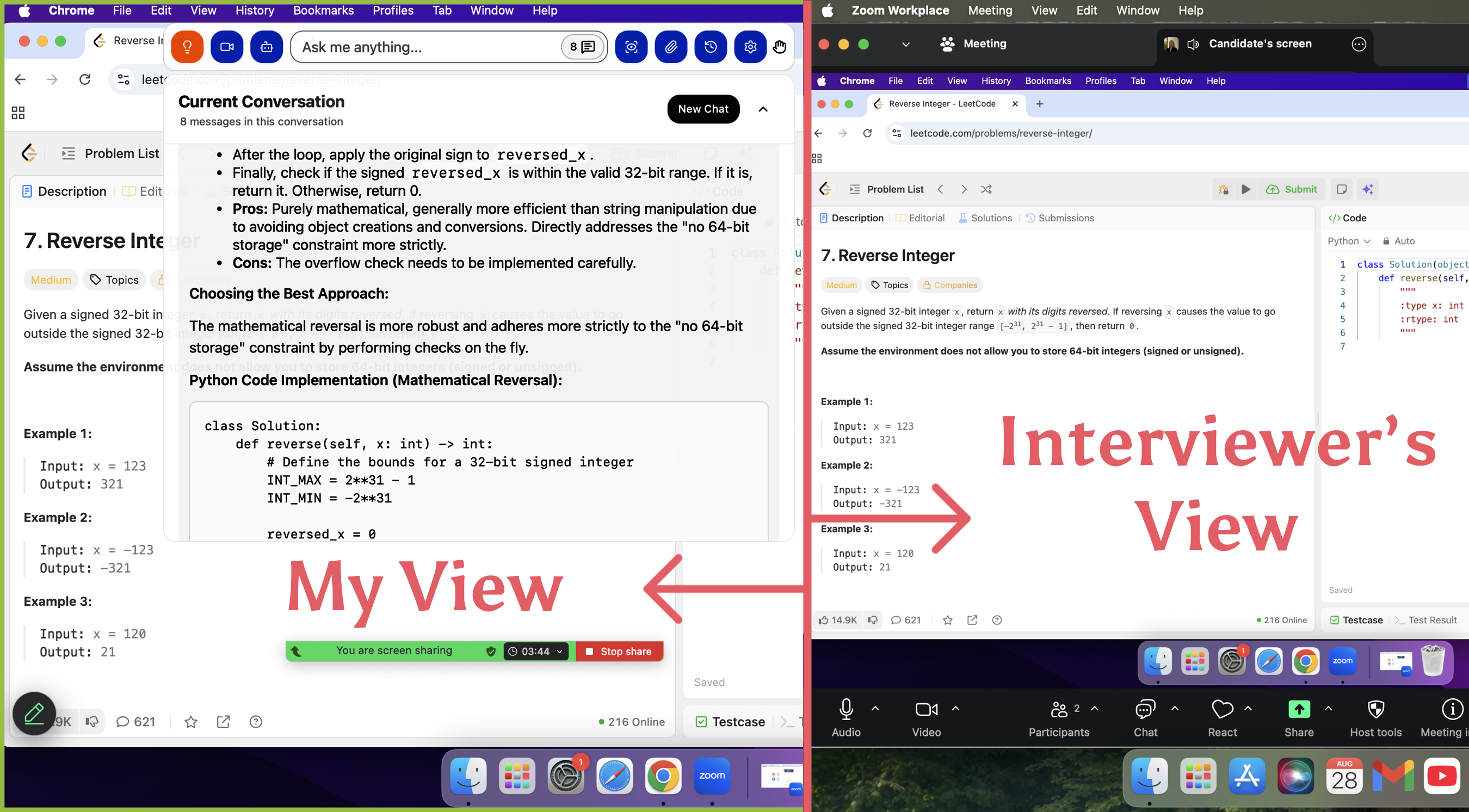
The overall difficulty level is moderately challenging, with no problems that appear completely baffling at first glance, yet the solutions are far from trivial.However, lacking experience in data analysis, I had no clue how to approach non-trivial results. Fortunately, Linkjob came to my rescue. It remains undetectable by interviewers or screening programs, so I used it throughout the process. Whenever I encountered unsolvable problems, it swiftly provided accurate responses. It also saved me significant time on computational tasks.
Phone Interviews: Probability & Statistics
The phone interviews dig deeper into math and probability. I remember getting questions like this:
A gambler begins with an initial fortune of 2 dollars. Each time he plays, he has the possibility of winning 1 dollar with a probability of p (where 0 < p < 1) or losing 1 dollar with a probability of g = 1 — p. The gambler will only stop playing if he either accumulates 5 dollars or loses all of his money. What is the likelihood that he will end up with 5 dollars?
You need to explain your thinking clearly. They want to see how you solve problems under pressure. Sometimes, they ask about statistics or python programming, especially if you mention engineering or data projects.
Virtual Onsite (Super Day)
The interviewer started off with an unusually calm tone, almost like chatting: “Let's work through a small case study. Don't rush to calculate just yet—first tell me how you interpret this constraint.” In that moment, I knew this wasn't about “whether you can solve it,” but rather “what you're actually looking at.”
My initial reaction was straightforward: With such a high overall win rate, it should intuitively be possible to arrange things nicely. But he immediately pressed further: “If you were a risk control/trading system, would you care more about the final outcome, or whether stop-loss lines were triggered along the way?” My mind cleared instantly—this problem, while superficially about hit rates and sequence, was fundamentally testing awareness of “path risk.”
After that, he gave me almost no hints, but pushed me deeper into “real trading scenarios” at every step: How would you translate that statement into a testable condition? Can you provide a concrete construction, not just “it should work”? What if the threshold is stricter? If I turn the rules into generic parameters, can you outline an executable algorithmic approach?
The most crucial point: He couldn't care less about how many theorems you've memorized. What matters is whether you can articulate clearly, maintain logical consistency, and account for all boundary conditions. Every time you mentioned “intuition,” he'd pull you back to reality with “How would you prove/validate that?” The experience felt exactly like a strategy review: It's not enough to claim it's good—you must demonstrate it won't fail midway.
My biggest takeaway after the interview wasn't solving the problem, but a realization: top-tier quant interviews don't test “computational power,” but whether you possess a researcher's mindset—first defining constraints, then abstracting them into models, next providing constructions or counterexamples, and finally generalizing into universal methods. Mastering these four steps transforms your entire demeanor from “problem-solving machine” to “strategy architect.”
If you're preparing too, my sincere advice: Don't just drill formulaic problems. Focus more on translating human language into mathematical constraints and clearly articulating risk control implications. Because when they interview you, they're really assessing whether you can articulate a strategy to the point where it's “ready for deployment.”
HRT Quant Interview Questions
Probability and Statistics
Probability and statistics questions show up everywhere in hrt interviews. I saw everything from basic definitions to complex case studies. The interviewers wanted to see if I could apply math to real trading scenarios. Here’s a table that sums up the main types of questions I faced:
Question Type | Description |
|---|---|
Conceptual probability questions | Definition-based questions that lead into more complex case studies. |
Probability case studies | Scenarios provided for calculation of event occurrences, often involving dice or card draws. |
Distribution case questions | Questions evaluating possible outcomes based on distributions. |
Statistical analysis questions | Questions requiring statistical analysis based on provided data. |
Easy Quant Probability Questions | Questions involving basic mathematical concepts and statistical analysis. |
Some real questions I got during my interviews included:
You have a stick of length 1. You break it two random points. What is the probability that the three results pieces can form a triangle?
A and B play a game. A has n+1 coins, and B has n coins.They each flip all their coins.What is the probability that A gets more heads than B?
Flipping an array of size N with all elements as 0.Given some intervals[a,b],flipping all the state within the interval(0->1,1->0).How to determine the final status of the array?
NYC citibike demand prediction at a specific location.
You have 98 unbiased coins, one coin with heads on both sides, and another coin with tails on both sides. A coin is picked randomly and tossed once, landing on a head. What is the chance that the tossed coin is the one with two heads?
A point is randomly placed on a unit square. What is the expected distance from this point to the nearest edge?
Roll two fair six-sided dice. What is the probability that the sum is greater than the product?
A particle starts at position 0 on the integers and moves +1 or -1 with equal probability at each step. What is the expected number of steps to return to 0 for the first time?
From a deck of 52 cards, you draw cards one by one without replacement until you get an ace.What is the expected number of cards you need to draw?
I found that practicing these types of math problems helped me think faster. I also reviewed basic statistics and probability concepts from my engineering classes. If you want to do well, try to solve these problems out loud. Explain your reasoning step by step. This shows the interviewer how you approach data and math in real trading situations.
Tip: Don’t just memorize formulas. Focus on understanding the logic behind each question. This will help you adapt if the interviewer changes the scenario.
Quantitative Trading Strategy & Mathematical Modeling
Design a mean reversion trading strategy for a stock that follows an Ornstein-Uhlenbeck process.
You observe two cointegrated stocks with prices
P1 and P2. The spread S = P1 - βP2 follows AR(1)
process. Design a pairs trading strategy.
Design a momentum strategy that captures short-term price trends while controlling for risk.
Identify and exploit statistical arbitrage opportunities in a basket of stocks.
Design a market making algorithm for high-frequency trading.
You are interviewing candidates and can only hire one. Candidates arrive in random order, and you must decide immediately whether to hire each candidate. You want to maximize the probability of hiring the best candidate. What strategy should you use?
Derive the Black-Scholes differential equation for a European call option.
Price a European call option using Monte Carlo simulation. The stock price is $100, strike is $105, risk-free rate is 5%, volatility is 20%, and time to maturity is 1 year.
Calculate the delta, gamma, and theta for a European call option with S=$100, K=$100, r=5%,δ=20%,T=0.25.
Coding Challenges
Coding challenges are a big part of the hrt interview process, especially for quant and engineering roles. I saw questions that tested my ability to solve problems quickly using programming. Most of my coding questions focused on python, but I also saw some C++ and SQL. Some friends told me they got questions in R or Java, depending on the team.
Here are the main programming languages I encountered:
Python
C++
SQL
R
Java
The questions in this section were quite challenging, but Linkjob AI worked great and I got through the interview without a hitch. It’s completely undetectable, and the interviewer had no idea I was using it.
Brainteasers and Logic
Brainteasers and logic puzzles are classic in hrt quant interviews. These questions test how you think, not just what you know. I got questions that felt like SAT math or logic games. Sometimes, the interviewer asked me to complete a series or solve a puzzle about coin tosses or weather patterns.
Here are some common types I faced:
SAT Math (Statistics)
Test Scores (Mathematics)
Coin Toss (Statistics)
Complete the Series (Mathematics)
Weather (Statistics)
The questions I was asked is "You have 100 prisoners in solitary cells. There's a central living room with one light bulb; the bulb is initially off. No prisoner can see the light bulb from their own cell. Everyday, the warden picks a prisoner at random, and that prisoner enters the living room. While in the living room, the prisoner can toggle the light switch (turn it on or off). The prisoner must then make a guess whether all 100 prisoners have been to the living room.
If they are right, all prisoners are set free. If they are wrong, all prisoners are executed. They are allowed to colludeand strategize before the first prisoner is chosen. What is the strategy?"
Note: Practicing brainteasers helps you stay calm under pressure. Try to solve a few every day before your interview.
Prep Tips for HRT Quant Interview

Areas of Study and Relevant Classes
When I started preparing for the hrt quant interview, I focused on the skills that matter most for quant roles. I spent time sharpening my mental math because quick calculations come up often. I reviewed probability and statistics, especially concepts like expected value and risk-taking theory. I practiced programming in python, since engineering and trading teams use it daily. I also brushed up on linear algebra and calculus basics, but I didn’t stress if I couldn’t master every detail.
Here’s what helped me most:
Mental Math
Make sure your mental math skills are solid. There aren't really any classes for this, so the best way to get better is to practice a lot—whether you’re working through math problems, probability exercises, or just dealing with numbers in everyday life! A great way to sharpen your mental math is by using ZetaMac. Stick to the default settings and aim to score over 40. If you don’t hit that score right away, don’t worry—just keep practicing. Like anything else, regular practice will make you faster and more accurate.Probability
This is definitely the most important topic to know well. Many trading interviews don't even test your coding abilities—they focus mainly on your understanding of math and probability. So, it’s crucial to really get this down. If you can, take at least one upper-division probability course while you’re in college. I recommend either Data 140 or EECS 126. EECS 126 covers more material overall, but Data 140 dives deeper into topics that actually show up in interviews, so I’d lean toward Data 140 if you can. If you go for Data 140, also consider taking Stat 150 to learn about stochastic processes, which sometimes pop up in interviews (though not super often). Stat 150 isn’t strictly necessary because the Green Book (which I mention in the “Books” section) already covers what you need to know about Markov chains and martingales, but I personally found Stat 150 very helpful for building a solid understanding.Programming and Algorithms
Programming skills usually aren’t tested much in Quant Trading roles, but if you’re interviewing for Quantitative Researcher positions, they often are. Firms more focused on quantitative research—like HRT, Headlands, and Jump Trading—will almost always test your programming through online assessments and Leetcode-style coding interviews. The best way to prep here is to keep your Leetcode skills sharp. The Grind 75 is a solid go-to list for practice and a good benchmark to measure yourself against. On the class side, make sure you have knowledge equivalent to CS 170 when it comes to programming and algorithms. For Berkeley students, this generally means you’ve taken CS 61A, CS 61B, and CS 70. Python is usually the preferred language in quantitative finance, but most firms will let you pick between Python and C++ for your coding interviews and challenges.Linear Algebra and Calculus
These aren’t super important for most Quant Trading interviews, but if you have some extra time, it’s worth brushing up on the basics. The Green Book has a good section on these topics that you can use to test yourself, but keep this as a lower priority compared to probability, statistics, mental math, and programming. For Berkeley students, make sure you’re comfortable with the material covered in classes like Math 53 and Math 54—pay more attention to Linear Algebra than Calculus. If you already took Multivariable Calculus or Linear Algebra in high school, that should be enough too.
Recommended Resources
I used a mix of books and online platforms to get ready for the hrt interview process. Here’s a table of resources I found most useful:
Resource Type | Title/Link | Description |
|---|---|---|
Book | Option Volatility and Pricing | Covers options pricing strategies |
Book | Option Trading | Explores options trading concepts |
Book | Volatility Trading | Focuses on volatility trading strategies |
Online Resource | Kaggle | Data science tutorials and competitions |
I also practiced on platforms like LeetCode, HackerRank, and CodeSignal. These sites helped me improve my python and engineering skills. Berkeley’s Data 140 course gave me a solid introduction to applied probability in a data science context.
Last-Minute Advice
Right before my hrt quant interview, I focused on three things:
Master fundamental statistics and probability. I reviewed expected value and risk-taking theory.
Practice actual interview questions. I solved problems from real quant interviews and mock assessments.
Use structured preparation methods. I joined a quant bootcamp for mock interviews and feedback.
Quick tip: Practice mental math under pressure. Build a small personal project using python and data analysis. The more you practice, the more confident you’ll feel. I found that talking through my solutions helped me stay calm and clear during interviews.
If you want to stand out to trading teams, show your passion for engineering, trading, and data. Stay persistent, keep practicing, and remember that preparation is the key to success in quant interviews.
Looking back, I see that the hrt quant interview rewards those who prepare with focus and curiosity. I practiced mental math under pressure, built small engineering projects, and talked about my trading ideas using python. I learned that nailing the details in my thought process made a real difference. Here are the biggest lessons I took away:
Quick mental math and clear thinking matter most in hrt interviews.
Building a personal engineering project with python helps you stand out.
Practicing real trading questions and mock interviews boosts confidence.
Focus on details in your answers, not just solving endless problems.
I found that learning from real hrt interview questions, mock interviews, and hands-on trading projects gave me an edge. Here’s what helped me grow:
Component | Description |
|---|---|
Real Quant Interview Questions | Practiced with updated questions from top trading firms. |
Mock Interviews | Got real-time feedback from experienced quants. |
Real-World Quant Projects | Built trading models using python and engineering skills. |
If you love engineering, trading, and data, keep practicing and stay persistent. The hrt quant interview is tough, but you can succeed with the right mindset and preparation. I hope my experience helps you approach your next interview with confidence and excitement for the world of trading, programming, and finance.
FAQ
How can I improve my mental math for hrt?
I practice with online drills and set a timer. I use flashcards for quick calculations. I also challenge myself with daily math puzzles. This routine helps me get faster and more accurate.
What if I make a mistake in my hrt interview?
I admit my mistake and correct it if I can. I explain what I learned from it. Interviewers appreciate honesty and a growth mindset. I try not to panic and keep moving forward.
How do I stand out in the hrt process?
I show my passion for problem-solving and learning. I build small projects using Python or data analysis. I practice real quant questions. I also share my excitement for teamwork and trading.
See Also
Interview Questions I Encountered in 2025 And My Responses
Sharing My Authentic Experience With The Zapier Interview
Exploring AI Tools For Effective Interview Preparation Strategies
How AI Helped Me Overcome Nerves During IT Interviews
Maximizing AI Tools For Comprehensive Interview Prep In 2026
Why People Choose Linkjob AI
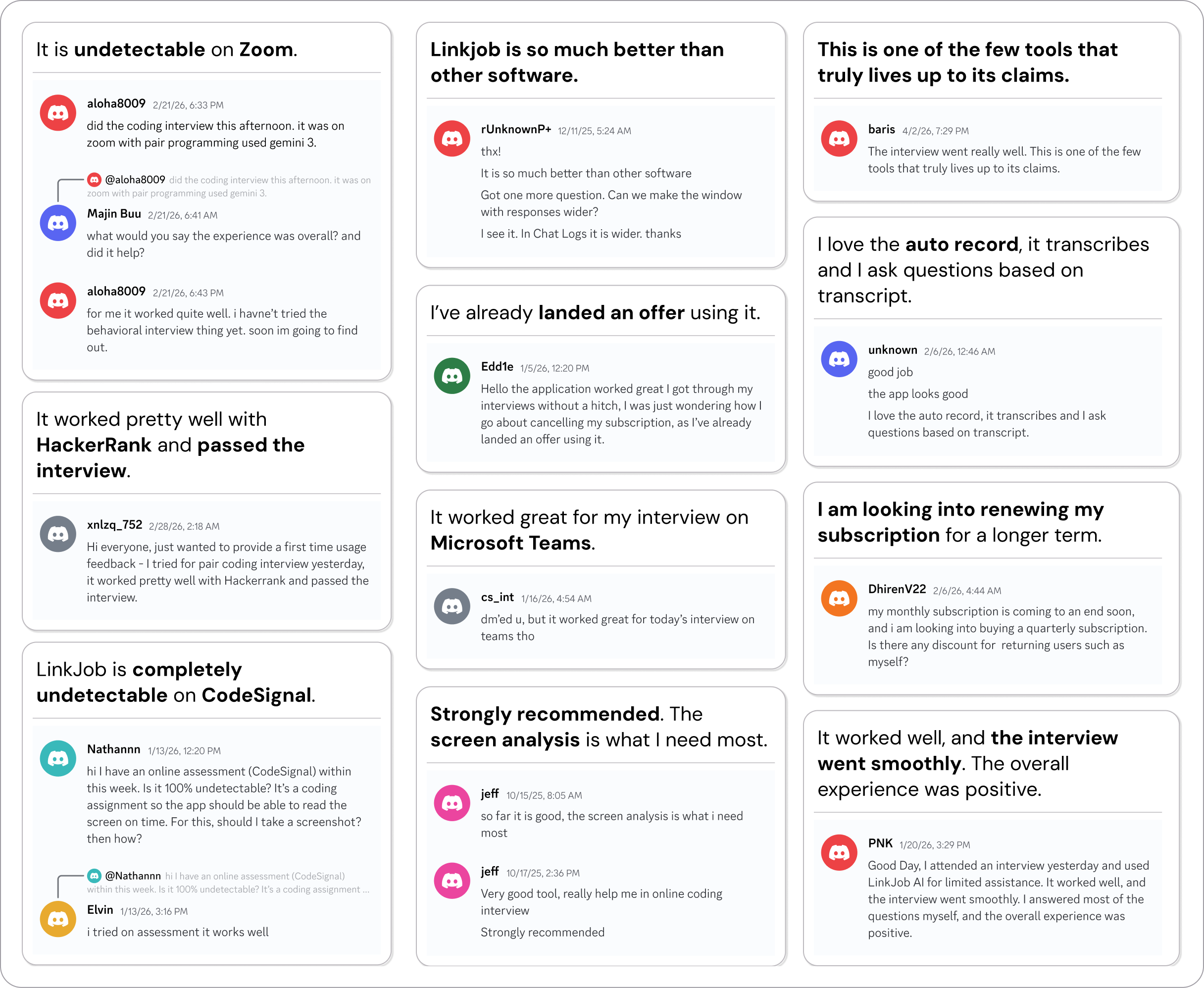
Smoother interviews, coding challenges cleared, and job offers landed. See how users describe their experience with Linkjob AI—in their own words.