How I Cracked the J.P. Morgan Data Scientist Interview in 2026


I just finished my interview for the J.P. Morgan Data Scientist role in 2026. As expected, the questions I encountered were from their question bank. Based on the interview experiences I’ve gathered, the core technical questions in their interviews—from machine learning to the case studies—are drawn from a specific set of topics. Some of these are recent additions that have replaced older ones. Below, I’ll share these key topics and actual questions I collected from various sources before my interview. Since the older questions are no longer in use, I won’t be covering them here.
I am really grateful to Linkjob.ai for helping me pass my interview, which is why I’m sharing these key topics and questions here. Having an undetectable AI interview tool during the process indeed provided me with a significant edge.
JP Morgan Data Scientist Interview Process
Overall, JP's Data Scientist interviews are highly technical, covering in-depth and extensive domains.
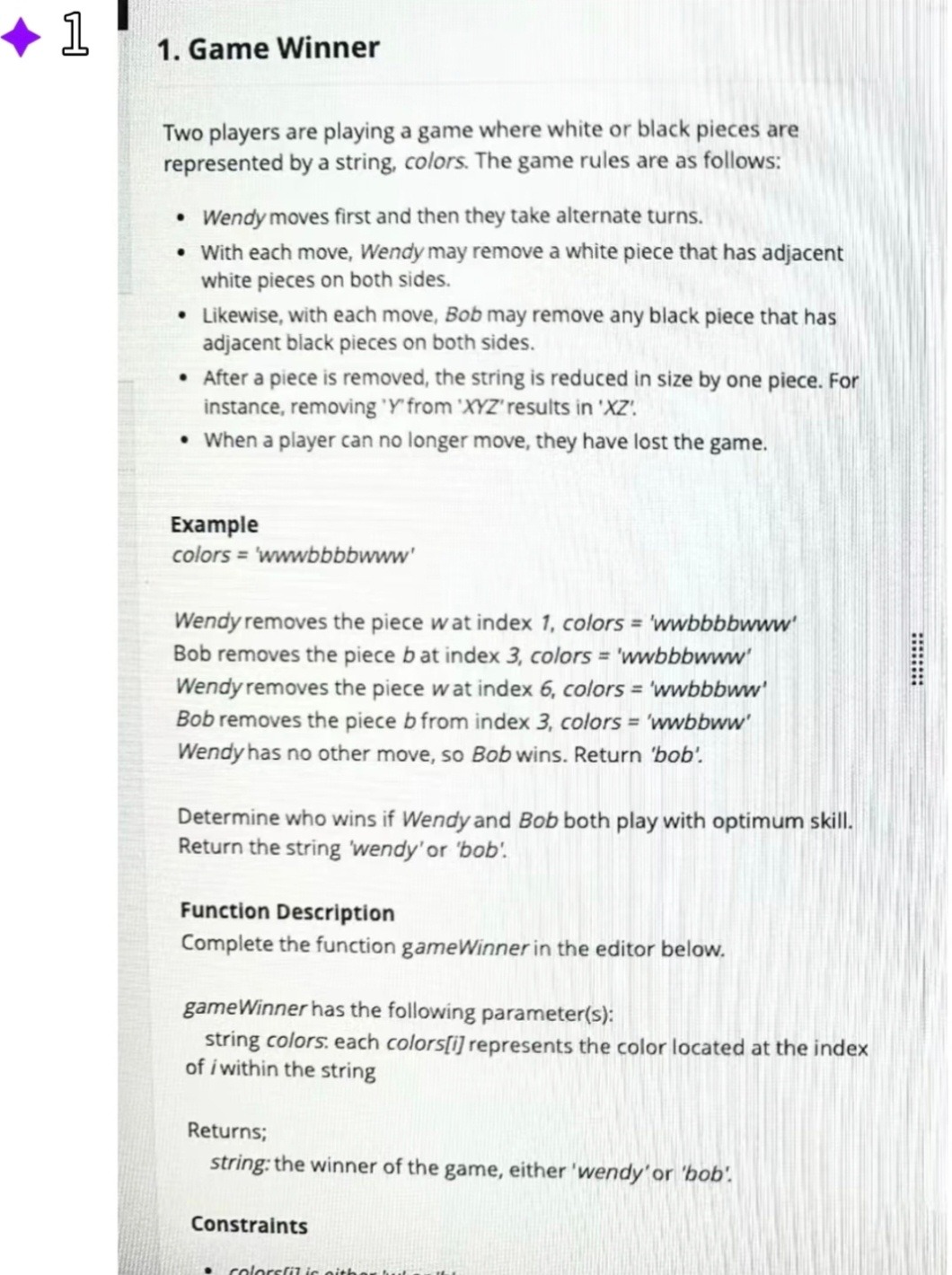
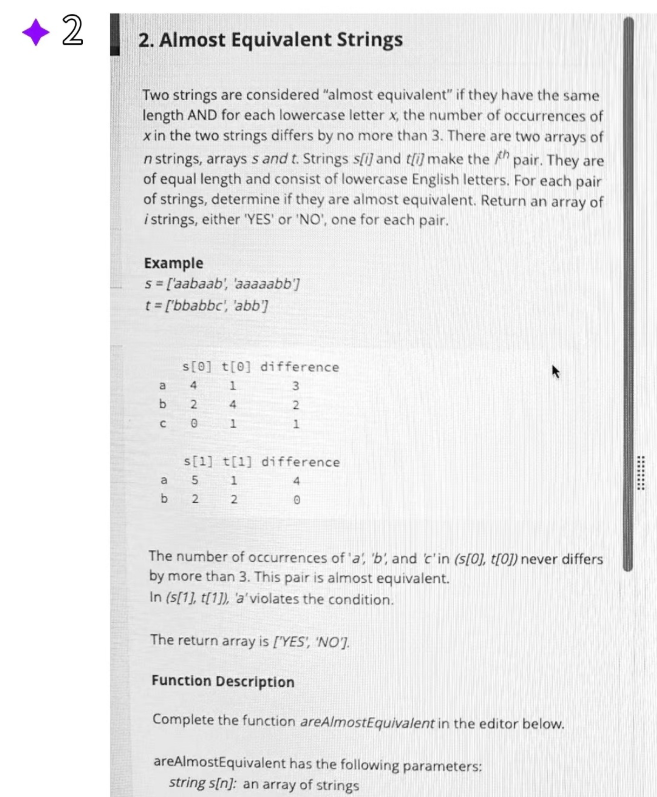
First off, let me talk about the OA (Online Assessment) I took for the Data Scientist role at JP Morgan. The OA had 2 coding questions that were randomly selected, and I had to finish both within 60 minutes — it was a pretty tight timeline, but manageable once I got into the groove.
After passing the OA, I moved on to the interview rounds, and here’s what each one was like from my experience:
Round 1: 60 Minutes Total, With Two VPs (30 Minutes Each)
The first round was split between two VPs, each spending 30 minutes with me.
First, I spoke with VP1, who had me walk through my resume in detail. I was a bit nervous because my NLP skills aren’t the strongest, but he reassured me that it was totally okay — the hiring team values diversity in skills, and NLP isn’t a requirement for this role.
Then VP2 took over, and he dived straight into technical questions. He asked me about L1 and L2 regularization, and specifically, under what conditions L1 regularization has a closed-form solution. I had to think through my answer carefully, but I managed to explain my reasoning clearly.
Round 2: 60 Minutes, With One VP (Deep Technical Analysis)
The second round was a single 60-minute session with another VP, and it was focused entirely on deep technical analysis — no small talk, just straight-up technical questions.
He started with PCA: first, he asked me to explain what PCA is, then the difference between eigen decomposition and PCA. Next, he asked how to choose the number of PCA components — beyond the common variance-based methods, what other approaches are there? I mentioned a few alternatives I’d learned, and he seemed satisfied with my answer.
He also threw in a bonus question at the end: what’s the relationship between PCA and deep neural networks? I hadn’t prepared for that specifically, but I connected what I knew about both and gave a coherent response.
Round 3: 2 Hours, Panel Interview With 4 VPs
The final round was the longest and most intense one — a 2-hour panel interview with four VPs, each taking turns to ask me questions.
VP1 started with questions about SGD (Stochastic Gradient Descent): he asked me to define it, then explain the difference between local minima and saddle points, and how to control for both when training models.
VP2 focused on Bayesian statistics — his main question was how to derive the solution for L1 regularization using Bayesian principles. This was one of the trickier questions, but I walked through the derivation step by step.
VP3 shifted to NLP and deep learning topics: he asked me about word embeddings, the Transformer architecture, encoder-decoder structures, and the attention mechanism. Even though my NLP skills aren’t my strongest, I was able to break down each concept clearly.
Finally, VP4 gave me a business case study focused on fraud detection. He asked me how I would approach building a model to detect fraud, what metrics I’d use, and how I’d communicate my findings to non-technical stakeholders. This was more practical than technical, but it tested my ability to apply data science to real business problems.
Here are a few of the OA questions:
Technical Screen Overview
Technical screen was the big hurdle in JP Morgan data scientist interview. I faced questions that tested my core data science knowledge and my ability to think on my feet. The interviewers wanted to see if I could handle real data problems and explain my reasoning clearly.
Here’s what they focused on:
SQL: I wrote queries using joins, aggregations, and window functions.
Statistical Analysis: I explained regression, hypothesis testing, and probability.
Machine Learning: I discussed model evaluation, feature engineering, and bias mitigation.
Financial Data Analysis: I analyzed datasets and suggested business recommendations.
Some of the questions I remember included:
Explain the difference between a p-value and a confidence interval.
How would you handle missing data in a dataset?
What is the purpose of cross-validation in model evaluation?
Describe a scenario where you would use a chi-square test.
How do you interpret the results of a logistic regression model?
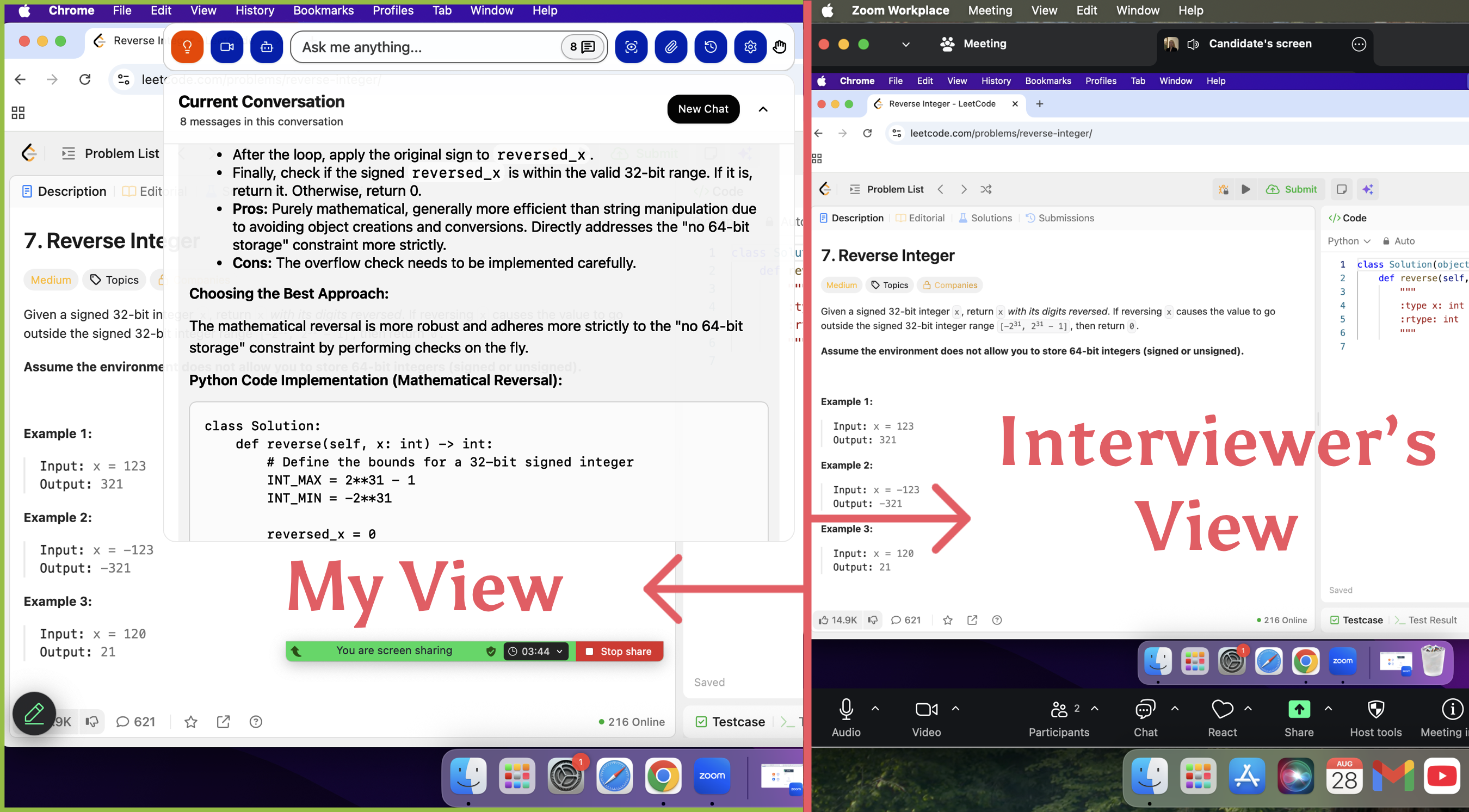
For tricky questions like these, especially under pressure, having real-time support was a game-changer. Linkjob.ai provided me with clear, concise answers instantly, and because it's undetectable, I used it without triggering any HackerRank detection.
Coding Challenge and Data Science Concepts
After the technical screen, I moved on to the coding challenge. This part of the jp morgan data scientist interview tested my ability to write clean, efficient code and apply data science concepts to real problems. I saw questions that required me to use Python, R, and SQL.
Coding Languages | Data Science Concepts |
|---|---|
Python | Data wrangling |
R | Statistics |
SQL | Algorithms |
Handling missing values | |
Outlier detection |
I practiced writing Python functions for tasks like calculating factorials, reversing strings, and implementing binary search. I also brushed up on data wrangling, handling missing values, and detecting outliers. The challenge often included a real-world dataset, and I had to show how I would clean the data, analyze it, and build a simple model.
During this round, I felt my performance was evaluated on three main fronts: my technical skills in data analysis and stats, my problem-solving ability in mini case studies, and how well I could articulate my past practical experiences.
Note: Practicing coding problems and reviewing your past projects can make a big difference in this round.
Zoom Screening and In-Depth Interviews
The final stage of the jp morgan data scientist interview process took place over Zoom. These interviews felt more personal and in-depth. I met with several team members, sometimes in a panel format. They asked me to walk through my resume, explain my project choices, and dive deep into my technical decisions.
I faced questions like:
Why did you choose a particular algorithm for a project?
How did you handle a tough data cleaning challenge?
Can you explain a time you worked with a difficult teammate?
I got the sense that the interviewers were looking for my ability to communicate complex ideas simply. They seemed to check if I understood the business impact of my work.
By understanding each stage of the jp morgan data scientist interview process, I could target my preparation and walk in with confidence. Each round tested different skills, but together they painted a full picture of my abilities as a data scientist.
Resume and Application Tips for JP Morgan Data Scientist Interview
Tailoring Your Resume
When I started working on my resume for the jp morgan data scientist interview, I realized that a generic resume just wouldn’t cut it. I focused on making every section relevant to the role. I used strong action verbs and made sure my professional summary reflected JP Morgan’s mission. I included keywords from the job description so my resume would pass through the ATS (Applicant Tracking System). I kept the formatting clean and easy to read. Recruiters want to see clarity and structure, so I avoided clutter and made sure each bullet point had a purpose.
Tip: Quantify your achievements whenever possible. For example, “Improved model accuracy by 15% in three months” stands out more than “Improved model accuracy.”
Highlighting Data Science Projects
My projects became the heart of my resume. I picked the ones that showed analytical thinking and problem-solving. I described each project with numbers, percentages, or timelines to show impact. I tailored my skills to match the job requirements, highlighting expertise in Python, SQL, and machine learning. I also emphasized transferable skills, like teamwork and communication. Here’s what I made sure to include in my project descriptions:
Clear connection to business problems
Quantified results
Relevant technical skills
Transferable skills
Strong action verbs
Project Name | Impact Statement | Skills Used |
|---|---|---|
Fraud Detection | Reduced false positives by 20% in 2 mo. | Python, SQL |
Churn Prediction | Predicted customer churn with 85% acc. | Machine Learning |
Crafting a Motivational Cover Letter
I wanted my cover letter to show my passion for data science and my interest in JP Morgan. I wrote about why I wanted to join the team and how my values matched theirs. I kept my sentences short and direct. I shared a story about a challenge I overcame and explained how it prepared me for the role. I made sure to mention how I could add value to their business. A strong cover letter can make you memorable, so don’t skip this step.
Note: Always customize your cover letter for each application. Recruiters notice when you take the time to connect your experience to their company’s goals.
Technical Preparation Strategies for the Data Scientist Role at JP Morgan
Getting ready for the jp morgan data scientist interview took more than just memorizing formulas. I had to build a solid foundation in technical skills and practice solving problems under pressure. Here’s how I tackled my preparation and what I recommend for anyone aiming for this role.
Python and Machine Learning Focus
Python became my best friend during my prep. I spent time writing scripts to clean data, build models, and visualize results. I focused on libraries like pandas, numpy, scikit-learn, and matplotlib. I made sure I could handle tasks like:
Loading and cleaning messy datasets
Creating visualizations to spot trends
Building and tuning machine learning models
Evaluating model performance with metrics like accuracy, precision, and recall
I didn’t just stop at the basics. I learned how to choose the right algorithm for different problems. I practiced explaining why I picked a certain model and how I improved its results. I also reviewed topics like bias mitigation and feature engineering. These skills helped me answer questions about real financial data and business scenarios.
Tip: Try building a simple classification model from scratch. Walk through each step and explain your choices out loud. This helps you get comfortable with technical interviews.
Practice for Coding Interviews
I knew that coding challenges would be a big part of the jp morgan data scientist interview. I practiced coding problems every day. I used platform like Linkjob to focused on:
Writing SQL queries with joins, aggregations, and window functions
Solving Python problems like string manipulation, sorting, and searching
Handling missing values and outliers in datasets
Implementing algorithms for regression, classification, and clustering
I set a timer for each problem to simulate the real interview environment. I reviewed my solutions and looked for ways to make my code cleaner and faster. I also practiced explaining my thought process, which helped me stay calm during the actual interview.
Coding Skill | Practice Method | Frequency |
|---|---|---|
SQL Queries | Online platforms | Daily |
Python Algorithms | Timed challenges | 3-4 times/week |
Data Wrangling | Real datasets | Weekly |
Note: Don’t just solve problems—review your mistakes and learn from them. This builds confidence and helps you avoid repeating errors.
Recommended Study Resources for JP Morgan Data Scientist Interview
I used a mix of books, online courses, and practice platforms to prepare. Here are my top picks:
Books:
“Python for Data Analysis” by Wes McKinney
“Hands-On Machine Learning with Scikit-Learn, Keras, and TensorFlow” by Aurélien Géron
Online Courses:
Coursera’s “Applied Data Science with Python”
DataCamp’s “SQL for Data Science”
Udemy’s “Machine Learning A-Z”
Practice Platforms:
LeetCode (SQL and Python sections)
HackerRank (Data Science track)
Kaggle (Competitions and datasets)
I also spent time learning about JP Morgan’s business model and financial services. Understanding how the company makes money and what problems they solve helped me answer case study questions. I practiced interpreting financial metrics and creating data visualizations that told a clear story.
Pro Tip: Read recent news about JP Morgan and explore their annual reports. This gives you context for case studies and shows you care about the company’s mission.
Here’s a quick checklist I used before my interviews:
Review Python basics and advanced topics
Practice SQL queries daily
Build and evaluate machine learning models
Study financial data analysis and visualization
Learn about JP Morgan’s business model and services
I found that consistent practice and targeted study made all the difference. By focusing on the skills that matter most, I walked into the jp morgan data scientist interview feeling ready for anything.
Case Studies and Behavioral Interview Prep for JP Morgan Data Scientist Interview
Approaching Case Study Questions
When I faced case study questions at JP Morgan, I knew I had to think beyond just numbers. The interviewers wanted me to understand their business model and services. JP Morgan works in investment banking and asset management, so I made sure to learn about these areas before my interview. Most case studies asked me to analyze financial products or create strategies for customer engagement. Sometimes, I got sample problems from the financial sector and had to use data analysis to find solutions.
Here’s how I tackled these questions:
I read the problem carefully and identified the main goal.
I asked myself, “What does JP Morgan care about in this scenario?”
I broke the problem into smaller steps and explained my reasoning out loud.
I used simple charts or tables to show my analysis.
I always connected my solution to a real business impact.
Tip: Practice with real financial datasets. Try to answer questions like, “How can we improve customer retention?” or “What data would help us launch a new product?”
Demonstrating Business Acumen
Showing business acumen helped me stand out. I didn’t just talk about technical skills. I explained how my work could help JP Morgan make smarter decisions or save money. I thought about the company’s goals and how data science could support them.
Skill | How I Demonstrated It |
|---|---|
Understanding trends | I spotted patterns in financial data |
Strategic thinking | I suggested ways to boost engagement |
Communication | I explained ideas in simple language |
I made sure to link my answers to JP Morgan’s services. For example, if the case study involved asset management, I talked about predicting market trends or managing risk.
Using the STAR Method
Behavioral interviews at JP Morgan often used the STAR method. I practiced telling stories using this structure:
Situation: I set the scene and described the challenge.
Task: I explained my role and what I needed to do.
Action: I shared the steps I took to solve the problem.
Result: I finished with the outcome and what I learned.
Here’s a quick example:
“I worked on a project to reduce customer churn. My task was to build a predictive model. I cleaned the data, tested different algorithms, and shared my findings with the team. As a result, we improved retention by 10%.”
Using the STAR method kept my answers clear and focused. It also helped me show my impact and growth.
Final Interview Insights for JP Morgan Data Scientist Superdays
Panel Dynamics
Superday at JP Morgan felt like a marathon, not a sprint. I walked into the building and saw other candidates waiting, each of us ready for a full day of interviews. The format included several back-to-back sessions, each lasting about half an hour. I met with hiring managers, senior team members, and even directors. Each person brought a different perspective and set of questions.
Here’s what the panel dynamics looked like for me:
Panel Dynamics | Description |
|---|---|
Number of Interviews | I had 3–5 interviews, each about 30–35 minutes. |
Types of Interviews | I faced case studies, behavioral rounds, and technical questions. |
Interviewers | I spoke with managers, potential teammates, VPs, and directors. |
Interview Environment | Everything happened in one day, either on campus or virtually. |
Discussion Pace | The pace felt fast, with quick shifts between topics and interviewers. |
I noticed that each interviewer focused on something different. Some wanted to know about my technical skills. Others cared more about how I fit into the team or how I handled pressure. I made sure to stay present and adapt my answers to each person’s style.
Unique Questions and How to Stand Out
During Superday, I faced a mix of technical, behavioral, and market-related questions. Some interviewers asked me to walk through a coding problem. Others gave me a business scenario and asked how I would analyze it. I also got questions about teamwork and leadership, where I used the STAR method to structure my answers.
Here’s how I made sure to stand out:
I kept up with financial news and trends. This helped me answer market awareness questions with confidence.
I practiced case studies and group scenarios, so I could show my problem-solving skills.
I researched JP Morgan’s culture and values. I made sure my answers reflected what the company cares about.
I networked with current employees before my interview. Their insights helped me understand what to expect.
I stayed calm and positive, even when a question surprised me.
Tip: Practice answering questions out loud and time yourself. This helps you stay clear and focused during the real thing.
I learned that Superday is not just about technical knowledge. It’s about showing who you are, how you think, and how you fit into the team. If you prepare well and stay true to yourself, you can make a strong impression.
Looking back, my success came down to targeted practice, understanding the company’s business, and staying persistent through the whole process.
FAQ
How did I manage my time while preparing for the interview?
I set up a daily schedule. I blocked out one hour for coding, another for case studies, and a little time for reading about JP Morgan. I used a checklist to track my progress.
What resources helped me the most?
I relied on LeetCode for coding, Coursera for machine learning, and Kaggle for real-world projects. I also read JP Morgan’s annual reports. These resources gave me both technical skills and business knowledge.
How did I stay calm during tough interview questions?
I took a deep breath and paused before answering. I reminded myself that it’s okay not to know everything. I focused on explaining my thought process clearly.
Should I network with current JP Morgan employees?
Yes! I reached out to employees on LinkedIn. Their advice helped me understand the company culture and what interviewers look for. A quick chat can give you valuable insights.
What if I don’t have a finance background?
No worries! I highlighted my data science skills and showed I could learn fast. I practiced with financial datasets and read basic finance articles. Showing a willingness to learn made a big difference.
See Also
My Journey to Success in the Palantir SWE Interview
Insights from My Databricks New Grad Interview Experience
Preparing for My Generative AI Interview: A True Account
© Copyright 2025 Linkjob.ai - All Rights Reserved.