My 2026 JP Morgan Superday Experience and Real Questions


The interview process at JP Morgan moved quickly. About a week after submitting my resume, I received a phone call and completed the online assessment the following day. Three days later, I had two phone interviews conducted by different interviewers within a single day (this may have been because my online assessment was on a Friday). Four days after the phone interviews, I received a call scheduling my Superday interview for the following day. The preparation time was extremely tight, but thanks to LinkJob—an invisible AI interview assistant—I successfully passed the interviews. Below are some of my experiences and recommend
JP Morgan Superday Structure
Rounds Of Superday Interviews
Behavior/Fit Interview:This part of the process is designed to gauge your passion for the industry and assess how well you align with the role they're offering.
Market&Macro Interview:In this segment, they want to understand your analysis of the market and JP Morgan, as well as your industry preferences. Beyond that, they will also ask you some fundamental knowledge questions.
Technical Interview:This section primarily assesses knowledge related to DCF modeling and data analysis.
My JP Morgan Superday Experience and Questions
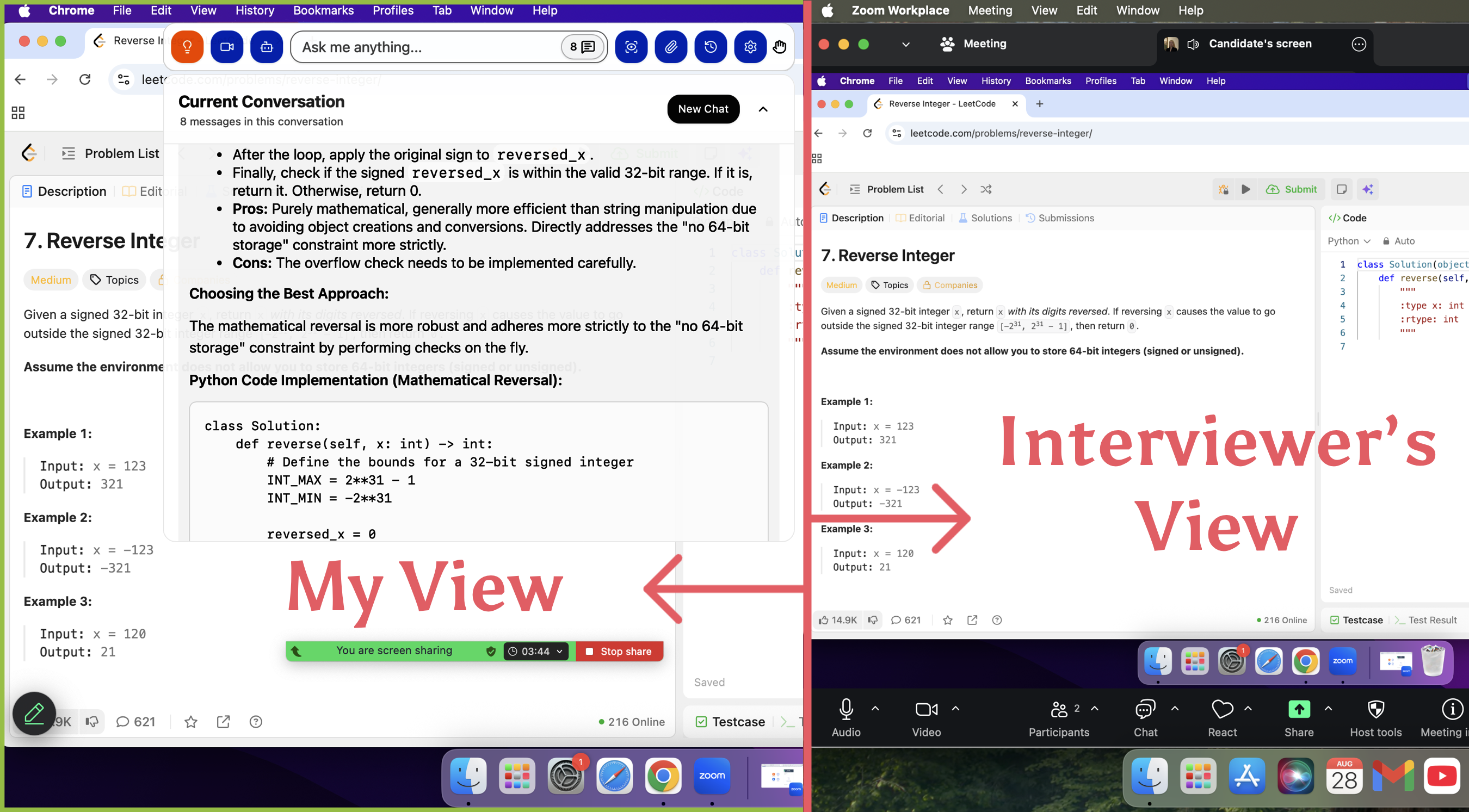
Honestly, I didn't think I'd made it past the second interview stage. The day after I got the pass notification was Superday, so I hadn't done any targeted prep for the JP Morgan Superday. But thankfully, I had Linkjob to help. It provides answers and complete reasoning without being detected by interviewers, so I used it throughout the entire Superday—it was a huge help.
Technical Interview
Walk me through the three financial statesment
This is a fundamental question, but it reveals whether your foundational knowledge is solid.
-Income Statement: Starting with revenue, subtract COGS to get gross profit. Then subtract operating expenses to arrive at operating income (EBIT). Next, subtract interest expense and taxes to finally arrive at net income.
-Balance Sheet: Assets = Liabilities + Shareholders' Equity. It provides a snapshot reflecting the company's financial position at a specific point in time.
-Cash Flow Statement: Starting with net income, adjust for non-cash expenses (like D&A) and changes in working capital to arrive at cash flow from operations. Add cash flow from investing activities and cash flow from financing activities to arrive at the net change in cash.
How do the three statements link together
This question builds upon the previous one, testing your understanding of the relationships between the three statements.
- Net income flows from the bottom of the Income Statement to the top of the Cash Flow Statement and to the Shareholders' Equity section of the Balance Sheet (via retained earnings).
- Depreciation & Amortization (D&A) is an expense on the Income Statement but must be added back on the Cash Flow Statement because it is a non-cash expense. On the Balance Sheet, it reduces the value of Property, Plant, and Equipment (PP&E).
- Changes in working capital affect Cash Flow from Operations while also reflecting in the Balance Sheet's current assets and current liabilities.
- Capital expenditures decrease Cash Flow from Investing while simultaneously increasing PP&E on the Balance Sheet.
Walk me through a DCF
DCF is the core of valuation, and you need to be able to clearly explain the entire process.
- Projected Free Cash Flow (FCF): Typically forecast for 5-10 years. FCF = EBIT * (1 - tax rate) + Depreciation & Amortization - Capital Expenditures - Change in Net Working Capital.
- Calculate Terminal Value: Two primary methods exist:
Gordon Growth Model and Exit Multiple Method.
- Discount FCF and Terminal Value: Use WACC (Weighted Average Cost of Capital) as the discount rate to discount future cash flows to present value, yielding Enterprise Value.
- Calculate Equity Value: Enterprise Value - Net Debt = Equity Value.
- Calculate Implied Share Price: Equity Value / Diluted Shares Outstanding.
These are the issues I encountered during this segment and my approach to addressing them. I hope this proves helpful to you.
Behavior/ Fit Interview
My first interview focused on behavioral and fit questions. The interviewer wanted to know who I was beyond my resume. Here are some questions I faced:
Tell me aboyut yourself.
Why JP Morgan?
Why investment banking?
Walk me through a recent deal.
I think the key to this segment lies in presenting yourself as a passionate, well-rounded professional to the interviewers. Share your career journey with them, demonstrating your enthusiasm for deal execution. Crucially, ensure you have a thorough understanding of JP Morgan as an institution. During the Q&A, be prepared to address specific differentiators and recent deals.
Market & Macro Interview
This section is similar to questions commonly asked in most investment banking interviews. The following are some I have encountered and my response strategy:
Current Market Conditions: Monitor interest rates and sector trends
Company Analysis: Conduct in-depth research on companies covered by JP Morgan
Sector Preferences: Provide substantive reasoning; avoid relying solely on “hot” labels
Reasons for Stock Declines: Earnings misses, guidance downgrades, sector headwinds
M&A Recommendations: Strategic rationale, valuation, financing structure
Financing Options: Analyze pros and cons of debt vs. equity
JP Morgan's interview questions are fairly consistent, but I ran into a very niche topic in DCF modeling. Fortunately, Linkjob provided the answer. It's incredibly useful—it quickly gave me the correct answers and response strategies throughout all three rounds of interviews. What's great is that interviewers can't detect it, so I could use it throughout the entire process.
How To Prepare For JP Morgan Superday
As mentioned earlier, I didn't have enough time to specifically prepare for JP Morgan Superday. Below are some general preparation tips I used throughout my entire job search process.
Recommended Resources
Market News: Bloomberg 5 Things to Start Your Day
Personally, I'm not a big fan of the Financial Times—maybe we just don't click. I highly recommend subscribing to Bloomberg's 5 Things to Start Your Day. You'll receive a daily email. I usually scan the headlines first, then skip straight to the end for “Here is what XXX is interested in this morning.” This section offers concise commentary on the day's topics—accessible and engaging, like following a daily TV series.
Corporate Finance: BIWS or CFA
I personally used BIWS's course—just the foundational one is sufficient. It covers everything from accounting to M&A, and the English materials are super handy for interview prep. If BIWS isn't an option, CFA Level I works too. I especially loved the Financial Statements section.
Preparation Strategies
Below are the steps I took to prepare for the interview and my recommendations after the interview concluded.
Share your career journey and highlight projects you've worked on to showcase a more authentic and multidimensional version of yourself during behavioral rounds.
Conduct mock interviews to familiarize yourself with the interview pace.
Develop a plan to reinforce knowledge across all categories and practice modeling exercises daily.
Research the company's cultural background and recent projects before the interview.
Research and learn from others' interview experiences—especially for firms like JP Morgan, knowing common interview questions in advance is invaluable.
Conduct post-interview debriefs and compare your experience with others.
Practice Tips
I found that practice was the most important part of my preparation for the jp morgan superday. Here are my top tips:
I simulated the consulting superday and investment banking superday environment. I asked friends to act as interviewers and give feedback.
I reviewed my resume and made sure I could explain every line. I wanted to be ready for any follow-up questions.
I stayed updated on market news. I prepared to discuss recent events during the investment banking superday.
I focused on my mindset. I reminded myself to stay calm and positive, even if I didn’t know every answer.
Tip: Practice under timed conditions. This helps you get comfortable with the fast pace of the consulting superday and investment banking superday.
I learned that preparation is not just about studying. It’s about building confidence and showing your best self. The jp morgan superday is tough, but with the right resources, strategies, and practice, you can stand out.
After The JP Morgan Superday
Feedback And Follow-Up
After the jp morgan superday, I felt a mix of relief and anticipation. I knew the waiting game had started. Most candidates expect feedback within 24 to 72 hours, but sometimes the timeline stretches longer. I’ve heard stories where people waited a few days, and others who didn’t hear back for weeks. Some banks don’t send rejection emails, so silence can mean you didn’t get the offer. I checked my inbox often and tried not to stress. If you don’t hear back right away, don’t panic. The process can take time.
Note: Always send thank-you emails to your interviewers within a couple of hours after the interviews. Mention something specific from your conversation and show your appreciation.
Offer Timeline
I watched my email closely after the superday. Here’s what I learned about the offer timeline:
Feedback usually arrives within a few days, but sometimes it takes up to two weeks.
Some banks never send rejection emails, so you might not get a response.
If you receive an offer, the email will include next steps and deadlines.
I felt excited when I saw the subject line pop up. If you get an offer, celebrate! If not, don’t let it discourage you. Superday acceptance rates are low, and many strong candidates don’t get through.
Next Steps
If you don’t receive an offer, here’s what I recommend:
Send a polite follow-up email to the recruiter or interviewer asking about your status.
Thank each interviewer for their time and mention topics you discussed.
Express your continued interest and ask for feedback if possible.
I learned that persistence matters. Even if you don’t get the job, staying in touch can help you in future recruiting cycles. Keep practicing, keep networking, and stay positive. The jp morgan superday taught me a lot about myself and the industry. If you keep improving, your next opportunity might be just around the corner.
I learned that preparation makes all the difference. Staying updated on market trends and practicing technical questions helped me feel ready. Authenticity mattered most—I shared my real stories and connected them to JP Morgan’s culture. Here’s what worked for me:
Build confidence by mastering technical skills and structuring answers with the STAR method.
Stay adaptable and view each interview as a learning opportunity.
Ask thoughtful questions and send thank-you notes.
If you approach Superday with a clear plan and positive mindset, you’ll stand out.
FAQ
How do I handle tough technical questions?
If I don’t know the answer, I stay calm. I explain my thought process and show how I would approach the problem. I never try to bluff. Interviewers respect honesty and logical reasoning more than memorized facts.
What if I get nervous during the interview?
I take a deep breath and remind myself that nerves are normal. I pause before answering. I focus on the question and try to speak slowly. Practicing with friends helps me feel more comfortable in real interviews.
How soon should I send thank-you emails after Superday?
I send thank-you emails within two hours after the interview. I mention something specific from our conversation. I keep the message short and sincere. This shows respect and helps me stand out.
See Also
Insights From My 2026 Bloomberg New Grad Interview Experience
Diverse Questions Faced During My McKinsey Interview Journey
Overview of My 2026 Palantir Interview Process and Queries
Details About My 2026 Perplexity AI Interview Experience
Comprehensive Guide to My Prompt Engineering Interview Process

© Copyright 2025 Linkjob.ai - All Rights Reserved.