Microsoft SDE Interview Secrets: SDE1 Journey, SDE2 Advice

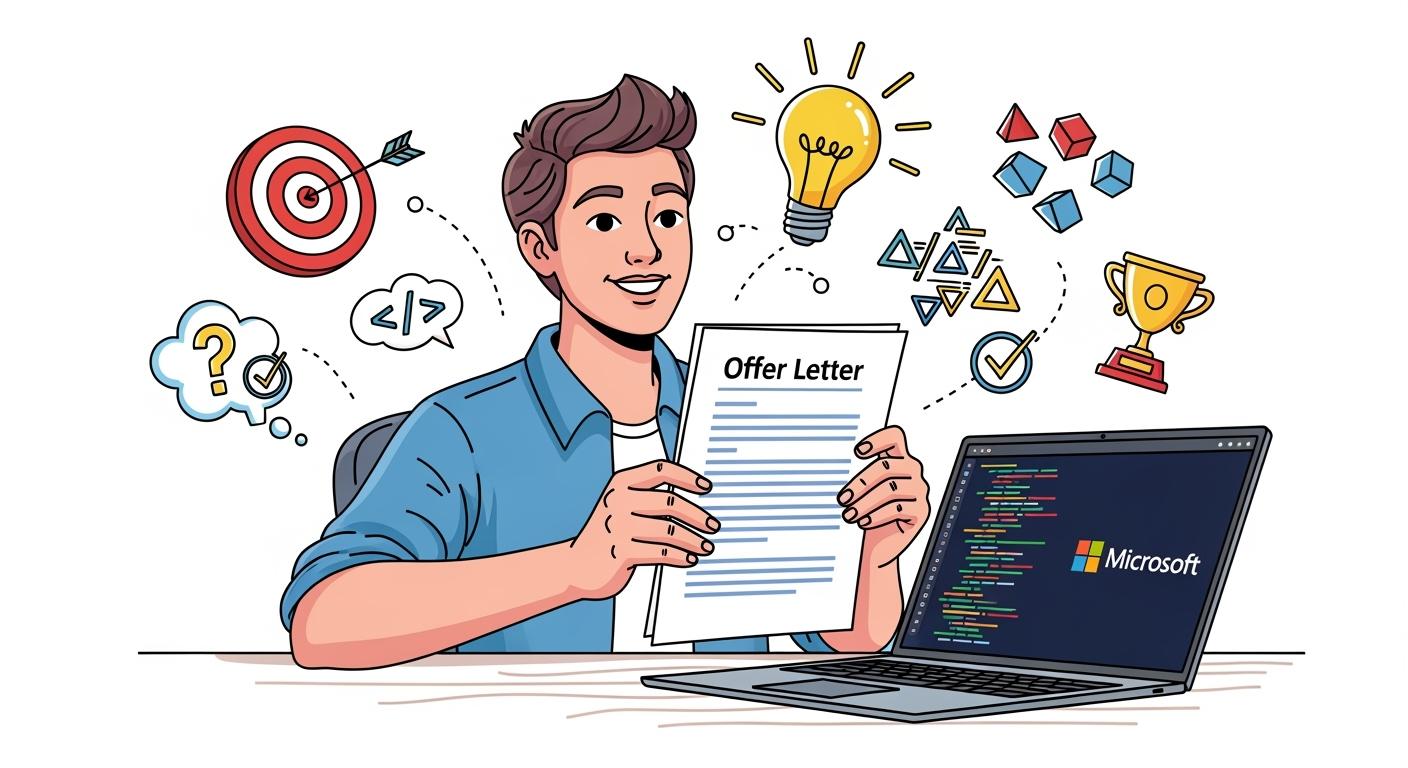
As a CS student graduating in 2026, I spent the past few months deep in LeetCode grind, system design whiteboarding, and countless mock interviews—sometimes coding late into the night after classes. Like many of us, I faced rejections, moments of doubt, and the pressure of balancing school with full-time interview prep.
So I’m genuinely excited (and still a little surprised!) to share that I passed the Microsoft SDE1 interview in early 2026. In this post, I’ll walk you through exactly what happened in my rounds, what I wish I’d known sooner—and I’ve also gathered real advice from engineers who’ve been through the SDE2 loop, so you can see what’s ahead.
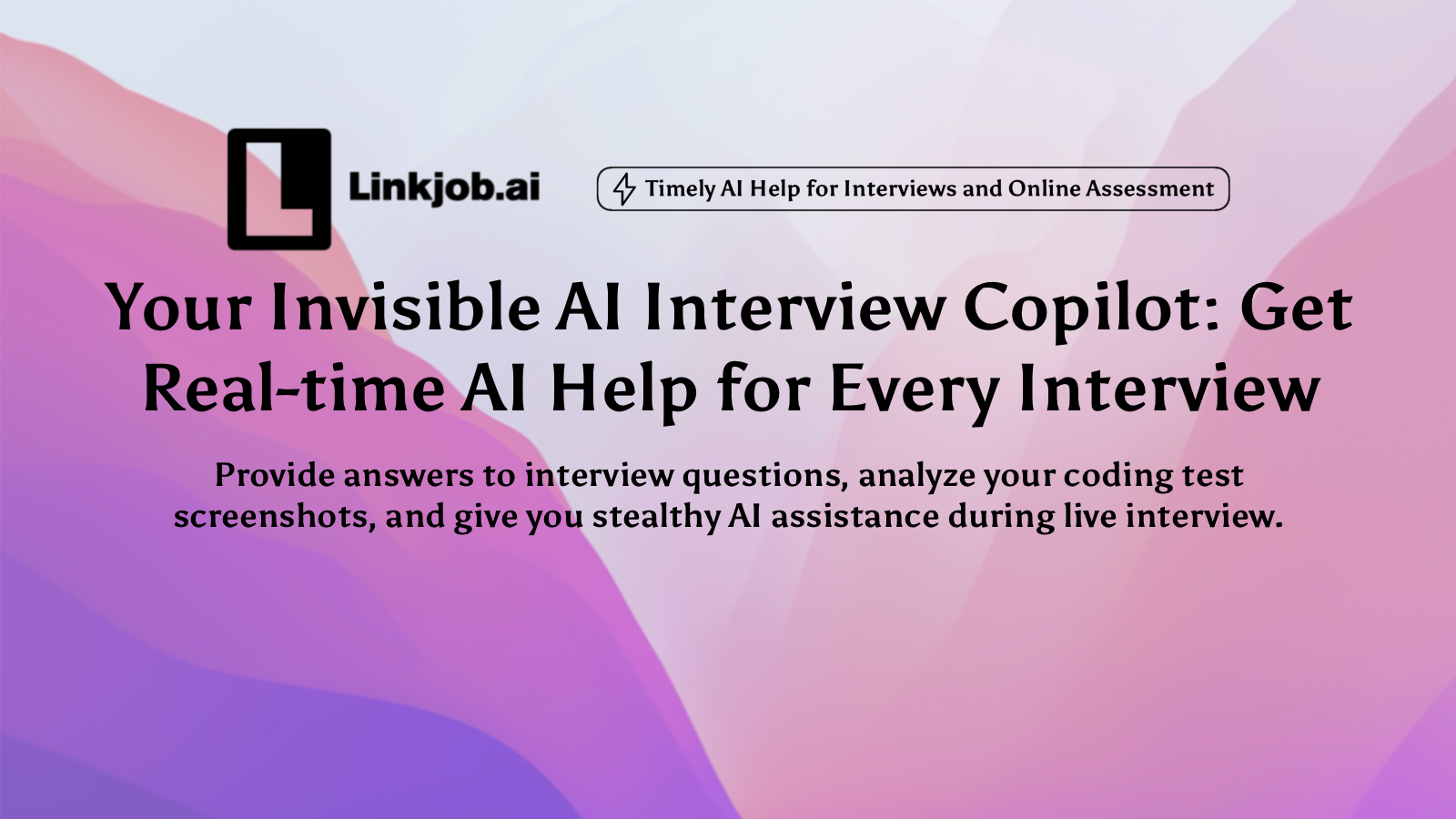
I’m really grateful to Linkjob AI for helping me pass my interview, which is why I’m sharing my SDE interview experience here. Having an undetectable AI Interview Assistant during the interview indeed provides a significant edge.
Microsoft SDE Interview Process
When I started my microsoft sde1 interview journey, I realized that understanding the process made everything less intimidating. Each stage has its own focus, and knowing what to expect helped me prepare smarter.
HR Screening
The first step was a recruiter call. The recruiter wanted to know about my background, my interest in the role, and if I matched the basic requirements. This part felt like a friendly chat, but I made sure to highlight my projects and explain why I wanted to join Microsoft. Here’s a quick look at the official stages:
Stage | Description |
|---|---|
Recruiter Call | Initial screening to discuss qualifications and interest in the role. |
Codility Test | Online coding assessment focusing on problem-solving, algorithms, and data structures. |
Technical Interview | Evaluation of coding skills, system design, and problem-solving abilities. |
Behavioral Interview | Assessment of teamwork, communication, and adaptability using the STAR method. |
Final Loop | Multiple rounds of interviews with team members and hiring managers to assess fit and skills. |
Codility Coding Round
Next came the Codility coding round. I had 60 minutes to solve a set of algorithm and data structure problems. The questions tested my ability to write clean, bug-free code. I practiced on similar platforms before the real thing, which made a big difference.
Technical Interviews
For me, the technical interview consisted of two 45-minute rounds with a 15-minute break in between. The first round was purely technical, while the second was also technical but included some behavioral (HR-style) questions. Both rounds were conducted over Zoom.Some positions conduct interviews on HackerRank. For details, you can refer to this article: Microsoft HackerRank test.
The technical interviews focused on coding, system design, and problem-solving. I got questions that required me to explain my thought process and write code in real time. Sometimes, I had to design a system from scratch. Here’s a breakdown of the formats I faced:
Interview Type | Description |
|---|---|
Coding | Show coding skills with clean, concise code in my preferred language. |
System Design | Demonstrate understanding of building or designing scalable systems and software architecture. |
Behavioral | Assess soft skills and cultural fit within the company. |
Behavioral Interviews
The behavioral interviews used the STAR method (Situation, Task, Action, Result). I shared stories about teamwork, communication, and how I handled challenges. The interviewers wanted to see if I could adapt and work well with others.
Virtual Interview Tips
Since all my interviews were virtual, I made sure to:
Test my webcam, microphone, and internet connection before each round.
Choose a quiet, well-lit space to avoid distractions.
Charge my laptop fully and silence my phone.
Dress comfortably but professionally.
Stay calm and ready to handle any tech issues.
Thanks to Linkjob AI, which is an undetectable AI coding interview copilot during the interview indeed provides a significant edge, I was able to approach questions and coding problems more calmly and with clearer, more structured thinking.
Note: Not all interview assistants can remain undetected like Linkjob. Before choosing an AI interview assistant, you may want to read this article: top AI tools for cheating.
My Interview Questions
When I went through the microsoft sde interview, I faced a mix of coding, system design, and behavioral questions. I want to break down the types of questions I got, how I approached them, and what helped me succeed.
Coding Questions
The coding questions focused on problem-solving with data structures and algorithms. I saw a pattern in the topics, so I made sure to practice these areas:
Arrays and strings
Linked lists
Trees and graphs
Here are some of the actual questions I encountered:
Two-sum problem
I used a hash map to store numbers and their indices. This let me check for the complement in constant time.def two_sum(nums, target): lookup = {} for i, num in enumerate(nums): if target - num in lookup: return [lookup[target - num], i] lookup[num] = iReverse a linked list
I iterated through the list, reversing the pointers one by one.Tip: Draw the nodes on paper if you get stuck. Visuals help a lot.
Matrix zeroing
I marked rows and columns to be zeroed, then updated the matrix in a second pass.Check if a binary tree is a BST
I used an in-order traversal and checked if the values were in ascending order.Remove duplicates from a string in-place
I used two pointers to overwrite duplicates as I scanned the string.Search for an element in a rotated sorted array
I applied a modified binary search to handle the rotation.Add two numbers represented by linked lists
I traversed both lists, added corresponding digits, and managed the carry.
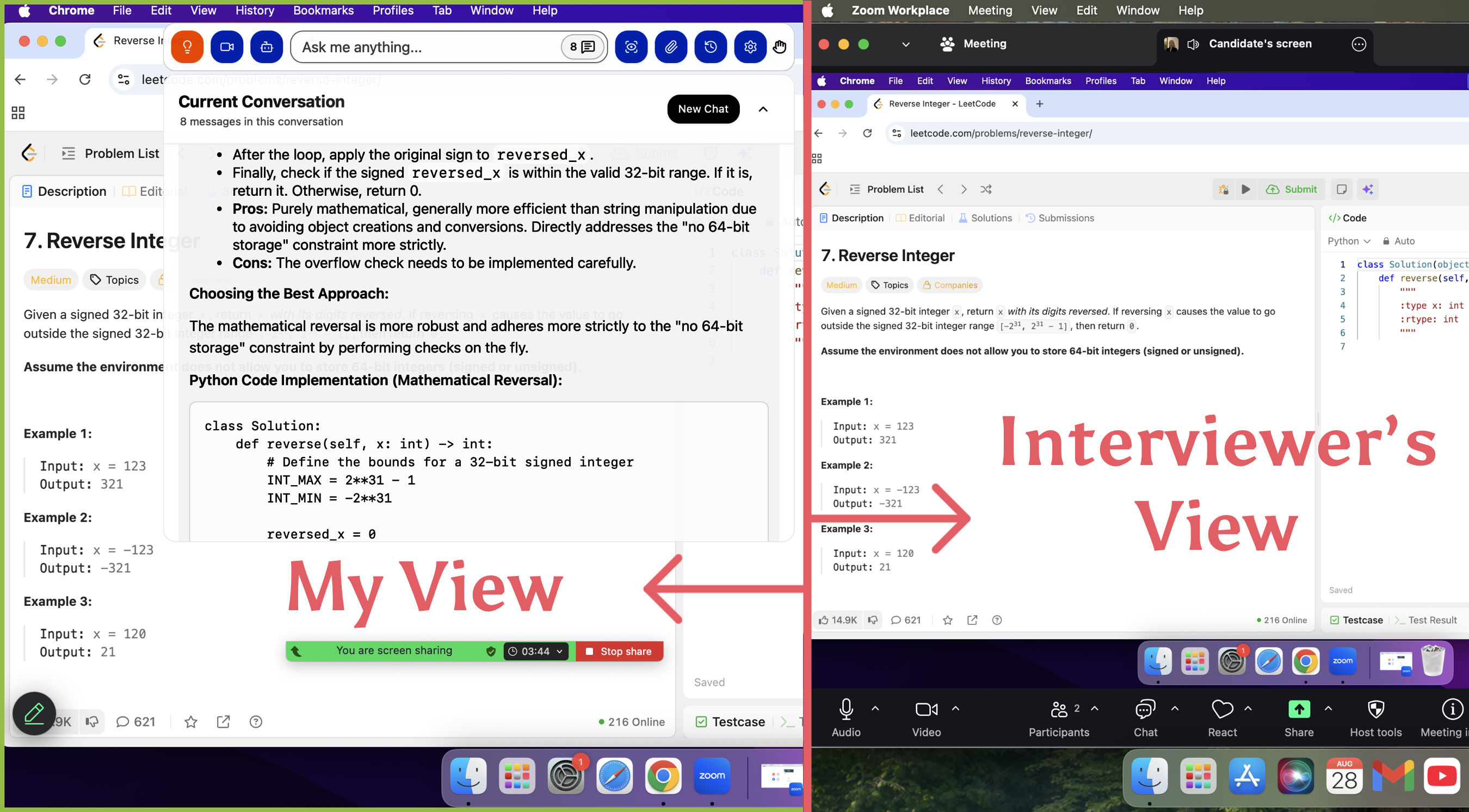
The tool's performance during my interview was exactly like this official promo image—it really is undetectable. And the results were undeniably great.
System Design Questions
During my second technical round, the interviewer focused on both coding and system design questions.The interview problem was set in the context of Azure Storage Services, where I was asked to design a simplified key-value store supporting three operations: put(key, value), get(key), and getWithPrefix(prefix).
I started with the most straightforward approach: using a hash map to implement put and get in O(1) average time. However, I immediately recognized that getWithPrefix would require a full scan of all keys—O(n) time—which doesn’t scale well under high data volume or frequent prefix queries.
To address this, I proposed two optimized alternatives:
A Trie (prefix tree), which naturally supports efficient prefix-based traversal, or
An ordered map (e.g., TreeMap in Java), which allows range queries via lexicographical ordering of keys—enabling
getWithPrefixin O(k + m log n) time (where k is prefix length and m is the number of matching keys).
The interviewer appreciated this progression from a basic implementation toward scalable design thinking. We then dove into system-level considerations:
How to shard the key space across multiple nodes (e.g., consistent hashing or key-range partitioning),
Trade-offs between strong vs. eventual consistency in a distributed setting,
Strategies for caching hot prefixes using an in-memory layer like Redis to reduce backend load,
And how metadata indexing (e.g., inverted indexes for prefixes) could further accelerate lookups at scale.
We didn’t complete a fully tested implementation; instead, after coding a clean, basic version of the core logic, the conversation shifted toward distributed systems trade-offs, fault tolerance, and real-world constraints in cloud storage services like Azure Blob or Table Storage.
This round effectively assessed not just coding ability, but also system intuition, iterative design, and the ability to bridge single-machine solutions to distributed architectures—exactly what Microsoft looks for in SDE candidates.
Behavioral Questions
Behavioral questions let the interviewer see how I work with others and handle challenges. They often used the STAR method (Situation, Task, Action, Result). Here are some questions I got:
How have you fostered a collaborative and inclusive environment within a diverse team?
How have you prioritized customer satisfaction and addressed their needs effectively?
How do you balance the demands of a fast-paced, innovative environment while maintaining your focus and productivity?
How have you adapted to changing priorities and evolving technologies?
How do your personal values align with Microsoft's mission to empower every person and every organization on the planet to achieve more?
My approach:
I wrote down answers to common behavioral questions before the interview.
I practiced saying my answers out loud to sound natural.
I used real stories from my projects, focusing on what I did and what I learned.
Tip: Practice the STAR method for every story. Keep your answers clear and to the point. If you get nervous, pause and think before you answer.
If you want to do well in the behavioral round, try interviewing yourself in front of a mirror or with a friend. This helps you get comfortable sharing your experiences.
By preparing for these types of questions and using a structured approach, I felt confident in every round of the microsoft sde interview.
Battle-tested SDE2 Advice
While preparing for the SDE1 interview, I also studied the SDE2 role. SDE1 and SDE2 are two common engineering levels in tech companies, representing early-career to mid-level software engineers. Their key differences are summarized below:
Dimension | SDE1 | SDE2 |
|---|---|---|
Experience | 0–2 years (new grads or entry-level) | 2–5 years (with experience delivering full projects) |
Role Focus | Executor (Individual Contributor) | Independent contributor + light technical leadership |
Coding Scope | Implement well-defined tasks, fix bugs, contribute to modules | Design modules/services, own end-to-end feature delivery |
System Design | Rarely required; if asked, kept simple | Required; must demonstrate architectural thinking and trade-off analysis |
Interview Rounds | 3–4 rounds (focused on DSA + behavioral) | 4–5 rounds (DSA + system design + leadership/behavioral) |
In addition to sharing my Microsoft SDE1 interview experience, I’ve compiled verified SDE2 questions and actionable insights from recent interviews across the industry.
Online Assessment (OA) Is Just a Filter
Expect 2 problems in 70 minutes (e.g., basic DSA + debugging). Passing ~80% of test cases is often enough to move forward.DSA Rounds Are Rigorous & Executable
You’ll face 2–3 medium-to-hard LeetCode-style problems (e.g., Asteroid Collision, Merge In Between Linked Lists, Cheapest Flights Within K Stops).
You must write, test, and run code live—often in your preferred language (C++/Java/Python).
Interviewers may ask language-specific follow-ups (e.g., C++ memory/threading details).
Design Rounds Test Real-World Engineering
Low-Level Design (LLD): Focus on clean OOP, interfaces, and thread safety (e.g., mutex/locks for concurrent transaction filtering).
High-Level Design (HLD): Be ready to design scalable cloud systems (e.g., Cloud Logging System). Use analogies (like AWS CloudWatch) and draw clear diagrams.
Emphasize trade-offs, not just components.
Behavioral & Leadership Matter — Especially with Senior Interviewers
The Hiring Manager (a VP-level L70) skipped coding entirely and asked a hypothetical estimation question: “How many physical devices are needed in a new Microsoft data center?”
The goal wasn’t technical precision—it was to assess structured thinking, prioritization, and real-world awareness (e.g., power, space, cooling—not just servers).
Process Timeline Is Unpredictable
From final interview to offer: ~3 weeks (despite “soon” promises). Patience is key.Mindset Wins
The candidate demonstrated:Iterative problem-solving
Willingness to adapt (e.g., switching from technical to operational thinking)
Curiosity (asking about team/org structure)
💡 Final Tip: Microsoft SDE2 isn’t just about coding—it’s about owning systems end-to-end, communicating trade-offs, and showing you can operate at scale. Prepare like an engineer who ships, not just solves.
Preparation Strategies
Study Plan
I started my microsoft sde interview prep with a clear plan. I gave myself six weeks. Each night, I spent about two hours practicing. I broke my schedule into three main parts: coding, system design, and behavioral questions. I set up 1:1 meetings with Microsoft employees. These chats gave me real insights and helped me focus on what mattered. I always took breaks between practice sessions. This kept my mind fresh and helped me avoid burnout. I made sure to prepare for every type of question I might see, from technical to behavioral.
Here’s how I structured my study plan:
Focused on one topic each week (coding, system design, behavioral)
Scheduled mock interviews in Linkjob AI, in which I can enhance my interview ability
Watched interview prep videos for specific roles
Reviewed feedback after each practice session
Best Resources
I used a mix of resources to cover all areas. Daily coding practice helped me spot weak points. For system design, I checked out GitHub repositories and YouTube playlists. Books like "Operating Systems: Three Easy Pieces" and "Database Systems Concepts" boosted my computer science basics. I practiced the STAR method for behavioral questions. I also researched Microsoft’s interview process and culture to tailor my answers.
My favorite resources:
LeetCode and Neetcode for coding
YouTube for system design walkthroughs
STAR method guides for behavioral prep
Others' Microsoft interview experience: Microsoft AI engineer interview
Mistakes to Avoid
I learned from my own mistakes and from others. I made sure to talk through my code during interviews. This showed my thought process. I kept my behavioral answers structured and clear. I always checked for edge cases and tested my solutions. I focused on a few key projects on my resume instead of listing everything. I also paid attention to how my work impacted users and products.
Tip: Practice explaining your solutions out loud. This helps you stay clear and confident during the real interview.
Interview Day & Reflections
Managing Stress
On the day of my microsoft sde interview, I felt nervous but ready. I used a few strategies to keep my stress under control:
I prepared thoroughly by reviewing my notes and practicing common technical questions.
I took deep breaths and did a short meditation before logging in.
I made sure to get enough sleep and eat a healthy breakfast.
I reminded myself of my past achievements and kept a positive attitude.
I paused to think before answering each question, which helped me stay calm.
These steps made a big difference. I treated the interview as a two-way conversation, not just a test. I sat up straight, made eye contact with the interviewer, and smiled when I could. This helped me feel more confident and present.
Communication Tips
Clear communication helped me stand out. I practiced explaining my thought process out loud during mock interviews. On the actual day, I focused on:
Speaking slowly and clearly.
Explaining my decisions and the reasons behind them.
Staying calm, even when I got stuck on a problem.
Following interview etiquette, like listening carefully and not interrupting.
I found that sharing my approach step by step made it easier for the interviewer to follow my logic. If I needed a moment to think, I said so. This showed that I could handle pressure and solve problems thoughtfully.
Lessons Learned
Looking back, I learned a few important lessons:
Communicating trade-offs matters as much as writing code.
Designing for current needs is key, but I should always consider future changes.
Clean, maintainable code wins over clever tricks, especially when time is short.
If you prepare well, manage your nerves, and communicate clearly, you can succeed in the microsoft sde interview. Every round is a chance to show your skills and learn something new.
Passing the Microsoft SDE interview takes focus and steady effort. Here’s what worked best for me:
I practiced 50-100 coding questions daily on LeetCode and HackerRank.
I reviewed data structures, algorithms, and system design basics.
I prepared real examples from my past work to show leadership and teamwork.
I researched Microsoft’s values and shared my thought process in every answer.
I kept my practice consistent and started with easy problems before moving to harder ones. If you stay curious, learn from others, and believe in yourself, you can do this too! For your next steps, try mock interviews and keep building your skills every day.
FAQ
What coding languages should I use for the Microsoft SDE interview?
I used Python because I felt comfortable with it. You can choose Java, C++, or any language you know well. The key is to write clean code and explain your logic clearly.
How did I practice system design questions?
I sketched diagrams on paper and talked through my ideas out loud. I focused on breaking big problems into smaller parts. I used YouTube and GitHub for examples and practiced explaining my choices.
What if I get stuck during a coding question?
I pause, take a breath, and talk through my thought process. I ask clarifying questions if needed. Sometimes, I write a brute-force solution first, then improve it. Staying calm helps me think better.
How do I prepare for behavioral interviews?
I write down stories from my past projects. I use the STAR method to organize my answers. I practice speaking out loud and keep my responses short and clear.
Can I ask questions during the interview?
Absolutely! I always ask about the team, the role, or the company culture. Asking questions shows interest and helps me learn if the job fits me.
See Also
My 2025 Anthropic SWE Interview Experience and Questions
Leveraging AI Tools to Ace My Microsoft Teams Interview
Insights from My Oracle Software Engineer Interview in 2025
© Copyright 2025 Linkjob.ai - All Rights Reserved.