Microsoft System Design Interview 2026: Questions & Advice


In late January 2026, I just received an SDE offer from Microsoft. My journey started in early December 2025 when I was referred for an SDE position at Microsoft Australia. About a week later, I received an email from a recruiter scheduling a 30-minute phone screening.
This was followed by three technical interview rounds. Since Microsoft typically hires by team, each round was with a different team within the company. The process concluded with a behavioral interview conducted by the hiring manager, focusing on my project experiences, teamwork, and how I’ve handled challenges—particularly assessing growth mindset and collaboration.
For the most challenging technical round, I’d like to share the system design question I encountered, along with my preparation strategy and approach to mastering system design interviews.
I’m really grateful to Linkjob AI for helping me pass my interview, which is why I’m sharing my system design interview experience here. Having an undetectable AI Interview Assistant during the interview indeed provides a significant edge.
Microsoft System Design Questions I Faced
All three interview rounds followed a similar pattern: each started with a fixed resume discussion, followed by an unpredictable mix of coding questions and system design (SD) problems. These are collectively referred to as "tech rounds."
In every round, I was first asked to walk through my resume, after which the interviewer would pivot with something like, "Let’s now do a coding/system design problem."
In my case, two out of the three rounds began with a coding question—and after finishing the coding part, I was then asked to tackle a system design problem. The third round didn’t include any coding at all and focused solely on system design.
Of course, this is just my own experience—and the YouTube video I watched before the interview helped a bit too—but neither one was a perfect match for what actually happened. Honestly, you never know what you’ll get: one round might be all coding, another pure system design, or even a mix of both. It really just depends on the interviewer! Therefore, What you really need to understand is mastering the method of analyzing problems.
Most Memorable Question
The most memorable system design question I encountered was as follows:
Build a multi-region quota & rate-limit system for Microsoft internal TI APIs that authenticates via AAD service principals, enforces per-customer limits with token-bucket bursts across second/minute/day windows at the API gateway, returns 429 on exceed, supports regional or global sharing, offers self-serve onboarding, real-time policy updates, monitoring, and chargeback.
This is a high-level system design question that asks you to build a multi-region, quota and rate-limiting system for Microsoft’s internal APIs. It evaluates your ability to design a scalable, secure, and observable distributed system that handles authentication (via Azure AD), enforces fine-grained per-customer limits with token-bucket bursting across multiple time windows, supports flexible quota sharing models (regional or global), and enables real-time policy updates—all while ensuring low latency, high availability, and operational features like monitoring and chargeback. The core focus is on trade-offs in distributed systems, not just algorithms.
I’ll use this question as an example to show you how to confidently and effectively tackle system design interviews. I’ll break it down into the following five steps:
Clarify Requirements.
Just to confirm:
This is for internal Microsoft APIs, authenticated via AAD service principals.
We need per-customer rate limits with token-bucket bursts across second/minute/day.
Quotas can be regional or global.
And we must support real-time updates and return 429 on exceed.
anlayze Its High-Level Architecture
I’d place the rate limiting logic at the API gateway, right after AAD authentication.The gateway checks a central policy store for the customer’s quota config, then applies a token-bucket algorithm to decide allow/deny. If over limit → return 429 immediately.
Dive into 1–2 Key Challenges
Step 3 is diving into one or two key technical aspects. During the interview, I used Linkjob.ai to quickly analyze this problem, and it highlighted two critical focus areas. Combining my own knowledge with undetectable AI assistance during interviews, I delivered a particularly strong response in this section, which earned me positive feedback from the interviewer on the spot.
Option A: How to implement multi-window token bucket efficiently?
“For second/minute/day windows, I’d use Redis sorted sets with timestamps.
For each request, add an entry with current time, then trim old entries outside the window.
Count remaining entries → if > limit, reject.
This supports bursts and is O(log N).”Option B: How to handle global vs regional sharing?
“If quotas are global, we need coordination across regions.
One option: use a central Redis cluster in a primary region for counters — but that adds latency.
Better: allow local enforcement with eventual sync, and tolerate small overuse (e.g., <1%) during spikes.
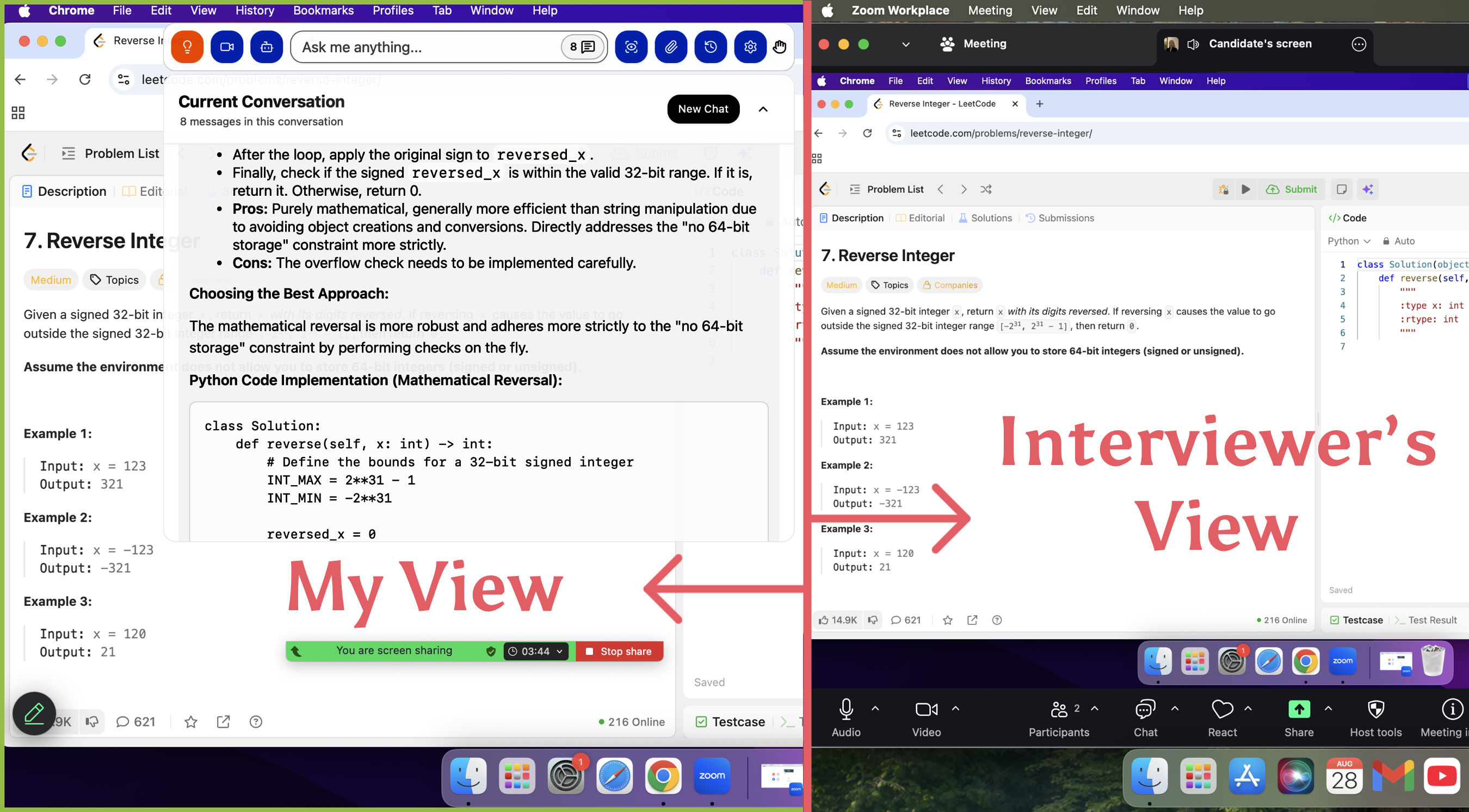
Or use sharding by customer ID so all requests for one customer go to the same region.”The tool's performance during my interview was exactly like this official promo image—it really is undetectable. And the results were undeniably great.
Mention Monitoring & Chargeback
Don’t skip operational concerns, but keep this part brief and structured.
Mention two layers:
Monitoring: What metrics matter? (e.g., 429 rate, latency, quota utilization)
Chargeback: What data must be logged? (customer ID, timestamp, region, endpoint, cost unit)
Suggest a simple pipeline (e.g., logs → event stream → storage + dashboard) without diving into tool names unless asked.
Frame it as: “These aren’t afterthoughts—they’re required for internal systems like this.”
This shows you think beyond pure functionality to real-world operability.
Invite Feedback
End your response by turning the monologue into a dialogue.
Explicitly acknowledge trade-offs you simplified (e.g., “I assumed eventual consistency for global quotas—happy to discuss stronger guarantees if needed”).
Ask the interviewer to guide the next depth level:
“There are several directions we could go deeper—consistency, failure handling, or scalability. Which aspect interests you most?”
This demonstrates humility, awareness, and adaptability—all signals of senior engineering judgment.
Remember: the interview isn’t about giving a perfect answer—it’s about showing how you think under guidance.
Interviewer Feedback
After each round, the interviewer gave me feedback. Sometimes they liked my high-level design but wanted more details about a specific component. Other times, they asked me to think about edge cases, like what happens if two users edit the same line at the same time.
Here’s a table that sums up the feedback I received:
Feedback Area | What I Did Well | What I Could Improve |
|---|---|---|
Clarifying Requirements | Asked good questions up front | Could dig deeper on scale |
High-Level Design | Clear diagrams and explanations | Add more about data flow |
Deep Dive | Strong on real-time updates | More on security and costs |
Trade-Offs | Discussed pros and cons | Suggest more alternatives |
Handling Edge Cases | Covered most scenarios | Think about rare failures |
The feedback helped me see where I needed to grow. I learned that the microsoft system design interview rewards candidates who stay curious and keep asking questions. I also realized that showing how I think matters as much as getting the “right” answer.
Common Microsoft System Design Interview Questions
Infrastructure-Based Examples
When I talked with other candidates, I noticed that Microsoft loves to ask about real-world infrastructure problems. These questions test how I think about data, performance, and reliability. Here are some examples I saw pop up in the microsoft system design interview:
Design a schema for a high-volume e-commerce analytics warehouse.
This query is scanning 10TB of data. How would you optimize it?
Explain when to use a clustered vs. non-clustered index.
How would you handle slowly changing dimensions for customer attributes?
These questions made me think about storage, indexing, and how to keep systems fast even with huge amounts of data. I found that interviewers wanted me to explain my choices, not just give a quick answer.
Product-Based Examples
Product-based questions felt a bit different. Interviewers wanted to see how I would design features that millions of people use every day. Some examples I heard from others included:
Design a document editor with real-time collaboration.
Build a job scheduling system for cloud services.
Create a movie ticket booking platform that handles peak traffic.
Design a notification system for a messaging app.
I liked these questions because they let me show how I balance user experience with technical trade-offs. I always tried to ask about user needs and business goals before jumping into the design.
Trends in 2026
I noticed some big changes in the types of questions asked this year. Here’s a table that sums up what’s new in 2026:
New Trends in 2026 | Description |
|---|---|
Advanced Knowledge | Focus on distributed systems, real-time systems, and architectural patterns. |
Communication of Trade-offs | I had to explain why I made certain design choices. |
Real-time Systems | More questions about WebSockets and live dashboards. |
Security in Design | Security features like OAuth2 and encryption were must-haves. |
Shift from Microservices | Less focus on buzzwords, more on solid architecture. |
Tip: If you want to stand out, practice explaining your design decisions and always think about security and real-time features.
I saw that the microsoft system design interview now expects deeper knowledge and better communication. It’s not just about drawing diagrams. It’s about showing how I solve real problems.
Preparation Tips and Strategies
Study Materials and Resources
I always start my prep with the right study materials. Some resources helped me more than others. Here’s what I found most useful:
Fahim ul Haq’s System Design Interview Study Guides break down real interview scenarios.
The System Design Handbook focuses on how to communicate your ideas.
AWS Architecture Blog shows practical design patterns.
MIT 6.824 Distributed Systems offers a free, deep dive into distributed systems.
Designing Data-Intensive Applications by Martin Kleppmann explains modern system design.
Alex Xu’s System Design Interview books cover both basics and advanced topics.
LeetCode helps me practice algorithms and pattern recognition.
Linkjob.ai gives free frameworks for system design questions.
Excalidraw lets me sketch out system diagrams quickly.
Tip: Mix reading with hands-on practice. I learn best when I sketch out designs and talk through my solutions.
Practice Methods
I use several methods to get ready for the microsoft system design interview. Here’s what works for me:
I work through Microsoft-themed questions, like designing OneDrive or Teams.
I study Azure fundamentals to boost my confidence.
I follow a structured framework to organize my thoughts.
I do mock interviews with friends to simulate real pressure.
I review Microsoft’s products to understand their systems.
I practice pattern matching and solve random problems to sharpen my skills.
A table helps me track my practice routine:
Practice Method | Benefit |
|---|---|
Mock Interviews | Builds confidence |
Product Study | Understands real systems |
Framework Practice | Keeps answers organized |
Azure Learning | Prepares for cloud questions |
Microsoft-Specific Tips
I noticed some strategies work especially well for Microsoft interviews:
I start with a simple version and scale up as needed.
I anchor my design trade-offs in customer impact.
I adapt quickly to interviewer feedback.
I outline my plan and summarize my approach under pressure.
Common pitfalls can trip up even strong candidates. Here’s how I avoid them:
I understand latency and global distribution for CDNs.
I use caching to fix bottlenecks.
I add queues to handle write spikes.
I apply the Saga pattern for distributed transactions.
I choose SQL for consistency and NoSQL for scalability.
Note: Interviewers want depth, not just buzzwords. I always explain why I pick a technology and how it solves the problem.
Lessons and Reflections
Key Learnings
Looking back, I picked up some important lessons from my Microsoft system design interview. I realized that the interview is not just about technical skills. It is about how I think and communicate. Here are a few things that stood out to me:
I need to explain my approach before I start drawing or coding.
I should talk about different ways to solve the problem and discuss the trade-offs.
Asking questions about requirements and constraints helps me avoid mistakes.
Walking through test cases and edge conditions out loud shows my thinking.
Microsoft really values a growth mindset. They want to see if I can handle feedback and learn from it.
These lessons helped me stay calm and focused during each round.
Growth and Perspective
The process changed how I see system design interviews. I used to think they were only about getting the right answer. Now, I know Microsoft wants to see my judgment and how I solve problems. The interview felt more like a conversation than a test. I learned that system design is often messy and full of choices. I had to get creative and think on my feet.
This experience also made me realize that communication matters as much as technical skill. I started to enjoy talking through my ideas and sharing my thought process. I now see technical interviews as a chance to show how I approach real-world problems.
Advice for Candidates
If you are preparing for a Microsoft system design interview, here is my advice:
Stay curious and ask questions. Do not rush into solutions. Take time to understand the problem.
Practice explaining your ideas out loud, even if you are alone.
Focus on why you make certain choices, not just what you choose.
Be open to feedback and show that you can learn from it.
Remember, Microsoft wants to see how you think, not just what you know.
You can do this. Keep learning and growing, and you will be ready for anything the interview throws at you.
FAQ
How much time should I spend preparing for the Microsoft system design interview?
I usually spend about four to six weeks. I practice a few hours each day. I focus on real-world problems and mock interviews. Consistency helps me more than cramming.
What if I get stuck during the interview?
I stay calm and talk through my thoughts. I ask clarifying questions. Interviewers want to see my problem-solving process, not just the final answer.
Do I need to know Azure for the interview?
Knowing Azure basics helps a lot. I review core services like storage, compute, and networking. I mention Azure when it fits the problem, but I focus on strong design principles.
How do I handle follow-up questions from interviewers?
I listen carefully and take a moment to think. I explain my reasoning step by step. If I do not know the answer, I share how I would find a solution.
What resources helped me the most?
Fahim ul Haq’s guides
Alex Xu’s books
MIT 6.824 lectures
LeetCode for practice
Linkjob.ai for interview
These resources gave me both theory and hands-on practice.
See Also
Insights Into My 2025 Oracle Software Engineer Interview Experience
Navigating Dell Technologies Interview Questions: My 2025 Approach
Responding To Continuous Learning Interview Questions: My 2025 Insights
Exploring My 2025 Palantir Interview Experience And Questions
A Journey Through My Technical Support Engineer Interview Q&As
© Copyright 2025 Linkjob.ai - All Rights Reserved.