How I Nailed the Millennium HackerRank OA in 2026My Millennium HackerRank Online Assessment Questions (And How I Passed in 2026)


When the Millennium HackerRank online assessment link arrived in my inbox after I applied for a Software Engineer role at Millennium Management, I knew I was in for a serious test. Millennium is one of the largest and most competitive multi-strategy hedge funds in the world, and unlike standard tech companies that test generic string-reversal warmups, Millennium designs its HackerRank assessments around high-throughput market data processing, limit order book matching, state-machine dynamic programming, and low-latency data structures.
During my 90-minute HackerRank session, I faced a Price-Time Priority Limit Order Book Matching Engine problem, a Rolling Window Volatility & Median Tracker problem, and a block of C++, concurrency, and probability multiple-choice questions (MCQs). On the Order Book problem, a naive O(n) list removal when handling CANCEL order events would have hit a Time Limit Exceeded (TLE) failure on the hidden 100,000-order stress tests if I had not used an AI interview assistant to immediately implement an O(1) lazy-cancellation tombstoning map on top of the price-level deque queues.
In this complete guide, I am sharing my Millennium HackerRank online assessment questions along with the full 2025–2026 question pool I compiled from fellow Software Engineer (SWE), Quantitative Developer (Quant Dev), Quantitative Researcher, and Data Engineer candidates across Millennium's New York, London, Miami, Singapore, Dublin, and Bangalore offices. I will walk you through the exact working Python and SQL implementations, the quant probability and C++ MCQ traps, how HackerRank's proctoring and Code Playback catch shortcuts, and how I use Linkjob AI in both Desktop Floating Window Mode and Dual-Device Mode to clear every hidden test case safely without triggering a single warning.
What My Millennium HackerRank Assessment Looked Like (And the 4 Role Tracks)
Because Millennium operates on a pod and central-platform model across Equities, Fixed Income, Commodities, and Quantitative Strategies, your HackerRank invitation will load one of four specialized assessment templates depending on the role you applied for.
1. Track 1: Software Engineer (Intern, New Grad, Core Trading, Risk & Execution Tech)
This is the primary HackerRank assessment sent to campus and experienced software engineering applicants.
Format and Duration: Typically 90 to 120 minutes containing 2 to 3 medium-to-hard coding questions, often paired with 6 to 10 technical MCQs on data structures, concurrency, and language internals.
Problem Themes: Expect at least one problem involving financial stream or order-book state management (matching bids and asks, tracking sliding-window VWAP or medians, or deduplicating bursts of market ticks) and one problem testing algorithmic optimization (monotonic queues, state-machine dynamic programming, or shortest-path arbitrage graphs) where
O(n^2)solutions fail hiddenn = 10^5test cases.
2. Track 2: Quantitative Developer (Quant Dev) & Quantitative Researcher (QR) Track
If you applied for a Quant Developer or Quant Researcher track, your 90-to-120-minute HackerRank test splits across coding and mathematical rigor:
2 Algorithmic / Numerical Coding Questions: Implementing rolling time-series regression/covariance calculators, optimal trade execution DP, or graph cycle detection.
10 to 15 Quant & Probability MCQs: Brainteasers on conditional probability (Bayes' theorem with biased coins/dice), expected number of trials to hit a pattern (Markov chains), linear algebra (positive semi-definite covariance matrices, eigenvalues, PCA), and ordinary least squares (OLS) assumptions.
3. Track 3: Low-Latency C++ Systems Engineer Track
For ultra-low-latency execution and market-data feed handler teams, the HackerRank assessment often restricts the coding language to C++17 / C++20 and includes deep MCQs testing vtable dispatch overhead, std::move vs. std::forward rvalue references, lock-free SPSC ring buffers (std::atomic memory ordering), and 64-byte CPU cache-line false sharing.
Real Interview Questions. Real Candidates. Continuously Updated
Our interview questions come from real job interviews taken by candidates using Linkjob AI. Based on actual interview experiences and continuously updated with new questions
4. Track 4: Data Engineer & Market Data Analytics Track (Python + SQL)
For data engineering and portfolio analytics roles, the assessment combines 2 Python data-stream processing coding questions with 1 to 2 advanced SQL problems (constructing daily Open-High-Low-Close bars and Volume-Weighted Average Prices from raw tick tables using window functions).
My Real Millennium HackerRank Coding & SQL Questions (With Full Working Solutions)
Below are the exact coding and SQL problems from my Millennium HackerRank session and the most frequently confirmed prompts in Millennium's 2026 question pool, complete with the hidden edge-case traps and 100%-pass implementations.
1. Question 1: Price-Time Priority Limit Order Book Matching Engine (process_orders)
This is the quintessential hedge-fund coding problem on Millennium's HackerRank OA. If you know how to write this cleanly in under 25 minutes, you are already ahead of 90% of the applicant pool.
The Problem Prompt: Build an order book engine that processes a stream of commands:
"ADD <order_id> <BUY|SELL> <price> <quantity>": Insert a new limit order. ABUYorder matches immediately against restingSELLorders ifbest_ask_price <= buy_price(and aSELLorder matches immediately against restingBUYorders ifbest_bid_price >= sell_price). Matching follows strict Price-Time Priority: better prices match first, and ties at the same price level match in First-In, First-Out (FIFO) arrival order. Any unfilled remainder rests on the book."CANCEL <order_id>": Remove any remaining open quantity of<order_id>from the book. If<order_id>is already filled or unknown, ignore the command.
Return the total volume of shares matched across the entire event stream, along with the final best bid and best ask prices.
The O(n) Cancellation Trap: If you scan a heap or list to delete
<order_id>on every"CANCEL"event, each cancellation takesO(n)time and times out on hidden test cases with50,000cancellations! Instead, store adequeof orders at each price level, keep anorder_map[order_id]pointing directly to the order's mutable[order_id, price, open_qty]record, and simply setopen_qty = 0on"CANCEL"inO(1)time, lazily popping zero-quantity orders when they reach the front of a price level!
Here is my complete O(log P) matching, O(1) cancellation implementation:
import heapq
from collections import defaultdict, deque

class LimitOrderBook:
    def __init__(self):
        self.bid_heaps = []                  # Max-heap of (-price)
        self.ask_heaps = []                  # Min-heap of (+price)
        self.bid_levels = defaultdict(deque) # price -> deque of [order_id, open_qty]
        self.ask_levels = defaultdict(deque) # price -> deque of [order_id, open_qty]
        self.orders = {}                     # order_id -> [order_id, open_qty]
        self.total_matched_qty = 0

    def _clean_top_bids(self) -> None:
        while self.bid_heaps:
            best_p = -self.bid_heaps[0]
            q = self.bid_levels[best_p]
            while q and q[0][1] == 0:
                q.popleft()
            if q:
                break
            heapq.heappop(self.bid_heaps)
            self.bid_levels.pop(best_p, None)

    def _clean_top_asks(self) -> None:
        while self.ask_heaps:
            best_p = self.ask_heaps[0]
            q = self.ask_levels[best_p]
            while q and q[0][1] == 0:
                q.popleft()
            if q:
                break
            heapq.heappop(self.ask_heaps)
            self.ask_levels.pop(best_p, None)

    def add_order(self, order_id: str, side: str, price: int, qty: int) -> None:
        if qty <= 0:
            return

        if side == "BUY":
            self._clean_top_asks()
            while qty > 0 and self.ask_heaps and self.ask_heaps[0] <= price:
                ask_price = self.ask_heaps[0]
                ask_queue = self.ask_levels[ask_price]
                resting_order = ask_queue[0]
                trade_qty = min(qty, resting_order[1])
                qty -= trade_qty
                resting_order[1] -= trade_qty
                self.total_matched_qty += trade_qty
                self._clean_top_asks()

            if qty > 0:
                record = [order_id, qty]
                self.orders[order_id] = record
                if price not in self.bid_levels or not self.bid_levels[price]:
                    heapq.heappush(self.bid_heaps, -price)
                self.bid_levels[price].append(record)

        elif side == "SELL":
            self._clean_top_bids()
            while qty > 0 and self.bid_heaps and (-self.bid_heaps[0]) >= price:
                bid_price = -self.bid_heaps[0]
                bid_queue = self.bid_levels[bid_price]
                resting_order = bid_queue[0]
                trade_qty = min(qty, resting_order[1])
                qty -= trade_qty
                resting_order[1] -= trade_qty
                self.total_matched_qty += trade_qty
                self._clean_top_bids()

            if qty > 0:
                record = [order_id, qty]
                self.orders[order_id] = record
                if price not in self.ask_levels or not self.ask_levels[price]:
                    heapq.heappush(self.ask_heaps, price)
                self.ask_levels[price].append(record)

    def cancel_order(self, order_id: str) -> None:
        # O(1) lazy cancellation by zeroing open_qty in place
        if order_id in self.orders:
            self.orders[order_id][1] = 0
            del self.orders[order_id]

    def get_best_bid_ask(self) -> tuple[int | None, int | None]:
        self._clean_top_bids()
        self._clean_top_asks()
        best_bid = -self.bid_heaps[0] if self.bid_heaps else None
        best_ask = self.ask_heaps[0] if self.ask_heaps else None
        return best_bid, best_ask
2. Question 2: Bounded Volatility Subarray Counter (Two Monotonic Deques in O(n) Time)
Millennium loves testing whether you can analyze rolling market-tick stability in linear time (O(n)) rather than quadratic time (O(n^2)).
The Problem Prompt: Given an array of integer tick prices
pricesof lengthn <= 100,000and a maximum allowed volatility spreadmax_spread, return the total number of contiguous subarraysprices[L..R]wheremax(prices[L..R]) - min(prices[L..R]) <= max_spread.My Clean O(n) Two-Deque Sliding Window Solution: Maintain a monotonic decreasing deque
max_dq(tracking the maximum in[left..right]) and a monotonic increasing dequemin_dq(tracking the minimum in[left..right]). Wheneverprices[max_dq[0]] - prices[min_dq[0]] > max_spread, advanceleft += 1and pop expired indices from the front of both deques. For eachright, all subarrays starting fromleft..rightand ending atrightare valid, addingright - left + 1to the count:
from collections import deque

def count_bounded_volatility_subarrays(prices: list[int], max_spread: int) -> int:
    max_dq = deque()  # Indices of elements in decreasing order
    min_dq = deque()  # Indices of elements in increasing order
    left = 0
    total_valid = 0

    for right, val in enumerate(prices):
        while max_dq and prices[max_dq[-1]] <= val:
            max_dq.pop()
        max_dq.append(right)

        while min_dq and prices[min_dq[-1]] >= val:
            min_dq.pop()
        min_dq.append(right)

        while prices[max_dq[0]] - prices[min_dq[0]] > max_spread:
            left += 1
            if max_dq[0] < left:
                max_dq.popleft()
            if min_dq[0] < left:
                min_dq.popleft()

        total_valid += (right - left + 1)

    return total_valid
3. Question 3: Optimal Trading Strategy PnL With Execution Fee & Cooldown (State-Machine DP)
In both the SWE and Quant Dev tracks, Millennium tests state-machine dynamic programming modeled around position holding, per-trade execution fees, and risk cooldown windows.
The Problem Prompt: Given an array of daily asset prices
prices, a per-round-trip transaction feefee, and a mandatory1-day cooldown after selling before you can buy again, compute the maximum net profit you can achieve (assuming you can hold at most 1 unit of the asset at a time).My O(n) Time, O(1) Space State-Machine Solution: Track three states at step
i:hold(max profit currently holding a share),sold_today(max profit having just sold today, entering cooldown), andrest(max profit flat and eligible to buy tomorrow):
def max_trading_pnl_with_fee_and_cooldown(prices: list[int], fee: int) -> int:
    if not prices:
        return 0

    hold = -prices[0]
    sold_today = 0
    rest = 0

    for price in prices[1:]:
        prev_hold = hold
        prev_sold = sold_today
        prev_rest = rest

        # Either keep holding, or buy today from the eligible rest state
        hold = max(prev_hold, prev_rest - price)
        # Sell today from hold state and pay the transaction fee
        sold_today = prev_hold + price - fee
        # Either stay in rest, or transition out of yesterday's sold cooldown
        rest = max(prev_rest, prev_sold)

    return max(sold_today, rest)
4. Question 4: Sliding-Window VWAP (Volume-Weighted Average Price) Over a Time Horizon
Unlike fixed-count windows (k elements), market data streams arrive at irregular millisecond timestamps, so Millennium frequently tests a time-based sliding window over [timestamp - window_ms, timestamp].
The Problem Prompt: Given a chronological stream of trades
(timestamp_ms, price, volume)and a lookback durationwindow_ms, return the rolling VWAP (sum(price * volume) / sum(volume)) at each trade's timestamp across all trades falling inside the inclusive window[timestamp_ms - window_ms, timestamp_ms], rounded to 4 decimal places.My O(1) Amortized Per-Tick Solution:
from collections import deque

def compute_rolling_vwap(
    trades: list[tuple[int, float, int]],
    window_ms: int
) -> list[float]:
    window = deque()  # Stores (timestamp_ms, notional_value, volume)
    running_notional = 0.0
    running_volume = 0
    vwap_results = []

    for ts, price, vol in trades:
        notional = price * vol
        window.append((ts, notional, vol))
        running_notional += notional
        running_volume += vol

        # Evict trades strictly older than ts - window_ms
        cutoff = ts - window_ms
        while window and window[0][0] < cutoff:
            _, old_notional, old_vol = window.popleft()
            running_notional -= old_notional
            running_volume -= old_vol

        vwap = (running_notional / running_volume) if running_volume > 0 else 0.0
        vwap_results.append(round(vwap, 4))

    return vwap_results
5. Question 5 (Millennium SQL Track): Generating Daily OHLC & VWAP Bars From Market Ticks
If your Millennium HackerRank assessment includes SQL, this is the exact market-data aggregation problem you need to know cold.
The Problem Prompt: Given a
market_tickstable (ticker,trade_date,trade_ts,price,volume), write a SQL query to produce daily summary bars for each(ticker, trade_date)showingopen_price(price of the earliesttrade_tsthat day),high_price,low_price,close_price(price of the latesttrade_tsthat day), anddaily_vwap(rounded to 4 decimal places).The Classic SQL
LAST_VALUE()Window Frame Trap: In standard SQL,LAST_VALUE(price) OVER (PARTITION BY ticker, trade_date ORDER BY trade_ts ASC)defaults toRANGE BETWEEN UNBOUNDED PRECEDING AND CURRENT ROW—meaning it returns the current row's price instead of the end-of-day close! To avoid that trap cleanly, useFIRST_VALUE(price) OVER (... ORDER BY trade_ts DESC)for the closing price:
WITH tick_Annotated AS (
    SELECT
        ticker,
        trade_date,
        price,
        volume,
        FIRST_VALUE(price) OVER (
            PARTITION BY ticker, trade_date
            ORDER BY trade_ts ASC
        ) AS open_price,
        FIRST_VALUE(price) OVER (
            PARTITION BY ticker, trade_date
            ORDER BY trade_ts DESC
        ) AS close_price
    FROM market_ticks
)
SELECT
    ticker,
    trade_date,
    MAX(open_price) AS open_price,
    MAX(price) AS high_price,
    MIN(price) AS low_price,
    MAX(close_price) AS close_price,
    ROUND(SUM(price * volume) / NULLIF(SUM(volume), 0), 4) AS daily_vwap
FROM tick_Annotated
GROUP BY ticker, trade_date
ORDER BY ticker ASC, trade_date ASC;
8 More Confirmed Problems in Millennium's 2026 HackerRank Pool (With Working Code)
When I reviewed recent candidate reports across Millennium's New York, London, and Singapore hiring loops, these eight additional problems appeared repeatedly across SWE and Quant Dev tracks:
Best Time to Buy and Sell Stock IV (Maximum PnL With At Most
KTrades inO(n * k)Time): Given daily prices and a cap ofkround-trip trades, compute maximum profit (including thek >= n // 2infinite-trade shortcut):
def max_profit_k_trades(k: int, prices: list[int]) -> int:
    n = len(prices)
    if n <= 1 or k <= 0:
        return 0
    if k >= n // 2:
        return sum(max(0, prices[i] - prices[i - 1]) for i in range(1, n))

    buy = [float("-inf")] * (k + 1)
    sell = [0] * (k + 1)

    for price in prices:
        for t in range(1, k + 1):
            if sell[t - 1] - price > buy[t]:
                buy[t] = sell[t - 1] - price
            if buy[t] + price > sell[t]:
                sell[t] = buy[t] + price

    return sell[k]
Find Median From a Live Market Tick Stream (
Two HeapsinO(log n)Per Tick): Maintain a max-heaplowerfor the smaller half of prices and a min-heapupperfor the larger half of prices soget_median()runs inO(1)time:
import heapq

class StreamingTickMedian:
    def __init__(self):
        self.lower = []  # Max-heap (negated values)
        self.upper = []  # Min-heap

    def add_price(self, price: float) -> None:
        heapq.heappush(self.lower, -price)
        heapq.heappush(self.upper, -heapq.heappop(self.lower))
        if len(self.upper) > len(self.lower):
            heapq.heappush(self.lower, -heapq.heappop(self.upper))

    def get_median(self) -> float:
        if len(self.lower) > len(self.upper):
            return float(-self.lower[0])
        return (-self.lower[0] + self.upper[0]) / 2.0
FX Currency Arbitrage Detection (Bellman-Ford Negative-Cycle Detection on
-log(rate)): Convert multiplicative exchange ratesr_ijinto additive weightsw_ij = -math.log(r_ij)and runViterations of Bellman-Ford to detect whether a negative-weight cycle (product of rates > 1.0) exists.LRU Cache With Microsecond TTL Expiration: Evict stale quotes both lazily on
get(key)and proactively inO(1)amortized time when capacity is full.Merge K Sorted Market Data Feeds (
heapqMin-Heap inO(N log k)): Mergekchronological tick iterators ordered by(timestamp_ns, sequence_id).Subarray Sum Equals K / Maximum Cumulative Drawdown: Single-pass prefix-sum and peak-to-trough tracking in
O(n)time.Shortest Path in a Network With Latency Constraints (Constrained Dijkstra): Find the minimum-fee execution route across venues subject to
total_latency_us <= max_latency.Thread-Safe Token Bucket Rate Limiter: Refill tokens lazily based on
(now_ns - last_refill_ns) * refill_rateinside a mutex lock to throttle outbound order messages per exchange gateway.
Inside the Millennium Quant Probability & C++ Systems MCQs (4 Real Traps)
If your Millennium HackerRank includes the multiple-choice section, expect sharp questions from either quantitative probability (for Quant Dev / QR) or C++ systems internals (for Low-Latency SWE). Here are four recurring questions and their exact solutions:
1. Quant MCQ 1: Expected Flips to See "HTH" vs. "HTT"
The Question: You flip a fair coin repeatedly until a specific 3-flip sequence appears. Which takes more expected flips:
"HTH"or"HTT"?The Exact Math (Martingale / Markov State Shortcut):
"HTH"takes10expected flips, while"HTT"takes only8expected flips! Why? Because"HTH"overlaps with itself (if you have"HT"and fail on the 3rd flip by getting"H", you fall all the way back to state"H"; wait—by Conway's leading-number algorithm,"HTH"overlaps with itself on the 1-letter prefix/suffix"H"AND 3-letter"HTH", giving2^3 + 2^1 = 8 + 2 = 10expected flips, whereas"HTT"has only the 3-letter overlap2^3 = 8expected flips!).
2. Quant MCQ 2: Correlation Constraints of a 3x3 Covariance Matrix
The Question: Assets
XandYhave correlationrho_XY = 0.8, and assetsYandZhave correlationrho_YZ = 0.8. What is the minimum possible correlationrho_XZbetweenXandZ?The Exact Math: For the 3x3 correlation matrix to remain positive semi-definite (
det(R) >= 0),1 + 2 * (0.8) * (0.8) * rho_XZ - (0.8^2 + 0.8^2 + rho_XZ^2) >= 0, or more simplycos(theta_1 + theta_2) = 0.8*0.8 - sqrt(1 - 0.64)*sqrt(1 - 0.64) = 0.64 - 0.36 = 0.28. The minimum valid correlation is0.28!
3. Systems MCQ 3: C++ Virtual Destructor Memory Leak
The Question: Given
Base* ptr = new Derived(); delete ptr;whereBasehas a non-virtual destructor~Base(), what happens?The Answer: Undefined Behavior (in practice, only
~Base()runs and~Derived()is skipped, leaking any heap resources owned byDerived). Any polymorphic base class in C++ must declarevirtual ~Base() = default;.
4. Systems MCQ 4: Lock-Free Ring Buffer (memory_order_acquire vs. memory_order_release)
The Question: In a single-producer, single-consumer (SPSC) lock-free queue, why does the producer update
write_index.store(next_w, std::memory_order_release)after writing the payload, while the consumer readswrite_index.load(std::memory_order_acquire)before reading the payload?The Answer: The release-acquire pair creates a happens-before synchronization edge without a full
mfence(memory_order_seq_cst), guaranteeing that neither the compiler nor the CPU reorders the payload write after thewrite_indexpublish or the payload read before thewrite_indexcheck.
How HackerRank Detects Cheating on the Millennium OA in 2026
Millennium enforces strict compliance standards across its hiring pipeline, and engineering managers inspect both your test-case score and your HackerRank proctoring log before scheduling phone screens. Here are the four detection layers running on HackerRank.
1. Default Copy/Paste Tracking and Keystroke Code Playback
Even when a Millennium HackerRank link does not turn on your webcam, Copy/Paste Tracking and Keystroke Code Playback are active by default on 100% of HackerRank assessments.
Every time you paste code from your system clipboard into the HackerRank Monaco editor, the platform highlights the pasted block in red on the recruiter's dashboard and logs the event on your Code Playback timeline. When a Millennium reviewer replays your session and sees an 80-line LimitOrderBook class appear in a single 1-second frame without any incremental typing or intermediate test runs, your submission is rejected immediately.
2. Tab Proctoring and Window Focus Telemetry (blur / visibilitychange)
When Tab Proctoring is active, the browser listens continuously for DOM focus-loss events (window.onblur and document.visibilitychange). Clicking outside the browser window, switching tabs to look up Python heapq or C++ STL syntax, or pressing a global OS shortcut that steals focus from your browser increments your violation counter and records the exact number of seconds you spent away from the test tab.
3. Webcam Proctor Mode and Multiple-Monitor Detection
On webcam-proctored Millennium HackerRank assessments:
Webcam Snapshot AI: The browser captures periodic webcam frames and flags missing faces, extra people in the background, or repeated off-screen eye gaze.
Multiple-Monitor Detection: HackerRank queries your browser's display API to detect secondary monitors. Always physically unplug any external HDMI or DisplayPort monitor before opening your assessment link.
Focus-Stealing Hotkey Traps: Pressing global keyboard shortcuts mid-test to toggle poorly built screen overlays frequently triggers focus-loss logs or exposes the window during screen checks.
4. AST Plagiarism Detection and Hidden Prompt Watermarks
HackerRank converts your submitted code into an Abstract Syntax Tree (AST) and compares its structure against public repositories and prior candidate submissions. Furthermore, HackerRank's Secure Mode embeds invisible Unicode characters or hidden prompt instructions inside the problem statement so candidates who blindly copy-paste the prompt into an external window produce watermarked variable names in their code.
How I Use Linkjob AI Safely on the Millennium HackerRank OA (Floating Window vs. Dual-Device Mode)
When I sat for my Millennium HackerRank test, I needed a way to immediately verify the O(1) lazy-cancellation structure on the Limit Order Book problem and double-check the Markov-chain probability MCQs without switching browser tabs, copying text to my clipboard, or pressing focus-stealing shortcut keys.
That is why I used an AI interview assistant to read the problem constraints directly on screen and show me the exact low-latency data structures and math derivations so I could type the solution naturally into the HackerRank editor myself. Depending on whether your Millennium invite runs in a standard web browser window or under strict webcam proctoring, here is how I set up the two modes.
1. Mode 1: Desktop Floating Window Mode (For Standard Web-Page Assessments)
So here is how it works when your Millennium HackerRank test runs on a standard web page. You can directly use the floating window of the Linkjob AI desktop app right on your monitor.
The moment a coding prompt, SQL schema, or Quant/C++ MCQ loads on screen, the floating window analyzes the problem requirements, highlights the O(n) / O(log n) complexity targets, and displays the clean code implementation right next to your editor—with zero clipboard interaction and zero tab switching.
When using the desktop floating window on a web-based test, there are only two strict rules to watch out for:
Finish all relevant settings before the test starts: Select your preferred programming language (Python 3, C++20, Java, or SQL), position the floating window near your code editor panel, and verify all preferences before you open the HackerRank link. Avoid clicking the app's Settings button during the test so your mouse focus never leaves the browser page.
Do NOT use
Cmd + \orCtrl + \to toggle the app during the test: Because HackerRank monitors global keyboard hooks and window focus changes, never pressCmd + \orCtrl + \once your assessment timer starts. Just leave the floating window open in place—all other features work normally.
2. Mode 2: Dual-Device Mode (For Extra Security, Webcam Proctoring, or Lockdown Browsers)
If you want extra security—or if your Millennium assessment runs under strict webcam Proctor Mode, Secure Mode, or requires a desktop lockdown client—you will need its Dual-Device Mode.
Under Dual-Device Mode, the Linkjob desktop app only runs silently in the background on my laptop with zero visible floating window or on-screen overlay, and all real-time code solutions, quant math derivations, and SQL queries display directly on my phone.
Here is why Dual-Device Mode is my favorite setup whenever webcam proctoring is active:
100% Clean Laptop Display: Even if the platform captures full-screen snapshots or scans for active desktop overlays, your computer monitor shows nothing except the official HackerRank browser tab.
Natural Eye Alignment and Spotless Keystroke Playback: By propping my phone right below my laptop webcam, my eyes stay pointed straight toward the camera while I read the solution on my phone and type the code into HackerRank line by line at my normal typing pace—creating a 100% organic Code Playback log with zero clipboard pastes and zero focus switches.
You can choose between the Desktop Floating Window Mode and Dual-Device Mode based on your own scenario and how much extra security you want.
3 Habits That Keep Your Code Playback Log Spotless for Millennium Reviewers
Even when a real-time AI interview assistant gives you the verified LimitOrderBook or monotonic deque algorithm immediately, remember that hedge-fund engineering teams frequently inspect the Code Playback timeline of top scorers. Follow these three habits while typing:
Build Your Classes Method by Method: On an Order Book or Sliding-Window tracker problem, write
__init__and the helper cleanup methods (_clean_top_bids) first, then writeadd_order, and finally writecancel_order.Click "Run Code" at Least Twice Per Problem: Running the visible sample tests midway through your implementation and again after adding boundary checks makes your Code Playback timeline look like a seasoned quant developer testing invariants iteratively.
Watch Integer Overflow and Floating-Point Precision: In C++ or Java, always accumulate notional values and subarray sums in
int64_t/longrather than 32-bitintso large hidden test cases (price * volumeup to10^14) never overflow.
Top Questions Candidates Ask About the Millennium HackerRank Assessment (FAQ)
1. How long is the Millennium HackerRank Online Assessment and how many questions are on it?
Most Millennium HackerRank assessments run 90 to 120 minutes and include 2 to 3 coding questions (Medium to Hard), often accompanied by 6 to 15 multiple-choice questions (MCQs) on C++/Python internals, concurrency, or quantitative probability depending on the role track.
2. What score do I need on the Millennium HackerRank OA to get an interview?
Because Millennium is a highly selective multi-strategy hedge fund, the cutoff is steep: most candidates who advance to the live phone screen pass all hidden test cases on at least 2 of the 3 coding problems and score 85%+ overall across the remaining coding and MCQ sections, backed by a clean proctoring and Code Playback log.
3. Should I use C++ or Python on the Millennium HackerRank assessment?
Check your invitation instructions first: some Low-Latency C++ Developer tracks lock the coding editor strictly to C++17 / C++20. However, for general Software Engineer, Quant Developer, Data Engineer, and Campus Intern/New Grad tracks where multiple languages are open, Python 3 is an excellent choice because built-in heapq, collections.deque, and arbitrary-precision integers let you implement complex order-book and sliding-window logic in half the time without worrying about 64-bit integer overflow.
4. Can HackerRank detect if I switch tabs or copy-paste code during the Millennium OA?
Yes. HackerRank enables Copy/Paste Tracking and Keystroke Code Playback by default on every assessment, and records browser focus loss (blur and visibilitychange) whenever Tab Proctoring is active. Pasting external code blocks or pressing focus-stealing shortcut keys will flag your recruiter report. Never copy-paste code, never press Cmd + \ or Ctrl + \ during a web-based test, or use Dual-Device Mode so all answers display on your phone while you type naturally into the editor.
5. What happens after you pass the Millennium HackerRank Online Assessment?
After clearing the HackerRank OA, a Millennium recruiter or pod head typically reaches out within 3 to 7 business days to schedule 1 to 2 Technical Phone Screens (45 to 60 minutes each) covering live coding, language deep dives (C++ memory/concurrency or Python internals), and quantitative/markets problem solving, followed by a Virtual or In-Person Superday (3 to 5 rounds) with senior engineers, quant researchers, and the Portfolio Manager (PM) or Technology Managing Director.
Why People Choose Linkjob AI
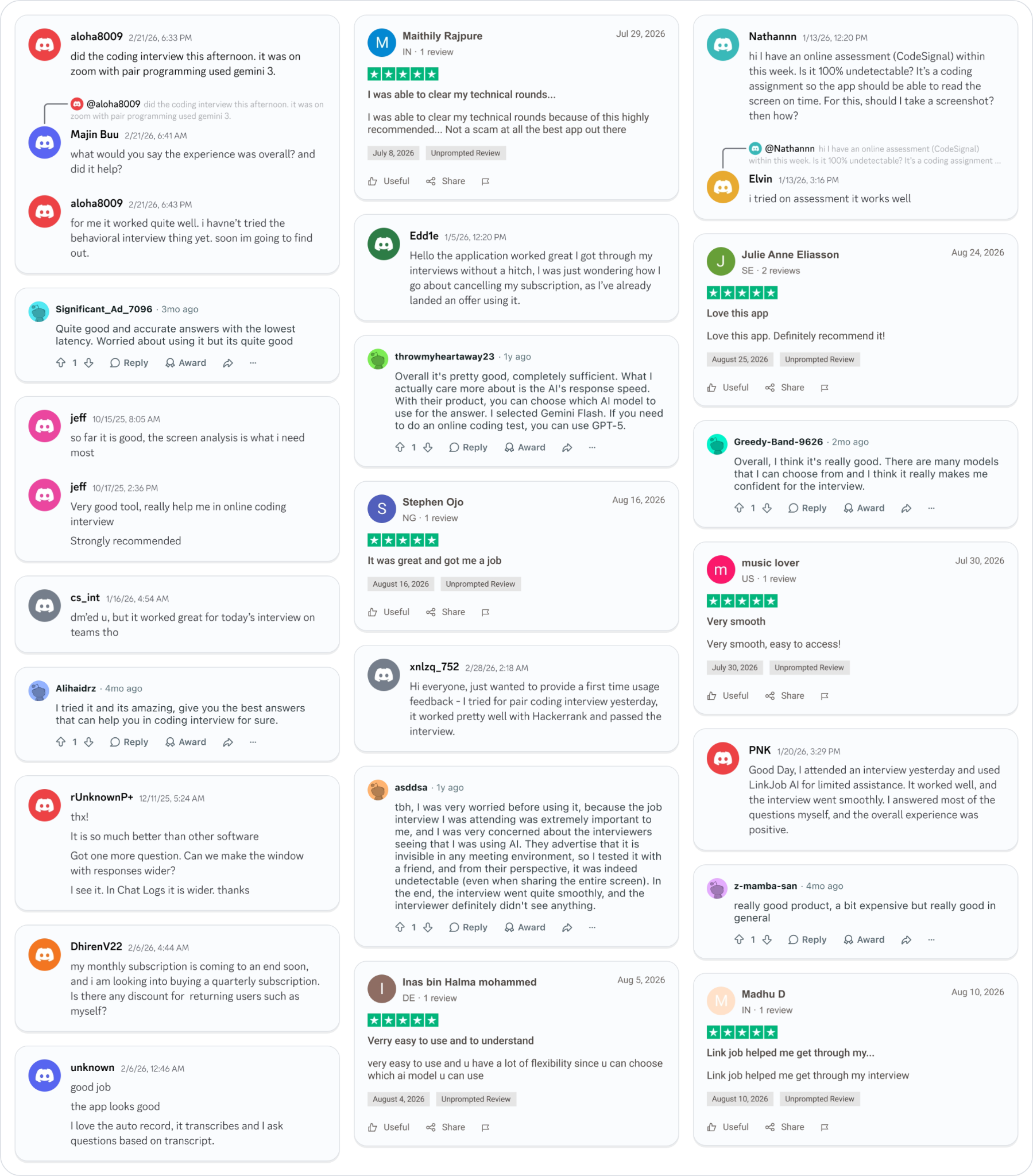
Smoother interviews, coding challenges cleared, and job offers landed. See how users describe their experience with Linkjob AI—in their own words.

© Copyright 2026 Linkjob AI - All Rights Reserved.