NVIDIA Coding Interview: Problems I Faced and My Solutions

When I walked into my Nvidia coding interview, I tackled three main problems: Last Stone Weight, Reverse Linked List, and Search in Rotated Sorted Array. I also saw questions like formatting an array of words, finding a missing integer in two lists, and designing a data pipeline. I’ll share how I broke down each problem and the solutions I came up with. I picked up some great tips from other candidates and noticed a few patterns that pop up often. If you’re getting ready for a tech interview, you’re in the right place!
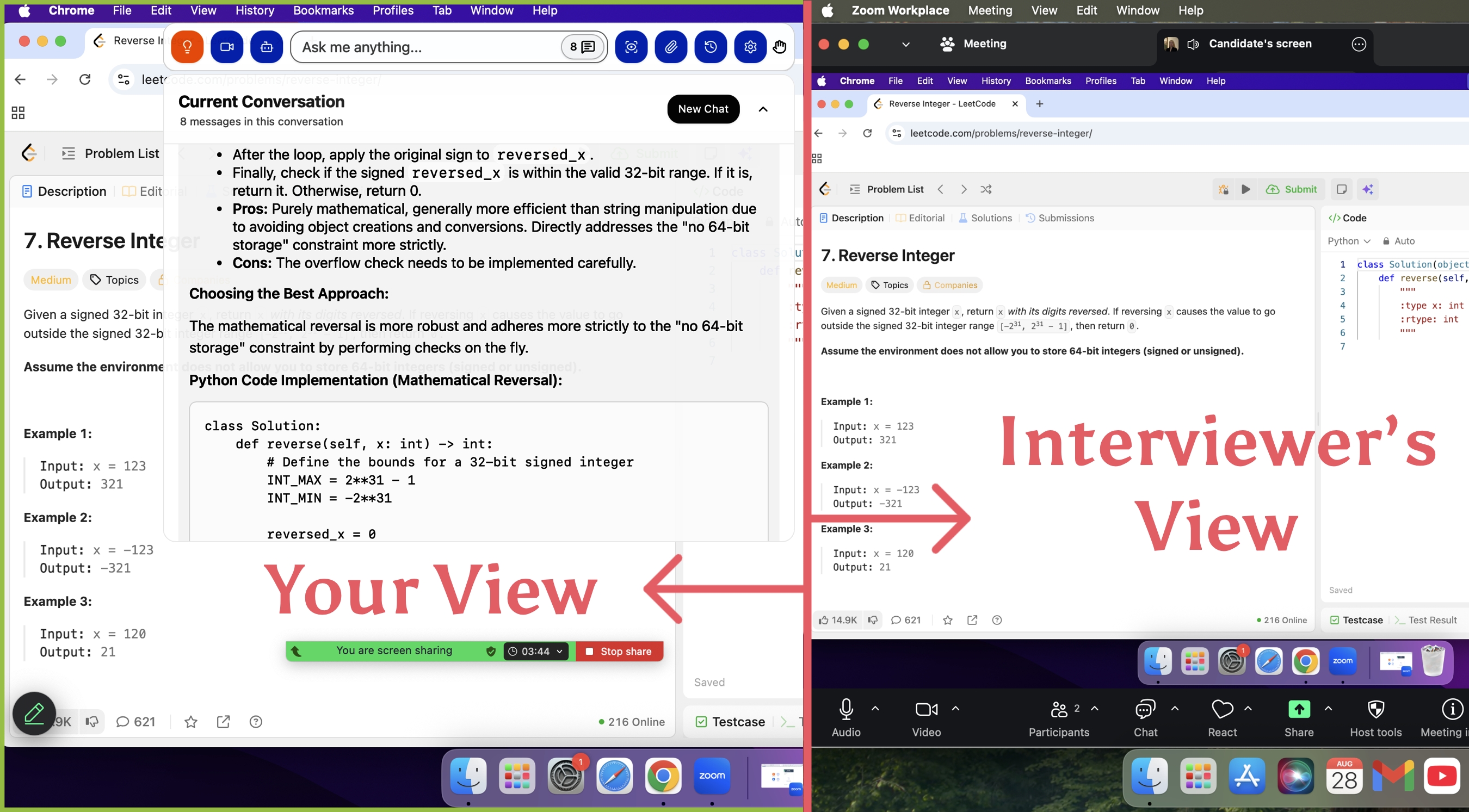
I want to specifically mention that I am truly grateful for the help Linkjob.ai provided throughout the entire process, so I wanted to share my interview experience here. Having an AI interview assistant readily available on my desktop to provide Q&A support during the interview was incredibly convenient. Most importantly, the interview software was completely unaware of my AI interview assistant's existence throughout the entire process.
My NVIDIA coding interview questions and answers
Last Stone Weight
When I sat down for my NVIDIA coding interview, the first problem I got was called "Last Stone Weight." The interviewer asked me to solve it in C++. Here’s how the question went:
You have a collection of stones, each with a positive integer weight. Every turn, you pick the two heaviest stones and smash them together. If they are the same weight, both stones get destroyed. If they are different, the lighter stone gets destroyed and the heavier stone’s weight is reduced by the lighter stone’s weight. Repeat this until only one stone is left or no stones remain. Return the weight of the last stone, or 0 if none are left.
I paused and thought about how to always pick the two heaviest stones quickly. A max-heap (priority queue) seemed perfect for this. I could push all the stones into a max-heap, then keep popping the top two and smashing them until only one or zero stones remained.
Here’s my step-by-step approach:
Push all stone weights into a max-heap.
While there are more than one stone left:
Pop the two largest stones.
If they are not equal, push the difference back into the heap.
If the heap is empty, return 0. Otherwise, return the remaining stone.
Here’s the code I wrote during my nvidia coding interview:
#include <queue>
#include <vector>
using namespace std;

int lastStoneWeight(vector<int>& stones) {
    priority_queue<int> maxHeap(stones.begin(), stones.end());
    while (maxHeap.size() > 1) {
        int stone1 = maxHeap.top(); maxHeap.pop();
        int stone2 = maxHeap.top(); maxHeap.pop();
        if (stone1 != stone2) {
            maxHeap.push(stone1 - stone2);
        }
    }
    return maxHeap.empty() ? 0 : maxHeap.top();
}
Tip: If you see a problem that needs you to pick the largest or smallest element many times, think about using a heap. It saves time and makes your code cleaner.
Reverse Linked List
The next challenge in my nvidia coding interview was a classic: Reverse Linked List. The interviewer wanted to see if I could handle pointers and linked list manipulation.
Here’s the problem statement:
Given the head of a singly linked list, reverse the list and return the new head.
I remembered that I needed to change the direction of the next pointers. I decided to use three pointers: prev, curr, and next. I would walk through the list, reverse the links one by one, and finally return the new head.
Here’s my plan:
Start with prev as nullptr and curr as head.
For each node, save curr->next in next.
Point curr->next to prev.
Move prev and curr forward.
When curr becomes nullptr, prev is the new head.
Here’s the code I wrote:
struct ListNode {
    int val;
    ListNode* next;
    ListNode(int x) : val(x), next(nullptr) {}
};

ListNode* reverseList(ListNode* head) {
    ListNode* prev = nullptr;
    ListNode* curr = head;
    while (curr) {
        ListNode* next = curr->next;
        curr->next = prev;
        prev = curr;
        curr = next;
    }
    return prev;
}
Note: Linked list problems show up a lot in nvidia coding interview rounds. Practice reversing, merging, and finding cycles in lists.
Search in Rotated Sorted Array
The third problem in my nvidia coding interview was a bit trickier. The interviewer gave me a rotated sorted array and asked me to find a target value’s index.
Here’s the problem:
You are given an array that was sorted in ascending order but then rotated at some unknown pivot. Write a function to search for a target value and return its index. If not found, return -1.
I realized that a normal binary search wouldn’t work because the array was rotated. I needed to figure out which half of the array was sorted at each step and decide where to search next.
Here’s my approach:
Use binary search.
At each step, check if the left half or right half is sorted.
If the target is in the sorted half, search there. Otherwise, search the other half.
Here’s the code I wrote:
int search(vector<int>& nums, int target) {
    int left = 0, right = nums.size() - 1;
    while (left <= right) {
        int mid = left + (right - left) / 2;
        if (nums[mid] == target) return mid;
        if (nums[left] <= nums[mid]) { // Left half is sorted
            if (nums[left] <= target && target < nums[mid])
                right = mid - 1;
            else
                left = mid + 1;
        } else { // Right half is sorted
            if (nums[mid] < target && target <= nums[right])
                left = mid + 1;
            else
                right = mid - 1;
        }
    }
    return -1;
}
Pro Tip: Binary search is powerful. In nvidia coding interview questions, always check if the array is sorted or rotated before you start searching.
I found that breaking down each problem into small steps helped me stay calm and focused. The nvidia coding interview can feel intense, but practicing these types of problems makes a huge difference.
NVIDIA Coding Interview Process
Interview Rounds Overview
When I started my nvidia coding interview journey, I noticed a clear structure. Here’s a quick look at the main stages:
Stage | Description |
|---|---|
Submit the Resume | I applied through NVIDIA’s Career page. |
Phone Screening | A recruiter called me after my resume got shortlisted. |
Technical Round | I faced several rounds that tested my problem-solving skills. |
HR Behavioral Interview | They checked if I fit the company culture and could work well in teams. |
Total Rounds | Most people go through 4 to 6 rounds, but it can change based on the role. |
Duration | The whole process took about 4-8 weeks from start to finish. |
I learned that junior and senior roles have different expectations. Here’s how they compare:
Role Type | Focus Areas | Preparation Strategy |
|---|---|---|
Junior Engineers | 80% Algorithms and Coding Problems | I solved over 150 coding problems to build strong fundamentals. |
Senior Engineers | 50% System Design, 20% Coding, 30% Behavioral | I practiced system design and explained my leadership experience. |
Online Coding Test Format
The nvidia coding interview usually starts with an online test. Here’s what I experienced:
The test happened on platforms like HackerRank or Codility.
It is common for software, data, and machine learning engineer roles.
I had to write code in C, C++, or Python, depending on the team. System teams wanted C, while infrastructure teams let me use any language.
Technical Interview Focus Areas
The technical rounds in the nvidia coding interview covered a wide range of topics. Here’s a table of what I saw:
Category | Topics/Skills |
|---|---|
Data Structures & Algorithms | Arrays, trees, graphs, bit manipulation |
Databases | SQL basics |
Operating Systems | Linux booting, multithreading, processes |
Computer Networks | Basics, protocols |
Software Engineering | OOP, parallel programming |
Domain Knowledge | GPU architecture, CUDA, AI hardware |
Programming Skills | C++, CUDA, Python |
Development | Parallel computing, drivers |
Data Tools | SQL, ML frameworks |
Testing & Version Control | Unit testing, Git |
Problem-Solving | High-performance code |
I realized that understanding data structures and algorithms is essential. I had to show both classic algorithm skills and real coding ability. Some rounds even focused on machine learning system design.
Tip: Practice writing clean, optimized code and review core concepts before your nvidia coding interview.
Other Candidates’ NVIDIA Coding Interview Experiences
Frequently Asked Coding Problems
When I started preparing for my NVIDIA interview, I wanted to know what other candidates faced. I checked out forums and noticed some patterns. Many people mentioned seeing problems like:
Merge Intervals
LRU Cache
Kth Largest Element in an Array
Word Ladder
Find the Missing Number
Design a Data Pipeline
I saw that NVIDIA likes to test a mix of classic data structures and real-world scenarios. Some candidates even got questions about GPU scheduling or parallel processing. That surprised me at first, but it makes sense for a company like NVIDIA.
Insights from Online Communities
I spent a lot of time reading posts from people who already went through the process. Here are some tips that kept coming up:
Collaboration is essential. NVIDIA cares a lot about teamwork. People say you should prepare stories about working with others. The company even says, “the project is the boss, even for the CEO.”
Apply strategically. Don’t just apply for one job. Most candidates suggest picking your top 3-5 roles to boost your chances.
Know the company. Study NVIDIA’s core values. Check their website and keep up with their latest news. This helps with both behavioral and technical questions.
Note: I found that candidates who did their homework on NVIDIA’s culture felt more confident in the interviews.
Interview Trends and Patterns
Over the past few years, I noticed that NVIDIA interviews have become tougher. The data structure and algorithm problems are more complex now. Interviewers expect you to write complete, working code—not just talk through your ideas. System design questions have also become more advanced. Now, even junior roles might get questions that used to be for senior engineers. This shift means you need to prepare well and show deep understanding if you want to stand out.
I learned that practicing a wide range of problems and understanding NVIDIA’s values can really make a difference. The more I read about others’ experiences, the better I felt about my own preparation.
NVIDIA Coding Interview Preparation Tips
Study Resources and Platforms
When I started preparing for the NVIDIA coding interview, I wanted to find the best study materials. I found some great courses and platforms that helped me build my skills. Here are my top picks:
NVIDIA: Fundamentals of Machine Learning
NVIDIA: Fundamentals of Deep Learning
Andrew Ng's "Machine Learning"
Deep Learning Specialization
TensorFlow 2 for Deep Learning Specialization
TensorFlow: Advanced Techniques Specialization
Machine Learning Engineering for Production (MLOps) Specialization
I also spent time on LeetCode and HackerRank. These platforms let me practice coding problems every day. I liked how they gave instant feedback and helped me track my progress.
Key Concepts to Master
I realized that mastering certain computer science concepts made a big difference. Here’s what I focused on:
Dynamic Programming (DP): Solving tough problems with smart strategies.
AI/ML Depth: Learning about transformers and memory optimization.
Multilingual Proficiency: Getting comfortable with C++ and Python.
System-Level Knowledge: Understanding computer architecture and system design.
Distributed data processing pipelines
High-performance caching and memory management
Low-latency systems like autonomous driving and AI inference
GPU task scheduling and load balancing
Fault tolerance and recovery
I spent extra time on C and C++ because many interview rounds tested my skills with pointers, memory layouts, and kernel operations. Debugging without tools pushed me to think logically and stay sharp.
Strategies for Success
I found that having a clear plan helped me stay focused. Here’s what worked for me:
Follow step-by-step guides for coding challenges and system design.
Do mock interviews and practice answering questions out loud.
Code every day and manage my time during assessments.
Prepare stories about teamwork and personal growth.
Research NVIDIA’s values and show how my experiences match.
Highlight unique achievements with real results. For example, I talked about reducing kernel occupancy bottlenecks by 22% and working on cross-functional projects.
Strategy | Description |
|---|---|
Highlight Specific Accomplishments | Share achievements with numbers, like improving system performance. |
Demonstrate Growth and Adaptability | Talk about overcoming weaknesses and learning new skills. |
Focus on Collaboration | Describe teamwork, such as integrating modules with other teams. |
Tip: Stay consistent, practice daily, and don’t forget to show what makes you unique. The nvidia coding interview rewards candidates who prepare well and share their stories.
NVIDIA Coding Interview Reflections and Lessons Learned
What Surprised Me
I walked into the NVIDIA interview expecting standard coding questions. I quickly realized the process went much deeper. The interviewers wanted to see how well I understood C, especially pointers and memory layouts. Syntax mattered less than my ability to explain what happened under the hood. I also faced questions about Linux kernel internals and device drivers. I had to show I understood the fundamentals, not just memorize facts.
One round threw me into a real-world debugging scenario. I could not use any tools. I had to rely on logic and clear thinking. That experience taught me that NVIDIA values problem-solving under pressure.
Here’s a quick look at the most unexpected parts:
Round | Unexpected Aspect | Key Takeaway |
|---|---|---|
1 | Deep dive into C, pointers, and memory layouts | Depth matters more than syntax |
2 | Linux kernel internals and device driver questions | Fundamentals beat memorization |
3 | Debugging without tools | Logical thinking wins under uncertainty |
Mistakes and Improvements
I made a few mistakes during my preparation and interviews. I want to share them so you can avoid them:
I jumped into coding before asking enough clarifying questions. Slowing down and understanding the problem first would have helped.
I sometimes forgot to explain my thought process out loud. Interviewers want to hear how I approach a problem, not just see the answer.
I skipped dry-running my code. This led to small bugs that I could have caught earlier.
I did not always discuss space and time complexity. Interviewers look for this to see if I understand performance.
I wrote code from scratch instead of using built-in language features. Using the right tools saves time and shows good judgment.
I did not always research the interviewer or the company. Knowing more about them helps tailor answers and build rapport.
I did not check the interview format ahead of time. Understanding the type of interview helps with preparation.
Tip: Take a breath before you start coding. Ask questions, explain your thinking, and check your work.
Final Encouragement
If you are preparing for a NVIDIA interview, remember that everyone feels nervous. I did too. Focus on understanding the basics and practicing real problems. Show your thought process and stay calm when things get tough. Every mistake is a chance to learn. You have what it takes to succeed. Keep going, and good luck!
Looking back, I learned a lot from my NVIDIA interview journey. I saw how important it is to research the company, balance my prep between coding and system design, and structure my answers clearly. I also made sure to practice behavioral questions and ask thoughtful questions at the end. If you want to get ready, here’s what worked for me:
Start early and practice coding every day.
Build small projects that show your skills.
Focus on core problems across topics.
Go to info sessions and network.
Do mock interviews and get feedback.
Tailor your resume to highlight your impact.
Prepare stories using the STAR method.
Use a checklist to stay organized.
You can do this! Stay consistent, keep learning, and believe in yourself. Good luck!
NVIDIA Coding Interview FAQ
How many coding questions did I get in my NVIDIA interview?
I got three main coding questions. Sometimes, interviewers add a follow-up or ask for optimizations. I always prepare for at least three to five problems.
Can I use Python in the NVIDIA coding interview?
Yes, I used Python for some rounds. Some teams prefer C or C++. I always check the job description and ask the recruiter about language preferences.
How much time do I get for each coding question?
I usually had 30 to 45 minutes per question. I read the problem, asked clarifying questions, and explained my approach before coding.
What if I get stuck during the interview?
I stay calm and talk through my thoughts. Interviewers want to see my problem-solving process. Sometimes, they give hints if I explain my ideas out loud.
Do I need to know system design for junior roles?
For junior roles, I saw basic system design questions. I focused on simple diagrams and clear explanations. For senior roles, I prepared for deeper system design discussions.
See Also
Navigating Dell Technologies Interview Questions: My 2025 Approach
Insights from My Oracle Software Engineer Interview in 2025
Leveraging AI for Success in My Microsoft Teams Interview
Mastering the BCG X CodeSignal Assessment: My 2025 Experience
ES6 Interview Questions in 2025: My Winning Answers Revealed
Why People Choose Linkjob AI
Smoother interviews, coding challenges cleared, and job offers landed. See how users describe their experience with Linkjob AI—in their own words.