How I Aced My 2026 NVDIA Software Engineer Interview

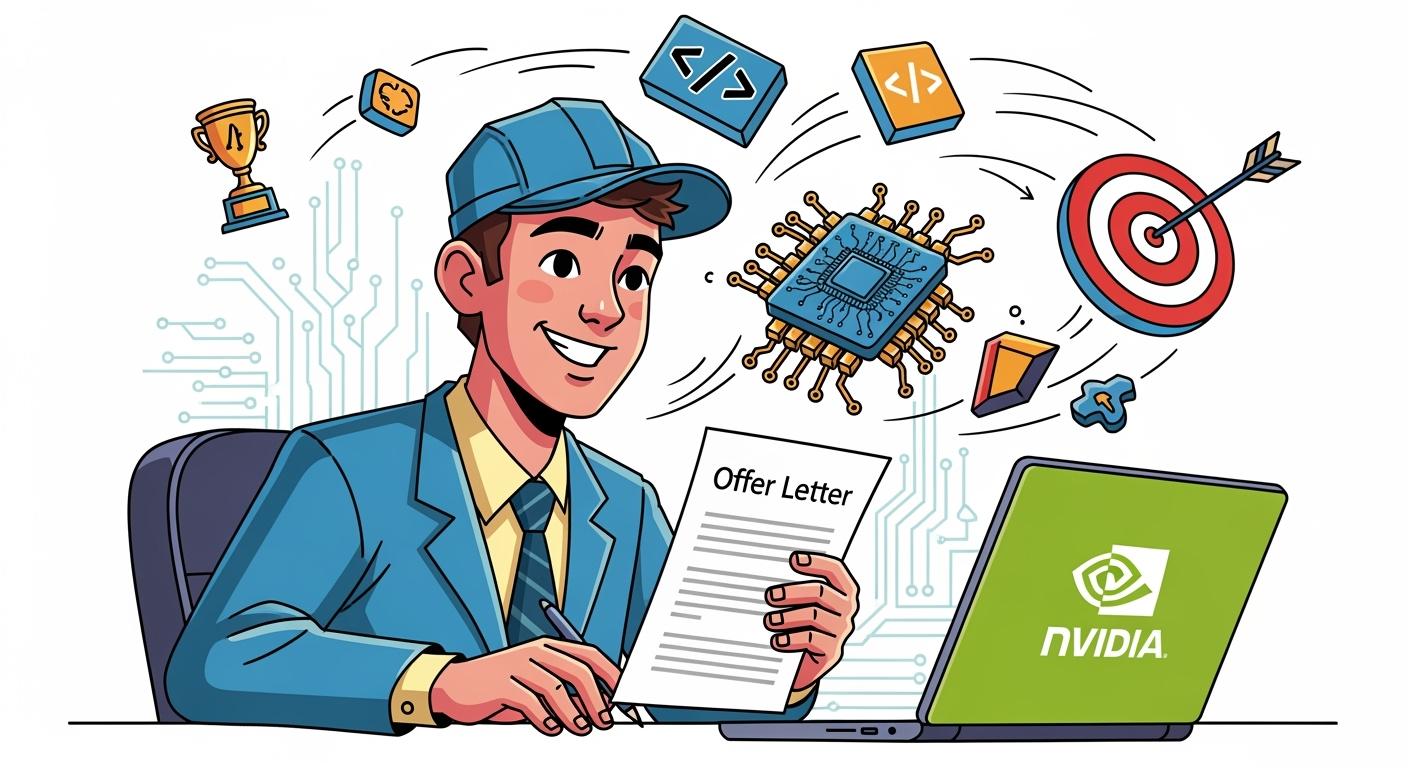
The NVDIA software engineer interview is typically divided into several stages:Intial Recrutier Screen, Technical Interview,HM rounds. The Technical Interview consists of four rounds, focusing on engineering skills and C++, problem-solving, AI expertise, GPU/CPU, and Python. The difficulty level is above average.
I’m really grateful to Linkjob.ai for helping me pass my interview, which is why I’m sharing my interview questions and experience here. Having an invisible AI interview assistant indeed provides a significant edge.
Key Takeaways
Adopt a growth mindset. Stay positive and trust your preparation to boost confidence during the interview process.
Understand the interview stages. Familiarize yourself with each step, from recruiter screening to technical assessments, to prepare effectively.
Practice coding challenges regularly. Use platforms like HackerRank to sharpen your problem-solving skills and get comfortable with coding under pressure.
Master the STAR method for behavioral questions. Structure your answers to showcase your experiences and how you handle challenges.
Utilize mock interviews for feedback. Simulate real interview conditions to improve communication skills and gain insights for continuous improvement.
NVIDIA Software Engineer Interview Process
Here’s a quick look at the main stages I went through:
Stage | Description |
|---|---|
Initial Recruiter Screening | During this stage, HR will delve into your past projects, discuss coding concepts, and present some simple problems to assess your skills. |
Technical Interview | This segment consists of four rounds and will be conducted based on the model developed by NVIDIA. |
HM rounds | This stage includes an HR interview and a behavioral interview, with a strong emphasis on the behavioral interview. It primarily assesses professional skills, work capabilities, prior experience, and teamwork abilities. |
Initial Recruiter Screening
The first round is typically a recruiter call lasting about 30-45 minutes. It begins with a standard self-introduction, followed by questions about your project background based on your resume—specifically focusing on what you did in the project and which tech stacks you used, rather than just broad descriptions. Midway, foundational technical questions may arise, such as common data structures, basic coding approaches, or asking you to verbally explain concepts (e.g., memory management, thread vs. process).
The focus here isn't difficulty but assessing your fundamental engineering aptitude and fit for the role. Finally, HR will briefly outline the team's direction and job responsibilities.
Technical Interview
This round has clearly ramped up the difficulty. It systematically assesses coding skills, C++ fundamentals, system understanding, and engineering experience, with questions delving into minute details.
Coding problems generally range from medium to medium-high difficulty. They rarely involve pure drill-style questions, instead resembling real-world development implementation tasks that require explaining design choices while coding.
C++ knowledge is probed deeply, covering object lifecycle, RAll, smart pointers, move semantics, multithreading synchronization, etc. Follow-up questions will directly address how you've applied these in real projects.
Additionally, questions will cover containers, DevOps, CI/CD pipelines, version control, and tools/standards related to software development processes. Some inquiries may even delve into specifics like naming conventions and code review focus areas.
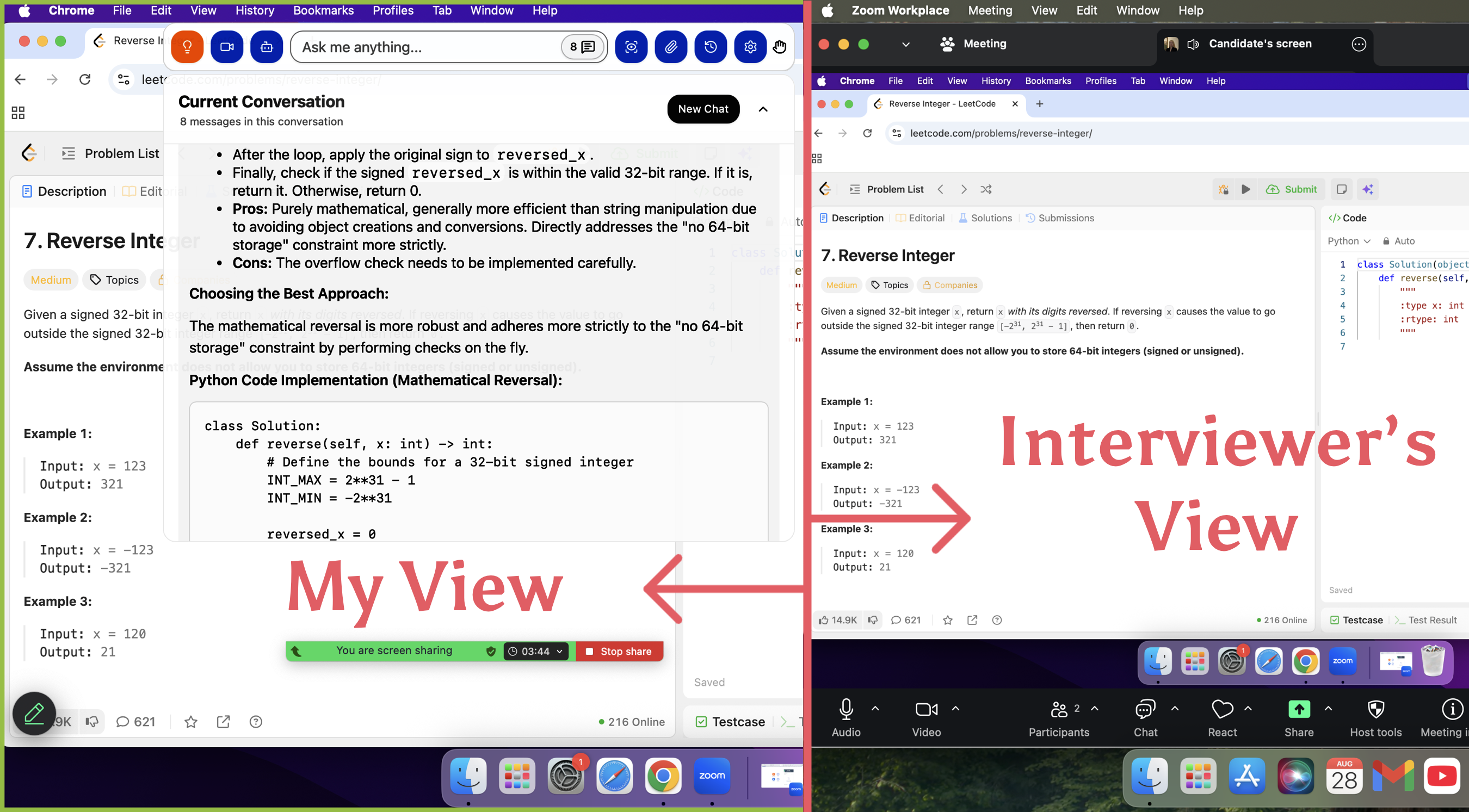
Throughout the interview process, I utilized Linkjob,an invisible AI assistant for technical interviews to assist me. Whether tackling technical questions or coding tests, it swiftly provided answers and offered problem-solving approaches. This approach aligns perfectly with NVIDIA's company culture, where they highly value whether you're a reliable engineering candidate rather than just an algorithm-solving machine.
HM Rounds
There will be several consecutive rounds where you engage in deep discussions directly with your future manager or tech lead. In these rounds, the coding proportion is actually lower, with greater emphasis placed on your technical depth, decision-making ability, project ownership, and team collaboration style.
You will be asked to elaborate on your most challenging project. The interviewer will probe with questions like: Why did you design it this way? What would you change if you could do it again? How did you balance performance and maintainability? Behavioral questions are also common, such as how you resolve technical disagreements or make trade-offs under deadline pressure.
Overall, this round assesses whether you're a good long-term fit for NVIDIA's engineering culture.
NVIDIA Software Engineer Interview Questions
The basic process for each interview stage can be summarized as resume screening, behavioral interviews, and problem-solving tasks, though the emphasis varies. I've compiled all the questions I recall from the interview stages.
Software Basic Questions
What does the “Accept” header mean in HTTP requests, and what do other fields in headers signify?
What is the difference between GET and POST?
The concept of idempotency
What is the difference between HTTP and HTTPS? What distinguishes symmetric and asymmetric encryption in HTTPS?
What is SQL injection? What causes it? How to prevent it? What is parameterized query?
How to view and terminate processes in Linux?
The approach of quicksort.
Data structure of hash tables; time complexity of get/put operations.
Data structures of stack and heap; insertion/deletion processes and time complexity for heap.
Memory usage of heap and stack during program execution.
Coding Questions
Screening: Given a set of time and CPU temperature pairs, detect temperature spikes.
Minimum sum after K operations problem.
Implement a function to verify matching brackets in mathematical expressions.
Process logs containing status codes and response times; aggregate by status code with count and average response time.
Tree planting problem - given a 2D array representing land with existing trees (marked as 1), determine where new trees can be planted (marked as 0), with the constraint that trees cannot be adjacent (up, down, left, right) to existing or newly planted trees. (graph problem).
Compute polynomial multiplication, e.g., (x^3-2x+5) * (x^2+2x+4). Input parameters are polynomial coefficients. You must define your own input/output, as if writing an API for users. Must be implemented in C.
LRU. All problem statements are described in C. (I mentioned that C is cumbersome because it lacks corresponding data structures. The interviewer then said this problem could be solved in C++.)
Recursive Construction of the Maximum Binary Tree: Given an array without duplicate values, find the largest number as the root node. The portion of the array to the left of this number forms the left subtree of the root node, while the portion to the right forms its right subtree. Proceed recursively in this manner to construct the binary tree, then return the resulting tree.
The interview questions gave me the impression that brushing up on NVIDIA classification problems on LeetCode wasn't particularly helpful—the question types were quite complex. Fortunately, I had Linkjob, which wouldn't be detected by interviewers or testing platforms, so I could use it throughout the entire process.
NVIDIA Software Engineer Interview Preparation
When I started preparing for the NVIDIA software engineer interview, I wanted a clear plan. I knew that mastering technical skills and understanding NVIDIA-specific domains would set me apart. I focused on the areas that matter most for a senior system software engineer role. Let me walk you through the resources, practice techniques, system design fundamentals, and mock interviews that helped me succeed.
Study Materials and Resources
I searched for the best study materials to build a strong foundation. I found that recent interviewees recommended a mix of guides, books, and online courses. Here’s what worked for me:
NVIDIA Software Engineer Interview Guide: This interview guide gave me a roadmap for the entire process. It included courses and resources tailored for NVIDIA.
I used classic books like "Cracking the Coding Interview" and "Introduction to Algorithms" to sharpen my coding and algorithm skills.
For GPU and parallel programming, "Programming Massively Parallel Processors" was a must-read.
I also explored online courses. Here’s a table that shows the most effective resources I used:
Resource Type | Title/Platform | Description |
|---|---|---|
Book | Cracking the Coding Interview | A well-known resource for coding interview preparation. |
Book | Introduction to Algorithms | A foundational text on algorithms essential for technical interviews. |
Book | Programming Massively Parallel Processors | Focuses on GPU architecture and parallel programming, relevant for NVIDIA. |
Online Course | Coursera: GPU Programming | Offers insights into GPU programming, crucial for NVIDIA roles. |
Online Course | Udacity: Intro to Parallel Programming | Teaches parallel programming concepts applicable to NVIDIA's technology. |
Online Course | edX: Deep Learning with NVIDIA GPUs | Covers deep learning techniques using NVIDIA's hardware, aligning with their focus. |
I made sure to cover data structures, algorithms, distributed systems, networking, and databases. These topics are essential for any software engineer aiming for a senior system software engineer position.
Coding Practice Techniques
Practicing coding problems became my daily routine. I wanted to build speed and accuracy for the interview. I used platforms that helped me simulate real interview scenarios. I solved mock problems and focused on NVIDIA-specific domains. I practiced coding questions on arrays, trees, graphs, and linked lists. I also worked on system design and performance analysis. I always clarified the problem before coding and explained my thought process. This approach helped me during the team interview and technical rounds.
Tip: Practice clear communication of your approach. Interviewers want to see how you think, not just the final answer.
I avoided common mistakes like jumping into code without understanding the requirements. I analyzed time and space complexity for each solution. This habit made me confident in tackling complex technical challenges.
System Design Fundamentals
System design questions are a big part of the NVIDIA software engineer interview, especially for senior system software engineer roles. I studied topics that NVIDIA values most:
High-Performance Computing (HPC)
Data Pipeline Design for AI Training
Distributed Storage Systems
Real-Time Systems
I learned how to design scalable and reliable systems. Here’s a table that shows how system design questions are structured in the interview:
Component | Description |
|---|---|
High-level design question | 1 question lasting 45–60 minutes |
Deep dives | Focus on storage, networking, concurrency, and optimization layers |
Discussion | Covers scalability, data flows, and edge cases |
Focus areas | Performance optimization, scalability, reliability, hardware awareness, communication |
I practiced designing systems that handle large data sets and real-time processing. I focused on performance optimization and hardware awareness. I always discussed trade-offs and clarified requirements before starting the design.
Note: Prepare to discuss technical challenges from past projects. Interviewers want to hear about your experience and how you solved tough problems.
Mock Interviews and Feedback
Mock interviews played a huge role in my preparation. They helped me improve my verbal communication skills, which is crucial for articulating thoughts during the interview. I got familiar with the interview format and expectations, making the real interview feel less intimidating.
Here’s how I used mock interviews to boost my performance:
After each mock interview, I debriefed using a structured template. I focused on clarity, structure, depth, communication, and trade-offs.
I learned to receive feedback well. I asked specific questions to turn vague comments into actionable insights.
I applied feedback by reattempting the same problem after a few days, implementing the changes I noted.
I kept a mock interview journal. I logged the date, topic, main takeaways, and next steps.
I quantified my progress by identifying patterns in feedback and assigning scores to key skills.
I built endurance by simulating longer interview sessions. This helped me prepare for the real interview environment.
Callout: Mock interviews are not just practice—they are a chance to learn and grow. Use feedback to improve your skills and build confidence.
I mastered the STAR method for behavioral questions. I practiced discussing complex challenges and trade-offs from my experience as a senior system software engineer. I focused on clear communication and structured responses. This strategy helped me stand out during the team interview and technical rounds.
If you want to ace the NVIDIA software engineer interview, build a solid foundation with the right study materials, practice coding daily, master system design fundamentals, and use mock interviews to refine your skills. Stay consistent, learn from feedback, and keep pushing yourself. Success comes from preparation and persistence.
FAQ
What resources helped me the most?
I found "Cracking the Coding Interview" and online courses on GPU programming very useful. I also practiced on HackerRank and LeetCode. Mock interviews gave me real feedback. These resources covered all the important areas.
How did I handle tough interview questions?
When I faced a hard question, I stayed calm and broke it into smaller parts. I explained my thought process out loud. If I got stuck, I asked for hints. This showed my problem-solving skills and kept the conversation going.
Do I need deep AI or GPU knowledge for every role?
Not every role needs deep AI or GPU knowledge. For some positions, basic understanding is enough. I checked the job description and focused on the required skills. I learned the basics to show my interest and adaptability.
See Also
Insights From My Dell Interview Journey in 2026
Successfully Navigating My Palantir New Grad Interview in 2025
Exploring My Oracle Senior Software Engineer Interview in 2026
© Copyright 2025 Linkjob.ai - All Rights Reserved.