How I Passed the OpenAI Software Engineer Interview in 2026


I applied to OpenAI cold, no internal referral or anything like that. The whole interview process was super efficient but also pretty intense, so I wanna walk you through every little detail.
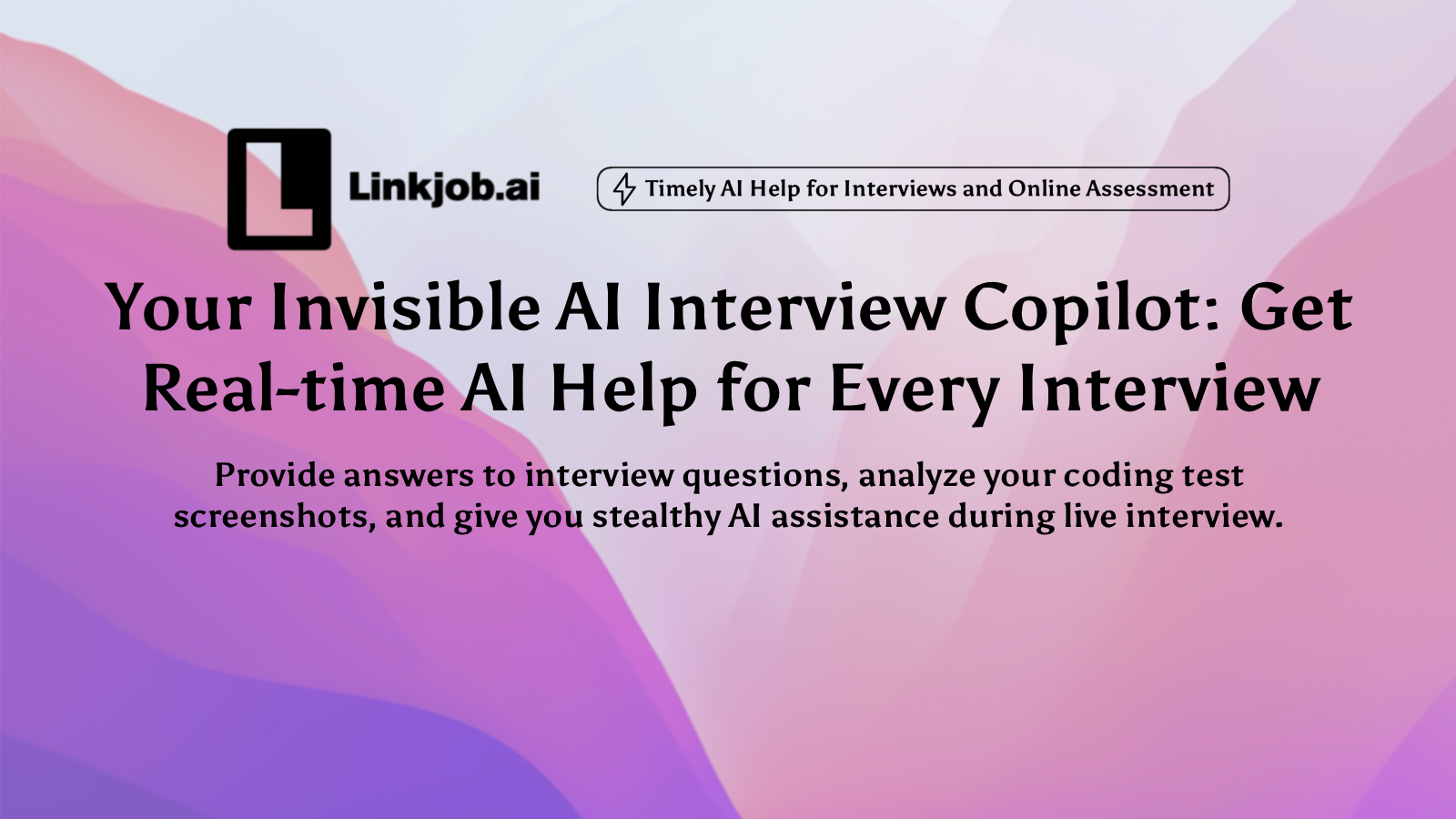
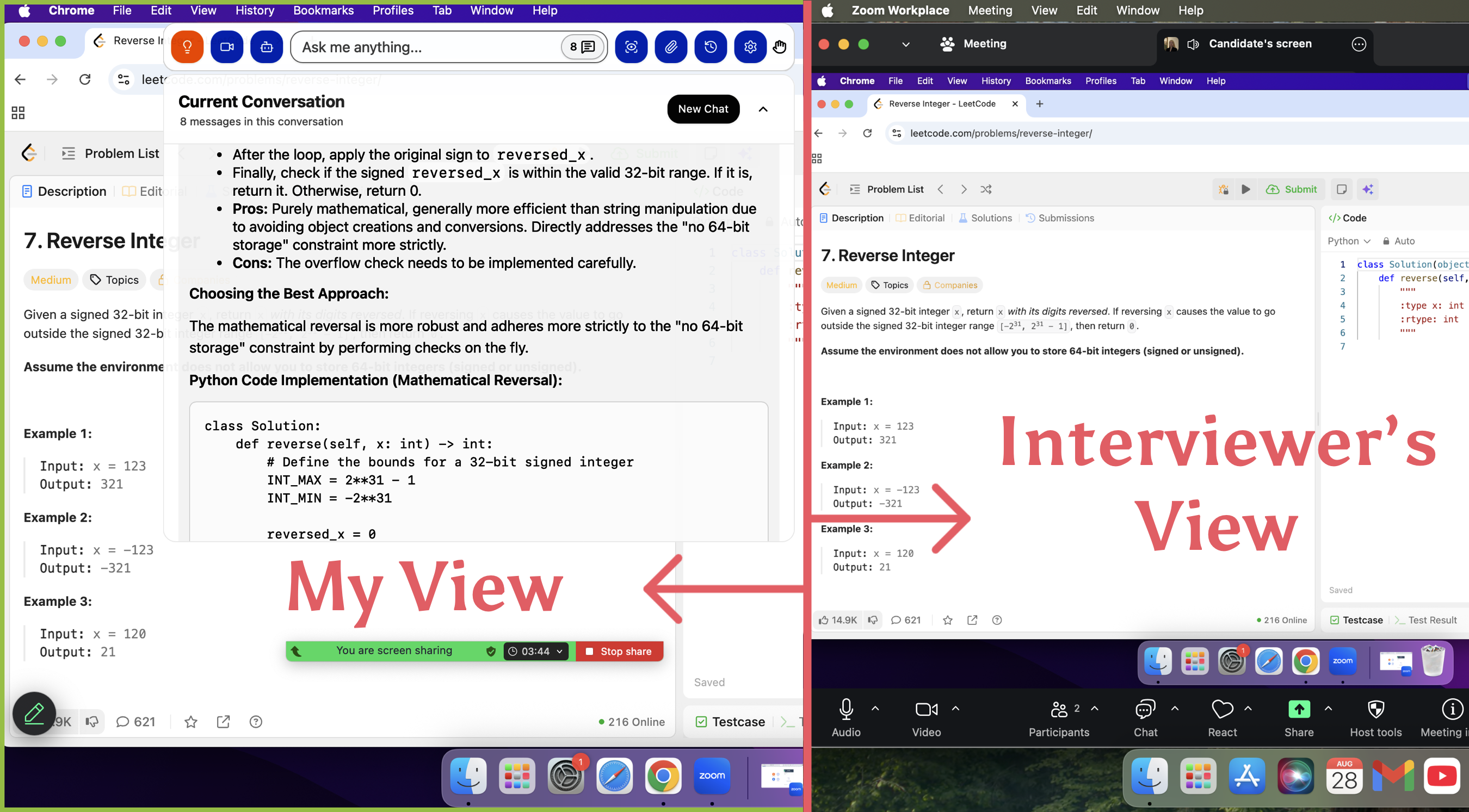
I had 6 years work experience, Bachelor's degree, backend software Engineer at a mid-sized company in the Bay Area. I am really grateful for the tool Linkjob.ai, and that's also why I'm sharing my entire interview experience here. Having an ai invisible interview assistant during the virtual interviews is indeed very helpful for me.
OpenAI Software Engineer Interview Process
Recruiter Chat and Motivation
When I started the openai software engineer interview, the first step was a recruiter call. This chat lasted about 30 minutes. The recruiter wanted to know why I applied and what motivated me. I talked about my interest in AI and my excitement to work with a team that pushes boundaries. The recruiter also explained the process and answered my questions. I felt nervous, but I reminded myself to stay honest and show my passion. This stage set the tone for everything that followed.
Coding and System Design Rounds
After the recruiter chat, I moved on to the technical rounds. It mixed Coding and System Design together. For the Coding part, they asked me to build an SQL Engine, kinda like a parser plus an executor. The main thing they cared about was clear structure, names that actually made sense, and logic that checked out. It wasn’t one of those tricky LeetCode problems at all; instead, they wanted to see how I’d actually build something in real engineering work.
Then for System Design, I had to design a CI system, similar to GitHub Actions. The key stuff here was job scheduling, dependency management, and the concurrent execution model. They didn’t get into CD or deployment processes, but I had to break down the engineering complexity in a way that was easy to follow.
Final Virtual Interviews
The last stage of the openai software engineer interview should be the onsite, however, because I sprained my ankle while exercising those days, they agreed to let me continue the interview online. I worked through more coding and system design questions with several engineers.
The first round was Coding again, and the task was to make an IP Address Iterator. It was more about practical engineering. If I got the class structure and iterator protocol clean, that was enough to get a good score. Nothing too fancy, just solid work.
The second round was System Design, building a payment gateway. The main components were authorization, queuing, retries, and idempotency. The focus was on error handling and scalability, and it wasn’t a cookie-cutter template question. The interviewer really dug into how well I understood system robustness and monitorability. They didn’t let me get away with surface-level answers.
Third round was the Behavioral one, which was with a manager. The questions were all around stuff like: how do you handle pressure? How do you stay motivated when no one’s pushing you? And how do you coordinate resources? I told them about a system migration project I worked on, and emphasized how I collaborated asynchronously with the team. The manager kept saying, over and over, that OpenAI moves really fast, engineers there have to be self-driven and take initiative to push things forward.
Fourth round was a Deep Dive, where I talked through one of my technical projects in detail. I walked them through the trade-offs I had to make during a system refactoring project, and then shifted gears to talk about the business value it brought, super important, I think. Later, the HR actually called that out specifically and praised me for it, saying it showed both technical depth and an understanding of the product side.
The process felt intense, but also fair. OpenAI’s acceptance rate is less than 0.5%, which is even lower than most FAANG companies. Now for the final result, I got the offer a week later! The whole process took less than three weeks, which is crazy efficient. The offer was really competitive too, such as base salary, equity, and bonus, all totally on-brand for OpenAI.
OpenAI Software Engineer Interview Questions
Try to use OpenAI’s products and think about how I would build or improve them. This helps me to see things from the company’s perspective. The following are the questions I compiled when I was reviewing before, which will help you understand the interview characteristics of this company.
Tree Related
Count Machines in a Tree
Design a method to count the total number of machines in a tree where each node represents a machine. Machines can only communicate with their parent and child nodes using a provided interface withsendAsyncMessage()andreceiveMessage()functions. Implement thereceiveMessagemethod to handle'count'messages by sending the same message to child nodes and'response'messages by recording the count number from each child, summing them up, and returning the sum to the parent node. Consider special cases such as when the node is a root or a leaf.Return a Tree Topology
Extend the feature from the previous question to not only count the machines but also return the entire tree's topology. Define two new message types,'topology'and'topologyResponse', and ensure the response includes the actual data needed to be sent back. Implement the logic to handle these messages similarly to the'count'and'countResponse'messages from the first question.Largest Value in Each Subtree Debugging
You are given a tree‑like class where each node can have 1 to 3 guides. The requirement is that a node must be the largest value in each subtree. However, the class is not returning the correct values. Identify and debug the issue in the class implementation.
Largest Sub‑Grid
Given a 2D array, find the maximum size of a square sub‑grid such that all sub‑grids of this size must have a sub‑grid sum less than or equal to a given
maxsum.
Web Crawler
Implement a web crawler that can actually run and, given a URL, return a list of all links connected to that page. Solve the problem using DFS/BFS search.
For the second part, modify the web crawler to use multi‑threading to address the issue of I/O blocking. The expectation is to use Python for this task.
Implement a cd Command
Implement a
'cd'command for the Linux system. Your solution should handle various special cases such as'../A/B/','./A/','../A/B/../', etc., by performing string processing to simplify the path. Discuss how you would handle these cases and any potential string processing or data structures you would use to implement the command.Write a
cd()method that takes two inputs: the current directory and a relative destination. The output should be the final path, similar to how the'cd'command works in a terminal followed by'pwd'.
Follow‑up questions:Add support for the
'~'symbol, which represents the user's home directory.Add support for symbolic links, assuming there is a map of symbolic link paths and their respective real paths.
Describe how you would implement the
'cd'command used in shell environments. Discuss how the Linux file system tree is implemented, including concepts such as inodes.
Shortest Path to Visit All Points on a Grid
In an m×n grid, where each grid point is either
'.','#'or'*', find the shortest path that visits all'*'points. Movement is allowed up, down, left, or right, and entry into'#'points is not allowed. The path can start at any non‑'#'grid point and can pass through non‑'#'grid points any number of times. The output should be an array of coordinates(xi, yi)representing the path, or an empty array if no such path exists.
Implement Spreadsheet with Cells
Implement a spreadsheet with cells that can either have a direct value or be dependent on other cells. The first question is straightforward and can be solved using DFS to traverse the cells. The second question asks for a more efficient search method. One approach is to use an additional cache to store values, along with a parent map. However, it might be possible to store the information directly in the
Cellclass. Consider the providedCellandSpreadsheetclass structures and discuss possible solutions for efficient cell value retrieval and updates.Design a spreadsheet system with a class
Cellthat can represent an integer value or the sum of two other cells. Implement two functions,getCell()andsetCellValue(). For example, if Cell A has a value of 6, Cell B has a value of 7, and Cell C is the sum of A and B (13), updating Cell A to 2 should automatically update Cell C to 9. Provide test cases to verify your solution.In a spreadsheet application, a cell can contain an integer or a formula like
'A1 + B1'. Initially, you can use a simple depth‑first search (DFS) for the evaluation. How would you optimize the evaluation process, especially considering multiple requests and their optimization?Implement a basic Depth‑First Search (DFS) for a spreadsheet application, using Python and the
networkxpackage. Then, optimize the implementation with caching, particularly focusing on how to find outdated downstream nodes when a node is changed.Implement a Spreadsheet API with functions
getCellandsetCell. ThesetCellfunction should be able to depend on other cells or provide an independent value, for example,setCell('A', 'B+C')orsetCell('A', 100). Start with a brute force solution and then optimize it.
Linear Algebra
Discuss various methods for handling matrix multiplication in a multithreading environment and explain how to aggregate the results. What are the pros and cons of these methods in practice?
Implement a Basic LRU Cache
Design and implement a basic Least Recently Used (LRU) cache with the following methods:
void addKey(string key)int getCountForKey(string key)
Additionally, maintain a max heap to record all entries with a specific priority. Discuss how you would handle changes in priority.
Refactor Chatbot Service Code
You are given a codebase for a chat service that supports various bots triggered by different keywords, such as
'away','meet','taco count', etc. Your task is to refactor the code to make it easier to support additional functionalities.Propose an interface called
IBotServicewith at least two APIs:shouldActivereturning a booleanexecutereturning a string
Describe how you would convert the existing bot logic into corresponding classes and register them within the chat room. When a new message arrives, explain how you would iterate through all registered bots, check if they are active, and if so, execute them. Also, address the challenge of handling a bot that requires global state.
Toy Language
You have a toy language grammar with primitives, tuples, generics, and functions.
Primitives:char,int,float
Generics: uppercase alpha with number e.g.T1,T2…
Tuples: list of Primitives or Generic or Tuple:[ int, T1, char ]
With tuple nested:[int, char, [ int, T1] ]Implement
Nodeclass to represent Primitives & Tuples (empty class provided). Constructor input isvalue(optional str) andchildren(optional list of Node).Valuepassed if primitive;childrenpassed if tuple.Functions have params and return like this:
[int; [int, T1]; T2] -> [char, T2, [float, float]]
Param is list of Node; Return is a tuple.Implement
Functionclass to represent functions (empty class provided). Constructor takesparams(list of Node) andreturn(Node).
P1: Implement
to_strforFunction&Node.
P2: Implementinfer_return(function, param) -> return.
Given function & param values, return actual return type after substituting out generics (T1,T2etc). Must raise error if there is type mismatch or conflict.Example:
Function:[T1, T2, int, T1] -> [T1, T2]
Parameters:[int, char, int, int]
Should return:[int, char]
If parameters were[int, int, int, int], raise error for type mismatch (intvschar).
If parameters were[int, int, int, char], raise error for type conflict.
OpenAI Software Engineer Interview Tips
In OpenAI interviews, they value the ability to solve real-world engineering problems more than simply mastering coding challenges. Here are some core dimensions that is need to focus on during the interview
Practical Coding Style
OpenAI's coding interviews typically don't use traditional LeetCode problems; instead, they require you to solve production-level problems.
Building Real-World Components: Be prepared to implement small systems from scratch, such as a time-based key-value store or a resumable iterator.
Code Robustness: Simply getting the code to run isn't enough. Interviewers will rigorously evaluate code structure, boundary condition handling, readability, and test coverage.
Progressive Challenges: A typical coding process has four gates of increasing difficulty. The goal is to pass at least the first two; very few people pass all of them.
In-depth System Design
For mid-to-senior level positions, system design interviews are very demanding, usually highly relevant to actual work at OpenAI.
Real-world Scenarios: it might be asked to design a distributed token usage monitoring system / bottleneck analysis of large-scale inference pipelines.
Detailed Analysis: Avoid providing only high-level architecture diagrams. The interviewer may delve into specific details, such as geospatial indexes or concurrent locking.
Trade-offs: Demonstrate your deep thinking on latency, cost, security, and scalability.
Weak Team Concept and Cultural Alignment
OpenAI's culture emphasizes high autonomy and People over Process.
Show Ownership: Prove through past projects that you can independently drive complex tasks with minimal oversight.
Mission-Driven: You need a deep understanding of OpenAI's mission, such as achieving safe general artificial intelligence, AGI, and the ability to express genuine passion.
Cooperate with Chaos: OpenAI operates at a very fast pace and can sometimes appear chaotic. Demonstrate your ability to remain calm and deliver results in ambiguous and dynamic environments.
Technical Project Presentation
Senior positions typically require a 4~5 page slide presentation, providing an in-depth analysis of a core project you led.
Key Points: Emphasize your personal contributions to the project, key technical decisions, and the specific improvements and impact you made.
Tips: OpenAI's hiring process sometimes involves "radio silence." This is usually because the company is in a period of rapid growth, and the process is relatively decentralized and not targeted at individuals.
FAQ
What resources helped me the most during preparation?
Read carefully the OpenAI Charter, research publications, and blog posts of OpenAI. And also the technical book, such as 《Deep Learning》《Spinning Up in Deep RL》.
How did I manage stress before and during the interview?
I have a severe fear of interviews, and the pressure they put on me can negatively impact a company's evaluation of me. This time, I was very fortunate to have the opportunity to conduct the interview entirely online, and thanks to Linkjob.Ai, I was able to handle the interview questions more calmly.
How long did my preparation take?
I spent about three weeks, studying 40 hours each week. I tracked my progress daily and adjusted my plan when I felt stuck.
What should I do if I get stuck on a coding problem?
I pause, break the problem into smaller parts. Sometimes, asking a clarifying question helps me get unstuck.
See Also
My Journey Through the OpenAI Interview Process in 2026
Leveraging AI to Succeed in My Microsoft Teams Interview
Maximizing AI Tools for Effective Interview Prep in 2026
My True Experience Preparing for a Generative AI Interview in 2025
© Copyright 2025 Linkjob.ai - All Rights Reserved.