How I Cracked the Oracle Coding Interview in 2026


I recently completed an Oracle coding interview. To my satisfaction, my performance in each section was passable. During my initial preparation for the Oracle interview, I conducted thorough research to understand the main components of the interview, including proven strategies, key topics, and real preparation tips from other interviewees. I also collected a large number of real interview questions to practice with.
Thanks to Linkjob AI for helping me pass my interview, which is why I'm sharing my interview experience and the real questions I've collected here. Having an undetectable AI interview tool during the process indeed provided me with a significant edge. These effectively boosted my confidence and led me to my dream job at Oracle.
Key Takeaways
I learned about the 4 parts of Oracle coding interview, making sure I would’t get flustered by the types of questions during the interview.
I created a clear study timeline. I broke down my study plan into achievable 4-week milestones to cover all the necessary topics.
I practiced coding problems daily, including real Oracle coding questions shared by other interviewees, focusing on key data structures and algorithms.
I used the STAR method for behavioral questions. I structured my responses to highlight my experiences and skills effectively. AI tools helped me refine my answer.
Oracle Coding Interview Process Overview
My interview process was divided into 4 parts.
Part | Title | Summary | Tips |
|---|---|---|---|
1 | Interviewer & Team Intro | Interviewer introduced themselves and gave an overview of the team and their work. | Listen carefully; reuse info later; ask 1–2 thoughtful questions if relevant |
2 | Projects & Challenges | Talked about past projects and a challenging problem I solved. | Focus on problem → action → result; highlight impact and trade-offs |
3 | Handling Unknown Problems | Asked how I approach unfamiliar problems with limited info. | Show structured thinking: break down, research, iterate, ask for help if needed |
4 | Coding | Solved “Container With Most Water” using two pointers. | Explain approach clearly; justify pointer movement; watch edge cases; aim for O(n) |
Part 1 Interviewer & Team Intro
The interviewer introduced himself, explained which team he was on, and described what they typically do.
Part 2 Projects & Challenges
I was asked to introduce myself and discuss past projects, focusing on problems I had solved that left a strong impression.
Part 3 Handling Unknown Problems
If you encounter a problem you’re unfamiliar with and don’t have sufficient relevant information, how would you go about solving it?
Part 4 Coding
The question was quite similar to the real questions of Oracle technical interview: Find the maximum container.
Real Oracle Interview Coding Interview Questions
Oracle Screening and VO Coding
If you encounter a problem you’re unfamiliar with and don’t have sufficient relevant information, how would you go about solving it?
Screening:
Problem: Implement simplified Redis-like data structure in Golang
Required Operations:
set: Set key to string value (override if exists)
list_push: Push string to head of list at key (create list if doesn't exist)
get: Return entry (string or list) for key
list_remove: Remove matching values from list (first N if count > 0, last N
if count < 0, all if count = 0)
Expiration functionality (deferred)
VO Coding: Hospital Appointment Booking API
Problem Statement
Design an API for a hospital with 1,000 doctors
Each doctor works 9 AM to 5 PM with 15-minute appointment slots
API should book the first available slot for a given doctor on a given date
Return the booked time slot or an error if no availability
Must maintain state across API calls (POST request)
Oracle Sr Principal SDE
Given a string composed solely of lowercase English letters (a-z), the following encoding rules are used to convert its characters into a string s:
'a' is represented as 1, 'b' as 2, 'c' as 3, up to 'i' which is represented as 9
'j' is represented as 10#, 'k' as 11#, 'l' as 12#, up to 'z' which is represented as 26#
If a character repeats consecutively two or more times, its count is indicated in parentheses following the encoded character, e.g., 'aa' is encoded as '1(2)'
Given an encoded string s, determine the character counts for each letter of the original, decoded string. Return an array of 26 integers where index 0 contains the number of 'a's, index 1 contains the number of 'b's, and so on.
Examples
s = "1226#24#", decoded = "abzx"
s = "1(2)23(3)", decoded = "aabccc"
s = "2110#(2)", decoded = "bajj"
s = "23#(2)24#25#26#23#(3)", decoded = "wwxyzwww"
The answer arrays for each string are shown.
[1, 1, 0, 0, 0, 0, 0, 0, 0, 0, 0, 0, 0, 0, 0, 0, 0, 0, 0, 0, 0, 0, 0, 1, 0, 1] "abzx"
[2, 1, 3, 0, 0, 0, 0, 0, 0, 0, 0, 0, 0, 0, 0, 0, 0, 0, 0, 0, 0, 0, 0, 0, 0, 0] "aabccc"
[1, 1, 0, 0, 0, 0, 0, 0, 0, 2, 0, 0, 0, 0, 0, 0, 0, 0, 0, 0, 0, 0, 0, 0, 0, 0] "bajj"
[0, 0, 0, 0, 0, 0, 0, 0, 0, 0, 0, 0, 0, 0, 0, 0, 0, 0, 0, 0, 0, 0, 5, 1, 1, 1] "wwxyzwww"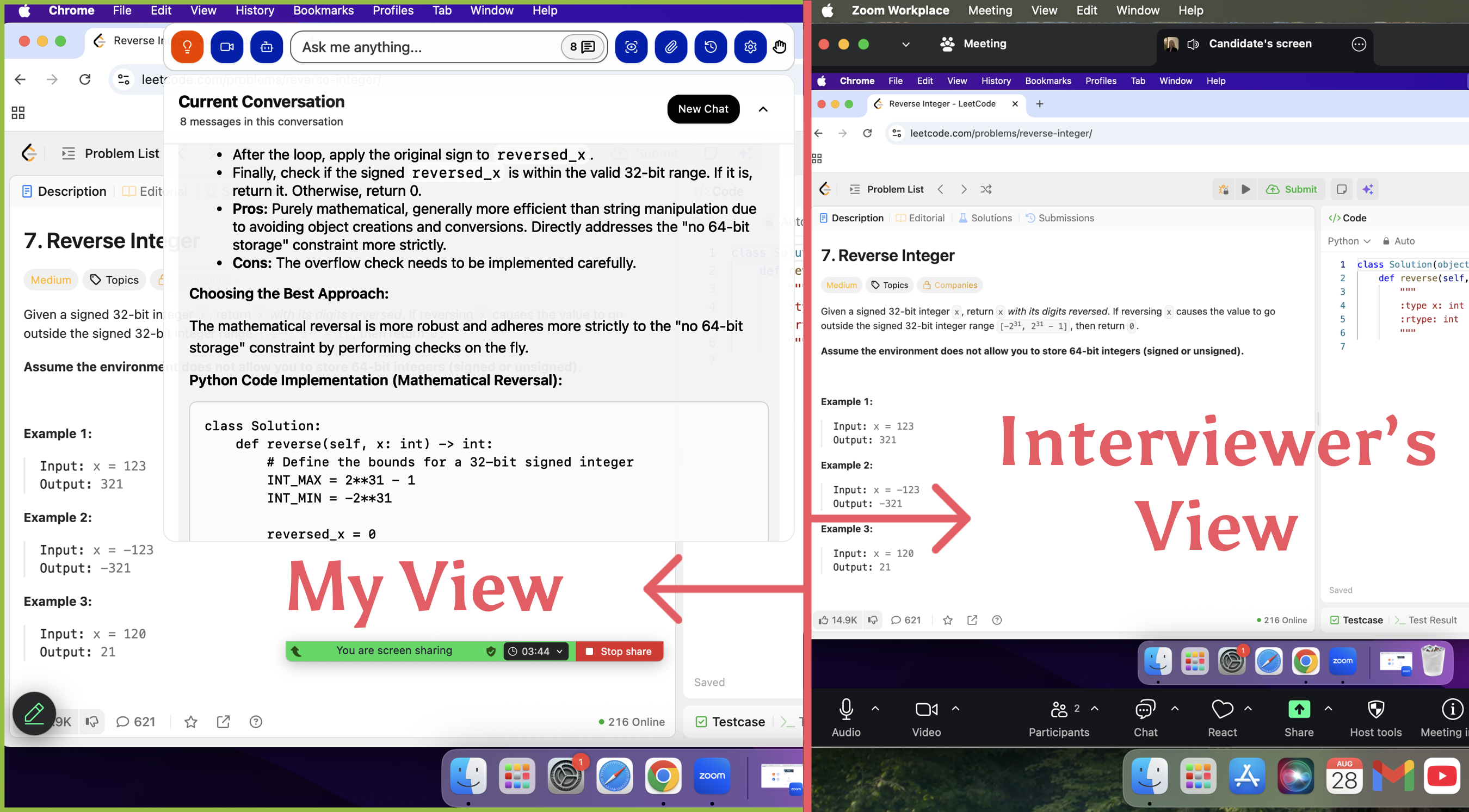
Undetectable AI Coding Interview Copilot
Linkjob AI is a very useful tool. When I was working on a coding problem and the interviewer asked me to share my screen, he didn't notice it was there.
Recent Oracle Interview Questions and Experience
Round 1. Algorithm / Problem Solving
Round 1 included three questions in total.
LRU Cache
The first round of the technical interview started right off with the classic LRU cache problem. Without any introduction, they immediately asked me to explain my approach and start coding.
The standard solution, of course, is to use a HashMap and a doubly linked list, with the key challenge being to ensure that both get and put operations are O(1). However, the Oracle interviewer clearly wasn’t satisfied with a boilerplate answer and immediately followed up after I finished coding: "What if this is a multithreaded environment?" "How would you minimize lock contention?""Is there a more scalable solution?"
My takeaway from this round was that the problem itself wasn't difficult, but the depth of the interview depended on how much you could discuss engineering principles. If you only stick to the LeetCode level, you'll likely be pressed for further details.
Merge Sorted Lists
The pattern for this round is very typical: they start with a relatively simple problem like "merge two sorted lists", and as soon as you finish it quickly, they immediately move on to "merge K sorted lists".
The interviewer is actually observing 2 things: whether you proactively analyze time complexity, and whether you know the optimal solution. After writing the double-linked list solution, if you mention on your own that you can use a min-heap to reduce the time complexity to O(NlogK), you'll generally be seen as having a mature approach.
This round isn't particularly stressful overall, but it thoroughly tests your fundamentals—it's the kind of question where "you won't fail, but it can create a gap between candidates".
Delete Target Leaf Nodes from BinaryTree
It featured a classic recursive tree problem: remove all leaf nodes whose values equal the target. However, the real challenge lies in the fact that when a leaf node is removed, its parent node may become a new leaf node, requiring further evaluation.
This problem essentially tests your ability to design sound recursive algorithms—for example, whether you know to use postorder traversal, and whether you can use the return value to directly indicate to the parent node whether it should be removed.
Interviewers pay close attention to code readability, including naming conventions, structure, and the presence of redundant logic. Upon writing the code, you'll find that Oracle does indeed have requirements for production-style code, rather than simply checking whether it passes the test.
Round 2. Project Deep Dive +
The first half of the interview involves a deep dive into your resume, and it’s extremely thorough. From why the system was designed the way it was, to the trade-offs involved, to how you would optimize it if you were to rebuild it—almost every detail is scrutinized. Many candidates don’t actually fail the coding portion; they fail here—because they aren’t familiar enough with their own projects.
The second half involves coding to design a Hospital Appointment Booking API. The scenario is a hospital with 1,000 doctors, each working from 9 AM to 5 PM, with 15-minute slots. The API must book the "earliest available" time for a specific doctor on a specific date and maintain state across multiple POST requests.
At its core, this is a lightweight system design problem. How should you model the Doctor and Slot entities? How can you quickly find the earliest available slot? How do you prevent double bookings? What if there's concurrency? As long as you proactively discuss topics like optimistic locking, data structure selection, or state management, the interviewer will usually nod in approval.
This round places a strong emphasis on engineering thinking rather than algorithmic skills.
Round 3. Hiring Manager Round (Behavioral Interview)
The final round focused on behavioral questions—no algorithms were involved, but don't let your guard down. The interviewer focused on two main areas: How do you typically prioritize tasks? And how would you handle a system failure that affects customers? The goal wasn't to test your ability to recite the STAR framework, but to see if you think like a reliable team member.
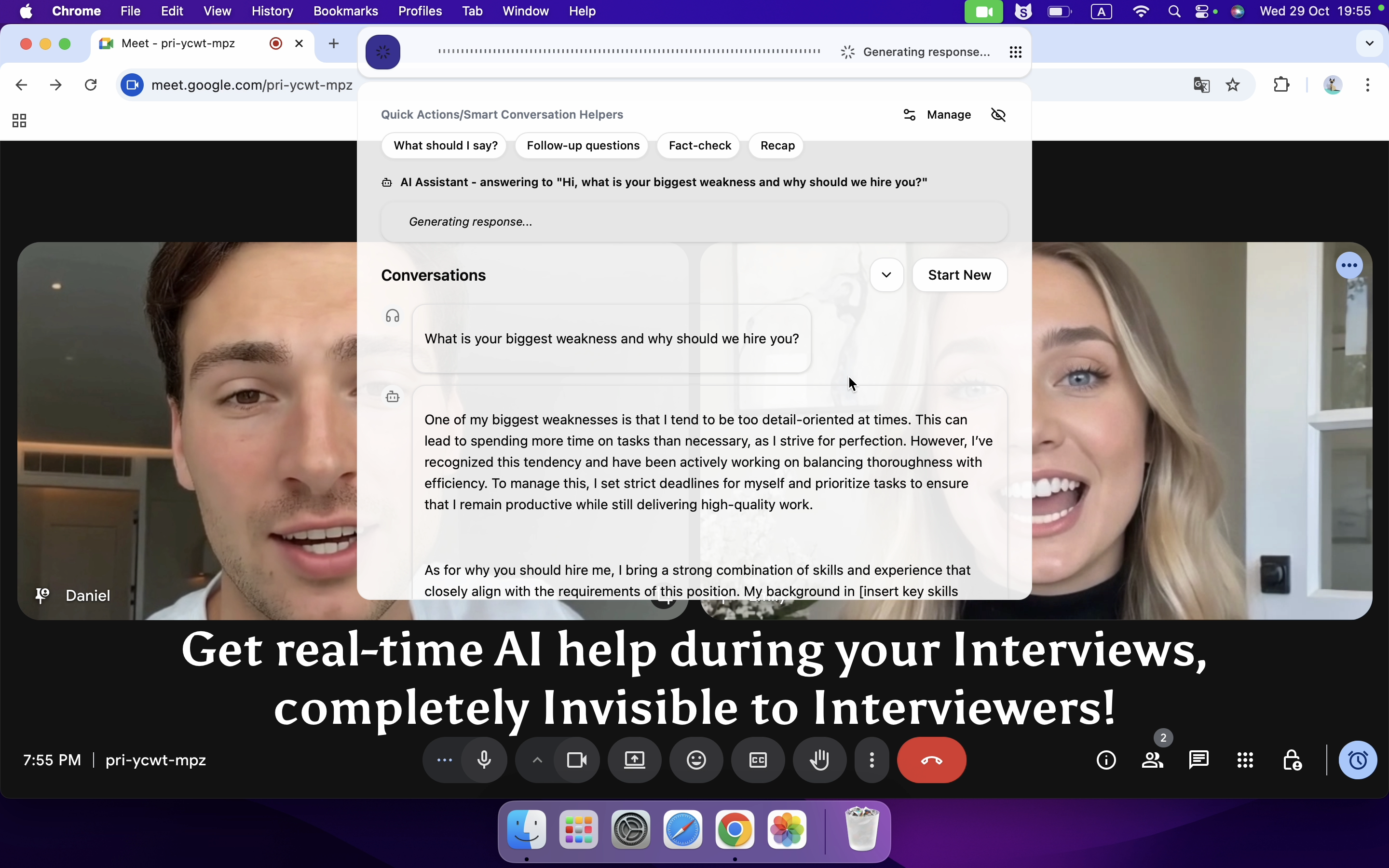
With the help of Linkjob AI, I did well during my interview and successfully received the offer.
Preparation for the Oracle Coding Interview
Planning My Study Timeline
Week | Focus Area | Goal |
|---|---|---|
1-4 | Basics & Concepts | Master fundamentals |
5-8 | Coding Practice | Solve daily problems |
9-12 | System Design & Behavior | AI Mock interviews |
Choosing Effective Resources
I picked resources that matched the oracle coding interview style. I used LeetCode for coding practice. I watched YouTube videos for system design, and made sure to review basic concepts like normalization and SQL indexing. I also collected and learned from other Oracle interviewee's experience, including Oracle ML interview experience and tips.
Tip: Always ask clarifying questions during practice. It helps you avoid confusion and shows your communication skills.
Tackling Oracle Coding Questions
Practical Coding Challenges
Communicate My Thought Process: I explained my plan before I started coding. I talked about possible solutions and why I picked one.
Focus on Scalability and Reliability: I mentioned how my code would handle large inputs or unexpected cases. I talked about ways to make my solution more robust.
Discuss Trade-offs and Alternatives: I shared the pros and cons of my approach. I showed that I understood there’s rarely a perfect answer.
Listen and Adapt: I paid attention to hints from the interviewer. If they suggested a different direction, I adjusted my solution.
# Example: Find the maximum subarray sum (Kadane's Algorithm)
def max_subarray_sum(nums):
    max_sum = nums[0]
    current_sum = nums[0]
    for num in nums[1:]:
        current_sum = max(num, current_sum + num)
        max_sum = max(max_sum, current_sum)
    return max_sum
Remember: The interviewer wants to see how you think, not just if you can code.
Succeeding in Oracle Behavioral Interviews
STAR Method for Responses
When I prepared for Oracle's behavioral interviews, I found that having a structure made everything easier. I always used the STAR method:
Situation: I set the scene. I described where I was and what was happening.
Task: I explained what I needed to do or what challenge I faced.
Action: I shared the steps I took. I focused on what I did, not just what the team did.
Result: I wrapped up with the outcome. I made sure to mention what I learned or how things improved.
Tip: Before the interview, I wrote out a few STAR stories from my past projects. Practicing them with AI interviewer helped me sound natural and confident. I also read other's Oracle Interview Experience and Tips during my pre
Common Behavioral Questions
Oracle's behavioral interviews felt just as important as the technical ones. I noticed they wanted to see how I worked with others, solved problems, and handled tough situations. I compiled a list of the behavioral questions from other positions, such as Oracle Senior SWE Interview, and practiced my answers using the STAR method.
I always tried to connect my answers to Oracle's values, like innovation and teamwork. I kept my stories attractive and focused on what I learned. Practicing these questions helped me walk into the interview feeling ready for anything.
Keep going. Growth comes from persistence and steady effort. 🚀
FAQ
How many coding problems did I practice before my Oracle interview?
I solved about 150 problems. I focused on quality over quantity. I picked problems from arrays, strings, trees, and graphs. I reviewed each solution and learned from my mistakes.
What should I do if I get stuck during a coding interview?
If I hit a wall, I pause and explain my thought process clamly. I also asked Linkjob AI for help. The AI tool offered me simpler approaches and broke the problem into smaller parts, which helped me think and handled the questions clearly.
How did I manage time during the interview?
I read each question carefully, and planned my approach before coding. I kept an eye on the clock. I first dealt with the questions I felt more confident about. If I got stuck, I moved on and came back later if time allowed.
Can I use online resources during the interview?
Actually yes! At first I indeed practiced coding on paper and in online editors without hints, which helped me get fit with real interview conditions. But during the formal interview, I still called out Linkjob AI for help, which proved to have built my confidence.
See Also
My 2026 Oracle OCI Interview Full Process and Real Questions
The 2026 OpenAI Coding Interview Question Bank I've Collected
6 Best AI Coding Interview Assistants in 2026: Review & Comparison
Anthropic Coding Interview: My 2026 Question Bank Collection
© Copyright 2025 Linkjob.ai - All Rights Reserved.