My Actual Oracle ML Interview Experience and Tips for 2026

My Oracle Timeline of the 2026 ML Interview
Round 1. Day 1, HM intro chat
Round 2. Day 7, pre screening with HR (behavior)
Round 3. Day 15, technical (coding + ml project deep dive )
Then no news at all, and I thought i might have failed. Then, one month later, I visited the Oracle booth at ICCV. I asked the HR why I hadn't received any updates. Then they told me that I had passed and would notify the responsible colleague.
Then the HR responsible finally scheduled a new interview a week later. However , the interview position was downgraded several times from senior principal => principal => senior AS before my interview was finalized.
Round 4. Day 97, Full loop (2 coding , 2 behavior)
Then still no news again.
Day 120, I sent an email to the HR and found out that the result was positive but they were still waiting for the final decision.
This company is really a mystery. I have never seen such an abstract process.
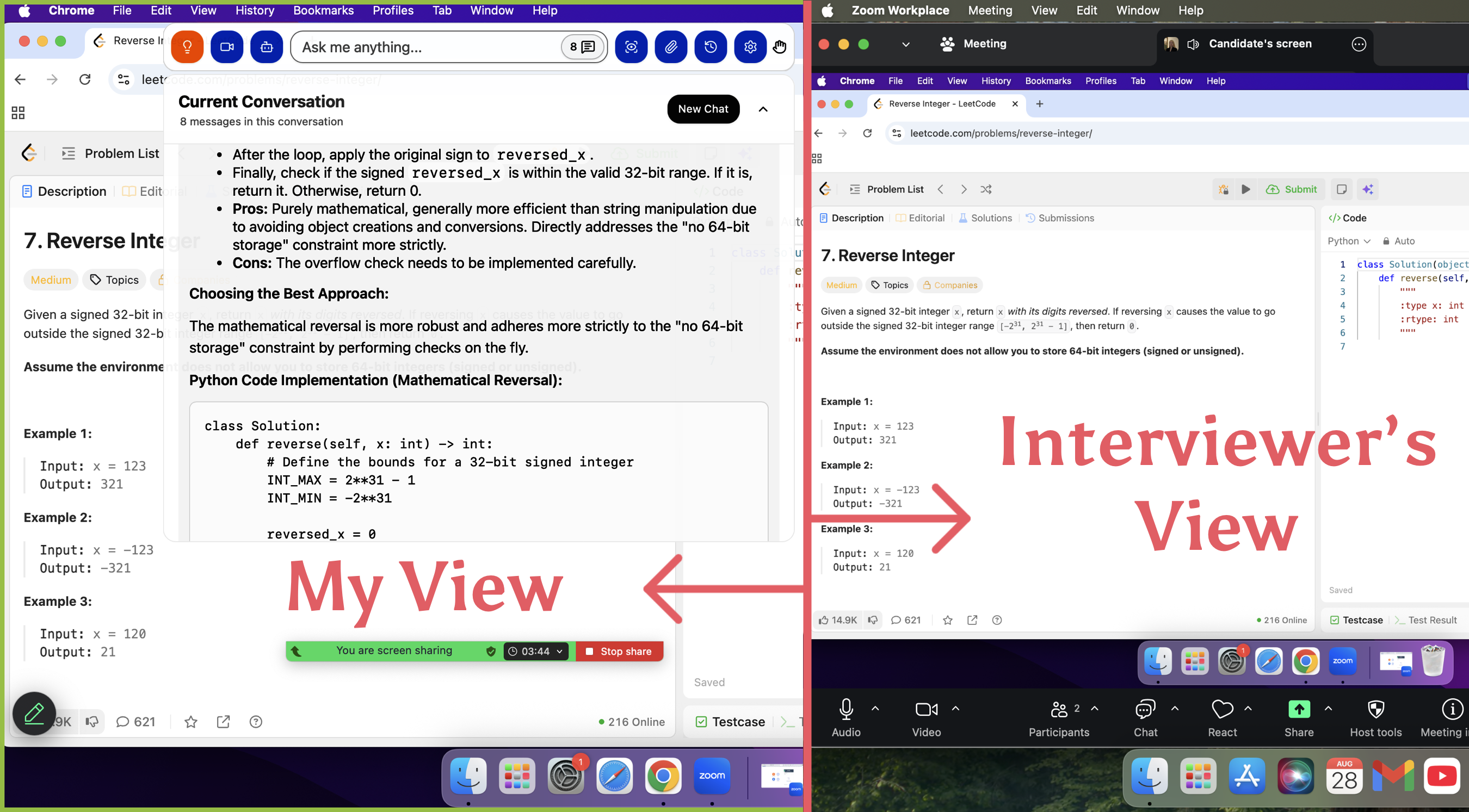
While the process was long, I managed to pass the interview with the help of Linkjob AI, which is why I’m sharing my interview experience here. Having an AI interview assistant that can see the screen and help answer questions indeed provides a significant edge. Below, I will share the actual interview questions I encountered in each round.
Oracle Machine Learning Interview Process
Application and Resume
The first step is always the application. I made sure my resume highlighted my technical skills and relevant projects experiences. Oracle always looks for candidates who show both technical ability and a strong willingness to learn. I recommend make your resume to match the job description 100% first. This step sets the stage for everything that follows.
focus on keywords from the job description.
note specific achievements and technologies.
keep resume clear and easy to read.
Round 1. HM Intro
After submitting my application, I received an invitation for a phone screening. This round felt more like a conversation than a test. The direct recruiter asked about my background, my interest in Oracle, and my understanding of the role.
He asked a few basic technical questions, but the main goal was to see if I would be a good fit for the team, the main questions are
Decision Question: Walk me through a recent ML project. Why did you choose that specific algorithm over others? What were the trade-offs?
Data Quality: In your experience, what takes up the most time in an ML pipeline? How do you handle missing values or noise data in a production environment?
Metric Selection: How did you measure the success of your project? Was it a technical metric or a business metric (like reduced churn or $ saved)?
Deployment & Scaling: How do you ensure a model remains accurate after it has been deployed? Have you ever dealt with Model Drift?
Round 2. Pre screening with HR
My HR interview felt very conversational. They wanted to know how I solve conflicts, work with others, and fit into Oracle’s culture. I prepared stories from my past experiences. I made sure to show how I solved problems, worked with teams, and learned from mistakes. The questions are:
Conflict: Tell me about you and your teammate disagreed on a technical approach, how did you resolve it?
Ambiguity: when you were given a vague problem statement, then how did you break it down into a ML task?
Learning ability: The ML field moves so fast., how do you stay updated with the latest research?
Round 3. Technical screen
This is typically the most substantial part of the technical screen. The interviewer selected the most relevant and high-impact projects from my resume and ask me to walk through them from end to end.
Key Focus Areas
Project Context: What was the specific problem/ Why was machine learning the right solution/ What was the business impact or the specific improvement in key metrics?
Data Pipeline: What was the data source and size / Describe the data cleaning process and Feature Engineering ,like how did you handle missing values, class imbalance, or feature selection?
Model Selection: Why did you choose this specific model , like Transformer vs. CNN? Which baselines did you compare it against?
Implementation Details: Describe the architecture (layers, hyperparameters) and the training process ,like choice of optimizer, loss functions, and regularization techniques used to prevent overfitting.
Challenges & Solutions: Did you encounter overfitting or underfitting/ How did you approach hyperparameter tuning / How did you address the Bias-Variance tradeoff?
Evaluation: Which metrics did you use ,like Accuracy, F1-score, AUC, BLEU, etc., and why were they appropriate for this specific task?
Deployment & Production: How was the model deployed? What were the A/B testing results? How did you address scalability and latency requirements?
Special Focus on LLM and GenAi
Since Oracle is heavily investing in GenAi, be prepared for questions on:
Transformer Architecture and Attention mechanisms.
Fine-tuning strategies,like PEFT, LoRA, etc.
RAG workflows and vector databases.
Evaluation metrics specific to LLMs ,like ROUGE, perplexity, or human-in-the-loop.
However, I gotta say, having Linkjob AI with me during those remote interviews made a huge difference. It seriously took all the stress out of the online vibe. It worked like a charm in the live interviews, and the interviewer had no clue I was using it. It fed me spot-on, professional answers for the tough questions I was blanking on.
Round 4. Full Loop(2coding, 2behavior)
The interview splited coding into General DSA (Data Structures & Algorithms) and Applied ML Coding (Mathematical implementation).
Coding round A: General DSA & Problem Solving
This round tests my ability to write clean, production-ready code. Oracle interviewers prefer pull from medium difficulty LeetCode patterns.
Oracle Patterns:
Arrays & Intervals: Merge Intervals and Meeting Rooms II are extremely frequent.
Strings & Hashing: Group Anagrams and Longest Palindromic Substring.
System Logic: LRU Cache , implementing a cache using a Doubly Linked List + HashMap.
Heaps/Sorting: Merge k Sorted Lists and Top K Frequent Elements.
Expectation: i was expected not only to solve it, and also discuss
Time/Space Complexity and handle edge cases,like empty inputs, nulls, overflow.
Coding round B: Applied ML Coding
This is specific to ML roles. They asked me to implement an algorithm from scratch using only NumPy or basic Python.
Tasks:
Implement K-Means: write the centroid initialization and the update loop.
Linear/Logistic Regression: Writing the Gradient Descent update rule ($w = w - \alpha \cdot \nabla J(w)$).
Matrix Operations: Sparse Matrix Multiplication or Dot Product of Two Sparse Vectors ,it is crucial for recommendation system roles.
Evaluation Metrics: Writing a function to calculate a Confusion Matrix, Precision-Recall, or IoU (Intersection over Union) for computer vision tasks.
Behavioral Rounds (2 Sessions)
I felt that Oracle places a high premium on Core Values , such as Integrity, Mutual Respect, and Excellence.
Key Themes & Questions
Theme | Question |
Conflict | Tell me about you ever had a technical disagreement with a senior engineer. How was it resolved? |
Failure | Describe a project that failed or missed a deadline. What did you learn? |
Ambiguity | Tell me about a time you had to work on a task with vague requirements. How did you proceed? |
Mentorship | Give an example of how you helped a struggling team member improve. |
The STAR Technique
Oracle recruiters explicitly look for the STAR (Situation, Task, Action, Result) format. For ML roles, ensure the action includes technical specifics. For example, I performed an error analysis on the false positives..., and my result includes metrics (e.g., ...which increased the F1-score by 12%).
Machine Learning Theory
When I had "Coding" and "Behavioral" rounds, ML theory questions often leak into these session:
Bias-Variance Tradeoff: How do you diagnose it, and what are the remedies Regularization, more data, etc.?
Deep Learning: If the role involves LLMs or CV, explain Transformer Attention mechanisms or Vanishing Gradients.
Production ML: How it is handled Data Imbalance or Model Drift once a model is deployed on OCI?
Preparation Checklist
Mock Coding: Practice Merge Intervals and LRU Cache until make sure to code them in under 20 minutes.
NumPy Fluency: Ensure to manipulate arrays (reshaping, broadcasting) without looking up documentation.
Know the OCI Stack: Briefly research OCI Data Science or Oracle's GenAI Service then to ask insightful questions at the end.
Lessons from Shared Experiences
Other candidates shared some great advice with me. Here are the lessons that helped me the most:
Always explain reasoning and the trade-offs in design choices.
Talk about scalability and reliability, like using horizontal scaling or redundancy.
Discuss alternatives and why it is picked in the solution.
Speak clearly and organize the thoughts.
Practice with mock interviews to get comfortable sharing the ideas.
Tip: The more we practice explaining our designs, the more confident we’ll feel in the real interview.
More Advice
Mistakes to Avoid
I made a few mistakes during my preparation and interviews.
I tried to memorize answers instead of understanding concepts.
I rushed through coding problems without checking for edge cases.
I forgot to ask questions at the end of interviews.
Encouragement for Candidates
Oracle looks for potential, not perfection. Show them with confidence. Good luck! 🚀. Here’s what helped me most in my Oracle interview journey:
Practice coding every day.
Explain my ideas out loudly.
Learn about Oracle products.
Pls See Also
Navigating Oracle Software Engineer Interview Questions in 2025
A Comprehensive Guide to Dell Technologies Interview Prep in 2025
Successfully Acing My Palantir New Grad SWE Interview in 2025
© Copyright 2025 Linkjob.ai - All Rights Reserved.