How I Passed 2026 Oracle Technical Interview: Real Questions


The technical interview process at Oracle was quite intense. It consisted of five rounds in total across the technical screen and virtual onsite stages. The pressure was intense because failing any single round would result in an overall rejection. In this post, I will share the specific questions from each round and the strategies I used to solve them.
I’m really grateful to Linkjob.ai for helping me pass my interview, which is why I’m sharing my interview questions and experience here. Having an undetectable AI coding interview helper during the interview indeed provides a significant edge.
The Real Questions in My Oracle Technical Interview
Technical Screening
Problem: Implement simplified Redis-like data structure in Golang
Required Operations:
set: Set key to string value (override if exists)
list_push: Push string to head of list at key (create list if doesn't exist)
get: Return entry (string or list) for key
list_remove: Remove matching values from list (first N if count > 0, last N if count < 0, all if count = 0)
Expiration functionality (deferred)
Virtual Onsite
System Design
Design a parking lot. It is required to have two floors. The first floor can only park compact cars, and the second floor has parking spaces shared by both large and small vehicles. Here, a priority service is required. That is, if a small car comes, it should first choose the first floor, and only when the first floor is full can it go to the second floor. Also, there is a requirement for time - based charging. Then, questions were asked about how to design the database and how to solve the problem if the data volume is too large.
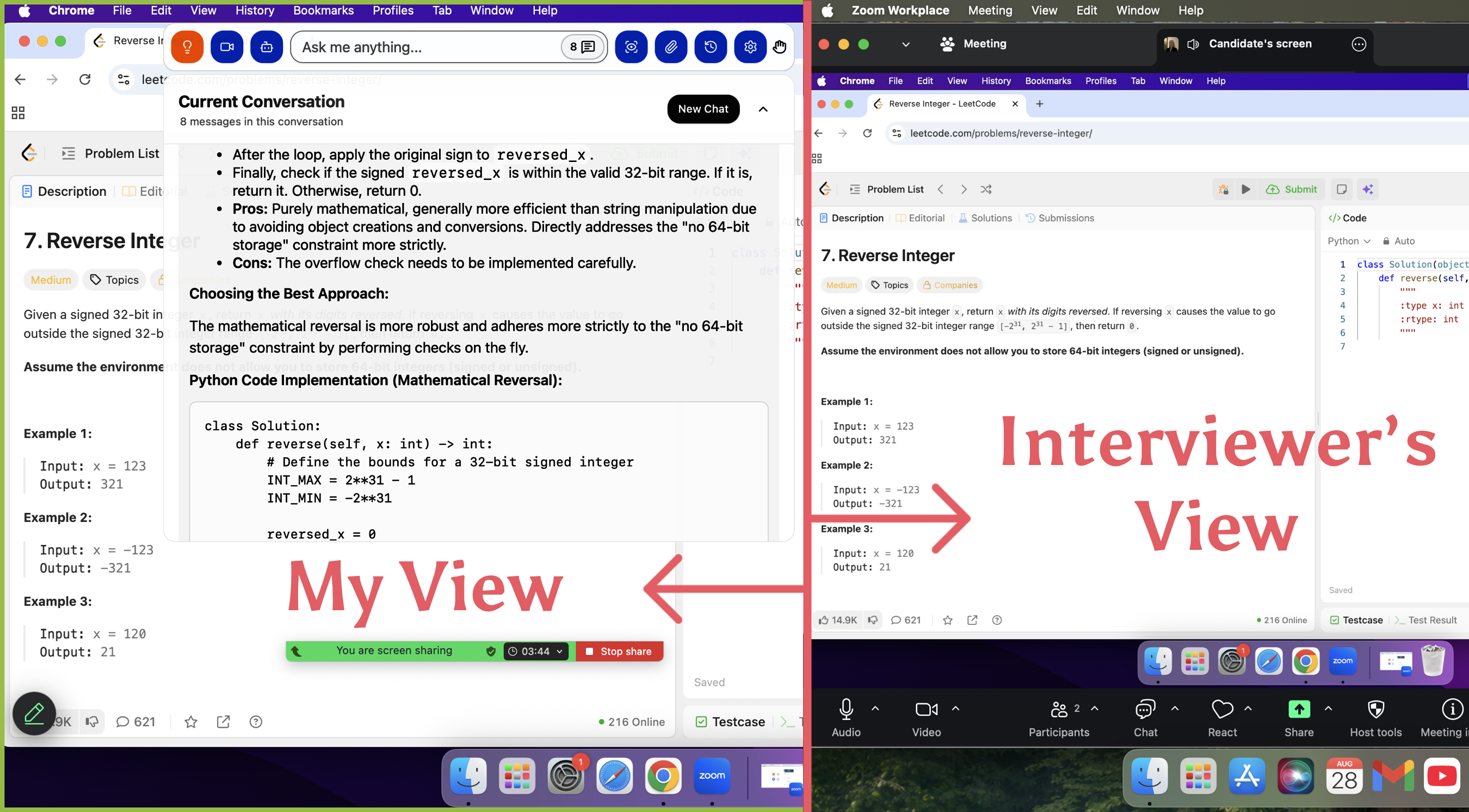
This question was quite challenging for me. I remember I actually turned to Linkjob AI to get the logic for the solution. It worked great and I got through the interview without a hitch. It’s completely undetectable, and the interviewer had no idea I was using it.
Coding 1
An array was given where each element in the array was at a distance of `k` from its target position, and then I was asked to sort the array. At first, I came up with a solution with a time complexity of \(O(nk)\). Then the interviewer required me to use a priority queue and achieve a time complexity of \(O(n \log k)\).
Coding 2
"Delete Target Leaf Notes". The interviewer asked a lot of questions, such as how to tell if a leaf node is indeed a leaf node. Then I was asked to keep repeating my algorithm and describe the operation process. I wasn't allowed to write the code until I had gone through all these to his satisfaction.
Coding 3
Given a rotated array and the number of rotations, one just needed to find the index of the maximum element in the array during each rotation process.
Behavioral Questions
Tell me about a time you faced a significant technical challenge. How did you handle it?
Describe a time when you had a disagreement with a team member or manager. How was it resolved?
Tell me about a time when you were under a tight deadline and couldn't complete everything. What did you prioritize?
Oracle Technical Interview Preparation
Study Plan & Resources
I realized early that I needed a realistic study plan. I broke down my preparation into weekly goals. My main focus areas were data structures, algorithms, and reviewing my past projects. I also set aside time for system design and SQL practice.
I used a mix of resources that other successful candidates recommended:
Oracle Interview Preparation guides with technical resources and real interview stories
Articles covering coding problems like Armstrong Numbers, dynamic programming, palindrome checks, and queue implementation
Navigating Oracle Recruitment Process for insights into the hiring process
LeetCode for coding challenges
Mock interviews with friends and online platforms
I tracked my progress in a notebook. Each week, I reviewed what I learned and adjusted my plan if I fell behind. This approach kept me motivated and on track.
Here’s a quick look at the technical topics I focused on:
Technical Topic | Description |
|---|---|
Database Architecture and Administration | Understanding Oracle’s instance architecture, memory structures, and backup strategies. |
SQL Performance Tuning | Mastering execution plans, finding performance bottlenecks, and understanding index types. |
PL/SQL Programming | Reviewing stored procedures, functions, exception handling, and bulk operations. |
Data Modeling and Normalization | Knowing normal forms, denormalization, and translating business needs into database schemas. |
Coding Practice & Projects
I knew that practicing coding questions was essential for the oracle technical interview. I solved problems on LeetCode, focusing on data structures and algorithms. I practiced under timed conditions to get used to the pressure.
I also worked on personal projects using real datasets. These projects helped me apply what I learned and gave me stories to share during interviews. I contributed to open-source repositories, which improved my coding skills and showed my commitment to learning.
When I talked about my projects, I made sure to explain the problems I solved and the impact of my work. I learned that hiring managers care about business outcomes, not just technical details. For example, I described how my project improved user experience or saved time for the team. This approach made my answers stand out.
Technical & Behavioral Questions
Before the interview, I compiled some common questions that often arise with Oracle. Now, I will share a few of the ones that I consider to be the most common:
How will you differentiate between varchar & varchar2?
What are the components of logical database structure in Oracle database?
Explain about the ANALYZE command in Oracle.
What types of joins are used in writing subqueries?
What is the use of Aggregate functions in Oracle?
When the conversation shifted to behavioral questions, I knew the goal was to show how I handle challenges at work. I shared stories about learning from mistakes and solving problems with my team.
Oracle Technical Interview Evaluation Points
Why do we need technical interviews? What are the characteristics of technical interviews compared to other types of interviews? Understanding the answers to these questions allows us to answer questions precisely and prepare for interviews in a targeted manner. In fact, there are some very important capabilities that software engineers need to possess, and only technical interviews can assess them:
1. Technical Capabilities
Ability to Analyze Problems and Organize Requirements: Initially, the problem may seem rather vague, but excellent and experienced engineers can identify the core requirements. This "identification" ability is particularly important, and I will elaborate on it later. There may be multiple requirements here, but considering time constraints, usually only one or two of them will be covered from a certain perspective during the interview.
Ability to Design a System Based on Requirements: This includes both functional and non - functional requirements. In fact, this can vary in scale. It doesn't necessarily only refer to whether the functions are implemented in system design. During this process, aspects such as system extensibility, availability, and consistency may also be involved.
Ability to Implement Core Logic: Nowadays, algorithms and data structures, whose assessment importance is often overestimated, generally fall into this category. It can also be considered from two perspectives: functional and non - functional. Functionally, whether the algorithm can meet the requirements; non - functionally, whether the algorithm has sufficient performance, whether the coding follows best practices, and whether the code has good extensibility, etc. And coding ability means that after reaching an agreement on the thinking, whether the core logic can be put down on paper (in code). After all, "empty talk harms the country, while actual work makes it thrive."
Experience and Other Engineering Capabilities: This part is relatively more flexible. For example, the assessment of testing ability, that is, what kind of tests can be done to ensure the correctness of functional and non - functional requirements. For specific teams and projects, sometimes they will focus particularly on specific technical capabilities. For example, a front - end team needs to assess front - end basic skills.
2. Non - Technical Abilities
Unlike the assessment of technical abilities, the evaluation of non - technical abilities varies more among different interviewers. In other words, each person may have different perspectives and standards. However, I think the following aspects are particularly important and thus must be covered:
Communication and Collaboration Skills: If there were no time constraints, what would be the ideal interview? It would actually be working together, as only during work would there be sufficient and necessary communication, and both positive qualities and negative issues would be exposed. But due to the limited time of an interview, we can't create a real working atmosphere. Nevertheless, we can still simulate the process of jointly examining, analyzing, and solving problems in a work environment, and this process is connected through "communication". Communication is a broad topic with many specific assessment items. For example, can the candidate accept suggestions? Can they discuss ideas? Some candidates, once they get into their own thinking mode, can't listen to others, so a point has to be emphasized several times. While others lack backbone, and without thinking, they immediately change their minds when slightly probed.
Passion and Interest: The influence of passion and interest is huge. It is said that interest is the best teacher, especially for junior engineers. Passion and interest not only affect their own future development but also the atmosphere of the entire team.
Learning Ability: Learning ability largely determines the potential for progress of a candidate in a new position. Given the same foundation and the ability to solve basic problems, some candidates can "catch on quickly" and draw inferences from one instance, which reflects their learning ability to a certain extent. Undoubtedly, software engineers face new problems every day. After joining the company, they will find that not only the problems are new, but also the code, libraries, and tools are new. So before they become mature enough to make certain contributions, learning is an inevitable step.
Which is more dominant, technical or non - technical abilities? In fact, both are of great importance, and each has its own characteristics. Relatively speaking, non - technical abilities are more difficult to improve, so more attention should be paid to issues in this regard. For example, it is almost impossible to transform a candidate who lacks passion and interest in the software field after they join the company.
Tips for Oracle Technical Interviews
Stress-Reduction Techniques
Preparing for the oracle technical interview can feel overwhelming. I wanted to stay calm and focused, so I tried several stress-reduction techniques. Here’s what worked for me:
Technique | Effect on Performance |
|---|---|
Technical rehearsals | Reduced my technical anxiety by 40% |
Environment optimization | Boosted my confidence by 25% |
Deep breathing exercises | Helped me stay calm under pressure |
Progressive muscle relaxation | Eased physical tension before interviews |
Grounding techniques | Managed anxiety during tough questions |
I also practiced mindfulness. Before each study session or mock interview, I took a few deep breaths and reminded myself to stay positive. I viewed each challenge as a chance to show my skills.
Time management played a big role in my preparation. I set clear study blocks and took regular breaks to avoid burnout. I learned from others that poor time management can lead to exhaustion and lower performance. By sticking to my schedule, I kept my energy up and avoided last-minute cramming.
Mock interviews helped me the most. They gave me a safe space to practice answering questions and receive feedback. Each session made me more comfortable and confident. I could see my progress, and that motivated me to keep going.
Tip: Simulate the interview environment as much as possible. Practice with a timer, use a whiteboard, or ask a friend to act as the interviewer. This will help you feel more prepared on the actual day.
By combining these strategies, I felt ready for anything the oracle technical interview could throw at me.
Communication Strategies
I focused on clear communication throughout the oracle technical interview. I practiced writing solutions by hand before the interview. During the session, I made sure to:
Ask clarifying questions if I didn’t understand something.
Explain my plan before jumping into code.
Describe my algorithm and consider test cases out loud.
Confidence and clear explanations made a big difference. I noticed the interviewer appreciated when I talked through my thought process.
Handling Surprises Calmly
Sometimes, I got questions I didn’t expect. I paused, took a deep breath, and asked for clarification if needed. Practicing mock interviews with interruptions helped me stay calm. I learned to adjust my answers on the fly and keep a positive attitude, even when things got tricky.
Post-Interview Mindset
After the oracle technical interview, I reminded myself that waiting for results is part of the process. I reflected on what went well and what I could improve. I realized that consistent preparation, a clear mindset, and strong fundamentals matter most. Each interview taught me something new for the next challenge.
Looking back, I learned that passing the Oracle technical interview takes more than just coding. Here are my top tips for future candidates:
Focus on system thinking, not just syntax.
Show security awareness.
Discuss performance and scalability.
Consider user experience.
Stay adaptable.
Communicate clearly.
Patience and honesty matter. Every round tests different skills. Stay positive and keep learning!
FAQ
How did I handle questions I did not know?
I just use Linkjob.ai to help me out. It has a screenshot feature that reads the coding problem right off my screen and gives me the full answer. I actually tested it with a friend beforehand, and they confirmed that Linkjob doesn't show up at all during screen sharing.
How did I stay calm during the interview?
I took deep breaths and reminded myself that I prepared well. I focused on one question at a time. This helped me stay relaxed.
What resources helped me the most?
LeetCode and mock interviews helped me the most. I also reviewed my own projects. These gave me confidence and real examples to share.
See Also
Insights From My 2026 Oracle Software Engineer Interview Process
A Detailed Account of My 2026 Dell Interview Journey
How AI Helped Me Overcome Interview Anxiety Effectively
Essential Responses for 2025’s Top Competency Interview Queries
© Copyright 2025 Linkjob.ai - All Rights Reserved.