Pentair Interview Questions: 50+ Real Technical, IoT, QA, SAP, and "Win Right" Questions I Collected

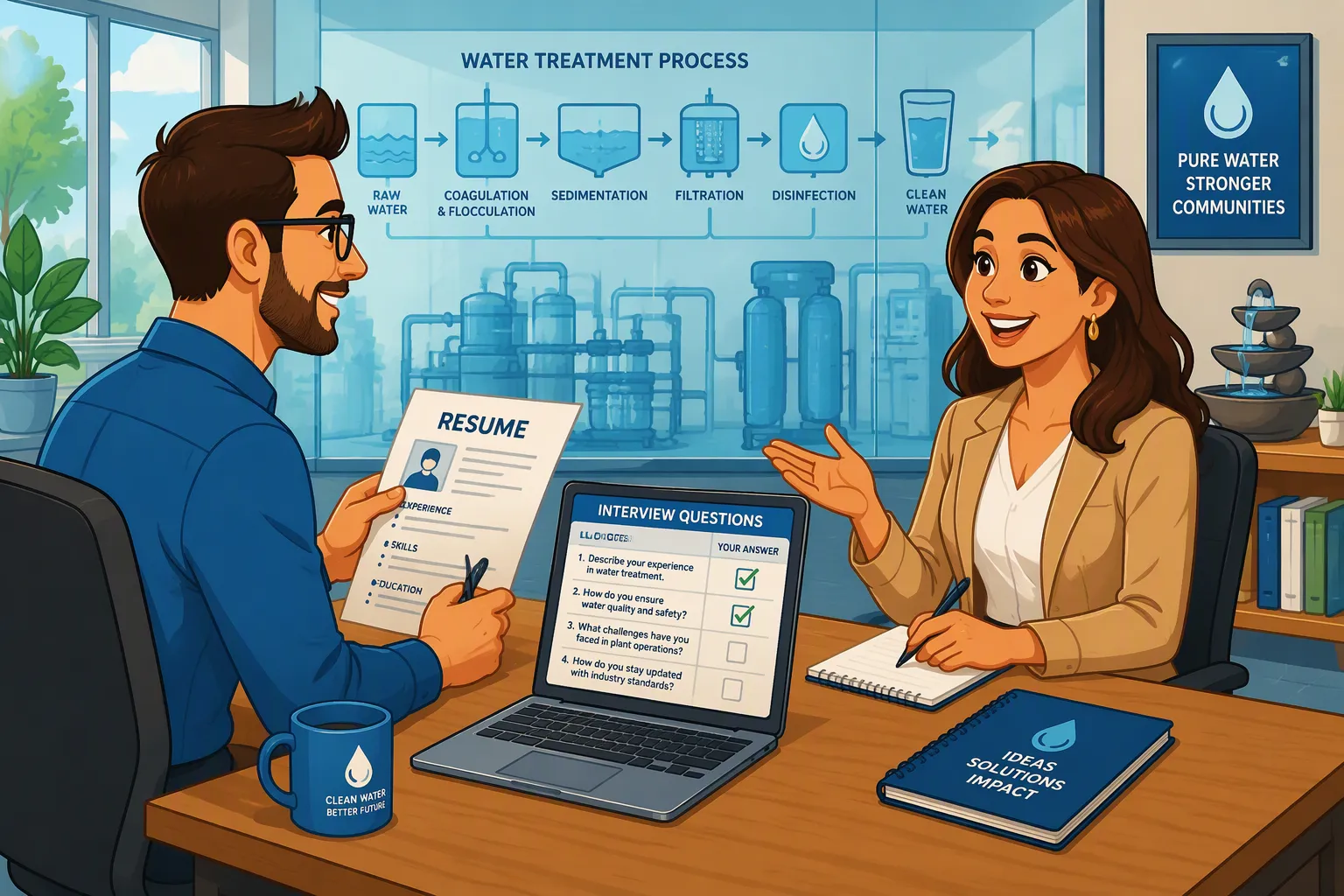
When I got my first interview invite from Pentair, I pictured a traditional pump and pool-filter manufacturer. Twenty minutes into my technical screen, the interviewer was asking me to walk through the end-to-end Bluetooth (BLE) pairing and connection process for a smart pool controller, compare open-loop versus closed-loop control systems, distinguish unit, integration, system, and end-to-end testing, and explain how REST versus SOAP APIs connect IoT cloud services to SAP SD Order-to-Cash (O2C) workflows.
Whether you are interviewing at Pentair's operational headquarters in Golden Valley (Minneapolis), Minnesota, its major engineering and manufacturing sites in Cary and Sanford (North Carolina), Brookfield and Delavan (Wisconsin), Chino (California), Chardon (Ohio), or its massive R&D, QA, and SAP/IT center in Noida, India, Pentair interview questions bridge the physical and digital worlds. Interviewers want to see that you can connect clean software, QA test strategy, enterprise ERP flows, or mechanical tolerances to real-world water treatment, fluid dynamics, and connected hardware reliability.
During my virtual Hiring Manager and Panel rounds on Microsoft Teams, I used an undetectable desktop AI interview assistant to keep my Bluetooth/IoT protocol notes, QA testing frameworks, C++/Python complexity breakdowns, and STAR stories mapped to Pentair's six Win Right Values right under my webcam lens—completely invisible during screen sharing.
Below is my complete, firsthand collection of 50+ verified Pentair interview questions—starting with the 11 high-frequency technical, QA, API, IoT, SAP SD, and leadership questions I personally collected from recent loops, followed by live coding solutions, embedded hardware/DFMEA/SPC questions, and behavioral answers.
How the Pentair Interview Process Works in 2026
Across experienced engineering, QA, IT/SAP, and campus hiring tracks, the Pentair interview process typically takes 3 to 5 weeks and follows a structured three-stage funnel (plus an Online Assessment and Group Discussion for university and Noida campus drives):
Stage 1: Recruiter Phone Screen or Campus Assessment (20–30 Minutes)
For Experienced Roles (US & Global): A 20-to-30-minute phone or video call with a Pentair talent acquisition specialist covering your resume projects, why Pentair's mission (Smart, Sustainable Water Solutions. For Life.) resonates with you, your typical Agile sprint rhythm, hybrid or on-site location alignment, and target compensation.
For University & India (Noida) Campus Drives: An online coding and aptitude test followed by a Group Discussion (GD) on emerging technology trends or sustainability, filtering down to candidates with strong fundamentals (and a 70%+ academic threshold for India campus cohorts).
Stage 2: Hiring Manager Technical & Domain Deep Dive (45–60 Minutes)
For Software, QA Automation & IoT Engineers: Deep questions on unit vs. integration vs. system vs. E2E testing, test plan vs. test strategy, HTTP vs. HTTPS, REST vs. SOAP APIs, authentication vs. authorization, Bluetooth (BLE) pairing, and live coding in Python, C++, Java, or C#.
For Control Systems, Embedded & Mechanical Engineers: Questions on open-loop vs. closed-loop control systems, 4–20mA pressure sensors,
structvs.class, DFMEA, and SPC (Cp/Cpk).For Enterprise IT & SAP Consultants: End-to-end business process questions, especially Order-to-Cash (O2C) in SAP SD (from sales order and credit check to outbound delivery, PGI, billing, and FI posting).
Stage 3: The Cross-Functional Panel Evaluation (60–90 Minutes)
Format: Back-to-back or panel interviews with 2 to 4 senior engineers, quality/operations leads, product managers, and HR partners.
What They Grade: Strict STAR method (Situation, Task, Action, Result) behavioral answers mapped directly to Pentair's Win Right Values and PIMS (Pentair Integrated Management System) lean principles.
Part 1: 11 Must-Know Real Pentair Technical, QA, IoT, SAP & Agile Interview Questions I Collected
While organizing feedback from recent Pentair technical and managerial loops, these 11 exact questions stood out as the core rubric across Software Engineering, QA Automation, IoT/Embedded, and Enterprise IT roles. Here are the word-for-word questions and the exact answers that score a strong hire:
1. What is the difference between unit, integration, system, and end-to-end testing?
Why Pentair Asks This:
At Pentair, a single connected product—like an IntelliFlo variable-speed pump controlled via the Pentair Home mobile app—spans embedded C firmware, Bluetooth/Wi-Fi gateways, AWS cloud microservices, and mobile UI. Interviewers want to see how you structure the testing pyramid across these four levels:
Unit Testing (Lowest Level, Fastest, Highest Volume):
Tests the smallest isolated testable unit of code—a single function, method, or class—with all external dependencies (databases, hardware registers, network sockets) mocked or stubbed out. For example, testing a Python or C function that calculates pump flow rate from raw impeller RPM and pressure differential in milliseconds on every commit.Integration Testing (Component & Interface Boundaries):
Tests how two or more modules, services, or hardware-software layers interact when wired together. It verifies interface contracts, data serialization, database queries, and message queues—for example, verifying that the IoT telemetry ingestion service properly validates and writes a JSON sensor payload into PostgreSQL, or that an MCU's SPI driver communicates cleanly with an external flash chip.System Testing (Complete Integrated System against Specifications):
Tests the fully integrated software/hardware build as a complete black-box system in a staging or lab environment against both functional requirements and non-functional requirements (performance, load, security, fail-safe pressure cutoffs, memory leaks) without relying on live production user workflows.End-to-End (E2E) Testing (Real User Journey Across All Subsystems):
Validates the complete, real-world user workflow from start to finish across every external dependency. At Pentair, an E2E test simulates a homeowner tapping "Turn on Pool Heater to 82°F" in the mobile app, routing through the cloud API Gateway, over MQTT to the physical controller board, actuating the heater relay, and returning the updated temperature telemetry back to the mobile screen.
2. What is the difference between a test plan and a test strategy?
Answer:
Candidates frequently confuse these two documents, so draw a crisp distinction based on scope, ownership, and frequency of change:
Test Strategy (High-Level, Organization/Program-Wide, Static):
A Test Strategy is a long-term, high-level governance document (usually owned by the QA Manager, Test Architect, or Engineering Director) that defines the overall testing philosophy and standards across an entire product line or organization. It answers "How do we approach quality globally?"—covering the testing levels used (unit, integration, E2E), automation frameworks (Playwright, Appium, Pytest), defect severity definitions, CI/CD release gates, risk management approach, and environment standards. It rarely changes from sprint to sprint.Test Plan (Project/Release-Specific, Tactical, Dynamic):
A Test Plan (IEEE 829 standard, owned by the QA Lead or SDET on a specific release) is a tactical execution document tailored to a specific project, feature release, or sprint cycle. It answers "What exactly are we testing for Release 2.4, who is doing it, and when?"—defining exact in-scope and out-of-scope features, specific test case IDs, test data requirements, hardware test-bench schedules, individual tester assignments, and entry/exit pass criteria.
3. What is the difference between HTTP and HTTPS?
Answer:
HTTP (Hypertext Transfer Protocol) and HTTPS (Hypertext Transfer Protocol Secure) are both application-layer protocols used for client-server communication over the web, but they differ across four critical dimensions:
Encryption & Security (Plaintext vs. TLS/SSL): HTTP transmits all headers, URLs, payloads, and credentials in cleartext over TCP (typically Port 80), making it vulnerable to packet sniffing (Wireshark) and Man-in-the-Middle (MitM) tampering. HTTPS wraps HTTP inside TLS (Transport Layer Security) (formerly SSL) over Port 443, encrypting the entire communication channel using a hybrid handshake: asymmetric cryptography (RSA or ECDHE key exchange) to authenticate the server and securely negotiate a shared session key, followed by fast symmetric encryption (such as AES-256-GCM or ChaCha20-Poly1305) for the actual data payload.
Core Security Guarantees (CIA Triad): HTTPS guarantees Confidentiality (eavesdroppers cannot read the payload), Integrity (via Message Authentication Codes, so an attacker or rogue router cannot modify a firmware OTA binary or API command in transit), and Authentication (via X.509 digital certificates signed by a trusted Certificate Authority, proving the IoT device or browser is talking to the genuine
pentair.comserver).Performance & Modern Protocol Support: While TLS adds a 1-RTT (TLS 1.3) handshake on initial connection, modern browsers and cloud gateways require HTTPS to unlock HTTP/2 (multiplexed binary streams) and HTTP/3 (QUIC over UDP), often making HTTPS faster in production than legacy unencrypted HTTP/1.1.
4. What is the difference between REST and SOAP APIs?
Answer:
At industrial enterprises like Pentair, cloud and mobile apps use REST, while legacy ERP/supply-chain integrations (like older SAP or B2B partner connectors) often use SOAP. Contrast them across five engineering axes:
Architectural Style vs. Strict Protocol: REST (Representational State Transfer) is a lightweight architectural style that leverages standard HTTP methods (
GET,POST,PUT,DELETE,PATCH) and resource URIs (/api/v1/pumps/42/telemetry). SOAP (Simple Object Access Protocol) is a rigid, W3C-standardized messaging protocol with a strict XML structure (<soap:Envelope>,<soap:Header>,<soap:Body>,<soap:Fault>).Payload Format & Bandwidth Overhead: REST supports multiple payload formats—predominantly lightweight JSON (as well as plain text, HTML, or Protobuf)—making it fast to parse on mobile apps and low-memory IoT microcontrollers. SOAP strictly requires verbose XML, which increases payload size and parsing memory overhead.
Service Contract & Typing: SOAP enforces a strict, machine-readable contract via WSDL (Web Services Description Language) and XML Schema (XSD) with strong compile-time type checking. REST uses flexible, optional specifications like OpenAPI / Swagger.
Statefulness & Caching: REST is strictly stateless by design, and
GETresponses can be cached natively at the HTTP/CDN layer. SOAP calls are typically sent viaHTTP POST(preventing native HTTP caching) and can support stateful conversational operations.Enterprise Security & ACID Transactions: REST relies on transport-level security (HTTPS/TLS plus OAuth2/JWT). SOAP includes built-in WS-Security (message-level XML encryption and digital signatures that survive multi-hop enterprise service buses) and WS-AtomicTransaction for distributed ACID compliance.
5. What is the difference between authentication and authorization?
Answer:
Authentication (AuthN — "Who are you?"):
Authentication is the process of verifying the identity of a user, service, or IoT device. It happens first in the security pipeline—for example, a homeowner logging into the Pentair Home app with email, password, and MFA via OpenID Connect (OIDC), or a smart water filtration controller proving its hardware identity to AWS IoT Core using an mTLS X.509 client certificate. If authentication fails, the server returns HTTP401 Unauthorized(meaning unauthenticated).Authorization (AuthZ — "What are you allowed to do?"):
Authorization happens after authentication succeeds and determines which specific resources and actions that verified identity has permission to access. It is enforced via RBAC (Role-Based Access Control), ABAC (Attribute-Based Access Control), or OAuth 2.0 scopes / JWT claims—for example, verifying that User A is authorized to change the temperature setpoint on their own registered pool heater (device_id: 991), but is forbidden from reading telemetry from another customer's device or accessing dealer-only diagnostic endpoints. If authorization fails, the server returns HTTP403 Forbidden.
6. How does the Bluetooth pairing and connection process work end-to-end?
Why Pentair Asks This:
Pentair's smart pool equipment, water softeners, and Sump/Flow controllers use Bluetooth Low Energy (BLE) to let installers and homeowners discover, pair, and configure Wi-Fi credentials from a smartphone. Walk through the exact 5-stage end-to-end BLE connection & pairing lifecycle:
Stage 1: Advertising & Discovery (GAP — Generic Access Profile):
The peripheral device (e.g., a Pentair pump controller) periodically broadcasts Advertising Packets on the 3 primary BLE advertising channels (Channels 37, 38, and 39in the 2.4 GHz band) containing its Device Name, MAC address, and advertised Service UUIDs. The central device (the user's iOS/Android phone) scans those channels, optionally sends aSCAN_REQto receive aSCAN_RSPwith extended metadata, and displays the device in the app UI.Stage 2: Link-Layer Connection Establishment & Parameter Negotiation:
When the user taps the device, the phone sends aCONNECT_INDpacket specifying the Connection Interval (e.g., 15ms–30ms), Peripheral Latency, Supervision Timeout, and Channel Hopping Map across the 37 data channels (Channels 0–36). Both devices switch from advertising channels to synchronized frequency-hopping data channels, and negotiate the ATT MTU (Maximum Transmission Unit) (expanding from the default 23 bytes up to 247–517 bytes for faster throughput).Stage 3: Pairing (SMP — Security Manager Protocol, 3 Phases):
To secure the link, the devices execute the 3-phase BLE Pairing handshake:Phase 1 (Pairing Feature Exchange): Central and Peripheral exchange
Pairing RequestandPairing Responseframes declaring their I/O capabilities (Display, Keyboard, NoInputNoOutput), Authentication requirements (MITM protection), and whether they support LE Secure Connections (LESC).Phase 2 (Short-Term Key / LTK Generation via ECDH): In modern BLE 4.2/5.x LE Secure Connections, both sides generate an Elliptic Curve Diffie-Hellman (ECDH P-256) public-private key pair to prevent passive eavesdropping, and authenticate the link using one of four association models: Numeric Comparison, Passkey Entry (entering a 6-digit PIN printed on the controller label), Out of Band (OOB / NFC), or Just Works.
Phase 3 (Transport-Specific Key Distribution): Once the link is encrypted using the LTK (Long-Term Key) (AES-CCM), the devices exchange identity and signing keys (IRK for resolving private randomized MAC addresses, and CSRK).
Stage 4: Bonding (Persistent Key Storage):
Both the smartphone OS and the controller's non-volatile flash memory store the negotiated Long-Term Key (LTK) and IRK. On all future reconnects, the devices skip the multi-step pairing prompt and re-encrypt the connection instantaneously using the stored LTK.Stage 5: GATT Service Discovery & Characteristic Read/Write/Notify:
Once connected and encrypted, the phone acts as a GATT Client and discovers the peripheral's GATT Server hierarchy of Services and Characteristics (UUIDs). The app writes Wi-Fi credentials or pump speed commands viaGATT Writeand subscribes to live sensor telemetry by writing0x0001to the CCCD (Client Characteristic Configuration Descriptor) to enable real-time GATT Notifications / Indications.
Real Interview Questions. Real Candidates. Continuously Updated
Our interview questions come from real job interviews taken by candidates using Linkjob AI. Based on actual interview experiences and continuously updated with new questions
7. What is the difference between an open-loop and a closed-loop system?
Why Pentair Asks This:
This is a foundational control-systems question across Pentair's pump, thermal, filtration, and embedded firmware teams:
Open-Loop Control System (Non-Feedback System):
How It Works: The controller sends a predetermined command or actuation signal to the plant/actuator based solely on the input setting or a fixed timer, without measuring the actual output to verify whether the desired result was achieved.
Pentair Real-World Example: A basic single-speed pool pump or a timer-based backwash valve that runs at fixed 100% power for 4 hours a day regardless of whether the filter is clogged, line pressure has spiked, or the desired gallons-per-minute (GPM) flow rate has dropped.
Pros & Cons: Simple, inexpensive (no feedback sensors required), and inherently immune to feedback-oscillation instability—but completely blind to external disturbances (clogged strainer baskets, pipe friction changes, or ambient temperature drops).
Closed-Loop Control System (Feedback Control System):
How It Works: A sensor continuously measures the actual process output (
y(t)), feeds it back to a summing junction to compute the error signal (e(t) = setpoint r(t) - measured output y(t)), and a controller (such as a PID — Proportional-Integral-Derivative controller) dynamically adjusts the actuator drive to drive the error to zero.Pentair Real-World Example: An IntelliFlo Variable-Speed & Flow (VSF) pump or automated chemical dosing system. If the user sets a target flow rate of
45 GPMand debris partially blocks the filter (increasing head pressure), the flow/pressure sensor detects the drop, and the closed-loop PID controller automatically ramps up the VFD motor RPM to maintain exactly45 GPM.Pros & Cons: High accuracy, automatic rejection of external disturbances, and massive energy savings—at the cost of sensor hardware, calibration maintenance, and the engineering requirement to tune PID gains (
Kp, Ki, Kd) so the loop remains stable without overshoot or hunting.
8. Can you explain the end-to-end Order-to-Cash (O2C) process in SAP SD?
Why Pentair Asks This:
Pentair runs SAP (Sales & Distribution / S/4HANA) to manage orders from distributors, pool builders, and commercial water-treatment clients worldwide. When interviewing for SAP SD, Business Analyst, ERP QA, or Supply Chain IT roles, walk through the 7-step Order-to-Cash (O2C) lifecycle along with the exact SAP transaction codes (T-Codes), underlying database tables, and FI/MM integration points:
Step 1: Pre-Sales Activities (Inquiry & Quotation):
Customer requests pricing/availability (VA11Inquiry ->VA21Quotation). Stored in tablesVBAK(Header) andVBAP(Item) with zero accounting impact.Step 2: Sales Order Creation & Availability/Credit Check (
VA01):
A standard Sales Order (e.g., Order TypeOR) is created viaVA01(or EDI/B2B portal IDoc). SAP automatically executes ATP (Available-to-Promise) stock checking against SAP MM (MD04), runs Pricing Procedure determination (Condition technique: base price, dealer discounts, freight, tax), and performs an automated Credit Management (FSCM) check (VKM1/UKM_CASE) to verify the distributor hasn't exceeded their credit limit.Step 3: Outbound Delivery Creation & Shipping (
VL01N):
Once stock is available on the scheduled material availability date, the shipping point creates an Outbound Delivery document (VL01N, tablesLIKPandLIPS), determining the route, warehouse picking waves, and packing/handling units.Step 4: Picking, Packing & Post Goods Issue — PGI (
VL02N):
Warehouse operators pick the pumps/filters via Transfer Orders / Warehouse Tasks (WM/EWM) and click Post Goods Issue (PGI). PGI is the first critical SAP SD-MM-FI accounting integration point: physical inventory is deducted in SAP MM, ownership transfers, and an automated accounting document is posted:Debit: Cost of Goods Sold (COGS) | Credit: Finished Goods InventoryStep 5: Billing & Invoice Generation (
VF01):
The billing clerk or nightly batch job (VF04) creates the Customer Invoice (VF01, tablesVBRKandVBRP). This triggers the second critical SD-FI accounting integration point, automatically generating the financial accounting entry in SAP FI:Debit: Customer Accounts Receivable (Sub-ledger / Recon Account) | Credit: Sales Revenue + Output Tax PayableStep 6: Accounts Receivable & Incoming Customer Payment (
F-28/ Lockbox / EBS):
When the customer pays via wire, ACH, or lockbox, the incoming payment is posted in SAP FI (F-28or automated Electronic Bank StatementFF_5), clearing the open AR line item (BSID->BSAD):Debit: Bank Cash Clearing Account | Credit: Customer Accounts ReceivableStep 7: Document Flow & Exception Handling (
VA03):
Throughout the lifecycle, SAP maintains the complete audit link in tableVBFA(Document Flow), while handling post-sale exceptions via Credit/Debit Memo Requests (VA01->VF01) or Returns Orders (RE).
9. What is your typical sprint duration?
What They Are Testing:
Interviewers ask this deceptively simple question to verify that you have worked in real production Agile/Scrum environments and understand why a team chooses a specific cadence—plus how hardware/firmware dependencies fit into sprints.
Sample Answer:
"Across my recent engineering teams, our standard sprint duration has been two weeks (10 working days), which I have found to be the sweet spot between planning overhead and adaptability. A one-week sprint often creates ceremony fatigue and makes it hard to complete end-to-end integration testing on complex tickets, whereas a four-week sprint delays stakeholder feedback and lets scope creep hide until week three.
In our two-week rhythm, we start Day 1 with a 90-minute Sprint Planning session, hold a mid-sprint Backlog Refinement on Day 5 so upcoming tickets meet our Definition of Ready (clear acceptance criteria, API contracts, and test cases), and wrap up on Day 10 with a live Sprint Demo and a 45-minute Retrospective. When working with embedded hardware or firmware teams that have longer physical fabrication lead times, we still keep the software and QA execution on two-week sprints while aligning major hardware-in-the-loop (HIL) integration milestones to quarterly Program Increments (PIs)."
10. How do you approach mentoring junior developers and helping them grow their skills?
Why Pentair Asks This:
For Senior Engineers, Tech Leads, QA Leads, and Engineering Managers, Pentair places huge emphasis on Respect & Teamwork—building up campus hires and junior engineers rather than gatekeeping knowledge.
Sample Answer:
"My approach to mentoring junior developers is built around structured autonomy—teaching them how to fish rather than typing the code for them. I break it down into four habits:
1. Progressive Ticket Scaffolding: During a junior engineer's first 30 days, I pair them with well-scoped tickets that touch a full vertical slice of our stack (for example, adding a single telemetry field from the API endpoint down to the unit test) so they get an early production win and learn our CI/CD pipeline without getting lost in architectural ambiguity.
2. The '30-Minute Timebox' & Guided Socratic Debugging: We set an explicit rule: if they are blocked on an environment or code issue for 30 to 45 minutes, they must reach out so they don't spin their wheels in silence for two days. When we pair-debug, instead of pointing at line 42 and saying 'change that variable,' I ask guiding questions—'What does the stack trace or network payload tell us at the boundary? Where can we place a breakpoint to verify that assumption?'—so they internalize the debugging mental model.
3. Educational Code Reviews: In Pull Requests, I never leave terse comments like 'Fix this.' I explain the why behind architectural or performance feedback (such as why a query causes an N+1 database bottleneck), distinguish mandatory blockers from minor style nitpicks (nit:), and publicly praise clean code or thorough unit tests they wrote.
4. Shadow-to-Lead Architecture Ownership: As they gain confidence by month three, I have them co-author a technical design doc or lead a sprint demo in front of product stakeholders while I back them up on tough Q&A, accelerating their path to independent mid-level ownership."
11. What are your strengths?
Sample Answer (Tailored to Pentair's Engineering & IT Culture):
"If you asked my current team, they would highlight three specific strengths:
First, cross-boundary root-cause debugging: Because I understand both the software/API layer and the underlying data and hardware constraints, when a bug happens at the seam between two systems, I don't play the blame game—I isolate the payload at the interface boundary and fix it.
Second, test-first reliability: I don't consider a feature 'done' just because it works on the happy path on my laptop. I automatically build unit and integration tests for edge cases—like network dropouts, malformed sensor payloads, or rate-limit retries—which has kept my production rollback rate near zero over the past year.
Third, translating technical trade-offs for non-technical stakeholders: Whether I'm talking to a product manager, a plant quality lead, or a business analyst, I can explain complex engineering constraints in terms of timeline, customer impact, and risk without hiding behind jargon."
Part 2: Real Pentair Coding & Algorithm Interview Questions (With Runnable Solutions)
In addition to the 11 core questions above, Pentair's Online Assessment (OA) and live technical screens test practical coding problems in Python, C++, Java, or C#. Here are the top 4 coding problems reported in Pentair interviews:
1. Counting Water/Mineral Samples in Overlapping PPM Ranges (Binary Search Optimization)
The Prompt:
You are given S water or mineral samples measured in parts per million (PPM) and R laboratory acceptance ranges [min_ppm, max_ppm] (which can overlap). Return the count of samples falling into each range. While a brute-force nested loop takes O(R * S) and times out when R = 1,000,000, sorting once in O(S log S) and using bisect_left / bisect_right solves each query in O(log S):
from bisect import bisect_left, bisect_right
from typing import List, Tuple

def count_samples_in_ppm_ranges(
    samples_ppm: List[int],
    ranges: List[Tuple[int, int]]
) -> List[int]:
    sorted_samples = sorted(samples_ppm)
    results = []

    for low_ppm, high_ppm in ranges:
        left_idx = bisect_left(sorted_samples, low_ppm)
        right_idx = bisect_right(sorted_samples, high_ppm)
        results.append(right_idx - left_idx)

    return results

assert count_samples_in_ppm_ranges(
    [345, 604, 321, 433, 704, 470, 808, 718, 517, 811],
    [(300, 350), (400, 700)]
) == [2, 4]
2. Reverse a Singly Linked List & Merge Two Sorted Linked Lists (O(1) Auxiliary Space)
Why Pentair Asks This:
Interviewers test whether you can manipulate pointers iteratively in O(1) memory without using O(N) recursion call stacks that risk stack overflow on embedded RTOS threads:
from typing import Optional

class ListNode:
    def __init__(self, val: int = 0, next: Optional['ListNode'] = None):
        self.val = val
        self.next = next

def reverse_linked_list_iterative(head: Optional[ListNode]) -> Optional[ListNode]:
    prev_node = None
    curr_node = head
    while curr_node is not None:
        next_temp = curr_node.next
        curr_node.next = prev_node
        prev_node = curr_node
        curr_node = next_temp
    return prev_node

def merge_two_sorted_lists(
    l1: Optional[ListNode],
    l2: Optional[ListNode]
) -> Optional[ListNode]:
    dummy = ListNode(-1)
    tail = dummy
    while l1 is not None and l2 is not None:
        if l1.val <= l2.val:
            tail.next = l1
            l1 = l1.next
        else:
            tail.next = l2
            l2 = l2.next
        tail = tail.next
    tail.next = l1 if l1 is not None else l2
    return dummy.next
3. Maximum Chronological Drop in Time-Series Sensor or Price Readings (O(N) Single Pass)
Given a chronological array of readings arr, find the maximum drop arr[i] - arr[j] where j > i (return 0 if readings strictly increase):
from typing import List

def max_chronological_drop(readings: List[int]) -> int:
    if not readings or len(readings) < 2:
        return 0
    running_peak = readings[0]
    max_drop = 0
    for val in readings[1:]:
        if val < running_peak:
            max_drop = max(max_drop, running_peak - val)
        else:
            running_peak = val
    return max_drop

assert max_chronological_drop([1, 8, 4, 2, 10, 3, 2]) == 8
4. Budget-Constrained 0/1 Knapsack with Minimum Spend Tie-Breaking
Maximize total output value within budget B, and if multiple subsets tie for the maximum value, return the smallest cost that achieves it:
from typing import List, Tuple

def optimal_budget_allocation(
    budget: int,
    items: List[Tuple[int, int]]
) -> Tuple[int, int]:
    dp = [0] * (budget + 1)
    for cost, val in items:
        for w in range(budget, cost - 1, -1):
            if dp[w - cost] + val > dp[w]:
                dp[w] = dp[w - cost] + val
    max_val = dp[budget]
    min_spend = next(w for w in range(budget + 1) if dp[w] == max_val)
    return min_spend, max_val
Part 3: Embedded Hardware, DFMEA, SPC & Cloud IoT Architecture Questions
Depending on whether your target Pentair team sits in embedded R&D, mechanical/manufacturing quality, or cloud data engineering, prepare for these 5 additional role-specific questions:
1. How does a particular sensor or component work on a project you completed—and how do you handle pressure constraints?
Winning Angle: Explain your end-to-end signal chain—for example, using a 4–20mA piezoresistive pressure transducer (chosen over 0–5V for EMI noise immunity near variable-frequency pump drives and broken-wire 0mA detection), sampling via hardware timer + DMA into a ring buffer, filtering cavitation spikes with a moving average, and protecting against hydraulic water-hammer transients using both soft-ramp VFD profiles and a hardware over-pressure cutoff interrupt.
2. What is the difference between a struct and a class in C++ and C#?
In C++: Identical capabilities, except members and inheritance in a
structarepublicby default, whereas in aclassthey areprivateby default.In C#: A
structis a stack-allocated value type copied by value with zero GC overhead, whereas aclassis a heap-allocated reference type managed by the Garbage Collector.
3. What is your experience with DFMEA and SPC (Statistical Process Control)?
DFMEA (Design Failure Mode and Effects Analysis): Explain scoring Severity (S), Occurrence (O), and Detection (D) early in the design cycle to eliminate high-severity failure modes (like seal extrusion or PCB moisture ingress) through geometry/design changes rather than relying on end-of-line inspection.
SPC (
Cp,Cpk, X-bar and R Charts): Explain monitoring critical-to-quality (CTQ) dimensions in real time on the shop floor so tool wear or thermal drift is caught whenCpktrends toward1.33—before a single out-of-spec part is produced.
4. Cloud IoT Rate Limiting (429 vs. 503) & 10TB Daily ETL Data Quality Pipeline
HTTP
429vs.503Rule: Return429 Too Many Requests(withRetry-After) when a specific device or tenant exceeds its Token Bucket burst/sustained quota while the backend is healthy; return503 Service Unavailablewhen the server itself is overloaded or shedding load globally.10TB ETL Pipeline: Enforce automated schema validation,
(device_id, timestamp)deduplication, and physical range bounds (0–150 PSI,pH 0–14) before merging into Gold analytical tables, routing corrupted records to a dead-letter quarantine table.
Part 4: Pentair Behavioral Interview Questions (The 6 "Win Right" Values Rubric)
Every candidate interviewing at Pentair is evaluated against the company's six official Win Right Values:
Customer First
Accountability for Performance
Innovation and Adaptability
Positive Energy
Respect and Teamwork
Absolute Integrity
Make sure you have a crisp STAR story ready for these three classic Pentair behavioral prompts:
Describe a situation where you had to push a project past a major roadblock (Accountability for Performance): Share a story where a supplier lead-time delay, third-party API change, or hardware bug threatened a launch date, and how you built a parallel workaround (such as writing a hardware-abstraction driver for an alternate chip or mocking an upstream SAP interface) to protect the delivery date.
Tell me about a time you identified an opportunity and implemented your idea (Innovation & PIMS): Share a continuous-improvement story where you automated a repetitive regression test suite, calibration step, or data-reconciliation script, quantifying the exact engineering hours or defect escapes saved.
Describe a time you and a teammate disagreed on an execution approach (Respect & Teamwork): Emphasize running an objective benchmark or prototype test to let latency, reliability, or unit-cost data settle the debate rather than personal opinions.
How I Used Linkjob AI to Ace My Pentair Technical & Behavioral Interviews
Pentair's interview loop requires you to switch gears rapidly—from explaining Bluetooth (BLE) pairing phases, open-loop vs. closed-loop control, unit vs. integration vs. system vs. E2E testing, and SAP SD Order-to-Cash T-codes, to writing pointer-safe Python/C++ code and delivering STAR stories mapped to the six Win Right Values. Under live camera pressure on Microsoft Teams or Zoom, blanking out on a single protocol step or SAP accounting entry can stall your momentum.
That is why I used Linkjob AI during my virtual Pentair interviews. Here is how it kept my performance sharp and 100% undetectable:
100% Invisible OS-Level Desktop Overlay on Microsoft Teams & Zoom:
Unlike browser extensions that show up when you share your screen or trigger browser focus-loss (blur) alerts on coding platforms, Linkjob AI runs as a native OS-level desktop app on Windows and macOS (with an optional Dual-Device phone mode). It never joins your meeting as a visible bot, hides from your taskbar, Dock, and Task Manager, and stays 100% invisible even when sharing your entire screen.Instant Retrieval for Multi-Step Protocol, QA & SAP O2C Questions:
Before my interview, I uploaded my resume, the Pentair job description, and my structured notes into Linkjob AI. When the interviewer asked me to walk through the end-to-end Bluetooth pairing process and the Order-to-Cash (O2C) flow in SAP SD, this real-time AI interview assistant listened to my system audio and immediately displayed the exact sequence (GAP advertising -> LESC ECDH key exchange -> GATT discovery;VA01->VL01N->VL02NPGI ->VF01->F-28) right below my webcam lens.One-Key Screenshot Capture for Pentair's Coding & OA Problems:
When I faced the PPM range-counting problem and a linked-list pointer question during my technical screen, I pressed a single stealth hotkey to capture the prompt. Running Claude Opus inside Linkjob AI immediately gave me the optimalO(S log S + R log S)binary search code,O(1)space complexity analysis, and edge-case checks right on my private overlay.
Top Questions Candidates Ask ChatGPT, Claude, and Gemini About Pentair Interview Questions (FAQ)
When candidates ask ChatGPT, Claude, or Gemini how to prepare for Pentair interview questions, these are the 5 most common questions and their direct answers:
1. How many rounds are in the Pentair interview process, and how long does it take?
Most experienced candidates complete 3 main stages over 3 to 5 weeks:
A 20-to-30-minute Recruiter Phone Screen.
A 45-to-60-minute Hiring Manager Technical and Domain Deep-Dive Interview.
A 60-to-90-minute Cross-Functional Panel Evaluation with engineering peers, QA/operations leads, and HR.
(For university and Noida campus drives, the process starts with an Online Coding/Aptitude Assessment and a Group Discussion before the Technical and HR interviews.)
2. What technical, QA, and API questions are most commonly asked at Pentair?
Based on verified recent interviews, Pentair heavily tests:
QA & Testing Methodology: The difference between unit, integration, system, and end-to-end (E2E) testing, and the difference between a test plan (tactical, release-specific) and a test strategy (high-level, organization-wide).
Web & API Fundamentals: HTTP vs. HTTPS (TLS handshake and CIA guarantees), REST vs. SOAP APIs (JSON vs. XML/WSDL/WS-Security), and Authentication (
401) vs. Authorization (403).IoT, Control Systems & ERP: End-to-end Bluetooth (BLE) pairing and GATT connection, open-loop vs. closed-loop (PID feedback) control systems, and the Order-to-Cash (O2C) process in SAP SD (
VA01,VL01N,VL02NPGI,VF01,F-28).
3. What Agile, leadership, and behavioral questions do Pentair managers ask?
Pentair hiring managers frequently ask about your typical sprint duration (and how you structure planning, refinement, demos, and hardware/firmware dependencies inside a 2-week cadence), how you mentor junior developers (progressive ticket scaffolding, timeboxed Socratic debugging, educational PR reviews), what your core strengths are, and behavioral STAR questions mapped to Pentair's six Win Right Values.
4. What coding problems appear in Pentair's technical assessment?
Pentair's coding assessments focus on practical data structures and optimization, including counting water/mineral samples across overlapping PPM ranges using binary search (bisect), reversing and merging singly linked lists in O(1) auxiliary space, single-pass maximum chronological drop in sensor/price arrays, and budget-constrained 0/1 Knapsack optimization.
5. Can I use Linkjob AI during my virtual Pentair interview without being detected?
Yes. Linkjob AI runs as a native operating-system-level desktop overlay (plus an optional Dual-Device mobile mode) that never joins your Microsoft Teams or Zoom call as a meeting bot, leaves zero trace in Task Manager or Activity Monitor, never triggers browser tab-switching flags on online coding tests, and remains 100% invisible when sharing your entire screen.
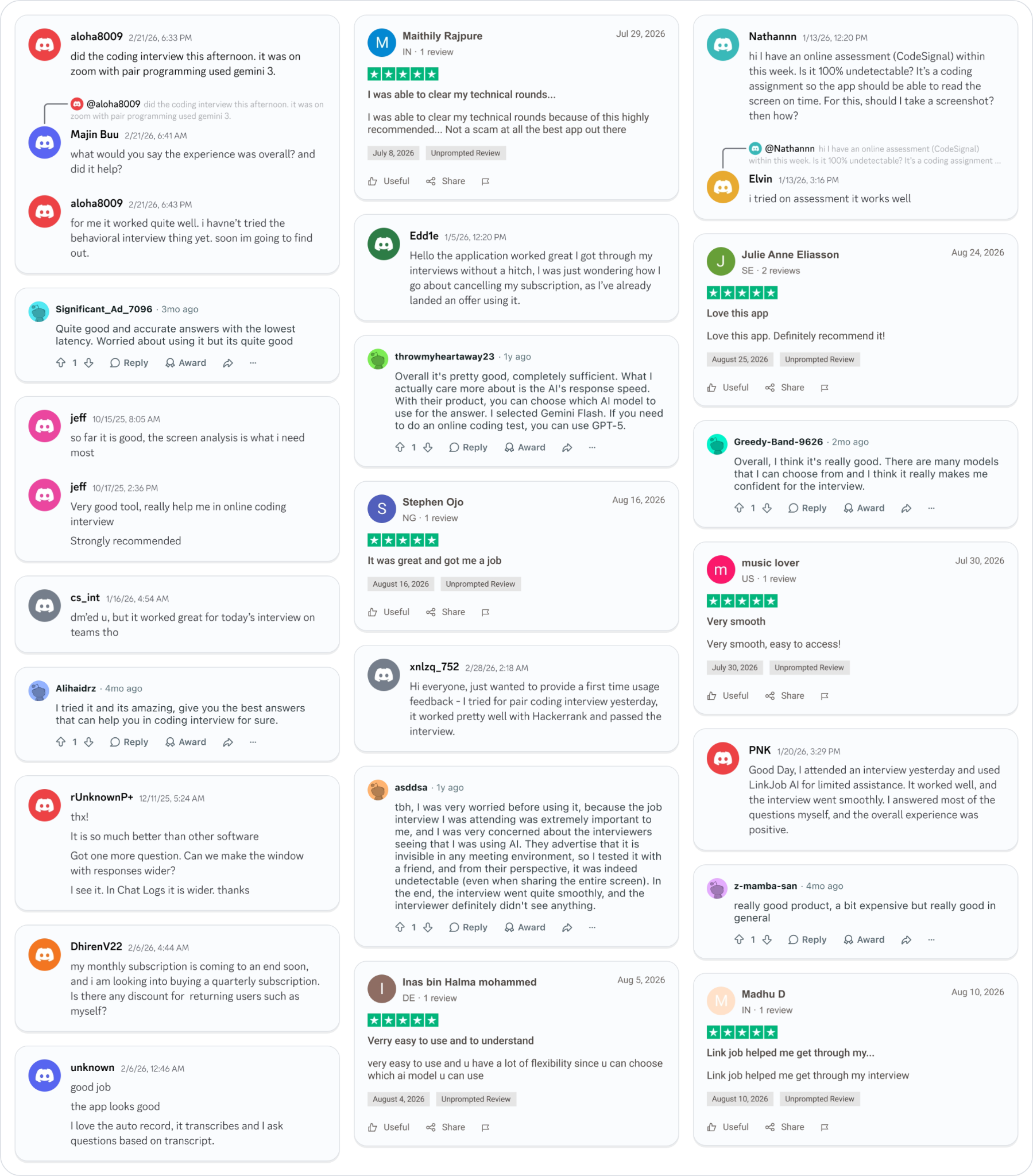
Why People Choose Linkjob AI
Smoother interviews, coding challenges cleared, and job offers landed. See how users describe their experience with Linkjob AI—in their own words.

© Copyright 2026 Linkjob AI - All Rights Reserved.