My 2026 Perplexity AI Interview Experience and Actual Questions


I recently interviewed for a Software Engineer position at Perplexity AI. I received a reach-out within three business days of submitting my resume. Their entire interview process was very fast, and the question bank wasn't very large. Overall, the interview questions weren't very difficult. It's worth noting, however, that they primarily use Python. This is likely because they want new hires to be able to get up to speed quickly, so I don't recommend using other languages like Java for the interview.
I’m really grateful to Linkjob.ai for helping me pass my interview, which is why I’m sharing my interview questions and experience here. Having an undetectable AI interview assistant for online interview indeed provides a significant edge.
Next, I'll go into detail about my interview process and the questions I encountered. In the second half of the article, I'll provide some interview tips and strategies I've found.
Perplexity AI Interview Process and Experience
My Perplexity AI interview process included 3 stages. Each stage felt different, but all of them tested my ability to solve problems and communicate clearly.
HR Call
During this 45-minute call, I talked about a lot of topics with the HR, and it felt like they kept asking me different questions. They started by asking why I wanted to work at Perplexity and why I applied for this position. Then they introduced the team’s daily work and which teams we would collaborate with. After that, they asked about my background, my tech stack, my most challenging project, and what made it challenging. Finally, they asked about my compensation expectations.
At the end, the HR also explained the upcoming interview process. They mentioned that the interviews would be tough, but once you get through, the work in the company offers a lot of freedom.
Technical Screen
Following the HR’s suggestion, I used Python to solve the technical problems. The session lasted 45 minutes. The interviewer focused more on my thought process and communication, but my code still needed to run. The format felt more like discussing with a coworker rather than a strict coding test. I could look up resources online or ask the interviewer for hints. The problems I faced were:
First question: I calculated the probability of each number appearing in a stream.
Second question: I determined whether a data stream was evenly distributed. Specifically, I randomly sampled three numbers from the stream’s data type. I looped through the stream, stored the data, then randomly picked three numbers. I verified whether the sampled points followed a uniform distribution, ensuring each had the same probability.
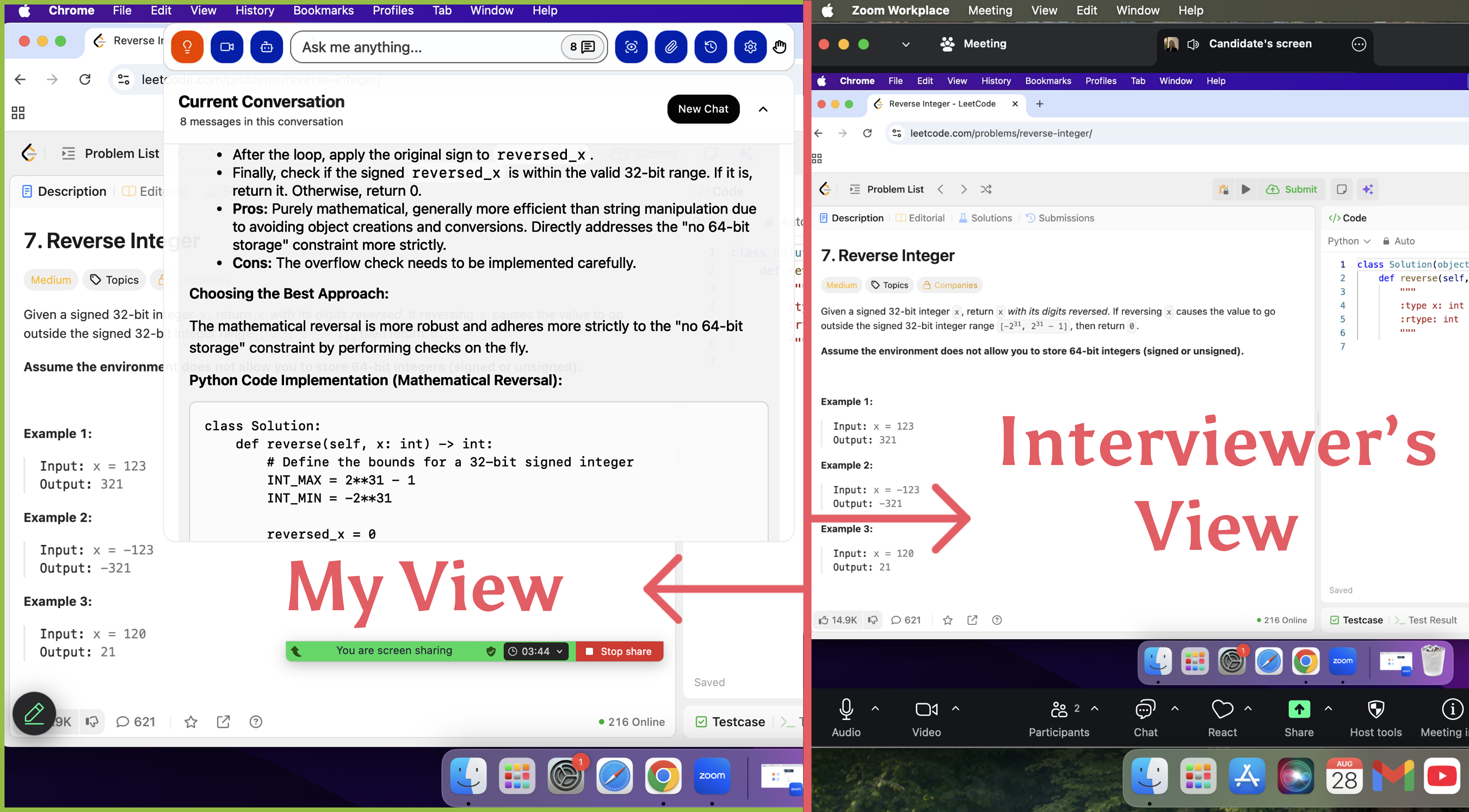
Linkjob AI worked great and I got through my interview without a hitch. It’s also undetectable, I used it and didn't trigger any HackerRank detection.
Virtual Onsite
VO - Infra Interview
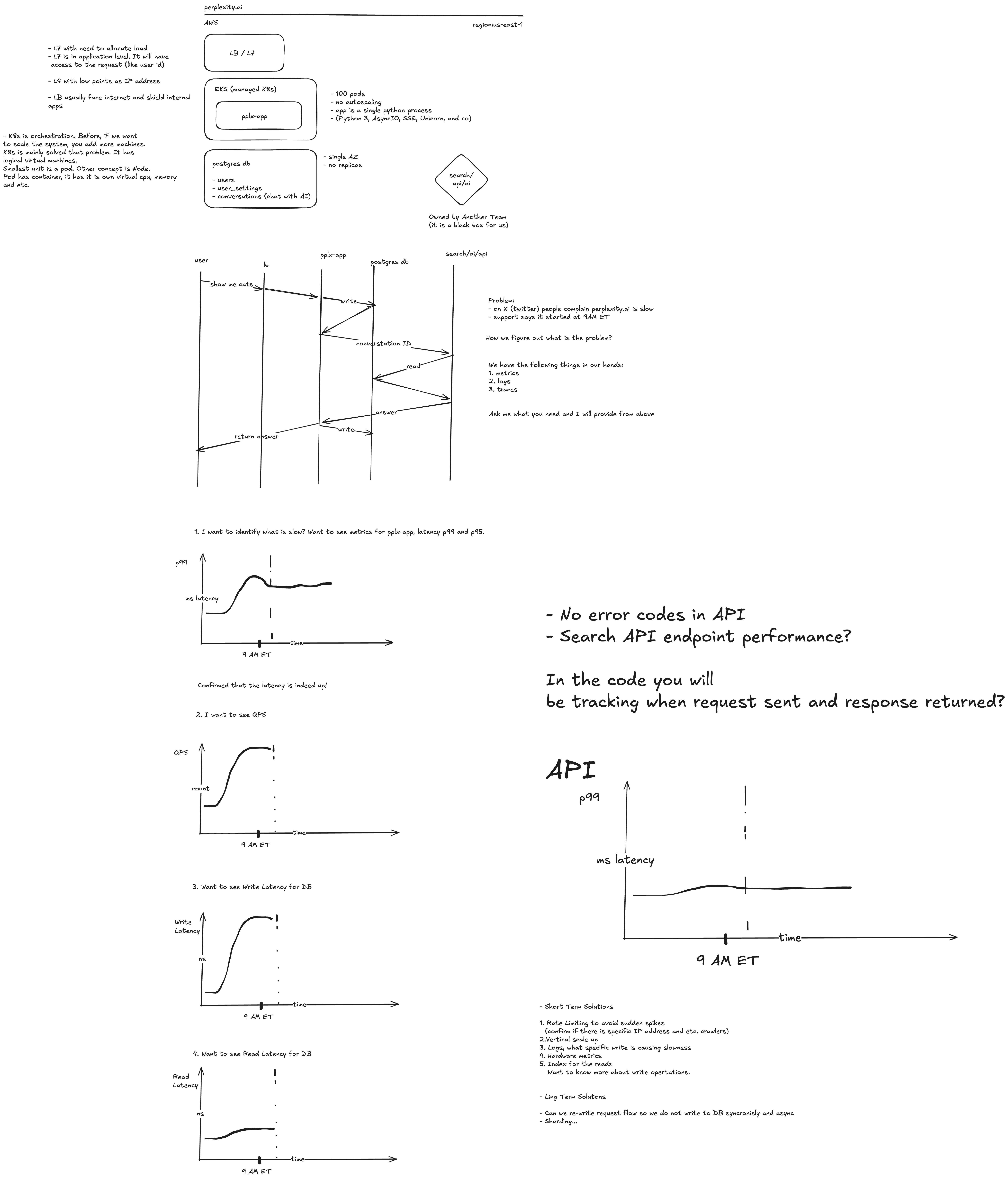
A unique question in the interview was about my familiarity with Kubernetes. The interviewer gave a scenario: the system is overloaded, and asked how I would debug it. I explained which metrics I would want to see, and they illustrated them for me.
VO - System Design
In this round, I was asked to design a personal finance management platform system that can sync spending data from multiple credit card accounts and then display that information to the user.
Requirements:
Connect to external credit card APIs
Reliably aggregate and normalize transaction data
Present it in a clear and unified way.
VO - Coding Challenge
Problem:
Implement a provider pool for external LLMs. The system should:
Support multiple providers.
Provide a unified interface to send prompts and receive responses.
Automatically switch to another provider if one fails.
Raise an error if all providers fail.
Requirements:
Provider class: name, query(prompt), status.
ProviderPool class: accepts a list of providers and implements query(prompt) with fallback.
Example:
p1 = Provider("ProviderA")
p2 = Provider("ProviderB")
pool = ProviderPool([p1, p2])
response = pool.query("Hello LLM")
print(response)
Optional: Add retries, priority selection, or async requests.
Perplexity AI Interview Questions
During my interview preparation, I also came across some real interview experiences and actual questions for different roles. As a supplement, I’ve listed them here.
Technical Screen – SWE Infra Questions
Time allocation: 5 minutes for self-introduction, 30 minutes for coding, 10 minutes for Q&A.
Given a string and a list of stop words, return the substring before the first stop word.
What if the input string comes as a stream and cannot be fully stored in memory?
What optimizations can be made for the first two questions (discussion only).
Example for part 2:
stop_sequences = ["<stop>", "<end>", "\n"]
word_chunks = Iterable(["Assume ", "the world is great<st", "op> you should"])
# Expected return: Iterable(["Assume ", "the world is great"])
Technical Screen – AI Engineer Questions
Remove duplicate strings from a stream.
Remove near-duplicate strings from a stream.
Definition of near-duplicate: could involve differences in punctuation, casing, or a single word being different within a sentence.
Onsite – AI Engineer Questions (Deployment and Inference Optimization focus)
Handle batching of sequences for an embedding model.
Each forward pass has max batch and max tokens constraints.
Implement a processing solution under these constraints.
Further optimize by implementing concurrent processing patterns (multi-threading patterns).
Coding - SWE Questions
Design a CreditTracker class with three methods:
def add_credit(start_time, end_time, credit)
def subtract_credit(time, credit)
When subtracting credit, remove from the earliest expiration first. The times in add_credit and subtract_credit are not guaranteed to be in increasing order.
def check_credit(time)
Coding - AI Engineer Questions
Implement beam search. A function signature is given; complete the code and make sure it passes unit tests.
def beam_search(
    input_seq: List[int],
    next_token_fn: Callable[[List[int]], List[float]],
    max_token: int,
    beam_size: int,
    stop_word_id: int
) -> List[List[int]]:
Virtual Onsite Process
Several rounds of technical interviews.
Meeting with the manager or CTP afterwards.
Perplexity Interview Strategies and Tips
Resume and Job Description Tips
When preparing my resume, I tailored every section to match the job description.
I collected several Perplexity job postings, pulled out recurring keywords like Python, machine learning, and ownership, and naturally wove them into my project experiences. For example, instead of simply writing “developed models,” I changed it to “developed scalable ML models in Python to improve accuracy by 15%,” which highlighted both the skill and the result.
I also noticed that adaptability appeared frequently, so I emphasized situations where I delivered results under uncertainty. Finally, I kept the format clean and concise, making sure every bullet directly aligned with the JD.
Practice Strategies
Practice was the most crucial part of my preparation.
I used Linkjob.ai to practice follow-up questions, which forced me to think on my feet and handle unexpected twists. The feedback also helped me notice that my answers could sometimes be too roundabout.
In addition, I did a few mock sessions with friends to sharpen my communication. Before the real interview, I researched Perplexity’s products and recent news so that I could ask thoughtful, relevant questions and connect my answers to the company’s direction.
Live Interview Tips
During the actual interviews, I relied on two key strategies to stay steady:
First, I made it a habit to explain my reasoning step by step, whether it was for coding or ML design, so the interviewer could follow my thought process.
Second, because I had practiced follow-up questions, I wasn’t caught off guard when interviewers pushed me with hypotheticals; I could extend my thinking quickly.
Between rounds, I jotted down quick notes on what went well and what I could improve, which helped me reset and not carry stress from one interview into the next.
Perplexity AI Interview Summary
What Perplexity AI Does
Perplexity’s core product is a platform that integrates the functions of a search engine and a chatbot. Unlike traditional search engines that provide a list of webpage links, Perplexity directly generates concise and accurate answers with cited sources, enabling users to easily verify the authenticity of the information. It achieves this through real-time web searches combined with large language models (LLMs), making its responses both timely and reliable.
Perplexity has also shown outstanding performance in the capital markets, receiving strong backing from prominent investors and institutions, including Jeff Bezos and NVIDIA. As of 2025, the company’s valuation has exceeded $18 billion, positioning it as a “unicorn” in the AI industry.
What Perplexity AI Look For
Perplexity’s corporate culture emphasizes the following:
Curiosity: Encouraging employees to ask questions, explore new perspectives, and go beyond obvious answers.
Velocity: Moving quickly in a fast-paced environment, rapidly building and testing ideas.
Ownership: Taking strong responsibility for the quality of work and striving to create meaningful products.
In summary, Perplexity AI is at the forefront of the AI search field, aiming to provide users with a more efficient and trustworthy new paradigm for accessing information through technological innovation.
From my interview experience, Perplexity really looks for people who are naturally curious and not afraid to ask “why” or explore different angles. They want you to show that you can move fast, test ideas quickly, and stay flexible in a high-speed environment. At the same time, they care a lot about ownership, which means taking real responsibility for your work and caring about the outcome. Most importantly, they’re looking for people who genuinely believe in the mission of making information search more reliable and efficient.
FAQ
How important is prior experience with AI or LLMs when interviewing at Perplexity AI?
It depends on the role. For AI Engineer positions, familiarity with concepts like beam search, embeddings, and inference optimization helps a lot. But for SWE Infra or Backend, the focus is more on system reliability, debugging, and data structure design.
What surprised you the most about the Perplexity AI interview process?
The interviews weren’t as intimidating as I expected. The difficulty level was fair, and the format encouraged open discussion. What really stood out was the freedom to explore different solutions instead of being boxed into a single “correct” approach.
How transparent is Perplexity AI about compensation and career growth during the interviews?
In my HR call, they directly asked about my compensation expectations and also explained the level of flexibility once you join. While exact numbers are usually discussed later in the process, I felt they were quite open about role responsibilities and the opportunities for growth inside the company.
See Also
My Secret Checklist to Pass 2025 OpenAI Coding Interview
My Personal Guide to Mastering XAI Interview Questions in 2025
© Copyright 2025 Linkjob.ai - All Rights Reserved.