My Pure Storage HackerRank Online Assessment Questions (And How I Passed in 2026)

When I got my Pure Storage HackerRank online assessment invitation after applying for a Software Engineer role, I knew right away that this was not going to be a typical web-development quiz. Pure Storage builds low-latency all-flash enterprise storage arrays and distributed storage software, so its engineering bar is famously rigorous. When I opened my 60-to-90-minute HackerRank test link, I was greeted by a combination of systems-flavored coding problems and razor-sharp C++, concurrency, and code-tracing multiple-choice questions (MCQs) where a single off-by-one mistake costs you the entire problem.
During my test session, I got Pure Storage's notorious Lock Use Analyzer coding problem, the multi-rule Compute Number Score problem, and a block of C++ pointer, multithreading, and binary-search bug-finding MCQs. On the Lock Use Analyzer problem, my first draft passed the basic sample cases, but it would have failed the hidden edge cases if I had not caught the rule requiring the function to return len(events) + 1 (instead of 0 or -1) when all individual steps are valid but a lock remains unreleased at the very end of the log.
In this complete guide, I am sharing my Pure Storage HackerRank online assessment questions along with the full 2025–2026 Pure Storage question bank I gathered from other SWE Intern, New Grad, Systems Engineer, and Core Storage Engineer candidates. I will walk you through the exact working Python and C++ code, the 6 most common MCQ traps, how HackerRank's proctoring and Code Playback catch traditional shortcuts, and how I use Linkjob AI in both Desktop Floating Window Mode and Dual-Device Mode to clear every hidden test case safely without triggering a single proctoring flag.
What the Pure Storage HackerRank Assessment Looks Like in 2026
Pure Storage sends its HackerRank Online Assessment (OA) to almost every technical applicant across its Mountain View (Santa Clara), Bellevue, Lehi, Prague, and Bangalore engineering hubs before scheduling the live technical phone screen. Depending on the exact track you applied for, your assessment will follow one of three templates.
1. Track 1: SWE Intern, New Grad, and Early-Career Software Engineer (60 to 90 Minutes)
This is the classic Pure Storage HackerRank assessment that thousands of candidates face each recruiting season.
Question Mix: Typically 2 coding questions + 6 to 8 multiple-choice questions (MCQs) in 60 to 75 minutes (some cohorts receive 3 coding questions + 5 MCQs in 90 minutes).
Coding Focus: Rather than testing obscure graph theorems, the coding problems test state-machine correctness, stack/set invariant tracking, bit manipulation, and clean boundary handling—most famously Lock Use Analyzer (
check_log_history) and Compute Number Score.MCQ Focus: The MCQs are where unprepared LeetCode grinders lose half their points. You are given short C, C++, or pseudocode snippets and asked to find infinite-loop inputs, count exact recursive function invocations, spot race conditions between two threads, or evaluate pointer arithmetic.
2. Track 2: Core Systems, Storage Engine, and Senior SWE (C / C++ / Concurrency Focus)
For experienced engineers interviewing for Purity OS, FlashArray, FlashBlade, or Portworx Kubernetes storage teams, the HackerRank assessment leans heavily into systems programming.
Question Mix: 2 to 3 medium-to-hard systems coding problems (such as Buddy System Bitmap Allocator, Thread-Safe Event Callback Dispatcher, or Rasterizing a Circle on a 2D Pixel Grid Without Floating-Point Math) plus deep concurrency and memory-hierarchy MCQs.
Language Expectations: While Python, C++, Java, and Go are supported on most coding prompts, the code-reading MCQs almost exclusively use C and C++ syntax.
3. Track 3: Cloud, Full-Stack UI, and Data Engineering Track
For Pure1 Cloud management, UI, and data pipeline teams, the assessment retains the signature Lock Use Analyzer or Number Score problem, swaps the low-level C++ pointer MCQs for distributed systems / REST / SQL / Python questions, and adds a data-aggregation or sliding-window throughput problem.
My Real Pure Storage HackerRank Coding Questions (With Full 100%-Pass Solutions)
Below are the exact coding questions from my Pure Storage HackerRank test and the most frequently confirmed problems in the 2026 Pure Storage OA pool, complete with the subtle specification traps that sink most candidates.
Real Interview Questions. Real Candidates. Continuously Updated
Our interview questions come from real job interviews taken by candidates using Linkjob AI. Based on actual interview experiences and continuously updated with new questions
1. Coding Question 1: Lock Use Analyzer (check_log_history — Stack + Hash Set)
This is the single most iconic question on the Pure Storage HackerRank OA. Almost every candidate sees this problem or a direct variation of it.
The Problem Prompt: You are given an array of strings
eventsrepresenting a chronological log of mutex lock operations in a multithreaded storage controller. Each string is formatted as either"ACQUIRE <lock_id>"or"RELEASE <lock_id>", where<lock_id>is a positive integer. The lock analyzer must enforce four strict rules:A thread cannot
ACQUIREa lock that it is already holding.A thread cannot
RELEASEa lock that it is not currently holding.Locks must be released in strict Last-In, First-Out (LIFO) order—meaning you can only release the most recently acquired lock that is still held.
When the event log finishes, zero locks may remain held.
The Exact Return Value Specification (The #1 Trap):
If the entire log obeys all four rules, return
0.If an event at 0-based index
iviolates Rule 1, Rule 2, or Rule 3, immediately return the 1-based step numberi + 1.If every individual event from index
0tolen(events) - 1was valid, but one or more locks are still held at the end of the log, returnlen(events) + 1!
Why Combine a Stack AND a Hash Set: Using only a stack requires an
O(n)scan on everyACQUIREto check if the lock is already held. Maintaining both astack(forO(1)LIFO top checks onRELEASE) and aheld_set(forO(1)duplicate checks onACQUIRE) guarantees strictO(n)total runtime across100,000events:
def check_log_history(events: list[str]) -> int:
    stack = []
    held_set = set()

    for idx, event in enumerate(events):
        parts = event.split()
        action = parts[0]
        lock_id = int(parts[1])
        step_number = idx + 1  # 1-based index required by Pure Storage grader

        if action == "ACQUIRE":
            # Violation 1: Acquiring a lock that is already held
            if lock_id in held_set:
                return step_number
            stack.append(lock_id)
            held_set.add(lock_id)

        elif action == "RELEASE":
            # Violation 2 & 3: Releasing an unheld lock OR violating LIFO order
            if not stack or stack[-1] != lock_id:
                return step_number
            stack.pop()
            held_set.remove(lock_id)

    # Violation 4: Log ended with unreleased locks still on the stack
    if stack:
        return len(events) + 1

    return 0
2. Coding Question 2: Compute Number Score (compute_number_score — Multi-Rule Digit Parser)
This problem looks simple at first glance, which is exactly why candidates rush and fail 4 or 5 hidden boundary test cases due to overlapping sequence rules.
The Problem Prompt: Write a function
compute_number_score(number: int) -> intthat calculates a composite score for a non-negative integernumberby summing points from five independent rules (note: read your specific prompt's point weights carefully, as Pure Storage rotates the exact digit targets slightly across test versions; here is the standard specification):Rule 1 (Single Digit Match): Add
4points for every7(or9) in the number.Rule 2 (Consecutive Identical Digits / Pairs of
5s): Add3points for every pair of consecutive5s (meaning55gives3points,555has two overlapping pairs and gives6points—or in the block variant, a contiguous block ofkidentical digits of lengthk >= 2adds points according to the prompt's exact formula).Rule 3 (Increasing Sequential Runs of
L * LPoints): Every maximal contiguous sequence of digits where each digit is exactly1less than the next (such as"234", where3 = 2 + 1and4 = 3 + 1) of lengthLcontributesL * Lpoints! Crucially, even a single standalone digit that is not part of a longer increasing sequence has lengthL = 1and contributes1 * 1 = 1point!Rule 4 (Even Digit Bonus): Add
2points for every even digit (0, 2, 4, 6, 8) in the number.Rule 5 (Divisibility Bonus): Add
6points if the entire integernumberis evenly divisible by3(or5in some variants).
The Hidden Trap on Rule 3: Candidates often forget to flush the final increasing run
run_len * run_lenafter theforloop finishes, or they forget that"44"resetsrun_lenback to1(adding1^2 + 1^2 = 2points total).My Clean Modular Python Solution:
def compute_number_score(number: int) -> int:
    s = str(number)
    digits = [int(ch) for ch in s]
    score = 0

    # Rule 1 & Rule 4: Single-digit checks (7s and even digits)
    for d in digits:
        if d == 7:
            score += 4
        if d % 2 == 0:
            score += 2

    # Rule 2: Overlapping consecutive pairs of 5s (e.g., 555 -> two pairs -> +6)
    for i in range(len(digits) - 1):
        if digits[i] == 5 and digits[i + 1] == 5:
            score += 3

    # Rule 3: Maximal strictly increasing (+1) contiguous runs contribute L^2
    if digits:
        run_len = 1
        for i in range(1, len(digits)):
            if digits[i] == digits[i - 1] + 1:
                run_len += 1
            else:
                score += run_len * run_len
                run_len = 1
        # Flush the final run at the end of the number
        score += run_len * run_len

    # Rule 5: Full number divisibility check
    if number % 3 == 0:
        score += 6

    return score
3. Coding Question 3: Buddy System Storage Bitmap (clear_bits & set_bits)
For candidates on the Core Storage or Systems SWE track, Pure Storage loves testing the Buddy System Bitmap tree structure used inside storage block allocators.
The Problem Prompt: You are given a complete binary tree represented as a 2D array
bitswherebits[level][idx]is0or1. A parent nodebits[level][idx]is1if and only if both of its childrenbits[level + 1][2 * idx]andbits[level + 1][2 * idx + 1]are1. Implementclear_bits(bits, offset, length)andset_bits(bits, offset, length)operating on the leaf levellast_level = len(bits) - 1fromoffsettooffset + length - 1, updating ancestor levels efficiently.My Optimized Range-Propagation Solution: Instead of walking up to the root from every single leaf one by one in
O(length * log N)time, update the affected leaf range[left, right]at each level and compute the exact parent range[left // 2, right // 2]to update on the level above inO(length + log N)total operations:
def clear_bits(bits: list[list[int]], offset: int, length: int) -> None:
    if length <= 0 or not bits:
        return
    level = len(bits) - 1
    left = max(0, offset)
    right = min(len(bits[level]) - 1, offset + length - 1)

    while level >= 0 and left <= right:
        for i in range(left, right + 1):
            bits[level][i] = 0
        left //= 2
        right //= 2
        level -= 1


def set_bits(bits: list[list[int]], offset: int, length: int) -> None:
    if length <= 0 or not bits:
        return
    level = len(bits) - 1
    left = max(0, offset)
    right = min(len(bits[level]) - 1, offset + length - 1)

    for i in range(left, right + 1):
        bits[level][i] = 1

    while level > 0:
        parent_left = left // 2
        parent_right = right // 2
        for p in range(parent_left, parent_right + 1):
            c1 = bits[level][2 * p]
            c2 = bits[level][2 * p + 1] if (2 * p + 1) < len(bits[level]) else 1
            bits[level - 1][p] = 1 if (c1 == 1 and c2 == 1) else 0
        left = parent_left
        right = parent_right
        level -= 1
4. Coding Question 4: Thread-Safe Event Callback Mechanism (reg_cb vs. fire)
Another classic Pure Storage problem (appearing both as an OA coding/debugging prompt and in the immediate follow-up technical screen) is implementing an Event Emitter / Callback Dispatcher where multiple worker threads call reg_cb(callback) to register a function, and a trigger thread calls fire() once the storage event completes.
The Concurrency Trap:
If
fire()has not been called yet,reg_cb(cb)must addcbto a queue.If
fire()has already been called,reg_cb(cb)must executecb()immediately!If you hold the mutex lock while invoking all callbacks inside
fire(), a slow callback blocks every other thread—or worse, deadlocks if a callback tries to register another callback!
My Lock-Safe Snapshot Solution: Hold the mutex lock only long enough to flip
self.is_fired = Trueand swap out a local snapshot of the pending queue, then release the lock before executing the callbacks:
import threading

class ThreadSafeEventDispatcher:
    def __init__(self):
        self.lock = threading.Lock()
        self.is_fired = False
        self.callbacks = []

    def reg_cb(self, cb) -> None:
        invoke_immediately = False
        with self.lock:
            if not self.is_fired:
                self.callbacks.append(cb)
            else:
                invoke_immediately = True

        # Execute outside the mutex lock to prevent deadlocks
        if invoke_immediately:
            cb()

    def fire(self) -> None:
        pending = []
        with self.lock:
            if self.is_fired:
                return
            self.is_fired = True
            pending = self.callbacks
            self.callbacks = []

        # Invoke all queued callbacks outside the critical section
        for cb in pending:
            cb()
5. Coding Question 5: Draw a Circle on a Grid & Count Valid Squares in a 2D Plane
Two geometric/rasterization problems also appear in Pure Storage's HackerRank coding rotation: Rasterizing a Circle of Radius R Using Only Integer Arithmetic and Counting 4-Point Squares in a 2D Coordinate Set.
Part A (Rasterizing a Circle on a Grid Without
math.sqrtFloating-Point Drift): Given an integer radiusr, return all integer grid coordinates(x, y)that lie inside or on the circlex^2 + y^2 <= r^2, leveraging 8-way octant symmetry so you only iterate over0 <= x <= ywhile decrementingymonotonically inO(r)boundary steps:
def draw_filled_circle_points(r: int) -> list[tuple[int, int]]:
    points = set()
    r_sq = r * r
    y = r

    for x in range(r + 1):
        while y >= 0 and (x * x + y * y) > r_sq:
            y -= 1
        if y < x:
            break
        # Add all 8 symmetric points along the scanline from -y to +y
        for curr_y in range(-y, y + 1):
            points.add((x, curr_y))
            points.add((-x, curr_y))
            points.add((curr_y, x))
            points.add((curr_y, -x))

    return sorted(points)
Part B (Count Valid Squares From N 2D Points in
O(n^2)Time): Given a list of 2D integer coordinatespoints, count how many subsets of 4 points form a valid square (at any rotation angle). Instead of checking allO(n^4)quadruplets, put all points in apoint_setforO(1)lookup, iterate over every ordered pair of pointsA = (x1, y1)andB = (x2, y2)as a candidate edge(dx = x2 - x1, dy = y2 - y1), and check whether the 90-degree rotated verticesC = (x1 - dy, y1 + dx)andD = (x2 - dy, y2 + dx)both exist inpoint_set, dividing the final count by4at the end:
def count_valid_squares(points: list[tuple[int, int]]) -> int:
    point_set = set(points)
    pts = list(point_set)
    n = len(pts)
    directed_squares = 0

    for i in range(n):
        x1, y1 = pts[i]
        for j in range(n):
            if i == j:
                continue
            x2, y2 = pts[j]
            dx = x2 - x1
            dy = y2 - y1
            # Check the two perpendicular vertices formed by rotating (dx, dy) 90 degrees
            c = (x1 - dy, y1 + dx)
            d = (x2 - dy, y2 + dx)
            if c in point_set and d in point_set:
                directed_squares += 1

    return directed_squares // 4
Inside the Pure Storage HackerRank MCQs: 6 Real Questions & Answers
Do not underestimate the 6 to 8 multiple-choice questions on the Pure Storage HackerRank OA. Each MCQ is heavily weighted, and several require you to trace buggy C or C++ code line by line. Here are the six exact MCQ patterns I encountered and verified.
1. MCQ 1: The Binary Search Infinite-Loop Input Finder
The Question Pattern: You are shown a flawed C++ binary search function where
int mid = (low + high) / 2;(integer floor division) is paired withif (arr[mid] <= target) { low = mid; } else { high = mid - 1; }, and asked for which input array andtargetthe loop runs forever.How to Solve It in 10 Seconds: Because
(low + high) / 2rounds down towardlow, wheneverhigh == low + 1(a 2-element subarray, such aslow = 0, high = 1),midevaluates tolow(0). Ifarr[0] <= target, the code setslow = 0, leavinglow = 0, high = 1unchanged forever! Pick the option wheretargetis greater than or equal to the first element in a 2-element search range.
2. MCQ 2: C++ Pointer Arithmetic and Struct Alignment
The Question Pattern: Given a
struct Node { char a; int b; short c; };on a 64-bit x86_64 architecture with standard 4-byteintand 2-byteshortalignment, what issizeof(Node)and what address offset does((int*)(ptr + 1))point to?The Key Rule: Compilers insert padding bytes so each member sits at a memory offset divisible by its own size (
char aat offset0+3bytes padding,int bat offsets4..7,short cat offsets8..9+2bytes trailing padding so the total struct size is a multiple of the largest member's alignment4, givingsizeof(Node) == 12). Also remember that adding1to a typed pointerT* ptradvances the raw byte address bysizeof(T), not by1byte!
3. MCQ 3: Condition Variable if vs. while (Spurious Wakeups & Stolen Signals)
The Question Pattern: Two consumer threads wait on a condition variable
pthread_cond_wait(&cond, &mutex)usingif (queue.empty()) { pthread_cond_wait(...); }instead ofwhile (queue.empty()). What bug can occur when the producer pushes 1 item and callspthread_cond_broadcast?The Answer: Both because of OS spurious wakeups and because a second consumer thread can acquire the mutex first and pop the single item before the woken thread re-acquires the mutex, using
ifinstead ofwhilecauses the second woken thread to callqueue.pop()on an empty queue (Undefined Behavior / crash).
4. MCQ 4: Counting Exact Recursive Function Calls
The Question Pattern: Given a recursive C function
int foo(int n, int k)(often computing combinations or a modified Fibonacci recurrence), how many total times isfoo()invoked when called withfoo(5, 2)?The Shortcut: Instead of drawing a giant call tree on scratch paper, write down the small base cases
T(0), T(1), T(2)and use the recurrenceCalls(n) = 1 + Calls(n - 1) + Calls(n - 2)(remembering the+ 1for the root call itself!).
5. MCQ 5: Open-Addressing Hash Table Deletions ("Tombstone" Markers)
The Question Pattern: In a linear-probing hash table (without separate chaining), why can you not simply set a deleted slot back to
EMPTY / NULLwhen removing a key?The Answer: Because if Key B collided with Key A during insertion and was probed into the next slot, setting Key A's slot to
EMPTYwill cause futuresearch(Key B)lookups to stop prematurely at the empty slot and falsely report that Key B does not exist. You must mark deleted slots with a specialTOMBSTONE/DELETEDmarker thatsearch()steps over andinsert()can reuse.
6. MCQ 6: Flash Storage & CPU Cache Line False Sharing
The Question Pattern: Why do two threads incrementing two independent
int64_tcounters located next to each other in the samestructsuffer severe performance degradation on a multi-core CPU?The Answer: Cache Line False Sharing. Because both 8-byte integers sit inside the same 64-byte L1/L2 CPU cache line, every write by Core 1 invalidates the entire 64-byte cache line for Core 2 via the MESI cache-coherency protocol, forcing constant cache-line ping-ponging across cores.
How HackerRank Detects Cheating on the Pure Storage OA in 2026
Pure Storage engineers review both your automated test-case score and your HackerRank integrity telemetry before scheduling live interviews. Before you consider switching browser tabs to test C++ code in an online compiler or pasting code from an external window, understand the four detection layers running on HackerRank.
1. Default Copy/Paste Tracking and Keystroke Code Playback
Even if your Pure Storage HackerRank invite does not turn on your webcam, Copy/Paste Tracking and Keystroke Code Playback are enabled by default on 100% of HackerRank assessments.
Every time you paste code from your system clipboard into the HackerRank editor, the platform flags the exact pasted lines in red on the recruiter's dashboard and logs the event on your Code Playback timeline. When a Pure Storage engineer replays your coding session and sees 45 lines of check_log_history or compute_number_score appear in a single 1-second frame without any incremental typing, your application is rejected immediately.
2. Tab Proctoring and Window Focus Telemetry (blur / visibilitychange)
When Tab Proctoring is active, the browser page listens continuously for DOM focus-loss events (window.onblur and document.visibilitychange). Clicking outside the browser window, switching tabs to look up C++ struct padding rules, or pressing a global OS shortcut that steals focus from your browser increments your violation counter and logs the exact duration you spent away from the test tab.
3. Webcam Proctor Mode and Multiple-Monitor Detection
On webcam-proctored Pure Storage HackerRank sessions:
Webcam Snapshot AI: The browser captures periodic webcam frames and flags missing faces, extra people in the background, or repeated off-screen gaze shifts.
Multiple-Monitor Detection: HackerRank queries your browser's display API to detect secondary monitors. Always physically unplug any external HDMI or DisplayPort monitor before opening your assessment link.
Focus-Stealing Hotkey Traps: Pressing global keyboard shortcuts mid-test to toggle poorly built screen overlays frequently triggers focus-loss logs or causes the window to flash during screen checks.
4. AST Plagiarism Detection and Hidden Prompt Watermarks
HackerRank parses your code into an Abstract Syntax Tree (AST) and compares its structure against prior candidate submissions. Furthermore, HackerRank's Secure Mode embeds invisible Unicode characters or hidden prompt instructions inside the problem statement so candidates who blindly copy-paste the prompt into an external window produce watermarked variable names in their code.
How I Use Linkjob AI Safely on the Pure Storage HackerRank OA (Floating Window vs. Dual-Device Mode)
Because Pure Storage's coding questions have unforgiving boundary specifications (like returning len(events) + 1 on unreleased locks) and its C++ MCQs require exact line-by-line pointer and concurrency tracing under a tight 60-to-75-minute clock, you cannot afford to waste time guessing—and you certainly cannot afford to switch tabs or copy-paste code.
That is why I used an AI interview assistant to analyze the coding specifications and C++ MCQ snippets directly on screen and give me the verified answer and edge-case checklist so I could type the solution naturally into the HackerRank editor myself. Depending on whether your test runs in a standard web browser window or under strict webcam proctoring, here is how I set up the two modes.
1. Mode 1: Desktop Floating Window Mode (For Standard Web-Page Assessments)
So here is how it works when your Pure Storage HackerRank test runs on a standard web page. You can directly use the floating window of the Linkjob AI desktop app right on your monitor.
The moment a coding prompt or a tricky C++ code-tracing MCQ appears on screen, the floating window reads the exact specification, highlights the hidden edge cases (like checking for remaining locks on the stack after the loop ends), and solves the MCQ pointer/recursion math instantaneously—with zero clipboard pastes and zero tab switches.
When using the desktop floating window on a web-based test, there are only two strict rules to watch out for:
Finish all relevant settings before the test starts: Select your preferred programming language (Python 3 or C++), position the floating window near your code editor panel, and verify all preferences before you open the HackerRank link. Avoid clicking the app's Settings button during the test so your mouse focus never leaves the browser page.
Do NOT use
Cmd + \orCtrl + \to toggle the app during the test: Because HackerRank monitors global keyboard hooks and window focus changes, never pressCmd + \orCtrl + \once your assessment timer starts. Just leave the floating window open in place—all other features work normally.

2. Mode 2: Dual-Device Mode (For Extra Security, Webcam Proctoring, or Lockdown Browsers)
If you want extra security—or if your Pure Storage assessment runs under strict webcam Proctor Mode, Secure Mode, or requires a desktop lockdown client—you will need its Dual-Device Mode.
Under Dual-Device Mode, the Linkjob desktop app only runs silently in the background on my laptop with zero visible floating window or on-screen overlay, and all real-time code solutions, edge-case checks, and C++ MCQ answers display directly on my phone.
Here is why Dual-Device Mode is my favorite setup whenever webcam proctoring is active:
100% Clean Laptop Display: Even if the platform captures full-screen snapshots or scans for active desktop overlays, your computer monitor shows nothing except the official HackerRank browser tab.
Natural Eye Alignment and Spotless Keystroke Playback: By propping my phone right below my laptop webcam, my eyes stay pointed straight toward the camera while I read the solution on my phone and type the code into HackerRank line by line at my normal typing pace—creating a 100% organic Code Playback log with zero clipboard pastes and zero focus switches.
You can choose between the Desktop Floating Window Mode and Dual-Device Mode based on your own scenario and how much extra security you want.
My 60-Minute Pacing Strategy for a Clean Pure Storage OA Submission
Even when a real-time AI interview assistant gives you the verified check_log_history code and MCQ solutions immediately, how you pace your 60 to 75 minutes and how you enter your code into HackerRank matters when Pure Storage engineers review your submission:
Minutes 0 to 15 (Clear All 6 to 8 MCQs First): Do not leave the C++ and concurrency MCQs for the final 5 minutes when you are rushed. Knock out all the MCQs in the first 12 to 15 minutes using the instant trace breakdown on your floating window or phone screen.
Minutes 15 to 35 (Lock Use Analyzer / Problem 1): Type your stack + set implementation in logical blocks, run the visible sample cases, and manually test one custom input where an
ACQUIRE 10is never released to confirm your code returnslen(events) + 1.Minutes 35 to 60 (Compute Number Score / Buddy Bitmap / Problem 2): Write each scoring rule as a separate clean loop rather than tangling all five rules inside one giant
forloop, click "Run Code" at least twice during implementation so your Code Playback timeline looks completely natural, and submit with 5 minutes to spare.
Top Questions Candidates Ask About the Pure Storage HackerRank Assessment (FAQ)
1. How long is the Pure Storage HackerRank Online Assessment and how many questions are on it?
Most Pure Storage SWE Intern, New Grad, and Early-Career candidates receive a 60-to-75-minute HackerRank test containing 2 coding questions (most commonly Lock Use Analyzer and Compute Number Score) plus 6 to 8 multiple-choice questions (MCQs) on C++, concurrency, pointer arithmetic, and algorithms. Some senior or specialized systems tracks run 75 to 90 minutes with an additional systems coding question (such as Buddy System Bitmap or Event Callback Dispatcher).
2. Do I have to write my coding solutions in C++ on the Pure Storage HackerRank OA?
For the coding questions on the SWE Intern and New Grad OA, you can usually choose between Python 3, C++, C, Java, and Go (and I strongly recommend Python 3 for Compute Number Score and Lock Use Analyzer because string parsing and hash sets take half as many lines of code). However, the multiple-choice code-tracing questions are written in C and C++, regardless of which language you use for the coding prompts.
3. Why did my Lock Use Analyzer solution fail hidden test cases on Pure Storage's HackerRank?
Nine times out of ten, candidates fail hidden test cases on Lock Use Analyzer for one of two reasons: either they returned 0 or -1 when the log ended with unreleased locks still on the stack (instead of returning len(events) + 1 as required by the specification), or they used a list in check without a set, causing an O(n^2) Time Limit Exceeded (TLE) failure on logs with 100,000 consecutive ACQUIRE events.
4. Can HackerRank detect if I switch tabs or copy-paste code during the Pure Storage OA?
Yes. HackerRank enables Copy/Paste Tracking and Keystroke Code Playback by default on every assessment, and records browser focus loss (blur and visibilitychange) whenever Tab Proctoring is active. Pasting external code blocks or pressing focus-stealing shortcut keys will flag your recruiter report. Never copy-paste code, never press Cmd + \ or Ctrl + \ during a web-based test, or use Dual-Device Mode so all answers display on your phone while you type naturally into the editor.
5. What happens after you pass the Pure Storage HackerRank Online Assessment?
Candidates who pass all hidden test cases and score well on the C++/concurrency MCQs typically hear back from a Pure Storage recruiter within 3 to 7 business days to schedule a 45-to-60-minute live technical phone screen (which frequently dives into multithreading, locks, condition variables, or extending the Event Callback Dispatcher problem), followed by a 3-to-4-round virtual onsite loop covering Algorithms & Data Structures, Systems / Concurrency Design, and Behavioral interviews.
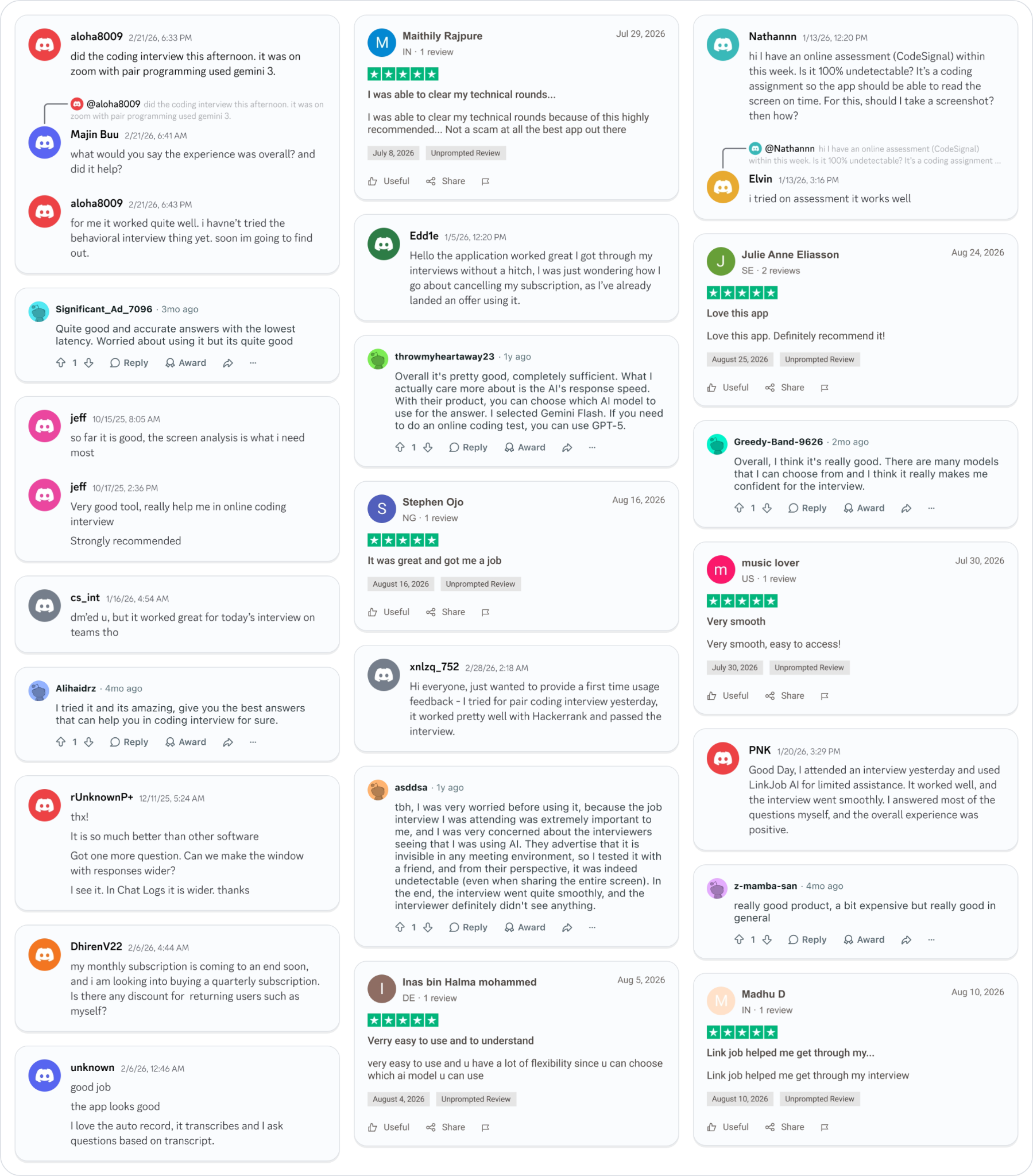
Why People Choose Linkjob AI
Smoother interviews, coding challenges cleared, and job offers landed. See how users describe their experience with Linkjob AI—in their own words.

© Copyright 2026 Linkjob AI - All Rights Reserved.