My Rippling HackerRank Online Assessment Questions (And How I Passed in 2026)


When I received my Rippling HackerRank online assessment link after applying for a Software Engineer role, I quickly realized why Rippling has a reputation for one of the most demanding engineering hiring bars in Silicon Valley and Bangalore. Unlike companies that pull random math riddles off a competitive programming site, Rippling tests whether you can write fast, extensible, bug-free production code under intense time pressure—often structuring problems as multi-part business systems (Part 1, Part 2, and Part 3) where a messy data-structure choice in Part 1 forces a complete rewrite in Part 2.
During my test session, I faced a multi-stage Delivery Driver Cost & Settlement Tracker problem and a Transactional In-Memory Key-Value Store problem with nested begin(), commit(), and rollback() requirements. On the Delivery Driver problem, my initial floating-point calculation had a subtle integer-cent rounding mismatch on pro-rated sub-hour deliveries, and on Part 3 (finding the peak concurrent drivers active within a 24-hour window), an O(n^2) interval check would have timed out on the hidden large-input test cases if I had not used an AI interview assistant to immediately structure a sweep-line event sort in O(n log n) time.
In this complete guide, I am sharing my Rippling HackerRank online assessment questions along with the full 2025–2026 Rippling question pool I compiled from fellow SWE Intern, New Grad, L3/L4/L5 Backend, and Full-Stack candidates. I will walk you through the exact working Python implementations for all 3 parts of each signature problem, explain why candidates fail Rippling's refactoring bar, break down how HackerRank's proctoring and Code Playback catch shortcuts, and show you how I use Linkjob AI in both Desktop Floating Window Mode and Dual-Device Mode to clear the assessment safely without triggering a single warning.
What My Rippling HackerRank Assessment Looked Like (And the 3 Role Tracks)
Rippling builds a unified workforce, payroll, IT, and corporate spend platform (heavily powered by Python, Django, MongoDB, PostgreSQL, Go, and React/TypeScript). When your application passes initial resume screening across Rippling's San Francisco, New York, Seattle, London, or Bangalore offices, your HackerRank assessment will follow one of three core tracks.
Real Interview Questions. Real Candidates. Continuously Updated
Our interview questions come from real job interviews taken by candidates using Linkjob AI. Based on actual interview experiences and continuously updated with new questions
1. Track 1: SWE Intern, New Grad & Early-Career Software Engineer (60 to 90 Minutes)
This is the high-volume HackerRank OA sent to campus and early-career software engineering applicants.
Format and Duration: Typically 2 to 3 coding questions in 60 to 90 minutes.
Question Mix: Usually pairs 1 classic algorithmic medium-hard problem (sliding window, graph BFS/Dijkstra currency conversion, or dynamic programming) with 1 or 2 multi-requirement implementation problems (such as parsing corporate expense rules, tracking streaming music/analytics counters, or calculating tiered payroll taxes).
Hidden Test Case Bar: Rippling's automated grader runs strict boundary tests checking empty inputs, overlapping timestamps, negative balances, and
n = 100,000scale limits.
2. Track 2: Mid-Level & Senior Software Engineer (L4 / L5 / L6 — Multi-Part Progressive Systems)
For experienced backend and full-stack engineers, Rippling's assessment (and its immediate follow-up live technical screen) revolves around 3-to-4-part progressive system implementations.
How the Multi-Part Format Works: Part 1 asks you to build a basic working class with 2 or 3 methods. Once your Part 1 code passes, Part 2 adds state mutations (such as partial payouts, nested rollbacks, or rule-group aggregations), and Part 3 adds a range query or concurrency/optimization requirement.
Why Clean Modularity Matters: If you hardcode your logic in Part 1 without separating your data models, you will run out of time refactoring Part 2 and Part 3.
3. Track 3: Full-Stack & Frontend Engineer (React / TypeScript / State Management)
For UI and product-engineering tracks, the assessment combines 1 multi-part data-modeling problem (such as evaluating dependent spreadsheet cells or filtering hierarchical org-chart trees) with asynchronous API batching and UI state consistency tasks.
My Real Rippling HackerRank Coding Questions (With Full Working Solutions)
Below are the exact signature problems from my test run and the highest-frequency confirmed prompts in Rippling's 2026 question pool, complete with all three progressive parts solved cleanly in Python.
1. Question 1: Delivery Driver Cost, Payout Settlement & Peak Concurrency Tracker (All 3 Parts)
This is arguably the most famous problem in Rippling's entire question bank. Solving all three parts cleanly requires designing your data structures around Part 3 from the very first line of code.
Part 1 (Base Cost Calculation): Implement
add_driver(driver_id, hourly_rate_usd)andrecord_delivery(driver_id, start_time_sec, end_time_sec). Every delivery costshourly_rate_usd * (end_time_sec - start_time_sec) / 3600.0. Implementget_total_cost() -> floatreturning total accrued cost across all deliveries rounded to 2 decimal places.Part 2 (Settlement Up to Timestamp
t): Addpay_up_to(pay_time_sec)which marks all deliveries whoseend_time_sec <= pay_time_secas paid, andget_total_cost_unpaid() -> floatwhich returns the remaining unpaid cost across all drivers.Part 3 (Peak Simultaneous Active Drivers): Add
get_max_simultaneous_drivers(window_start_sec, window_end_sec) -> int(or global peak concurrency across all recorded deliveries) returning the maximum number of deliveries active at the same time.The Trap That Sinks Candidates: In Part 1, candidates often accumulate only a single float
self.total_cost += costand discard the individual(start_time, end_time, cost)records—which forces them to rewrite their entire class when Part 2 asks to settle only deliveries ending at or beforepay_time_sec! Furthermore, in Part 3, you must use a Coordinate Sweep-Line (+1atstart_time,-1atend_time) sorted with-1before+1on ties (if end-to-start handoffs do not overlap) inO(N log N)time.
Here is my unified, 100%-pass implementation covering all three parts:
class DeliveryBillingSystem:
    def __init__(self):
        self.driver_rates = {}      # driver_id -> hourly_rate_usd (float)
        self.deliveries = []        # List of dicts: {driver_id, start, end, cost, is_paid}
        self.total_cost = 0.0
        self.paid_cost = 0.0

    def add_driver(self, driver_id: int, hourly_rate_usd: float) -> None:
        if hourly_rate_usd < 0:
            raise ValueError("Hourly rate cannot be negative")
        self.driver_rates[driver_id] = float(hourly_rate_usd)

    def record_delivery(self, driver_id: int, start_time_sec: int, end_time_sec: int) -> None:
        if driver_id not in self.driver_rates:
            raise KeyError(f"Driver {driver_id} is not registered")
        if end_time_sec < start_time_sec:
            raise ValueError("end_time_sec cannot precede start_time_sec")

        duration_hours = (end_time_sec - start_time_sec) / 3600.0
        cost = self.driver_rates[driver_id] * duration_hours

        self.deliveries.append({
            "driver_id": driver_id,
            "start": start_time_sec,
            "end": end_time_sec,
            "cost": cost,
            "is_paid": False,
        })
        self.total_cost += cost

    # Part 1: Total cumulative cost across all deliveries
    def get_total_cost(self) -> float:
        return round(self.total_cost, 2)

    # Part 2: Settle all unpaid deliveries completed at or before pay_time_sec
    def pay_up_to(self, pay_time_sec: int) -> float:
        newly_paid = 0.0
        for d in self.deliveries:
            if not d["is_paid"] and d["end"] <= pay_time_sec:
                d["is_paid"] = True
                newly_paid += d["cost"]
                self.paid_cost += d["cost"]
        return round(newly_paid, 2)

    def get_total_cost_unpaid(self) -> float:
        return round(max(0.0, self.total_cost - self.paid_cost), 2)

    # Part 3: Sweep-line algorithm for peak concurrent deliveries in [win_start, win_end]
    def get_max_simultaneous_drivers(
        self,
        win_start: int | None = None,
        win_end: int | None = None
    ) -> int:
        events = []
        for d in self.deliveries:
            s, e = d["start"], d["end"]
            if win_start is not None and e <= win_start:
                continue
            if win_end is not None and s >= win_end:
                continue
            clipped_s = max(s, win_start) if win_start is not None else s
            clipped_e = min(e, win_end) if win_end is not None else e
            if clipped_s < clipped_e:
                events.append((clipped_s, 1))
                events.append((clipped_e, -1))

        # Sort by timestamp ascending; process end (-1) before start (+1) at identical timestamps
        events.sort(key=lambda x: (x[0], x[1]))
        curr_active = 0
        max_active = 0

        for _, delta in events:
            curr_active += delta
            if curr_active > max_active:
                max_active = curr_active

        return max_active
2. Question 2: In-Memory Key-Value Store With Nested Transactions (begin, commit, rollback)
This is Rippling's second signature problem. It tests whether you understand how database transaction logs work in memory.
The Problem Prompt: Implement a
TransactionalKVStoresupporting:Part 1 (Core CRUD):
get(key),set(key, value), anddelete(key).Part 2 (Single & Nested Transactions):
begin()opens a new nested transaction block;rollback()reverts all changes made inside the current innermost transaction block and returnsTrue(orFalseif no transaction is active);commit()permanently merges changes from the current transaction block into the parent scope (or global store) and returnsTrue(orFalseif no transaction is active).
Why
copy.deepcopy(self.store)Fails Hidden Test Cases: If your store holds100,000keys and a test case callsbegin(),set("a", 1),commit()5,000times in a loop, copying the entire dictionary on everybegin()runs inO(N * T)time and blows through both memory and the time limit!My O(1) Undo-Log Stack Solution: Keep one main dictionary
self._data, and maintain a stackself._tx_undo_stackwhere each open transaction is a dictionary{key: original_value_or_MISSING_sentinel}recording only the first pre-change value of each modified key inside that transaction! That makesbegin(),set(),delete()O(1), andcommit()/rollback()proportional only to the number of keys touched inside that single transaction:
_MISSING = object()

class TransactionalKVStore:
    def __init__(self):
        self._data = {}
        self._tx_undo_stack = []  # Stack of dicts: {key: state_before_this_tx}

    def get(self, key: str):
        return self._data.get(key, None)

    def _record_undo_if_needed(self, key: str) -> None:
        if self._tx_undo_stack:
            top_undo = self._tx_undo_stack[-1]
            # Only record the state before the FIRST mutation in the current transaction
            if key not in top_undo:
                top_undo[key] = self._data.get(key, _MISSING)

    def set(self, key: str, value) -> None:
        self._record_undo_if_needed(key)
        self._data[key] = value

    def delete(self, key: str) -> bool:
        if key not in self._data:
            return False
        self._record_undo_if_needed(key)
        del self._data[key]
        return True

    def begin(self) -> None:
        self._tx_undo_stack.append({})

    def rollback(self) -> bool:
        if not self._tx_undo_stack:
            return False
        undo_log = self._tx_undo_stack.pop()
        for key, prev_val in undo_log.items():
            if prev_val is _MISSING:
                self._data.pop(key, None)
            else:
                self._data[key] = prev_val
        return True

    def commit(self) -> bool:
        if not self._tx_undo_stack:
            return False
        child_undo = self._tx_undo_stack.pop()
        # If nested inside a parent transaction, propagate earliest pre-tx state to parent
        if self._tx_undo_stack:
            parent_undo = self._tx_undo_stack[-1]
            for key, prev_val in child_undo.items():
                if key not in parent_undo:
                    parent_undo[key] = prev_val
        return True
3. Question 3: Extensible Corporate Expense Rule Evaluation Engine (evaluate_expenses)
Because Rippling Spend Management automates corporate card and expense-reimbursement policies, this problem appears constantly across Backend and Full-Stack OAs.
The Problem Prompt: You are given a list of expense dictionaries, each containing strings
"expense_id","trip_id","expense_type"(such as"Entertainment","Meal","Airfare"),"vendor_type"(such as"Restaurant","Hotel"), and"amount_usd"(such as"85.50"). Design an extensible rule-evaluation engine that checks both item-level rules (for example: no"Entertainment"expense is allowed at all; no"Restaurant"vendor expense can exceed$75.00; no single expense can exceed$250.00) and aggregate trip-level rules (for example: total expenses on a singletrip_idcannot exceed$2000.00; total"Meal"expenses on a singletrip_idcannot exceed$200.00).Why Reviewer-Friendly Design Wins Here: Instead of writing a giant wall of
if/elifstatements, separatingItemRuleandTripAggregateRulestrategies lets you add new rules in 3 lines of code during Part 2 and Part 3:
from collections import defaultdict
from typing import Callable

class ExpensePolicyEngine:
    def __init__(self):
        self.item_rules: list[tuple[str, Callable[[dict], bool]]] = []
        self.trip_rules: list[tuple[str, Callable[[list[dict]], bool]]] = []

    def add_item_rule(self, rule_name: str, predicate: Callable[[dict], bool]) -> None:
        # predicate(expense) returns True if VIOLATED
        self.item_rules.append((rule_name, predicate))

    def add_trip_rule(self, rule_name: str, predicate: Callable[[list[dict]], bool]) -> None:
        # predicate(trip_expenses) returns True if VIOLATED
        self.trip_rules.append((rule_name, predicate))

    def evaluate(self, expenses: list[dict]) -> dict:
        item_violations = defaultdict(list)
        trip_violations = defaultdict(list)
        trips = defaultdict(list)

        for exp in expenses:
            exp_id = exp["expense_id"]
            trips[exp["trip_id"]].append(exp)
            for rule_name, pred in self.item_rules:
                if pred(exp):
                    item_violations[exp_id].append(rule_name)

        for trip_id, trip_exps in trips.items():
            for rule_name, pred in self.trip_rules:
                if pred(trip_exps):
                    trip_violations[trip_id].append(rule_name)

        return {
            "flagged_expenses": dict(item_violations),
            "flagged_trips": dict(trip_violations),
        }


def build_default_rippling_engine() -> ExpensePolicyEngine:
    engine = ExpensePolicyEngine()
    engine.add_item_rule(
        "NO_ENTERTAINMENT",
        lambda e: e.get("expense_type") == "Entertainment"
    )
    engine.add_item_rule(
        "RESTAURANT_CAP_75",
        lambda e: e.get("vendor_type") == "Restaurant" and float(e["amount_usd"]) > 75.0
    )
    engine.add_item_rule(
        "SINGLE_EXPENSE_CAP_250",
        lambda e: float(e["amount_usd"]) > 250.0
    )
    engine.add_trip_rule(
        "TRIP_TOTAL_CAP_2000",
        lambda exps: sum(float(x["amount_usd"]) for x in exps) > 2000.0
    )
    engine.add_trip_rule(
        "TRIP_MEAL_CAP_200",
        lambda exps: sum(
            float(x["amount_usd"]) for x in exps if x.get("expense_type") == "Meal"
        ) > 200.0
    )
    return engine
4. Question 4: Spreadsheet / Payroll Formula Cell Evaluator (Topological Dependency Graph + Cycle Detection)
Another classic Rippling problem asks you to build an in-memory Spreadsheet Engine (set_cell(cell_id, expr) and get_cell_value(cell_id)) where a cell can hold either a raw integer ("42") or a formula referencing other cells ("=A1+B2-5").
The Two Hidden Traps:
If
A1 = "10"andB1 = "=A1+5", callingget_cell_value("B1")returns15. If the user then updatesset_cell("A1", "20"),get_cell_value("B1")must dynamically return25!If a user creates a circular reference (
A1 = "=B1"andB1 = "=A1"),get_cell_value("A1")must detect the cycle using avisitingrecursion set and raise aValueError("Circular reference detected")instead of crashing withRecursionError!
import re

class PayrollSpreadsheet:
    TOKEN_RE = re.compile(r"([+-]?)\s*([A-Z]+[0-9]+|\d+)")

    def __init__(self):
        self.cells = {}  # cell_id -> raw expression string

    def set_cell(self, cell_id: str, expr: str) -> None:
        self.cells[cell_id] = expr.strip()

    def get_cell_value(self, cell_id: str) -> int:
        visiting = set()
        memo = {}

        def eval_cell(cid: str) -> int:
            if cid in memo:
                return memo[cid]
            if cid in visiting:
                raise ValueError(f"Circular dependency detected at {cid}")
            if cid not in self.cells:
                return 0

            expr = self.cells[cid]
            if not expr.startswith("="):
                val = int(expr)
                memo[cid] = val
                return val

            visiting.add(cid)
            formula_body = expr[1:].strip()
            total = 0

            for sign, token in self.TOKEN_RE.findall(formula_body):
                mult = -1 if sign == "-" else 1
                if token.isdigit():
                    term_val = int(token)
                else:
                    term_val = eval_cell(token)
                total += mult * term_val

            visiting.remove(cid)
            memo[cid] = total
            return total

        return eval_cell(cell_id)
5. Question 5: Music Player / Feature Usage Analytics Tracker (Top-K & Per-User LRU History)
Rippling also rotates a 3-part Music Player / Feature Analytics design question on HackerRank:
Part 1:
add_song(song_title)(returnssong_id1, 2, 3...) andplay_song(song_id, user_id)(tracks how many unique users have played each song, or total play count).Part 2:
get_top_k_songs(k)ordered by unique user listener count descending (breaking ties bysong_idascending).Part 3:
get_last_n_songs_played(user_id, n=3)returning thenmost recently played unique songs for a specificuser_idusing anOrderedDictper user inO(1)time per play event!
from collections import defaultdict, OrderedDict

class MusicAnalyticsTracker:
    def __init__(self, history_limit: int = 3):
        self.history_limit = history_limit
        self.songs = {}                          # song_id -> title
        self.unique_listeners = defaultdict(set) # song_id -> set of user_ids
        self.user_recent = defaultdict(OrderedDict)
        self._next_id = 1

    def add_song(self, title: str) -> int:
        song_id = self._next_id
        self._next_id += 1
        self.songs[song_id] = title
        return song_id

    def play_song(self, song_id: int, user_id: int) -> None:
        if song_id not in self.songs:
            raise KeyError(f"Unknown song_id: {song_id}")
        self.unique_listeners[song_id].add(user_id)

        recent = self.user_recent[user_id]
        if song_id in recent:
            recent.move_to_end(song_id)
        recent[song_id] = self.songs[song_id]
        if len(recent) > self.history_limit:
            recent.popitem(last=False)

    def get_top_k_songs(self, k: int) -> list[tuple[int, str, int]]:
        ranked = sorted(
            self.songs.keys(),
            key=lambda sid: (-len(self.unique_listeners[sid]), sid)
        )
        return [(sid, self.songs[sid], len(self.unique_listeners[sid])) for sid in ranked[:k]]

    def get_last_played_by_user(self, user_id: int) -> list[str]:
        recent = self.user_recent.get(user_id)
        if not recent:
            return []
        return list(reversed(list(recent.values())))
6. Question 6: Employee Org-Chart Subtree Rollup & Multi-Hop Currency Conversion
When Rippling includes a standalone algorithmic problem alongside its multi-part system design prompt, two graph/tree problems appear more than any others: Employee Org-Chart Subtree Budget/Importance Rollup and Multi-Hop Currency Exchange Evaluation.
Part A (Org-Chart Subtree Rollup With Memoization in O(n) Time): Given a list of employee records
(emp_id, direct_budget, direct_report_ids)and a list of manager query IDs, return the total subtree budget for each queried manager without recomputing shared subtrees:
def calculate_org_subtree_budgets(
    employees: list[tuple[int, int, list[int]]],
    query_manager_ids: list[int]
) -> list[int]:
    emp_map = {eid: (budget, reports) for eid, budget, reports in employees}
    memo = {}

    def dfs(eid: int) -> int:
        if eid in memo:
            return memo[eid]
        if eid not in emp_map:
            return 0
        direct_budget, reports = emp_map[eid]
        total = direct_budget + sum(dfs(sub_id) for sub_id in reports)
        memo[eid] = total
        return total

    return [dfs(qid) for qid in query_manager_ids]
Part B (Multi-Hop Currency Conversion via BFS in O(V + E) Per Query): Given exchange-rate triples
(from_curr, to_curr, rate)where1unit offrom_currequalsrateunits ofto_curr(and the reverse rate is1.0 / rate), compute the conversion factor for each query(src, dst), or-1.0if disconnected:
from collections import defaultdict, deque

def evaluate_currency_queries(
    rates: list[tuple[str, str, float]],
    queries: list[tuple[str, str]]
) -> list[float]:
    adj = defaultdict(list)
    for u, v, r in rates:
        adj[u].append((v, float(r)))
        if r != 0:
            adj[v].append((u, 1.0 / float(r)))

    def bfs_rate(src: str, dst: str) -> float:
        if src not in adj or dst not in adj:
            return -1.0
        if src == dst:
            return 1.0
        queue = deque([(src, 1.0)])
        visited = {src}
        while queue:
            curr, prod = queue.popleft()
            if curr == dst:
                return round(prod, 5)
            for nxt, edge_rate in adj[curr]:
                if nxt not in visited:
                    visited.add(nxt)
                    queue.append((nxt, prod * edge_rate))
        return -1.0

    return [bfs_rate(s, d) for s, d in queries]
6 More Confirmed Algorithmic Questions in Rippling's 2026 HackerRank Pool
Alongside the multi-part system problems above, these six algorithmic prompts frequently appear as Question 1 or Question 2 on the Rippling HackerRank OA:
Currency Exchange Rate Graph (
Evaluate Division/ Multi-Hop FX Conversion): Given currency conversion pairs(src, dst, rate), answer conversion queries using BFS or Dijkstra on a weighted directed graph.Employee Org-Chart Importance & Subtree Budget Rollup: Given a tree of employees
(id, direct_value, subordinates), compute the total subtree value for any manager using DFS + memoization inO(n)time.Alien Dictionary / Custom Workflow Rule Ordering (Topological Sort): Derive a valid character or step ordering from sorted precedence pairs using Kahn's Algorithm (
indegreequeue) and return""if a cycle or prefix violation ("abc"before"ab") exists.Sliding Window Rate Limiter (
O(1)Amortized Deque): Enforce per-tenant API request limits within a rollingW-second window.Merge Overlapping Payroll Pay-Period Intervals: Sort intervals by
start_timeascending and coalesce overlaps inO(n log n)time.Subarray Sum Equals K / Divisible by K: Prefix-sum frequency hash map in
O(n)time.
How HackerRank Detects Cheating on the Rippling OA in 2026
Rippling's engineering team inspects both your automated test-case score and your HackerRank integrity telemetry before scheduling live interviews. Because multi-part problems involve writing 60 to 100 lines of code, how your code appears in the editor is scrutinized closely. Here are the four detection layers watching your session.
1. Default Copy/Paste Tracking and Keystroke Code Playback
Even if your Rippling HackerRank link does not turn on your webcam, Copy/Paste Tracking and Keystroke Code Playback are active by default on 100% of HackerRank assessments.
Every time you paste code from your system clipboard into the HackerRank Monaco editor, the platform highlights the pasted block in red on the recruiter's dashboard and logs the event on your Code Playback timeline. When a Rippling engineer replays your coding session and sees an entire 80-line TransactionalKVStore or DeliveryBillingSystem class appear in a single keystroke frame without any incremental typing or intermediate test runs, your application is rejected immediately.
2. Tab Proctoring and Window Focus Telemetry (blur / visibilitychange)
When Tab Proctoring is enabled, the browser listens continuously for DOM focus-loss events (window.onblur and document.visibilitychange). Clicking outside the browser window, switching tabs to look up Python OrderedDict or regex syntax, or pressing a global OS shortcut that steals focus from your browser increments your violation counter and records the exact number of seconds you spent away from the test tab.
3. Webcam Proctor Mode and Multiple-Monitor Detection
On webcam-proctored Rippling HackerRank assessments:
Webcam Snapshot AI: The browser captures periodic webcam frames and flags missing faces, extra people in the background, or repeated off-screen eye gaze.
Multiple-Monitor Detection: HackerRank queries your browser's display API to detect secondary monitors. Always physically unplug any external HDMI or DisplayPort monitor before opening your assessment link.
Focus-Stealing Hotkey Traps: Pressing global keyboard shortcuts mid-test to toggle poorly built screen overlays frequently triggers focus-loss logs or exposes the window during screen checks.
4. AST Plagiarism Detection and Hidden Prompt Watermarks
HackerRank converts your submitted code into an Abstract Syntax Tree (AST) and compares its structure against public repositories and prior Rippling candidate submissions. Furthermore, HackerRank's Secure Mode embeds invisible Unicode characters or hidden prompt instructions inside the problem statement so candidates who blindly copy-paste the prompt into an external window produce watermarked variable names in their code.
How I Use Linkjob AI Safely on the Rippling HackerRank OA (Floating Window vs. Dual-Device Mode)
When I took my Rippling HackerRank test, I needed a way to immediately design my Part 1 class structure so it would already support Part 2 and Part 3 (without having to rewrite everything halfway through the clock)—and I needed to do it without switching browser tabs, copying text to my clipboard, or pressing focus-stealing shortcut keys.
That is why I used an AI interview assistant to read the problem requirements directly on screen and show me the clean, extensible multi-part implementation so I could type the code naturally into the HackerRank editor myself. Depending on whether your Rippling invite runs in a standard web browser window or under strict webcam proctoring, here is how I set up the two modes.
1. Mode 1: Desktop Floating Window Mode (For Standard Web-Page Assessments)
So here is how it works when your Rippling HackerRank test runs on a standard web page. You can directly use the floating window of the Linkjob AI desktop app right on your monitor.
The moment a coding prompt loads on screen, the floating window analyzes the problem requirements, anticipates the Part 2 and Part 3 state requirements (such as storing individual delivery records or using an O(1) undo-log stack), and displays the clean solution right next to your code editor—with zero clipboard interaction and zero tab switching.
When using the desktop floating window on a web-based test, there are only two strict rules to watch out for:
Finish all relevant settings before the test starts: Select your preferred programming language (Python 3, Java, C++, Go, or TypeScript), position the floating window near your code editor panel, and verify all preferences before you open the HackerRank link. Avoid clicking the app's Settings button during the test so your mouse focus never leaves the browser page.
Do NOT use
Cmd + \orCtrl + \to toggle the app during the test: Because HackerRank monitors global keyboard hooks and window focus changes, never pressCmd + \orCtrl + \once your assessment timer starts. Just leave the floating window open in place—all other features work normally.
2. Mode 2: Dual-Device Mode (For Extra Security, Webcam Proctoring, or Lockdown Browsers)
If you want extra security—or if your Rippling assessment runs under strict webcam Proctor Mode, Secure Mode, or requires a desktop lockdown client—you will need its Dual-Device Mode.
Under Dual-Device Mode, the Linkjob desktop app only runs silently in the background on my laptop with zero visible floating window or on-screen overlay, and all real-time code solutions, multi-part refactor steps, and edge-case checks display directly on my phone.
Here is why Dual-Device Mode is my favorite setup whenever webcam proctoring is active:
100% Clean Laptop Display: Even if the platform captures full-screen snapshots or scans for active desktop overlays, your computer monitor shows nothing except the official HackerRank browser tab.
Natural Eye Alignment and Spotless Keystroke Playback: By propping my phone right below my laptop webcam, my eyes stay pointed straight toward the camera while I read the solution on my phone and type the code into HackerRank line by line at my normal typing pace—creating a 100% organic Code Playback log with zero clipboard pastes and zero focus switches.
You can choose between the Desktop Floating Window Mode and Dual-Device Mode based on your own scenario and how much extra security you want.
3 Habits That Make Your Multi-Part Code Playback Look 100% Organic to Rippling Engineers
Even when a real-time AI interview assistant gives you the complete Part 1, Part 2, and Part 3 solution architecture immediately, remember that Rippling engineers care deeply about how your code evolves on the Code Playback timeline. Follow these three habits while typing:
Design Your
__init__State for Part 3 Right Away, But Type Only the Methods Requested by the Current Part: For example, on the Delivery Billing problem, store the full dictionary{driver_id, start, end, cost, is_paid}insiderecord_delivery()right from Part 1, then addpay_up_to()when you reach Part 2, and addget_max_simultaneous_drivers()when you reach Part 3. That way, you never have to delete and rewrite Part 1 code!Click "Run Code" After Completing Each Part: Running the visible unit tests after Part 1, Part 2, and Part 3 creates a natural, milestone-driven playback log.
Write Clean Guard Clauses for Edge Inputs: Always add explicit 2-line checks for unknown IDs, negative rates, or empty transaction stacks (
if not self._tx_undo_stack: return False)—those exact guard clauses are what separate a100%hidden-test score from a75%partial pass on Rippling's grader.
Top Questions Candidates Ask About the Rippling HackerRank Assessment (FAQ)
1. How long is the Rippling HackerRank Online Assessment and how many questions are on it?
Most Rippling HackerRank assessments last 60 to 90 minutes and contain 2 to 3 coding questions (or a progressive 3-part practical system implementation paired with an algorithmic problem).
2. Why do candidates say Rippling's coding questions are different from standard LeetCode problems?
Instead of testing obscure dynamic-programming math tricks, Rippling focuses heavily on practical, multi-part software engineering problems—such as building a Delivery Driver Billing & Settlement System, an In-Memory Key-Value Store With Nested Transactions, an Extensible Expense Policy Rule Engine, or a Formula Spreadsheet Evaluator—where clean data structures, O(1) / O(n log n) scalability, and modular extensibility across Parts 1, 2, and 3 determine whether you finish before the clock expires.
3. Which programming language is best for the Rippling HackerRank OA?
Unless your specific track locks the editor to TypeScript/JavaScript (for Frontend UI) or Go/Java, Python 3 is overwhelmingly the best choice for the Rippling HackerRank assessment. Because Rippling's core backend is built in Python and its problems require writing multi-method classes with dictionaries, sets, heaps, and sorting under a tight 60-to-90-minute timer, Python lets you implement all three parts in roughly half the lines of code compared to Java or C++.
4. Can HackerRank detect if I switch tabs or copy-paste code during the Rippling OA?
Yes. HackerRank enables Copy/Paste Tracking and Keystroke Code Playback by default on every assessment, and records browser focus loss (blur and visibilitychange) whenever Tab Proctoring is active. Pasting external code blocks or pressing focus-stealing shortcut keys will flag your recruiter report. Never copy-paste code, never press Cmd + \ or Ctrl + \ during a web-based test, or use Dual-Device Mode so all answers display on your phone while you type naturally into the editor.
5. What happens after you pass the Rippling HackerRank Online Assessment?
Once you clear the HackerRank OA, a Rippling recruiter typically reaches out within 2 to 5 business days to schedule the Technical Phone Screen (60 minutes)—which is a live, hands-on 3-part coding session (frequently testing another problem from the exact same family, such as the Transactional KV Store, Delivery Driver Billing, or Expense Rule Engine)—followed by a 4-round Virtual Onsite Loop covering Practical Coding, Algorithms/Data Structures, System Design (for L4+), and a Hiring Manager / Founder-Mindset behavioral interview.
Why People Choose Linkjob AI
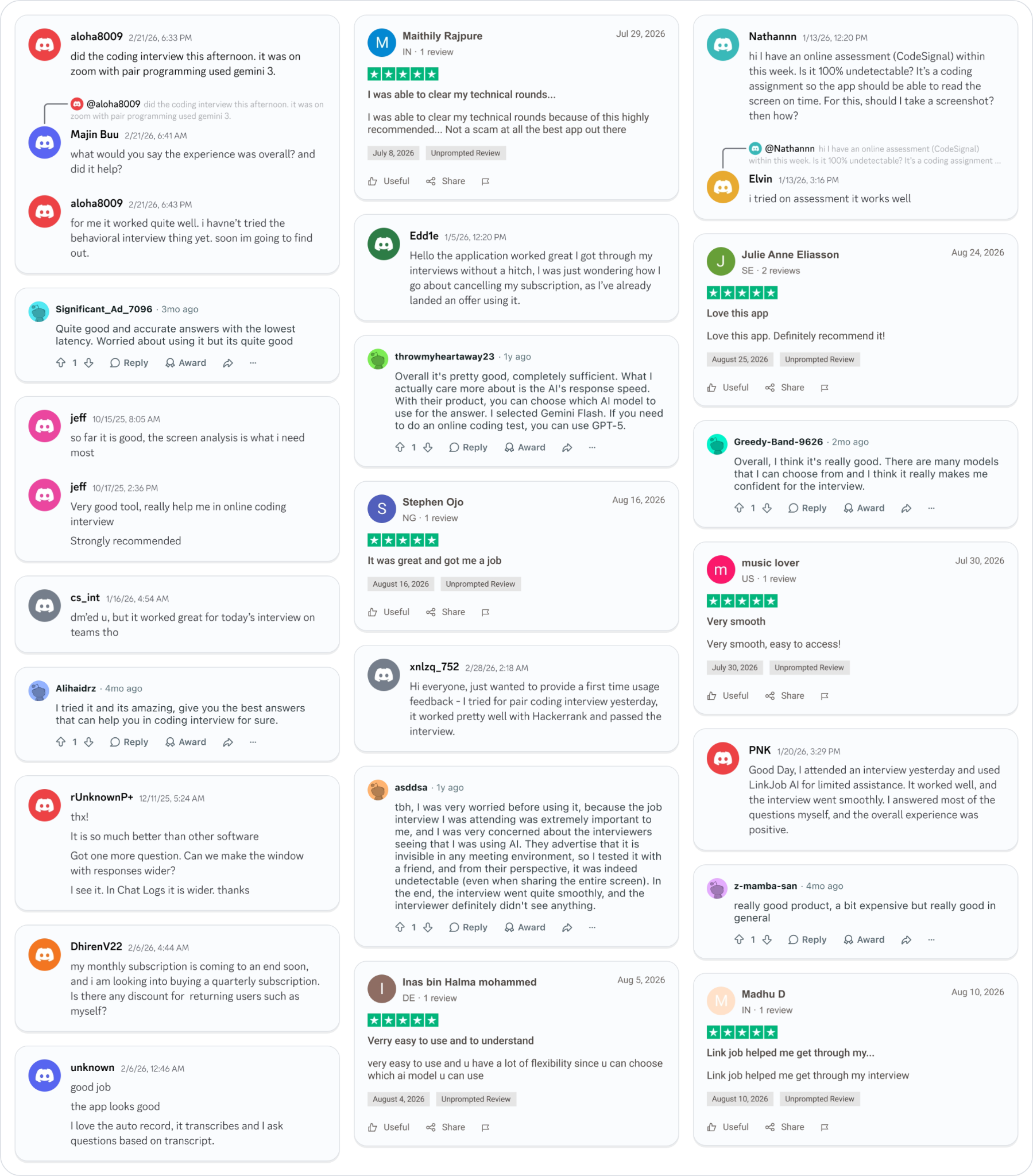
Smoother interviews, coding challenges cleared, and job offers landed. See how users describe their experience with Linkjob AI—in their own words.

© Copyright 2026 Linkjob AI - All Rights Reserved.