The Questions That Came Up in My 2025 RxJS Interview and the Answers I Gave


Are you tired of feeling intimidated by RxJS interview questions? The truth is, mastering RxJS isn't about memorizing every single operator. It's about understanding the core concepts and knowing how to apply them. In this article, I'll share the simple, step-by-step process I used to conquer RxJS and land a new job in 2025, and it's a process anyone can follow, regardless of their experience level.
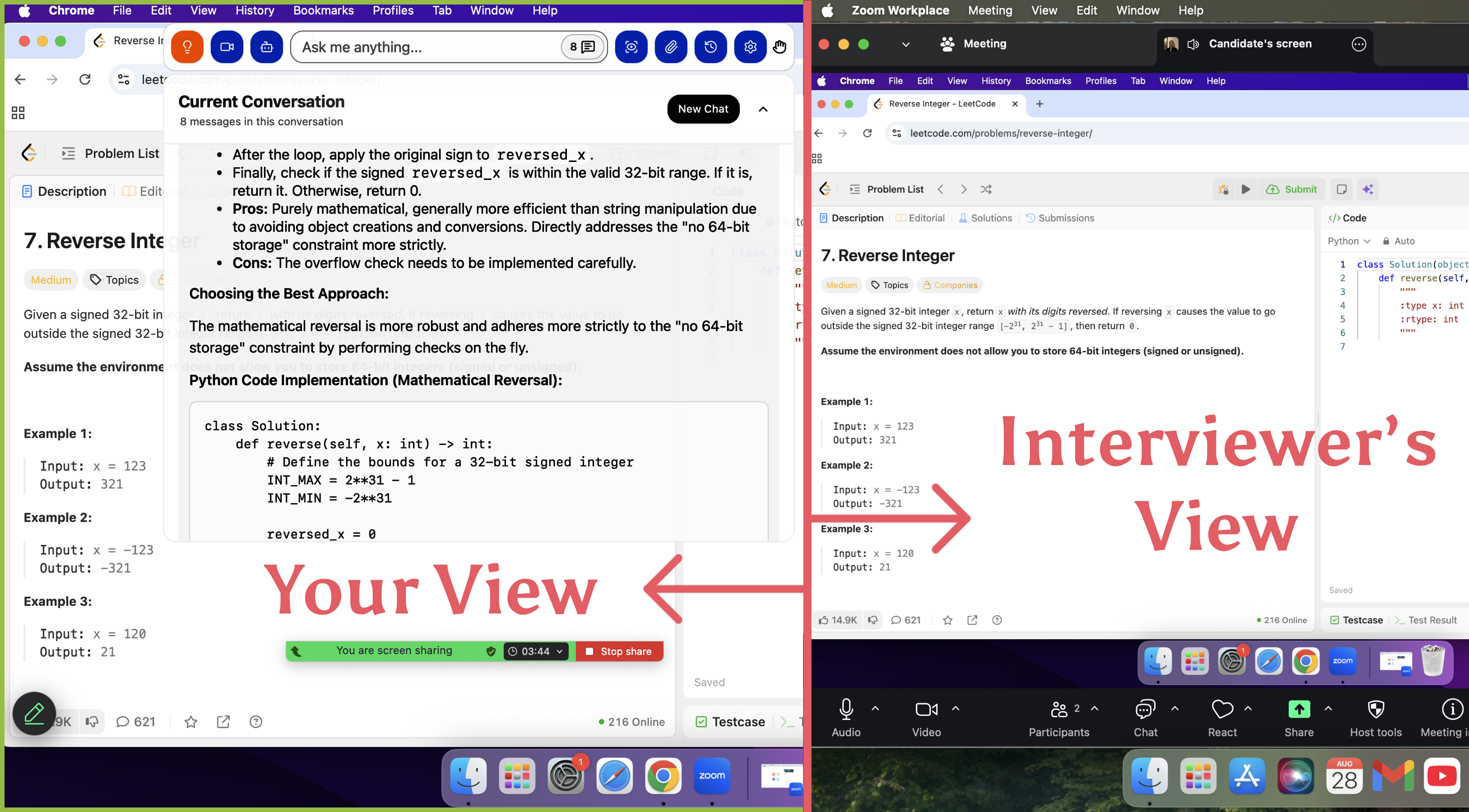
I am really grateful for the tool Linkjob.ai, and that's also why I'm sharing my interview experience and questions here. Having an undetectable AI assistant during the interview is indeed very convenient.
RxJS Interview Debrief: Stages and Questions
First, let me walk you through my RxJS interview process as a better introduction. The interview can be divided into three stages. I will debrief on what the interviewer asked and how I answered.
Stage 1: The Initial Screening
This stage felt like a preliminary check. The interviewer mainly focused on whether I could connect RxJS to my previous projects. So the questions were quite general. For example, "How did you use RxJS in your projects?" and "What is the difference between Observables and Promises?" were both easy to answer.
My Answer:
For the first question, they asked me how I would use RxJS to build a search box. I told them I used debounceTime to reduce API requests and then switchMap to cancel old requests. I felt the feedback I got on that was pretty good. Looking back, I think it was because my answer was very specific. Another question asked about the difference between Observables and Promises. Here I only said that an Observable can emit multiple values while a Promise can only emit one. I was too nervous at the time and forgot to mention the "push" versus "pull" data flow model. Also, while I mentioned the "lazy" nature of Observables, I did not emphasize that their code will not run at all without a subscriber. That is a pretty key point. I wish I had said it then.
Stage 2: The Technical Deep Dive
In this round, the questions were very in-depth. The goal was to see if I truly understood the "why" behind RxJS and not just the "what." They asked some tricky questions. For example, "Can you use an example from a real project to explain the difference between mergeMap and switchMap?" or "How do you use catchError and retry to handle errors in an Observable stream?"
My Answer:
I think I did a pretty good job answering the question about switchMap and mergeMap. I used the search box analogy to explain switchMap. I also used the scenario of downloading multiple files simultaneously to explain mergeMap. The interviewer understood it right away. My answer on catchError was also steady. I knew how to use it to prevent the data stream from terminating due to an error. But when it came to the difference between Subjects and BehaviorSubjects, although I knew that a BehaviorSubject needs an initial value and new subscribers can get the current value, I failed to provide a very clear and practical example.
Stage 3: The Practical Coding Challenge
The final round was a live coding exercise. They gave me a problem and just watched me write code. The problem was something like this: "Create an Angular component with a text input. Use RxJS to make an API request after the user stops typing for 500ms. If the request fails, display a default 'Guest User' message and the application should not crash."
My Answer:
I started by following my usual routine. I broke the problem down and talked through my process as I coded. I told them I would first use fromEvent to listen to the input. Then I would use debounceTime(500) to add a delay. After that, I chose switchMap to handle the API request. I felt switchMap was the best choice here because it automatically cancels any previous requests. This is crucial for a search box. I then used catchError to handle the failed request.
Rxjs Interview Questions Overview
Common Topics
When I started preparing for rxjs interview questions, I noticed some topics kept coming up. Here’s what I saw most often:
Observables and how they work in Angular
Differences between Observables and Promises
Angular Signals vs RxJS Observables, especially around synchronous and asynchronous data
RxJS operators like switchMap, mergeMap, and debounceTime
Hot vs Cold Observables and how to use share() or shareReplay()
Real-world scenarios, like handling multiple API calls or managing UI state
Interviewers often asked me to explain how RxJS helps with user interactions, HTTP requests, or timers. They wanted to know if I could use Observables to make apps more responsive. Sometimes, I got questions about multicasting, higher-order observables, and performance optimization in Angular.
Tip: I always made a list of these topics before each interview. It helped me focus my study time and avoid surprises.
Key Concepts
I realized that understanding the basics wasn’t enough. Interviewers wanted me to dive deeper. Here’s how I broke down the key concepts:
Basic RxJS Concepts
What is RxJS? What are Observables?
How do Observers and Subscriptions work?
How do you create Observables with of(), from(), or interval()?
Intermediate RxJS Concepts
Subject vs BehaviorSubject
Using operators like mergeMap, switchMap, concatMap, exhaustMap
Chaining with pipe()
Managing subscriptions with takeUntil()
Handling errors with catchError() and retry()
Advanced RxJS Concepts
Hot vs Cold Observables
Multicasting and sharing data streams
Performance optimization in Angular
Here’s a table that helped me understand the difference between imperative and reactive programming:
Aspect | Imperative Programming | Reactive Programming (RxJS) |
|---|---|---|
Style | Step-by-step instructions | Declarative, uses Observables |
State Management | Manual, error-prone | Automatic, less buggy |
Error Handling | Manual, can miss errors | Built-in, robust |
Scalability | Hard to scale | Easy to scale |
Data Flow | Pull-based | Push-based |
When I focused on these concepts, I felt more confident answering rxjs interview questions. I also practiced explaining how RxJS handles async data, error handling, and state management. This made a big difference in my interviews.
Core Concepts And Operators To Answer Rxjs Interview Questions
Observables
Definition
Observables are the heart of everything. An Observable in RxJS lets me create a stream of data that I can listen to over time. It can emit values, errors, or a completion signal. This pattern helps me handle async data, like user input or HTTP responses, in a clean way.
Creation Methods
I use several methods to create Observables. The most common ones are:
of(): Emits the arguments I pass, then completes.from(): Converts arrays, promises, or iterables into Observables.interval(): Emits numbers in sequence every specified interval.fromEvent(): Turns events (like clicks) into Observable streams.
Common Use Cases
I often use Observables to:
Handle user input in forms or search bars.
Manage HTTP requests and responses.
Combine multiple async data sources.
Control timers and intervals in apps.
Frequently Asked Interview Questions
In rxjs interview questions, I often get asked:
What is the difference between Observables and Promises?
How do you cancel an HTTP request using RxJS?
Can you explain the difference between Subject and BehaviorSubject?
How do you combine multiple Observables?
Here’s a table of foundational RxJS concepts that interviewers expect me to know:
RxJS Concept | Description |
|---|---|
combineLatest | Combines multiple Observables and emits values calculated from the latest values of each input. |
distinctUntilChanged | Emits values only when the current value differs from the previous one, preventing duplicates. |
Subject vs BehaviorSubject | Subject emits values to observers; BehaviorSubject requires an initial value and emits the current value to new subscribers. |
switchMap | Maps to a new Observable, cancels the previous inner Observable, and emits values from the new one. |
mergeMap vs concatMap | mergeMap subscribes to inner Observables concurrently; concatMap subscribes sequentially, waiting for each to complete. |
catchError | Handles errors in an Observable stream by catching errors and returning a new Observable. |
shareReplay | Shares a source Observable among multiple subscribers and replays a specified number of emissions upon subscription. |
Code Examples
Here’s a quick example I used in interviews:
import { of, from } from 'rxjs';
import { map, filter } from 'rxjs/operators';

const numbers$ = from([1, 2, 3, 4, 5]);
numbers$.pipe(
  filter(n => n % 2 === 0),
  map(n => n * 10)
).subscribe(val => console.log(val)); // Output: 20, 40
Operators
Operators in RxJS let me transform, filter, and combine Observable streams. I use switchMap to switch to a new Observable when a new value comes in, which is great for search bars. mergeMap helps me handle multiple HTTP requests at once. I also use concatMap when I need to process requests one after another. Interviewers love to ask about these in rxjs interview questions.
State Management
Interviewers often test my understanding of state management with RxJS. Here’s what they look for:
I know how to use Observables, Subjects, and BehaviorSubjects.
I can explain the difference between Observables and Promises.
I use operators like switchMap and mergeMap to manage async data.
I combine HTTP requests and manage streams in parallel or sequence.
Integration with Angular: Real-World Case Study
In one interview, I built an Angular component that fetched user data and updated the UI reactively. I used the async pipe and BehaviorSubject to manage state. The interviewer asked me to explain my approach and write unit tests for my logic.
Integration with React: RxJS State Management Example
I once managed a React app’s state using RxJS. I created a BehaviorSubject to hold the app state and used operators to update the UI when data changed. This approach impressed the interviewer because it kept the code clean and reactive.
Node.js Server-Side: RxJS State Management Case Study
On the server side, I used RxJS to handle multiple API calls in Node.js. I combined Observables with mergeMap to process requests in parallel. This pattern made my code more efficient and easier to test.
Practice Coding
Real-World Examples
When I started preparing for RxJS interviews, I realized that reading theory only got me so far. So, I began working through real-world coding examples. I built small Angular apps that used Observables to fetch data, handle user input, and manage state. For example, I created a search bar that used debounceTime and switchMap to fetch results as the user typed. This helped me understand how to connect abstract RxJS concepts to real scenarios.
I found that practicing with real code made a huge difference. I could see how operators like filter, mergeMap, and catchError worked together. I learned to create observable streams from arrays, promises, and events. I also practiced handling async data, like making multiple API calls and combining their results. These exercises helped me answer rxjs interview questions with confidence because I could explain not just the theory, but also how I used RxJS in actual projects.
I remember one interview where the interviewer asked me to process a list of emails asynchronously. Because I had practiced similar examples, I used from, mergeMap, and catchError to solve the problem on the spot. Real-world examples gave me the practical experience I needed to discuss RxJS applications clearly and confidently.
Tip: Try building a simple Angular app that fetches data from an API and updates the UI reactively. Use operators like
switchMapandcatchErrorto handle user actions and errors. This kind of hands-on practice will prepare you for the types of questions interviewers love to ask.
Mock Interviews
After working through real examples, I wanted to test my skills under pressure. I started doing mock interviews, both with friends and on my own. Structured practice made a big difference. I broke down RxJS topics into smaller sections and focused on one area at a time, like error handling or state management.
One thing that really helped me was using Linkjob, an AI-powered mock interview assistant. Linkjob simulated realistic interviews by asking me targeted questions and listening to my answers. It didn’t just stick to a script, it followed up based on what I said, just like a real interviewer. After each session, Linkjob gave me instant feedback and suggested ways to improve my answers. This dynamic feedback helped me refine my explanations and build confidence.
Here’s what I noticed about structured practice and dynamic feedback:
I covered all the important RxJS topics by breaking them into smaller parts.
Working on real-world projects gave me stories to share in interviews.
Instant feedback improved my clarity and technical accuracy.
During my practice, I also discovered some common mistakes that candidates make in rxjs interview questions:
Mixing up
switchMapandmergeMap. I learned thatswitchMapcancels previous requests, whilemergeMaphandles them all at once.Not understanding how
debounceTimeworks. It waits for the user to stop typing before sending a request.Confusing
concatMapandexhaustMap.concatMapqueues requests, butexhaustMapignores new ones if one is running.Struggling with error handling. I practiced using
catchErrorandretryto manage failures.Not knowing the difference between
forkJoinandcombineLatest.forkJoinwaits for all observables to finish, whilecombineLatestupdates whenever any observable emits.
By practicing these scenarios and using Linkjob for mock interviews, I felt much more prepared. I could answer questions clearly, avoid common mistakes, and stay calm even when the interviewer asked something unexpected.
Mastering RxJS interviews took more than just reading docs. I built confidence by following these steps:
I studied RxJS concepts and practiced coding real-world examples.
I used mock interviews and real-time support tools like Linkjob to get instant feedback and stay sharp.
When I combined deep learning with smart tools, I managed async data, state, and real-time events with ease. This approach made my code cleaner and my interviews smoother.
FAQ
1. How should I prepare for a live coding session?
Live coding can be nerve-wracking, but it's all about preparation and process. My advice is to practice writing code in a non-IDE environment, like a simple text editor or even a whiteboard. This forces you to think about the syntax and structure without autocomplete. When you're in the interview, the key is to communicate. Start by breaking the problem down into smaller, manageable steps. Then, as you write the code, talk through your thought process. Explain why you're choosing a specific operator or data structure. This shows the interviewer how you think, not just what you know. It's a skill you can practice by doing mock interviews or even just talking to yourself while you code.
2. Besides the operators you mentioned, what other RxJS concepts are important for interviews?
That's a great question, because interviews often go beyond the basic operators. You'll want to be comfortable with more advanced concepts like Schedulers, which are how RxJS controls when and where a task executes, like using asapScheduler for asynchronous tasks. Another crucial topic is Multicasting, which is all about sharing a single Observable execution among multiple subscribers. This is where Subjects and operators like shareReplay come in. I would also highly recommend studying Marble Diagrams. These visual representations of Observable streams are a fantastic way to understand and explain how complex operators like combineLatest or mergeMap really work. Being able to draw and explain a marble diagram can be a game-changer.
3. How do I deal with RxJS questions if I'm not using Angular or React?
RxJS is a standalone library, so its core concepts and operators are completely independent of any framework. If you're not using Angular or React, just focus on its use cases in a pure JavaScript environment. For example, you can talk about handling DOM events with fromEvent or managing asynchronous data with ajax or fromFetch. The key is to demonstrate that you understand how to use RxJS to manage asynchronous data streams, regardless of the framework. Many of the same principles apply. The core ideas of Observables, Subscriptions, and operators are what matter most.

© Copyright 2025 Linkjob.ai - All Rights Reserved.