My Stripe Software Engineer Interview Journey In 2026


A little while ago, I went through the Stripe software engineer interview process. Overall, I found the questions to be flexible and unpredictable — definitely not the usual LeetCode-style algorithm problems,but for more practical code. What stood out to me was how much Stripe cares about clean, readable code. I was constantly asked to explain my thought process out loud. It felt like they cared much more about how I reasoned through a problem than whether I used some advanced optimization trick.
I also learned that only about 12% to 20% of onsite candidates receive an offer, so the bar is clearly high.From my experience, succeeding in this process required a really deep understanding of algorithms, along with strong mental resilience. I was asked follow-up questions frequently, sometimes digging into edge cases or design trade-offs. I spent a significant amount of time preparing for that level of depth.
One tool that made a real difference for me was a useful AI interview assistant called linkjob.ai. What impressed me most was how discreet it is — there’s no visible trace during the interview — and how precise and practical the generated answers are. Using it gave me a strong sense of confidence throughout the process.
I plan to share the exact questions I encountered and the strategies that helped me most.My goal is to make this journey clearer, more structured, and far less stressful for anyone serious about succeeding in it.
The Stripe SWE interview Process
Application and recruiter call
I started my stripe software engineer interview journey by submitting my application online. Stripe uses a OA as the first step. (if you want to learn something about Stripe's OA, then check this passage named Stripe HackerRank Online Assessment Questions), it was mainly about seeing whether my experience actually aligns with what the company is looking for.
Team Screen
The interview lasted 60 minutes, with about 45 minutes dedicated to coding. During that time, I was required to write code while simultaneously explaining my reasoning. I had to clearly justify each design decision and implementation choice. Throughout the session, the interviewer continuously challenged my approach and asked follow-up questions about why I structured the solution in a particular way.
Some of the specific follow-up questions included:
How does the function handle empty input?
Does the function behave correctly under edge cases? Could it throw exceptions?
How should network failures be handled?
Coding
In the coding round, I was given a CSV data processing task. I used Pandas to handle validation and aggregation directly. The algorithm question was about currency conversion, which essentially boiled down to a graph search problem.
The system design round was the most important part. I was asked two very practical questions: how to design a scheduling system that supports recurring payments, and how to build a scalable and idempotent payment system. I had reviewed idempotency keys beforehand, and it turned out to be directly relevant to the discussion.
Then there was a bug squash round where I had to debug a piece of code that contained a race condition. That part really tested engineering judgment. It wasn’t something that could be fully covered just by practicing algorithm problems.
Behavioral round
The behavioral round lasted about an hour. Stripe asked questions about teamwork, problem-solving, adaptability, and customer focus. I used the STAR method to describe my past projects and technical decisions. Stripe values learning from mistakes and aligning with company values. I shared stories that showed how I handled challenges and learned from them.
Here, I’ve also included software engineer interview experiences from two other companies (Anthropic and Roblox) here. I believe these interview experiences from the two companies will be helpful to you as well, they are as follows: My 2025 Anthropic SWE Interview Experience and 2026 Roblox SWE Interview Process.
Real questions from my Stripe software engineer interview
Coding and algorithms
When I reached the coding and algorithms round of the stripe software engineer interview, I noticed the questions focused on real-world data and practical scenarios. Here are questions that I faced:

I used Pandas’ read_csv to load the CSV file and handled exceptions such as file not found or malformed input. Then I validated the data according to the required rules — for example, making sure the transaction amount was positive — and filtered out any invalid records. Finally, I grouped the data by user ID and computed the total transaction amount for each user using groupby and sum.

This question mainly tested my understanding of graph algorithms. It models currencies and exchange rates as a graph: each currency is a node, and each exchange rate is a weighted edge between two nodes. Calculating the exchange rate between any two currencies essentially means finding a path from the source to the target and multiplying the weights along that path.
In my implementation, I first built an adjacency list to represent the graph, adding both forward and reverse edges. For each query, I ran BFS or DFS to search for the target currency. During the traversal, I kept track of the cumulative exchange rate from the starting node and used a visited set to avoid revisiting nodes. Once I reached the target node, the accumulated product was the final result. If the search completed without finding a path, that meant there was no valid conversion route between the two currencies.

This question clearly tested my understanding of task scheduling system design. A reliable scheduler has to cover data modeling, triggering logic, scalability, and fault tolerance.
I started by designing a schedules table with fields like next_run_time, task type (one-time or recurring), and status. From there, I built a scheduler that polls the database every minute and selects tasks where next_run_time <= current time and the status is pending. Once a task is picked up, the invoice ID gets pushed into a message queue, and the task is marked as “processing.”
The actual sending logic lives in a separate worker service. That service consumes messages from the queue and handles invoice delivery. After a successful send, one-time tasks are marked as completed or removed, while recurring tasks have their next execution time recalculated using the cron expression and next_run_time is updated accordingly.
To make the system reliable, I introduced retry handling for failed jobs and tightened up the state transitions so a scheduler crash wouldn’t cause missed or duplicated executions. An index on next_run_time helps reduce the database load during polling. Overall, the key design choice was decoupling scheduling from execution, which makes horizontal scaling much easier.
System design

System design questions in the stripe software engineer interview focused on building reliable and correct systems. At its core, this question was about whether I could think about a payment system through the lens of a financial-grade system. Even with unstable networks and unreliable external dependencies, the system still needs to prevent duplicate charges, maintain traceable state transitions, guarantee strong consistency for critical data, and stay highly available. On top of that, all the pieces — API design, data storage, concurrency control, error handling, observability, and disaster recovery — have to fit together as a coherent whole.
One of the most critical priorities was preventing duplicate charges. In a real business context, charging a customer twice is a serious trust issue. To address that, I implemented idempotency at the API layer, but I didn’t stop there. At the database level, I enforced additional constraints by creating a unique index on a combination like (user_id, order_id). That way, even under concurrency or retry scenarios, the system fundamentally prevents the same order from being processed twice.
If you want to prepare for this round, practice modeling workflows as state machines. Think about what happens if a network call fails or if a user tries to pay twice. Always mention compliance and monitoring in your answers.
Bug bash and debugging
The bug bash round in the stripe software engineer interview felt like a real on-call shift.

At that point, I quickly skimmed through the codebase to locate the API entry point, the request handler, and the part where it interacted with the database. I focused on what fields were being updated and how those updates were written back. Given the symptom — lost updates under high concurrency — my first instinct was that this was a classic race condition. The code was doing a read–modify–write sequence without proper concurrency control.
After identifying that initial issue, though, I honestly got stuck. The interviewer kept pushing with follow-up questions, and the pressure started building. I was trying to keep my explanation structured and logical, but that actually made me more nervous in the moment.
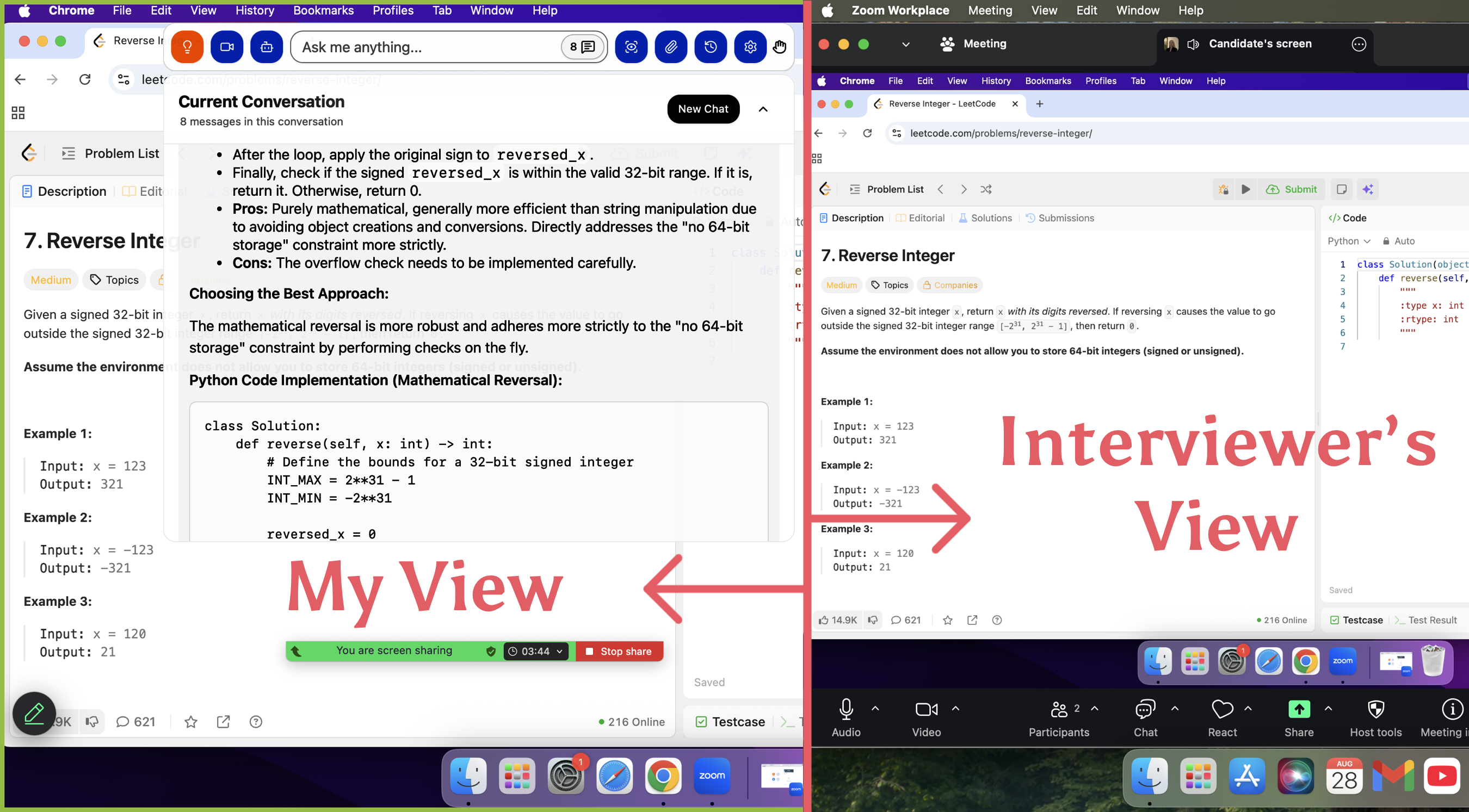
Fortunately, I had an AI interview tool (linkjob.ai) supporting me. It quickly pointed out additional flaws I hadn’t noticed, and in the end I managed to fix three separate bugs. What made it especially helpful was that it was completely discreet — there was no visible trace, and the interviewer couldn’t detect anything unusual. The suggestions were precise and clearly reasoned, which helped me regain control of the situation and work through the problem confidently.
Behavioral questions
The behavioral round of the stripe software engineer interview tested how I worked with others and handled challenges. Stripe asked me questions about learning new technologies, responding to criticism, and using automated testing tools. Here are some examples:
Describe a time when you had to learn a new technology to complete a task or project.
How do you respond to criticism of your work, especially when you believe it’s unwarranted?
Can you discuss your experience with using automated testing tools?
Can you give an example of a time when you demonstrated analytical skills?
Which of Stripe's core values resonates most with you and why?
I prepared stories that showed my ability to maintain high standards and overcome challenges. I used the STAR method (Situation, Task, Action, Result) to structure my answers. For example, when asked about a mistake I made, I explained what happened, how I fixed it, and what I learned.
If you want to succeed in the stripe software engineer interview, focus on clear communication, real examples, and showing how you align with Stripe’s values.
Other candidates' experiences and more Stripe interview questions
Common patterns
I talked to other candidates who went through the Stripe software engineer interview. We noticed some clear patterns in the types of questions Stripe asks. If you want to prepare well, you should focus on these areas:
Coding Assessments
Stripe loves algorithmic challenges. I saw questions about data structures and code efficiency. Practicing LeetCode and HackerRank helped me a lot.System Design
Interviewers want to see how you build scalable systems. They ask about fault tolerance and database design. I drew diagrams and explained my choices step by step.API Integration
Stripe expects you to work with RESTful APIs. You need to handle JSON data and manage errors. I practiced writing code that connects to APIs and handles failures gracefully.Behavioral Aspects
Structured answers matter. Stripe looks for candidates who fit their culture. I used the STAR method and shared stories that showed impact.
Tip: Focus your prep on these four areas. Practice coding, draw system diagrams, build API projects, and rehearse your stories.
Unique or challenging questions
I found interview experiences shared by other candidates. If you want to know what the Stripe interview is like and the types of questions they ask, I actually wrote an article about Stripe interview questions before.
Some Stripe interview questions stand out as especially tough or unusual. I heard about these from other candidates and saw a few myself. Here are examples:
Problem Type | Example Question | Description |
|---|---|---|
Intern/SDE-1 | Design a rate limiter that allows 100 requests per user per hour | This tests your ability to solve practical problems with simple logic. |
SDE-2 | Implement a cache with TTL that can handle 10k ops/sec | This pushes you to think about performance and efficiency in real-world systems. |
Another classic question was parsing an input string that represents a shipping route, something like "{source}:{target}:{method}:{cost}". I was asked to write a function that extracts the relevant information and returns what’s needed — whether that’s the cost, the full route details, or even identifying the cheapest route among multiple entries.

I found that Stripe likes to mix practical engineering with performance challenges. If you see a question like these, start by breaking down the requirements. Sketch out your approach before you write code. Test your solution for edge cases and explain your reasoning.
I also noted another candidate’s experience.
First, after setting up the development environment, the interviewer provided an open-source library and asked for a bug fix. After that, there was a new coding question. The difficulty was similar to a typical team screen, but with many follow-ups. The interviewer asked about edge cases like empty arrays, malformed JSON files, and missing fields.
Second, the Integration round was very hands-on. The interviewer shared a Git repository along with API documentation. The task was to run the project locally, read JSON or data files, and implement monthly transaction statistics based on the given requirements. There were five smaller tasks in total, mainly testing familiarity with APIs, file handling, and integrating logic across components.
Third, in the Bug Squash round, a repository and a pytest suite were provided. The goal was to identify failing test cases and fix the underlying issues. I used a debugger and print tracing to narrow down and isolate the problems.
Preparation Tips for the Stripe Software Engineer Interview
Coding and testing practice
I started my Stripe interview prep by focusing on practical coding skills. I didn’t just grind algorithms—I worked on writing clean, readable code and solving real-world problems. Here’s what helped me the most:
Used LeetCode and HackerRank to simulate exam conditions. I set a timer and tried to pass all test cases, not just get the right answer.
Prioritized methodical debugging. I wrote small tests for my code and explained my process out loud.This will help you be adapted for real procession.
Tip: Focus on code quality and clear communication. Stripe values both.
System design prep
System design can feel intimidating, but I broke it down into steps:
Strengthened my coding skills with data structures and algorithms.
Reviewed design patterns and real-world applications, especially those related to payments and APIs.
Learned the basics of Stripe’s domain—payment APIs and fintech concepts.
Did mock interviews to simulate the real thing and get feedback.
I made sure to highlight any personal experience using Stripe, even for side projects. This showed my genuine interest in their products.
Behavioral interview prep
Stripe cares about culture fit. I prepared stories that showed customer obsession and adaptability. I reflected on times when I put users first or learned from mistakes. I also read about Stripe’s recent focus on cost efficiency and made sure to mention relevant skills during my interviews.
Note: Use the STAR method to structure answers. Practice telling stories out loud.
Managing time and stress
Balancing prep with life felt tough. I managed my time by setting clear goals each week. I used a simple to-do list app to track deadlines and responsibilities. Practicing under timed conditions on LeetCode helped me stay calm during the real interview. I reminded myself to focus on accuracy, not just speed.
Prioritize tasks and break them into small steps.
Use tools to track progress.
Simulate interview pressure to build confidence.
Remember, staying organized and practicing under pressure makes a big difference. You’ve got this!
Lessons and Surprises from My Stripe Software Engineer Interview
Unexpected challenges
Stripe’s interview process surprised me in a few ways. I thought I could treat it like a LeetCode marathon, but that approach did not work. Stripe wanted to see how I solved real-world problems, not just how fast I could code. I learned that I needed to slow down and think about the bigger picture.
Here are some unexpected challenges I faced and noticed others mention:
I sometimes jumped into coding without asking clarifying questions. This led to wrong assumptions and wasted time.
My first solutions lacked structure and clear error handling. Stripe interviewers cared about code readability and maintainability.
I gave quick system design answers but forgot to explain trade-offs. Stripe wanted to hear my reasoning and see that I could weigh different options.
Tip: Always pause to clarify the problem, structure your code, and explain your choices. Stripe values engineers who think before they build.
What I’d do differently
Looking back, I see a few things I would change if I could do the Stripe interview again:
I would practice asking clarifying questions before starting any coding or design task. This helps avoid misunderstandings.
I would focus more on writing clean, readable code with good error handling. I would treat every problem like production code.
I would make a list of thoughtful questions to ask interviewers. This shows genuine interest and helps me learn about Stripe’s culture.
Practice real-world scenarios, communicate your thought process, and show curiosity. That’s what Stripe looks for in great engineers.
Here’s what helped me most in my Stripe interview journey:
I focused on data structure problems and wrote clean code.
I practiced debugging and API integration with small projects.
Stay curious and keep learning. Use your own experience and talk with others who have been through the process. A positive mindset makes a big difference!
FAQ
How did I manage my time during Stripe interview prep?
I set daily goals and used a simple checklist app. I broke big tasks into small steps. I practiced coding under timed conditions. This helped me stay focused and calm.
What resources helped me the most?
I used LeetCode for coding, Stripe’s own docs for APIs.I also read Stripe’s engineering blog for real-world examples.
What should I focus on when preparing for the Stripe software engineer interview?
Based on my experience, preparation should include:
Writing clean, production-style code
Practicing data processing and API-related problems
Reviewing system design fundamentals (especially idempotency and scalability)
What is the most important concept for Stripe interviews?
Idempotency and preventing duplicate charges. Stripe is a payments company, so financial correctness and reliability are top priorities.
See Also
How I Passed 2025 Stripe Technical Interview with Real Questions
How I Nailed Stripe Integration Round in 2025 on My First Try
My 2026 Oracle Senior Software Engineer Interview Questions and Answers
How I Solved Real Problems in My 2025 Stripe Intern Interview
How I Aced the Goldman Sachs Software Engineer Online Assessment in 2025

© Copyright 2025 Linkjob.ai - All Rights Reserved.