How I Passed 2025 Stripe Technical Interview with Real Questions


As a new grad who just finished the Stripe interview process, I’d like to share my experience and the technical questions I was asked. In this post, I will cover the four interview rounds from two stages and share the experiences I collected during my preparation.
I am really grateful for the tool Linkjob.ai, and that's also why I'm sharing my entire OA interview experience here. Having an undetectable AI interview assistant for the technical interview is indeed very convenient.
Stripe Technical Interview Stages and Process
Phone Screen
Coding - 45min
Virtual Onsite
Coding - 45min
Debug - 50min
Integration - 50min
Stripe Technical Interview Questions
Phone Screen
The interviewer provided a set of user data where each row represents a user record. Each record contains:
id
name
email
company
Each field has its own similarity weight. For example:
name weight = 0.2
email weight = 0.5
company weight = 0.3
Given a threshold, if the total similarity score between two records is >= threshold, they are considered to be the same person (linked user).
Input
rows: List of user records
weights: Map (field → weight)
threshold
target_user_id
Output
All record IDs that are considered the same as the target_user_id.
Example Input
rows = [
  { "id": 1, "name": "Alice", "email": "alice@gmail.com", "company": "Stripe" },
  { "id": 2, "name": "Alicia", "email": "alice@gmail.com", "company": "Stripe" },
  { "id": 3, "name": "Alice", "email": "alice@yahoo.com", "company": "Google" },
  { "id": 4, "name": "Bob",   "email": "bob@gmail.com",   "company": "Stripe" }
]
weights = { "name": 0.2, "email": 0.5, "company": 0.3 }
threshold = 0.5
target_user_id = 1
Follow-up 1
The requirement is to find not only directly linked users but also indirect (1-hop) users. For example:
If 1 and 2 are linked
And 2 and 3 are linked
But 1 and 3 are NOT directly linked
The output should still include: 2, 3.
Follow-up 2
Instead of just 1-hop, find all indirectly linked users (no limit on hops). You need to return the entire linked component.
Virtual Onsite
Coding
Implement an AccountScheduler class to determine if a specific account is available at a given timestamp.
Input includes:
A list of
account_ids (all accounts in the system).A dictionary:
{ account_id : locked_until_timestamp }, representing until when each account is locked.
Requirements:
Provide an interface is_available(account_id, t) which returns whether the account is available at time t. All queries occur sequentially; assume no concurrency.
Example Input
accounts = [1, 2, 3, 4]
locked_until = { 1: 10, 2: 5, 3: 0, 4: 20 }

# Queries
is_available(1, 8)   # -> False
is_available(2, 8)   # -> True
is_available(3, 1)   # -> True
is_available(4, 21)  # -> True
Follow-up 1
Add a new function to the class: acquire(account_id, duration).
This locks the account for a specific duration starting from the current query time t.
Example: At current time
t, callingacquire(2, 5)updateslocked_until[2] = t + 5.
Follow-up 2
Extend acquire to follow LRU (Least Recently Used) logic:
If
acquireis called without a specificaccount_id, the system must automatically pick an available account.The system must pick the account that was available and least recently used.
After acquisition, update that account's
locked_untiltimestamp.
Integration and Debug
My Integration and Debug rounds were Bikemap and Mako.
Content for these rounds has been shared previously in articles regarding Stripe interview questions on Linkjob.ai.
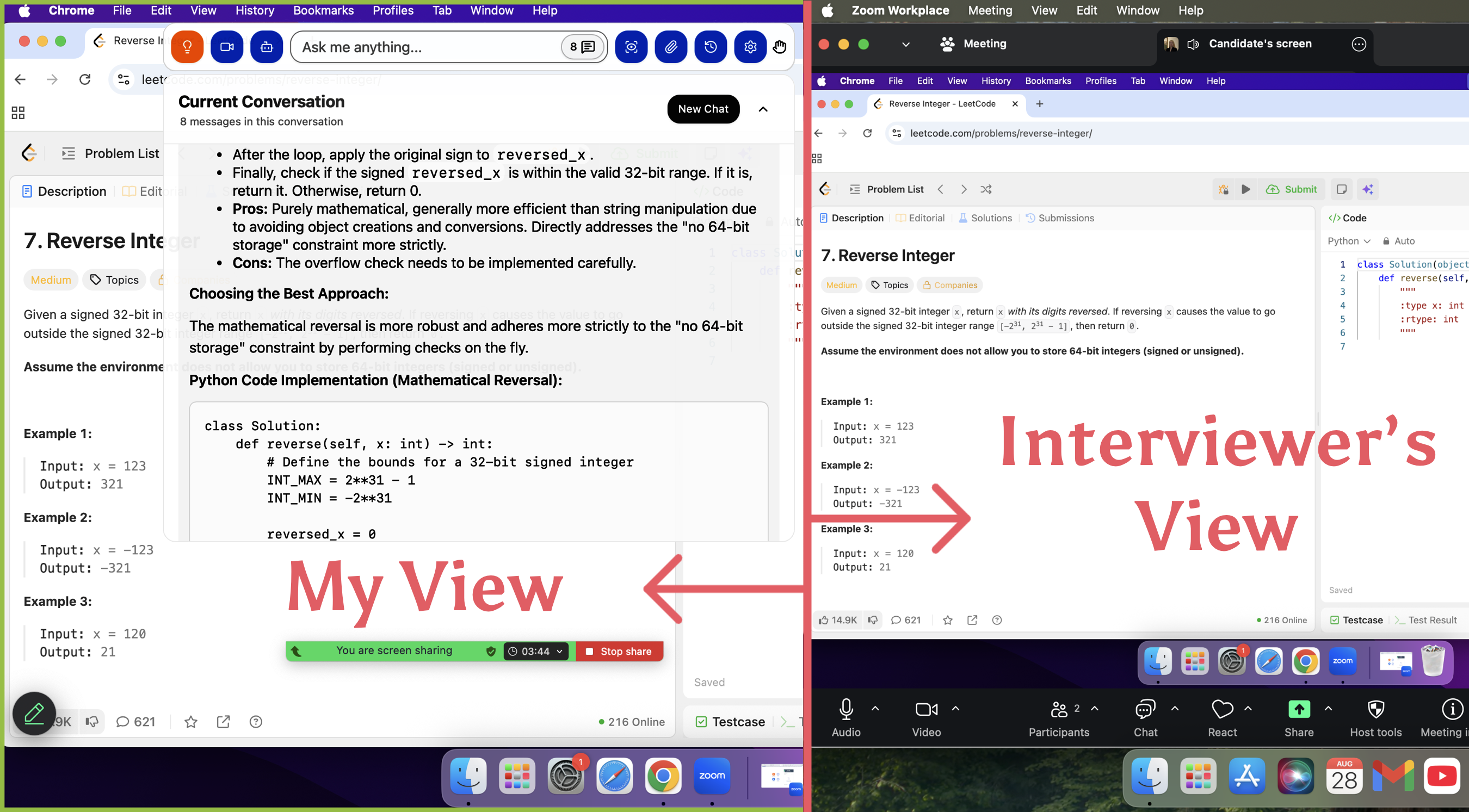
I have to say, Linkjob AI is really easy to use. I used it during the interview after testing its undetectable feature with a friend beforehand. With just a click of the screenshot button, the AI provided detailed solution frameworks and complete code answers for the coding problems on my screen. I’ve successfully passed the test, with the HackerRank platform not detecting me at all.
Experience and Common Questions Collected
Experience 1: 2026 Intern VO
Coding
I didn't get the common Stripe "email subscription" problem; my question was about transactions. (If you want to see the email problem, you can refer to the article in the link mentioned above).
Part 1: Given a series of transactions, output the names of users with a non-zero balance and their corresponding balances.
Example Input:
account_name, timestamp, currency, amount
acct_123, 1, usd, 1000
acct_123, 2, usd, 500
acct_321, 3, usd, 400
acct_321, 4, usd, -400
Output:
acct_123 and 1500 (since acct_321 balance is 0).
Part 2: Output a rejected_transaction list. If a user's current_balance + amount < 0, the transaction should be added to the rejected list. Also, output the non-zero balances for users as in Part 1.
Example Input:
account_name, timestamp, currency, amount
acct_123, 1, usd, 1000
acct_123, 2, usd, 500
acct_321, 3, usd, 400
acct_321, 4, usd, -500
Output:
acct_123: 1500
acct_321: 400
rejected_transaction: ["acct_321, 4, usd, -500"]
Part 3: This part was very long and divided into 3(a) and 3(b). I only finished 3(a).
3(a): Given a platform_id and the transaction history. For any account that is not the platform_id, if the account balance falls below 0, it can "borrow" money from the platform_id to cover the deficit.
Required Output: max_reserve (total amount borrowed from the platform), rejected_transaction, and users with non-zero balances.
Example Input: (where platform_id = acct_123)
account_name, timestamp, currency, amount
acct_123, 1, usd, 1000
acct_321, 3, usd, 400
acct_321, 4, usd, -500
Output: max_reserve: 100
rejected_transaction: []
acct_123: 900 (1000 original - 100 borrowed by others)
Integration: Bikemap
I spent the first 10 minutes on self-introductions and environment setup, leaving only about 30-40 minutes for the actual coding. The time was extremely tight and the problem description was very long.
Specific details for this problem can be found in the Linkjob.ai article about Stripe interview questions mentioned previously, which contains the original prompt.
Experience 2: 2026 Java NG VO
Coding
My coding round was the Email Subscription problem.
Regarding the send_schedule, you are allowed to define your own structure; a Map<String, String> works. The interviewer emphasized that the code should be reusable and general. Although there is currently only a "-15" key (which is subject to change), the send_schedule could contain various other numbers. Therefore, I cannot simply iterate through the map and look for a key that can be parsed into an integer to find that specific one.
I asked the interviewer how to distinguish between welcome, expired, and these numeric schedules. They stated that in the send_schedule, apart from "start" and "end" which are fixed, all other keys should be treated as numbers (dynamic).
Effectively, this means every time we iterate through the users, we also iterate through the send_schedule. We handle "start" and "end" as special cases, and for any other numeric keys, we calculate the corresponding relative time.
Bug Squash
This was a new problem: Snakeyaml.
Debug
There were two primary reasons for the failing tests:
Boolean Parsing: The system failed to parse
"flag: On"into the correctBoolean.Truevalue.CSV Parsing: Errors occurred during the parsing of CSV files.
Stripe Technical Interview Preparation Tips and Strategies
Timed Coding Practice
I set a timer every time I solved a coding problem. Stripe interviewers care about how quickly and accurately I can write code. I used online platforms like LeetCode and HackerRank, but I also wrote code in my own editor to mimic the real interview environment.
I picked problems that matched Stripe’s style—real-world scenarios.
I focused on finishing each problem in 30–45 minutes.
After coding, I reviewed my solution for bugs and edge cases.
Here’s a table of strategies that helped me succeed:
Strategy | Description |
|---|---|
Align with values | I prepared examples showing rigor, ownership, and clarity in my work. |
Time-boxed case studies | I practiced structuring my analysis quickly and prioritizing impact, just like a 48-hour assignment. |
Know Stripe products and metrics | I learned about Stripe’s products and core metrics to ground my answers. |
Analytics engineering hygiene | I described checks for data quality and reproducibility in my solutions. |
Critical skills | I blended technical skills with product insight, focusing on SQL, statistical design, and storytelling. |
Tools and technologies | I reviewed SQL, Python, and visualization tools, plus A/B testing and regression techniques. |
Product-sense interview | I practiced translating data into strategic insights and reviewed recent launches and metrics. |
Explaining Thought Process
Stripe wants to see how I think, not just what I code. I made it a habit to talk through my ideas step by step. I described my assumptions, the trade-offs I considered, and why I chose a certain approach.
When I solved problems, I said things like:
“I’m going to use a hash map here because it lets me look up values quickly.”
“If the input is very large, I’ll need to optimize for memory.”
I also explained how I debugged my code and how I would test it. If I made a mistake, I talked about how I found it and what I learned.
Bug Squash Preparation
The bug squash round felt different from regular coding interviews. Stripe gave me a codebase from GitHub and asked me to find and fix a failing test case. I prepared for this by working with open-source projects and practicing reading unfamiliar code.
Here’s how I got ready:
I downloaded sample repositories and looked for bugs in the code.
I ran test cases to see which ones failed.
I fixed the bugs and explained my reasoning.
Some resources I used:
Practiced with open-source libraries on GitHub.
Focused on identifying failing test cases and fixing them.
Reviewed common debugging techniques in my preferred language.
Cultural Fit and Stripe Values
Problem-Solving Skills
Stripe interviewers really care about how I solve problems. They want to see more than just code. I learned that I needed to show a mix of technical and product thinking. Here’s a table that helped me focus my preparation:
Skill Type | Description |
|---|---|
Coding | Writing efficient and effective code that solves the problem. |
Debugging | Finding and fixing bugs, especially in real codebases. |
System Design | Building systems that work well and scale. |
Product-Minded Approach | Thinking about the bigger picture, like how my work helps customers and supports business goals. |
When I practiced, I didn’t just write code. I asked myself, “How does this help the user?” and “What would I do if this system had to handle a million users?” That mindset made a big difference.
Communication
Strong communication skills set me apart at Stripe. Interviewers watched how I explained my ideas and how I worked with others. Here’s what I focused on:
I explained technical concepts in simple words.
I shared stories that showed leadership, even if I wasn’t the team lead.
I made sure to listen and ask questions, not just talk.
Tip: If you get stuck, talk through your confusion. Stripe values candidates who can communicate clearly, even when things get tough.
Alignment with Stripe’s Mission
Stripe wants people who care about their mission. I tried to show that I take ownership, think long-term, and care about others. Here’s a table that guided my answers:
Key Element | Description |
|---|---|
Ownership | I take responsibility for my work and follow through on tasks. |
Clarity | I explain my ideas so everyone understands. |
Long-term Thinking | I make decisions that help Stripe grow and last. |
Empathy | I try to understand what teammates and customers need. |
When I answered questions, I always linked my stories back to these values. That helped me show I was a good fit for Stripe’s culture.
FAQ
How much do I need to know about Stripe’s products?
I learn the basics of Stripe’s payment APIs and core features. I read their docs and blog posts. I mention what I know in interviews. This shows I care about the company’s mission.
Can I choose my preferred programming language?
Yes! Stripe lets me pick the language I feel most comfortable with.
How do you prepare for the bug squash round?
I practice reading open-source code on GitHub. I also gathered interview experiences from various platforms, such as Blind, Glassdoor, Indeed, and Reddit.
See Also
Insights From My Stripe Interview: Questions And Experiences
Stripe HackerRank Online Assessment Questions I Got in 2025
How I Nailed Stripe Integration Round in 2025 on My First Try
Navigating Dell Technologies Interview Questions: My 2025 Approach

© Copyright 2025 Linkjob.ai - All Rights Reserved.