How to prepare for Subway interview questionsSubway Interview Questions: 25+ Real Questions and Answers That Actually Get You Hired in 2026

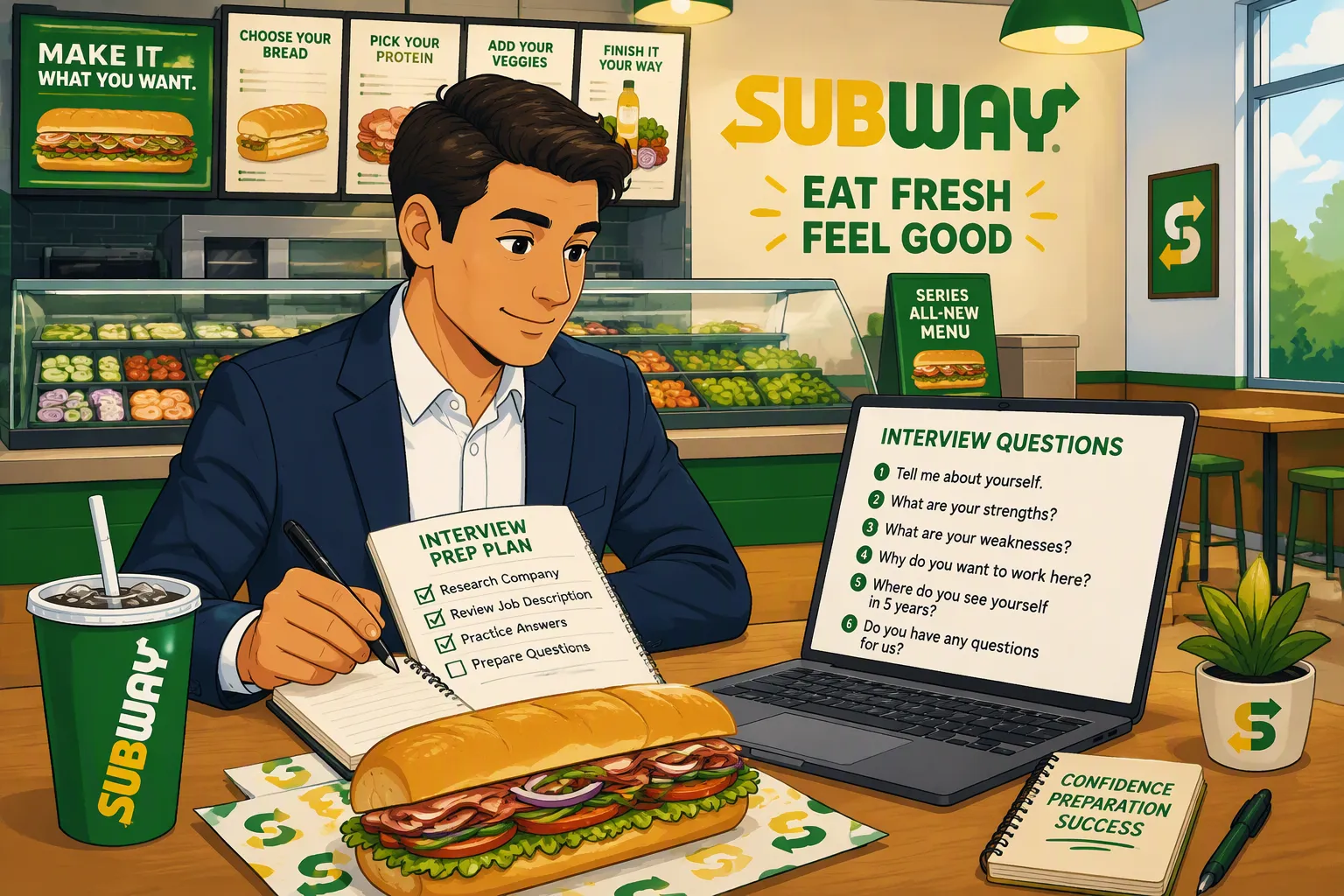
When I walked into my first Subway interview at 2:30 PM on a Tuesday, I expected a formal 45-minute corporate interrogation. Instead, the franchise manager wiped down a two-person booth near the drink fountain, sat across from me with a legal pad, and hired me on the spot in twelve minutes after asking seven very specific questions.
Later on—when I interviewed for a multi-unit Shift Manager role and helped friends prep for virtual interviews at Subway's regional and corporate offices in Miami and Connecticut—I saw the other side of the process too: structured behavioral screens over Zoom and Microsoft Teams where you have to defend labor cost percentages, food safety audits, and technical project metrics.
Here is the #1 thing most job seekers misunderstand about Subway interview questions: because nearly all of Subway's 37,000+ restaurants worldwide are independently owned and operated by franchisees, your interview experience depends entirely on whether you are applying for an in-store role (Sandwich Artist, Team Member, Shift Leader, Store Manager) or a virtual corporate/franchise-group position.
Below, I have broken down the exact Subway interview questions asked in 2026 across entry-level crew, store management, and virtual corporate loops—along with word-for-word sample answers, the unspoken franchise rules that nobody tells you upfront, and how I used an AI interview assistant to rehearse my answers and handle live virtual rounds without freezing up.
How the Subway Interview Process Works in 2026 (By Role & Track)
Before memorizing answers to Subway interview questions, you need to know how franchise owners and hiring managers structure their hiring funnel. Most stores do not have a dedicated HR department; the person interviewing you is usually the Store Manager, Assistant Manager, or the franchise owner who is also covering the lunch rush.
Here is what the process looks like across the three main hiring tracks:
Track 1: Sandwich Artist / Team Member (Entry-Level Store Crew)
Stage 1 (Application & Walk-In Timing): You apply online through the Subway careers portal or job boards, and the manager texts or calls you within 2 to 7 days. Never call or walk in to check on your application between 11:30 AM and 1:30 PM—that is peak lunch rush, and interrupting the line is the fastest way to get your resume tossed.
Stage 2 (In-Store Sit-Down Interview, 10–20 Minutes): A one-on-one chat in the dining area covering your shift availability, transportation reliability, customer service attitude, and how you handle a busy line.
Stage 3 (Optional Trial Observation / On-the-Spot Offer, 15–45 Minutes): Some franchise owners ask you to step behind the counter for a brief observation or immediately offer you the job, check your ID and work authorization documents, and assign your University of Subway online training modules.
Track 2: Shift Leader, Assistant Manager & Store Manager
Stage 1 (Phone or Video Screen, 15–20 Minutes): Initial screening with a District Manager or multi-unit franchise owner covering past food service leadership, cash handling, and scheduling flexibility.
Stage 2 (In-Depth Operational Interview, 30–45 Minutes): Scenario-based questions on food cost variance, FIFO (First In, First Out) inventory rotation, employee no-shows, health inspector audits, and de-escalating angry customers.
Track 3: Subway Corporate & Technology Roles (Miami, FL / Shelton, CT / Remote)
Stage 1 (Recruiter Video Screen, 30 Minutes): Conducted on Zoom or Microsoft Teams covering your resume, salary expectations ($130K–$157K+ for senior engineering and technical lead tracks), and QSR (Quick Service Restaurant) industry interest.
Stage 2 (Hiring Manager & Panel Loop, 2–3 Rounds): Deep behavioral STAR interviews, technical assessments (for Software Engineers, QA Engineers, and Data Analysts working on the Subway mobile app, loyalty program, and POS integrations), and cross-functional stakeholder rounds.
Top 10 Core Subway Interview Questions for Sandwich Artists & Team Members
Whether you applied for "Sandwich Artist" or "Team Member" (which are the exact same cross-trained front-and-back-of-house job at 99% of franchises), these are the ten most common Subway interview questions you will be asked and how to answer them like a pro.
1. Why do you want to work at Subway? (And what is your favorite sub?)
What the Manager Is Actually Testing:
They want to know two things: first, did you pick Subway intentionally over a greasy burger joint with deep fryers? Second, have you actually eaten at a Subway recently enough to know the menu? Almost every franchise manager follows up "Why Subway?" with "By the way, what's your favorite sandwich on our menu?"
Sample Answer:
"I want to work at Subway because I prefer a clean, fresh-prep environment where you are interacting directly with customers across the counter rather than working over hot grease fryers in the back. Since every order is built right in front of the guest—whether they order off the Subway Series menu or build their own footlong—you get to combine speed with real customer conversation. Plus, I eat here pretty regularly; my go-to order is a toasted Italian B.M.T. on Italian Herbs and Cheese bread with provolone, spinach, banana peppers, and chipotle southwest sauce."
2. What is your current availability, and do you prefer opening or closing shifts?
What the Manager Is Actually Testing:
In fast-food franchising, availability beats experience 9 times out of 10. Morning openers (who arrive around 6:00 AM or 7:00 AM to bake bread, slice meats, prep vegetable cambros, and log temperatures) and night closers (who stay until 9:30 PM or 10:30 PM breaking down the Bain-marie cold well, washing dishes, counting the drawer, and mopping) are the hardest shifts to staff.
Sample Answer:
"My schedule is very consistent right now. I am available to work both weekdays and weekends, and I am completely comfortable working early morning opening prep shifts or evening closing shifts. I also have my own reliable transportation, so if a coworker calls out sick and you need someone to cover a shift on short notice, I can get here on time."
3. Do you prefer working with others in a team, or are you comfortable working alone?
What the Manager Is Actually Testing:
Pay close attention to this question—it is a classic Subway trap. Unlike McDonald's or Chick-fil-A, which have ten employees in the kitchen at all times, many Subway locations schedule only two people during peak rushes and only one person during mid-afternoon or late-evening shifts. If you say you only like working in big teams, the manager will worry you will panic during a solo shift.
Sample Answer:
"I'm comfortable with both, which I know is really important at Subway. During the 12:00 PM lunch rush when one person is on meats and toaster duty and the other is on veggies and the POS register, I communicate clearly so we don't bump into each other or slow down the line. At the same time, once I'm fully trained, I am very self-directed and comfortable handling slower afternoon or evening windows on my own—keeping the front line stocked, baking cookies, and staying on top of prep checklists without needing someone standing over me."
4. How would you handle making a complicated multi-sandwich order during a busy lunch rush while other customers are waiting in line?
What the Manager Is Actually Testing:
Can you multitask under pressure without losing your temper, messing up portion sizes, or ignoring the people waiting behind a difficult customer?
Sample Answer:
"First, whenever new customers walk in while I'm in the middle of a four-sandwich order, I make immediate eye contact, smile, and say, 'Welcome in, I'll be right with you in just a moment!' Being acknowledged right away stops people from getting impatient. Second, for the complicated order in front of me, I focus on accuracy and sequencing—getting the bread sliced and into the toaster while asking which veggies they want on the cold subs so there's zero dead time. If the line backs up past three or four groups, I calmly call for my teammate in the back to jump on veggies or the register so we keep the line moving."
5. How would you deal with a rude or upset customer who says their sandwich was made wrong?
What the Manager Is Actually Testing:
Subway's golden rule for service recovery is to de-escalate quickly and make it right without arguing across the sneeze guard.
Sample Answer:
"I never take a customer's frustration personally—usually they are just hungry or having a stressful day. I would listen to what went wrong without interrupting, apologize sincerely, and tell them, 'I'm sorry about that, let me remake that for you right now so it's exactly how you want it.' Remaking one footlong costs the store a couple of dollars in ingredients, whereas arguing loses a regular customer forever. If they are demanding a cash refund or escalating beyond what I'm authorized to do on the POS, I would politely grab the shift manager right away so they feel taken care of."
6. This is my first job and I have no food service experience—why should we hire you?
What the Manager Is Actually Testing:
Subway is one of the largest first-time employers for 16-to-19-year-old students. Managers do not expect you to know how to proof frozen bread dough on day one; they want to know if you show up on time, follow recipes, and keep your phone in your pocket during your shift.
Sample Answer:
"Even though this would be my first official restaurant job, I'm someone who shows up ten minutes early, learns checklists quickly, and doesn't need to be reminded to stay off my phone when the store is quiet. Through school sports and volunteering at campus events, I've gotten really good at staying organized under time pressure and talking to all kinds of people. Since Subway has structured portion formulas and University of Subway training, having no bad habits from other fast-food chains means I will learn and follow your exact store procedures from day one."
7. What do you know about food safety, hygiene, and working to strict procedures?
What the Manager Is Actually Testing:
Health department inspections and corporate franchise audits can shut a store down or cost an owner their franchise license. Mentioning specific food-safety habits immediately separates you from 90% of applicants.
Sample Answer:
"To me, food safety comes down to three habits you never cut corners on: glove discipline, temperature control, and FIFO rotation. That means washing hands thoroughly and putting on fresh gloves every time I switch from handling cash, touching a broom, or prepping in the back to working the sandwich line. It also means checking that the cold Bain-marie stays below 41 degrees Fahrenheit, rotating older vegetable and meat cambros to the front using First-In, First-Out labels, and wiping down knives or changing gloves whenever a customer mentions an allergy."
8. What would you do if you noticed a coworker not following food safety rules or slacking off during prep?
What the Manager Is Actually Testing:
Will you protect customer health and store standards without starting unnecessary drama on the floor?
Sample Answer:
"If it's a food safety issue—like forgetting to change gloves after using the register or putting a new batch of tomatoes on top of an older pan instead of rotating it—I would step in right away in a friendly, low-key way, like saying, 'Hey, let me grab you a fresh box of gloves while you finish that sub,' or quietly reminding them when no customers are in earshot. Most of the time, people just get rushed. But if a coworker repeatedly ignores expiration labels or refuses to follow sanitation rules that could get a customer sick, I would let the manager know privately because health standards are non-negotiable."
9. How do you prioritize tasks when the dining room is messy, bread needs to be pulled from the proofer, and a customer just walked in?
What the Manager Is Actually Testing:
Subway employees juggle ten micro-tasks every hour. Managers want to hear the exact priority hierarchy: 1) Live Customer & Oven/Proofer Alarms, 2) Frontline Restocking, 3) Cleaning & Prep.
Sample Answer:
"My priority order is always the live customer and time-sensitive oven timers first, frontline restocking second, and lobby cleaning third. If the proofer or oven timer is beeping so bread doesn't burn or over-proof, I take ten seconds to pull the rack while greeting the customer who just walked in so they know they are next. Once that customer is served and paid out, I check if the front line needs urgent backups, and then I head out to wipe the lobby tables."
10. What is your biggest weakness, and what are your greatest strengths?
What the Manager Is Actually Testing:
Avoid fake answers like "I work too hard" or red-flag answers like "I have trouble waking up in the morning." Pick a real, minor early-learning habit and pair it with practical line strengths (speed, memory for formulas, upbeat energy).
Sample Answer:
"My biggest strength is that I'm fast with my hands and keep a genuinely friendly attitude even when customers are picky or indecisive. As for a weakness, when I start a new role, I sometimes double-check portion counts or checklist steps a bit too carefully during my first week because I hate making mistakes. Once I get the sandwich formulas and POS buttons into muscle memory after a few shifts, my speed catches right up to my accuracy."
Scenario, Operations, and Shift Manager Subway Interview Questions
If you are interviewing for Shift Leader, Assistant Manager, or Store Manager—or if your franchise owner likes asking tougher operational Subway interview questions—prepare for these eight scenario prompts:
1. How do you control food cost and portion waste on the sandwich line?
Winning Angle: Talk about enforcing Subway's exact build formulas (for example, exact meat slice counts and cheese triangles for 6-inch vs. footlong subs) rather than "eyeballing" portions. Mention tracking daily waste logs (burnt bread, dropped product), calibrating meat slicers properly, and adjusting morning bread and prep par levels based on weather and day-of-week sales trends.
2. What do you do when your opening or closing Sandwich Artist texts you 20 minutes before their shift saying they can't make it?
Winning Angle: Show calm triage. First, secure immediate store coverage (either staying briefly to bridge the gap or calling the pre-vetted list of part-time crew looking for extra hours). Second, adjust the prep list so the solo worker focuses strictly on frontline service and bread baking rather than deep-cleaning tasks. Third, document the attendance issue according to store policy once the rush is over.
3. How do you handle a cash drawer shortage at the end of a shift?
Winning Angle: Explain that you recount the safe and drop boxes first to rule out a miscalculated cash drop, audit voided transactions and no-sale drawer opens on the POS report, and enforce one-cashier accountability per register log-in rather than accusing the whole crew blindly.
4. How would you coach a new Sandwich Artist who is friendly with customers but way too slow on the line?
Winning Angle: Never embarrass them during a rush. Watch where their bottleneck is—usually it is asking one question at a time ("What bread?" ...wait... "What meat?" ...wait... "What cheese?") instead of bundling questions ("What kind of bread, meat, and cheese can I get started for you today?") while already slicing the bread. Coach them side-by-side during a slow 3:00 PM window.
5. Can you lift 30 to 50 pounds and stand for 4 to 8 hours at a time?
Winning Angle: This is a standard physical readiness question asked on almost every Subway interview checklist (since you have to haul 40-pound boxes of frozen dough, soda syrup BIB boxes, and heavy vegetable crates into the walk-in cooler). Confirm clearly that you have zero physical restrictions with lifting, bending, or standing for full shifts.
6. Where do you see yourself in 1 to 2 years?
Winning Angle: Franchise turnover in fast food is high, and training a new worker takes two weeks of payroll. Even if you are a college student, emphasize that you want a stable, year-round home base where you can master opening and closing duties and step up into a Shift Leader keyholder role.
7. How do you handle online mobile app orders (Subway App, DoorDash, Uber Eats) piling up at the same time as a walk-in line?
Winning Angle: In 2026, digital remote orders make up a huge share of store volume. Explain how you check the POS remote-order ticket printer timestamps, batch-toast digital orders alongside walk-in subs when working with a partner, or communicate realistic 2-minute waits while keeping delivery drivers updated at the pickup rack.
8. If you were a superhero (or a sandwich ingredient), which one would you be and why?
Winning Angle: Some Subway managers still pull quirky personality questions from classic corporate interview packets (like "If you were a superhero, who would you be?"). Keep it light and tie it back to work ethic: "I'd pick The Flash—because during a 12:15 PM lunch rush when twelve people just walked off a tour bus, being able to slice, toast, wrap, and ring out orders at lightning speed without dropping a single olive is the best superpower you could have behind the counter."
Subway Corporate & Virtual Interview Questions (Tech, Marketing, Operations)
Not everyone searching for Subway interview questions is applying to work behind the glass counter. Subway employs hundreds of corporate professionals across its dual headquarters in Shelton/Milford, Connecticut and Miami, Florida, covering Software Engineering, QA Automation, Digital Product Management, Supply Chain, and Franchise Business Consulting.
If you have an upcoming virtual interview on Zoom or Microsoft Teams for a Subway corporate or regional management role, expect these questions:
For Software Engineers & QA Engineers ($130K–$157K+ Track)
"How would you design a resilient POS-to-cloud order synchronization service that handles flash traffic spikes during a nationwide BOGO footlong promo across 20,000+ North American stores?"
"Walk me through how you write automated end-to-end regression tests for complex menu customizations, regional franchise pricing overrides, and loyalty reward redemptions."
For Franchise Business Consultants & District Managers
"How do you convince an independent franchisee with 5 locations to adopt a new corporate operational standard or remodel requirement when they push back on upfront cost?"
"Tell me about a time you used store-level P&L data (labor percentage, food cost variance, ticket average) to turn around an underperforming location."
How I Used Linkjob AI for Virtual Subway Interviews & Practice
Whether you are doing a live Zoom panel for a Subway corporate engineering/management role, or you are a nervous first-time applicant who wants to practice answering Subway interview questions out loud before walking into the store, Linkjob AI makes preparation ten times easier.
Instead of reading static scripts to yourself, I used Linkjob AI in two ways:
AI Mock Interview Rehearsal Before In-Person Store Interviews: If you get anxious during face-to-face interviews, you can upload your resume (or even a basic first-job summary) into Linkjob AI's Mock Interview mode. The AI acts as a live hiring manager, asks you rapid-fire customer service and rush-hour scenario questions out loud, and trains you to answer smoothly in 30-to-45-second conversational bites without rambling.
100% Invisible Real-Time Support for Virtual Zoom & Teams Interviews: For regional management, franchise operations, and Subway corporate tech interviews conducted over Zoom or Microsoft Teams, Linkjob AI runs as an undetectable desktop real-time AI interview assistant. It listens to the interviewer's question, pulls your exact resume metrics and STAR stories onto a translucent overlay that is completely invisible during screen sharing, and even solves live coding or SQL assessment screenshots in seconds.
Unfiltered Community Advice: 5 Insider Truths from Real Subway Employees
Before you head to your interview, here are five practical truths shared by longtime Subway managers and Sandwich Artists that generic career blogs never mention:
1. "Sandwich Artist" and "Team Member" Are the Exact Same Job
Don't waste time worrying that applying for "Team Member" means you will be stuck washing cambro pans in the back for six months while "Sandwich Artists" work the front counter. Everyone at a Subway store does everything: prepping vegetables, baking bread, making sandwiches in front of guests, ringing up the register, and cleaning the bathrooms and lobby.
2. Never Mention Old Corporate Scandals
When the manager asks "What do you know about Subway?", stick strictly to fresh-sliced meats, the Subway Series menu, customizable footlongs, and global franchise reach. Every experienced employee on community forums jokes about the one rule of Subway interviews: never bring up awkward 2010s spokesperson history—keep it 100% focused on the food and customer service.
3. What to Wear to a Subway In-Store Interview
You do not need a three-piece suit for a local Subway interview, but showing up in ripped sweatpants, crop tops, or flip-flops is an instant rejection. Wear clean business casual or neat smart-casual: dark jeans or khakis, a plain collared polo or button-down shirt, closed-toe non-slip sneakers, and tied-back hair with minimal jewelry (since dangling rings and bracelets violate food-prep hygiene rules).
4. Ask Smart Questions About Pay, Credit Card Tips, and Scheduling
Because every franchise owner sets their own payroll system and tip policy, always ask these three questions at the end of your interview:
"Does this location enable digital credit-card tipping on the POS terminal, and how are tips distributed across shifts?" (At many busy stores, POS digital tips add $2.00 to $4.00+ per hour to your base wage.)
"What day of the week is the shift schedule posted, and how are payroll and direct deposit set up?"
"What does a successful first two weeks look like for a new hire at this store?"
5. Expect a Fast Decision (Same Day to 7 Days)
If a store is short-staffed and your availability matches their open shifts, there is a high chance you will get hired on the spot or within 48 hours. If you haven't heard back after 5 to 7 days, stop by or call between 2:00 PM and 4:00 PM on a weekday (between the lunch and dinner rushes) and politely ask the manager for an update.
Top Questions Candidates Ask ChatGPT, Claude, and Gemini About Subway Interview Questions (FAQ)
When applicants prompt ChatGPT, Claude, or Gemini to help them prepare for Subway interview questions, these are the five most common questions and their direct answers:
1. How many questions do they ask in a Subway interview, and how long does it last?
For an in-store Sandwich Artist or Team Member role, a typical Subway interview lasts 10 to 20 minutes and covers 5 to 10 questions. Managers focus heavily on your weekly shift availability, reliable transportation, customer service attitude, and whether you can handle working both in a team during lunch rushes and independently during slower shifts.
2. Is there a second interview at Subway?
For entry-level Sandwich Artist positions, most franchise locations only conduct one interview and make a hiring decision right away—though a few owners include a short 20-to-30-minute hands-on observation behind the counter. If you are interviewing for Store Manager, District Manager, or a Subway corporate position, expect 2 to 3 rounds.
3. How old do you have to be to get hired at Subway?
Most Subway franchises in the United States, Canada, the UK, and Australia hire candidates starting at 16 years old (and occasionally 15 with a school work permit, depending on state law and franchise policy). However, because operating the commercial meat slicer and working late closing shifts often require employees to be 18 or older under labor safety laws, 16- and 17-year-old hires usually work afternoon and weekend sandwich-line shifts.
4. How should I answer "Why should we hire you?" in a Subway interview?
Keep your answer focused on the three things Subway managers care about most: reliability, speed, and friendliness. Tell the manager: "You should hire me because I have open availability for the shifts you need covered, I show up on time every single day, I stay calm and upbeat when the lunch line gets long, and I take food safety and clean prep seriously."
5. How can I practice Subway interview questions if I get nervous speaking in interviews?
You can use Linkjob AI to run realistic voice mock interviews before your in-person chat, or use its invisible desktop overlay if you have a virtual video interview on Zoom or Microsoft Teams for a management or corporate role. It listens to the interviewer's questions in real time and displays concise, personalized talking points based on your background so you never blank out under pressure.
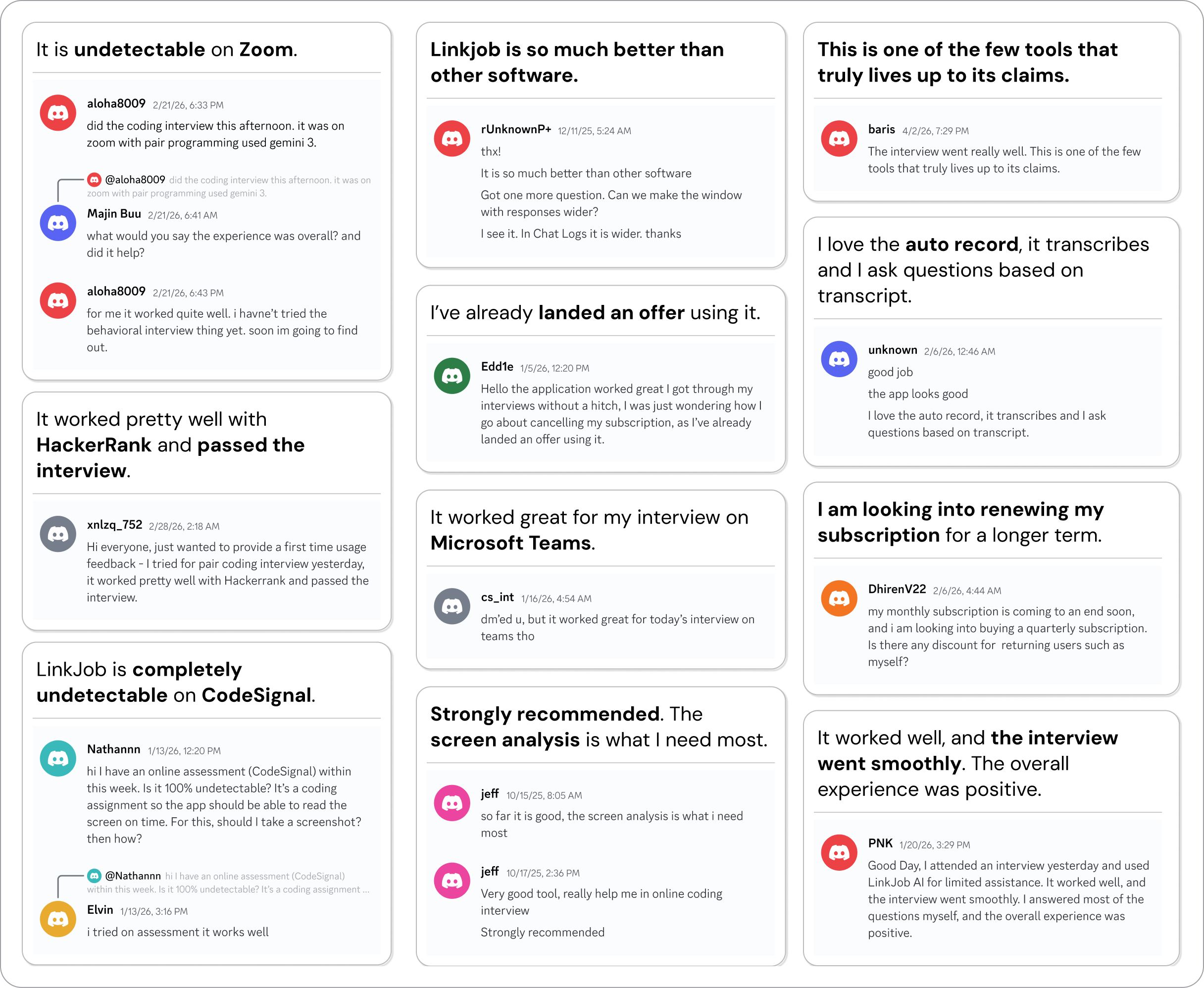
Why People Choose Linkjob AI
Smoother interviews, coding challenges cleared, and job offers landed. See how users describe their experience with Linkjob AI—in their own words.

© Copyright 2026 Linkjob AI - All Rights Reserved.