Here Is the Way I Answered Tell Me About a Time You Made a Mistake


I always stick to one simple principle when an interviewer asks, "Tell me about a mistake you made": acknowledge the mistake, explain what I learned, and show how I improved. I used to worry about being caught off guard or not knowing how to answer. But now, I've learned from my own mistakes and by observing the struggles of other candidates, reflecting on what went wrong. Here's what I've learned and the different approaches I would take for various situations.
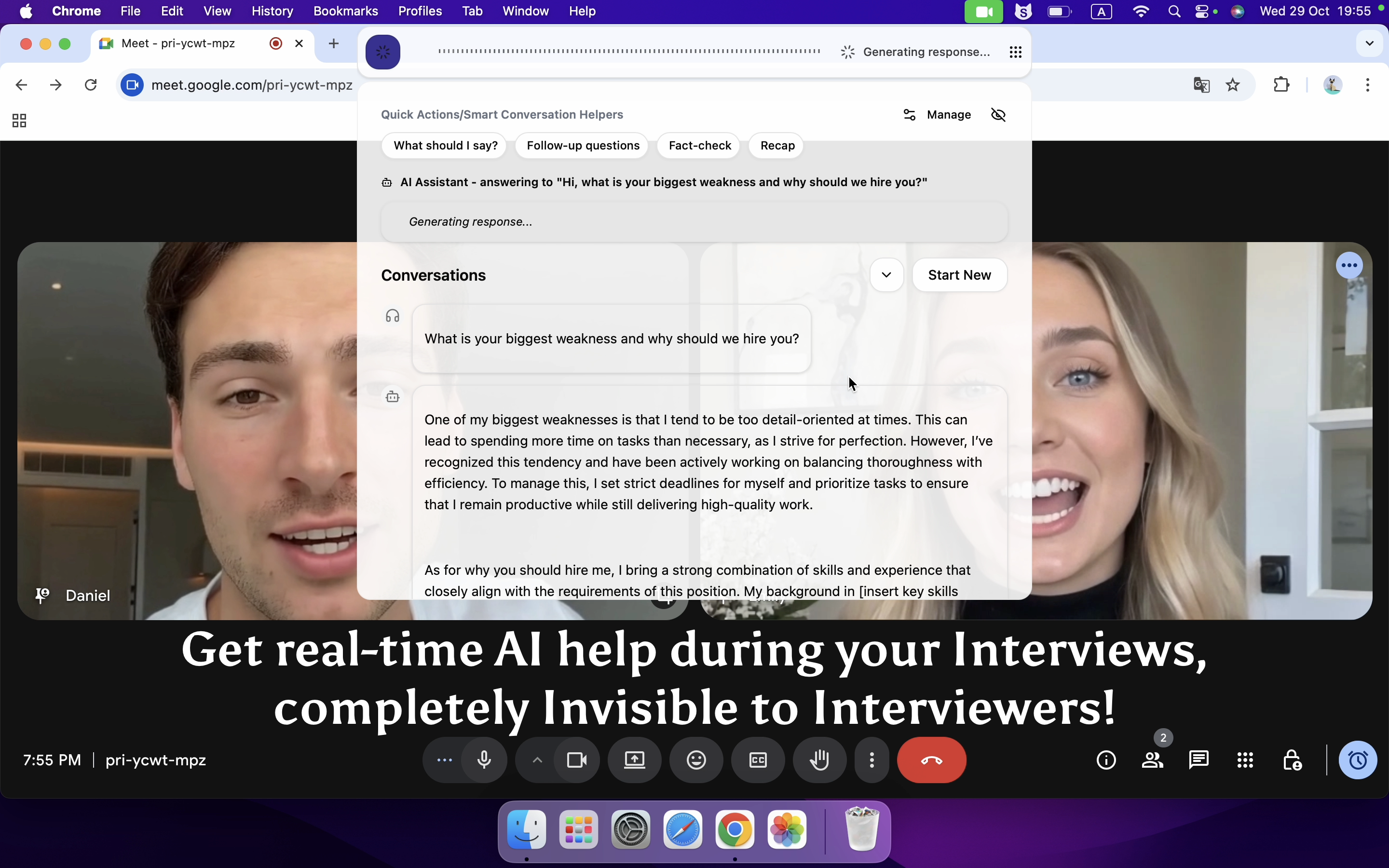
I have to say, Linkjob.ai is really incredibly useful for AI real time interview help. During the interview process, it's completely invisible—even if the interviewer requires screen sharing, the other party can't see at all that I'm using AI.
What Interviewers Look For & Key Points to Include
Mistakes are an inevitable part of any job, but not everyone is good at mitigating them and reflecting on what went wrong. Many candidates have great skills and soft skills, but the real challenge in an interview is showing those abilities to the interviewer, and this is a skill you can develop with the right preparation.
Why Interviewers Ask This
To answer the question well, you first have to understand it. You need to figure out the interviewer's purpose for asking, and then use your response to demonstrate that you have the right qualities and abilities.
Here’s what interviewers look for when they ask behavioral interview questions like this:
They want to see if I can own my failure without blaming others.
They check if I have self-awareness and can talk about my weaknesses.
They look for a growth mindset.
They want to know if I can stay composed under pressure.
They look for emotional intelligence and maturity.
They want to see if I can rebuild trust and solve problems after a setback.
What Makes a Great Answer
Next, you need to provide a strong, structured answer that clearly explains your abilities. You must be honest about the experience you had, but also elaborate on how you solved the problem. And the latter is far more important than the former.
Here’s what I focus on:
I pick a real mistake from work, not something minor or fake.
I explain what happened and what I did to fix it.
I talk about what I learned from the failure and how it changed my approach.
I show humility and keep a positive attitude.
I make sure my answer matches the company’s values.
Structuring Your Interview Answer
Now that you know the key points your answer should include, the next step is to turn them into a structured response. All you need is a clear framework to fill with a compelling story.
Using the STAR Method
The STAR method, which stands for Situation, Task, Action, and Result, is the most suitable framework for this question. This simple structure helps me tell a clear story every time. Here’s how I break it down:
Situation: I set the scene and explain where I was working and what was happening.
Task: I describe what I needed to do or what my responsibility was.
Action: I talk about what I actually did to solve the problem or fix the mistake.
Result: I share what happened because of my actions and try to include numbers or facts if I can.
Using the STAR method helps me avoid vague answers. I focus on real examples and show exactly what I did. Interviewers can see my problem-solving skills and understand how I handle challenges.
Here’s a quick checklist I use before any interview:
I create a list of 8-10 stories from work or school that show leadership, teamwork, or problem-solving.
I structure each story with STAR, keeping my answers short and clear.
I practice my delivery, making sure I sound natural and positive.
This approach helps me structure my answer and makes my examples easy for interviewers to follow.
Choosing the Right Mistake
Picking the right mistake to talk about in behavioral interview questions is just as important as how I tell the story. I always choose a real, work-related mistake that mattered but wasn’t a disaster. I avoid talking about personal issues or mistakes that could make me look careless or untrustworthy.
Here’s what I look for when choosing my example:
The mistake should be something I could fix or learn from.
It should show that I take responsibility and don’t blame others.
I make sure the story matches the job I want.
Common Mistakes to Avoid in Behavioral Interviews | Why They Hurt Your Chances |
|---|---|
Vague or unclear answers | Makes me seem unprepared |
Shifting blame to others | Shows lack of accountability |
Overly rehearsed responses | Feels fake or insincere |
Not showing what I learned | Misses the growth mindset |
Choosing irrelevant examples | Doesn’t match the job |
I always focus on honesty and admit what went wrong and explain what I learned. This shows I have self-awareness and a growth mindset. Interviewers want to see that I can own my mistakes and use them to get better. I also make sure my story lines up with the company’s values and the job requirements.
If you’re wondering how to answer interview questions about mistakes, remember this: honesty, accountability, and relevance matter most.
Answer Template and Sample Answers
Answer Template
Situation: I was a [Your Job Title] working on a [Project Name/Type of Project] for my team. We were on a tight deadline to complete [Project Goal].
Task: My specific responsibility was to [Your Specific Responsibility].
Action: I made a mistake when I [Describe your mistake in a direct and honest way]. This resulted in [Explain the negative outcome].
I immediately [Describe the immediate action you took to fix the problem, e.g., "owned up to the error," "apologized to my team/manager," or "started looking for a solution"].
To prevent this from happening again, I [Describe a concrete solution you implemented, e.g., "created a new checklist," "documented the process," or "scheduled a meeting to clarify the requirements"].
Result: As a result, [Describe the positive outcome of your actions, e.g., "the project was back on track," "the error was fixed," or "the team adopted my new process"]. The most important thing I learned was [State your key takeaway, e.g., "the importance of clear communication," "to double-check my work," or "to ask for help when needed"].
Sample Answer For Finance Job
Situation: Last year, I worked as a junior analyst at a finance firm. We had a tight deadline for a client report.
Task: I was responsible for double-checking all the financial data before we sent the report.
Action: I rushed through the review because I wanted to impress my manager with my speed. I missed a small error in one of the spreadsheets. The client noticed the mistake and emailed us about it. I immediately owned up to the error, apologized to both my manager and the client, and fixed the numbers. I also created a new checklist for myself and the team to make sure we would not miss similar mistakes in the future.
Result: The client appreciated my honesty and quick response. My manager thanked me for taking responsibility. After that, our team’s error rate dropped by 30% because of the new checklist. I learned to slow down and focus on accuracy, not just speed.
Sample Answer For Tech Job
Situation: Last year, I was a junior front-end developer working on a new feature for our company's e-commerce platform.
Task: My task was to build and integrate a new product review section for a tight pre-holiday launch.
Action: I chose to use a third-party animation library to save time but didn't thoroughly test its compatibility with our existing codebase. After the feature was deployed, a user reported that the page would freeze on mobile devices. I immediately took ownership, debugged the issue, and patched the bug with a hotfix. I also created a new checklist for my team to ensure all future third-party integrations are rigorously tested.
Result: The bug was fixed quickly, and my team lead appreciated my honesty and quick response. The new checklist was adopted by the team and has prevented similar issues since. I learned the critical importance of prioritizing code stability and rigorous testing over speed.
Answering Strategies and Tips
Showing Growth
Interviewers want to see more than just the failure. They want to know how I bounced back. When I answer "tell me about a time you failed," I always show how the experience made me stronger.
When I prepare for "tell me about a time you failed," I focus on learning, improvement, and resilience. I want the interviewer to see that every failure story is a chance to grow and show my best self.
Avoid Common Mistakes
Being Too Vague
Interviewers want real stories, not empty phrases. If I just say, "I'm a team player," without sharing a specific example, I miss the chance to show my skills. Vague answers make it look like I am hiding something or that I do not understand the question. They see it as a sign that I might not have real experience or that I am not prepared. Hiring managers notice when someone avoids details.
Dodging Responsibility
Sometimes, I wanted to blame the situation or other people for my failure. I thought this would make me look better, but it actually hurt my chances. Interviewers look for honesty and want to see if I can admit when I am wrong. If I avoid talking about my role in a failure, they see it as a lack of maturity and self-awareness. If I dodge responsibility, I lose credibility and trust.
FAQ
What if I can’t think of a good failure story?
I look back at school projects, internships, or group work. Even small mistakes count if I learned something important. I write down a few examples and practice telling them with the STAR method.
Should I admit if I made a big mistake at work?
Yes, if I learned from it and fixed the problem. I show what I did to make things right. I focus on growth and responsibility. Interviewers respect honesty and want to see how I handle tough situations.