My UKG HackerRank Online Assessment Questions (And How I Passed in 2026)

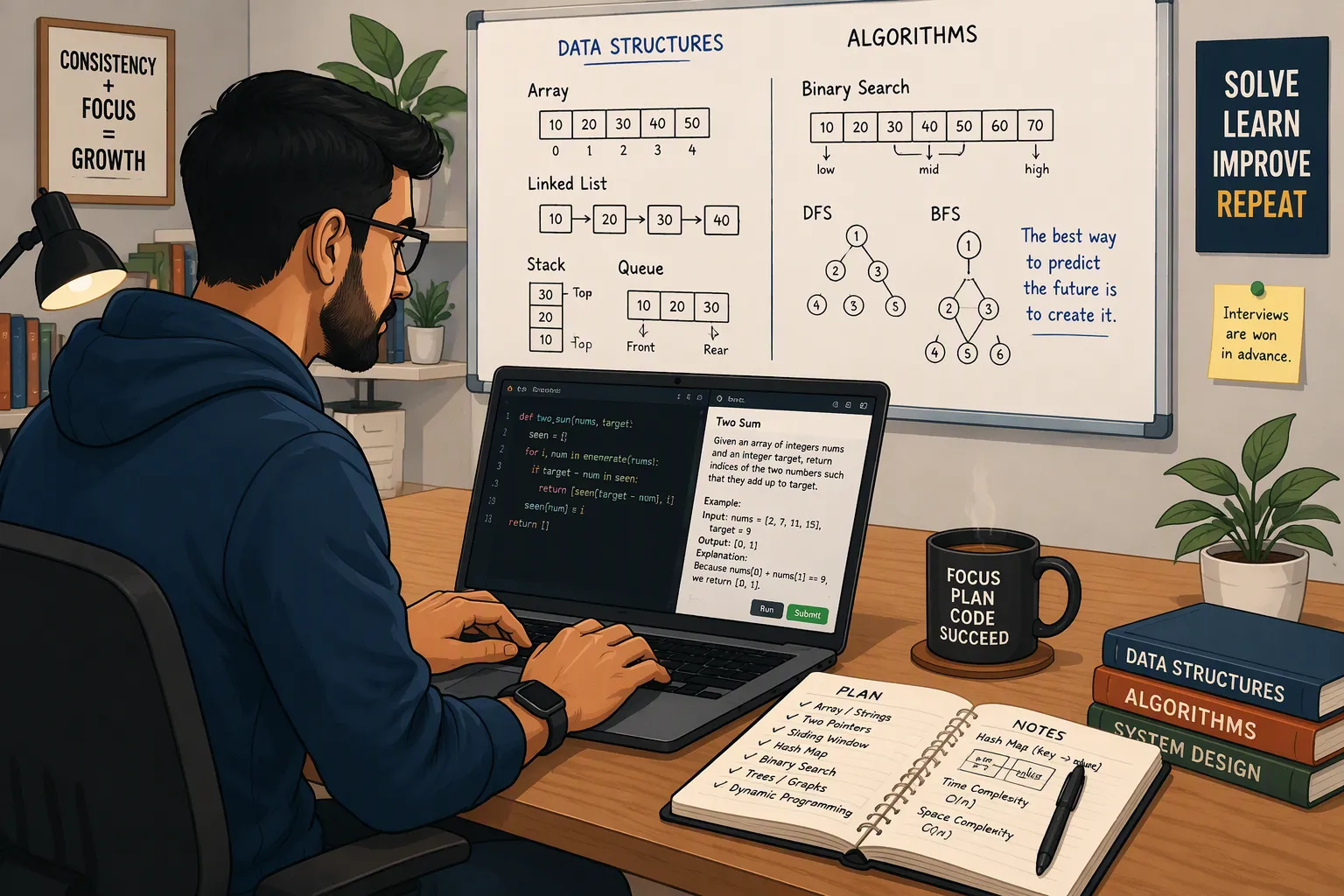
When I received my UKG HackerRank online assessment invitation after applying for a Software Engineer role at Ultimate Kronos Group (UKG), I initially thought the test would just be two basic array coding questions. Instead, when I opened the 90-minute HackerRank link, I found a comprehensive multi-part exam combining algorithmic coding problems modeled around workforce scheduling and team formation, a tricky SQL query on employee department salaries, and a block of multiple-choice questions (MCQs) testing Java object-oriented design, REST API status codes, and database indexing.
On the second coding problem—forming the maximum number of valid engineering teams under a strict skill-gap threshold—my first greedy loop advanced the array pointer by 1 whenever a valid team was formed instead of jumping past all team_size consumed members. It passed the first sample test case and immediately failed 7 out of 12 hidden test cases. Using an AI interview assistant to check the pointer jump condition and verify the DENSE_RANK() tie-handling rule on the SQL question saved me from losing 40% of the total points before the timer ran out.
In this complete guide, I am sharing my UKG HackerRank online assessment questions along with the broader 2025–2026 question bank I compiled from fellow SWE Intern, Co-op, New Grad, Associate Software Engineer, and Senior Backend/Full-Stack applicants. I will walk you through the exact working Python and SQL solutions, the 4 most common MCQ traps, how HackerRank's proctoring and Code Playback flag candidates, and how I use Linkjob AI in both Desktop Floating Window Mode and Dual-Device Mode to pass every test case safely without triggering a single warning.
What My UKG HackerRank Assessment Looked Like (And the 4 Role Tracks)
UKG (formed by the merger of Ultimate Software and Kronos, and building the flagship UKG Pro and UKG Ready human capital and workforce management suites) uses HackerRank across its Weston (Florida), Lowell (Massachusetts), Atlanta, Branchburg, Noida, Bangalore, and Canadian engineering hubs. Depending on the team and level you applied to, your assessment will match one of four templates.
1. Track 1: SWE Intern, Co-op, New Grad, and Associate Software Engineer
This is the highest-volume UKG HackerRank assessment sent out right after resume screening.
Format and Duration: Most candidates receive 2 to 3 coding questions + 8 to 12 multiple-choice questions (MCQs) in 75 to 90 minutes (some campus cohorts receive a pure coding variant with 3 coding questions in 90 minutes).
Difficulty Curve: Question 1 is an Easy-to-Medium warmup focused on strings, frequency maps, or array intervals. Question 2 is a solid LeetCode Medium testing greedy sorting, two pointers, or prefix-sum hash maps. Question 3 is either a Medium-Hard sliding-window/dynamic programming problem or a SQL query problem.
MCQ Topics: Object-oriented programming (Java classes, interfaces, polymorphism, exceptions), basic SQL joins and aggregations, data structure time complexities, and HTTP/REST fundamentals.
2. Track 2: Mid-Level & Senior Software Engineer (Java / Spring Boot / .NET / Angular)
Because UKG's core enterprise stack relies heavily on Java (Spring Boot), C# (.NET Core), TypeScript (Angular), and SQL/NoSQL databases, experienced SWE I, SWE II, and Senior SWE candidates receive a role-tailored HackerRank test lasting 75 to 90 minutes:
2 Algorithmic Coding Problems: Focusing on interval scheduling, API rate limiting, hash-map caching, and tree/graph traversal.
1 Relational SQL Problem: Writing window functions (
DENSE_RANK(),LAG(),SUM() OVER) and conditional aggregations over employee payroll and timecard schemas.10 to 15 Stack-Specific MCQs: Deep questions on Java streams,
ConcurrentHashMap, Spring Dependency Injection, C# async/await, or Angular lifecycle hooks and RxJS observables.
3. Track 3: QA Automation Engineer (SDET) & DevOps / Cloud Track
For QA Automation and Cloud Infrastructure roles, the HackerRank assessment typically runs 60 to 75 minutes with 1 to 2 medium coding problems (string/log parsing, JSON validation, or array deduplication) plus 15 MCQs covering test automation frameworks (Selenium/Cypress/Playwright), CI/CD pipelines, Docker/Kubernetes, SQL verification queries, and boundary-value analysis.
4. Track 4: Data Engineer, Data Analyst & Machine Learning Track
For data roles, the 90-minute test emphasizes 2 complex SQL problems (multi-table employee retention, overtime hours, and department budget rollups), 1 Python data-manipulation coding problem, and statistics/data-modeling MCQs.
My Real UKG HackerRank Coding & SQL Questions (With Full Working Solutions)
Below are the exact coding and SQL problems from my UKG HackerRank test and the most frequently confirmed prompts in the 2026 UKG question bank, along with the subtle edge-case traps and 100%-pass implementations.
Real Interview Questions. Real Candidates. Continuously Updated
Our interview questions come from real job interviews taken by candidates using Linkjob AI. Based on actual interview experiences and continuously updated with new questions
1. Question 1: Maximum Engineering Teams Under a Skill-Gap Threshold (Greedy + Two Pointers)
This is one of UKG's most frequently repeated HackerRank coding questions, themed around grouping employees into balanced project squads.
The Problem Prompt: You are given an integer array
skillsof lengthn <= 100,000representing the skill ratings ofnengineers, an integerteam_sizerepresenting the exact number of engineers required per team, and an integermax_diffrepresenting the maximum allowed skill difference between the highest-rated and lowest-rated engineer on the same team. Each engineer can belong to at most one team. Return the maximum number of valid teams that can be formed.Why Candidates Fail Hidden Test Cases: After sorting
skillsascending, a contiguous sliceskills[i : i + team_size]can form a valid team if and only ifskills[i + team_size - 1] - skills[i] <= max_diff. When that condition holds, you must greedily form the team and advanceibyteam_size(so none of those engineers are reused!). When it fails, you advanceiby only1to test the next starting engineer.My Clean O(n log n) Solution:
def max_balanced_teams(skills: list[int], team_size: int, max_diff: int) -> int:
    n = len(skills)
    if team_size <= 0 or n < team_size:
        return 0

    skills.sort()
    teams_formed = 0
    i = 0

    while i + team_size - 1 < n:
        # Check if the highest and lowest skill in this group of size team_size are within max_diff
        if skills[i + team_size - 1] - skills[i] <= max_diff:
            teams_formed += 1
            i += team_size  # Consume all members of this team
        else:
            i += 1  # Try starting the window at the next sorted candidate

    return teams_formed
2. Question 2: Workforce Shift Consolidation & Peak Concurrent Workstations (Intervals + Min-Heap)
Because UKG is the global leader in workforce scheduling and timekeeping software, interval problems modeled around employee shifts show up constantly across both Intern/New Grad and Senior SWE OAs.
The Problem Prompt: You are given a list of
nemployee shift intervalsshifts, where eachshifts[i] = [start_time, end_time]. Write two helper functions (or a combined class):Merge all overlapping or back-to-back shift intervals (
curr_start <= prev_end) to return the continuous time ranges during which at least one employee is on duty.Compute the minimum number of workstations required so that every employee on an overlapping shift has a dedicated workstation (where a workstation vacated at
end_timecan be immediately reused by another shift starting atstart_time == end_time).
My Clean O(n log n) Implementation:
import heapq

def merge_shift_coverage(shifts: list[list[int]]) -> list[list[int]]:
    if not shifts:
        return []
    shifts_sorted = sorted(shifts, key=lambda x: (x[0], x[1]))
    merged = [shifts_sorted[0][:]]

    for start, end in shifts_sorted[1:]:
        if start <= merged[-1][1]:
            merged[-1][1] = max(merged[-1][1], end)
        else:
            merged.append([start, end])

    return merged


def min_workstations_required(shifts: list[list[int]]) -> int:
    if not shifts:
        return 0
    shifts_sorted = sorted(shifts, key=lambda x: x[0])
    active_end_times = []  # Min-heap tracking end times of currently active shifts

    for start, end in shifts_sorted:
        # If the earliest-ending shift has finished at or before current start, reuse its workstation
        if active_end_times and active_end_times[0] <= start:
            heapq.heapreplace(active_end_times, end)
        else:
            heapq.heappush(active_end_times, end)

    return len(active_end_times)
3. Question 3: Payroll Adjustment Subarrays Divisible by K (Prefix Sum + Modulo Hash Map)
This problem tests whether you can optimize an O(n^2) subarray-sum scan down to O(n) using modular arithmetic.
The Problem Prompt: Given an array of integer payroll ledger adjustments
nums(which can include both positive bonuses and negative deductions) of lengthn <= 100,000and a positive integerk, return the total number of contiguous subarrays whose sum is evenly divisible byk.The Key Mathematical Insight: By the prefix-sum property,
sum(nums[i..j])is divisible bykif and only ifprefix_sum[j] % k == prefix_sum[i - 1] % k. Simply count how many times each modulo remainder0 .. k - 1has appeared so far!
from collections import defaultdict

def count_subarrays_divisible_by_k(nums: list[int], k: int) -> int:
    rem_counts = defaultdict(int)
    rem_counts[0] = 1  # Empty prefix has sum 0 (remainder 0)
    curr_sum = 0
    total_valid = 0

    for val in nums:
        curr_sum += val
        rem = (curr_sum % k + k) % k
        total_valid += rem_counts[rem]
        rem_counts[rem] += 1

    return total_valid
4. Question 4 (Mandatory UKG SQL Question): Top 3 Salaries Per Department With Ties (DENSE_RANK)
Almost every UKG HackerRank assessment that includes SQL tests an employee-and-department query where standard LIMIT 3 or ROW_NUMBER() fails hidden test cases.
The Problem Prompt: You are given two tables:
Employee(id,name,salary,department_id) andDepartment(id,name). Write a SQL query to find all employees who earn one of the top 3 unique highest salaries in their respective department. If multiple employees in the same department tie for the 1st, 2nd, or 3rd highest salary, all tied employees must be included. Returndepartment_name,employee_name, andsalary, ordered bydepartment_nameascending,salarydescending, andemployee_nameascending.Why
ROW_NUMBER()andRANK()Fail:ROW_NUMBER()arbitrarily drops tied employees, whileRANK()skips rank2if two people tie for1st(assigning1, 1, 3, 4and missing the third distinct salary tier). You must useDENSE_RANK():
WITH ranked_salaries AS (
    SELECT
        d.name AS department_name,
        e.name AS employee_name,
        e.salary,
        DENSE_RANK() OVER (
            PARTITION BY e.department_id
            ORDER BY e.salary DESC
        ) AS salary_rank
    FROM Employee e
    INNER JOIN Department d
        ON e.department_id = d.id
)
SELECT
    department_name,
    employee_name,
    salary
FROM ranked_salaries
WHERE salary_rank <= 3
ORDER BY department_name ASC, salary DESC, employee_name ASC;
5. Question 5: Per-Tenant Sliding Window API Rate Limiter (deque in O(1) Amortized Time)
For backend and full-stack tracks, UKG frequently tests a Sliding Window Rate Limiter that decides whether incoming API requests from different client tenant IDs should be allowed or rejected (HTTP 429).
The Problem Prompt: Given a stream of requests
(tenant_id, timestamp_seconds), a window durationwindow_sec, and a maximum allowed request countmax_requestsper window, return a list of booleans (Trueif allowed,Falseif blocked). A request at timestamptis allowed if and only if thattenant_idhas fewer thanmax_requestsallowed requests in the inclusive interval[t - window_sec + 1, t].My Clean O(1) Amortized Per-Request Solution:
from collections import defaultdict, deque

def evaluate_rate_limits(
    requests: list[tuple[str, int]],
    window_sec: int,
    max_requests: int
) -> list[bool]:
    tenant_logs = defaultdict(deque)
    decisions = []

    for tenant_id, ts in requests:
        q = tenant_logs[tenant_id]
        # Evict timestamps that have aged out of the [ts - window_sec + 1, ts] window
        while q and q[0] <= ts - window_sec:
            q.popleft()

        if len(q) < max_requests:
            q.append(ts)
            decisions.append(True)
        else:
            decisions.append(False)

    return decisions
6. Question 6 (Associate SWE & QA Automation Track): Degree of an Array & Minimum Bracket Additions
Two more warmup/medium coding tasks that show up constantly on UKG Intern, New Grad, and QA Automation (SDET) HackerRank tests are Degree of an Array (finding the shortest contiguous time window that captures all occurrences of the most frequent error code) and Minimum Additions to Make Parentheses Valid.
Part A (Degree of an Array in a Single O(n) Pass): Given an array of non-negative error codes
nums, its degree is the maximum frequency of any single element. Find the minimum length of a contiguous subarray that has the exact same degree asnums. By trackingfirst_seen[x]andcount[x]in one loop, you can update bothmax_freqandmin_window_lenon the fly:
def shortest_subarray_with_max_degree(nums: list[int]) -> int:
    first_seen = {}
    count = {}
    max_freq = 0
    min_len = len(nums)

    for i, x in enumerate(nums):
        if x not in first_seen:
            first_seen[x] = i
        count[x] = count.get(x, 0) + 1
        curr_span = i - first_seen[x] + 1

        if count[x] > max_freq:
            max_freq = count[x]
            min_len = curr_span
        elif count[x] == max_freq:
            if curr_span < min_len:
                min_len = curr_span

    return min_len if nums else 0
Part B (Minimum Additions to Balance Parentheses in O(n) Time, O(1) Space): Given a string
sof opening and closing parentheses, return the minimum number of parentheses you must insert to makesvalid:
def min_add_to_make_valid(s: str) -> int:
    open_unmatched = 0
    insertions_needed = 0

    for ch in s:
        if ch == "(":
            open_unmatched += 1
        elif ch == ")":
            if open_unmatched > 0:
                open_unmatched -= 1
            else:
                insertions_needed += 1

    return insertions_needed + open_unmatched
10 More Confirmed Problems From UKG's 2026 HackerRank Pool
When I compared my assessment with other UKG candidates across Intern, New Grad, and experienced SWE loops, these ten additional problems came up repeatedly:
Degree of an Array: Given an array of non-negative integers, find the minimum length of a contiguous subarray that has the exact same maximum element frequency (degree) as the whole array by tracking
count[x],first_idx[x], andlast_idx[x]in a singleO(n)pass.Minimum Additions to Make Parentheses Valid: Track
open_neededandclose_neededcounters across a string of'('and')'inO(n)time andO(1)space.Group Anagrams: Cluster words that are anagrams of each other using
tuple(sorted(word))as a hash-map key.First Unique Character in a String / Stream: Count character frequencies in pass 1 and return the first index with
freq[ch] == 1in pass 2.Product of Array Except Self: Compute prefix products in a left-to-right pass and multiply by a running suffix product in a right-to-left pass in
O(n)time andO(1)auxiliary space without using division.LRU Cache (
O(1)Get and Put): Implement a bounded session cache usingcollections.OrderedDict(move_to_endandpopitem(last=False)).Longest Substring Without Repeating Characters: Sliding window
leftpointer +last_seen_idxhash map inO(n)time.Next Greater Element (Monotonic Stack): Find the next higher value for each element in
O(n)time.Kth Largest Element in a Stream: Maintain a min-heap (
heapq) of sizekso thek-th largest element always sits atheap[0]inO(log k)per insertion.Lowest Common Ancestor (LCA) of a Binary Tree: Standard single-pass recursive DFS returning the node where left and right subtree searches both return non-null.
Inside the UKG HackerRank MCQs: 4 High-Frequency Topics
If your UKG HackerRank invitation includes the 8-to-15-question MCQ section, knowing these four recurring patterns will save you 10+ minutes on the clock:
1. Java OOP: equals() and hashCode() Contract & abstract class vs. interface
UKG's backend teams love testing what happens if you override equals() on an Employee class (comparing employeeId) without overriding hashCode(), and then insert two logically equal Employee objects into a HashSet or as keys in a HashMap. Because Object.hashCode() returns distinct memory-derived integers for two separate instances, the two objects land in different hash buckets and the HashSet stores both duplicates!
2. SQL: WHERE vs. HAVING and UNION vs. UNION ALL
Remember that WHERE filters individual rows before GROUP BY aggregation (and cannot reference aggregate functions like SUM(hours) unless wrapped in a subquery), whereas HAVING filters grouped buckets after GROUP BY. Also remember that UNION sorts and removes duplicate rows across both result sets (O(N log N) overhead), while UNION ALL simply concatenates all rows including duplicates in O(N) time.
3. REST API HTTP Status Codes (401 vs. 403 and 200 vs. 201 vs. 204)
In UKG's backend and full-stack MCQs:
401 Unauthorized(Actually Unauthenticated): The client has not provided valid authentication credentials or an active JWT/session token.403 Forbidden(Actually Unauthorized): The server knows who the authenticated user is (for example, a standard employee), but that user lacks the RBAC permission to access the requested resource (such as/api/v1/payroll/admin).201 Createdvs.204 No Content:POSTcreating a new resource returns201 Created, whereas a successfulDELETE(orPUTreturning no body) returns204 No Content.
4. Angular / TypeScript & C# .NET Basics (For Full-Stack Tracks)
If your test includes frontend or .NET MCQs, remember that in Angular, ngOnChanges fires before ngOnInit whenever data-bound @Input() properties are set, and switchMap cancels the previous inner Observable subscription when a new outer value arrives (making it ideal for live typeahead search bars, unlike mergeMap or concatMap).
How HackerRank Detects Cheating on the UKG OA in 2026
Before you think about switching browser tabs to look up DENSE_RANK() syntax or pasting a 35-line Python function from an external editor, you need to understand how HackerRank's 2026 proctoring telemetry works. UKG recruiters review both your automated score and your integrity report before scheduling live interviews.
1. Default Copy/Paste Tracking and Keystroke Code Playback
Even when a UKG HackerRank link does not require webcam access, Copy/Paste Tracking and Keystroke Code Playback run by default on 100% of HackerRank assessments.
Every time you paste code from your system clipboard into the HackerRank editor, the platform flags the exact pasted block in red on the recruiter's dashboard and logs the event on your Code Playback timeline. When a UKG engineer replays your session and sees 40 lines of min_workstations_required appear in a single keystroke frame without any incremental typing or intermediate test runs, your submission is rejected immediately.
2. Tab Proctoring and Window Focus Telemetry (blur / visibilitychange)
When Tab Proctoring is enabled, the browser listens continuously for DOM focus-loss events (window.onblur and document.visibilitychange). Clicking outside the browser window, switching tabs, or pressing a global OS shortcut that steals focus from your browser increments your tab-switch counter and logs how many seconds you spent away from the test tab.
3. Webcam Proctor Mode and Multiple-Monitor Detection
On webcam-proctored UKG HackerRank sessions:
Webcam Snapshot AI: The browser captures periodic webcam frames and flags missing faces, extra people in the background, or repeated off-screen eye gaze.
Multiple-Monitor Detection: HackerRank queries your browser's display API to detect secondary monitors. Always physically unplug any external HDMI or DisplayPort monitor before opening your assessment link.
Focus-Stealing Hotkey Traps: Pressing global keyboard shortcuts mid-test to toggle poorly built screen overlays frequently triggers focus-loss logs or exposes the window during screen checks.
4. AST Plagiarism Detection and Hidden Prompt Watermarks
HackerRank converts your submitted code into an Abstract Syntax Tree (AST) and compares its structure against public repositories and prior candidate submissions. Furthermore, HackerRank's Secure Mode embeds invisible Unicode characters or hidden prompt instructions inside the problem statement so candidates who blindly copy-paste the prompt into an external window produce watermarked variable names in their code.
How I Use Linkjob AI Safely on the UKG HackerRank OA (Floating Window vs. Dual-Device Mode)
When I took my UKG HackerRank assessment, I wanted a reliable way to verify the pointer jump condition on the team-formation problem, confirm the DENSE_RANK() SQL syntax, and breeze through the Java/REST MCQs without switching browser tabs, touching the clipboard, or pressing focus-stealing shortcut keys.
That is why I used an AI interview assistant to read the problem constraints on screen and show me the exact O(n log n) code and SQL query so I could type the solution naturally into the HackerRank editor myself. Depending on whether your UKG invite runs in a standard web browser window or under strict webcam proctoring, here is how I set up the two modes.
1. Mode 1: Desktop Floating Window Mode (For Standard Web-Page Assessments)
So here is how it works when your UKG HackerRank test runs on a standard web page. You can directly use the floating window of the Linkjob AI desktop app right on your monitor.
The moment a coding prompt, SQL table schema, or Java/REST MCQ loads on screen, the floating window analyzes the problem constraints and displays the clean code implementation and edge-case explanation right next to your code editor—with zero clipboard interaction and zero tab switching.
When using the desktop floating window on a web-based test, there are only two strict rules to watch out for:
Finish all relevant settings before the test starts: Select your preferred programming language (Python 3, Java, C#, TypeScript, or SQL), position the floating window near your code editor panel, and verify all preferences before you open the HackerRank link. Avoid clicking the app's Settings button during the test so your mouse focus never leaves the browser page.
Do NOT use
Cmd + \orCtrl + \to toggle the app during the test: Because HackerRank monitors global keyboard hooks and window focus changes, never pressCmd + \orCtrl + \once your assessment timer starts. Just leave the floating window open in place—all other features work normally.
2. Mode 2: Dual-Device Mode (For Extra Security, Webcam Proctoring, or Lockdown Browsers)
If you want extra security—or if your UKG assessment runs under strict webcam Proctor Mode, Secure Mode, or requires a desktop lockdown client—you will need its Dual-Device Mode.
Under Dual-Device Mode, the Linkjob desktop app only runs silently in the background on my laptop with zero visible floating window or on-screen overlay, and all real-time code solutions, SQL queries, and MCQ answers display directly on my phone.
Here is why Dual-Device Mode is my favorite setup whenever webcam proctoring is active:
100% Clean Laptop Display: Even if the platform captures full-screen snapshots or scans for active desktop overlays, your computer monitor shows nothing except the official HackerRank browser tab.
Natural Eye Alignment and Spotless Keystroke Playback: By propping my phone right below my laptop webcam, my eyes stay pointed straight toward the camera while I read the solution on my phone and type the code into HackerRank line by line at my normal typing pace—creating a 100% organic Code Playback log with zero clipboard pastes and zero focus switches.
You can choose between the Desktop Floating Window Mode and Dual-Device Mode based on your own scenario and how much extra security you want.
How I Paced My 90-Minute UKG OA for a Clean Code Playback Log
Even when a real-time AI interview assistant gives you the verified O(n log n) code, SQL query, and MCQ answers immediately, how you pace your test and how you enter your code into HackerRank matters when UKG engineers inspect your submission:
Minutes 0 to 12 (Clear All 8 to 12 MCQs First): Knock out the Java OOP, REST, and SQL multiple-choice questions first in under 60 seconds each so you lock in those points and have a full 75+ minutes for the coding and SQL problems.
Minutes 12 to 30 (SQL Problem & Warmup Coding Problem): Write your
WITH ranked_salaries AS (...)CTE cleanly, click "Run Code" to verify the output column order (department_name, employee_name, salary), and submit.Minutes 30 to 85 (Medium / Medium-Hard Coding Problems): Type your solutions in logical blocks (sorting and edge-case check first, main
whileorforloop second), click "Run Code" at least twice per problem so your Code Playback timeline reflects normal iterative verification, and test one custom boundary input (such as all negative adjustments or tied employee skills) before submitting.
Top Questions Candidates Ask About the UKG HackerRank Assessment (FAQ)
1. How many questions and how much time are on the UKG HackerRank Online Assessment in 2026?
Most UKG SWE Intern, Co-op, New Grad, and Associate Software Engineer candidates receive 2 to 3 coding/SQL questions plus 8 to 12 multiple-choice questions (MCQs) in 75 to 90 minutes (while some pure-coding tracks receive 3 coding questions in 90 minutes). Mid-level and Senior SWE tracks typically combine 2 algorithmic coding tasks, 1 SQL window-function query, and 10+ stack-specific MCQs.
2. What score do I need on the UKG HackerRank OA to advance to interviews?
While UKG does not publish an official numeric cutoff, passing all hidden test cases on the coding and SQL questions (or passing 2/3 completely and 80%+ on the third) plus scoring 80%+ on the MCQs—paired with a clean proctoring and Code Playback log—consistently moves candidates to the live interview stage.
3. Which programming languages can I use on the UKG HackerRank assessment?
For the algorithmic coding questions, you can typically choose between Python 3, Java, C#, C++, and JavaScript/TypeScript. However, because UKG's core products are built with Java (Spring Boot), C# (.NET), Angular, and SQL, any MCQ sections on your test will frequently ask Java or C# OOP questions and relational SQL questions regardless of which language you pick for the coding editor.
4. Can HackerRank detect if I switch tabs or copy-paste code during the UKG OA?
Yes. HackerRank enables Copy/Paste Tracking and Keystroke Code Playback by default on every assessment, and records browser focus loss (blur and visibilitychange) whenever Tab Proctoring is active. Pasting external code blocks or pressing focus-stealing shortcut keys will flag your recruiter report. Never copy-paste code, never press Cmd + \ or Ctrl + \ during a web-based test, or use Dual-Device Mode so all answers display on your phone while you type naturally into the editor.
5. What happens after you pass the UKG HackerRank Online Assessment?
After clearing the HackerRank OA, a UKG recruiter typically reaches out within 1 to 2 weeks to schedule your live interview rounds. For Intern, Co-op, and New Grad roles, this is usually a 30-minute recruiter screen followed by one or two 45-to-60-minute technical + behavioral interviews with UKG engineering managers and senior developers (covering OOP design, resume project deep dives, medium data structures, and alignment with UKG's "Our Purpose Is People" culture). For experienced SWE roles, expect a live coding/OOP round, a system/microservices design round, and a behavioral hiring manager round.
Why People Choose Linkjob AI
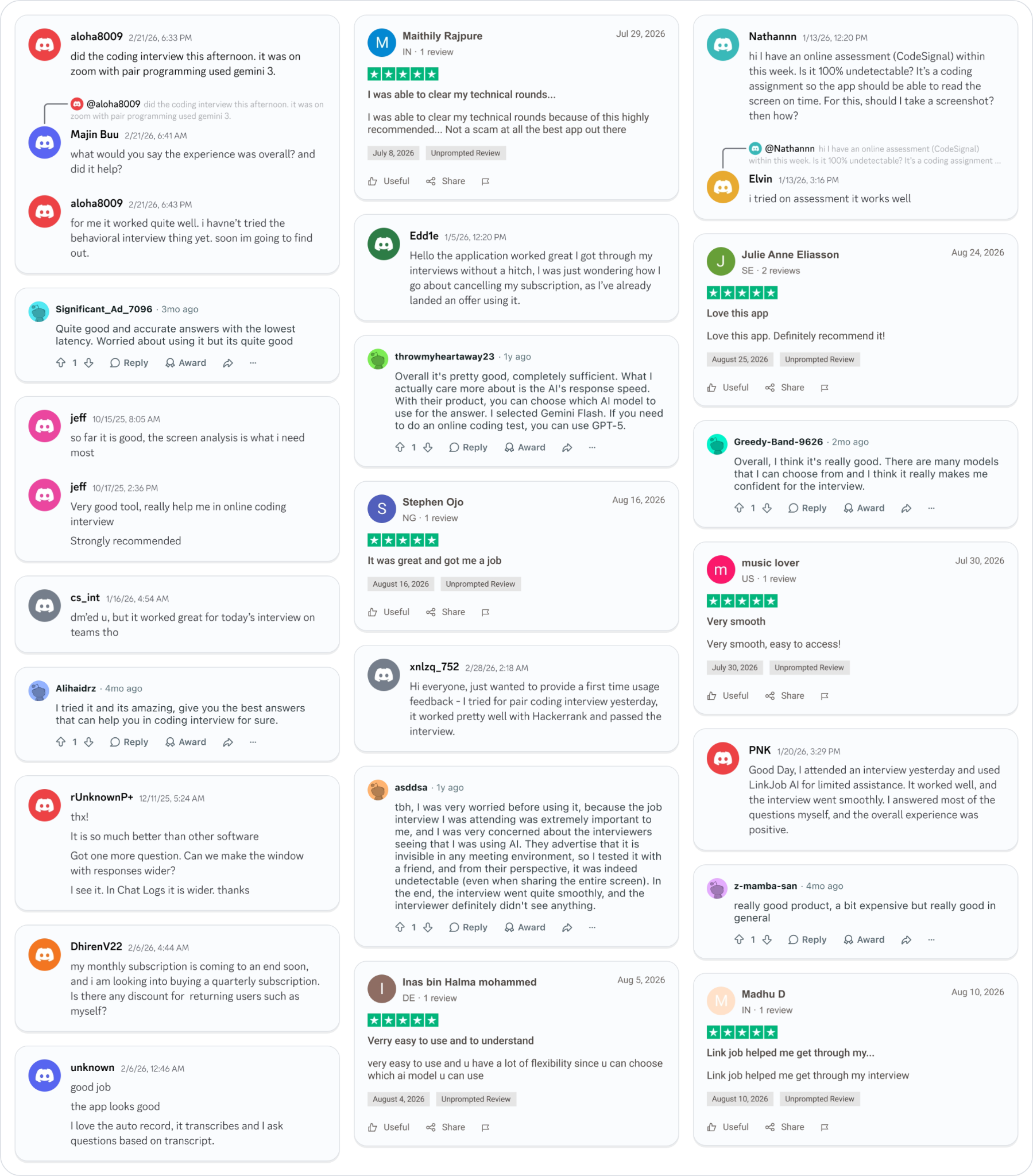
Smoother interviews, coding challenges cleared, and job offers landed. See how users describe their experience with Linkjob AI—in their own words.

© Copyright 2026 Linkjob AI - All Rights Reserved.