Veeva Systems Interview Questions: Coding, Cases, and How I Answer

Veeva Systems Interview Questions Asked in Real Interviews
Real Interview Questions. Real Candidates. Continuously Updated
Our interview questions come from real job interviews taken by candidates using Linkjob AI. Based on actual interview experiences and continuously updated with new questions
HTTP and REST APIs
What is the difference between PUT and PATCH HTTP methods?
Can you use the HTTP PUT method to create a new resource?
What is the purpose of the HTTP POST method?
What are the common HTTP status codes and what do they represent?
What does an HTTP 500 internal server error indicate, and how do you troubleshoot it?
Software Testing and Version Control
What is the difference between white-box and black-box testing?
What version control tools and workflows do you use for your projects?
Cloud Computing and Data Storage
What is AWS EC2 and what are its instance types?
What is AWS S3 and what is it used for?
What is a data lake and its key characteristics?
Cybersecurity
What is the Cyber Kill Chain and its seven phases?
Behavioral Questions
What type of work environment helps you do your best work?
How do you approach learning a new technology or tool?
Veeva Systems Interview Questions: How I Cracked the 2026 Hiring Loop
If you show up to a Veeva technical screen expecting to breeze through a dynamic programming problem in Python, or if you treat their Associate Consultant case study like a generic management consulting profitability prompt, you will get cut before the final Team Day.
Over the course of my own interview loop, I mapped out every question pattern Veeva actually uses across technical, consulting, and product tracks. I also tested what works under real-time pressure, including how I configured Linkjob AI during my live coding and behavioral rounds so I never blanked on Java syntax or FDA compliance edge cases while sharing my screen.
Why Most Candidates Fail Veeva Systems Interview Questions Before Round Two
Before you look at a single coding prompt or behavioral rubric, you need to understand what makes Veeva Systems an outlier in the tech market. Headquartered in Pleasanton, California, with major engineering and consulting hubs in Columbus (Ohio), Toronto, Boston, and Europe, Veeva is the dominant vertical SaaS provider for the global life sciences industry. With more than 1,550 life sciences customers, over $3.19 billion in annual revenue, and the majority of top 20 global biopharmaceutical companies committed to its proprietary Vault CRM and Vault Platform, Veeva operates with high profitability and a very specific hiring bar.
Because Veeva builds regulated cloud software for clinical trials, pharmacovigilance, quality management, and commercial pharma teams, their interview process is built around four rigid filters that trip up unprepared applicants:
Strict Java-First Engineering Culture: Unlike generalist tech firms that let you interview in whatever language you prefer, Veeva's backend runs overwhelmingly on Java. Countless candidates fail the hiring manager technical screen simply because they practiced algorithms in Python and froze when forced to write idiomatic Java Object-Oriented Programming (OOP) classes, custom exceptions, and
java.timedate manipulations live.Automated Rembrandt Personality Screening: Before a human recruiter even reads your resume for many entry-level and Generation Veeva tracks, an automated system sends you the Rembrandt Advantage personality and aptitude assessment. Answering inconsistently across forced-choice questions gets your application silently filtered out.
Chronological Resume Interrogations and 3 Mandatory References: Veeva does not just ask for two casual STAR stories. In the final stages—and often right after the initial screen—they require three professional references and conduct a deep chronological walkthrough of your work history, probing why you left roles and how you handled manager friction.
Regulated Domain Stakes (GxP and 21 CFR Part 11): Even if you have zero pharma background, interviewers evaluate whether you grasp that a software bug at Veeva does not just break a social feed—it can corrupt an FDA audit trail, invalidate an electronic signature under 21 CFR Part 11, or delay a clinical trial
Veeva Systems Interview Questions Breakdown by Stage and Timeline
The typical Veeva hiring timeline runs 3 to 5 weeks from application to offer, though scheduling the multi-hour "Team Day" and reference calls can make the process feel intense. Here is how the stages break down across Veeva's three primary hiring tracks:
Track 1: Software Engineer & Associate SWE (EDP)
Stage 1 (Automated Filter): 30-minute Rembrandt Personality and Cognitive Assessment sent automatically after applying.
Stage 2 (Recruiter Screen): 30-minute video call covering "Why Veeva", your 5-year career plan, a chronological resume walkthrough, and compensation expectations.
Stage 3 (Technical Gate): Online Assessment (CodinGame or HackerRank with 3 questions, including Java OOP) followed by a 45-to-60-minute Hiring Manager live Java screen.
Stage 4 (Team Day Final Loop): 3 to 5 back-to-back interviews consisting of 2 Java coding rounds, 1 Vault-flavored system design or concurrency round, and 1 to 2 team and behavioral chats.
Stage 5 (Reference & Offer): 3 professional references verified, followed by a 30-minute post-interview candidacy call to present the offer.
Track 2: Associate Consultant (CDP) & Business Consulting
Stage 1 (Automated Filter): Rembrandt Personality Assessment triggered right after application submission.
Stage 2 (Recruiter Screen): 30-minute behavioral video interview testing consulting motivation, client travel readiness, and long-term trajectory.
Stage 3 (Case Gate): 60-minute behavioral and domain interview, followed by the Candidate Exercise (a practical SaaS implementation case study with 3 days to prepare).
Stage 4 (Team Day Final Loop): Live Case Presentation, stakeholder roleplay Q&A, and back-to-back executive and team fit interviews.
Stage 5 (Reference & Offer): Verification of 3 professional references and final leadership sign-off.
Track 3: QA / SDET & Veeva Vault Technical Roles
Stage 1 (Automated Filter): Rembrandt Assessment plus technical resume screening.
Stage 2 (Recruiter Screen): 30-minute HR video call covering Software Testing Lifecycle (STLC) background, Vault familiarity, and role alignment.
Stage 3 (Technical Gate): Live Java coding on CoderPad paired with Selenium/Cucumber test automation, SQL query optimization, or Vault lifecycle configuration.
Stage 4 (Team Day Final Loop): 3 to 4 rounds covering test architecture, edge-case debugging, database validation, and cultural alignment.
Stage 5 (Reference & Offer): Reference check and location-adjusted compensation package.
Stage 1: The Rembrandt Personality Test and Initial Veeva Systems Interview Questions
One of the most common questions candidates have right after applying is: What is the Rembrandt test actually measuring, and how do you avoid getting auto-rejected?
When I took the 30-minute assessment right after submitting my application, I noticed it combines rapid-fire cognitive pattern matching with forced-choice personality statements. You are frequently given blocks of statements where none of the options look appealing, or where two options seem equally corporate-friendly, and you must pick "Most Like Me" and "Least Like Me."
Here is the real mechanism behind the Rembrandt filter and how to pass it:
Consistency Over "Faking Perfect": The assessment tracks internal contradiction (consistency versus backtracking). If you select "I thrive best when collaborating in large group settings" on Question 8, and then select "I prefer independent deep work over group consensus" on Question 42 because the other choices looked worse, the system flags your profile for low reliability.
Role-Weighted Scoring Curves: If you are applying for the Engineering Development Program (EDP) or Software Engineering, the rubric weights analytical persistence, ownership, and structured rule-following. If you are applying for the Consultant Development Program (CDP) or Commercial Sales, it weights consultative assertiveness, comfort with ambiguity, and client-facing stamina.
How I Passed It: Before starting the timer, I locked in a single, specific persona anchored to Veeva's four core values (Do the Right Thing, Customer Success, Employee Success, Speed). Whenever a forced-choice question pitted "moving fast and taking ownership" against "waiting for formal consensus," I consistently chose ownership paired with strict ethical compliance.
Stage 2: Recruiter and Hiring Manager Veeva Systems Interview Questions
If you clear the Rembrandt filter, a university recruiter or technical recruiter schedules a 30-minute video call (not an audio-only phone call—expect camera-on from round one).
Do not treat this as a casual vibe check. There are two very specific landmines during the recruiter and hiring manager screens:
Applying to Multiple Roles Simultaneously: Have a crystal-clear understanding of the specific role you applied for and why you want to join Veeva in that exact track. Never apply to five different positions at once. Veeva recruiters check your application dashboard during the call and view shotgun applications across SWE, PM, and Consulting as a lack of conviction.
Pushing Competing Deadlines Too Early: Candidates who aggressively use competing offers or tight deadlines to rush the recruiter screen often get a cold reception. Veeva prides itself on low attrition and long expected tenure; if you sound like you are using them purely as a negotiation lever, they will cut the process short.
Stage 3: Online Assessment (OA) and Live Coding Veeva Systems Interview Questions
For technical tracks, Stage 3 splits into an Online Assessment (often hosted on CodinGame, HackerRank, or a proctored browser test) followed by a 45-to-60-minute live technical interview with a hiring manager or senior engineer on CoderPad or an IDE.
During the OA, you typically get 3 problems: two easy-to-medium data structures or string manipulation tasks and one heavier Object-Oriented Programming (OOP) design problem. In the 60-minute live screen, the first 20–25 minutes cover resume deep-dives and behavioral questions, and the remaining 35–40 minutes require you to write working Java code, complete a partially implemented class, or debug a file-scanning script while narrating your thought process.
Stage 4: Team Day, Reference Checks, and Final Veeva Systems Interview Questions
The final stage of the loop is Company Team Day. Depending on your track, this is a 2-to-4-hour virtual or onsite block featuring 3 to 5 back-to-back interviews. You will meet peers, engineering managers, directors, and cross-functional partners.
If you perform well on Team Day, the recruiter asks for three professional references before extending a formal written offer, followed by a 30-minute post-interview candidacy call to walk through your offer details.
Real Software Engineer Veeva Systems Interview Questions (Java, OOP & SQL)
Let's get into the exact technical Veeva Systems interview questions you will encounter. If you are used to memorizing standard algorithm solutions in Python, pay close attention: Veeva favors practical Object-Oriented Programming (OOP), string parsing, date/time manipulation, file I/O, and SQL query optimization over esoteric graph theory.
Java OOP Veeva Systems Interview Questions: The Animal Shelter Queue Problem
One of the most frequently tested OA and live coding Veeva Systems interview questions for Associate Software Engineer and mid-level SWE roles is the Animal Shelter OOP problem.
The Prompt:
"Design an Animal Shelter management system in Java that houses Dogs and Cats. However, unlike a standard FIFO shelter, this shelter needs to support multiple adoption rules: customers can adopt the animal that arrived earliest (adoptByArrival()), adopt the oldest animal by biological age (adoptByAge()), or filter adoptions by species (Dog vs. Cat). Implement the class hierarchy, state how you handle tie-breakers if two animals arrived at the exact same timestamp, and analyze the time complexity of each operation."
Why Candidates Fail This Question:
Most candidates recognize the classic Animal Shelter queue and immediately code two LinkedList queues. Then the interviewer (or the OA test suite) hits them with the Veeva twist: What happens when a customer asks for the oldest animal by biological age, and then the next customer asks for the animal with the earliest arrival time? If you remove an animal from your age-based PriorityQueue, how do you avoid an O(N) linear scan to remove that same animal from your arrival-based queue?
How I Solved It (Java Architecture):
To achieve O(log N) insertions and O(log N) (or amortized O(1) lazy deletion) across both arrival order and biological age without corrupting state:
Define an
abstract class Animalencapsulatingfinal String id,final String name,final double biologicalAge,final long arrivalOrder, and aboolean adoptedflag (for lazy deletion).Create concrete subclasses
Dog extends AnimalandCat extends Animalto satisfy Veeva's OOP grading rubric (they specifically grade encapsulation, inheritance, and polymorphism).Maintain dual
PriorityQueue<Animal>(orTreeSet<Animal>) structures per species: one ordered byComparator.comparingLong(Animal::getArrivalOrder)and another ordered byComparator.comparingDouble(Animal::getBiologicalAge).reversed().thenComparingLong(Animal::getArrivalOrder).When an animal is adopted from either structure, flip
animal.markAdopted(). On subsequentpoll()calls on the secondary heap, run awhile (!heap.isEmpty() && heap.peek().isAdopted()) { heap.poll(); }cleanup loop.
Notice the explicit null check and IllegalArgumentException in the constructor. Veeva interviewers frequently ask: "Do you have experience writing a custom exception in Java?" Throwing domain-specific custom exceptions (like EmptyShelterException extends RuntimeException) during your live coding session scores immediate bonus points with Veeva's Java engineers.
String and Algorithm Veeva Systems Interview Questions: Count and Say, Palindromes & Anagrams
When it comes to pure algorithm rounds, Veeva's coding prompts show a heavy concentration around String manipulation and Hash Map frequency counting:
Count and Say (Medium, High-Frequency String Question):
Prompt: Given a positive integer
n, generate then-th term of the count-and-say sequence using run-length encoding (RLE) of the previous string.Veeva Follow-Up: In Java, if you concatenate strings inside a loop using
result += count + "" + char, you create quadratic string copies in the String Pool. You must useStringBuilderand explicitly state that time complexity is O(N * L) where L is the maximum length of the generated sequence, and space complexity is O(L).
String Palindromes and Valid Anagram (Easy/Medium Warmups):
Prompt: Interviewers frequently use variations of Valid Anagram and Palindrome partitioning—often with a regulated-document twist, such as normalizing Unicode clinical document titles or ignoring punctuation and case in metadata tags.
Wordle / Countdown File-Based Game Exercise:
Prompt: Several candidates receive a hands-on assignment involving file-based Wordle or Countdown word-matching games where you must complete a function inside an existing multi-class Java codebase and handle dictionary lookups efficiently using a
Trieor character frequency bitmask.
File-Scanning, Concurrency, and Date/Time Veeva Systems Interview Questions
Two of the most revealing technical prompts highlight how Veeva tests practical backend engineering rather than textbook puzzles:
The "Best Friend by Location & Timestamp" OOP Problem:
"Design an object-oriented program to find a user's 'best friend' based on how long each person spent in the same location. You must parse timestamps and evaluate overlapping intervals using Java Date and Time functions, then rank the strongest connection."
How to Prepare: Brush up on
java.time.LocalDateTime,java.time.Instant, andjava.time.Duration.between(start, end). To compute overlapping time intervals between User A and User B at the samelocationId, sort intervals by start time and calculate overlap asMath.max(0, Duration.between(maxStart, minEnd).toMinutes()).
File-Scanning Script and Worker Request Assignment:
In this 60-minute screen, you are asked to review and extend a script that scans directories of files, clarify ambiguous requirements before writing code, and discuss thread safety and concurrency (ExecutorService,ConcurrentHashMap, and producer-consumer queues) when assigning incoming document processing requests across worker nodes.
SQL, QA Automation, and SDET Veeva Systems Interview Questions
Whether you are interviewing for Backend SWE, Data Engineering, or QA/SDET, expect hands-on database and testing prompts:
2nd Highest Salary & Top Three Salaries per Department (
DENSE_RANK): Write a query usingDENSE_RANK() OVER (PARTITION BY department_id ORDER BY salary DESC)rather thanROW_NUMBER()so ties in compensation are not arbitrarily dropped.Slow SQL Query Optimization: Interviewers give you a slow multi-join query against a massive
documentsandaudit_trail_eventstable and ask how you would diagnose and fix it. Walk through runningEXPLAIN ANALYZE, replacing correlated subqueries with indexed joins, adding a composite index on(tenant_id, document_id, created_at DESC), and avoiding leading-wildcardLIKE '%term%'predicates that force full table scans.QA / SDET Automation and STLC Questions: Do not assume a QA Engineer loop will bypass coding. You will face live Java coding challenges alongside questions on the Software Testing Lifecycle (STLC), explaining the "why" behind choosing API-level regression tests over brittle UI tests in Selenium and Cucumber (BDD), and validating regulated Vault state transitions where a single missed negative test case could allow an unapproved clinical document to be viewed by external partners.
System Design and Veeva Vault Interview Questions (Multi-Tenant SaaS & 21 CFR Part 11)
For mid-level, senior, and staff engineers—as well as Vault Administrators, Vault Developers, and Technical Consultants—the system design and platform depth rounds are where offers are won or lost. Veeva will not ask you to design Twitter or a generic URL shortener. Instead, their system design Veeva Systems interview questions revolve around Veeva Vault—regulated document management, multi-tenant isolation, workflow engines, and FDA compliance.
Document Versioning and Append-Only Audit Trail Veeva Systems Interview Questions
Sample Question:
"Design a regulated document version control system with immutable audit trails that satisfies FDA 21 CFR Part 11 and ALCOA+ data integrity standards. How do you handle concurrent edits, minor vs. major versions, and inspection exports?"
How to Structure a Winning Answer:
Major vs. Minor Versioning & Check-In/Check-Out: Explain how Veeva Vault tracks minor versions (
0.1,0.2) during theDraftandIn Reviewlifecycle states and increments to a major version (1.0) upon reaching theApprovedorEffectivesteady state. Mention pessimistic locking (traditional check-out where one author locks the binary file) versus optimistic concurrency control and Collaborative Authoring via Microsoft 365 integration.Append-Only Audit Architecture (21 CFR Part 11 & ALCOA+): Under FDA 21 CFR Part 11 and ALCOA+ principles (Attributable, Legible, Contemporaneous, Original, Accurate), audit logs can never be updated or deleted—even by a database administrator. Design an append-only event log table partitioned by
tenant_idand time, capturingevent_timestamp_utc,actor_user_id,object_or_doc_id,previous_value,new_value, and a cryptographic hash chain (or WORM storage sink) so tampering is mathematically detectable.Insider Vault Nuance: In Veeva Vault, System Audit History, Document Audit History, and Object Record Audit History are separated. Bulk operations performed via Vault Loader are not tracked in System Audit History, and object record field changes are only audited if that object's "Audit data changes" setting is explicitly enabled. Mentioning this distinction immediately sets you apart from candidates who only know generic system design.
Workflow Engine and State Machine Veeva Systems Interview Questions
Sample Question:
"Pharmaceutical promotional materials (PromoMats) and standard operating procedures (QualityDocs) require a 5-to-15 step approval workflow with medical, legal, and regulatory (MLR) reviewers, conditional routing, parallel approvals, and electronic signatures. How would you model and persist this workflow engine?"
Key Architectural Talking Points:
Decouple Document Lifecycles from Workflows: In Vault, a Lifecycle defines the state machine of a document (
Draft→In MLR Review→Approved→Superseded/Obsolete) along with entry/exit criteria and state-based security, whereas a Workflow orchestrates the human or automated tasks required to transition between states.DAG State Persistence & Electronic Signatures: Model the workflow definition as a metadata-driven Directed Acyclic Graph (DAG) stored in relational/JSON tables (
workflow_definitions,workflow_instances,workflow_tasks). Differentiate between a simple "Approval" click and a 21 CFR Part 11 Electronic Signature, which requires re-authentication (username + password/MFA challenge), a printed meaning of the signature (e.g., "Approved for Regulatory Submission"), and binding the cryptographic signature record permanently to that exact document version rendition.
Multi-Tenant Isolation, VQL, and Role-Based Access Control (DAC) Veeva Systems Interview Questions
Sample Question:
"How do you isolate one pharmaceutical customer's data from another in a multi-tenant cloud architecture while allowing each customer to configure custom objects, custom fields, and Dynamic Access Control (DAC) without deploying custom code?"
How to Answer:
Tenant Isolation Strategy: Explain how every query executed through VQL (Veeva Vault Query Language) or the Vault REST API injects a mandatory
tenant_id(Vault ID) context at the middleware/ORM layer, backed by database-level Row-Level Security (RLS) or isolated schema routing so cross-tenant data leakage is impossible.Declarative Metadata vs. Vault Java SDK: Contrast declarative UI configuration (admin-defined objects, picklists, validation rules) with pro-code extensions written in the Vault Java SDK (which runs inside Vault's sandboxed execution limits, distinct from external calls via the Vault REST API).
Evaluating Dynamic Access Control (DAC) Without N+1 Query Bottlenecks: Pharmaceutical clients have intricate roles (Clinical Research Associates, Pharmacovigilance Officers, external CRO partners) with delegation chains. Explain how security profiles and permission sets establish baseline access, while Atomic Security (lifecycle-state security) and Dynamic Access Control (DAC) govern record-level visibility using precomputed access control lists (ACLs) or indexed join tables evaluated at query time rather than running N+1 permission checks in application memory.
Vault CRM Migration and Veeva AI Agents in 2026 Veeva Systems Interview Questions
If you are interviewing in 2026, interviewers love testing whether you follow Veeva's real-world strategic shifts:
The Great Salesforce Split & Vault CRM Migration: Veeva ended its long-standing Salesforce OEM agreement in September 2025 and is actively migrating global biopharma clients off legacy Salesforce-based Veeva CRM onto Vault CRM (built natively on the Veeva Vault platform), with legacy support ending December 31, 2029. Mentioning how Vault Loader and Migration Mode handle massive historical data migrations during this transition signals strong product awareness.
Veeva AI Agents: Reference Veeva's rollout of Veeva AI Agents embedded directly into the Vault Platform—starting with commercial agents (Vault CRM and PromoMats) and expanding into R&D, Clinical, and Safety through 2026. Emphasize that in life sciences, AI agents must operate within strict GxP guardrails with human-in-the-loop auditability.
Generation Veeva (CDP & EDP), Product Manager, and Consultant Veeva Systems Interview Questions
A huge slice of candidates searching for Veeva Systems interview questions are new grads and early-career professionals applying to Generation Veeva—specifically the Consultant Development Program (CDP), the Business Consultant Development Program (BCDP), and the Engineering Development Program (EDP)—as well as Product Manager candidates.
The 3-Day CDP Candidate Exercise and Case Study Veeva Systems Interview Questions
Every candidate entering the Consultant Development Program completes a practical SaaS implementation case study with three days to prepare, culminating in a live presentation and roleplay Q&A. Similarly, Product Manager candidates complete a take-home product case and live presentation.
Here is what the CDP and PM case exercises actually test:
Translating Messy Pharma Workflows into Vault Configuration: You are given a fictional pharmaceutical or biotech client struggling with fragmented processes—for example, a clinical trials team tracking study startup documents across spreadsheets and email, or a quality team failing SOP compliance deadlines. You do not need deep biochemistry knowledge, but you must map their pain points to specific Veeva Vault concepts (centralizing documents in Vault eTMF or QualityDocs, defining clear Lifecycle states, automating review routing via Workflows, and configuring dashboards for bottleneck visibility).
Scope Management & Pushback (Customer Success vs. Yes-Man): During the live roleplay, one of the interviewers plays a stubborn pharma stakeholder who demands a convoluted custom feature that will break best practices or delay go-live. Veeva interviewers are testing whether you politely push back and recommend standard declarative Vault configuration over fragile custom code.
Avoiding the 40-Hour Over-Engineering Trap: Some candidates burn 30 to 40 hours building a massive 40-slide deck for their Veeva case study and still get rejected because they lost sight of executive clarity. Keep your presentation to a crisp 8-to-10 slide deck covering Current State Pain Points, Proposed Vault Solution Architecture, Implementation Roadmap & Data Migration Risk, and Change Management/Training.
Client Discovery and Life Sciences SaaS Veeva Systems Interview Questions
Beyond the case study, expect these exact consulting Veeva Systems interview questions:
Question 1: "As a consultant with Veeva Systems, your role will be vital in gathering information from our customers in building new technology for them. What would be your goals in an initial consultation with a new or existing client?"
How I Answered It: "My primary goal in an initial discovery session is to separate the client's underlying regulatory and operational objective from their legacy habit. Many pharma clients ask us to replicate their old manual SharePoint or paper workflow inside Veeva Vault. I focus on three things: first, mapping the exact compliance requirement (such as 21 CFR Part 11 signature checkpoints or eTMF inspection readiness); second, identifying where handoffs between Clinical, Quality, and Regulatory teams currently stall; and third, aligning stakeholders on a 'standard-first' Vault configuration so they can go live quickly and adopt Veeva's tri-annual release upgrades without technical debt."
Question 2: "Beyond revenue, how do Veeva Systems's products benefit our clients?"
How I Answered It: "In life sciences, time saved in clinical trial execution, regulatory submissions, and quality assurance translates directly into getting life-saving therapies to patients faster while reducing the risk of FDA 483 warning letters or clinical holds. Notice how Veeva reincorporated as a Public Benefit Corporation (PBC) in 2021—that legal structure reflects that cutting weeks off a study start-up in Vault CTMS or eliminating siloed handoffs in Vault RIM isn't just an IT cost-saving metric; it compresses the timeline for drugs to reach market."
Question 3: "What interpersonal skills do you use to handle conflicts with clients, and how do you handle pressure when a client escalates a complaint?"
How I Answered It: Anchor your answer to Veeva's #1 core value: Do the Right Thing. Share a concrete example where you owned a mistake transparently with a client or stakeholder rather than hiding behind contract language, isolated the root cause under tight time pressure, and gave them a realistic remediation timeline rather than an empty promise.
Behavioral and Cultural Alignment Veeva Systems Interview Questions (With Word-for-Word Answers)
Veeva's behavioral loop digs much deeper—and gets much more personal—than standard corporate interviews. Below are the highest-frequency behavioral prompts and how to answer them without sounding rehearsed.
Core Values and "Why Veeva" Behavioral Veeva Systems Interview Questions
"What do you think Veeva Systems values in its employees, and how does that align with how you work?"
What They Are Testing: Do you actually know Veeva's four core values in exact priority order (Do the Right Thing, Customer Success, Employee Success, Speed), and do you know about their Vision 2025 / 2030 and Public Benefit Corporation (PBC) status?
Sample Answer:
"What stood out to me when researching Veeva is that your values aren't just listed randomly—they are explicitly ranked in order: Do the Right Thing, Customer Success, Employee Success, and Speed. In my last engineering role, we were two days away from a major client release when I discovered an edge-case data sync bug that only affected 2% of multi-currency records. Pushing the release on Friday would have hit our quarterly speed metric, but it would have corrupted downstream audit reports for those clients. I flagged it immediately, proposed a scoped hotfix that delayed the deployment by 36 hours, and walked the client success lead through the exact impact. That habit of putting data integrity and long-term customer trust ahead of short-term optics is why Veeva's engineering culture resonates with me."
"What would you change about Veeva Systems?"
What They Are Testing: Can you offer thoughtful, well-researched constructive analysis without trashing the company or giving a fake humblebrag?
Sample Answer:
"Because Veeva Vault has expanded so rapidly across R&D, Quality, Safety, and now Vault CRM, the developer and admin ecosystem outside of existing life sciences partners can feel walled off compared to open-sandbox platforms. While Veeva Basics has made huge strides in onboarding emerging biotechs faster, expanding self-serve sandbox access or public developer documentation around the Vault Java SDK and VQL would make it even easier for engineers coming from outside pharma to ramp up on Vault's architecture before day one."
"What is your expected tenure at Veeva Systems, and where do you see yourself in 5 years?"
What They Are Testing: Because Generation Veeva (CDP/EDP) invests heavily in onboarding cohorts before promoting them into senior product and consulting tracks, saying you want to leave for grad school or start your own company in two years is an instant rejection. Frame a 4-to-5+ year trajectory growing across Vault product suites.
Conflict, Ambiguity, and Background Deep-Dive Veeva Systems Interview Questions
Be ready for these direct, high-pressure behavioral questions that catch many candidates off guard:
"Tell me about a conflict you had with your manager and how it was resolved."
"What is one thing that really tests your patience when dealing with your coworkers?"
"How would you address chronic meeting tardiness or coworker tardiness on your team?"
"Tell me something that is NOT on your resume."
"Talk about a time when things didn't go as planned on the job or hurdles in data projects. What allowed you to persevere?"
Why Veeva Asks About Coworker Tardiness and Manager Conflict:
Veeva operates with a "Work Anywhere" remote policy paired with high personal autonomy and strict accountability. They dislike passive-aggressive communication and people who hide problems until a sprint fails. When they ask how you address coworker tardiness or what tests your patience, do not say "Nothing really bothers me, I get along with everyone." Instead, say: "What tests my patience is silent blockers—when someone realizes on Tuesday that they won't hit a Friday integration dependency but waits until Friday's standup to mention it. When a teammate was repeatedly late to our API contract syncs, I pulled them aside 1-on-1 privately first—never publicly in a group channel—to check if they had a calendar conflict, and we shifted the sync by 15 minutes while agreeing on a hard async update rule."
Unfiltered Candidate Insights on Veeva Systems Interview Questions
To make sure you have the ground truth rather than corporate PR, I synthesized the most common patterns shared by candidates across engineering and consulting interviews:
The Python-to-Java Trap in SWE Interviews:
What Actually Happens: Candidates who practice algorithm problems exclusively in Python get tripped up in Round 2 and Team Day because interviewers insist on working through problems in Java to match Veeva's internal stack.
How to Prepare: Stop practicing in Python at least 10 days before your Veeva screen. Drill Java collections (
Map,PriorityQueue), streams, custom exceptions, andLocalDateTime.
Live Coding in QA, SDET, and DevOps Loops:
What Actually Happens: DevOps and QA loops include a hiring manager technical screen, a CoderPad exercise, and rapid-fire technical fundamentals on Linux, Docker, Selenium, Cucumber, and SQL queries.
How to Prepare: Even if your title is QA, SDET, or Associate DevOps, prepare for a real live coding exercise in CoderPad alongside infrastructure and testing questions.
Compensation Structure and Negotiation:
What Actually Happens: Base cash is slightly below pure Big Tech, but RSUs and company profitability are strong, with mid-level US SWE total compensation around $230K–$320K and Senior SWE at $320K–$450K.
How to Prepare: When negotiating your offer, focus on base salary and RSU refreshers rather than expecting a massive one-time signing bonus.
Customer Support and Data Steward Scenario Drills:
What Actually Happens: Support, Data Steward, and implementation roles get grilled on scenario questions: handling high pressure, de-escalating customer complaints, regional language fluency, and flexibility with global client hours.
How to Prepare: Prepare 2 concrete customer-escalation stories where you calmed down an angry external user while coordinating with backend engineering.
Mid-Level System Design vs. Concurrency Coding:
What Actually Happens: Some "system design" rounds for mid-level SWEs turn into a hands-on Java concurrency or worker-request assignment coding problem rather than purely drawing architecture boxes on a whiteboard.
How to Prepare: Ask your recruiter in Round 1 whether the final loop's architecture slot is high-level Vault system design or low-level Java concurrency and worker design.
How I Used Linkjob AI to Ace Live Technical and Behavioral Veeva Systems Interview Questions
Let's be completely honest about what happens in a high-stakes 2026 remote interview loop. When you are staring at a proctored browser OA, a 60-minute Java CoderPad session where you cannot remember the exact method signature for DateTimeFormatter, or a 4-hour Team Day where five different interviewers cross-examine your chronological resume history, one mental freeze can tank weeks of preparation.
That is why I used Linkjob AI throughout my Veeva Systems interview loop—both during my prep sessions and live during the actual Zoom and CoderPad interviews.
Unlike generic chatbots that force you to alt-tab or look away from your webcam, Linkjob AI is built specifically as an undetectable, real-time AI interview assistant that stays 100% invisible during screen sharing on Zoom, Microsoft Teams, Google Meet, CoderPad, HackerRank, and CodeSignal. Here is the exact workflow I used to pass Veeva's toughest rounds without breaking a sweat:
Handling the Java-Only Live Coding Screen on CoderPad:
During my 60-minute technical screen with the engineering manager, I had to share my screen and implement an object-oriented document state validator in Java. With Linkjob AI running in stealth mode (hidden from the macOS Dock, Activity Monitor, and Zoom screen capture), I captured the coding prompt with a single invisible hotkey. Within seconds, Linkjob AI generated clean, idiomatic Java code with custom exceptions, step-by-step logic comments, and the exact O(N log N) time and space complexity breakdown so I could narrate my trade-offs naturally while typing.Keeping Behavioral Stories 100% Consistent Across 5 Team Day Rounds:
Veeva's interviewers compare notes during the Hiring Committee debrief. If you tell the Hiring Manager you left your last internship in August because a project ended, and then tell a Director on Team Day a slightly different timeline, they will catch it. Before my loop, I uploaded my resume, the exact Veeva job description, and my Vault compliance notes into Linkjob AI. As each interviewer asked a live follow-up question, Linkjob AI listened to the system audio in real time and displayed concise, personalized bullet points anchored to my actual resume projects—so my dates, metrics, and STAR stories stayed rock-solid across all five rounds.Nailing Unpredictable Vault & 21 CFR Part 11 Follow-Ups:
When a senior architect asked me a curveball follow-up about how I would prevent N+1 permission queries when evaluating Dynamic Access Control (DAC) delegation chains during an FDA audit export, Linkjob AI (running on Claude Opus for deep architectural reasoning and Gemini Flash for low-latency spoken follow-ups) surfaced the exact PostgreSQL row-level security and ACL caching trade-offs right on my screen. My eye line never left the camera, my cursor shape never changed, and the interviewer complimented how structured my explanation was.
If you have an upcoming Veeva OA, CoderPad screen, or CDP case presentation, you can test the exact same setup on Linkjob AI before your interview starts.
Top Questions Candidates Ask About Veeva Systems Interview Questions (FAQ)
1. Does Veeva Systems force you to code in Java during the technical interview, or can I use Python?
For almost all backend Software Engineer (SWE), Associate Software Engineer (ASE / EDP), and SDET roles, expect to write Java in the live hiring manager screen and Team Day rounds. While some initial online assessments allow Python, Java, or JavaScript, live technical rounds frequently hand you an existing Java class to extend or insist on Java because Veeva Vault's backend is built in Java. Frontend-specific roles also test TypeScript and React.
2. Do I need pharmaceutical or life sciences experience to pass Veeva Systems interview questions?
No prior biology or pharma work experience is required for Software Engineering or Generation Veeva (CDP/EDP) roles. However, candidates who treat Veeva like a generic B2B SaaS app score poorly. You must spend at least two hours reading up on GxP, FDA 21 CFR Part 11 (electronic records and electronic signatures), ALCOA+ data integrity, and the difference between Veeva Vault (regulated content and data platform across Clinical, Regulatory/RIM, Quality, and Safety) and Vault CRM (commercial pharma engagement).
3. Why does Veeva ask for 3 professional references, and what happens during the post-Team Day call?
Veeva takes reference checks seriously—even for Associate and new-grad roles. Recruiters actually call or email your three references to verify your reliability, teamwork, and the accuracy of the stories you shared during your background interview. Once references clear, the recruiter schedules a 30-minute "candidacy update" video call, which is almost always the verbal offer and compensation breakdown.
4. What is the passing score on the Veeva Rembrandt personality test?
Veeva does not publish a numeric cutoff for the Rembrandt assessment because it grades your responses against a role-specific behavioral profile. The #1 cause of failure is internal inconsistency—contradicting your earlier answers when forced to choose between two unappealing options. Pick a consistent professional persona aligned with ownership, ethical transparency, and collaborative problem-solving, and never backtrack.
5. Can CoderPad, CodinGame, or Zoom detect if I use an AI interview copilot during my Veeva interview?
Browser-based assessment platforms like CodinGame and HackerRank track browser tab switching, window focus loss (blur events), and clipboard paste events. However, desktop-level stealth tools like Linkjob AI run inside an OS-level invisible overlay that never triggers browser tab-switching flags, never alters your cursor state, and remains completely invisible when sharing your full screen on Zoom, Microsoft Teams, or Google Meet. As long as you configure Linkjob AI before launching your test browser and use its stealth hotkeys, your interviewer and the assessment platform cannot detect it.
Why People Choose Linkjob AI
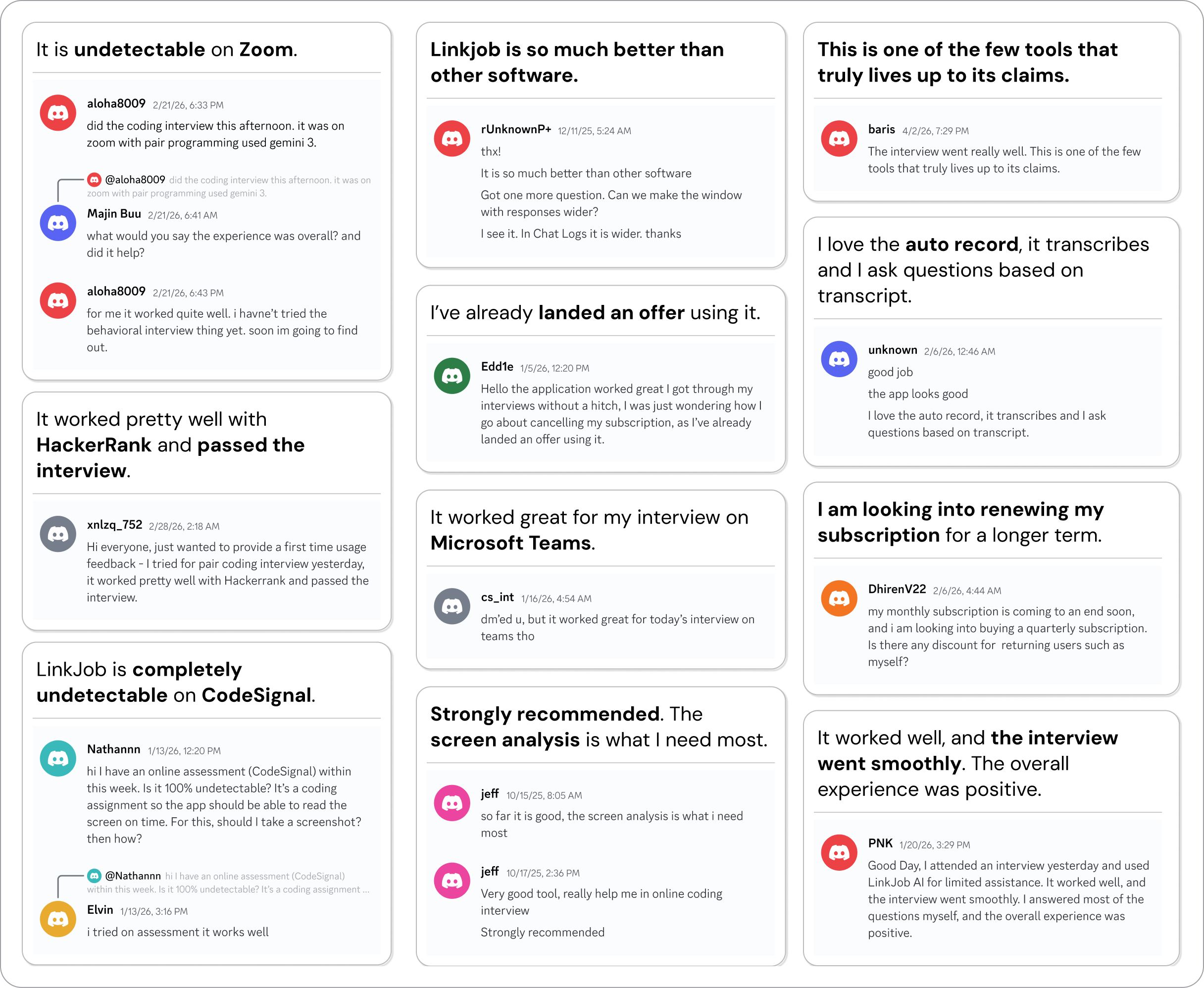
Smoother interviews, coding challenges cleared, and job offers landed. See how users describe their experience with Linkjob AI—in their own words.
© Copyright 2026 Linkjob AI - All Rights Reserved.