Visa HackerRank Assessment Guide: Real 2026 OA Questions, Proctoring Rules, and How I Cleared It

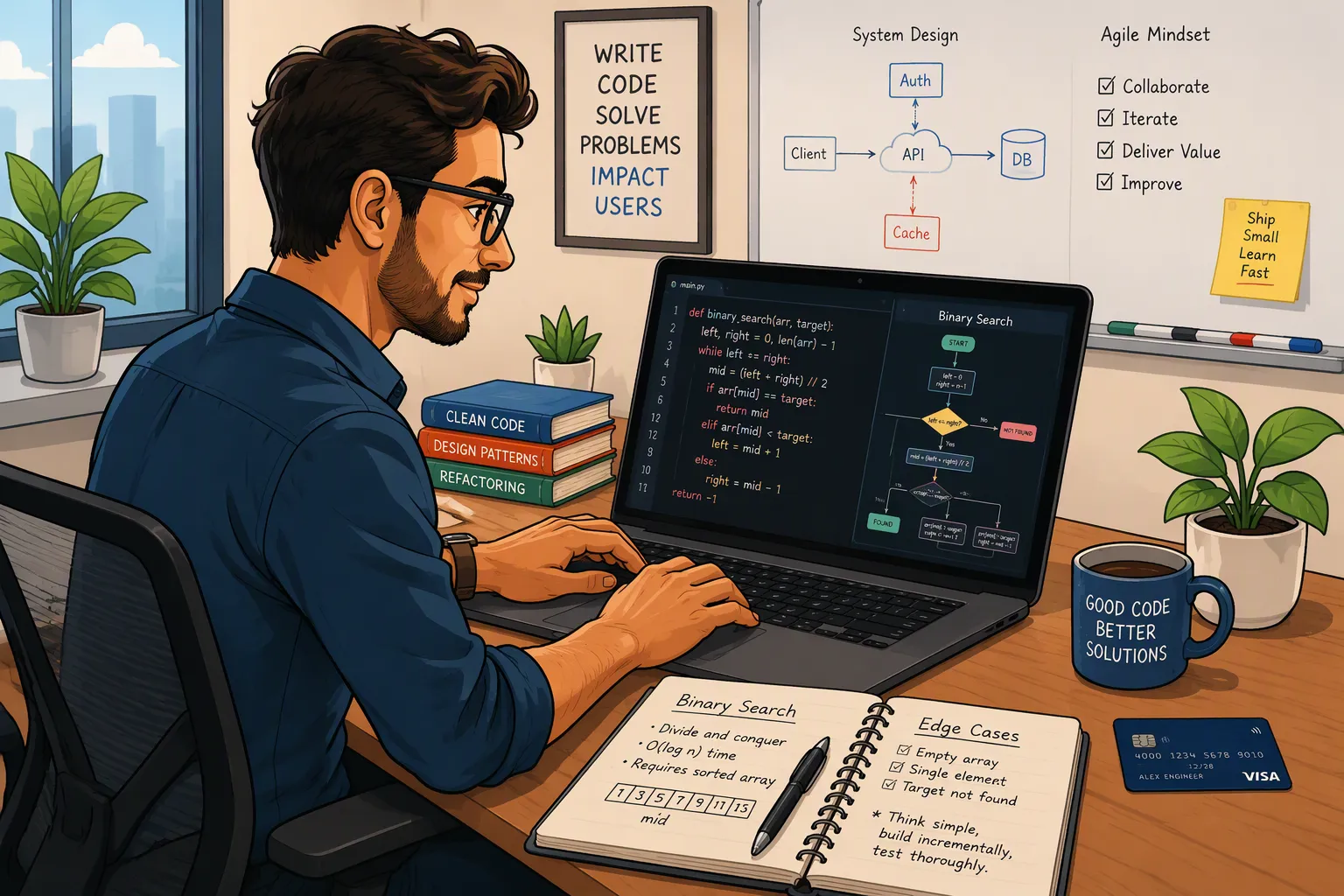
When I received my Visa HackerRank online assessment invitation for a 2026 Software Engineer role, the email looked straightforward enough: it described the test as "2 foundational and 1 intermediate problem solving questions" with a 90-minute timer. Because I had already solved a couple hundred LeetCode problems, I assumed I could breeze through the first two questions in 25 minutes and spend the rest of the hour casually working out the third.
That overconfidence nearly wrecked my test run. While I cleared the first two problems—a 3Sum-style array task and a monotonic stack problem—without much trouble, the third question threw me into a classic Dynamic Programming vs. Greedy trap. With the 90-minute clock ticking down, my initial greedy heuristic kept failing four hidden test cases because the intervals had variable weights. If I had not used an AI interview assistant to immediately compare the greedy counterexample against a bottom-up DP + binary search state transition, I would have timed out with a partial score on the most heavily weighted problem of the exam.
Before and after my test, I studied dozens of recent 2025 and 2026 Visa HackerRank reports across SWE Intern, New Grad, SWE 1, Staff Engineer ("Visa Coding – Expert"), and Data Science tracks. In this complete guide, I am going to share the exact question patterns and working Python/SQL code from the Visa HackerRank pool, explain why Visa's OA format varies by level, break down how HackerRank's proctoring and Code Playback catch traditional shortcuts, and show you how I use Linkjob AI in both Desktop Floating Window Mode and Dual-Device Mode to pass every test case safely without triggering a single proctoring flag.
What the Visa HackerRank Assessment Actually Looks Like in 2026
Unlike companies that send the exact same assessment to every engineering applicant, Visa segments its HackerRank invitations into four distinct tracks depending on your seniority and job family. Knowing which variant you are taking before you click "Start Test" will save you from studying the wrong material.
1. Track 1: SWE Intern, New Grad, and SWE 1 ("2 Foundational + 1 Intermediate")
This is the highest-volume Visa HackerRank assessment sent out after initial resume screening.
Question Count and Time Limit: Most candidates receive 3 coding questions in 90 minutes, though the broader early-career pool ranges from 3 to 4 questions with timers between 70 and 110 minutes.
Difficulty Progression: The invitation email frequently labels the structure as "2 foundational and 1 intermediate problem solving questions." In LeetCode terms, Questions 1 and 2 are solid Easy-to-Medium problems focused on arrays, hash maps, strings, two pointers, or stacks. Question 3 is a true Medium-to-Hard algorithmic separator—almost always testing Dynamic Programming vs. Greedy interval scheduling, graph traversal (BFS/DFS), or prefix-sum optimization where a naive
O(n^2)loop times out on hidden large-input test cases.
2. Track 2: Mid-Level Software Engineer ("Visa Coding – Intermediate")
For experienced SWE II and Senior Software Engineer roles (across US hubs like Foster City, Austin, Atlanta, and Bellevue, as well as London/Featurespace and Bangalore), Visa sends the HackerRank Intermediate Coding Assessment.
Structure: Typically 2 to 3 medium-to-hard coding questions in 75 to 90 minutes, occasionally paired with 5 to 10 multiple-choice questions on Java/Spring internals, multithreading, REST APIs, and relational database indexing.
Focus Areas: Sliding window maximums, LRU cache design, interval merging, and tree/graph manipulation.
3. Track 3: Staff Software Engineer ("Visa Expert Coding Assessment")
Candidates interviewing for Staff SWE or Principal Engineer positions receive the Visa Expert Coding Assessment on HackerRank before advancing to two live coding rounds and a system design round. Expect problems that combine algorithmic optimization with systems constraints—such as concurrent data structures, custom memory-bounded caches, and high-throughput stream deduplication.
4. Track 4: Visa Data Scientist, Data Engineer, and Analytics HackerRank OA
If you applied for a Data Scientist, Machine Learning Engineer, or Data Analyst role at Visa, your HackerRank test splits across three modules:
1 to 2 SQL Coding Questions: Writing complex aggregations,
CASE WHENpivots, and window functions (RANK(),DENSE_RANK(),LAG()) over payment transaction and merchant tables.1 to 2 Python Coding Questions: Data cleaning, array/dictionary manipulation, or algorithmic problem solving.
Multiple-Choice Questions (MCQs): Probability and statistics puzzles (such as expected dice rolls), A/B testing hypothesis validation, and machine learning fundamentals.
Real Coding & SQL Questions From the 2026 Visa HackerRank OA (With Working Solutions)
Below are the core coding and SQL questions from my own test run and the most frequently confirmed problems in Visa's 2026 HackerRank bank, along with the exact edge cases that trip up candidates.
1. Question 1 (Foundational / Medium): 3Sum-Style Triplet Matching & Subarray Sum Equals K
Visa loves array problems modeled around reconciling payment ledger entries or finding combinations of transaction values that hit a specific target. Two variants dominate Question 1:
Variant A (3Sum Target / Closest Triplets Without Duplicates): Given an integer array
numsof lengthn <= 3000and atarget, find all unique triplets[nums[i], nums[j], nums[k]]withi < j < ksuch that their sum equalstarget. The trap that sinks candidates on hidden test cases is failing to skip duplicate values on both the outer loop indexiand the inner two pointersleftandright.Variant B (Count Contiguous Subarrays With Sum Equals K): Given an array of positive and negative transaction adjustments
numsand an integerk, return the total number of contiguous subarrays whose sum equalsk. Becausenumscontains negative numbers, a two-pointer sliding window fails completely; you must use a Prefix Sum + Hash Map inO(n)time.
Here are both clean 100%-pass implementations:
from collections import defaultdict

def three_sum_target(nums: list[int], target: int) -> list[list[int]]:
    nums.sort()
    n = len(nums)
    result = []

    for i in range(n - 2):
        # Skip duplicate anchor elements
        if i > 0 and nums[i] == nums[i - 1]:
            continue
        # Early pruning using sorted bounds
        if nums[i] + nums[i + 1] + nums[i + 2] > target:
            break
        if nums[i] + nums[n - 2] + nums[n - 1] < target:
            continue

        left, right = i + 1, n - 1
        while left < right:
            curr_sum = nums[i] + nums[left] + nums[right]
            if curr_sum == target:
                result.append([nums[i], nums[left], nums[right]])
                left += 1
                right -= 1
                while left < right and nums[left] == nums[left - 1]:
                    left += 1
                while left < right and nums[right] == nums[right + 1]:
                    right -= 1
            elif curr_sum < target:
                left += 1
            else:
                right -= 1

    return result


def count_subarrays_with_sum_k(nums: list[int], k: int) -> int:
    prefix_counts = defaultdict(int)
    prefix_counts[0] = 1
    curr_sum = 0
    total_subarrays = 0

    for x in nums:
        curr_sum += x
        total_subarrays += prefix_counts[curr_sum - k]
        prefix_counts[curr_sum] += 1

    return total_subarrays
2. Question 2 (Foundational / Medium): Monotonic Stack & Bracket Reversal Validation
The second slot on the Visa HackerRank OA consistently tests Stacks. You will typically see either a Monotonic Decreasing Stack problem (computing the number of days/minutes until a higher transaction load occurs, or finding the next greater element in a circular array) or a Minimum Bracket Reversals / Balanced Expression parser.
Here is the O(n) time, O(n) space Monotonic Stack pattern that clears every large-input test case without hitting a Time Limit Exceeded (TLE) error:
def days_until_higher_load(loads: list[int]) -> list[int]:
    n = len(loads)
    answer = [0] * n
    stack = []  # Stores indices of loads in strictly decreasing order

    for curr_idx, curr_load in enumerate(loads):
        while stack and loads[stack[-1]] < curr_load:
            prev_idx = stack.pop()
            answer[prev_idx] = curr_idx - prev_idx
        stack.append(curr_idx)

    return answer
Real Interview Questions. Real Candidates. Continuously Updated
Our interview questions come from real job interviews taken by candidates using Linkjob AI. Based on actual interview experiences and continuously updated with new questions
3. Question 3 (Intermediate / Hard Separator): The DP vs. Greedy Interval Scheduling Trap
This is the exact question family where most candidates run out of time on the 90-minute Visa HackerRank clock.
Why Candidates Get Stuck: The prompt gives you a list of payment settlement windows or merchant promotional campaigns with
start_time,end_time, and a reward/weightprofit(orfee), asking you to maximize the total reward from mutually non-overlapping intervals.When Greedy Works vs. When Greedy Fails: If every interval has the exact same weight (
1), sorting byend_timeand picking greedily works inO(n log n)time. However, the moment each interval has a custom profit or fee, a greedy choice (picking the earliest-ending interval or the highest-profit single interval) will block two medium intervals that sum to a higher total!The Clean DP + Binary Search (
bisect_right) Solution: Sort the intervals byend_time. Definedp[i]as the maximum profit achievable using a subset of the firstiintervals. For each interval, use binary search (bisect_right) on the sortedend_timesarray to find the latest non-overlapping interval inO(log n)time, and transition viadp[i] = max(dp[i - 1], dp[prev_idx] + curr_profit).
from bisect import bisect_right

def max_settlement_profit(start_time: list[int], end_time: list[int], profit: list[int]) -> int:
    # Sort all jobs by end_time ascending
    jobs = sorted(zip(end_time, start_time, profit))
    ends = [job[0] for job in jobs]
    n = len(jobs)

    dp = [0] * (n + 1)

    for i in range(1, n + 1):
        curr_end, curr_start, curr_profit = jobs[i - 1]
        # Find how many jobs end at or before curr_start
        prev_compatible_idx = bisect_right(ends, curr_start, 0, i - 1)
        dp[i] = max(dp[i - 1], dp[prev_compatible_idx] + curr_profit)

    return dp[n]
4. Question 4 (Data Science & Backend SQL Track): ApplePay Contactless Transaction Volume
For Data Scientist, Data Engineer, and full-stack backend roles, Visa tests SQL fluency with a classic payment-method aggregation problem:
The Prompt: You are given a
transactionstable containingmerchant_id,transaction_id,amount, andpayment_method(which contains values like'apple pay','ApplePay','google pay','credit card','debit card'). Write a query to return eachmerchant_idand their total transaction volume processed through ApplePay, returning0for merchants who only have non-ApplePay transactions, ordered from highest ApplePay volume to lowest.The Trap: Putting
WHERE payment_method = 'ApplePay'in the outerWHEREclause filters out merchants who have$0in ApplePay volume, causing hidden test cases to fail! You must use conditional aggregation (SUM(CASE WHEN ... ELSE 0 END)) inside theSELECTclause instead.
SELECT
    merchant_id,
    SUM(
        CASE
            WHEN LOWER(REPLACE(payment_method, ' ', '')) = 'applepay'
            THEN amount
            ELSE 0
        END
    ) AS total_applepay_volume
FROM transactions
GROUP BY merchant_id
ORDER BY total_applepay_volume DESC, merchant_id ASC;
5. Question 5 (Intermediate & Staff SWE Track): Sliding Window Maximum & Thread-Safe LRU Cache
If you are taking the Visa Coding – Intermediate or Visa Expert Coding Assessment for SWE II, Senior, or Staff roles, you will very likely face either Sliding Window Maximum (computing peak transaction throughput over a rolling k-second window in O(n) time) or designing an O(1) LRU Cache for payment token lookups.
Why Naive Sliding Window Solutions Fail on Visa's Grader: Calling
max(nums[i:i+k])inside a loop runs inO(n * k)time, which immediately triggers a Time Limit Exceeded (TLE) failure on Visa's hiddenn = 100,000, k = 50,000test cases. You must use a monotonic decreasingcollections.dequestoring array indices so every element is pushed and popped at most once (O(n)total time).Why
OrderedDictIs Your Secret Weapon for LRU Cache in Python: Instead of spending 20 minutes debugging raw doubly-linked-listprev/nextpointer mutations under a 75-minute clock, Python's built-incollections.OrderedDictimplements a hash-map-backed doubly linked list in C. Callingmove_to_end(key)andpopitem(last=False)gives you guaranteedO(1)time complexity in 18 clean lines of code.
Here are both production-ready implementations:
from collections import deque, OrderedDict

def max_sliding_window_throughput(nums: list[int], k: int) -> list[int]:
    dq = deque()  # Stores indices in decreasing order of nums[idx]
    result = []

    for i, val in enumerate(nums):
        # 1. Remove indices that have fallen outside the left edge of the window
        while dq and dq[0] <= i - k:
            dq.popleft()

        # 2. Maintain monotonic decreasing order by popping smaller tail elements
        while dq and nums[dq[-1]] <= val:
            dq.pop()

        dq.append(i)

        # 3. Record window maximum once the first full window of size k is formed
        if i >= k - 1:
            result.append(nums[dq[0]])

    return result


class PaymentTokenLRUCache:
    def __init__(self, capacity: int):
        self.capacity = capacity
        self.cache = OrderedDict()

    def get(self, key: int) -> int:
        if key not in self.cache:
            return -1
        self.cache.move_to_end(key)
        return self.cache[key]

    def put(self, key: int, value: int) -> None:
        if key in self.cache:
            self.cache.move_to_end(key)
        self.cache[key] = value
        if len(self.cache) > self.capacity:
            self.cache.popitem(last=False)
10 More Confirmed Problems From Visa's Broader HackerRank & Technical Question Bank
If you want to cover every base before starting your test or your follow-up live technical rounds, here are ten additional confirmed questions pulled directly from Visa's recurring question bank:
Sliding Window Maximum: Given an array of integers and a fixed window size
k, return the maximum value in each sliding window of sizekinO(n)time using a monotoniccollections.deque.Number of Islands / Connected Fraud Clusters: Given a 2D grid of
'1's and'0's (or an adjacency list of linked accounts), count the number of connected components using BFS or DFS inO(R * C)time.LRU Cache Implementation: Design a Least Recently Used cache supporting
get(key)andput(key, value)in strictO(1)time using a doubly linked list and hash map (or Python'sOrderedDict.move_to_end).Diagonal Sum of a Binary Tree: Given the root of a binary tree, compute the sum of all nodes along each top-left-to-bottom-right diagonal by passing
diagonal_leveldown the recursion (leftchild incrementsdiagonal_level + 1,rightchild stays on the samediagonal_level).Find All Duplicate Files in a File System: Given directory strings like
"root/a 1.txt(abcd) 2.txt(efgh)", parse the file paths and group all files sharing identical content strings using a hash map.Shortest Distance Between Two Words in an Array of Strings: Track the most recent index of
word1andword2in a single linear pass (O(n)time,O(1)space), updatingmin_dist = min(min_dist, abs(idx1 - idx2))whenever either word is seen.Non-Overlapping Intervals (Minimum Removals): Given a collection of intervals, find the minimum number of intervals you need to remove to make the rest non-overlapping (sort by
end_timeascending and count overlaps inO(n log n)time).Valid N x N Sudoku / Payment Grid Validator: Check whether all rows, columns, and sub-boxes of a grid contain no duplicate digits using bitmasks or hash sets in a single pass.
Case-Insensitive Alphanumeric Palindrome: Verify whether a string is a palindrome in
O(n)time andO(1)space using two pointers (left,right) that skip non-alphanumeric characters via.isalnum()and compare.lower().Java & OOP MCQ Classics (For Intermediate/Backend Tracks): Know the exact difference between
final(constant variable / non-overridable method / non-inheritable class),finally(exception block that always executes), andfinalize()(deprecated garbage-collector hook), plus how Dependency Injection decouples service implementations in Spring Boot microservices.
How HackerRank Detects Cheating on the Visa OA in 2026
A lot of candidates ask on Reddit whether Visa turns on every proctoring feature on HackerRank. Because different Visa business units and regional recruiting teams configure different security toggles—and HackerRank never tells you upfront which back-end heuristics are active—I always treat every Visa OA as if maximum proctoring is live. Here are the four detection layers you are up against.
1. Default Copy/Paste Logging and Keystroke Code Playback
Even when a Visa test link does not turn on your webcam, HackerRank enables Copy/Paste Tracking and Code Playback by default on 100% of assessments.
If you solve a problem in an external IDE or copy a 40-line dynamic programming solution from another window and press Ctrl + V into the HackerRank editor, HackerRank attaches a red "External Paste" badge to your submission. Even worse, when a Visa engineer opens your Code Playback timeline, they see the entire solution appear in a single 1-second frame instead of watching you write the class signature, define helper variables, run sample tests, and fix edge cases incrementally.
2. Tab Proctoring and Window Focus Loss (blur / visibilitychange)
Whenever Tab Proctoring is active, the browser page records a timestamped violation every time the HackerRank tab loses active focus. Clicking onto a second browser window, opening a local terminal, or pressing an OS shortcut key that briefly steals focus from Chrome/Edge is logged in the recruiter's integrity summary.
3. Webcam Proctoring, Multiple-Monitor Detection, and Overlay Traps
On proctored Visa HackerRank assessments:
Webcam Snapshot AI: The browser captures periodic webcam frames and flags if you leave your chair, if another person enters the room, or if your eyes repeatedly look off-camera toward a second laptop.
Multiple-Monitor Hardware Detection: HackerRank queries your browser's display API to detect extended desktops. Always unplug any external monitor before opening the test link.
Focus-Stealing Hotkey Overlays: Many naive "invisible overlay" apps require you to press a global hotkey combination during the test to summon or hide their panel. Pressing those hotkeys mid-test frequently triggers browser focus-loss events or causes the overlay to flash during screen-capture checks.
4. Plagiarism AST Matching and Hidden Prompt Watermarks
HackerRank converts your final code into an Abstract Syntax Tree (AST) and compares its structure against public repositories and thousands of previous Visa OA submissions. In addition, HackerRank's Secure Mode embeds invisible Unicode characters or hidden prompt instructions inside the problem statement to catch candidates who blindly copy-paste the prompt text into an external chatbot.
How I Use Linkjob AI Safely on the Visa HackerRank Assessment (Web Floating Window vs. Dual-Device Mode)
When I sat for my Visa HackerRank assessment and hit the Question 3 DP vs. Greedy bottleneck with the clock running down, I needed a way to immediately verify the recurrence relation and edge cases without switching browser tabs, touching the clipboard, or pressing focus-stealing shortcut keys.
That is why I use an AI interview assistant that reads the problem directly and gives me the exact algorithm, time/space complexity, and hidden test-case checks so I can type the code naturally into the HackerRank editor myself. Based on my personal experience, here is how I set up the tool across its two operating modes depending on the test environment.
1. Mode 1: Desktop Floating Window Mode (For Standard Web-Page Assessments)
So here is how it works when your Visa HackerRank test runs on a standard web page in your desktop browser. You can directly use the floating window of the Linkjob AI desktop app right on your screen.
As soon as a coding question or SQL prompt loads, the floating window analyzes the problem description, input constraints (such as n <= 10^5 requiring O(n log n) instead of O(n^2)), and starter code signature. For Question 3 on my OA, it immediately showed me why a greedy sort would fail on weighted intervals and displayed the clean dp + bisect_right implementation so I could type it in with time to spare.
When using the desktop floating window on a web-based test, there are only two critical rules you must watch out for:
Finish all relevant settings before the test starts: Configure your preferred programming language (Python 3, Java, C++, or SQL), position the floating window near your code editor, and verify your preferences before launching the HackerRank link. Avoid clicking the app's Settings button during the test so your mouse focus never leaves the browser page.
Do NOT use
Cmd + \orCtrl + \to toggle the app during the test: Because HackerRank listens for keyboard hooks and window focus changes, never pressCmd + \orCtrl + \once the timer starts. Leave the floating window open in place—all other features work normally.
2. Mode 2: Dual-Device Mode (For Extra Security, Webcam Proctoring, or Lockdown Browsers)
If you want extra security—or if your Visa assessment turns on strict webcam Proctor Mode, Secure Mode, or requires a desktop lockdown client—you will need its Dual-Device Mode.
Under Dual-Device Mode, the Linkjob desktop app only runs silently in the background on my laptop with zero visible floating window or on-screen UI, and all real-time code solutions, SQL queries, and MCQ answers display directly on my phone.
Here is why I recommend Dual-Device Mode whenever you want total peace of mind on a proctored OA:
100% Clean Laptop Screen: Even if the assessment captures full-screen snapshots or checks for active desktop overlays, your laptop monitor shows nothing except the official HackerRank browser tab.
Natural Eye Alignment and Keystroke History: By placing my phone on a small stand right below my laptop webcam, my eyes stay pointed straight toward the camera while I read the solution on my phone and type the code organically into the HackerRank editor—producing a spotless Code Playback log with zero clipboard pastes and zero tab switches.
You can choose between the Desktop Floating Window Mode and Dual-Device Mode based on your own scenario and how strict your Visa invitation is.
My 90-Minute Pacing Blueprint for the 3-Question Visa HackerRank OA
Even with a real-time AI interview assistant helping you verify optimal algorithms on the spot, how you pace your 90 minutes and how you enter your code into HackerRank makes a huge difference. Here is the exact pacing blueprint I follow:
Minutes 0 to 20 (Question 1 — Foundational Array / Hash Map / String): Read the constraints carefully, type out the
O(n)orO(n log n)solution, run the visible sample cases, and manually test one boundary custom input (such as an empty array, all negative numbers, or duplicate elements) before clicking Submit.Minutes 20 to 45 (Question 2 — Foundational Stack / Two Pointers / Sliding Window): Type your solution in logical milestones (initialize variables first, write the main loop second, add edge-case guards third) and click "Run Code" at least twice so your Code Playback timeline shows normal iterative engineering behavior.
Minutes 45 to 85 (Question 3 — Intermediate DP / Greedy / Graph Separator): Never spend 25 minutes coding a greedy guess without verifying whether weights or negative values break the greedy choice property. Use Linkjob AI to confirm the exact
O(n log n)orO(V + E)recurrence upfront, type the clean implementation at a steady human cadence, and reserve the final 5 minutes to verify that all three questions show a "Submitted" status.
Top Questions Candidates Ask About the Visa HackerRank Assessment (FAQ)
1. Does Visa use HackerRank or CodeSignal for its 2026 Online Assessment?
Visa uses both platforms, with HackerRank being the most widely reported platform for US, UK/Europe, and India Software Engineer (Intern, New Grad, SWE 1, Intermediate, and Staff/Expert) and Data Science roles, while select campus cohorts occasionally receive a CodeSignal assessment. Your invitation email will clearly show whether your test is hosted on HackerRank.
2. How many questions and how much time are on the Visa HackerRank OA?
For SWE Intern, New Grad, and SWE 1 roles, the most common format is 3 coding questions in 90 minutes (often described in the invite email as "2 foundational and 1 intermediate problem solving questions"), though variants across the wider pool range from 2 to 4 questions in 70 to 110 minutes.
3. What score do I need on the Visa HackerRank OA to get an interview?
Visa does not publish an official numeric pass cutoff, and HackerRank grades your submissions against hidden test cases. Based on verified candidate outcomes, passing all test cases on Questions 1 and 2 (2/2 foundational) plus passing at least 70% to 100% of the hidden test cases on Question 3 (with a clean proctoring and Code Playback log) consistently moves candidates forward to the technical interview loop.
4. Can HackerRank detect if I switch tabs or copy-paste code during the Visa OA?
Yes. HackerRank enables Copy/Paste Tracking and Keystroke Code Playback by default on every assessment, and logs browser focus loss (blur and visibilitychange) whenever Tab Proctoring is active. Pasting external code blocks or triggering focus-stealing shortcut keys will flag your candidate report. That is why you should never copy-paste code, never press Cmd + \ or Ctrl + \ during a web-based test, or use Dual-Device Mode so all answers appear on your phone while you type naturally into the editor.
5. What happens after you pass the Visa HackerRank Online Assessment?
Once you clear the HackerRank OA, a Visa recruiter typically reaches out within 1 to 2 weeks to schedule your live technical rounds. For Intern and New Grad SWE roles, this is usually a 45-to-60-minute technical + behavioral round (or two back-to-back 45-minute virtual onsite interviews) covering medium LeetCode data structures, OOP/Java/Python fundamentals, resume deep dives, and alignment with Visa's leadership principles. For Senior and Staff SWE roles, expect two live coding rounds, one system design round (often focused on high-availability payment processing, idempotency keys, and distributed databases), and a hiring manager behavioral round.
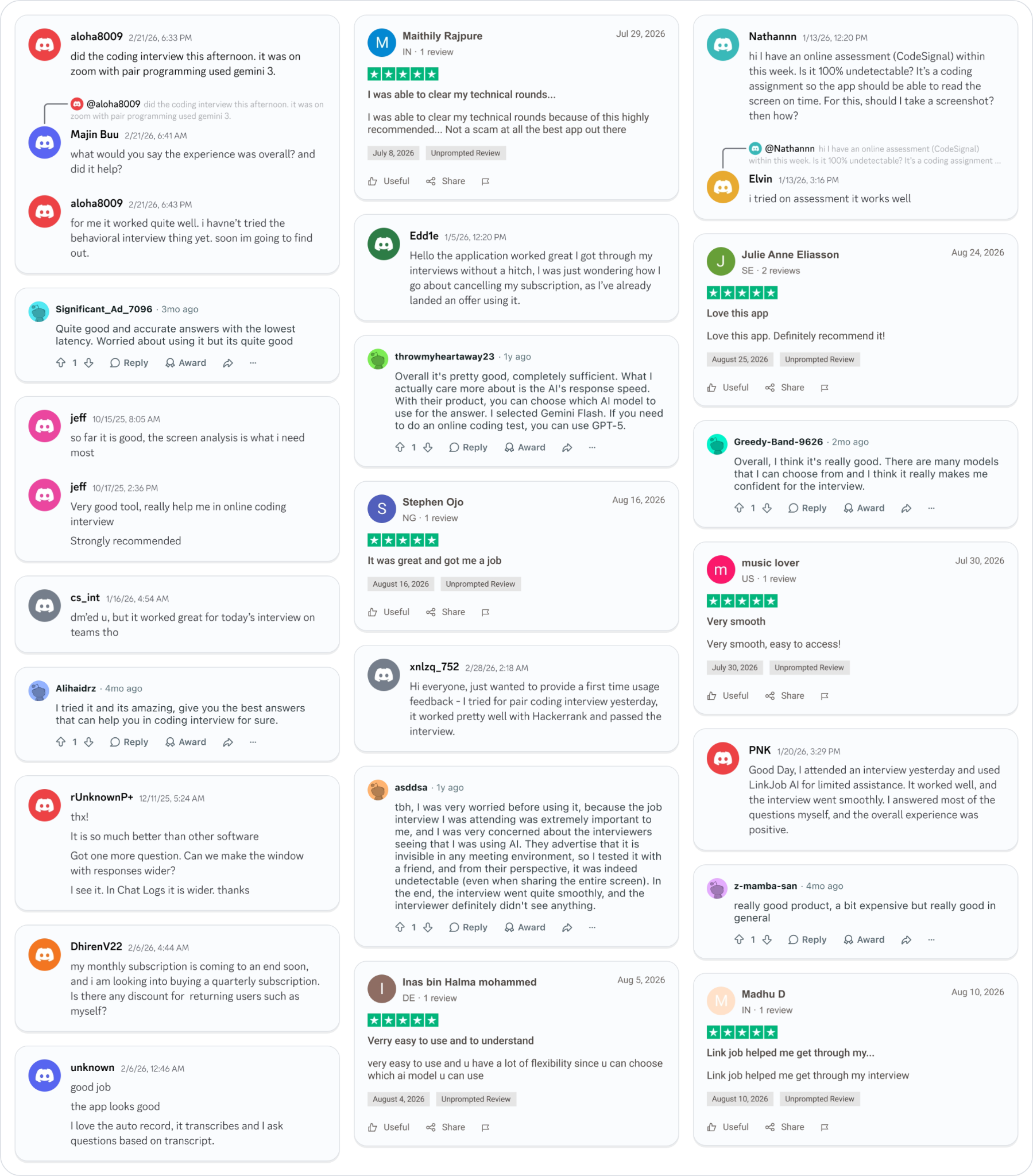
Why People Choose Linkjob AI
Smoother interviews, coding challenges cleared, and job offers landed. See how users describe their experience with Linkjob AI—in their own words.

© Copyright 2026 Linkjob AI - All Rights Reserved.