My Wayfair HackerRank Online Assessment Questions (And How I Passed in 2026)


When the Wayfair HackerRank online assessment invitation landed in my inbox after I applied for a Software Engineer (L2/L3) role, I noticed right away that Wayfair does not use generic competitive-programming brainteasers. Because Wayfair runs one of the largest home-goods e-commerce catalogs and logistics networks in the world, its HackerRank questions are modeled directly around hierarchical product catalog trees, coupon inheritance rules, formatted string arithmetic, warehouse shipping capacity optimization, and clickstream analytics.
During my 75-minute HackerRank session, I faced a multi-part Category & Coupon Inheritance Hierarchy problem, a Comma-Formatted Big-Integer Addition & Validation problem, and a Warehouse Shipping Capacity Binary Search problem (alongside an SQL aggregation query on supplier order revenue). On the Category & Coupon problem, a naive upward parent traversal on every query would have hit a Time Limit Exceeded (TLE) error when the hidden test suite ran 100,000 product-price lookups against a deep category tree—until I used an AI interview assistant to immediately add path-compression memoization and handle the future-dated date_modified filter cleanly.
In this complete guide, I am sharing my Wayfair HackerRank online assessment questions along with the broader 2025–2026 Wayfair question bank I compiled from fellow SWE Intern, New Grad, L2/L3 Backend & Full-Stack, and Data/Analytics Engineer applicants across Boston, Austin, Mountain View, Toronto, Berlin, and Bangalore. I will walk you through the exact working Python and SQL solutions, the hidden edge-case traps, how HackerRank's proctoring and Code Playback catch shortcuts, and how I use Linkjob AI in both Desktop Floating Window Mode and Dual-Device Mode to clear the assessment safely without triggering a single warning.
What My Wayfair HackerRank Assessment Looked Like (And the 4 Role Tracks)
Wayfair uses HackerRank as its primary initial technical filter (often followed by a live Karat or Wayfair engineer technical screen). Depending on which engineering or analytics track you applied to, your HackerRank invitation will load one of four distinct configurations.
1. Track 1: SWE Intern, New Grad, and L1 / L2 Software Engineer (60 to 90 Minutes)
This is the core coding assessment sent to campus and early-to-mid-career software engineers.
Format and Duration: Typically 2 to 3 coding questions in 60 to 85 minutes (or 2 coding questions + 1 SQL question in 75 minutes).
Difficulty Progression: Question 1 is an Easy-to-Medium string or hash-map problem (such as comma-formatted string addition, palindrome creation, or log deduplication). Question 2 is a Medium tree or DP problem (such as the signature Category Coupon Inheritance Tree or Longest Contiguous Shared Browsing History). Question 3 is either a Medium-Hard binary search / interval packing problem or a multi-table SQL query.
2. Track 2: Senior Software Engineer (L3 / L4 — Backend, Catalog & Supply Chain Systems)
For experienced backend and full-stack engineers, the HackerRank assessment focuses heavily on multi-rule e-commerce domain logic and algorithmic scalability:
Progressive Business Logic: Expect multi-part requirements where you resolve hierarchical product categories, filter out expired or future-dated promotional rules, and compare percentage (
"15%") vs. fixed-dollar ("$25.00") discounts across10^5catalog items.Strict Complexity Thresholds: Hidden test cases routinely pass
100,000queries or elements to verify that you used memoization, prefix sums, orO(n log n)binary search rather thanO(n^2)nested scans.
3. Track 3: Data Engineer, Business Intelligence (BI) & Analytics Engineer Track
If you applied for a Data Engineering, Product Analytics, or BI role at Wayfair, your 60-to-90-minute HackerRank test centers on:
2 Advanced SQL Problems: Writing window functions (
DENSE_RANK(),LAG(),SUM() OVER), handlingLEFT JOINzero-order suppliers, and calculating year-over-year category revenue growth or cart-to-checkout conversion funnels.1 to 2 Python Data-Processing Tasks: Transforming nested JSON product feeds or aggregating session clickstreams.
4. Track 4: Frontend / UI Engineer (React / TypeScript / Storefront)
For storefront and UI engineering roles, the HackerRank assessment pairs 1 to 2 JavaScript / TypeScript tree-flattening or array-grouping problems with asynchronous Promise caching and DOM/React state tasks.
Real Interview Questions. Real Candidates. Continuously Updated
Our interview questions come from real job interviews taken by candidates using Linkjob AI. Based on actual interview experiences and continuously updated with new questions
My Real Wayfair HackerRank Coding & SQL Questions (With Full Working Solutions)
Below are the exact coding and SQL problems from my Wayfair HackerRank run and the highest-frequency confirmed questions in Wayfair's 2026 question pool, complete with the hidden traps and 100%-pass implementations.
1. Question 1: Wayfair's Signature Category & Coupon Inheritance Tree (All 3 Parts)
This is the single most famous question in Wayfair's engineering interview and OA pool. If you are interviewing at Wayfair in 2026, you must know all three parts of this problem inside out.
Part 1 (Basic Ancestor Coupon Inheritance): You are given a list of
coupons(category_name, coupon_name)and a list ofcategories(category_name, parent_category_name)representing a forest of product category trees (where root categories haveparent_category_name = None). Many child categories (like"Bathroom Accessories") do not have their own direct coupon; instead, they inherit the coupon of their nearest ancestor category (such as"Bed & Bath"or"Home"). Given acategory_name, return its effectivecoupon_name, orNoneif neither the category nor any of its ancestors has a coupon.Part 2 (Multiple Coupons With
date_modifiedFiltering): Now each category can have multiple coupons(category_name, coupon_name, date_modified_str, discount_str). Given a referencetoday_str(in"YYYY-MM-DD"format), you must ignore any coupon modified in the future (date_modified > today). If a category has multiple valid non-future coupons, pick the one with the most recentdate_modifiedbefore climbing to the parent!Part 3 (Best Discount Calculation —
%vs.$Off): Given a product dictionary{"name": "Velvet Sofa", "price": 500.00, "category": "Living Room Sofas"}and allowing multiple valid coupons on the most recent date, apply the coupon ("20%"off vs."$85.00"off) that yields the lowest final price (floored at0.00), rounded to 2 decimal places.
Here is my complete, memoized O(1) amortized lookup solution covering all three parts:
from collections import defaultdict

class WayfairCouponEngine:
    def __init__(
        self,
        categories: list[tuple[str, str | None]],
        coupons: list[tuple[str, str, str, str]],
        today_str: str = "2026-10-31"
    ):
        self.parent_map = {}
        for child, parent in categories:
            self.parent_map[child] = parent

        # Group valid non-future coupons by category: (date_str, coupon_name, discount_str)
        raw_coupons = defaultdict(list)
        for cat, cname, date_str, disc_str in coupons:
            if date_str <= today_str:
                raw_coupons[cat].append((date_str, cname, disc_str))

        # Keep only the coupon(s) from the most recent valid date_str for each category
        self.direct_coupons = {}
        for cat, clist in raw_coupons.items():
            max_date = max(item[0] for item in clist)
            self.direct_coupons[cat] = [
                (cname, disc_str) for d_str, cname, disc_str in clist if d_str == max_date
            ]

        self._resolved_cache = {}

    def get_effective_coupons(self, category: str | None) -> list[tuple[str, str]]:
        if category is None:
            return []
        if category in self._resolved_cache:
            return self._resolved_cache[category]

        if category in self.direct_coupons:
            res = self.direct_coupons[category]
        else:
            parent = self.parent_map.get(category)
            res = self.get_effective_coupons(parent)

        self._resolved_cache[category] = res
        return res

    @staticmethod
    def _apply_discount(price: float, disc_str: str) -> float:
        disc_str = disc_str.strip()
        if disc_str.endswith("%"):
            pct = float(disc_str[:-1])
            return max(0.0, price * (1.0 - pct / 100.0))
        if disc_str.startswith("$"):
            amt = float(disc_str[1:])
            return max(0.0, price - amt)
        return price

    def get_best_discounted_price(self, product: dict) -> float:
        base_price = float(product["price"])
        category = product["category"]
        coupons = self.get_effective_coupons(category)
        if not coupons:
            return round(base_price, 2)

        best_price = min(
            self._apply_discount(base_price, disc_str)
            for _, disc_str in coupons
        )
        return round(best_price, 2)
2. Question 2: Comma-Formatted Big-Integer String Addition (add_formatted_strings)
Wayfair loves testing string-based big-integer arithmetic (often adding a twist where inputs and outputs contain thousands-separator commas like "1,234,567" + "89,999" = "1,324,566", or where you must compute the Nth Fibonacci number using that string adder without using built-in BigInteger / arbitrary-precision int() casting!).
The Problem Prompt: Given two non-negative integer strings
num1andnum2(which may contain commas every 3 digits from the right), compute their sum using character-by-character digit addition (without converting the whole string to an integer) and return the result formatted with thousands-separator commas every 3 digits from the right.My Clean O(N + M) Digit-by-Digit Solution:
def add_formatted_strings(num1: str, num2: str) -> str:
    s1 = num1.replace(",", "").strip()
    s2 = num2.replace(",", "").strip()

    i = len(s1) - 1
    j = len(s2) - 1
    carry = 0
    digits_rev = []

    while i >= 0 or j >= 0 or carry > 0:
        d1 = (ord(s1[i]) - ord("0")) if i >= 0 else 0
        d2 = (ord(s2[j]) - ord("0")) if j >= 0 else 0
        total = d1 + d2 + carry
        carry = total // 10
        digits_rev.append(str(total % 10))
        i -= 1
        j -= 1

    raw_res = "".join(reversed(digits_rev)).lstrip("0") or "0"

    # Insert thousands commas every 3 digits from the right
    groups = []
    for end in range(len(raw_res), 0, -3):
        start = max(0, end - 3)
        groups.append(raw_res[start:end])

    return ",".join(reversed(groups))
3. Question 3: Longest Contiguous Shared Browsing History (2D DP / Subarray Match)
This e-commerce clickstream problem appears on both the Wayfair HackerRank OA and the follow-up technical phone screen.
The Problem Prompt: You are given two lists of URL strings,
user1_historyanduser2_history, representing the chronological sequence of product pages visited by two shoppers. Return the longest contiguous sequence of URLs that appears identically in both users' browsing histories (if there is a tie, return the first one found).Why Subsequence DP Fails Here: Standard Longest Common Subsequence (LCS) allows skipping elements in between. Because the problem requires a contiguous browsing streak (Longest Common Subarray),
dp[i][j]must reset to0wheneveruser1_history[i - 1] != user2_history[j - 1]!My Space-Optimized O(N * M) Time, O(M) Space Solution:
def longest_shared_browsing_history(
    user1_history: list[str],
    user2_history: list[str]
) -> list[str]:
    n, m = len(user1_history), len(user2_history)
    prev_dp = [0] * (m + 1)
    max_len = 0
    best_end_idx = 0  # End index in user1_history

    for i in range(1, n + 1):
        curr_dp = [0] * (m + 1)
        u1_url = user1_history[i - 1]
        for j in range(1, m + 1):
            if u1_url == user2_history[j - 1]:
                curr_dp[j] = prev_dp[j - 1] + 1
                if curr_dp[j] > max_len:
                    max_len = curr_dp[j]
                    best_end_idx = i
        prev_dp = curr_dp

    return user1_history[best_end_idx - max_len : best_end_idx]
4. Question 4: Minimum Freight Truck Capacity to Ship Furniture in D Days (Binary Search on Answer)
Because Wayfair operates its own CastleGate fulfillment and freight network, logistics optimization problems are a staple of the Question 2 / Question 3 slot.
The Problem Prompt: Furniture packages with weights
weights[0..n-1]arrive on a warehouse conveyor belt and must be loaded onto freight trucks in the exact order given. You havedaystrucks (one per day), and each truck has the same maximum weight capacityC. Return the minimum capacityCrequired so allnpackages can be shipped withindaysdays.My O(n log(sum(weights))) Binary Search Solution: The minimum possible capacity is
max(weights)(since a single package cannot be split across two trucks), and the maximum possible capacity issum(weights)(shipping everything on Day 1). Binary search the range[max(weights), sum(weights)]:
def min_truck_capacity_within_days(weights: list[int], days: int) -> int:
    low = max(weights)
    high = sum(weights)

    def can_ship(capacity: int) -> bool:
        days_used = 1
        curr_load = 0
        for w in weights:
            if curr_load + w > capacity:
                days_used += 1
                curr_load = w
                if days_used > days:
                    return False
            else:
                curr_load += w
        return True

    while low < high:
        mid = (low + high) // 2
        if can_ship(mid):
            high = mid
        else:
            low = mid + 1

    return low
5. Question 5 (Wayfair SQL Classic): Top 3 Suppliers Per Category With Cancelled-Order Exclusion
If your Wayfair HackerRank assessment includes SQL (mandatory for Data Engineers, BI Analysts, and many full-stack/backend tracks), expect an e-commerce order-items query that tests conditional filtering and window functions.
The Problem Prompt: Given
products(product_id,category_name,supplier_id) andorder_items(order_id,product_id,quantity,unit_price,order_status,order_date), write a SQL query to find the top 3 suppliers by net fulfilled revenue (order_status = 'DELIVERED') in 2026 within eachcategory_name(including ties viaDENSE_RANK()), returningcategory_name,supplier_id,fulfilled_revenue, andcategory_rank.My Clean SQL Solution:
WITH supplier_category_rev AS (
    SELECT
        p.category_name,
        p.supplier_id,
        ROUND(SUM(oi.quantity * oi.unit_price), 2) AS fulfilled_revenue
    FROM products p
    INNER JOIN order_items oi
        ON p.product_id = oi.product_id
    WHERE oi.order_status = 'DELIVERED'
      AND oi.order_date >= '2026-01-01'
      AND oi.order_date < '2027-01-01'
    GROUP BY p.category_name, p.supplier_id
),
ranked_suppliers AS (
    SELECT
        category_name,
        supplier_id,
        fulfilled_revenue,
        DENSE_RANK() OVER (
            PARTITION BY category_name
            ORDER BY fulfilled_revenue DESC
        ) AS category_rank
    FROM supplier_category_rev
)
SELECT
    category_name,
    supplier_id,
    fulfilled_revenue,
    category_rank
FROM ranked_suppliers
WHERE category_rank <= 3
ORDER BY category_name ASC, category_rank ASC, supplier_id ASC;
6. Question 6: Warehouse Badge Access Mismatches & 1-Hour Swipe Velocity Alerts
Two more multi-part questions that show up constantly across Wayfair's HackerRank OA and follow-up technical screens are Warehouse Badge Access Log Mismatches and Key-Card 60-Minute Velocity Alerts.
Part A (Badge Access Mismatches): Given a chronological list of
[employee_name, "enter" | "exit"]records for a single shift (assuming the warehouse starts and ends completely empty), return two sorted lists:(exited_without_entering, entered_without_exiting). Notice that an employee who enters twice in a row ("enter","enter","exit") must be flagged inentered_without_exitingeven though they eventually exited at the end!
def find_badge_mismatches(records: list[list[str]]) -> tuple[list[str], list[str]]:
    inside = set()
    missing_enter = set()
    missing_exit = set()

    for name, action in records:
        if action == "enter":
            if name in inside:
                missing_exit.add(name)
            inside.add(name)
        elif action == "exit":
            if name not in inside:
                missing_enter.add(name)
            else:
                inside.remove(name)

    # Anyone still inside at the end of the log forgot to badge out
    missing_exit.update(inside)
    return sorted(missing_enter), sorted(missing_exit)
Part B (3+ Badge Swipes Within Any 60-Minute Window): Given
[employee_name, time_int]records wheretime_intis formatted asHHMMorHMM(for example,"830"means08:30,"1315"means13:15—note that1000 - 930is30minutes, NOT70minutes!), find all employees who swiped 3 or more times within any 60-minute window and return the earliest 3+ swipe window for each flagged employee:
from collections import defaultdict

def to_minutes(hhmm_str: str) -> int:
    val = int(hhmm_str)
    hours = val // 100
    mins = val % 100
    return hours * 60 + mins

def find_frequent_badge_swipes(records: list[tuple[str, str]]) -> dict[str, list[str]]:
    emp_times = defaultdict(list)
    for name, t_str in records:
        emp_times[name].append((to_minutes(t_str), t_str))

    flagged = {}
    for name, entries in emp_times.items():
        entries.sort(key=lambda x: x[0])
        n = len(entries)
        right = 0
        for left in range(n):
            while right < n and entries[right][0] - entries[left][0] <= 60:
                right += 1
            if right - left >= 3:
                flagged[name] = [entries[k][1] for k in range(left, right)]
                break

    return flagged
8 More Confirmed Problems in Wayfair's 2026 HackerRank & Technical Pool
When I compared my assessment with other Wayfair candidates across Boston, Toronto, Berlin, and Bangalore, these eight additional questions came up repeatedly:
Badge Access / Security Log Mismatches: Given a chronological log of
["Martha", "enter"]and["Martha", "exit"]events, return two sorted lists: employees who exited without a matching badge-in, and employees who badged in without badging out before the end of the shift.Subdomain Visit Count Aggregation: Given strings like
["9001 discuss.wayfair.com"], aggregate total visits across every parent domain ("discuss.wayfair.com","wayfair.com","com") using a hash map inO(n)time.Alert Key-Card Swipes (3+ Swipes Within Any 60-Minute Window): Convert
"HH:MM"strings to integer minuteshours * 60 + mins, sort per employee, and check iftimes[i] - times[i - 2] <= 60.Non-Overlapping Promotional Banner Schedules: Sort promotional intervals by
end_timeascending and select the maximum number of non-overlapping campaigns inO(n log n)time.Group Anagrams / Product Search Query Normalization: Cluster search queries that are anagrams or token permutations of each other.
LRU Cache (
O(1)Get and Put): Build an in-memory product catalog cache usingcollections.OrderedDict.Find Players With Zero or One Losses (Parent-Child Graph Indegree): Given
[parent, child]pairs, return nodes with0parents (roots) and nodes with exactly1parent, plus check whether two nodes share a common ancestor via upward BFS.Word Search / Warehouse Grid Robot Path: Standard 2D grid DFS/BFS with obstacle cells.
How HackerRank Detects Cheating on the Wayfair OA in 2026
Wayfair's talent acquisition and engineering teams check both your automated test-case score and your HackerRank proctoring telemetry before advancing you to the live interview stage. Here are the four detection layers watching your session.
1. Default Copy/Paste Tracking and Keystroke Code Playback
Even when a Wayfair HackerRank invitation does not require webcam access, Copy/Paste Tracking and Keystroke Code Playback are enabled by default on 100% of HackerRank assessments.
Every time you paste code from your system clipboard into the HackerRank Monaco editor, the platform highlights the pasted block in red on the recruiter's dashboard and logs the event on your Code Playback timeline. When a Wayfair engineer replays your coding session and sees a 60-line WayfairCouponEngine class appear in a single keystroke frame without any incremental typing or intermediate test runs, your submission is rejected immediately.
2. Tab Proctoring and Window Focus Telemetry (blur / visibilitychange)
When Tab Proctoring is enabled, the browser listens continuously for DOM focus-loss events (window.onblur and document.visibilitychange). Clicking outside the browser window, switching tabs to look up Python string methods or SQL window-function syntax, or pressing a global OS shortcut that steals focus from your browser increments your violation counter and records the exact number of seconds you spent away from the test tab.
3. Webcam Proctor Mode and Multiple-Monitor Detection
On webcam-proctored Wayfair HackerRank assessments:
Webcam Snapshot AI: The browser captures periodic webcam frames and flags missing faces, extra people in the background, or repeated off-screen eye gaze.
Multiple-Monitor Detection: HackerRank queries your browser's display API to detect secondary monitors. Always physically unplug any external HDMI or DisplayPort monitor before opening your assessment link.
Focus-Stealing Hotkey Traps: Pressing global keyboard shortcuts mid-test to toggle poorly built screen overlays frequently triggers focus-loss logs or exposes the window during screen checks.
4. AST Plagiarism Detection and Hidden Prompt Watermarks
HackerRank converts your submitted code into an Abstract Syntax Tree (AST) and compares its structure against public repositories and prior Wayfair candidate submissions. Furthermore, HackerRank's Secure Mode embeds invisible Unicode characters or hidden prompt instructions inside the problem statement so candidates who blindly copy-paste the prompt into an external window produce watermarked variable names in their code.
How I Use Linkjob AI Safely on the Wayfair HackerRank OA (Floating Window vs. Dual-Device Mode)
When I took my Wayfair HackerRank test, I needed a way to immediately verify the path-compression memoization and date_modified tie-breaking rules on the Category Coupon problem—and confirm the comma-insertion boundaries on the Big-Integer string adder—without switching browser tabs, copying text to my clipboard, or pressing focus-stealing shortcut keys.
That is why I used an AI interview assistant to read the problem constraints directly on screen and show me the clean, bug-free implementation so I could type the code naturally into the HackerRank editor myself. Depending on whether your Wayfair invite runs in a standard web browser window or under strict webcam proctoring, here is how I set up the two modes.
1. Mode 1: Desktop Floating Window Mode (For Standard Web-Page Assessments)
So here is how it works when your Wayfair HackerRank test runs on a standard web page. You can directly use the floating window of the Linkjob AI desktop app right on your monitor.
The moment a coding prompt or SQL schema loads on screen, the floating window analyzes the problem requirements, highlights the hidden edge cases (such as date_modified > today filtering and O(1) memoized ancestor lookups), and displays the clean code implementation right next to your editor—with zero clipboard interaction and zero tab switching.
When using the desktop floating window on a web-based test, there are only two strict rules to watch out for:
Finish all relevant settings before the test starts: Select your preferred programming language (Python 3, Java, C#, TypeScript, or SQL), position the floating window near your code editor panel, and verify all preferences before you open the HackerRank link. Avoid clicking the app's Settings button during the test so your mouse focus never leaves the browser page.
Do NOT use
Cmd + \orCtrl + \to toggle the app during the test: Because HackerRank monitors global keyboard hooks and window focus changes, never pressCmd + \orCtrl + \once your assessment timer starts. Just leave the floating window open in place—all other features work normally.
2. Mode 2: Dual-Device Mode (For Extra Security, Webcam Proctoring, or Lockdown Browsers)
If you want extra security—or if your Wayfair assessment runs under strict webcam Proctor Mode, Secure Mode, or requires a desktop lockdown client—you will need its Dual-Device Mode.
Under Dual-Device Mode, the Linkjob desktop app only runs silently in the background on my laptop with zero visible floating window or on-screen overlay, and all real-time code solutions, multi-part refactor steps, and SQL queries display directly on my phone.
Here is why Dual-Device Mode is my favorite setup whenever webcam proctoring is active:
100% Clean Laptop Display: Even if the platform captures full-screen snapshots or scans for active desktop overlays, your computer monitor shows nothing except the official HackerRank browser tab.
Natural Eye Alignment and Spotless Keystroke Playback: By propping my phone right below my laptop webcam, my eyes stay pointed straight toward the camera while I read the solution on my phone and type the code into HackerRank line by line at my normal typing pace—creating a 100% organic Code Playback log with zero clipboard pastes and zero focus switches.
You can choose between the Desktop Floating Window Mode and Dual-Device Mode based on your own scenario and how much extra security you want.
3 Habits That Keep Your Wayfair Code Playback 100% Organic
Even when a real-time AI interview assistant gives you the verified WayfairCouponEngine or binary-search shipping algorithm immediately, remember that Wayfair engineers inspect your Code Playback timeline before scheduling your virtual onsite loop. Follow these three habits while typing:
Build Multi-Part Classes Incrementally: On the Category & Coupon problem, write the basic parent-lookup dictionary first, click "Run Code" to verify Part 1, and then add the
date_modifiedfilter and_apply_discount()helper for Parts 2 and 3.Test One Custom Edge Case Before Submitting: On
add_formatted_strings, test"0"+"0"and"999,999"+"1"("1,000,000") using HackerRank's Custom Input box to prove your comma-grouping loop never leaves a leading comma like",1,000,000".Keep Variable Names Clean and E-Commerce-Specific: Using clear names like
parent_map,direct_coupons, andfulfilled_revenuemakes your code look like production Wayfair code during human engineering review.
Top Questions Candidates Ask About the Wayfair HackerRank Assessment (FAQ)
1. How long is the Wayfair HackerRank Online Assessment and how many questions are on it?
Most Wayfair HackerRank assessments last between 60 and 85 minutes and contain 2 to 3 coding or SQL questions (most commonly pairing a string/big-integer warmup with the Category & Coupon Inheritance Tree, Shared Browsing History, or Warehouse Shipping Capacity problem).
2. Why do so many candidates hit Time Limit Exceeded (TLE) on Wayfair's Category & Coupon problem?
Candidates hit TLE on hidden test cases because they climb the parent_map chain from scratch on every single find_coupon(category) call without caching the resolved result. When a hidden test case passes a deep 5,000-node category chain and runs 100,000 product lookups, un-memoized traversal takes 5 * 10^8 operations and times out. Caching each category's resolved coupon in self._resolved_cache drops the total runtime to O(N + Q).
3. Which programming language is best for the Wayfair HackerRank OA?
While Wayfair's backend production stack uses Java, Python, C#, PHP, and Go (and React/TypeScript on the frontend), Python 3 is the fastest language to use on the HackerRank OA. Tasks like parsing "YYYY-MM-DD" dates, splitting "15%" vs. "$20.00" discount strings, and building defaultdict parent trees take half as many lines in Python as in Java or C#.
4. Can HackerRank detect if I switch tabs or copy-paste code during the Wayfair OA?
Yes. HackerRank enables Copy/Paste Tracking and Keystroke Code Playback by default on every assessment, and records browser focus loss (blur and visibilitychange) whenever Tab Proctoring is active. Pasting external code blocks or pressing focus-stealing shortcut keys will flag your recruiter report. Never copy-paste code, never press Cmd + \ or Ctrl + \ during a web-based test, or use Dual-Device Mode so all answers display on your phone while you type naturally into the editor.
5. What happens after you pass the Wayfair HackerRank Online Assessment?
After clearing the HackerRank OA, a Wayfair recruiter typically follows up within 3 to 7 business days to schedule either a 60-minute live technical screen (often conducted via Karat or a Wayfair engineer, which frequently tests the Badge Access Log, Subdomain Visits, or Shared Browsing History problem families) or moves you directly to the Virtual Onsite Loop covering Coding, Low-Level Object-Oriented / System Design (such as designing a furniture inventory reservation service or coupon engine), and Behavioral Experience interviews.
Why People Choose Linkjob AI
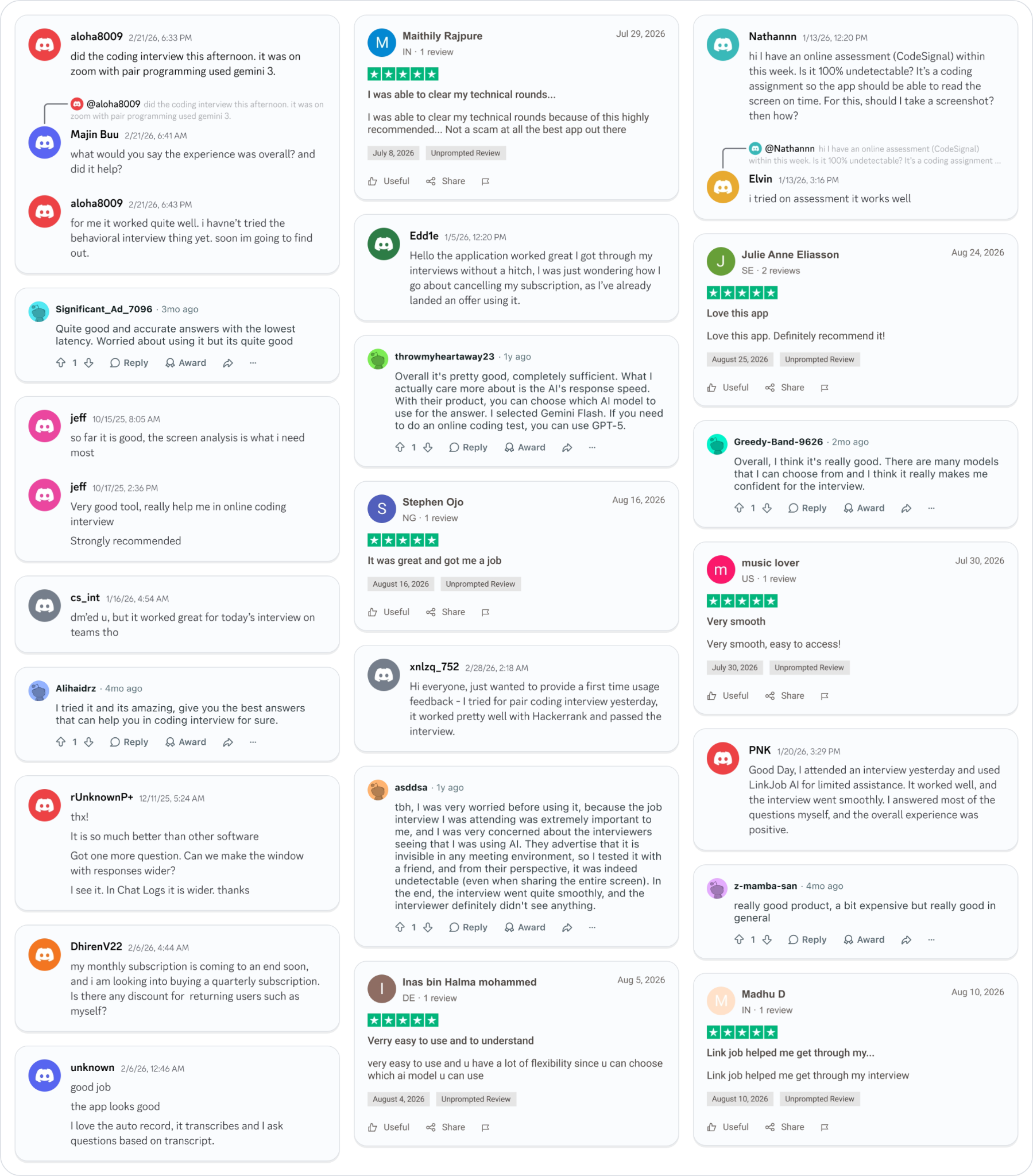
Smoother interviews, coding challenges cleared, and job offers landed. See how users describe their experience with Linkjob AI—in their own words.

© Copyright 2026 Linkjob AI - All Rights Reserved.