Interview Copilot: What It Is and How It Works

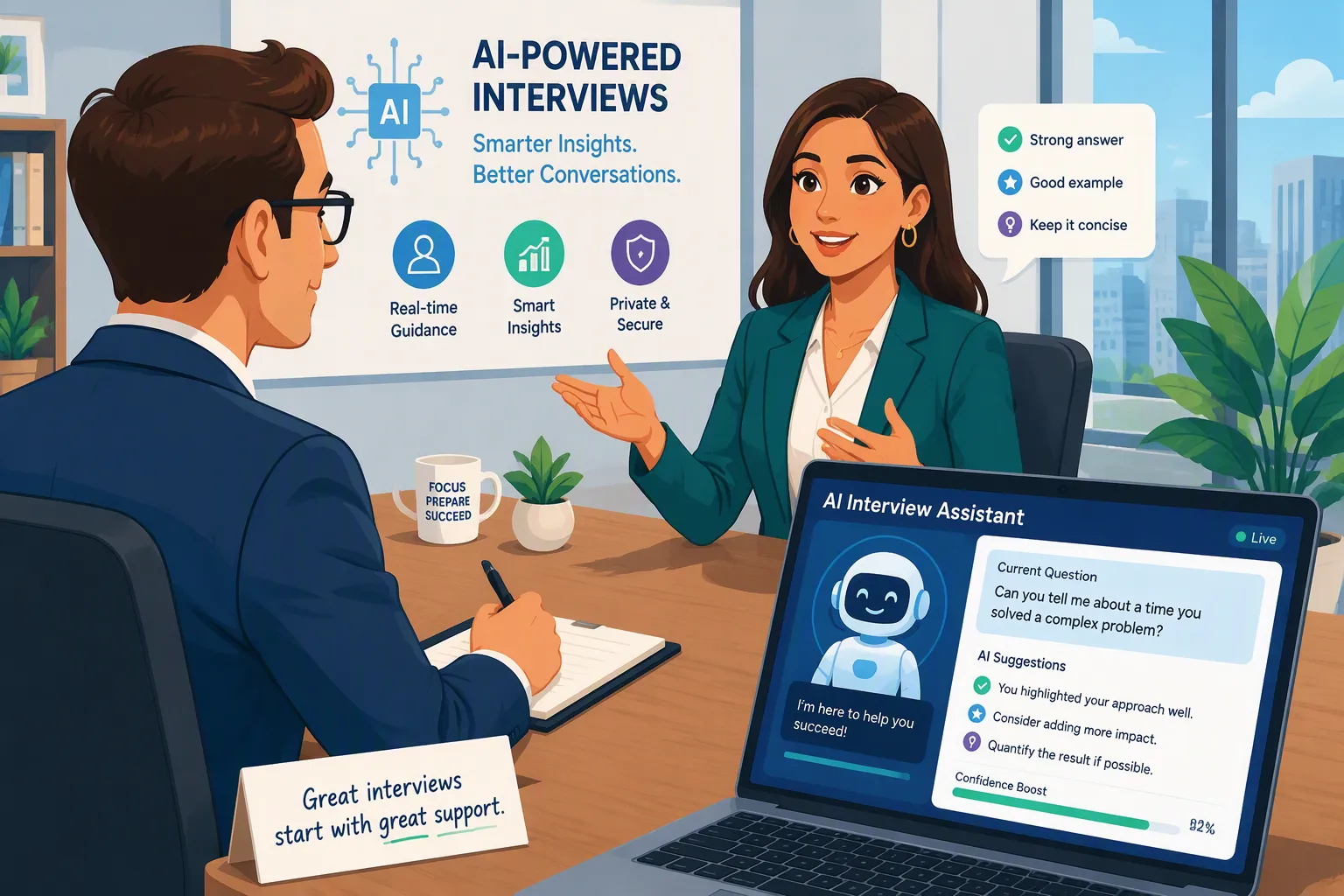
An interview copilot is an AI assistant designed to work alongside an interview and provide useful guidance while the conversation is happening.
That's the short definition.
The reason the term has become popular is pretty simple: traditional interview tools usually help you before the interview, while an interview copilot is designed to stay useful during it.
Someone asks you a question.
The copilot listens.
It works out what the interviewer is actually asking.
Then it gives you something useful — maybe a suggested structure, talking points, a technical explanation, or a more complete response.
I think the word copilot fits surprisingly well.
The AI isn't supposed to be the person having the interview.
It's there beside the person who is.
A good example is Linkjob AI Interview Copilot, a desktop AI interview assistant built around real-time interview support. It can use the live question together with information such as your resume, job description, and custom context to generate more relevant guidance.
So if you've been seeing terms like AI interview copilot, real-time interview copilot, or interview assistant, they're all describing closely related ideas.
The important part is understanding where the “copilot” part begins.
Key Takeaways
An interview copilot is generally an AI assistant that works alongside a live interview rather than only helping with preparation.
A typical interview copilot combines live questions with AI reasoning and candidate context such as a resume or job description.
Interview copilot and AI interview assistant overlap, but “copilot” usually suggests a more active, real-time role.
Linkjob AI is one example of a candidate-side interview copilot designed for behavioral, technical, coding, and other professional interviews.
What Does Interview Copilot Mean?
There isn't one official definition that every company follows.
That matters because the term is now being used in two different ways.
For job seekers, interview copilot usually means an AI tool that helps the candidate during an interview.
For recruiters, some companies use the same term for tools that help the interviewer — for example by suggesting follow-up questions, capturing notes, or tracking what has already been covered.
So whenever I see the term, the first thing I ask is:
Copilot for whom?
On Linkjob AI, the meaning is candidate-side.
The Linkjob AI Interview Copilot is designed to work alongside the person being interviewed. It follows the interview context and produces guidance relevant to the question being asked.
For this glossary entry, that's also the meaning I'm mainly talking about:
An AI interview copilot for candidates that provides real-time assistance during a job interview.
How Does an Interview Copilot Work?
The workflow sounds more technical than it actually feels from the user's side.
Imagine you're in an interview and someone asks:
“Tell me about a time you had to convince a stakeholder who initially disagreed with you.”
Without any AI help, your brain has to do several things almost immediately.
You need to understand what the interviewer is really testing.
You need to choose a relevant story.
You need to remember the details.
You need to structure the answer.
And then you need to start speaking before the silence gets awkward.
An interview copilot tries to shorten that process.
Stage | What the Interview Copilot Does | Example |
|---|---|---|
Listen | Receives the interview question | “Tell me about a difficult stakeholder.” |
Understand | Identifies the interviewer's intent | Influence, communication, conflict |
Add context | Uses candidate information | Resume + job description + custom prompt |
Generate guidance | Produces relevant talking points or an answer | Relevant experience + suggested structure |
Continue context | Uses the conversation for later questions | Understands follow-up questions in context |
That's the basic idea.
The interesting part isn't just transcription.
Turning speech into text is easy compared with understanding what the interviewer actually wants from the answer.
For example:
“Why are you leaving your current company?”
and:
“What are you looking for in your next company?”
sound similar.
But they're not really asking the same thing.
The first usually requires a careful explanation of your transition.
The second is more about motivation, priorities, and fit.
A useful interview copilot needs to understand that difference.
Otherwise, you're basically using subtitles with a chatbot attached.
How Linkjob AI Works as an Interview Copilot
Linkjob AI is a useful example because it shows what the term interview copilot means in an actual product.
Before the interview, you can give the AI context about yourself.
That might include your resume, the job description, your target role, or instructions about how you'd like answers structured.
Then the interview starts.
When the interviewer asks a question, the copilot doesn't have to start completely from scratch.
It already has some idea of:
who you are,
what role you're applying for,
what experience you have,
and what the interview is about.
That changes the usefulness of the answer quite a lot.
Take a question like:
“Tell me about your biggest professional challenge.”
A completely generic chatbot can easily produce a polished answer.
But it doesn't know which challenge from your background makes sense.
A context-aware interview copilot can use the information you've already given it and generate a response that is more relevant to your actual experience.
That's the part of products like Linkjob AI that I think matters more than simply saying:
“We use a powerful AI model.”
The model matters.
But the context around the model is often what makes the response useful.
What Does an Interview Copilot Look Like?
There isn't one standard interface.
Some interview copilots are browser-based.
Some run as desktop applications.
Some use a floating overlay.
Some focus on full generated answers, while others try to keep responses much shorter.
Linkjob AI is a desktop-based interview copilot, which makes sense for live interview workflows because it can stay alongside the interview rather than behaving like another normal browser chatbot.
Linkjob AI is an example of a desktop interview copilot that provides real-time guidance alongside a job interview.
The screenshot is useful because it shows something that's slightly difficult to explain with words.
An interview copilot isn't really meant to become the main thing you're looking at.
The actual interview is still the main event.
The copilot sits next to it.
See an Interview Copilot in Action
If you've never used one, watching the workflow is probably easier than reading another explanation.
This short Linkjob AI demo shows what a real-time Interview Copilot looks like during an interview:
There's also a more detailed guide explaining how to use an AI Interview Copilot if you want to see the workflow step by step.
Why Does an Interview Copilot Need Your Resume?
This is one of the first questions I'd ask when comparing interview copilots.
Does the AI know anything about me?
Because without personal context, a lot of interview answers become painfully generic.
Imagine two candidates.
One is interviewing for their first graduate analyst job.
The other has twelve years of experience managing engineering teams.
Both are asked:
“Tell me about a time you had to make a difficult decision.”
Obviously, those candidates should not get the same answer.
That's why Linkjob AI allows users to provide information such as a resume and job description before or during the interview setup.
The resume gives the AI a sense of your experience.
The job description gives it information about what the employer appears to care about.
Put those together with the interview question and the AI has a much better starting point.
That doesn't mean every answer suddenly becomes perfect.
It means the AI is no longer meeting you for the first time every time someone asks a question.
Interview Copilot vs. AI Interview Assistant
These terms overlap enough that people often use them interchangeably.
I don't think that's necessarily wrong.
But if I had to separate them, I'd draw the line here:
AI interview assistant is the broader category.
Interview copilot is usually the more real-time version.
AI Interview Assistant | Interview Copilot | |
|---|---|---|
Meaning | Broad category of AI tools for interviews | AI working alongside a live interview |
When used | Before, during, or after interviews | Mainly during the interview |
Typical features | Practice, feedback, coaching, answer generation | Live question understanding and guidance |
Resume context | May be used | Often especially important |
Main purpose | Help with interviewing | Help while the interview is happening |
For example, an AI mock-interview tool is clearly an AI interview assistant.
But I wouldn't normally call it an interview copilot if it only runs before the real interview.
Linkjob AI actually covers both sides.
Its AI Mock Interview is more preparation-focused.
Its Interview Copilot is the real-time side.
That's a useful example of why the broader and narrower terms both exist.
Interview Copilot vs. ChatGPT
This is probably the comparison that matters more in practice.
Why not just use ChatGPT?
For preparation, you absolutely can.
You can upload a resume.
Paste a job description.
Ask ChatGPT to generate questions.
Have it improve your STAR answers.
Ask it to simulate an interviewer.
For basic preparation, that may be enough.
The problem starts when you're already inside a live interview.
Imagine an interviewer suddenly asks:
“Tell me about a decision you made without enough information.”
With a normal chatbot workflow, you might have to:
remember the question,
open ChatGPT,
type or paste it,
make sure the AI still has the right context,
wait for the response,
and then work out which part of the answer is useful.
An interview copilot is built around removing those extra steps.
So I wouldn't describe the difference as:
Interview Copilot = better AI than ChatGPT.
I'd describe it as:
Interview Copilot = AI organized specifically around the live interview.
That's a much more accurate distinction.
What Can an Interview Copilot Help With?
Behavioral interviews are probably the most obvious example.
Someone asks:
“Tell me about a time you disagreed with your manager.”
You don't need AI to invent a fake experience.
The useful part is helping you remember which real experience is relevant and how to structure it.
Maybe the copilot reminds you of:
context → disagreement → what you did → result
That's enough to help you start talking.
Technical interviews are more complicated.
Now the copilot may need to understand algorithms, code, architecture, debugging, or system design.
That's why Linkjob AI also has a separate Coding Interview Copilot for technical interview workflows.
A response to:
“What's your biggest weakness?”
should obviously not look anything like the answer to:
“How would you design a distributed cache?”
Both are interview questions.
The AI job is completely different.
Interview copilots can also be useful for consulting, finance, product management, case interviews, system-design interviews, and other professional conversations.
The underlying idea stays the same.
The type of guidance changes.
What Is a Real-Time Interview Copilot?
A real-time interview copilot is simply an interview copilot where speed is part of the product.
That sounds obvious, but it matters a lot.
If you're using AI to prepare an answer tonight, waiting five seconds isn't a big deal.
During a live interview, five seconds can feel surprisingly long.
Someone asks a question.
There's a natural pause.
You think.
That's the window where the copilot has to become useful.
If the response arrives after you've already started answering, a lot of its value disappears.
This is why I think interview-copilot products should be judged differently from ordinary chatbots.
Model intelligence matters.
But so do:
response speed,
answer length,
and how quickly you can understand what's on the screen.
An interview copilot can have the best model in the world and still be annoying if it gives you the right answer at the wrong time.
Why Short Interview Copilot Answers Can Be Better
This is something I don't think is obvious until you imagine using the product live.
A 700-word AI answer looks great in a screenshot.
During an interview, it's horrible.
The interviewer asks:
“Why do you want this role?”
Your copilot generates eight beautiful paragraphs.
Now what?
You're not going to silently read the whole thing.
For real-time use, I often think something like this is more practical:
Why role: matches my move toward X
Why company: interested in Y
My evidence: connect with project Z
That's enough.
You understand the direction.
Then you speak naturally.
That's the relationship I think an interview copilot should have with the candidate.
Support the answer rather than replace the conversation.
Interview Copilot for Behavioral Interviews
Behavioral questions are a surprisingly good fit for copilots because the difficulty isn't normally understanding the vocabulary.
It's retrieving the right experience quickly.
Take:
“Tell me about a time you failed.”
Most professionals could probably think of ten possible stories if you gave them an hour.
In an interview, you don't have an hour.
You need a relevant one now.
If the interview copilot already has access to your resume and background, it has a much better chance of helping you choose the right direction.
For Linkjob AI, this is one of the reasons candidate context is useful.
The AI isn't just answering:
“How should somebody answer this?”
It's trying to answer:
“Given this candidate and this interview, what would be useful here?”
Those are very different prompts.
Interview Copilot for Coding and Technical Interviews
This is where the term starts getting broader.
A behavioral interview copilot mostly deals with conversation.
A coding interview copilot may need to reason about information on the screen.
Suppose the interviewer gives you a coding problem.
Now the assistant may need to help with:
algorithm selection,
time and space complexity,
debugging,
edge cases,
code explanations,
or system design.
Linkjob AI's Coding Interview Copilot is an example of this more technical branch of the category.
I think it's useful to keep these branches separate conceptually.
A product can call itself an interview copilot and be excellent for behavioral interviews without necessarily being strong at coding.
If you're choosing one, your actual interview type matters more than the label.
Interview Copilot vs. AI Mock Interview
These tools solve almost opposite timing problems.
An AI mock interview helps before the real interview.
An interview copilot helps alongside the real interview.
I wouldn't treat one as a replacement for the other.
If your interview is next week, a mock session can help you discover that:
your answers are too long,
your STAR stories are weak,
your examples aren't specific enough,
or you have no idea how to answer a particular technical question.
That's great.
You want to discover those things before the interviewer does.
The copilot solves a different problem.
You prepared properly.
Then someone asks something from an angle you weren't expecting.
Or your brain suddenly goes blank.
That's where real-time assistance becomes relevant.
Linkjob AI happens to offer both AI Mock Interview and Interview Copilot functionality, which makes this distinction fairly easy to see in practice.
Are Interview Copilots Only for Candidates?
No.
This is one nuance worth keeping in a glossary definition.
Recruiter-side interview copilots also exist.
Instead of helping someone answer, those products can help the person conducting the interview.
For example, they may suggest a follow-up question, remind the interviewer which competencies haven't been covered, or produce notes afterward.
So the phrase interview copilot doesn't automatically tell you who the user is.
That's why context matters.
Linkjob AI is explicitly on the candidate side.
Its Interview Copilot is built to support the person taking the interview.
Other products may use the same term for the person asking the questions.
Same terminology.
Very different product.
What Should You Look for in an Interview Copilot?
I wouldn't start with the longest feature list.
I'd start with the actual interview.
Does the copilot understand what the interviewer is asking?
Can it use your own context?
Does it respond quickly?
Are the answers easy to scan?
Can it handle the type of interview you're taking?
Those five questions tell you quite a lot.
For a software engineer, technical and coding support might be critical.
For someone interviewing in a second language, multilingual support could matter much more.
For a behavioral-heavy management role, resume personalization and answer structure may matter most.
There isn't one perfect interview-copilot feature list.
Because there isn't one type of interview.
Limitations of an Interview Copilot
Interview copilots still rely on AI models.
That means they can misunderstand things.
They can produce inaccurate answers.
They can also generate suggestions that sound much more confident than they deserve to.
Technical interviews make this especially obvious.
If an AI tells you the complexity is O(n log n), that doesn't make it true.
You still need to understand what you're saying.
Another limitation is attention.
A copilot is supposed to reduce cognitive load.
But if you're spending the entire conversation staring at it, you've simply moved your attention problem from one place to another.
There's also no universal rule around external assistance.
Employers, interviewers, and assessment platforms can have different policies.
So I'd always understand the rules of the interview you're taking rather than assuming every environment treats AI tools the same way.
A Simple Linkjob AI Interview Copilot Example
Let's make this concrete.
Imagine I'm interviewing for a senior product manager role.
Before the interview, I provide Linkjob AI with my resume and the job description.
The interviewer asks:
“Tell me about a product decision you made that turned out to be wrong.”
A generic chatbot can explain the STAR method.
That's useful, but not especially personal.
An interview copilot with candidate context can potentially recognize:
this is a behavioral question,
the interviewer is testing judgment and learning,
and there may be a project in my own experience that fits.
Then it can suggest something like:
what I believed → why I made the decision → what happened → what I changed → what I learned
Now I have a direction.
That's the part of the interview copilot concept that I think is actually interesting.
Not that AI can generate interview answers.
That's no longer surprising.
The interesting part is connecting:
the question happening now
with:
the candidate's actual background
fast enough to still be useful.
So, What Is an Interview Copilot?
An interview copilot is an AI assistant designed to work alongside an interview and provide useful guidance while the conversation is taking place.
For candidates, an interview copilot typically listens to interview questions, understands their intent, combines those questions with candidate context such as a resume or job description, and produces real-time response guidance.
Some interview copilots focus mainly on behavioral interviews.
Others support coding, technical questions, system design, consulting, finance, case interviews, and other professional interview formats.
Linkjob AI Interview Copilot is one example of this candidate-side category.
The terminology may still change.
Maybe “interview copilot” sticks.
Maybe “real-time AI interview assistant” becomes more common.
But the underlying product idea is pretty clear:
The interview keeps happening, and the AI stays close enough to understand the context and help when needed.
Frequently Asked Questions About Interview Copilot
What is an interview copilot?
An interview copilot is an AI assistant that works alongside a job interview and provides guidance while the conversation is happening.
Candidate-side interview copilots can listen to questions, interpret what the interviewer is asking, and generate relevant response suggestions in real time.
How does an interview copilot work?
An interview copilot typically receives the interview question, converts speech into usable context, identifies the intent of the question, combines it with candidate information such as a resume and job description, and then generates useful guidance.
What is an AI interview copilot?
An AI interview copilot is another name for an interview copilot powered by artificial intelligence.
The term emphasizes that AI is used to understand interview context and generate real-time assistance.
Is an interview copilot the same as an AI interview assistant?
Not exactly.
AI interview assistant is the broader category and can include mock interviews, preparation, coaching, feedback, and live help.
Interview copilot usually refers more specifically to AI working alongside the live interview.
What is the difference between an interview copilot and ChatGPT?
ChatGPT is a general-purpose AI assistant.
An interview copilot is designed specifically around live interviews and may include automatic question understanding, candidate context, real-time response guidance, and interview-focused answer presentation.
Can an interview copilot use my resume?
Many candidate-side interview copilots can use resume and job-description information to personalize their suggestions.
Linkjob AI, for example, can use candidate context so its responses better match the person's experience and target role.
Can an interview copilot help with coding interviews?
Some can.
Technical interview copilots may assist with algorithms, debugging, complexity analysis, coding questions, and system design.
Linkjob AI also has a dedicated Coding Interview Copilot for this use case.
What is a real-time interview copilot?
A real-time interview copilot is designed to provide guidance quickly enough to be useful while the interview is still happening.
Speed and concise output are therefore much more important than they would be in a normal chatbot.
Is an interview copilot the same as a mock interview?
No.
A mock interview is primarily used before the real interview for practice and feedback.
An interview copilot is designed to work alongside the live interview.
Are interview copilots only for job candidates?
No.
Some recruiter-side tools also use the term interview copilot to describe AI that assists the interviewer with questions, notes, or interview structure.
Is Linkjob AI an interview copilot?
Yes.
Linkjob AI is a candidate-side real-time Interview Copilot that can combine live interview questions with information such as the user's resume, job description, and custom interview context.
What types of interviews can an interview copilot support?
Depending on the product, interview copilots can support behavioral, technical, coding, system-design, consulting, finance, case, product-management, and other professional interviews.
See Also
Understanding AI Interview Assistants: Their Function and Operation