How to Choose the Best AI Model for Every Interview Type?

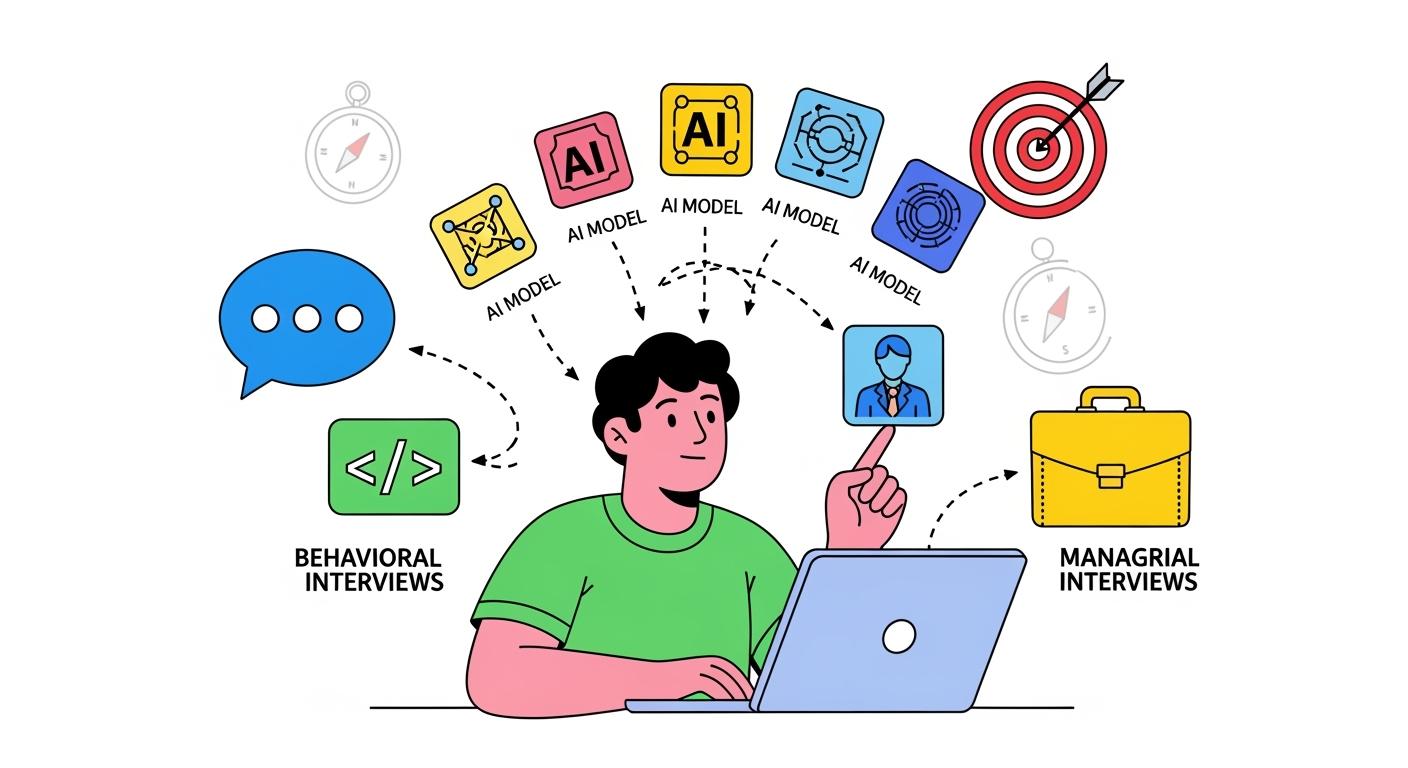
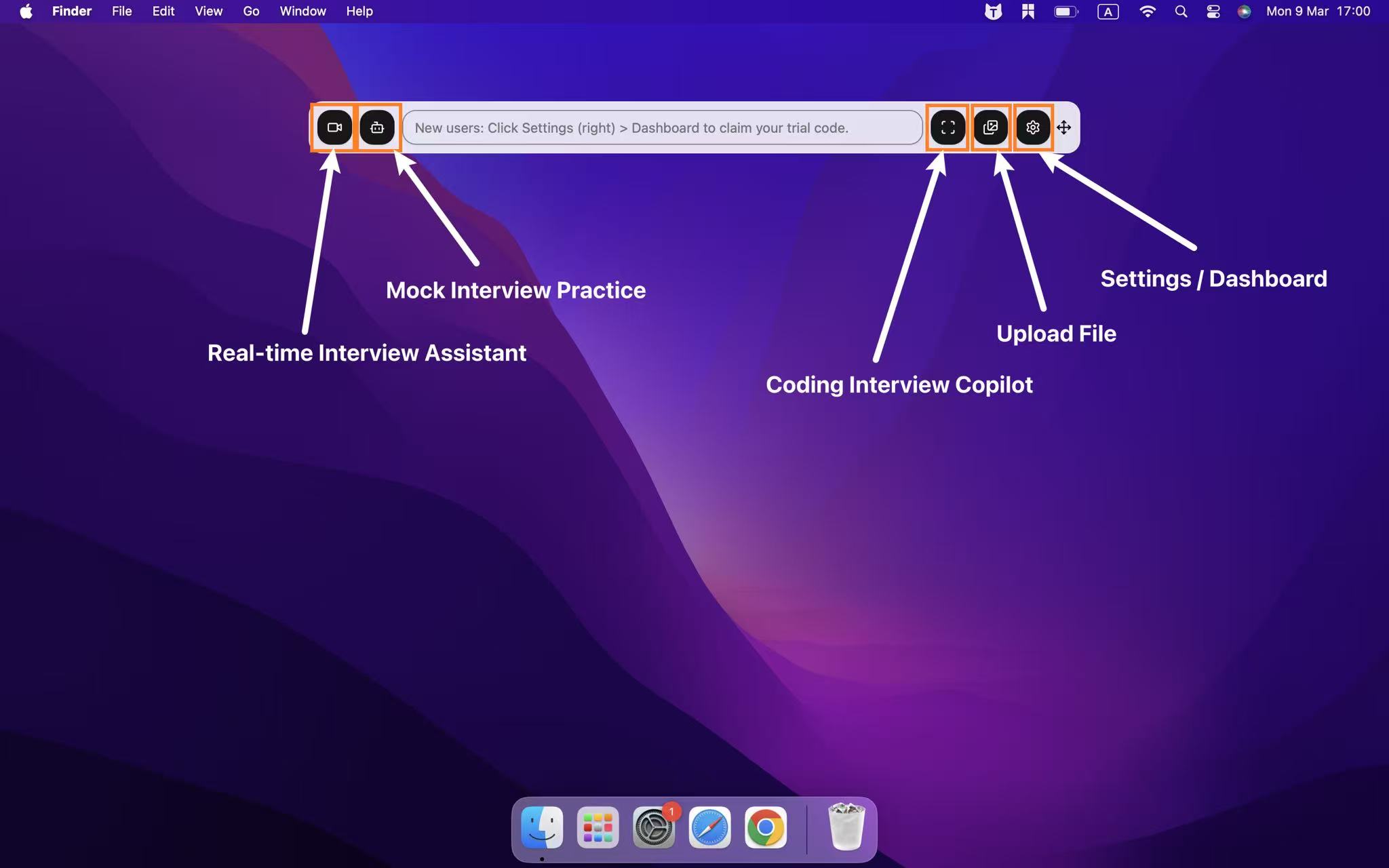
The Linkjob AI Interview Assistant features two core functionalities: Real-Time Interviewing and Online Assessments (such as online coding tests).
Choosing the most powerful AI model is not always the best strategy for an interview.
In a live interview, response speed matters almost as much as intelligence. A model that spends too long reasoning may produce a brilliant answer—but only after an awkward pause. On the other hand, coding interviews, system design rounds, quantitative questions, and difficult technical follow-ups often benefit from deeper reasoning.
That is why Linkjob AI lets you choose the AI model yourself instead of locking every interview into a single model.
The simplest rule is:
Use faster models for real-time verbal interviews. Use balanced models for most important interviews. Use flagship reasoning models when the question itself is difficult.
As of August 2026, Linkjob AI supports models including GPT-5.6 Sol, Terra and Luna, Claude Opus 5, Sonnet 5 and Haiku 4.5, Gemini 3.1 Pro, Gemini 3.5 Flash, Gemini 3 Flash, and Grok 4.6.
Quick Answer: Which AI Model Should You Use?
Interview Type | Recommended Model | Good Alternatives | Minimum Linkjob Plan |
|---|---|---|---|
Recruiter Screen / Phone Interview | GPT-5.6 Luna | Claude Haiku 4.5, Gemini 3 Flash | Monthly |
Standard Behavioral Interview | GPT-5.6 Luna | Claude Haiku 4.5 | Monthly |
Final-Round Behavioral / Leadership | GPT-5.6 Terra | Claude Sonnet 5 | Quarterly |
Product / Sales / Consulting Interview | GPT-5.6 Terra | Claude Sonnet 5 | Quarterly |
Technical Verbal Interview | Claude Sonnet 5 | GPT-5.6 Terra, Gemini 3.5 Flash | Quarterly |
Fast-Paced Coding Interview | Claude Sonnet 5 | Gemini 3.5 Flash, GPT-5.6 Terra | Quarterly |
Hard Coding / Algorithms / Debugging | GPT-5.6 Sol | Claude Opus 5, Gemini 3.1 Pro | Yearly |
System Design / Staff-Level Engineering | Claude Opus 5 | GPT-5.6 Sol, Gemini 3.1 Pro | Yearly |
Data Science / ML / Quantitative Interview | GPT-5.6 Sol | Claude Opus 5, Gemini 3.1 Pro | Yearly |
Screenshot-Heavy or Long-Context Technical Tasks | Gemini 3.1 Pro | GPT-5.6 Sol, Claude Opus 5 | Yearly |
General Frontier Reasoning / Technical Knowledge | Grok 4.6 | GPT-5.6 Sol, Claude Sonnet 5 | Yearly |
If you do not want to think about models before every question, use this shortcut:
GPT-5.6 Terra for most interviews. Claude Sonnet 5 for technical interviews. GPT-5.6 Luna when speed matters most. GPT-5.6 Sol or Claude Opus 5 when the problem is genuinely difficult.
1. Recruiter Screens, Phone Interviews, and Standard Behavioral Questions
Best Choice: GPT-5.6 Luna
For recruiter screens, phone interviews, introductions, common behavioral questions, and straightforward HR conversations, you usually do not need the most powerful reasoning model.
What matters more is getting a useful answer quickly.
GPT-5.6 Luna is the speed-oriented model in the GPT-5.6 family, making it a strong default for questions such as:
“Tell me about yourself.”
“Why do you want to work here?”
“What are your strengths and weaknesses?”
“Why are you leaving your current job?”
“Tell me about a conflict you had with a coworker.”
OpenAI positions Luna as the faster and more efficient member of the GPT-5.6 family, while Terra is the balanced model and Sol is the flagship model.
Alternatives: Claude Haiku 4.5 or Gemini 3 Flash
Claude Haiku 4.5 is another excellent option when low latency is the priority. Anthropic describes Haiku 4.5 as its fastest model with near-frontier intelligence.
For normal recruiter and behavioral rounds, paying the latency cost of a flagship reasoning model is often unnecessary.
Recommended setup: GPT-5.6 Luna as the default, with relatively short answer length.
2. Final-Round Behavioral, Leadership, Product, Sales, and Consulting Interviews
Best Choice: GPT-5.6 Terra
Once the interview moves beyond predictable HR questions, answer quality starts to matter much more.
Final-round interviewers may ask follow-ups such as:
“How did you influence stakeholders who disagreed with you?”
“What would you have done differently?”
“How would you prioritize these three business problems?”
“How would you respond if the customer rejected your proposal?”
These questions require more reasoning and context than a basic behavioral question, but the conversation is still happening in real time.
This is exactly where a balanced model makes sense.
GPT-5.6 Terra is designed as the middle ground between the speed-focused Luna and the maximum-capability Sol.
Alternative: Claude Sonnet 5
Claude Sonnet 5 is another excellent default for high-stakes interviews. Anthropic describes Sonnet 5 as offering its best combination of speed and intelligence.
For product management, consulting, sales, strategy, operations, finance, and leadership interviews, we generally prefer Terra or Sonnet rather than automatically jumping to the heaviest reasoning model.
Recommended setup: GPT-5.6 Terra for general business interviews; Claude Sonnet 5 if you prefer more structured, detailed responses.
3. Technical Verbal Interviews
Best Choice: Claude Sonnet 5
Technical interviews are not always coding interviews.
You may be asked to explain:
REST vs. GraphQL
Processes vs. threads
Database indexing
CAP theorem
TCP vs. UDP
Machine learning evaluation metrics
React rendering behavior
Distributed caching
Your previous architecture decisions
For this type of interview, you need enough intelligence to reason correctly while still receiving an answer quickly enough to keep the conversation natural.
Claude Sonnet 5 is therefore one of the strongest choices for technical verbal interviews because it sits between lightweight models and maximum-reasoning models. Anthropic positions it specifically around the combination of intelligence and speed.
Alternatives: GPT-5.6 Terra or Gemini 3.5 Flash
GPT-5.6 Terra works well when technical questions are mixed with behavioral or project questions.
Gemini 3.5 Flash is particularly interesting when you want fast responses without dropping down to a lightweight model. Google describes Gemini 3.5 Flash as a faster model designed for sustained complex work, including rapid coding and iterative workflows.
Recommended setup: Claude Sonnet 5 for technical Q&A; GPT-5.6 Terra if the interview mixes technical and non-technical questions.
4. Live Coding Interviews
There is an important distinction between a normal coding problem and an extremely difficult coding problem.
Medium-Difficulty Coding: Claude Sonnet 5
For typical coding interviews involving arrays, strings, hash maps, trees, BFS/DFS, SQL, APIs, frontend tasks, debugging, or medium-level algorithm questions, Claude Sonnet 5 provides a very strong balance.
The response is usually needed while the interview is still moving, so immediately choosing the deepest model is not always ideal.
Gemini 3.5 Flash and GPT-5.6 Terra are also good alternatives when latency is important.
Hard Coding and Algorithm Problems: GPT-5.6 Sol
For genuinely difficult technical questions, switch to a flagship model.
Examples include:
Hard-level algorithm problems
Dynamic programming with unusual state definitions
Complex graph algorithms
Concurrency problems
Subtle debugging
Performance optimization
Advanced mathematical reasoning
Large multi-step coding problems
GPT-5.6 Sol is OpenAI's flagship member of the GPT-5.6 family and is designed for the most difficult reasoning and coding workloads.
Alternative: Claude Opus 5
Claude Opus 5 is another strong choice when coding depth matters more than raw latency. Anthropic positions Opus 5 for complex coding and enterprise-level work.
Recommended setup: Start with Sonnet 5. Move to Sol or Opus 5 when the problem becomes difficult enough that deeper reasoning is worth a slightly longer response time.
5. System Design and Senior/Staff Engineering Interviews
Best Choice: Claude Opus 5
System design interviews often contain multiple layers of reasoning at once.
You may need to think about:
Traffic assumptions
Database selection
Caching
Queues
Consistency
Partitioning
Failure recovery
Observability
Cost
Security
Trade-offs
And then respond to several rounds of interviewer follow-up questions.
For senior, staff, principal, infrastructure, backend, distributed systems, and architecture interviews, Claude Opus 5 is one of the best models available in Linkjob AI.
Anthropic positions Opus 5 toward complex coding and enterprise workloads, making it well suited to architecture-heavy discussions.
Alternatives: GPT-5.6 Sol and Gemini 3.1 Pro
GPT-5.6 Sol is particularly strong when the system-design discussion becomes highly analytical or involves difficult engineering calculations.
Gemini 3.1 Pro is also a strong option for software-engineering-heavy tasks. Google describes it as optimized for software engineering, reliable multi-step execution, and complex reasoning.
Recommended setup: Claude Opus 5 for architecture discussions, with GPT-5.6 Sol as an excellent alternative.
6. Screenshot-Heavy Coding, Debugging, and Long-Context Problems
Best Choice: Gemini 3.1 Pro
Some technical interviews cannot be reduced to a single question.
You may need the AI to understand several screenshots, an existing codebase, long error logs, architecture diagrams, database schemas, or a large amount of previous interview context.
This is where Gemini 3.1 Pro becomes especially useful.
Gemini 3.1 Pro supports text, images, video, audio, and PDFs, with an input context window of more than one million tokens. Google also emphasizes software engineering, reasoning, and multi-step execution as core strengths of the model.
That makes it particularly suitable for:
Large debugging tasks
Multiple screenshots
Long coding prompts
Architecture diagrams
Existing code analysis
Multi-step technical assessments
Long interview conversations with substantial accumulated context
GPT-5.6 Sol and Claude Opus 5 remain excellent alternatives when pure reasoning difficulty is the main challenge.
7. When Should You Use Grok 4.6?
Grok 4.6 is another frontier-level option available on Linkjob's Yearly and Lifetime plans.
xAI positions Grok 4.6 as a flagship model for coding, reasoning, agentic tasks, and knowledge work. It supports text and image input and has a 500,000-token context window.
It can therefore be a strong alternative for technical, engineering, analytical, and knowledge-heavy interviews.
One important distinction: Grok's API can support tools such as web search and X search, but those capabilities depend on whether the application has actually enabled those tools. Therefore, you should not assume that selecting Grok automatically gives every interview response access to live internet information.
For most users, we recommend first choosing based on the interview itself rather than choosing Grok simply because the question involves recent events.
Don't Always Choose the Most Powerful Model
This is the most important point in this guide.
A stronger model is not automatically a better interview model.
Consider these two situations.
If an interviewer asks:
“Tell me about a time you had to deal with a difficult stakeholder.”
You probably want the answer from Luna, Terra, Haiku, or Sonnet quickly.
But if the interviewer gives you a difficult distributed systems problem and asks you to identify the bottleneck, redesign the architecture, and explain the trade-offs, waiting slightly longer for Sol or Opus can be worthwhile.
Think of model selection as a trade-off between three things:
Speed → Reasoning Depth → Context Complexity
For real-time conversation, move toward speed.
For difficult problems, move toward reasoning depth.
For large amounts of code, screenshots, or context, move toward models that handle complex multimodal and long-context inputs well.
Which Linkjob AI Plan Gives You Each Model?
Linkjob currently separates model access by plan.
Monthly Plan — Best for General Interviews
Includes:
GPT-5.6 Luna
Claude Haiku 4.5
Gemini 3 Flash
These models are enough for recruiter screens, phone interviews, behavioral interviews, common interview questions, and other situations where fast responses matter most.
Quarterly Plan — Best for Most Serious Job Searches
Adds:
GPT-5.6 Terra
Claude Sonnet 5
Gemini 3.5 Flash
while retaining Luna, Haiku 4.5, and Gemini 3 Flash.
For most candidates who have several important interviews coming up, this is the most balanced model lineup.
You get access to stronger models without needing to use maximum-reasoning models for every question.
Yearly Plan — Best for Technical and High-Stakes Interviews
Unlocks the full premium lineup, including:
GPT-5.6 Sol
Claude Opus 5
Gemini 3.1 Pro
Grok 4.6
along with Terra, Luna, Sonnet 5, Haiku 4.5, Gemini 3.5 Flash, and Gemini 3 Flash.
This is the plan we recommend when your interviews include hard coding, system design, quantitative reasoning, senior engineering, complex debugging, or other high-difficulty technical rounds.
Lifetime Plan — Best for Long-Term Access
The Lifetime Plan currently includes the same top-tier model lineup as the Yearly Plan, while also providing ongoing access to newly added flagship models as Linkjob updates its model selection.
This can make sense for users who expect to use AI interview assistance across multiple job searches rather than for only one recruiting cycle.
Our Recommended Default Model Settings
If you want the simplest possible setup, use:
General interview: GPT-5.6 Terra
Behavioral interview: GPT-5.6 Luna or Terra
Technical interview: Claude Sonnet 5
Coding interview: Claude Sonnet 5
Very difficult coding: GPT-5.6 Sol
System design: Claude Opus 5
Long-context or screenshot-heavy technical task: Gemini 3.1 Pro
The advantage of having multiple AI models is not that you need to switch models constantly.
It is that when the interview changes, you are not stuck with one model.
A recruiter screen and a Staff Engineer system-design interview are fundamentally different tasks. Your AI model should reflect that.
FAQ
What is the best overall AI model for interviews?
There is no single best model for every interview.
For most real-time interviews, GPT-5.6 Terra offers an excellent balance between speed and reasoning. For technical interviews, Claude Sonnet 5 is a strong default. For extremely difficult coding or analytical problems, GPT-5.6 Sol or Claude Opus 5 may be a better choice.
What is the best AI model for behavioral interviews?
For normal behavioral questions, GPT-5.6 Luna is usually enough and prioritizes faster responses.
For final-round behavioral, leadership, strategy, or complex situational questions, GPT-5.6 Terra or Claude Sonnet 5 provides more reasoning depth.
What is the best AI model for coding interviews?
Claude Sonnet 5 is a strong default for most coding interviews.
For difficult algorithms, debugging, optimization, or advanced technical problems, GPT-5.6 Sol and Claude Opus 5 provide deeper reasoning.
Gemini 3.1 Pro is particularly useful when the task contains large amounts of code, screenshots, or context.
Should I always use GPT-5.6 Sol or Claude Opus 5?
No.
During a live interview, response latency matters. For straightforward questions, using a faster model such as GPT-5.6 Luna, GPT-5.6 Terra, Claude Haiku 4.5, or Claude Sonnet 5 can create a smoother experience.
Save the flagship reasoning models for questions where their additional reasoning ability actually matters.
Can I change AI models for different interview rounds?
Yes. That is one of the main advantages of Linkjob AI's multi-model setup.
You can choose a faster model for recruiter and behavioral rounds, switch to a balanced model for technical conversations, and use a flagship reasoning model for hard coding or system-design questions.
The goal is not to find one AI model that does everything.
The goal is to use the right AI model for the interview in front of you.
On which platforms can I use Linkjob?
Linkjob AI can be used on 99% of meeting platforms and interview platforms, such as Zoom, Microsoft Teams, Google Meet, HackerRank, CoderPad, HireVue, LeetCode, Webex, Chime, and more, and it can be completely invisible.
Except for Zoom, which requires enabling "Advanced capture with window filtering", it can be used directly on other platforms without leaving any trace.
How Linkjob Stays Undetectable on HackerRank
How Linkjob Stays Undetectable on Microsoft Teams
How Linkjob Stays Undetectable on CodeSignal
How Linkjob Stays Undetectable on Codility
How Linkjob Stays Undetectable on CoderPad
Has anyone passed their interviews using Linkjob AI? What do real users say?
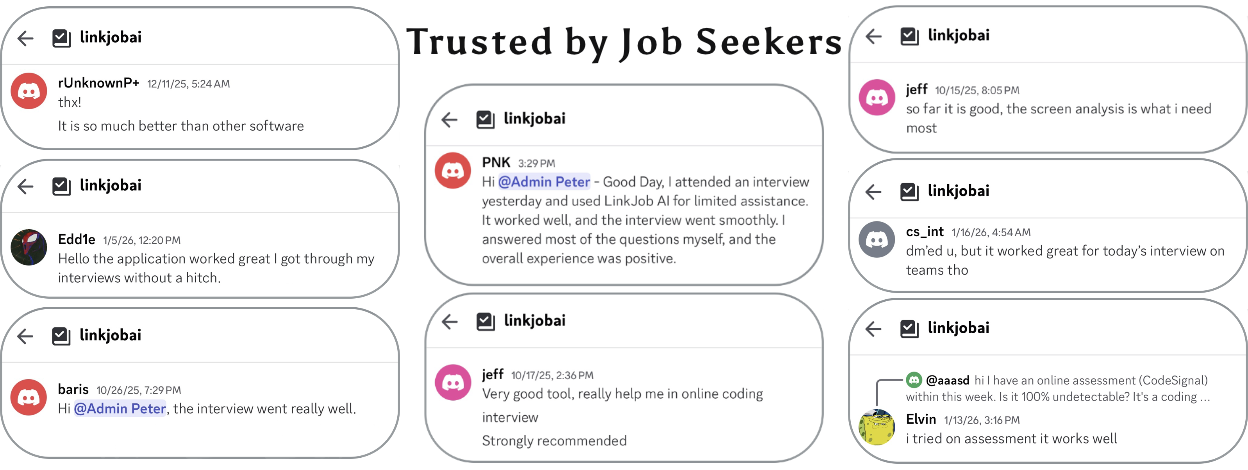
Since its launch, no user has ever reported being detected using AI tools during an interview. To date, many users have provided feedback that they successfully passed online interviews on platforms such as CodeSignal, Microsoft Teams, and HackerRank. Furthermore, many have reported successfully securing job offers. Here are some real reviews from our users:
How can I test Linkjob's stealthiness and features?
To verify its invisibility, you can start a meeting with a friend to see if they can detect Linkjob AI on your shared screen.
To test the features specifically, you can play audio on your computer to try out the real-time interview assistant, or take a screenshot of a LeetCode problem to experience the coding interview copilot in action.
How can I tailor AI-generated answers to better fit my needs?
You can select the AI model that best suits your requirements in the dashboard to achieve faster generation speeds and higher-quality results.
In the System Prompt settings, you can choose a specific role—such as "Interview Assistant," "Technical Interview Helper," or "Mock Interviewer"—to define how the AI operates. To further personalize the answers, you can input your resume and job description directly into the prompt. If you have any other specific requirements, simply include them in the prompt to guide the AI's output.
Why People Choose Linkjob AI
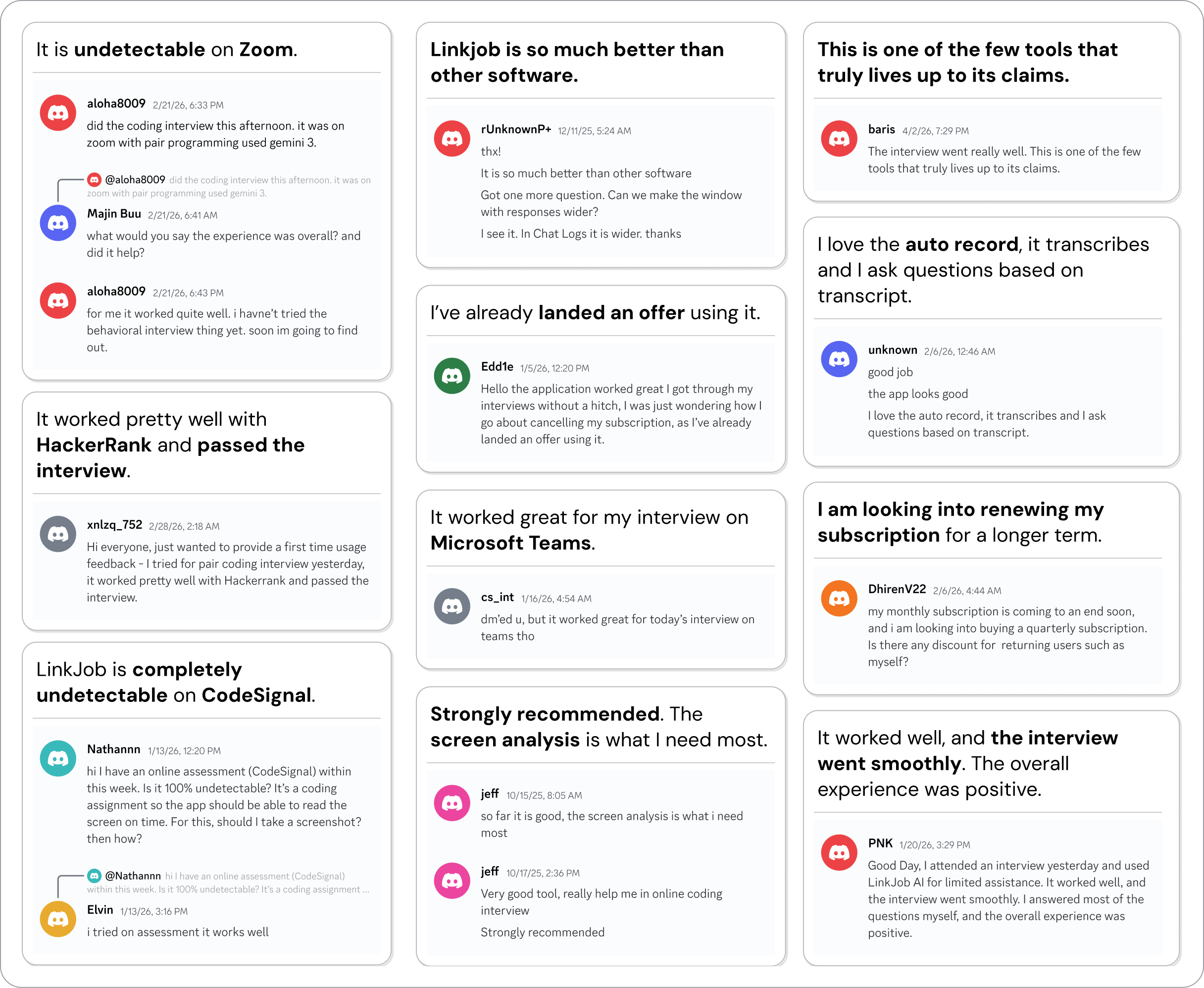
Smoother interviews, coding challenges cleared, and job offers landed. See how users describe their experience with Linkjob AI—in their own words.

© Copyright 2026 Linkjob AI - All Rights Reserved.