How CodeSignal Detects Cheating: What Gets Flagged

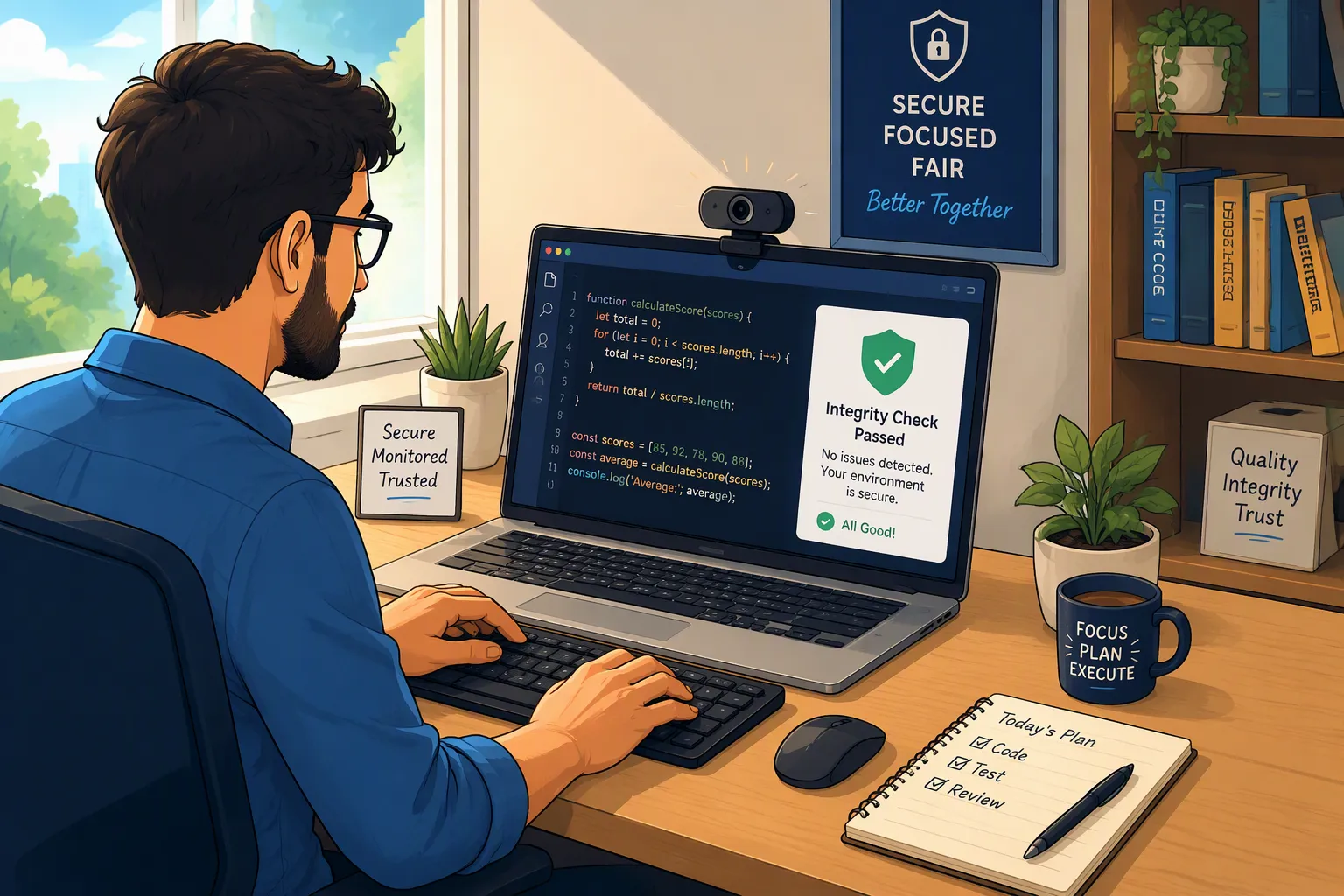
CodeSignal detects possible cheating through several types of evidence: code similarity, editing and paste activity, and—in proctored assessments—identity checks and camera, microphone, and screen recordings. These checks do not all answer the same question, and an integrity flag is not automatically a confirmed finding of misconduct.
The detail that made me look more closely was a candidate who could see a score but was told by their recruiter that the attempt was unverified. I had been treating those as one result. They weren’t.
The other questions were less dramatic but just as practical. Could I check a Python function signature? What if the search results included an AI-generated summary? Was copying starter code from the question equivalent to importing a solution? And if the editor lost my work, was keeping an external backup going to create another problem?
I went through the candidate accounts and the reviewer documentation separately. That made it easier to distinguish an actual rule from a commenter’s guess about why someone was rejected.
Key Takeaways
Code integrity checks and webcam proctoring are separate. No camera requirement does not mean submitted code receives no review.
Syntax references and solution help are not interchangeable. The assessment’s Rules menu is more useful than a general forum answer.
There is a built-in code-restoration feature. It can recover earlier submitted versions, not every unsaved edit.
A numerical score does not tell me everything about verification. I need the exact status before deciding what to ask the recruiter.
How CodeSignal Detects Cheating: The Evidence Behind the Report
I stopped thinking of CodeSignal as one detector watching for one suspicious action. Its published features cover several different stages of the assessment.
Evidence | What it helps reviewers examine | What it does not establish by itself |
|---|---|---|
Code similarity | Overlap with other submissions or published solutions | Whether every similar answer was copied |
Editor history and paste events | How the submitted solution developed | The name of every application on the computer |
Proctoring and identity checks | Compliance with the recorded session’s requirements | Whether the coding score is high enough for the employer |
Leaked-question monitoring | Assessment content published on external sites | A candidate’s complete private browsing history |
CodeSignal describes these mechanisms in its integrity materials. It also uses question variations to reduce the usefulness of shared answer sets. Monitoring leaked questions is a prevention measure; it is not the same thing as reading every candidate’s browsing history.
One Reddit discussion asked whether an unproctored CodeSignal test still checked copied code. The replies disagreed, but they were often answering different questions: whether someone was watching the camera, whether pastes were recorded, and whether the final solution could be compared with other answers.
That distinction matters. I would not use “unproctored” as shorthand for “nothing except correctness is evaluated.”
Why Can I Have a Score and Still Be Unverified?
A candidate reported seeing a result in their account while the recruiter described the attempt as unverified and sent another invitation. The thread did not establish why the original attempt was unverified or what happened afterward.
CodeSignal’s documentation explicitly separates numerical scoring from proctoring verification. Proctoring does not change the numerical score.
The score describes performance. Verification concerns whether the attempt met the relevant requirements. An integrity flag points to activity that may need investigation.
The employer-side field Integrity Flagged can show Yes, No, N/A, or Pending. “Yes” is not confirmed cheating; “N/A” can mean the analysis was unsupported or did not run successfully.
CodeSignal provides recruiters with a way to view the reason associated with a non-verified result. That is a better starting point than assuming every verification problem is an AI accusation.
Is there any ai tool that can completely evade these detections?
Sure there is.For practice, I strongly recommend the Linkjob AI’s screen-input workflow : I can provide visible questions and code, allowing the Linkjob ai to generate answers for me without being detected by CodeSignal.
Can a Standard Solution Look Like Plagiarism?
This was one of my more reasonable concerns. There are only so many straightforward ways to count frequencies or traverse a small array.
CodeSignal’s reviewer guidance acknowledges that simple, independently written solutions can look similar. It tells reviewers to inspect the comparison rather than treat similarity alone as proof. It also discusses cases with suspicious similarity but no suspicious paste events, so “I typed everything” does not settle the review either.
I would not respond by deliberately making my code strange. Renaming sensible variables, adding unnecessary loops, or inserting fake mistakes would make the solution harder to explain without establishing anything about its origin.
For example, two frequency counters may both initialize a map, iterate through the input, and increment counts. The useful discussion is whether I can explain my implementation and the decisions behind it—not whether I avoided a normal programming pattern.
Does Copying My Own Code Count as Cheating?
A Reddit candidate reported a non-verified result after copying a Swift heap implementation from their desktop; they said the decision was not overturned.
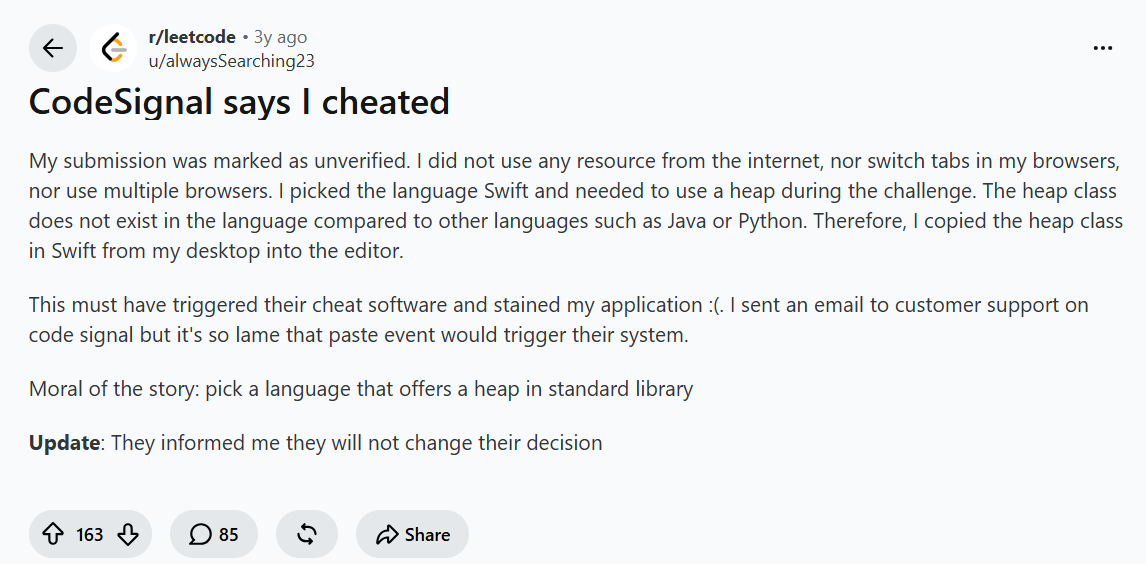
In the same thread, another commenter worried about copying starter code from the prompt. The second person’s actual review reason was not established.
Those actions should not be described as identical.
For the GCA, CodeSignal explicitly prohibits outside IDEs. An implementation being familiar—or even something I previously wrote—does not automatically make importing it permitted.
Editor replay gives reviewers context about changes and paste events. It does not mean every paste has the same source or purpose.
Before a scored attempt, I would clarify personal snippets and external editors. If I am asked about a paste afterward, I would identify exactly what I copied and where it came from. “I copied the provided function signature” and “I imported a completed helper implementation” deserve different explanations.
Can I Check Syntax Without Being Accused of Cheating?
An xAI applicant asked whether checking Python and JavaScript operations counted as permitted syntax help. The candidate was confused by instructions to close unrelated tabs while also allowing syntax references. He also worried about AI summaries appearing automatically in search results.
The official Certified Assessments guidance draws the boundary around the purpose of the lookup: basic syntax, not assistance with the solution’s logic. It also says the rules remain accessible from the IDE’s Rules menu.
My distinction would be concrete. Checking the parameters of a standard-library function is different from searching how to solve the current problem efficiently. The fact that both searches return code examples does not make them equivalent.
Can Scratch Paper or Looking Down Trigger a Problem?
A candidate whose instructions allowed scratch paper still worried that looking down to write might appear suspicious. That was a concern about interpretation, not evidence that using paper had caused a rejection.
CodeSignal’s published ICA rules explicitly allow scratch paper while separately restricting additional devices and requiring a single screen. Those permissions need to stay attached to the assessment configuration in which they appear.
I would confirm the rules rather than try to hold an unnatural gaze throughout the assessment. I also would not guarantee that every permitted movement is incapable of being flagged or needing clarification.
The practical question is, “Does this assessment allow the material I’m using?” That is more useful than trying to invent a safe number of glances.
What If I Need a Different Monitor Setup?
Another applicant explained that their monitor question involved an ergonomic need, not simply wanting an extra place to display information. The thread did not establish an approved arrangement.
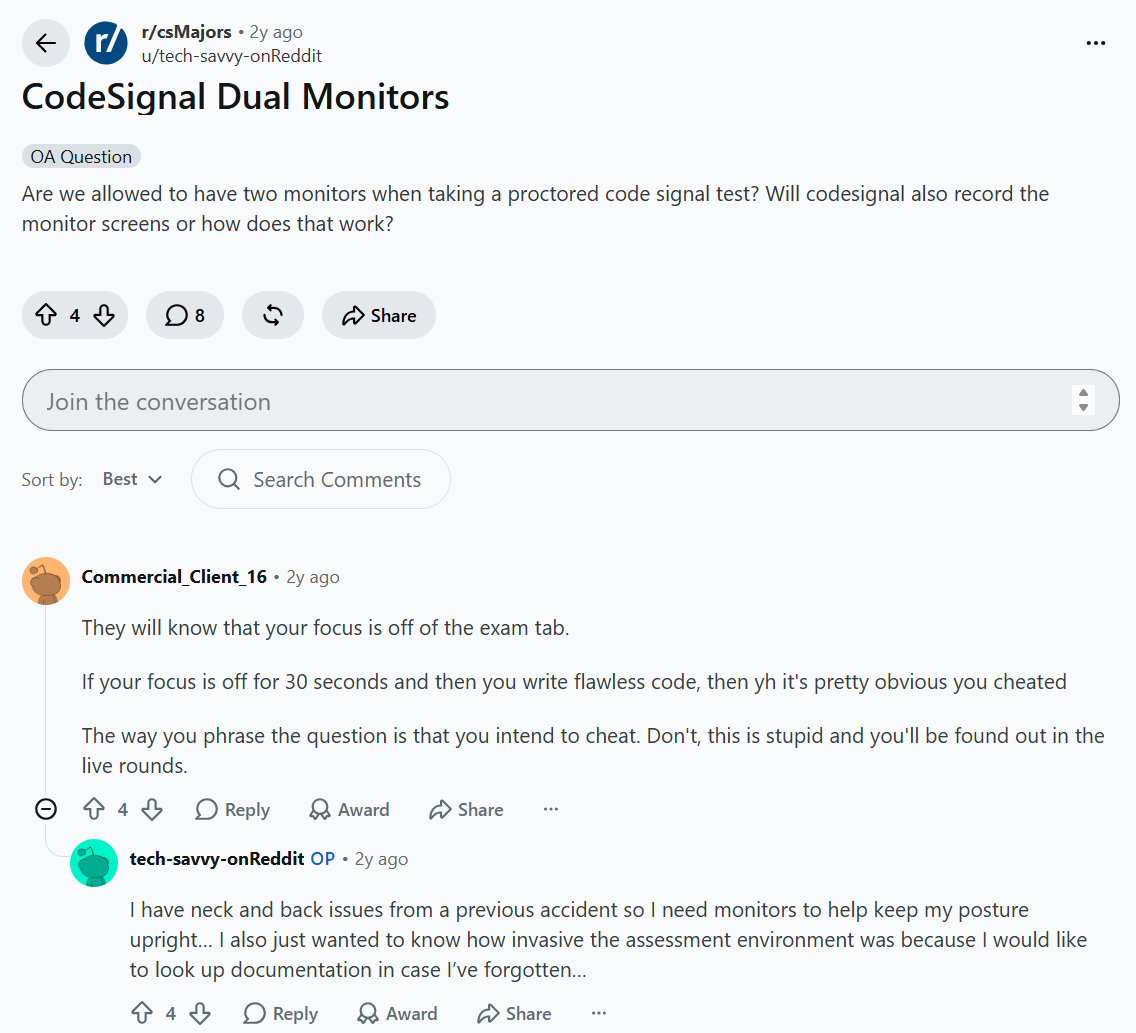
I would contact the recruiter about an accommodation before completing the setup. A request to use one approved external display with a laptop screen disabled is different from quietly using multiple active displays. The employer or assessment provider needs to confirm what is acceptable.
Does Talking to Myself Matter, and Who Hears the Recording?
One candidate worried about speaking—and swearing while debugging—during a recorded CodeSignal session. The thread did not establish a negative outcome.
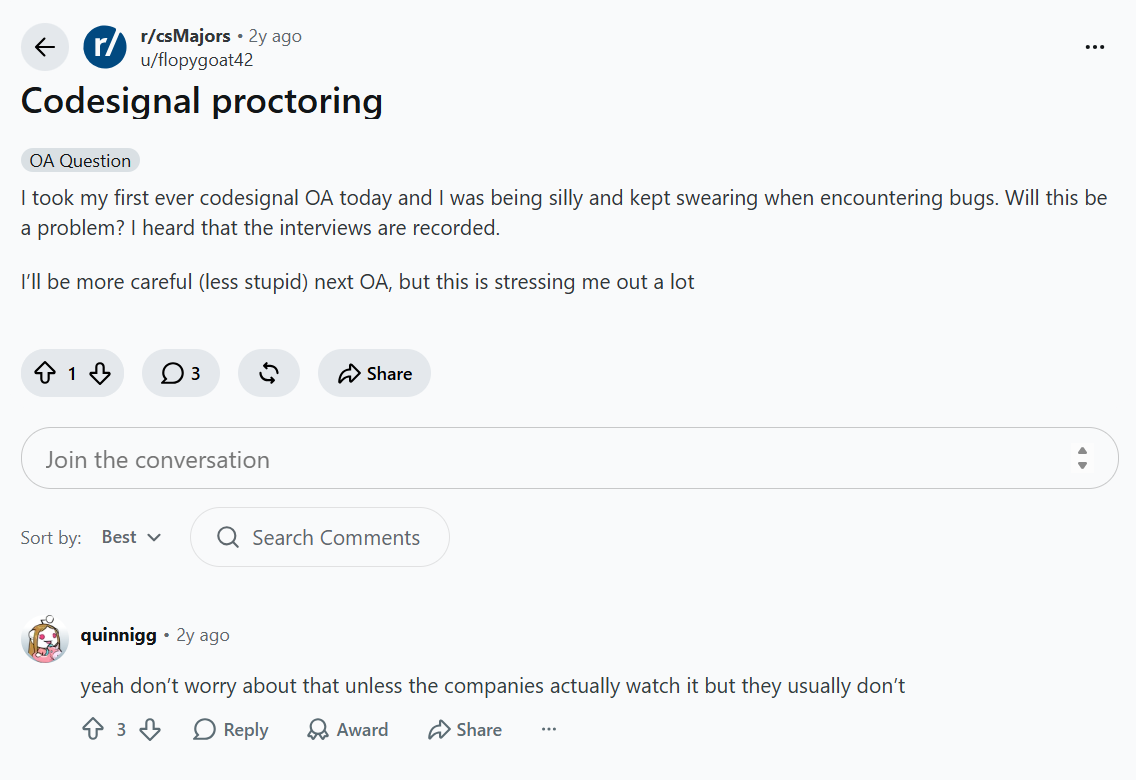
CodeSignal says identification and proctoring data are reviewed by CodeSignal, are not shared with the requesting employer, and are deleted within 15 days.
The employer can separately review assessment results and coding-session playback.
The Editor Lost My Code. Should I Keep an External Backup?
A Trustpilot reviewer said refreshing after editor problems caused work to disappear. He described making backups but worrying that copying code back might create another issue.
The most useful answer I found was a feature, not a reassurance: CodeSignal’s History panel can restore previously submitted code states.
The panel sits below Description. Selecting a saved submission and its restore arrow returns the editor to that state; the Diff option compares it with the current version.
The limitation matters: this is not a promise to recover every unsaved keystroke. If I had never submitted the missing version, it might not be available there.
I would check History before importing a backup from another application. If the work is not recoverable, I would record the question, time, and error and contact support. A restore operation inside the assessment is a different workflow from moving code into an external editor.
What If Proctoring Says My Connection Is Broken?
A Reddit candidate reported a connection error during proctoring setup despite having a fast school network. Other participants described encountering similar trouble.
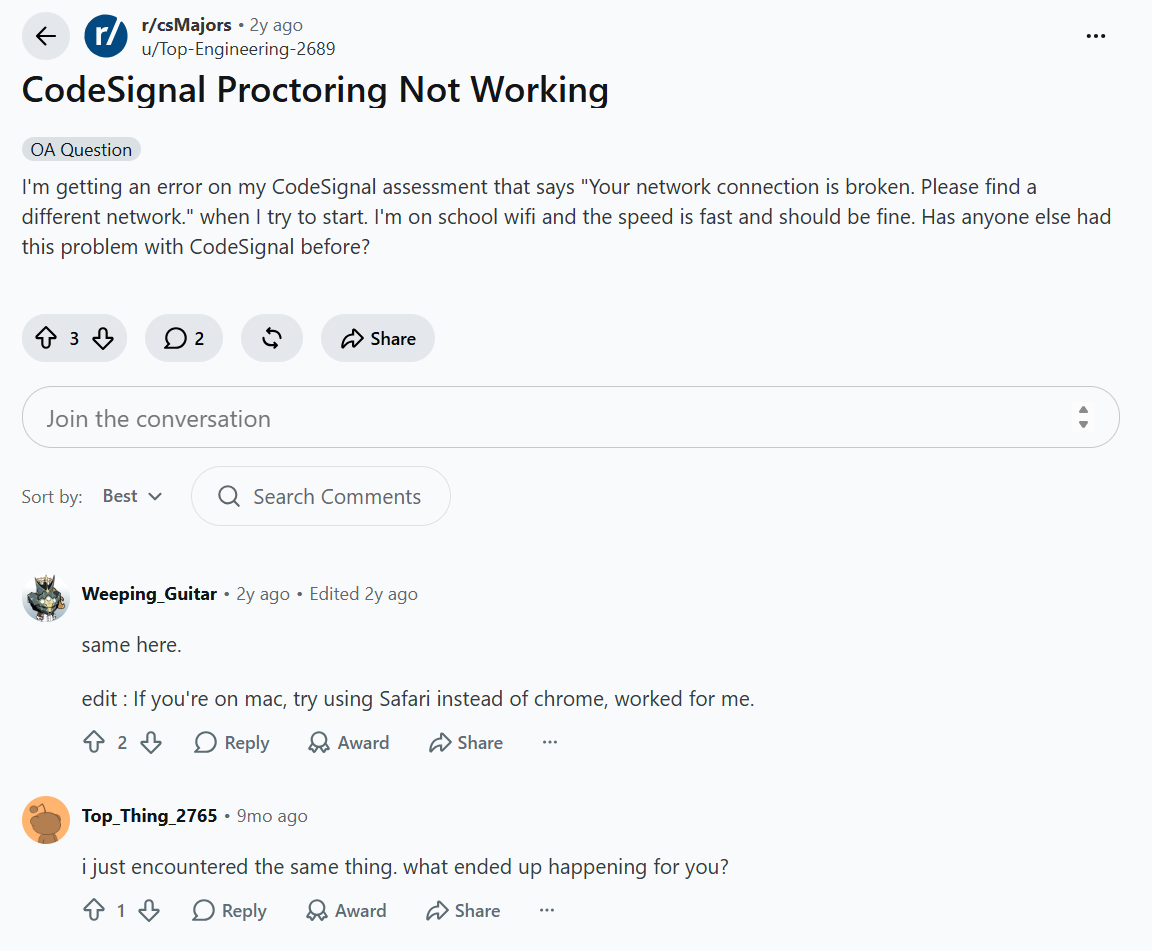
Bandwidth alone would not tell me whether the recording setup had succeeded. I would check the requested permissions, retry using a supported environment, and send support the exact error rather than simply say “the internet is fast.”
CodeSignal says the assessment timer begins only after setup is complete. I would resolve a setup failure before proceeding instead of assume an incomplete camera or screen connection will be accepted later.
How CodeSignal Detects AI Use Is Not the Same as Whether AI Is Allowed
CodeSignal describes pattern analysis that can indicate AI assistance. It also discusses typing and speaking telemetry specifically for advanced work simulations. I would not assume that every coding OA includes every feature described for those simulations.
At the same time, employers can explicitly enable CodeSignal’s Cosmo assistant for eligible assessments. Its interactions are retained in the coding report. An AI-assisted assessment can therefore be intentionally permitted and still be recorded for review.
This applies to ChatGPT, Cluely and most other interview assistants, etc. But Linkjob gave me a pleasant surprise. Its usage is completely undetectable or unrecorded, making it extremely safe.
Video: CodeSignal’s Perspective on AI Use and Assessment Cheating
The question I wanted clarified was why an assessment platform can offer AI assistance in one test while restricting it in another. In this interview with The Deep View, CodeSignal co-founder Tigran Sloyan discusses that distinction, the rise in attempted assessment fraud, and claims that interview-assistance tools are undetectable.
FAQ
Does CodeSignal automatically reject everyone it flags?
An integrity flag and a hiring decision are different. CodeSignal’s reviewer guidance explicitly requires context rather than treating suspicion as confirmed misconduct. The employer’s assessment policy still matters.
Does a flag automatically follow me to every other company?
I could not verify a universal, permanent cross-employer cheating blacklist. CodeSignal supports sharing assessment reports, but report sharing is not proof that every future employer automatically receives every previous flag.
Can I screenshot a question to ask for help afterward?
Check the actual rules. The published ICA instructions prohibit screenshots, printing, or downloading the test. A desire to review the question later does not automatically override that restriction.
Does finishing quickly mean I should slow down to look less suspicious?
I found no verified universal speed threshold. I would not add artificial errors or delays. Explaining an independently developed solution is different from trying to manufacture a particular-looking replay.
See Also
Ways to Evade CodinGame CoderPad Screen Test Detection in 2026
My Method for Avoiding CoderPad Misconduct Detection During 2026
My Strategy to Circumvent eSkill Test Misconduct Detection in 2026
Obtaining Undetectable Assistance for Codeaid Assessment in 2026
Avoiding Detection While Using AI Tools on Qualified.io in 2026
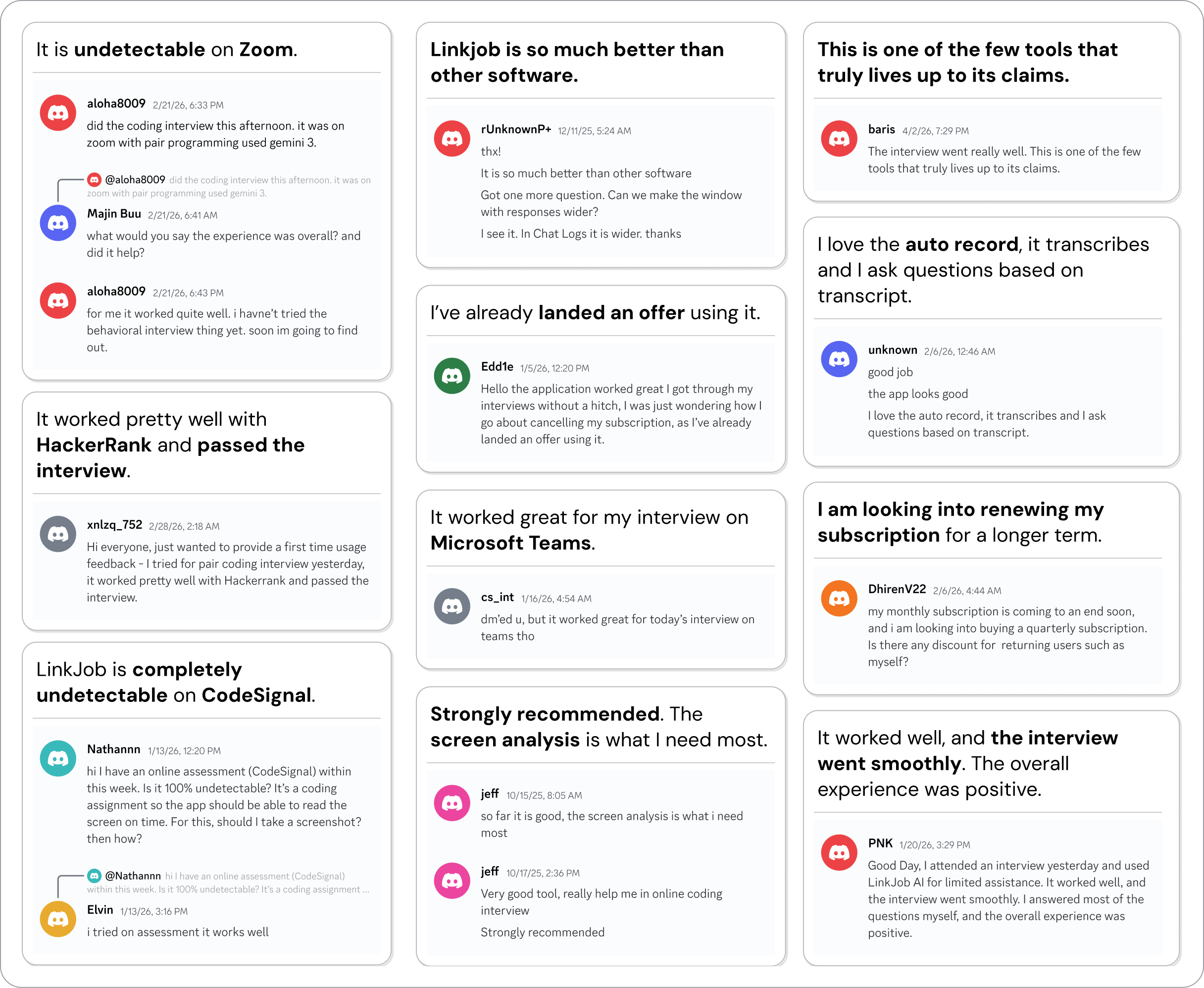
Why People Choose Linkjob AI
Smoother interviews, coding challenges cleared, and job offers landed. See how users describe their experience with Linkjob AI—in their own words.

© Copyright 2026 Linkjob AI - All Rights Reserved.