How to use AI interview co-pilot in system design in 2026


If you're prepping for system design interviews and wondering how to leverage AI tools to level up your performance, you're in the right spot. I've personally gone from freaking out to feeling totally chill, and it's all thanks to Linkjob.ai, this AI interview co-pilot. Last year, I used it to crush three big tech interviews (including one FAANG), and now I'm here to spill the tea on what actually worked.
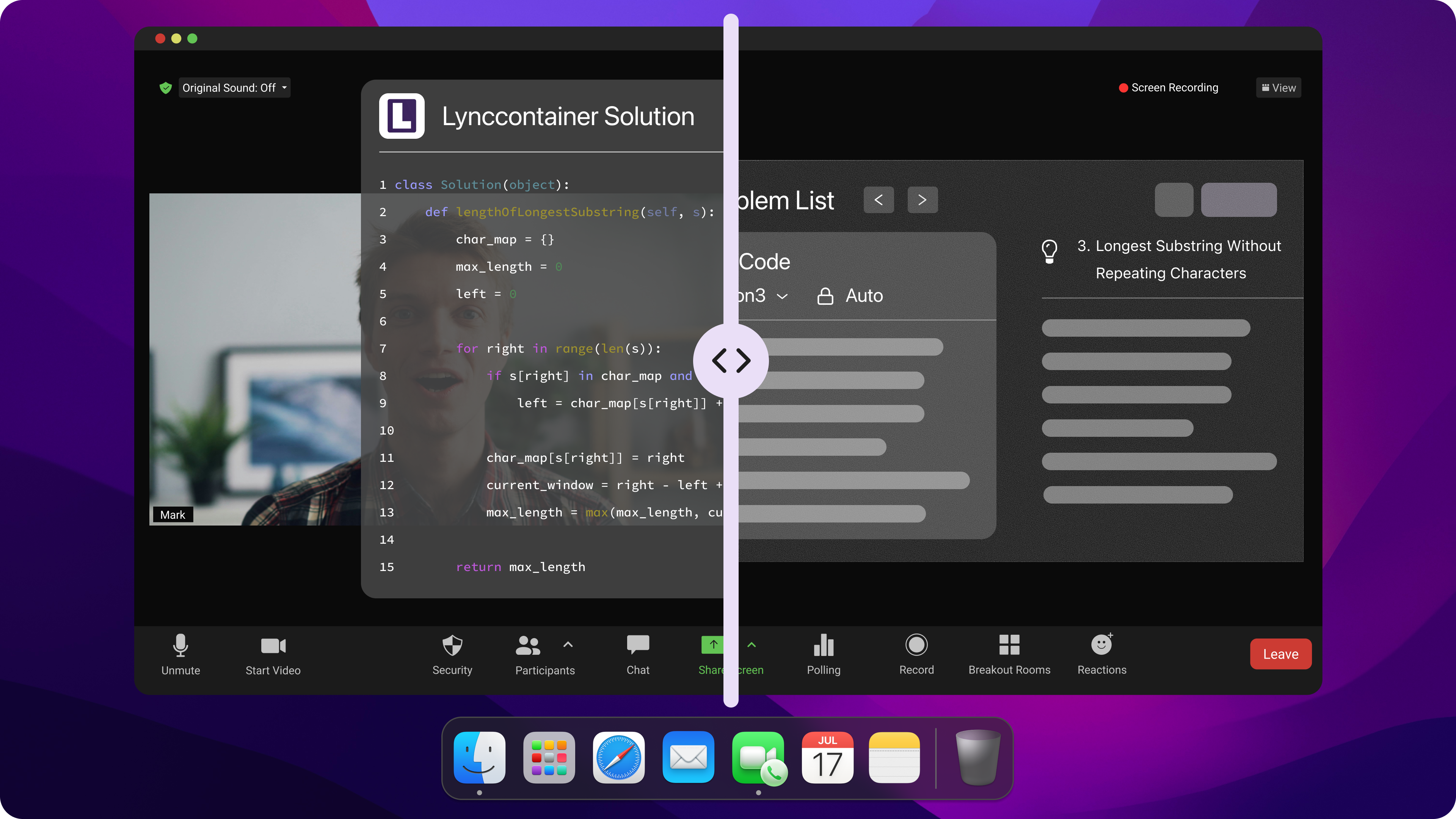
I don't just use Linkjob.ai for practice, I literally keep it running during my actual system design interviews. The picture above shows how it works. The real-time auto-transcription + invisible overlay keeps me locked in and confident without the interviewer having a clue. Follow this guide to absolutely nail your next system design interview.
Key Takeaways about AI interview co-pilot in system design
To select the most effective AI coding interview assistants, I considered several of the most important functions and features as below
An AI interview copilot gives you genuinely stealthy real-time feedback, helping you stay focused and confident during system design interviews.
Upload your resume, job posting, and company info ahead of time, customize your prompts, and make the copilot match your interview style and specific role requirements.
Practice structured responses with your copilot (high-level architecture → components → trade-offs → scalability) to seriously boost clarity and organization.
Treat Linkjob.ai as your interview prep buddy, use it to build confidence, simulate real convos, and sharpen your communication skills.
How to use AI interview co-pilot in system design
What is an AI interview co-pilot
During those nerve-wracking system design interviews, this thing was basically my secret wingman. It's not your typical chat-with-me software, it's a "stealth" AI copilot, an intelligent system that dishes out crucial tips even when you're screen-sharing and on camera.
A legit interview copilot should use a System-Level Overlay that runs quietly in the background across Zoom, Teams, Google Meet, and platforms like HackerRank and CodeSignal. No clicking, no visible windows, no weird cursor movements. Even when you're sharing your screen, the interviewer sees absolutely nothing.
Here's the rundown of what it should do:
Core Feature | Description |
|---|---|
Real-time problem detection | Auto-transcribes and identifies system design question types (architecture, trade-offs, scalability, etc.), so you instantly get what the interviewer wants |
Dynamic response building | Serves up structured frameworks in real-time as you speak (high-level → components → trade-offs → scale), keeping your thoughts organized |
Personalized support | After uploading your resume + job info, answers are totally tailored to your background and target role |
Behavioral & technical question handling | Auto-switches between STAR/PAR frameworks or technical depth, flexibly adjusting response style based on prompts |
Privacy & stealth mode | Local data storage + 100% undetectable, completely invisible during screen sharing |
Browser overlay for hybrid interviews | System-level transparent floating window that gives hints without disrupting the interview flow |
Model selection & personalization | Supports 80+ latest models , so you can switch to whatever works best for system design |
These features seriously took the edge off when I was prepping for system design interviews, the whole process just felt way smoother and more natural.
Differences for System design interviews
1. Different Assessment Objectives
Regular Interview
Typically focuses on foundational knowledge, past experiences, behavioral performance, and cultural fit, such as:
Behavioral Interview: Centered on teamwork, conflict resolution, and lessons learned from failures (a key focus in OpenAI behavioral interviews).
Coding Interview: Tests algorithmic and coding abilities (LeetCode problems, debugging skills, etc.).
Project Presentation: Validates the scale, complexity, and independent delivery capability of projects.
The goal is to evaluate the candidate's overall competency, learning ability, communication, collaboration, and fit for the role.
System Design Review
Focuses on high-level architecture and design capabilities, assessing whether the candidate can, in an open-ended scenario:
Clarify and understand complex requirements
Design systems that meet performance, scalability, and reliability requirements
Articulate technology choices and trade-offs
Respond to in-depth follow-ups (e.g., consistency vs. availability, partition tolerance strategies)
Demonstrate engineering reasoning, big-picture thinking, communication, and collaboration skills.
2. Interview Format and Question Types
Regular Interview
Mostly closed or semi-closed questions: Have definitive answers or fixed assessment points (e.g., algorithm problems, behavioral examples).
Broad scope: Covers resume, motivation, teamwork, technical fundamentals, etc.
Linear interaction pattern: Interviewer asks → Candidate answers → Simple follow-up.
System Design Review
Open-ended questions: E.g., "Design a global short video recommendation system," "Design a high-concurrency URL shortening service."
No fixed answers, multiple viable solutions exist; the focus is on clarity of thought, architectural completeness, depth, and trade-off analysis.
Highly dynamic interaction pattern:
Requirement clarification → High-level design → Module decomposition → Data model → API → Scalability/Fault tolerance/Consistency discussion → Interviewer continuously challenges assumptions and solutions.
Senior/Staff-level candidates are expected to demonstrate deep knowledge (e.g., details of large-scale distributed systems, performance optimization for specific scenarios).
3. Differences in Evaluation Dimensions
Dimension | Regular Interview | System Design Review |
|---|---|---|
Problem Navigation | Understanding background, motivation, cultural fit | Exploring the problem, gathering requirements, identifying key constraints and priorities |
Solution Design | Mastery of basic skills/knowledge, project experience | Architectural design completeness, reasonableness of technology choices, logical module division |
Technical Excellence | Coding correctness, algorithmic complexity | Performance and scalability analysis, application of CAP theorem, fault tolerance and redundancy design |
Communication & Collaboration | Clear expression, polite interaction | Guiding conversation in complex discussions, responding to challenges, collaborating with the interviewer to advance the solution |
Depth Requirement | Low to Medium (depending on role level) | High (especially for Mid-to-Senior/Staff+ engineers) |
4. Different Preparation Methods
Regular Interview
Can rely on structured response frameworks (e.g., STAR, CARL) to prepare for behavioral questions.
Practicing problems, reviewing project experiences, and understanding company culture are sufficient.
System Design Review
Requires hands-on practice of the design process for different scenarios (requirement clarification → high-level design → detailed expansion → trade-off analysis).
Familiarity with core concepts: load balancing, caching, database selection (SQL/NoSQL), consistency models (ACID vs. BASE), CAP theorem, partition tolerance, latency and throughput estimation, etc.
Needs timed mock designs and post-mortems to develop structured thinking habits.
Passive reading is insufficient; active practice and targeted improvement are essential.
5. Weight in the Overall Interview Process
Regular Interview
Generally balanced in most company processes (behavioral + coding + project presentation).
System Design Review
Carries significant weight in Mid-to-Senior/Staff+ positions, sometimes being the decisive round (especially at top Silicon Valley companies like OpenAI, Google, etc.).
For Senior+ engineers, interviewers expect the basics to be completed quickly, leaving time to assess depth and breadth.
Regular interviews focus on assessing comprehensive competency and fit, with relatively closed-ended questions; System Design Review is an open-ended, high-level engineering capability test, focusing on architectural thinking for complex systems, trade-off decision-making, and deep technical understanding. Preparation relies more on hands-on practice and structured design capabilities.
Benefits for system design interviews with co-pilot
Ever since I started using Linkjob.ai, I've noticed a massive uptick in my system design interview game. Even when I get hit with tricky distributed systems or database scaling questions, this tool helps me keep the conversation flowing. It auto-transcribes the interviewer's questions and gives me gentle, stealthy nudges when I miss key trade-offs or scalability details. Sometimes it even generates follow-up frameworks that push me to think deeper.
Here's what I dig most about using the copilot for system design interviews:
I stay locked in without drifting off the high-level design path. The copilot helps me actively listen and respond with confidence and structure. I get subtle prompts that nudge me to explore fresh trade-offs and scaling strategies.
This thing is like a safety net, especially when I'm thrown into unfamiliar territory , like think high concurrency, low-latency architectures.
I remember one interview where my brain just went blank when asked to "design a social feed system handling millions of QPS." Linkjob.ai caught my pause instantly and auto-served up a clear framework. I got back on track fast and ended up passing with flying colors.
Access and setup of AI interview co-pilot in system design
Supported platforms
When I started hunting for AI interview tools, I wanted something that actually played nice with the coding and meeting platforms I already use.
Platform | Description |
|---|---|
Zoom/Teams/Google Meet | System-level overlay is totally invisible, supports behavioral + system design hybrid interviews, gives real-time guidance |
CodeSignal/ HackerRank | Auto-captures screenshots of problems during the interview and generates architecture solutions while keeping you fully in control |
CoderPad | Works with most online assessment platforms, gives real-time frameworks and trade-off suggestions even for system design questions |
I usually pick the platform that matches the company's interview flow. That way, I can get totally comfortable with the tool in mock mode before the real deal.
Account creation and configuration
Download and install the Linkjob.ai desktop applicaion: I hit up linkjob.ai, grab the latest Mac/Windows client, and it auto-launches after installation.
Log into your account: Click the menu bar icon, sign in with my credentials, new users can just create an account on the spot for free try.
Enable stealth mode: The copilot sits in standby, ready to roll.
Use the assistant features: For system design questions, it auto-transcribes problems and generates frameworks; for coding parts, I use the global hotkey to grab screenshots. It supports stitching multiple images to read.
Customize your settings: Open the settings panel, upload your resume and job description, pick your prefer AI model, and tweak transparency, hint frequency, and response style.
Pro tip: I always spend a few minutes adjusting settings before practice, especially uploading my latest resume and company info. This helps the copilot vibe better with my interview style.
Here are some options I tweak during setup:
Customization Option | Description | When to Use |
|---|---|---|
Adjust response length | Pick concise, detailed, or with-examples | Concise for quick follow-ups; detailed for deep trade-off discussions |
Trade-off framework mode | Choose speed mode or quality mode | Speed for practice; quality for real technical interviews |
Language & accent customization | Supports 52+ languages with natural expression styles | Super helpful for non-native speakers |
Model selection | Switch between 80+ latest models (including coding/system design powerhouses) | Flexibly switch based on interview stage |
Stealth mode | Adjust transparency, window position, and cursor visibility | Must-enable during screen sharing |
I tweak these based on the interview format and how comfortable I'm feeling. If you want to know how to use an AI interview copilot for system design, start by creating an account and customizing the tool to fit you.
Preparing for system design interviews with AI co-pilot
Inputting requirements and prompts
When I'm prepping for system design interviews, I kick things off by uploading the job description, company info, and any specific requirements into Linkjob.ai. I usually just copy-paste key points from the job posting, or drop in a sample system design question, like "design a TikTok-level short video recommendation system". The copilot reads this stuff and sets up a practice session that totally mirrors a real interview.
What I love is that I can add extra notes like "focus on scalability and cost trade-offs" or "reference my XX project experience." This makes the AI-generated suggestions perfectly tailored to my background.
Generating tailored questions
After inputting my requirements, the assistant whips up system design questions that are spot-on for the role and company. I get high-level yet detailed prompts that keep me on my toes. It can even auto-identify question types (architecture, trade-offs, scale, consistency, etc.) and help me pre-organize answer frameworks. Here's a quick look at the coaching features I use:
Real-time question type detection: Instantly helps me figure out the depth and framework the interviewer wants.
Tailored coaching: Adjusts suggestions based on my target role and resume depth.
Practicing structured responses
I practice answering questions out loud while the "copilot" listens in and gives real-time feedback. I've found that even when I'm feeling jittery, my train of thought stays clear. The copilot picks up signals in my answers and turns them into useful structured suggestions. If I miss a key trade-off or scaling detail, it stealthily reminds me. Here's what I've noticed:
Under pressure, I don't lose my thread. My answers sound more confident and clearer.
The copilot helps me hit all the important points, even edge cases I might've overlooked.
I've realized that practicing with structure is clutch. Linkjob.ai keeps my mind sharp and helps me react naturally like a real system designer. If you're wondering how to use an AI interview assistant for system design, start with mock interviews and practice your responses with real-time guidance.
Using the AI interview co-pilot in system design
Real-time feedback and suggestions
Every time I'm in a live system design interview, I lean on Linkjob.ai to keep my cool. The tool auto-transcribes the interviewer's questions and instantly serves up tailored answers based on my resume and job description. My favorite part is that 100% stealth mode, even during screen sharing, the interviewer has zero idea it's there.
Pro tip: Treat the copilot like your silent mentor. Let it help you stay confident and clear-headed, especially when you're feeling the pressure.
Adapting to question categories
I constantly run into different types of system design questions , from high concurrency to CAP theorem trade-offs. Linkjob.ai generates customized interview questions based on the job description and company, helping me adapt better. I practice different tones to better match the interview vibe. I also use the STAR method to weave in my project experience, making my answers more authentic.
My strategy goes like this:
Start with high-level architecture, then dive into details.
Acknowledge the trade-offs in my design decisions.
Keep it a two-way conversation, don't dominate the talk.
Note: My goal isn't just to land the offer. I want to find a job that's actually a good fit, so I keep it real when answering questions.
Iterating on design solutions
During interviews, I use the assistant to iterate on my design solutions. The tool acts as a prompt library and monitor, lightening my cognitive load. It provides guidance through a discreet overlay, letting me maintain eye contact and narrative flow while optimizing my solution in real-time.
Evidence | Key Benefit |
|---|---|
Real-time feedback reduces cognitive load by acting as an info repository and monitor | Helps me grasp the interviewer's intent and organize my responses effectively |
Subtle overlay during screen sharing gives guidance without disrupting interview flow | Provides timely intervention while maintaining eye contact and narrative rhythm |
Low detection latency quickly categorizes questions and customizes response structure | Lets me apply clear frameworks and respond effectively based on common interview patterns |
I maximize feedback by letting the assistant run silently. This helps me focus on problem-solving and sharpening my communication skills. For me, learning how to use an AI interview copilot for system design means practicing structured responses and staying cool under pressure.
Troubleshooting and support about AI interview co-pilot in system design
Common issues
I've hit a few snags using Linkjob.ai for system design interviews. Sometimes the hint frequency gets a bit high and briefly distracts me; sometimes auto-transcription slightly merges sentences when I'm talking super fast. I've also noticed that if I don't upload my latest resume, the personalization takes a hit.
Here are the most common issues I've run into:
Too many prompts or suggestions causing brief cognitive overload
Sentence merging at very fast speech speeds leading to slight answer mismatches
Needing to get familiar with hot key settings when first starting out
When these pop up, I don't panic. I use some quick, effective fixes to get back on track:
Real-time problem detection keeps the interview flow smooth and avoids delays.
Dynamic answer organization helps me stay clear-headed and reduces mental strain.
Privacy stealth mode lets me use the copilot confidently during screen sharing without worrying about being spotted.
By picking the right model for personalization, I can match the copilot's response style to my own.
Referencing my resume and projects with context-relevant examples makes my answers more targeted.
Pro tip: If you're feeling overwhelmed, take a quick breather and tweak the copilot settings. Sometimes switching to a simpler model or dialing down the hint frequency makes a huge difference.
Finding help and resources about AI interview co-pilot in system design
I also learned to master Linkjob.ai' through Discord community. Most platforms have a help center or FAQ section. If I run into issues, I hit up their online support or join communities where other candidates share their experiences.
Note: Don't hesitate to ask for help. The communities around these tools are super friendly and love sharing advice.
If you want to fix issues fast, start with the basics: check your settings, look for updates, and use the resources above. With a little patience, you can solve most problems and keep your interview prep on track.
Best Practices for AI interview co-pilot in system design
I've found that using Linkjob.ai for system design interviews makes the whole process way smoother and more efficient. Here's what works best for me:
I pick an AI model that matches my communication style.
I personalize responses based on the company's language vibe.
I use low-latency auto-transcription to keep the conversation flowing naturally.
I clarify the interview scope upfront and use structured questioning.
I review my mock sessions to find areas to improve.
Real-time feedback and structured practice give me the edge I need to succeed.
FAQ
How do I get started with an AI interview assistant?
I download the desktop client, log in, and open my interview platform. After uploading my resume and job info, it automatically goes into standby mode.
Pro tip: For best results, I always tweak settings before practice, especially the model and hint frequency.
How can such tools be used both effectively and safely with HackerRank / CodeSignal / HackerEarth?
The key lies in the combination of "automated screenshot analysis" and "natural behavior simulation":
Problem Acquisition: Use the tool's preset global hotkey (system-level, difficult to be detected by platform scripts) to capture screen questions, and AI automatically analyzes images to provide solution ideas and code.
Code Integration: Never directly copy-paste the complete code generated by AI, as this will trigger behavior detection. You should manually input or reference segment by segment, maintaining a natural typing rhythm and modification traces.
Behavior Management: Place the tool's transparent answer window directly below the camera or near the question area, making eye movement appear to be reading the question or thinking. The tool provides "invisible cursor" and other settings to reduce suspicious mouse trajectories.
Can the copilot help me during live interviews?
Heck yeah! Linkjob.ai runs in 100% stealth mode. It auto-transcribes and gives real-time feedback. Even when I'm nervous, I can stay focused and confident.
See Also
How to Cheat HackerRank Tests With AI: My 2026 Update
How to Cheat on CodeSignal Proctored Tests in 2026: My Tricks
How I Use AI Assistant in Zoom for Undetectable Help
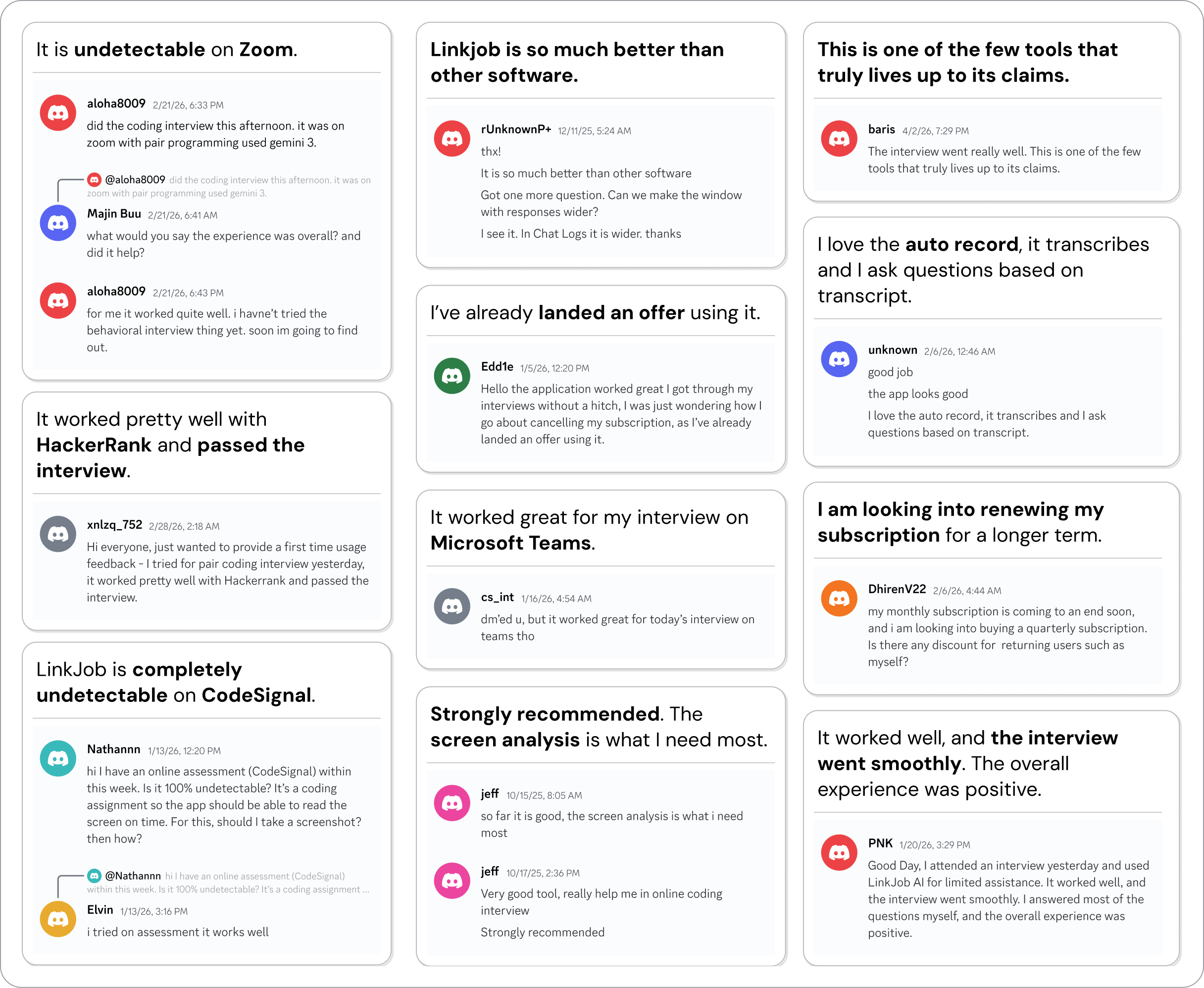
Why People Choose Linkjob AI
Smoother interviews, coding challenges cleared, and job offers landed. See how users describe their experience with Linkjob AI—in their own words.

© Copyright 2026 Linkjob AI - All Rights Reserved.