My Personal Guide to Acing the Adobe HackerRank Test in 2026
Adobe Hackerrank Process
I applied for an Adobe internship and received the OA about two weeks later. They set a deadline for completion. The questions weren't overly difficult, there were three in total. I didn't need to turn on my camera for the assessment. However, since the system monitors the screen, I recommend not switching tabs or pages.
I’m really grateful to Linkjob.ai for helping me pass my interview, which is why I’m sharing my OA questions and experience here. Having an undetectable AI coding interview copilot during the test indeed provides a significant edge.
Question 1: Minimum Project Cost
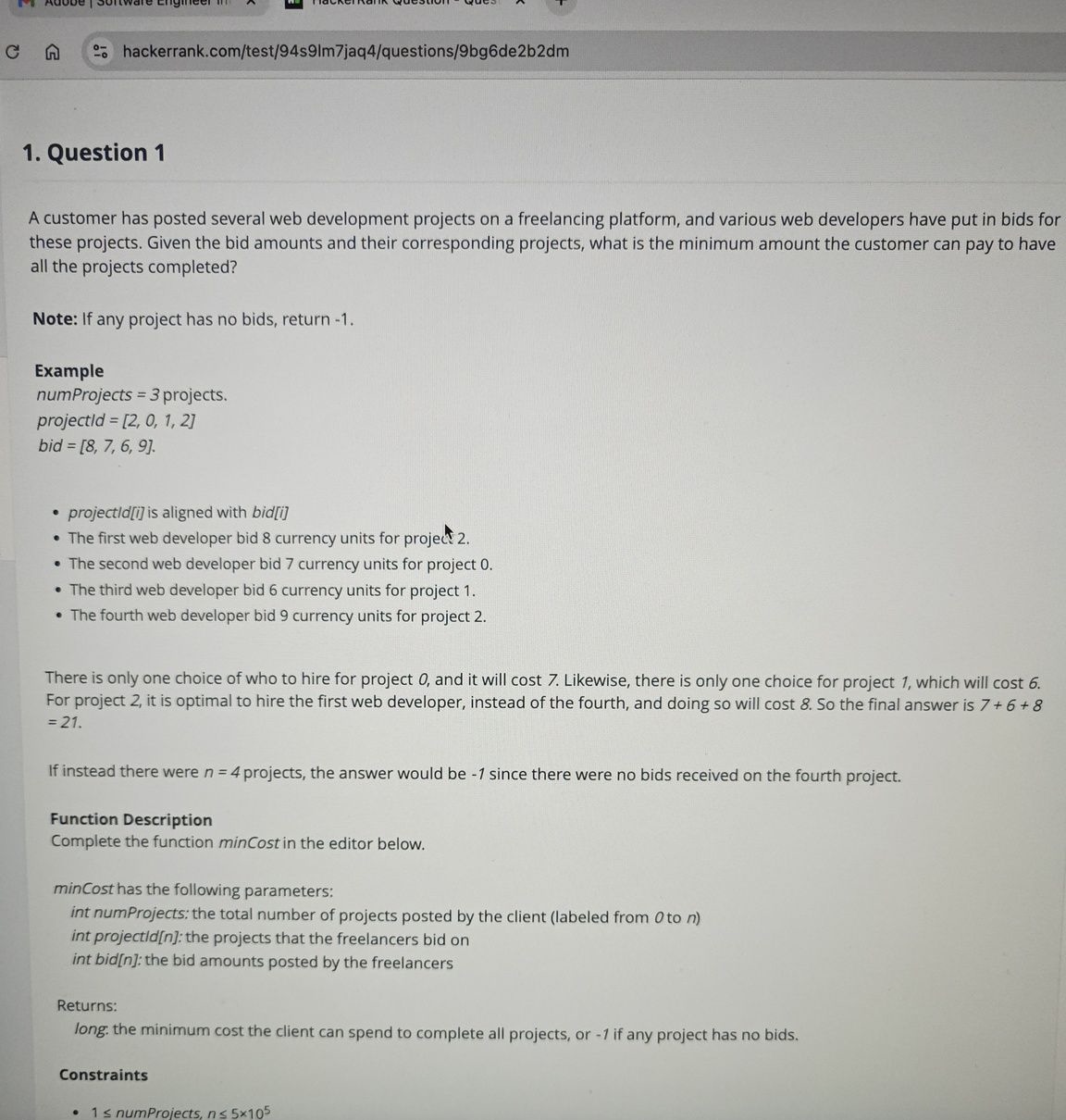
The problem requires finding the lowest bid for each project, returning -1 if any project has no bids. I decided to use a dictionary to record the minimum bid amount for each project. After iterating through the projectId and bid arrays, for each project, if it’s not yet in the dictionary or the current bid is smaller, I update the minimum bid in the dictionary. Then I check all projects (from 0 to numProjects-1) to see if each has a corresponding minimum bid. If any are missing, return -1; otherwise, sum all the minimum bids to get the result.
Question 2: Players Eligible for Level-Up
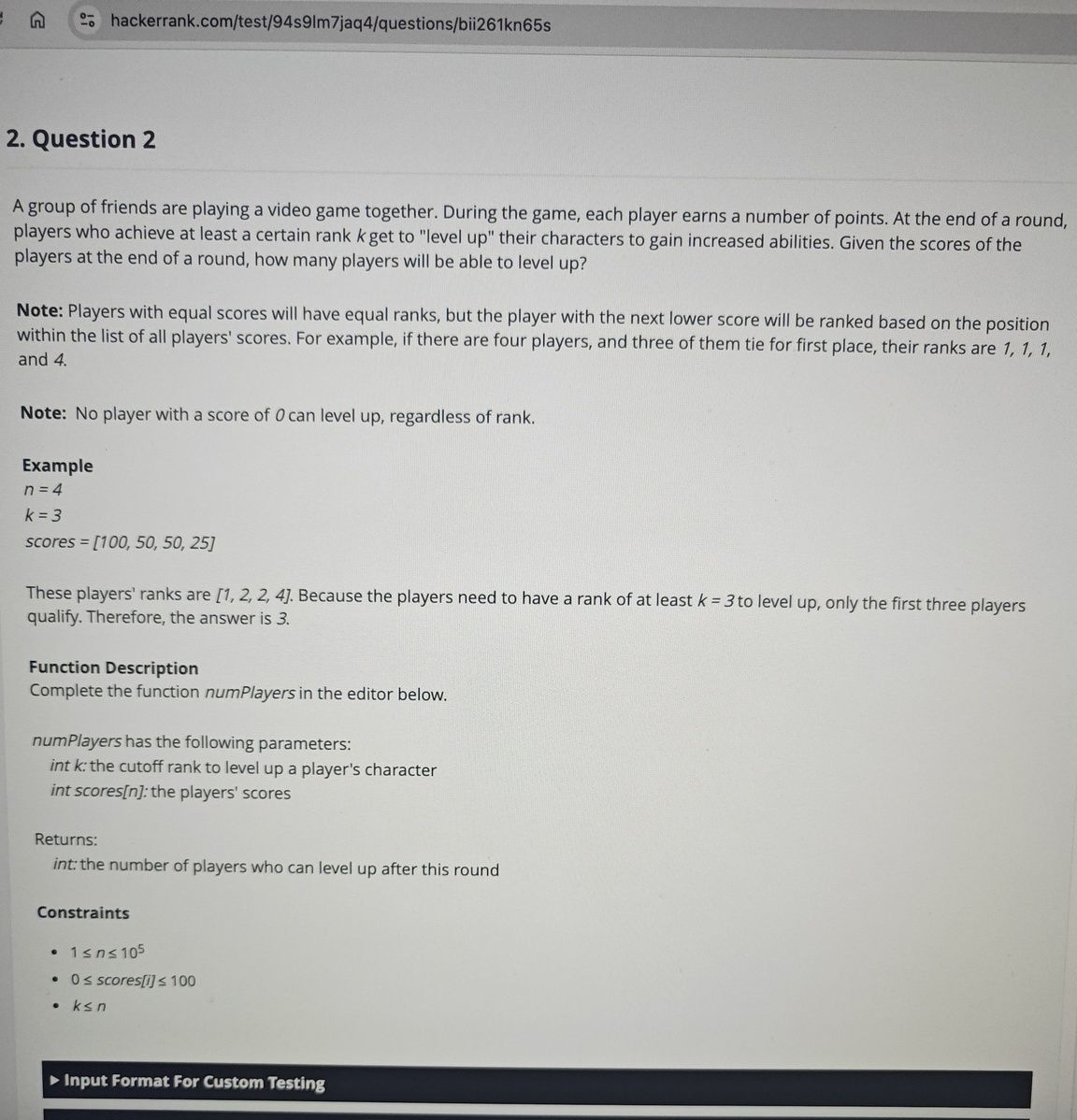
This question requires understanding the ranking rules: higher scores rank higher, equal scores share the same rank, and the next different score takes its position in the overall list. Note that players with a score of 0 cannot level up. My approach was to first sort the scores in descending order, then traverse the sorted list while maintaining the current rank and the previous score. For each score, skip if it’s 0. If the current score differs from the previous, update the rank to the current index + 1. Then check if the rank is less than or equal to k; if so, increment the count. Finally, return the count.
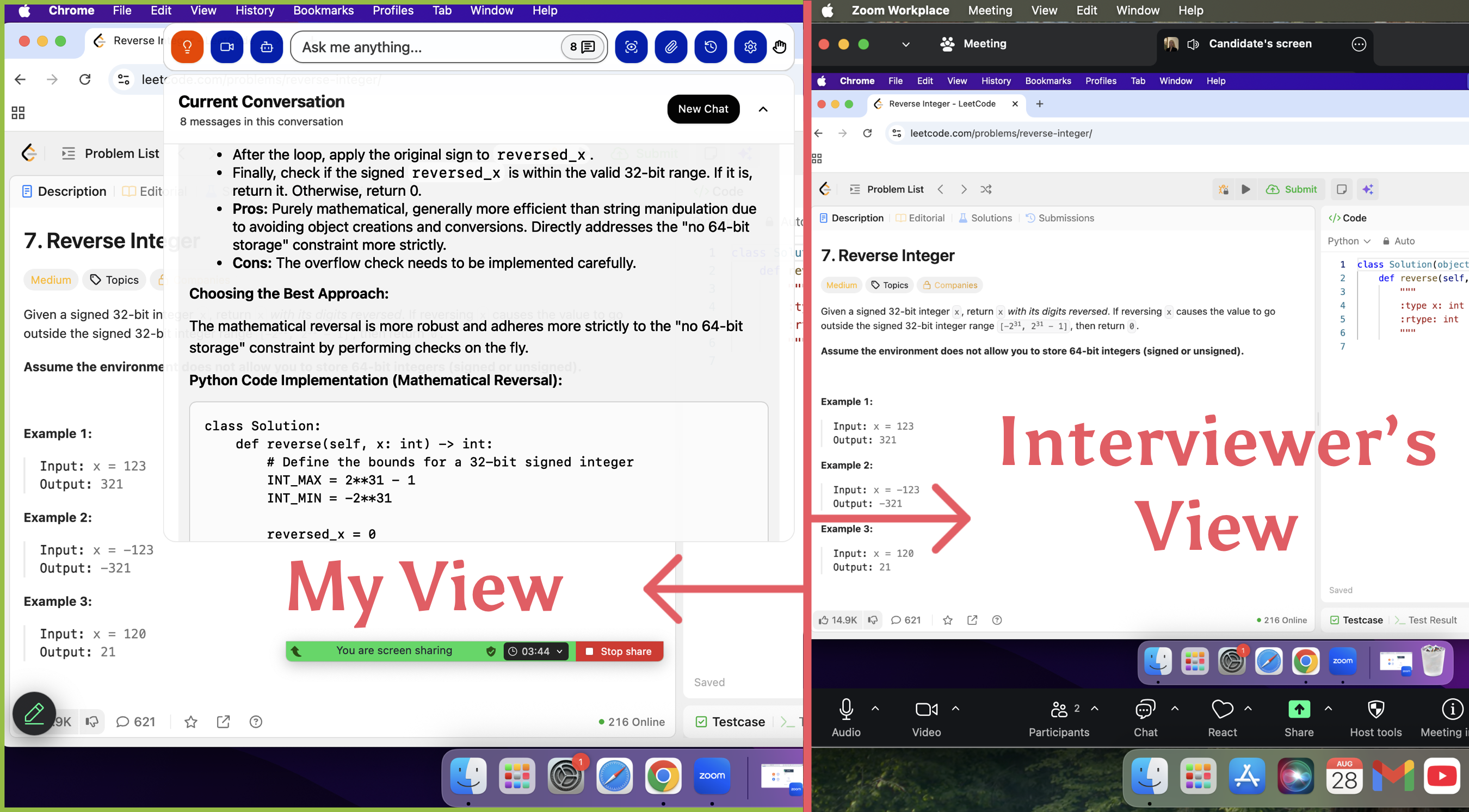
Linkjob AI worked great and I got through my interview without a hitch. It’s also undetectable, I used it and didn't trigger any HackerRank detection.
Question 3: Nested Dictionary Value Retrieval
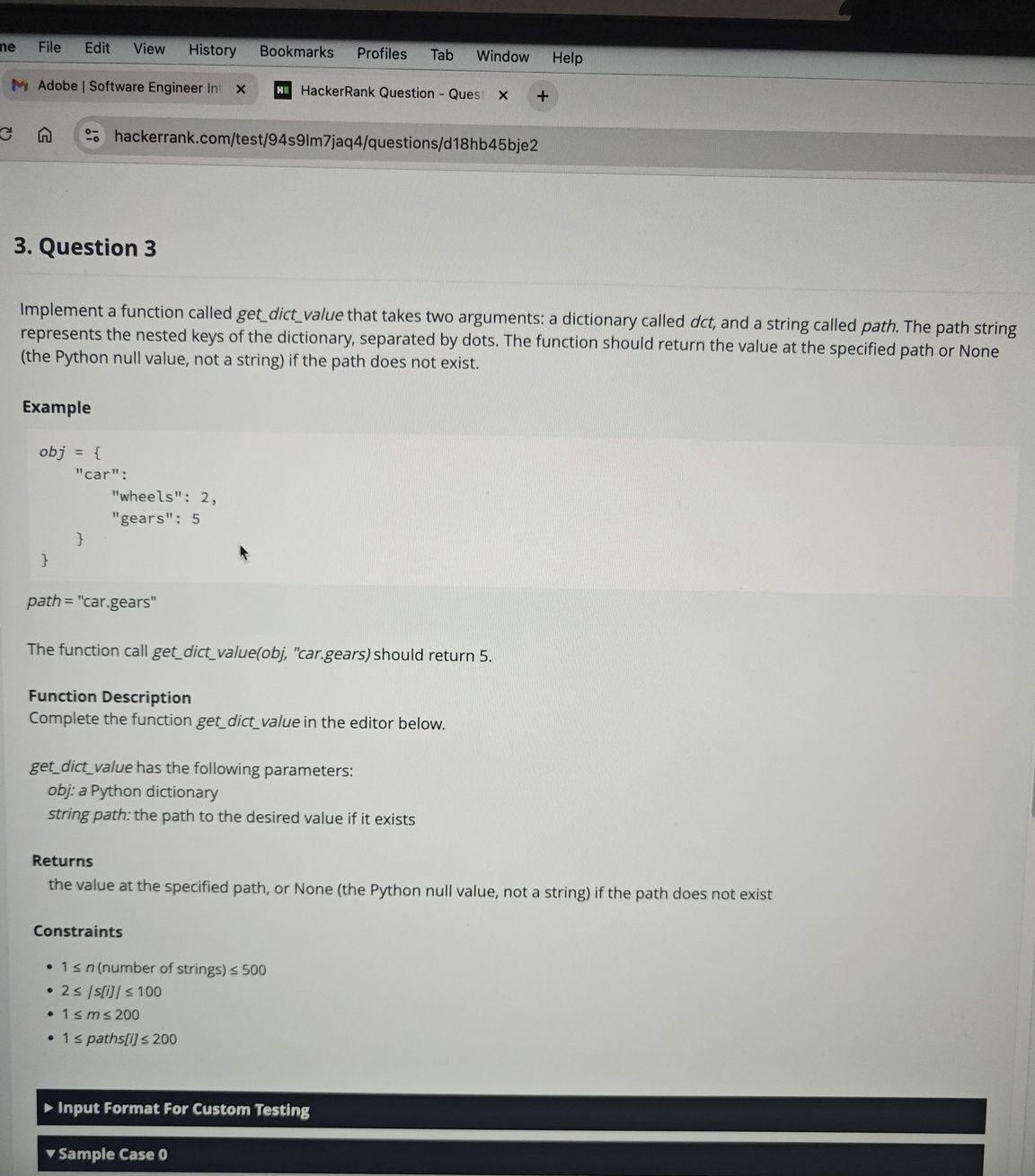
The last question requires retrieving a value from a dictionary given a dot-separated path string. I first split the path into a list of keys, then started from the dictionary and traversed it step by step according to each key. At each step, if the current object is a dictionary and contains the key, I updated the current object to the corresponding value; otherwise, I returned None. After traversing all keys, I returned the final object.
Adobe HackerRank Test Format
Adobe HackerRank Test Format and Content
For SDE Interns: It consists of traditional LeetCode-style questions. There are 3 problems, primarily focusing on Strings and Stacks. They aren't overly complex, with a difficulty level ranging from Easy to Medium, and there are no specific "traps" in the hidden test cases.
For MLE Interns: The format deviates from traditional LeetCode. There are 3 problems that mainly involve using libraries like PyTorch or OpenAI Gym to solve specific mathematical problems. The difficulty is also Easy to Medium, and the code for each solution typically stays under 20 lines.
Adobe HackerRank Test Tips
Proctoring: The camera remains off, but there is screen monitoring. Because of this, I used an AI tool that is undetectable by screen-sharing monitors to assist with the coding.
Question Pool: For candidates in the same batch, the questions are identical. Therefore, before starting my own assessment, I tried to find as many shared experiences as possible from others in the same application window.
Adobe HackerRank Test Timeline and Process
Notification: First, I received a notification congratulating me on moving to the OA stage.
Invitation: Three days later, they sent the actual OA link.
Results: Ten days after completion, I received a notification regarding whether I had passed to the next round.
Next Steps: The next round is directly the Final Interview.
Final Round: It included 20 minutes of coding and 20 minutes of BQ. The rest of the time was for introductions and my questions for the interviewer.
Programming Language Choice
The platform supports popular languages like Python, Java, and C++. I chose Python since I’m more comfortable with it, and its concise syntax for dictionaries and lists helps save time. The interface layout was straightforward: the problem description on the left, the code editor on the right, and the output or error messages at the bottom. You can switch views anytime during the test without needing to scroll back and forth.
Preparation Strategies
Fundamentals
Here are some of the core concepts I reviewed:
Data Structures: Arrays, lists, linked lists, stacks, queues, trees, and graphs.
Algorithms: Sorting (like bubble sort or quicksort), searching (like binary search), and problem-solving techniques.
What Worked
Here’s a quick list of what worked for me:
I set a daily goal for coding problems.
I reviewed my mistakes after every practice test.
I joined online forums to ask questions and share tips.
I used flashcards for quick revision.
I kept my workspace tidy to help me focus.
I also talked to friends who had taken the adobe hackerrank before. Their advice helped me avoid common mistakes and gave me a sense of what to expect.
Test-Day Tips
Time Management and Coding Approach
Here’s how I manage my time during the test:
Read all questions quickly at the start.
Solve the easiest question first.
Keep an eye on the clock.
Skip questions that take too long and return to them later.
Write clear and simple code.
Move on if I get stuck, then return if time allows.
Save a few minutes at the end to check my answers.
Debugging
Before submitting my code, I tested it with the sample inputs. Another important step was to look for possible edge cases. If something went wrong, I went through my logic step by step to find the issue.
FAQ
If I pass the Adobe HackerRank, what are the next interview stages like?
In my case, I received the next-round interview about two weeks later, and it was scheduled for the following week. The first 20 minutes were behavioral questions, and the remaining 40 minutes were coding. The behavioral part mainly focused on Adobe’s core values.
About two weeks later, I got a waitlist notification saying I had passed the interview but hadn’t been matched with a team. I thought that was the end, but a week later, I received an email from a talent partner, and two days after that, I got the offer call.
What if I applied to many Adobe positions but never got the OA?
My suggestion would be to try getting a referral. But from what I’ve seen, even some candidates who fully aced the OA didn’t get an interview invite afterward, so luck definitely plays a big part in the process.
If I pass the Adobe HackerRank test, how long will it take to get the results?
If you’ve been waiting for a while with no updates, it’s totally fine to send a follow-up email. In my case, I didn’t hear anything for two weeks after finishing the OA, so I reached out. And the next day, I got an interview invite. Actually, not just one, but two! One of the teams even reached out to me even though I hadn’t applied for their position before.
See Also
How to Cheat HackerRank Tests With AI: My 2026 Update
How I Passed 2026 Microsoft HackerRank Test on My First Try
How I Passed 2026 JP Morgan HackerRank Assessment: Q&A
2026 Update: My Stripe HackerRank Online Assessment Questions
Questions I Encountered in 2026 Goldman Sachs HackerRank Test
© Copyright 2025 Linkjob.ai - All Rights Reserved.