My 2026 Akuna Capital HackerRank Test Process and Questions


Akuna Capital HackerRank Test Questions
I just finished the Akuna Capital HackerRank test. The total time limit was 80 minutes, and there were three coding questions. In addition, there were also some multiple-choice questions, which were presented in the following format.

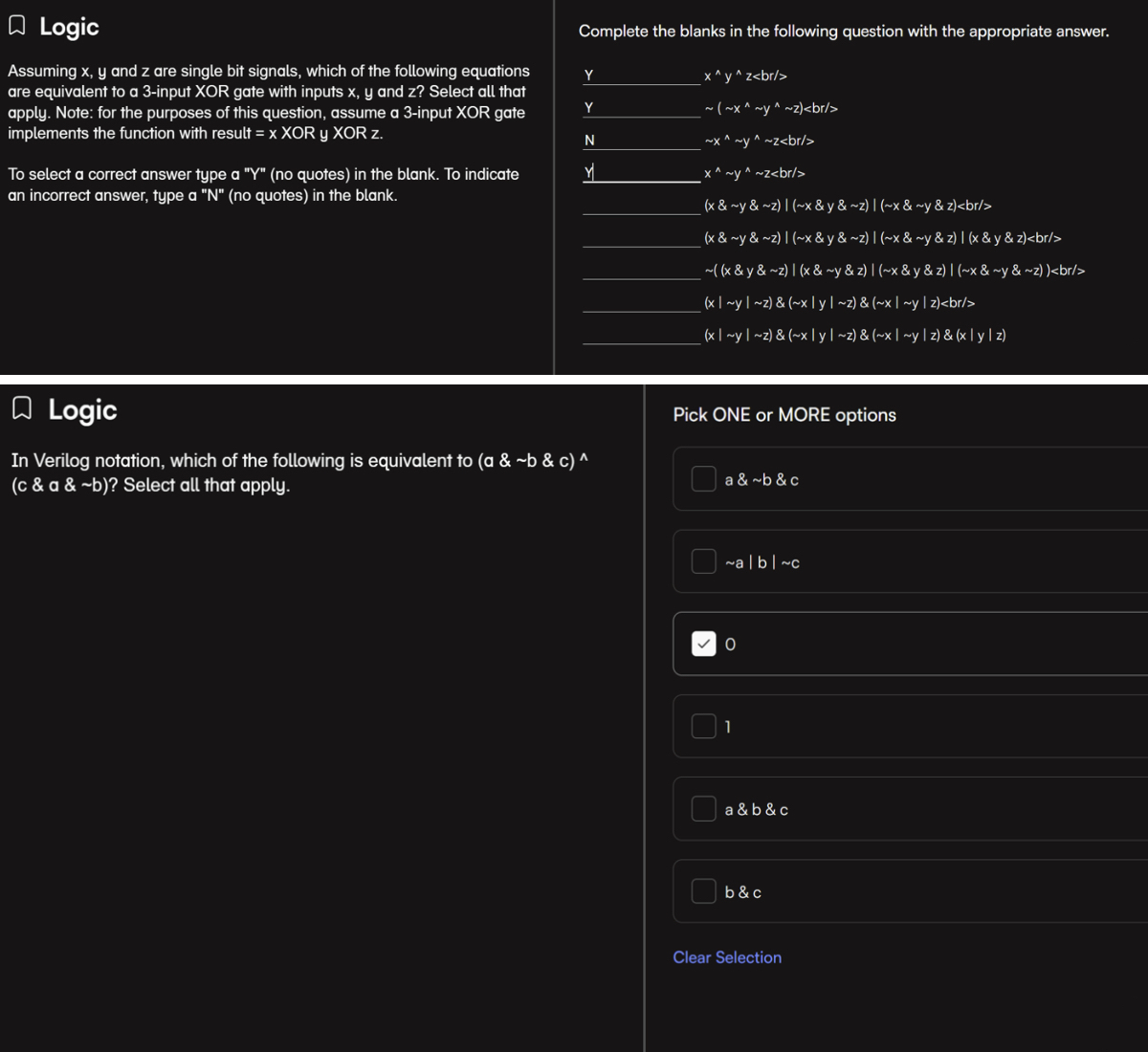
I found these questions not too difficult, but the time felt quite tight. Regarding the programming language used in the interview, I used Python. It felt like there was a higher emphasis on code robustness and the rigor of the thought process.
I’m really grateful to Linkjob.ai for helping me pass my interview, which is why I’m sharing my OA questions and experience here. Having an undetectable AI interview assistant during the OA indeed provides a significant edge.
This article is part of the HackerRank series. If you're interested in other articles in this series, feel free to read: Microsoft HackerRank test, JP Morgan HackerRank test, Stripe HackerRank online assessment.
Next are the three coding questions I completed on HackerRank.
Question1: Minimum Swaps
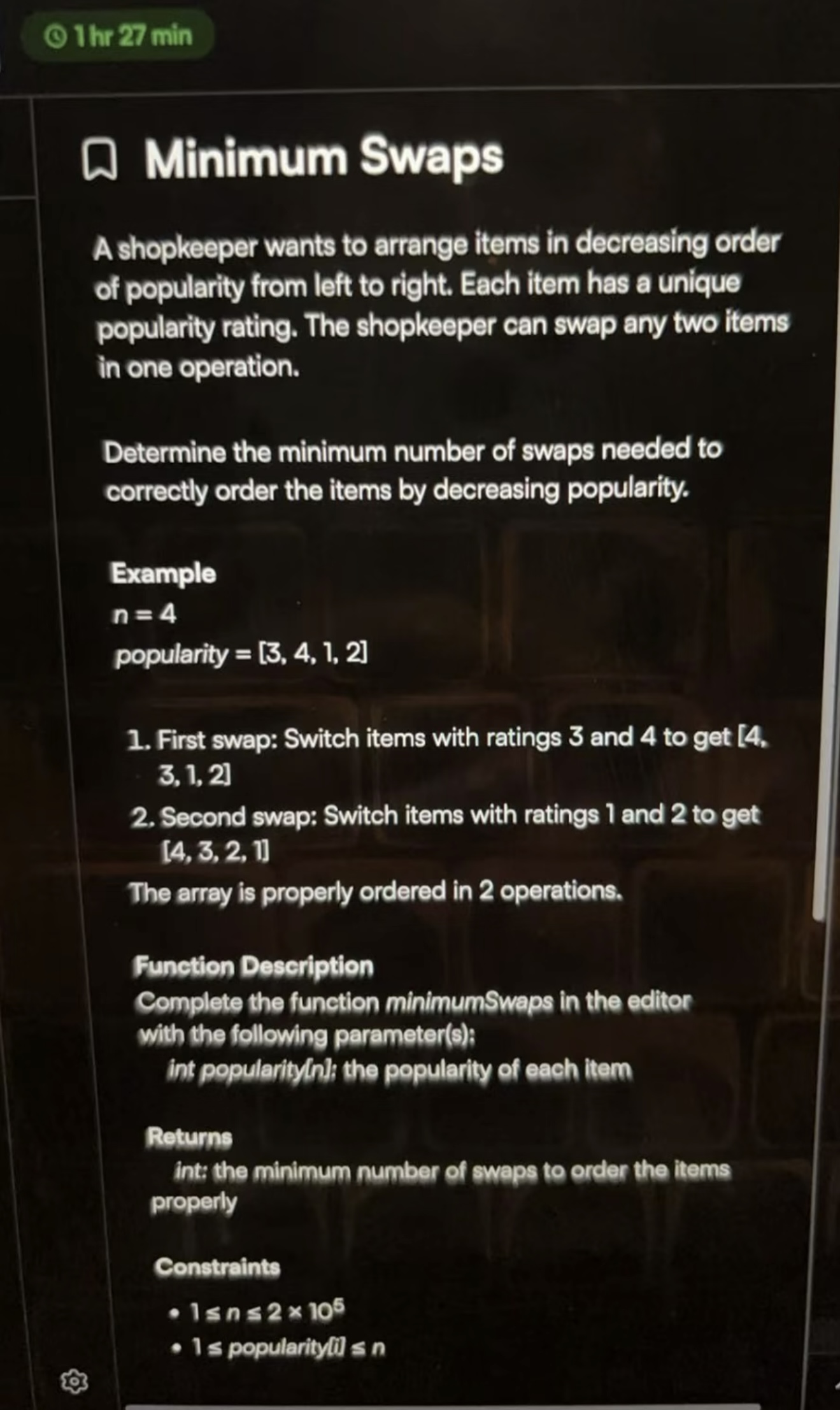
First question mainly tested my ability to transform a problem. I first sorted the array in descending order and then transformed the problem into finding the minimum number of swaps needed to sort it. I bound each element to its original index. After sorting the values in descending order to determine the target positions, I traversed the array to find the size of each cycle. The number of swaps for a cycle is the cycle length minus 1. Summing these values gave me the final result.
Question 2: Delivery Management System
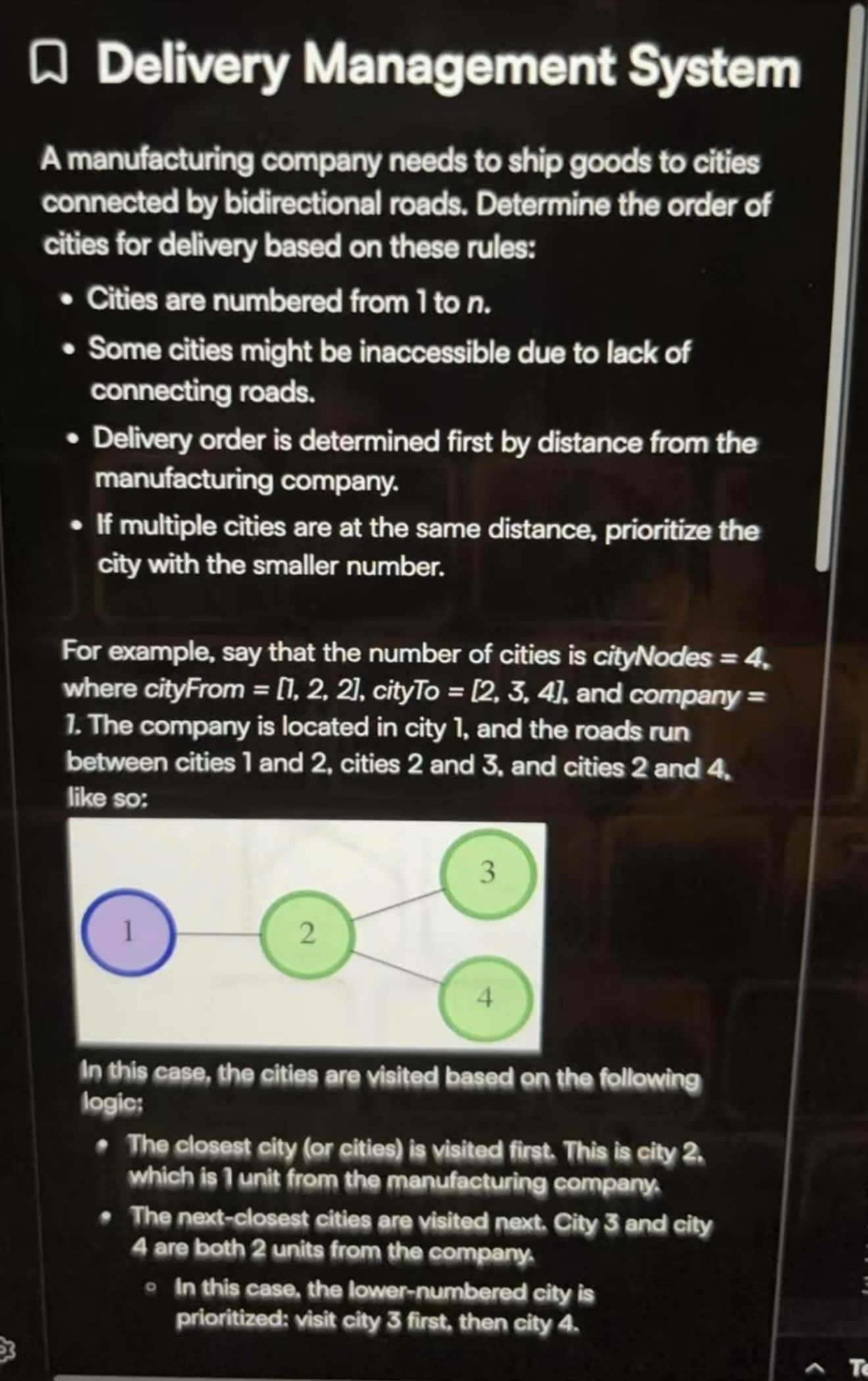
Second question mainly tested BFS. I started by building a graph: an undirected graph of cities and roads, stored as an adjacency list. I performed BFS starting from the city where the company is located to ensure visiting cities from near to far. For each layer of cities, I sorted them in ascending order of their numbers before adding them to the result. This ensured that when distances were the same, the city with the smaller number was prioritized. Finally, I returned the city numbers layer by layer.
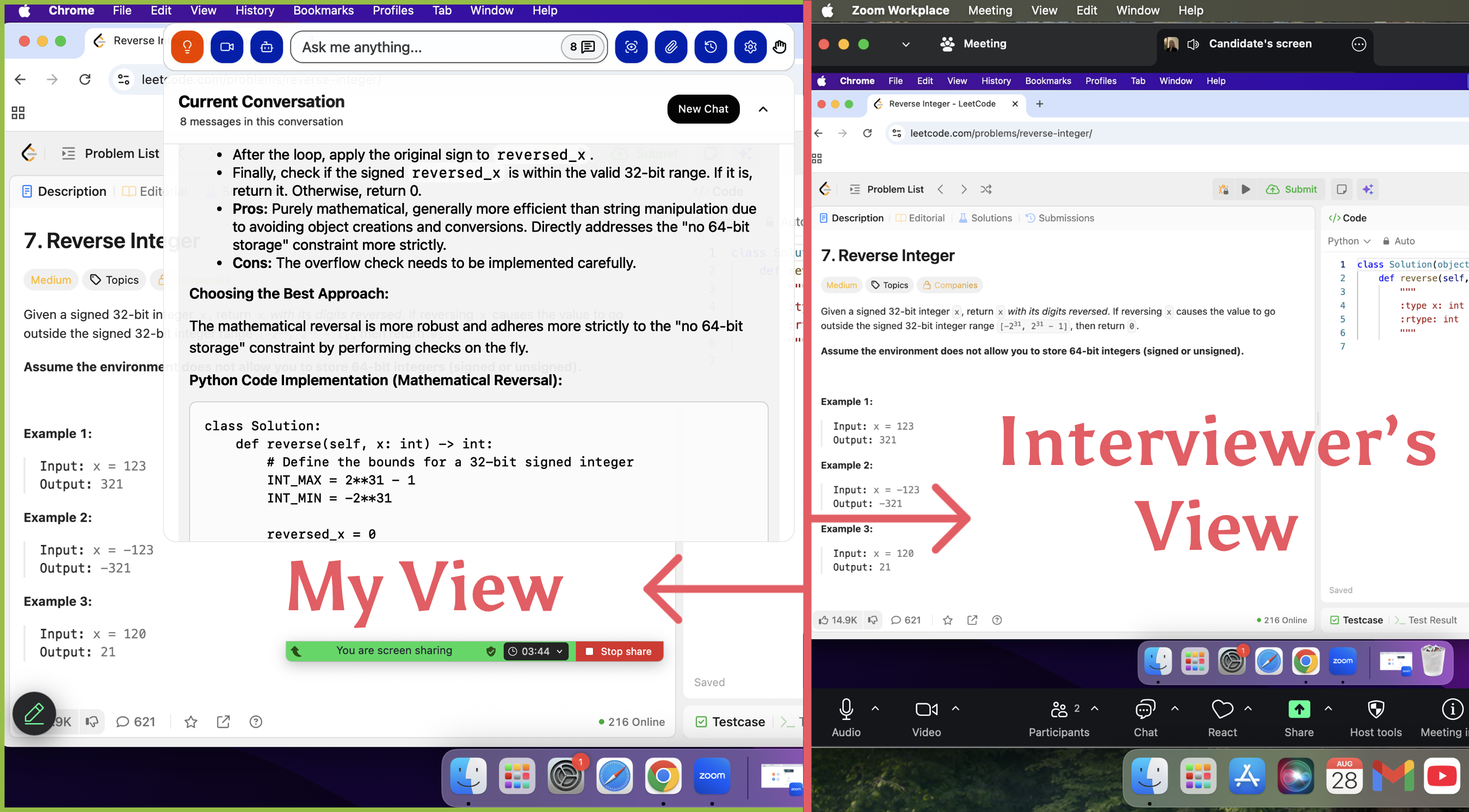
Linkjob AI worked great and I got through my interview without a hitch. It’s also undetectable, I used it and didn't trigger any HackerRank detection.
Tutorial: HackerRank how to cheat—Learn how AI interview assistants evade detection on platforms like HackerRank.
Question 3: Binary Circuit
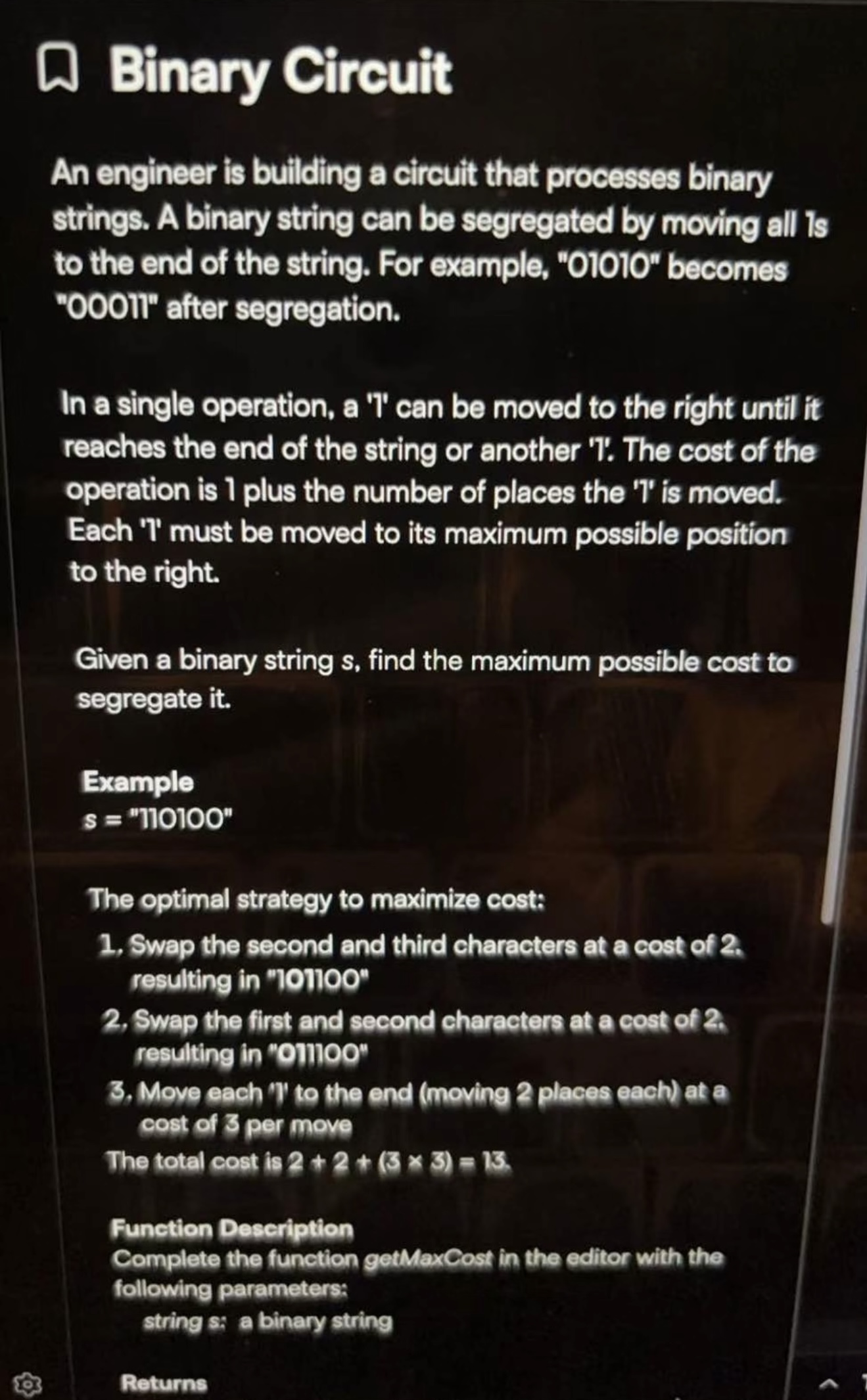
Third question mainly tested how to calculate contributions. I first divided consecutive 0s into segments. Each segment of 0s would be crossed by all the 1s on the left once, because each 1 needs to move to the rightmost possible position. Crossing a segment of 0s of length z counts as one operation, costing z + 1. If there are ones number of 1s to the left of a 0 segment, the total cost is ones × (z + 1). Summing the costs of all 0 segments gave me the maximum total cost.
Akuna Capital HackerRank Assessment Overview
The HackerRank assessment at Akuna Capital is the core technical screening for positions such as software engineers and quantitative developers. It primarily evaluates candidates’ algorithm design skills, coding proficiency, and ability to break down logical problems. The assessment does not rely on domain-specific knowledge, focusing solely on general technical abilities, making it equally relevant for candidates from different educational backgrounds.
Core Evaluation Focus
The assessment concentrates on three key technical abilities, all of which are essential for the role:
Fundamental Algorithm Skills:
Questions cover common basic and intermediate algorithms, including but not limited to array sorting and searching, linked list operations, graph traversal (BFS/DFS), hash table applications, and simple dynamic programming. The goal is to assess candidates’ understanding of algorithm principles and their ability to apply them flexibly.
Logical Transformation Ability:
Candidates are expected to convert textual business requirements into executable mathematical models and algorithmic logic. For example, “filtering data according to rules” is translated into conditional statements and loops, while “optimizing resource usage” becomes a problem of finding extrema.
Code Performance and Robustness:
Beyond functional correctness, code must be efficient (e.g., time complexity within O(n) or O(n log n)) and handle various edge cases (such as empty input, duplicate data, or extreme values), ensuring stable and reliable execution in practice.
Question Characteristics and Design Logic
The questions are designed around general technical scenarios, while closely reflecting the actual technical demands of the role:
Data Processing Questions:
Candidates may need to classify, count, or filter large, unordered datasets, testing their ability to apply efficient data structures such as hash tables or heaps.
Logic Optimization Questions:
Tasks may involve finding optimal solutions under multiple constraints, such as maximizing a target value with limited resources, evaluating algorithm design and logical reasoning skills.
Process Simulation Questions:
Candidates may be asked to simulate a specific operational process (e.g., task scheduling or data transmission), testing control flow and attention to detail in coding.
The core purpose of these questions is to use general technical scenarios to determine whether candidates possess the technical potential and problem-solving mindset required for the role, rather than to assess experience in a specific domain.
Akuna Capital HackerRank Test Preparation Strategy
Analyzing Assessment Requirements
When I start preparing for the akuna capital hackerrank assessment, I break down the requirements step by step. This helps me avoid surprises and focus my energy where it matters most. Here’s how I do it:
I study the structure and content of each part of the assessment.
I note the time limits and the types of problems that show up often.
I remind myself that the assessment is just the first stage. I prepare for interviews that come after, so I keep practicing communication and problem-solving skills.
Testing top AI tools for cheating, choosing the AI copilot that best suits me----Linkjob.
Study Routine
My routine balances math and coding practice, with study sessions split into short, focused blocks. This keeps me sharp and helps prevent burnout.
Daily Routine:
I start with 15 minutes of mental math drills.
I spend 60 minutes on coding practice. I solve problems on and review python concepts.
I finish with a review of mistakes. I write down what I got wrong and try similar problems the next day.
Weekly Routine:
I take one full-length mock test every weekend using Linkjob’s mock interview. I time myself and treat it like the real assessment.
I join online forums or study groups once a week. I ask questions and share strategies with others.
I review my progress every Sunday. I adjust my plan based on what I need to improve.
Akuna Capital HackerRank Test-Taking Tactics
Approaching Question Types
When tackling the Akuna Capital HackerRank assessment, I start by quickly scanning the entire test. For multiple-choice questions, each option is read carefully to eliminate the obvious wrong answers. If I get stuck, I mark it and move on, avoiding spending too much time on a single problem.
For coding questions, I usually break the problem into smaller steps and sketch out a plan before writing any code. Simple test cases are run first, and any bugs are fixed immediately rather than rewriting everything
Time and Stress Management
Time can slip away quickly during the assessment, so I always keep an eye on the clock and set mini-deadlines for each section. Any extra time is used to double-check answers. When stress builds, a deep breath helps me reset and remember that I’ve prepared for this.
Staying calm makes it easier to think clearly and avoid silly mistakes. Each question is treated as a new challenge rather than a threat.
Avoiding Pitfalls
Rushing through instructions and missing key details.
Spending too long on one question and running out of time.
Forgetting to test code with edge cases.
To avoid these traps, I read every question twice, stick to my time plan, and always review my work if I have time left. This routine keeps me on track and boosts my score.
FAQ
What’s the difficulty level of Akuna Capital’s HackerRank Test?
Akuna’s HackerRank test is of moderate difficulty. Problems often tie to real trading scenarios, requiring both technical skill and logical problem transformation.
How to prepare effectively for Akuna’s HackerRank Test?
Prioritize mastering core algorithms (sorting, graph traversal, cycle detection) and quantitative logic (e.g., segment contribution calculation for cost problems). Practice company-specific OA questions to align with Akuna’s problem style, and focus on writing optimized code to handle tight constraints.
Will Akuna Capital’s HackerRank Test Include Quantitative or Finance-Related Questions?
Yes, the test often integrates basic quantitative and finance-aligned logic, though it doesn’t require deep finance expertise. For example, problems might involve calculating "costs" in binary string operations or optimizing resource allocation. These questions test your ability to map abstract logic to practical scenarios, not specialized financial knowledge.
See Also
2026 Nvidia HackerRank Test: Questions I Got and How I Passed
How I Cracked 2026 Citadel HackerRank Assesment Questions
My IBM 2026 HackerRank Assessment: Real Questions & Insights
My 2026 MathWorks HackerRank Assessment Questions & Solutions
Questions I Encountered in 2026 Goldman Sachs HackerRank Test

© Copyright 2025 Linkjob.ai - All Rights Reserved.