How I Use Anthropic Blog for My Interviews in 2026


I’m a PhD in Computer Science (AI/ML focus) from University College London. Back in December, I applied for the Research Engineer position at Anthropic’s London office, and by February, I successfully made it to the final round of interviews. During my prep, the most useful resource I relied on was Anthropic’s official blog. It’s packed with high-quality content ranging from cutting-edge research to practical applications, as well as discussions on AI safety and ethics. Honestly, it feels like a treasure trove of knowledge — not only is it free, but the depth and breadth of information are invaluable for anyone interested in this field.
In this article, I’ll walk you through a detailed breakdown and practical guide on how to explore and leverage this blog to ace your interviews — whether it’s for Anthropic Interview process (Initial Screening, OA, Virtual Onsite) or even other top-tier AI companies like OpenAI interview process. By doing so, you’ll give yourself a significant edge in the job hunt,, elevate your preparation efforts, ace every anthropic interview question and reduce the stress that often comes with the process.
Having a real-time, undetectable AI interview assistant during phone interviews, virtual interviews, or online technical assessments can help you stay calm and composed under pressure. In a job market that’s more competitive than ever, where companies are raising the bar for interview prep, investing in an AI tool to boost your efficiency could be one of the smartest moves you make. And don’t feel embarrassed about using AI tools for your prep — Anthropic itself encourages candidates to leverage AI to optimize their interview performance!
Finding Content for Anthropic Blog Interview
Anthropic’s blogs generally fall into two main categories: the “Science” and “Research” blogs available on their official website, and the blog dedicated to their flagship product, Claude. In this article, I’ll focus on the latter. The former, while incredibly rich in content, is more complex and requires additional effort to organize, so I’ll cover that in a separate post later.
To access the Claude blog, you can simply search for “Claude Blog” or navigate to it directly through the “Product > Claude > Blog” section on Anthropic’s official website.
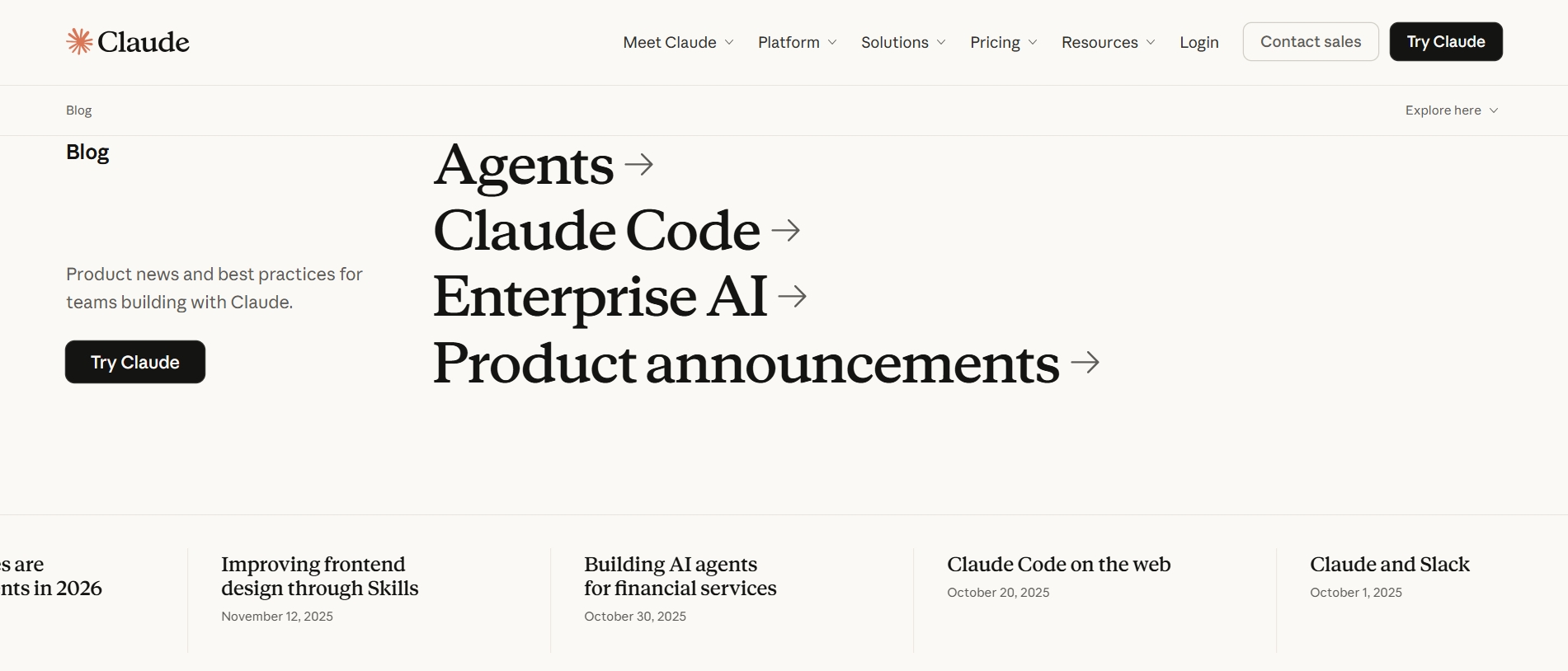
Categories and Tags for Anthropic Claude Blog
Anthropic’s Claude blog is divided into four main categories: Agents, Claude Code, Enterprise AI, and Product Announcement. Each category has its own unique focus and purpose:
Agents — Intelligent Agents and Application Scenarios
This category revolves around Anthropic's work on intelligent agents, aiming to showcase functionality and demonstrate value in real-world applications. It highlights how Claude can serve as an efficient AI assistant to handle complex tasks, support automation, optimize workflows, and enable intelligent decision-making.
The blog explores Claude’s performance in various use cases, such as improving personal productivity or integrating with industry tools, and provides in-depth examples to illustrate how Claude acts as a “proxy” to help users achieve complex objectives. The target audience for this category includes individuals, teams, and businesses looking to incorporate AI into their everyday tasks.
Claude Code — AI Programming and Code Generation
This section focuses on Claude’s capabilities in coding tasks such as code generation, debugging, and optimization. Its purpose is to empower developers and provide effective tools for technical tasks. The goal is to attract developers and tech professionals to use Claude as a programming assistant to boost efficiency and lower technical barriers.
The content primarily features examples of Claude generating code, diagnosing issues, explaining functionality, and optimizing solutions. It also shares tutorials and technical guides to help developers integrate Claude into their workflows. The target audience includes programmers, development teams, and anyone interested in leveraging AI to improve software development productivity.
Enterprise AI — Enterprise Solutions and Industry Applications
This category centers on how Claude can help businesses with digital transformation, process optimization, and productivity enhancement, aiming to deliver enterprise-grade value. The focus is on attracting business clients by showcasing how Claude’s AI capabilities can address specific challenges in various industries.
The blog provides examples of Claude’s applications in areas like customer support, workflow management, and data analysis. It also explores Claude’s integration with enterprise tools like CRM and ERP systems, along with industry trend analyses and best practices for incorporating AI into business operations. The target audience here includes enterprise customers and decision-makers in various industries.
Product Announcement — Product Updates and Feature Launches
This category is dedicated to announcing new products, features, and major updates from Anthropic. The goal is to keep current users engaged while drawing in potential users by showcasing the latest advancements and updates, positioning Claude as a cutting-edge solution.
Content includes announcements of new functionalities or enhancements (e.g., improved conversational capabilities, upgraded code generation features) and insights into Anthropic’s technological breakthroughs or product roadmaps. This category appeals to early adopters, technology enthusiasts, and anyone interested in staying up-to-date with Anthropic’s developments.
Technical Concepts for Anthropic Claude Blog
Agent
This section of the blog is divided into four major categories: Industry Applications, Skills & Extensibility, Architecture & Design, and Enterprise & Ecosystem.
Industry Applications
This category focuses on adapting general AI models to specific industries, such as finance and healthcare, essentially turning them into domain experts. It delves into how AI can tackle high-risk areas, emphasizing critical considerations like regulatory compliance, data privacy, and accuracy validation when working with sensitive information such as money or health data.
Beyond compliance, it showcases practical applications of AI that address real-world pain points, such as financial risk analysis and processing medical literature. The goal is to demonstrate how Claude can be tailored to meet the unique demands of vertical industries while maintaining safety and reliability.
Skills & Extensibility
This section is all about empowering developers to extend Claude’s capabilities beyond a traditional language model. It’s broken down into two key phases:
Foundations and Advanced Concepts: Starting with basics like prompt engineering, the blog progresses to introducing the concept of "Skills."
Development and Integration: It dives into the process of developing Skills and leveraging MCP servers to connect Claude with the outside world.
The core message here is enabling developers to push Claude’s boundaries — giving it the ability to use tools, access live data, and execute code to handle more complex tasks. It’s all about making Claude more dynamic and versatile for real-world applications.
Architecture & Design
This category explores key principles for designing intelligent agents and systems:
Workflow Patterns: It outlines common agent workflows, such as planning, reflection, and tool usage.
Multi-Agent Systems: It examines how multiple AI roles can collaborate effectively within complex systems.
Future Trends: Finally, it provides a big-picture analysis of software development trends from 2025-2027, helping developers understand the role of intelligent agents in the evolving software ecosystem.
The focus is on giving developers the frameworks and insights to design smarter, collaborative AI systems that align with future tech trends.
Enterprise & Ecosystem
This category highlights how AI agents can transform business operations through specialization, collaboration, and integration:
Specialization and Collaboration: It discusses how Skills can be used to build specialized AI agents and how organizations can manage and share these Skills across teams.
Product Integration: It focuses on Claude Cowork, explaining how plugins can seamlessly integrate Claude into existing workflows for enterprise-level scalability.
Scalability and Deployment: The blog emphasizes the importance of safe, efficient AI deployment at scale, ensuring organizations can maximize value while maintaining operational reliability.
The overarching goal of this category is to showcase how Claude can be leveraged as a powerful enterprise tool, helping teams and businesses unlock new levels of productivity and innovation.
Claude Code
This section of the blog covers key topics including Claude Code's core architecture, enterprise-scale deployment, workflow optimization, and detailed guides for building and applying Skills.
Core Architecture & SDK
The Claude Agent SDK allows agents to interact with terminals, file systems, and editors much like humans. It operates through a loop of “context gathering -> action-taking -> result validation” to complete tasks efficiently. Agents don’t just rely on prompts—they connect to external tools like GitHub and Slack using MCP (Model Context Protocol) servers and automate behaviors through hooks (e.g., auto-formatting files upon save).
The SDK also introduces Auto Mode, which enables agents to work autonomously without real-time human intervention, handling complex development tasks from concept creation to final submission. This makes Claude an ideal assistant for streamlining workflows and handling repetitive coding tasks.
Enterprise Scaling & Management
This section focuses on strategies for scaling Claude Code at the organizational level. It suggests rolling out the tool gradually through pilot programs with "power users," hackathons, and internal expert teams rather than enforcing a top-down mandate.
Key metrics like Contribution Metrics are recommended for tracking adoption rates, improvements in development speed, and ROI. Additionally, it emphasizes monitoring developer satisfaction and onboarding time reduction.
Another highlight is legacy system modernization, showcasing Claude Code’s ability to assist with migrating systems written in older languages like COBOL. The AI helps decode complex logic and translate legacy code, breaking down the cost and complexity barriers typically associated with such migrations.
Context Engineering & Configuration
This blog discusses CLAUDE.md, a central configuration mechanism that lets teams inject coding standards, architecture diagrams, and workflows directly into Claude’s context. Using the /init command, teams can auto-generate foundational configurations for projects.
Additionally, hooks allow customizable behaviors for file operations—for example, automatically running linters or Prettier before saving code to ensure team standards are met. The blog also offers project management tips, emphasizing the importance of adapting to AI-driven development paradigms. It explores how Claude can assist with code reviews and automate workflows like Preview, Review, and Merge cycles.
Skills Development & Application
Skills are developed in a standardized SKILL.md file format, which combines metadata, core instructions, and bundled files for on-demand loading. This structure allows infinite knowledge expansion without consuming excessive context.
For example, in frontend design, Claude can unlock creative potential by using specific design-focused Skills, breaking away from generic styles like basic gradients and default fonts. It can generate high-quality UI with unique animations, typography, and even thematic designs (e.g., RPG-inspired styling).
The blog highlights that Skill development is an iterative process: “test, measure, refine”. Teams are encouraged to start with specific use cases, gradually fine-tuning instructions and examples to achieve optimal results.
Enterprise AI
This section of the blog covers Claude’s strategy and organizational transformation, industry-specific solutions, core technology and product capabilities, as well as functional use cases and practical applications.
Strategy & Transformation
This part focuses on the “why” and macro trends behind Anthropic’s efforts. It explores how organizations can move from AI pilots to full-scale adoption while transforming their structure. Key themes include:
Scaling adoption: Shifting from “AI-assisted” to “AI-autonomous collaboration,” where organizations treat AI agents as core infrastructure.
Economic impact: By 2026, 80% of organizations reported measurable ROI from deploying AI agents.
Lowering barriers: Self-serve tools and enterprise-grade management features make it easy to scale AI organization-wide.
Industry transformation: AI is reshaping industries like retail, automotive, and cybersecurity by transforming supply chains, customer experiences, and R&D workflows.
This section is all about how businesses can strategically integrate AI to drive organizational change and long-term value.
Industry Solutions
This category focuses on “where to apply AI”, highlighting how it solves high-barrier, highly regulated, and complex processes across industries. It showcases three key use cases:
Financial Services (FinServ): Using specialized plugins (e.g., FactSet, MSCI) and Excel integrations, Claude can handle complex financial modeling, risk management, and compliance reviews.
Healthcare & Life Sciences: Operating in strict compliance environments (e.g., HIPAA), Claude helps process fragmented data, accelerate drug discovery (e.g., the Pfizer use case), and automate clinical documentation.
Engineering: Claude assists with complex engineering calculations and system design challenges, reducing the cognitive load on engineers.
The focus is on demonstrating how AI can address the unique challenges of highly specialized and regulated industries.
Core Tech & Product
This section dives into “what tools and technologies to use”, highlighting breakthroughs in Claude’s foundational capabilities and productivity tools. It covers four main areas:
Ultra-Long Context: With a 1-million-token context window now standard, Claude can handle large-scale documents and codebases effortlessly.
Office Integrations: Deep integration with Microsoft Office tools like Excel and PowerPoint enables end-to-end automation, from data processing to presentation creation.
Skills & Plugins: Modular skills (e.g., Notion, Figma) and enterprise-grade plugins extend AI capabilities across various workflows.
Model Evolution: By iterating based on customer feedback (e.g., Opus 4.6), Claude continuously improves reasoning abilities, particularly for domain-specific tasks like financial analysis.
This section emphasizes how Claude’s technology stack evolves to enhance productivity and flexibility across different use cases.
Functional Use Cases
This category focuses on “how to apply AI”, diving into specific departments or business types and how they can use AI to boost efficiency. Key examples include:
Startups: AI acts as a “force multiplier,” allowing startups to compensate for limited resources and rapidly iterate from prototype to product launch.
Software Development: The blog covers everything from code generation and refactoring to enabling non-technical users with low-code/no-code tools. It also highlights the creation of internal knowledge bases.
Traditional Functions:
Legal: AI can compress multi-day contract reviews into hours and automate compliance checks.
Marketing: AI reduces ad creative production time from 30 minutes to 30 seconds, enabling large-scale personalized marketing campaigns.
The focus here is on how different teams—whether in startups, legal, development, or marketing—can integrate Claude to drive measurable productivity gains.
Product Announcement
This blog section announces key feature updates for the Claude product and outlines the future evolution of Claude’s product ecosystem. It’s divided into four main categories:
Core Engine & Architecture
The focus here is on building a stronger foundation, enhancing the model’s parameters, context length, and search precision to support more powerful applications. Key updates include:
Ultra-Long Context Handling: Both Opus 4.6 and Sonnet 4.6 now support 1-million-token context windows, unlocking capabilities to process massive documents and codebases seamlessly.
Infrastructure Integration: Claude 2 is now available on Amazon Bedrock, marking a major milestone for enterprise-grade cloud integration and accessibility.
Search Precision Optimization: The introduction of dynamic filtering technology significantly improves the accuracy and efficiency of search results, reducing hallucinations and yielding more reliable outcomes.
This category ensures Claude’s foundational capabilities stay cutting-edge, ready to meet the demands of high-performance applications.
Code & Development
The emphasis here is on developer productivity, showing how Claude has evolved from a code completion tool into a full-stack “engineering manager” and “code reviewer”. Key features include:
Full Lifecycle Automation: The desktop update introduces features like code preview, automated reviews, bug fixes, and PR merging, creating a seamless, end-to-end development workflow.
Deep Code Reviews: A multi-agent code review system has been launched, specifically designed to scan for bugs in large, complex PRs, tackling bottlenecks in manual reviews.
Automation Mode: Claude’s Auto Mode enables it to independently execute a range of coding tasks, reducing the need for human intervention.
Metrics & Optimization: Contribution metrics help teams quantify the impact of AI on development efficiency, providing actionable insights for continuous improvement.
This category positions Claude as a transformative tool for streamlining software development and enhancing team performance.
Collaboration & Workflow
This category centers on breaking down silos and making Claude the connective tissue between tools and teams. Key updates include:
Interactive Connectors: Tools like Figma, Canva, Slack, and Linear can now be directly operated within Claude as interactive components, enabling “native” actions across platforms.
Skills Ecosystem: A new Skills feature and partner directory allow non-technical users to leverage pre-built skills, enabling Claude to operate internal enterprise tools effortlessly.
Computer Usage: Through the Dispatch feature, Claude gains the ability to directly control local applications and execute cross-software tasks on users’ computers.
Team Management: Updates to the Claude Team plan and customizable Cowork plugins enhance enterprise-level security and collaboration capabilities.
This category highlights Claude’s ability to integrate workflows, tools, and people into a unified system, driving efficiency and collaboration across organizations.
UX & Visualization
The focus here is on multi-modal interaction, using visual elements and context-aware capabilities to deepen human-AI collaboration. Key features include:
Interactive Visualization: Claude can now generate charts, graphs, and visual tools (e.g., interactive periodic tables) directly in conversations, making it easier to understand complex ideas and data.
Thinking Partner Mode: With memory, voice capabilities, and cross-device synchronization, Claude evolves into a “thinking partner” that understands long-term project contexts and supports users throughout the creative-to-execution process.
This category aims to make Claude more intuitive and engaging, providing a richer collaborative experience that goes beyond traditional text-based AI interactions.
Organizing Insights for Job Interview Success
The summary above provides a structured overview of Anthropic’s blog content, but now let’s shift focus to what truly matters—how this ties into your interview prep. Before diving into interview preparation, it’s crucial to undergo a mindset shift. Don’t approach this vast pool of technical blogs as scattered pieces of knowledge to memorize. Instead, think of them as building blocks for your own personalized technical narrative.
Anthropic isn’t just evaluating how much code you can write during the interview—they’re also assessing whether you deeply understand the future they’re working to build. So, the first step in your preparation is to internalize these blog insights, transforming them into a framework for how you view the engineering, productization, and safety of AI systems. Your goal during the interview is to demonstrate not just technical proficiency, but a genuine alignment with Anthropic’s mission and vision.
Relating to Industry Insights & Awareness
First of all, I believe it’s crucial to extract key value anchors from Anthropic’s blog content. Here are the four core values I’ve distilled:
Anchor 1: From “Assistance” to “Autonomy”
This includes features like Claude Code’s Auto Mode, the “collect-act-verify” loop in the Agent SDK, multi-agent collaboration, and software construction trends for 2026-2027. The core value here is that Anthropic envisions AI not just as a Copilot, but as an Agent capable of completing tasks independently. They emphasize reducing “human-in-the-loop” friction and enabling AI to close task loops autonomously.
Anchor 2: Explainability and Safety Compliance
Examples here include compliance requirements in industries like finance and healthcare, HIPAA data handling, Skills testing and metrics, dynamic filtering to reduce hallucinations, and deep bug scanning in code reviews. Anthropic places a strong emphasis on control and reliability alongside capability. Particularly in enterprise markets, safety is not optional—it’s the entry ticket. They value engineers who can design systems that are both powerful and trustworthy.
Anchor 3: Engineering and Standardization
This includes tools like CLAUDE.md configuration files, Hooks, SKILL.md metadata, Contribution Metrics, and modernizing legacy systems. The key value here is that AI shouldn’t feel like magic—it must be grounded in engineering principles. Anthropic is committed to making AI capabilities standardized and measurable, and they look for candidates who can manage the uncertainties of AI models through structured approaches like configuration, testing, and metrics.
Anchor 4: Ecosystem Integration and Breaking Silos
Examples include MCP servers, interactive connectors for tools like Excel, Slack, and PPT, and direct computer operations via Claude’s Dispatch functionality. The core value here is that AI should not exist as an isolated chatbot but as the central nervous system of an operational ecosystem. Anthropic values the ability of AI to seamlessly integrate with real-world tools and data.
Once you’ve established these value anchors, the next step is to form industry-specific insights.
For example, in the software development lifecycle’s transformation (like Claude Code’s “preview-review-merge” automation loop and legacy system modernization), my takeaway is that the traditional workflow (requirements → coding → testing → deployment) is being compressed by AI. In the future, engineers will resemble product managers or architects, with their core skills shifting from “writing code” to defining problems and validating outcomes. During the interview, I might say:
"I noticed how Claude Code is advancing the automation of the entire development loop, from concept to commit. This made me realize that the bottleneck in future software engineering won’t be the speed of code generation but rather the accuracy of context management and the breadth of automated testing coverage."
Similarly, regarding enterprise AI’s “last-mile” challenge in workflow integration, my insight is that general-purpose large models often struggle in enterprise deployment due to severe data silos and the need for high accuracy. By 2026, competition will focus on which AI systems can deeply embed themselves into existing workflows (e.g., Excel, Salesforce) rather than forcing users to adapt to a new chatbot interface. In the interview, I might say:
"After reading about financial plugins and Office integrations, I realized that the success of enterprise AI doesn’t depend solely on model size but on its ability to seamlessly integrate into existing workflows like Excel, solving the ‘last mile’ deployment challenge that enterprises face."
Regarding standardizing AI governance and metrics, my insight is that many businesses currently lack clarity on the true value AI brings, often following trends blindly. The industry is now transitioning into a phase of precision operation, akin to DevOps evolving into AIOps, where quantified metrics drive AI iteration. During the interview, I might say:
"I was particularly impressed by the mention of ‘contribution metrics’ in the blog. It reflects the industry’s shift from the ‘sandbox phase’ to the ‘industrialization phase.’ Establishing objective metrics to measure AI’s impact on productivity is essential to scaling AI teams effectively."
Bringing These Insights to the Interview
In the interview, you can naturally weave these insights into the conversation to showcase the depth of your understanding. By connecting Anthropic’s blog themes with industry trends and your own perspective, you demonstrate not just technical proficiency but also strategic thinking and alignment with Anthropic’s mission.
Collecting Value-Based Points
Online Assessment and Coding
In this stage, the focus is on your coding fundamentals and your proficiency with AI-assisted programming tools. Based on the extensive coverage of Claude Code in Anthropic’s blog, it’s clear they place a strong emphasis on engineers who can leverage AI tools to boost productivity. So, when practicing coding problems, don’t just aim to pass test cases. Instead, intentionally practice writing code that’s well-structured, maintainable, and adheres to modern engineering standards.
You could incorporate tools like Claude Code into your practice—use it to assist with code reviews or refactoring and experience firsthand the efficiency gains from features like Auto Mode or Hooks configuration, as described in the blog. This way, when the interviewer asks how you ensure code quality or improve development efficiency, you can share practical insights. You could discuss how you’ve used AI tools for automated linting, testing, and handling complex logic refactoring. This approach goes beyond just showcasing your algorithm-solving skills—it demonstrates your ability to integrate AI into real-world engineering workflows.
Phone Screening
The phone screening typically focuses on your motivation and cultural fit. This is your opportunity to draw from the insights you’ve gained from blogs on Enterprise AI and strategic transformation. When asked why you chose Anthropic, don’t just say you’re passionate about AI. Instead, tie your response to the shift from AI assistance to AI autonomy, as highlighted in their blogs, and express your excitement about contributing to the development of next-gen AI infrastructure.
For example, you could reference cases from the blog where startups used Claude Code to multiply their resources or how enterprises leveraged Skills for scalable deployment. This shows that your interest goes beyond technical details—you’re also interested in the broader impact of how AI creates business value. This kind of big-picture thinking will help you stand out among candidates and demonstrate that you’re ready to be an engineer who drives not just technology but also tangible business outcomes.
Using Examples in Coding Interviews
Onsite Technical Interview
This is the most intense stage, typically involving system design and deep technical questioning. For the system design portion, Anthropic’s blog content on agent architecture and design can be your secret weapon. When asked to design a large-scale AI system, don’t limit yourself to traditional microservice architectures. Instead, introduce concepts like multi-agent collaboration, planning, and reflection mechanisms discussed in the blog.
You can draw inspiration from blog examples in the financial or healthcare sectors, highlighting how to integrate compliance checks, data privacy safeguards, or external tool connections via MCP servers into your system. When addressing high-concurrency or complex task handling, reference technical details like context engineering and the use of 1-million-token context windows. This demonstrates not just your engineering skills but also a nuanced understanding of Anthropic's product features and the technical possibilities they enable.
Here’s a sample approach for a system design interview:
When discussing external integrations, you could say:
“We might leverage the MCP protocol mentioned in the blog to seamlessly connect external tools...”When talking about data security, you might add:
“Drawing from the compliance example in the financial sector, we should incorporate HIPAA-level privacy filters into the design...”When focusing on code quality, suggest:
“We could implement a mechanism similar to Hooks, where automatic Linting runs before code is committed...”
By proactively incorporating these ideas, you not only showcase your technical expertise but also demonstrate a deep alignment with Anthropic’s mission and engineering principles. This approach signals that you’re prepared to design systems that are forward-thinking, practical, and perfectly tuned to their vision.
Addressing Behavioral Questions
Behavioral Interview
Anthropic places significant emphasis on aligning with their core values, especially their commitment to AI safety and responsible innovation. When answering behavioral questions, you can skillfully incorporate insights from their blog posts on safety and compliance. For instance, if asked how you handle technical disagreements or project risks, you could reference their perspective on building agents in high-risk domains and the importance of regulatory considerations. Highlight examples from your own experience where you prioritized data security and model accuracy in challenging projects.
Additionally, draw on the blog’s discussions about skill development and iteration to showcase your growth mindset. You might describe how, like developing a Skill, you refined your workflow or solved a complex technical problem through testing, metrics, and continuous improvement. By mapping technical concepts to personal traits in this way, your answers will come across as both thoughtful and authentic, demonstrating that you’re the kind of engineer Anthropic is looking for—technically adept and deeply committed to safety.
Sample Scenarios
Scenario A: “Why do you want to join Anthropic?”
Low-scoring Answer: “Because your models are powerful, and I want to use the latest tools.”
High-scoring Answer (aligned with value anchors):
“I’ve been following Anthropic’s blog closely, and I’m especially inspired by the shift you’re driving—from assistance to autonomy. The introduction of Auto Mode and Agent SDK in Claude Code isn’t just about adding new features; it’s a forward-looking prediction of how software engineering paradigms will evolve. I deeply resonate with your vision of unlocking AI’s full potential through engineering approaches like CLAUDE.md configuration files and Hooks for modular workflows. Joining Anthropic would give me the opportunity to contribute to building the next-generation infrastructure for AI.”
Scenario B: “What’s your view on the AI industry?”
Low-scoring Answer: “AI is developing quickly, and it will replace a lot of jobs in the future.”
High-scoring Answer (incorporating industry insights):
“I think 2026 will be a pivotal year for the ‘engineering phase’ of AI. From Anthropic’s blog posts on enterprise-scale deployment, it’s clear the industry’s challenges have shifted from ‘model capability limitations’ to ‘how to safely and effectively deploy AI at scale.’ For example, the use of Skills and MCP to address data silos, and the creation of systems like Contribution Metrics to measure impact. I believe the future lies in building middleware and architectures that allow AI to operate like human employees—securely, in compliance with regulations, and deeply integrated with enterprise workflows.”
By embedding technical insights and value-driven perspectives into your answers, you demonstrate not only a strong understanding of Anthropic’s mission and challenges but also the ability to connect broader industry trends with your own aspirations and capabilities. This approach positions you as a well-rounded candidate who aligns perfectly with their goals.
Key Takeaways
The blog summaries you have aren’t just product manuals—they’re Anthropic’s strategic playbook.
Key Values to Extract: Autonomy, Safety, Engineering Excellence, Connectivity.
Insights to Map: Software engineering transformation, workflow integration as a priority, and standardization of metrics.
Interview Application: Use these insights to show that you’re not just an engineer who can write code, but a strategic collaborator who understands industry trends and product vision.
Best of luck with your interview!
FAQ
How do I find the most relevant Anthropic Blog posts for interviews?
I use the search bar and filter by tags like “SDE,” “Research Engineer,” and “interview process.” Bookmarking categories helps me spot new posts quickly.
Can I reference Anthropic research papers during interviews?
Yes! I always mention key papers, especially on AI safety and interpretability. This shows I understand Anthropic’s mission and current research.
What tools help me organize my interview prep?
I rely on Obsidian for notes and flashcards. I use a scratchpad for brainstorming. Claude helps me review concepts and track progress.
How often should I check the Anthropic Blog for updates?
I check weekly. Subscribing to the newsletter and using RSS feeds keeps me informed about new posts and changes in the interview process.
What if I want to learn from others’ interview experiences?
I read online stories and connect with friends who interviewed at Anthropic, OpenAI, or DeepMind. Their feedback gives me new ideas and helps me improve.
See Also
How I Beat 2026 Anthropic Interview: My Process & Questions
Top 20 Real Anthropic Interview Questions I Compiled for 2026
My 2026 Anthropic SWE Interview Experience and Questions
Anthropic Coding Interview: My 2026 Question Bank Collection
How I Practiced Anthropic Codesignal and Passed the Interview
© Copyright 2025 Linkjob.ai - All Rights Reserved.