My Anthropic System Design Interview Experience: From Problem to Architecture


Preparing for a system design interview at Anthropic requires tackling questions that extend far beyond conventional scalability. You'll need to address AI-specific challenges like safe model deployment, large-scale inference serving, and data privacy, along with practical trade-offs between cost, latency, and system reliability.In this post, I’ll share real interview questions I was asked, along with actionable strategies I used to structure my responses and succeed.
I’m really grateful to Linkjob.ai for helping me pass my interview, which is why I’m sharing my interview questions and experience here. Having an undetectable AI coding interview copilot during the interview indeed provides a significant edge.
Anthropic System Design Interview Breakdown
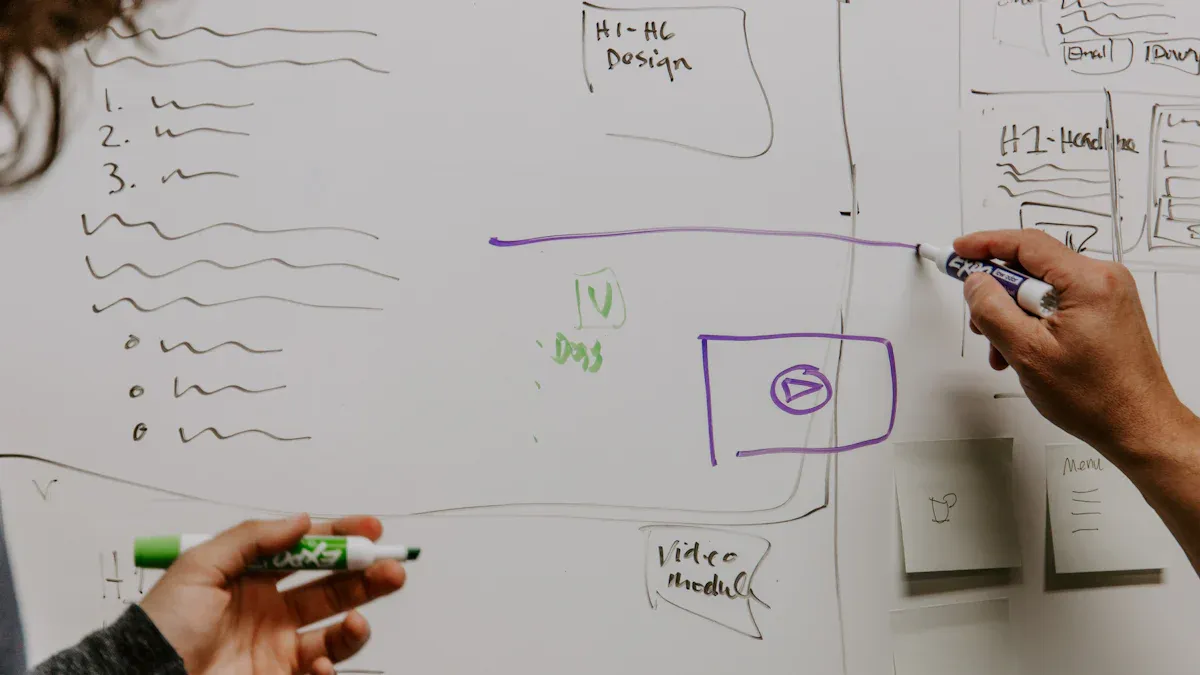
Anthropic System Design Interview Questions
I noticed that the questions in the Anthropic system design interview focused on real-world challenges. They wanted to see how I would design systems that could scale, stay reliable, and keep users safe.The system design assessment was conducted across two interview rounds: the first round and the fourth round.These questions reflect Anthropic’s distinct focus on practical, product-integrated system thinking. Below are the exact system design problems I encountered during my own interview loops:
First Round: Coding + System Design Hybrid
Question Type: System design integrated into a coding session
System Design Problem:
You are building a service that calls the Uber API to schedule rides.
Part 1 – Scaling: How would you design this service to handle a 100x increase in request volume?
Part 2 – Reliability: How would you prevent a bug or surge in your service from crashing or overwhelming Uber's API?
Fourth Round: Dedicated System Design Interview
Question Type: End-to-end product-driven system design
System Design Problem:
Design a Prompt Playground (like ChatGPT Playground) for a large language model.
Phase 1 – Product Requirements:
What core features would you include? How would you structure the user interface and interaction flow?
Phase 2 – Technical Implementation & Scaling:
How would you architect the backend to support real-time prompt execution, response streaming, and user concurrency? How would the system scale globally?
Beyond these questions, I have also compiled some past interview questions:
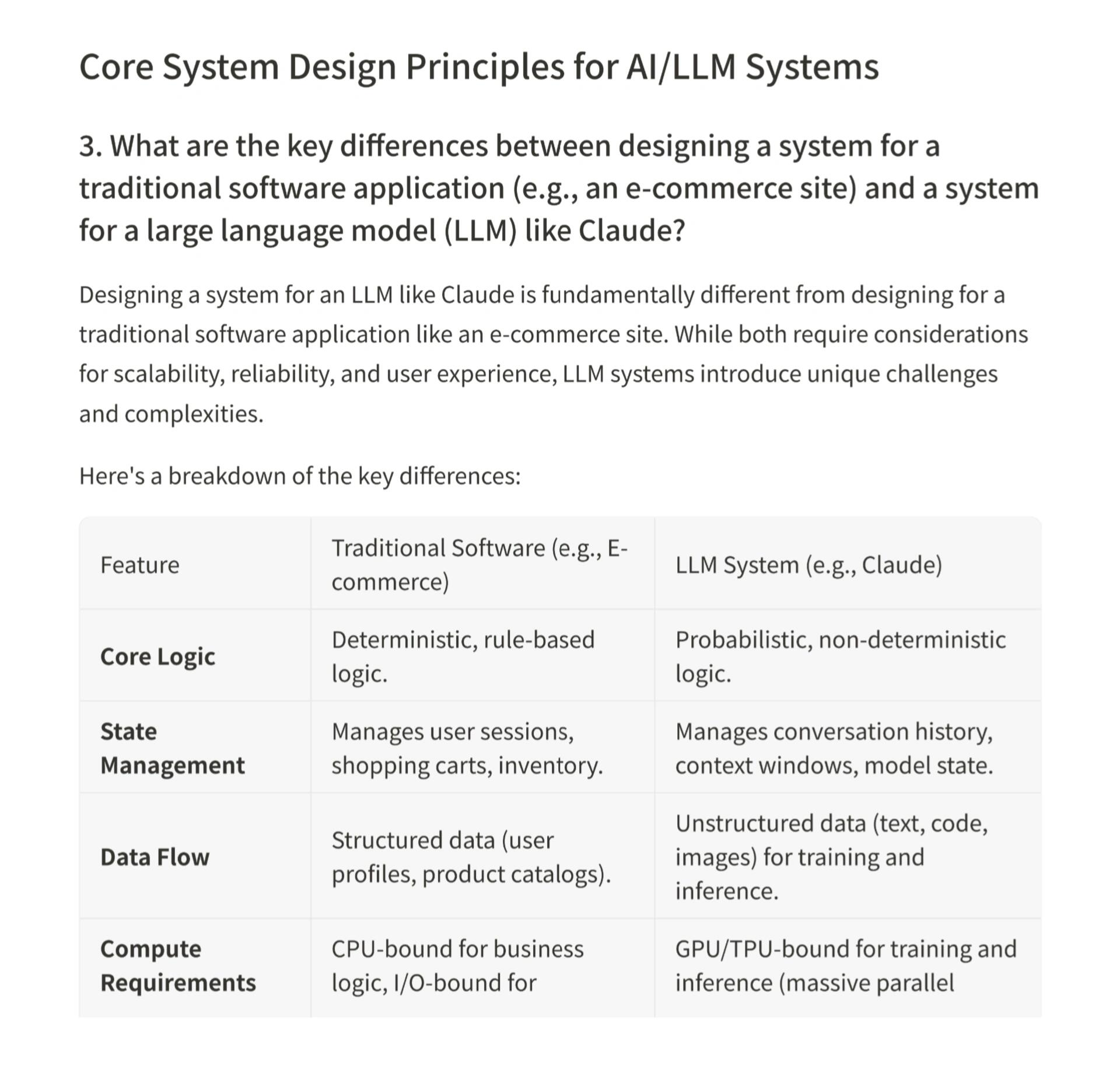
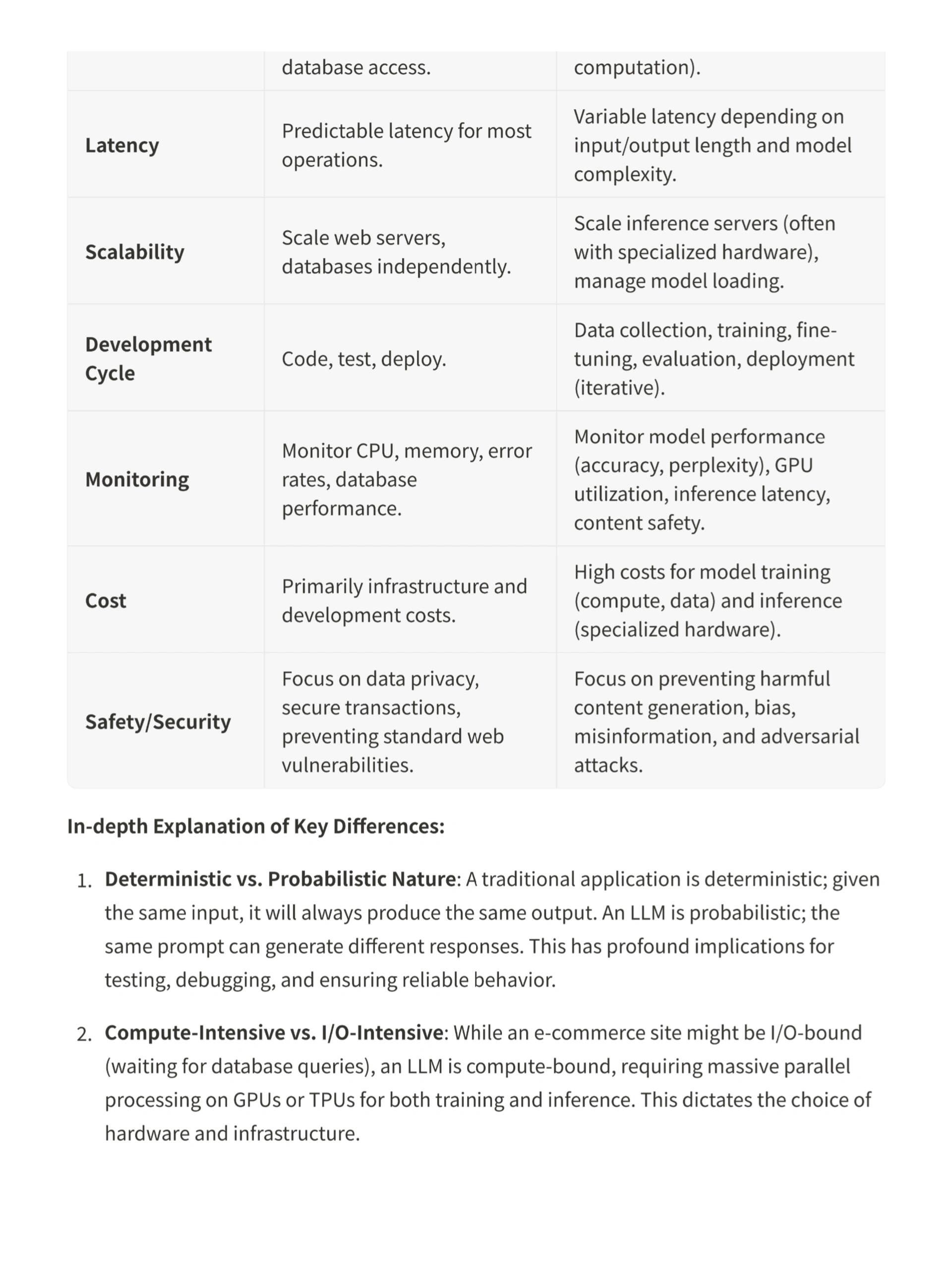
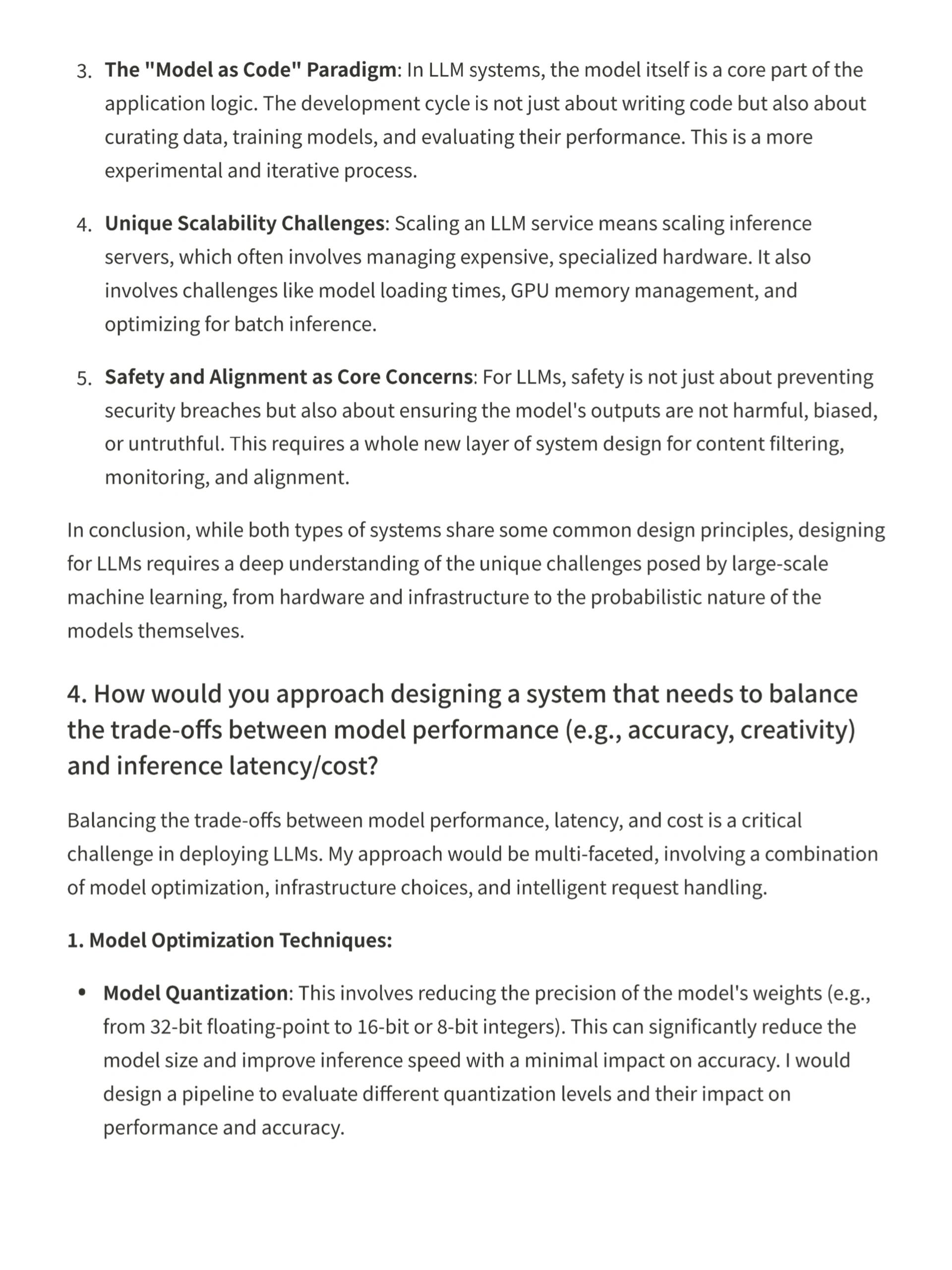
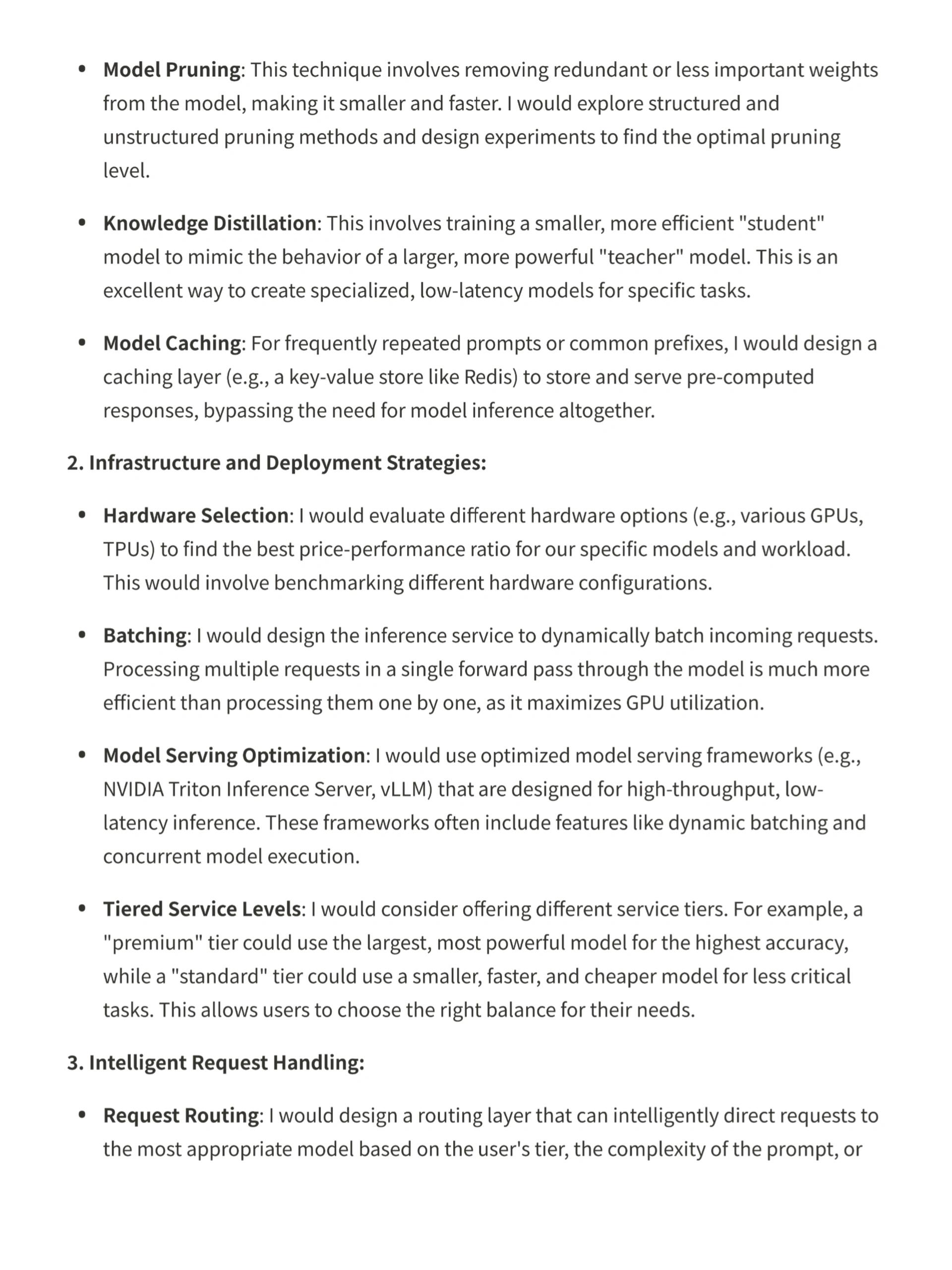
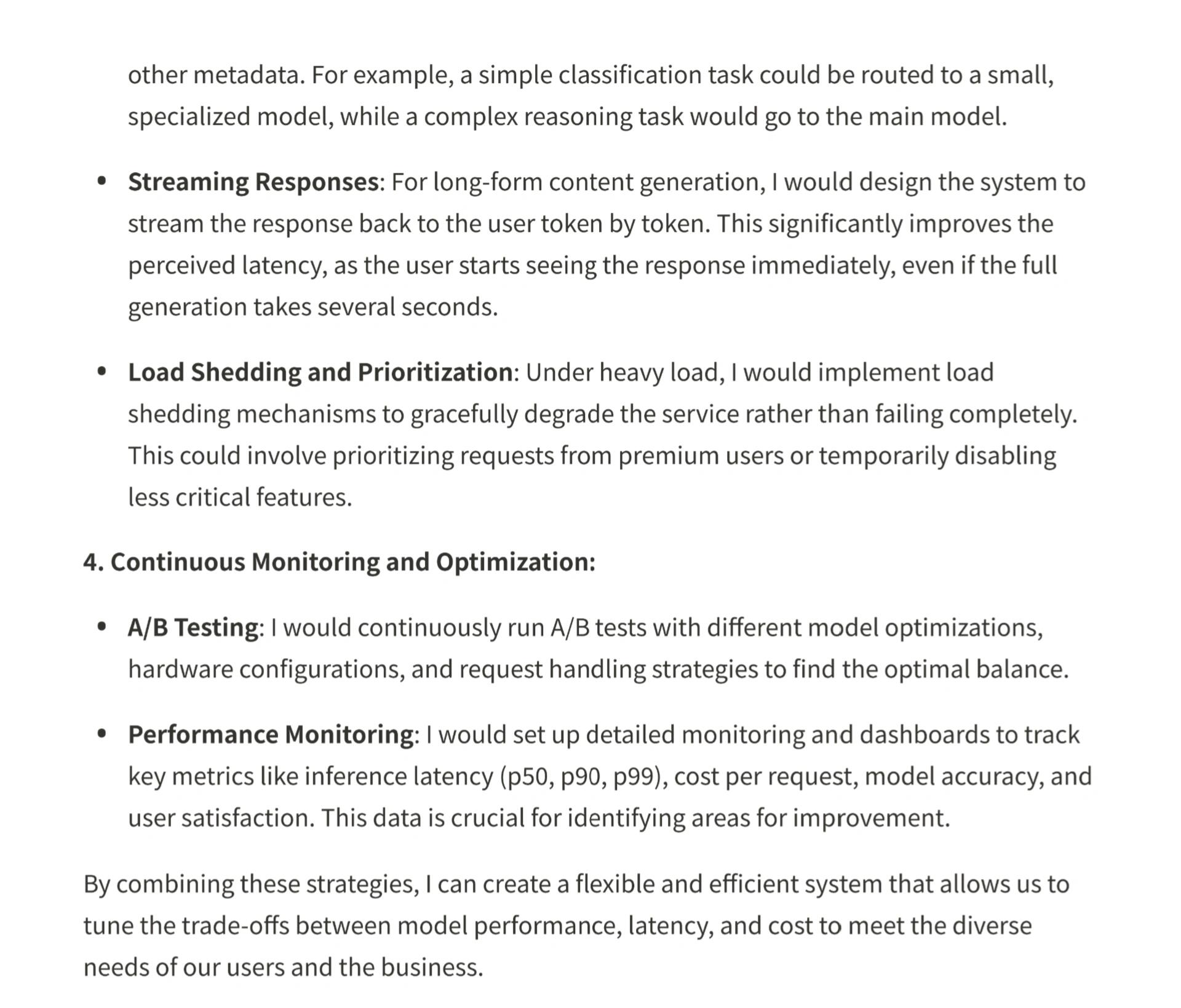
During the interview,the interviewer encouraged me to clarify goals, state my assumptions, and sketch high-level architectures. I had to iterate on my design, breaking it into components and justifying every trade-off. They wanted to see how I balanced cost, latency, and reliability, and how I built in operational practices like monitoring and safety checkpoints.If you want to learn more about real interview questions, you can check out the video below. I discovered it before my interview and it was very beneficial to me.
System Design Interview Format
During the system design interview,the interviewers wanted to see how I approached building scalable and safe systems. They cared about my ability to design machine learning infrastructure and distributed systems that could handle real-world constraints.
The format felt structured but open-ended. The interviewer started with a broad prompt, like “Design a model serving platform for large language models.” I had to clarify requirements, ask questions, and define the scope. They expected me to break down the problem, identify the main components, and sketch a high-level architecture. I needed to justify my choices and explain trade-offs, especially around safety, latency, and reliability.
Tip: Don’t rush into the details. Take a moment to clarify the problem and state your assumptions. This shows safety-first thinking and helps you avoid missing key requirements.
Evaluation Criteria
The evaluation in the Anthropic system design interview felt fair but thorough. The interviewer looked for more than just technical knowledge. They wanted to see how I thought, how I communicated, and how I handled feedback.
Here’s what I learned about their evaluation criteria:
For junior candidates, they focused on clarity and understanding of the basics.
For mid-level candidates, they expected reasoning about scalability and performance.
For senior candidates, they wanted to see how I handled trade-offs, failures, and system evolution.
They paid close attention to my logical progression and clear communication. They wanted simple language that showed deep understanding. If I got stuck or made a mistake, they watched how I adapted and responded to feedback. They valued honesty and the ability to acknowledge uncertainty.
Note: The best way to stand out is to connect your design choices to real-world production needs. Show how your design supports safety, reliability, and scalability. Always explain your reasoning.
Reflections from My Interview
To be honest, Anthropic's system design round is the most unique and pragmatic one I have ever experienced. My most intuitive feeling is that they are not satisfied with just testing a "pure architecture", but will closely tie system design and algorithm implementation together. For example, after you have just explained the distributed deployment scheme of a module, the interviewer will immediately follow up: "So within this module, how would you implement the specific matching or sorting algorithm? If the requirement of real-time updates is added, how would the time complexity change?" They simulate real and extreme scenarios in the business, forcing you to push your design from the top-level architecture all the way down to the code level. This process is very stressful, but after it's over, you will have a very thorough understanding of the linkage between distributed systems and core algorithms.
Another distinctive feature is the strong product and full-stack orientation. The problems are not standardized like those in traditional large companies (such as "design a short link system"), but are more closely related to Anthropic's own business scenarios. For example, I was asked to design an interactive product similar to ChatGPT Playground. The problem starts with defining product functions, gradually deepens to how the front end and back end collaborate, how to manage state, and then how to scale the back-end services. You need to constantly switch between product thinking, user experience, and system architecture - this is very different from other companies' main focus on back-end scalability.
From the perspective of difficulty, the knowledge points of the questions themselves are not unattainable, but they are highly targeted, and conventional preparation can easily miss the mark. You can continue to use classic system design frameworks (such as discussing load balancing, caching, and message queues first), but the core difficulties will quickly focus on AI infrastructure and MLOps. For example, when designing a high-concurrency AI inference API, the discussion will quickly shift to: how to dynamically allocate and release GPU resources based on traffic fluctuations? How to strike a balance between latency and cost? Without prior knowledge of modern AI engineering stacks (such as inference service, model deployment, and hardware elastic scheduling), it is easy to expose knowledge gaps here.Just in case, I used linkjob.ai during the interview process. This software is very useful, as it allows me to use its AI tool during the online interview without being detected by the interviewer. Even when sharing the screen, the interviewer cannot see the AI tool on my screen. Thanks to this tool, I successfully passed the online interview stage of Antropic.
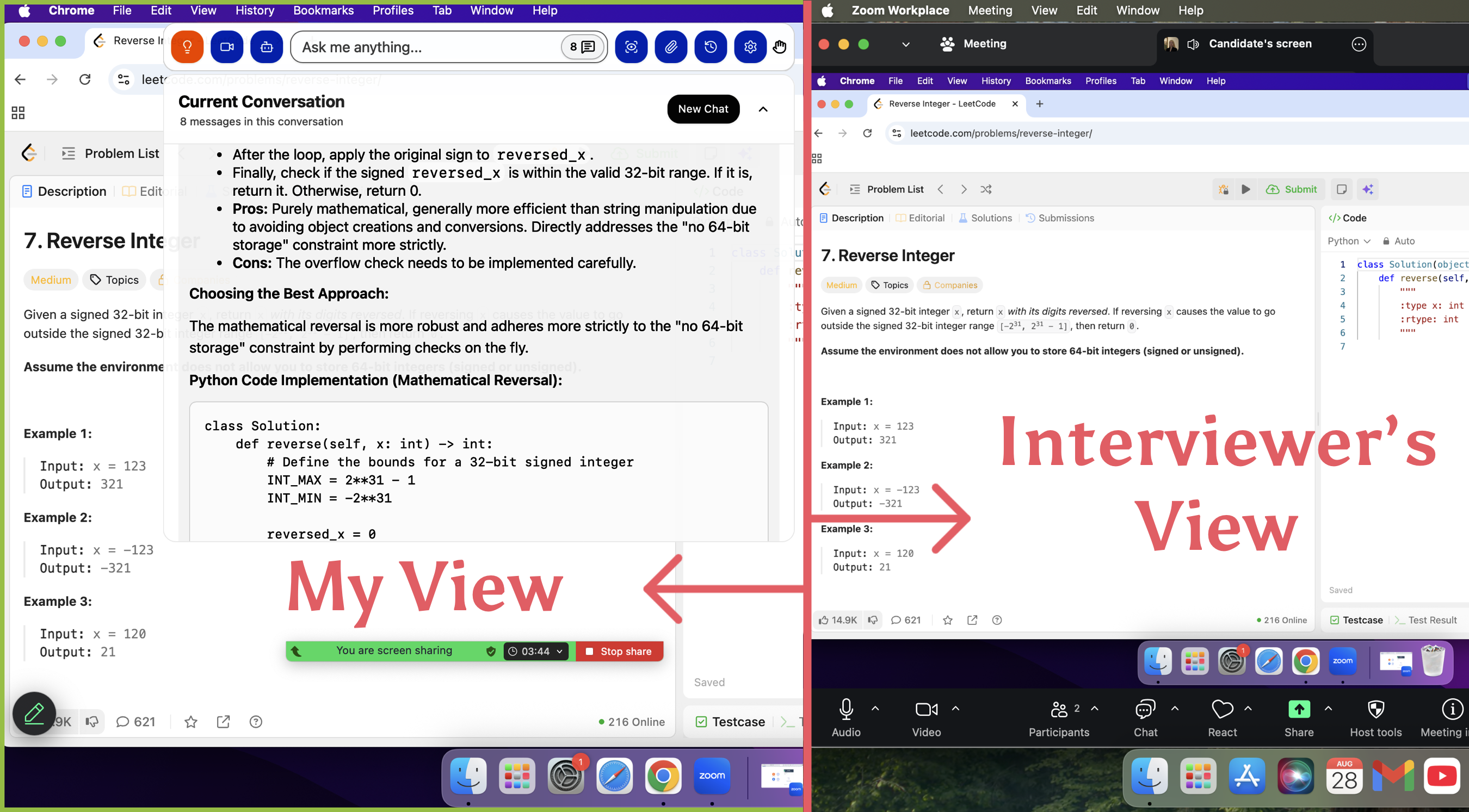
This is completely invisible from the interviewer's perspective! I tested it with my friend before the interview, and she couldn't see the AI tool on my shared screen at all!
In summary, Anthropic seems to be looking for talents who not only possess solid system architecture skills, but also have the ability to design implementable and scalable AI systems from the perspective of product experience. The biggest inspiration I gained from this interview is that in an AI company, system design is no longer just about backend scalability, but also about how to transform complex technical capabilities into smooth user value through a stable and efficient system.
Preparation Strategies and Tools

System Design Interview Preparation
I started my technical preparation by reviewing core concepts in algorithms, data structures, and system design. I set aside time each day to solve coding problems and sketch out system diagrams. I focused on design questions that tested my ability to build scalable systems. I practiced explaining my thought process out loud, which helped me stay clear and confident during the interview. I also reviewed past technical projects and thought about how I handled risk and failure. This made it easier to answer questions about design trade-offs and technical decisions.
I found that the best way to tackle the Anthropic system design interview was to engage actively with the interviewer. I asked clarifying questions and identified the core functionalities and users. I estimated system resources and focused on high-level design before diving into details. I broke down complex problems and balanced trade-offs between performance, cost, and safety.
I made sure to connect my answers to Anthropic’s mission. I talked about how my design would support safe AI deployment and reliable machine learning infrastructure. I used clear communication and safety-first thinking in every answer.
Study Resources and Practice
When I started prepping for my Anthropic interview, I realized that having a solid plan made everything less overwhelming. I built my own question bank with a mix of technical, behavioral, and situational questions. Practicing with mock interviews helped me get comfortable with the format and timing. I always recorded my answers so I could spot areas for improvement. Here’s what worked best for me:
use a comprehensive question bank that covered all types of scenarios.
set up mock interviews to simulate real conditions.
track feedback on my answers and focused on weak spots.
collect resource links, including articles and videos, to deepen my understanding.
One resource I found super helpful was the Notion Bookshelf. It offered curated learning materials and templates, including a Notion template for tracking progress. I also tried the Software Engineering Interview Prep template by Aurelio Benito from the Notion Marketplace. These tools kept me organized and motivated.
Tip: Practice out loud and treat every mock interview like the real thing. It makes a huge difference when you face actual system design interview questions.
Mindset and Time Management
Staying positive during interview prep isn’t easy, but I learned a few tricks. I treated every interview as a learning opportunity. This helped me stay curious and relaxed. I saw each session as practice, not just a test. I created a personal knowledge base to reflect on my experiences and prepare better for the next round.
break my study sessions into short, focused blocks.
set small goals for each day and celebrated progress.
remind myself that every interview, even the tough ones, helped me grow.
Pro Tip: Keep your mindset flexible. If you stumble on a question, treat it as a chance to learn, not a failure.
Using AI for Interview Success
Of course. Using AI to prepare for technical interviews is no longer just a nice-to-have; it’s becoming an essential tool for efficient preparation. Its greatest value lies in structuring the open-ended exploration process. When you’re faced with a complex, open-ended question like “design a distributed inference API,” traditional prep often leads to fragmented searching and passive reading. With AI, you can quickly build an interactive, iterative thinking sandbox.
It can dynamically play different roles:
As a Mock Interviewer: It can generate follow-up questions, poke at edge cases, and challenge your assumptions in real-time, simulating the pressure and unpredictability of a real interview.
As a Collaborative Architect: You can iterate on a system diagram by having a dialogue—explaining your design, getting instant feedback on trade-offs, and exploring alternative approaches without having to schedule another person.
As a Knowledge Synthesizer: Need to connect the dots between Kubernetes autoscaling, GPU resource pooling, and inference latency SLOs? AI can instantly provide concise explanations and relevant concepts, saving hours of manual research.
This transforms preparation from a solitary study session into an active, dialog-driven drill. You’re not just consuming static information; you’re stress-testing your reasoning, filling knowledge gaps on-demand, and building the muscle memory to think aloud and adapt under questioning—which is precisely the core skill being assessed. In short, AI doesn’t replace deep understanding, but it dramatically accelerates the path to achieving it, making your preparation more focused, adaptive, and ultimately, more complete.
I learned that understanding the process and using tools like Linkjob AI made a huge impact. My experience taught me to value every challenge and see each interview as a chance to grow. If you’re a candidate aiming for Anthropic, trust your experience, highlight your impact, and let your mission-first culture shine. Your problem-solving and culture-fit will set you apart!
Summary of Main Points
Prepare for interviews by practicing coding and system design questions. Use mock interviews to simulate real scenarios and improve your communication.
During the system design interview, clarify requirements and justify your design choices. Focus on safety, scalability, and reliability in your solutions.
Use tools like Linkjob AI(an invisible AI interview assistant) for real-time feedback during interview. This can help you solve difficult problems and enhance your confidence.
Show genuine interest in Anthropic's mission during interviews. Connect your experiences and values to their focus on safe and ethical AI.
FAQ
What surprised me most about the Anthropic interview process?
I expected a standard interview process, but Anthropic focused on ai safety and culture from the start. The process included deep dives into system design and llm infrastructure. Every step felt connected to their mission, not just technical skills.
Did I use Linkjob AI during the actual interview?
Yes! Linkjob AI gave me real-time support and personalized answers. It worked smoothly with CoderPad. And it is completely invisible from the interviewer's perspective when sharing the screen, so with it, I can silently seek help from AI tools during online interviews. In short, it's a very useful tool.
How did I prepare for the system design interview?
I broke down the process into small steps. I reviewed ai concepts, practiced system design questions, and studied llm architecture. I used mock interviews to simulate the interview process. I also focused on how my answers reflected Anthropic’s culture and values.
What role did AI play in my interview preparation?
Ai helped me understand the interview process better. I used tools like ChatGPT to practice system design and coding. The ai gave me feedback on my answers and helped me improve. This made the process less stressful and boosted my confidence before the offer.
How important is culture fit in the Anthropic interview process?
Culture fit matters a lot. The interview process includes questions about ai safety, teamwork, and values. I shared stories about working with different teams and building safe systems. The process checks if you align with their mission before you get an offer.
What advice would I give to someone hoping for an offer from Anthropic?
Start by learning about their interview process and ai mission. Practice system design and llm questions. Show your passion for safe ai and culture. Use every part of the process to highlight your skills. Stay positive and keep learning until you get that offer!
See Also
Insights From My 2025 Anthropic Software Engineer Interview
My Strategy for Succeeding in the 2026 Anthropic Interview
Details of My 2026 Interview Journey With Palantir
© Copyright 2025 Linkjob.ai - All Rights Reserved.