My Experience With Atlassian HackerRank Questions in 2026


Atlassian’s SDE interview includes three questions in total. Overall, they aren’t very difficult, roughly medium level. With clear reasoning and solid familiarity with basic algorithms and string manipulation, they can be solved.
I’m really grateful to Linkjob.ai for helping me pass my interview, which is why I’m sharing my OA questions and experience here. Having an undetectable AI interview assistant during the OA indeed provides a significant edge.
Atlassian HackerRank Questions
Question 1: Romanizer
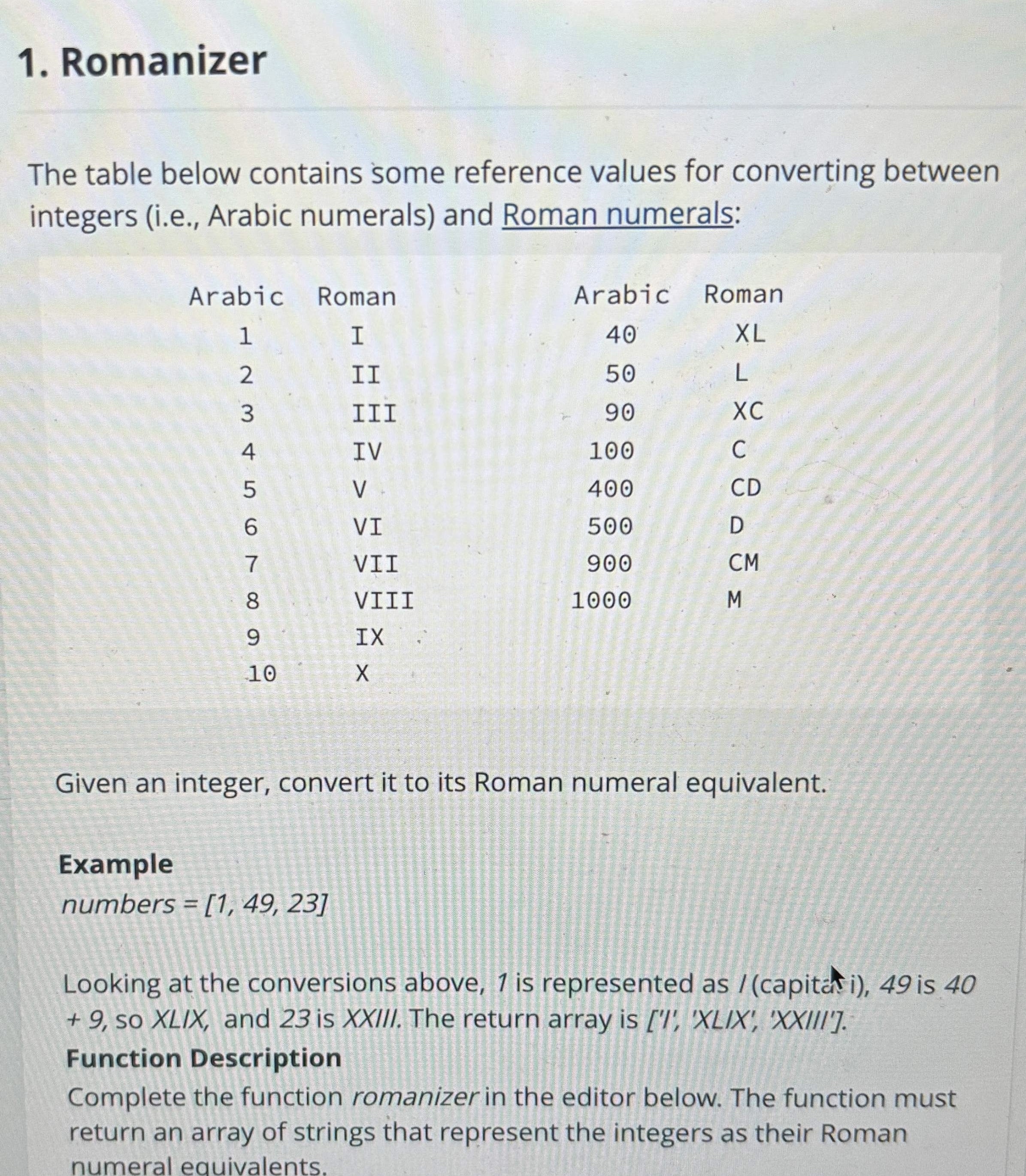
When I saw this problem, my first reaction was that it was quite standard and mainly about mapping and concatenating based on fixed rules.
First I needed to sort out the Roman numeral mappings. The problem provides the table for 1 to 1000, and the core idea is matching larger values first, for example 49 is formed by taking 40 (XL) and then 9 (IX).
My approach was to store the Arabic numbers and Roman numerals in a list ordered from largest to smallest, such as [(1000, ‘M’), (900, ‘CM’), …, (1, ‘I’)].
Then I iterated through each input number and checked from largest to smallest whether the number could be reduced by that value. Whenever it could, I appended the corresponding Roman numeral and subtracted the value until the number reached zero.
For example, when I processed 23, I appended two 10s (XX), then 3 as III, giving XXIII.
Question 2: Better Compression
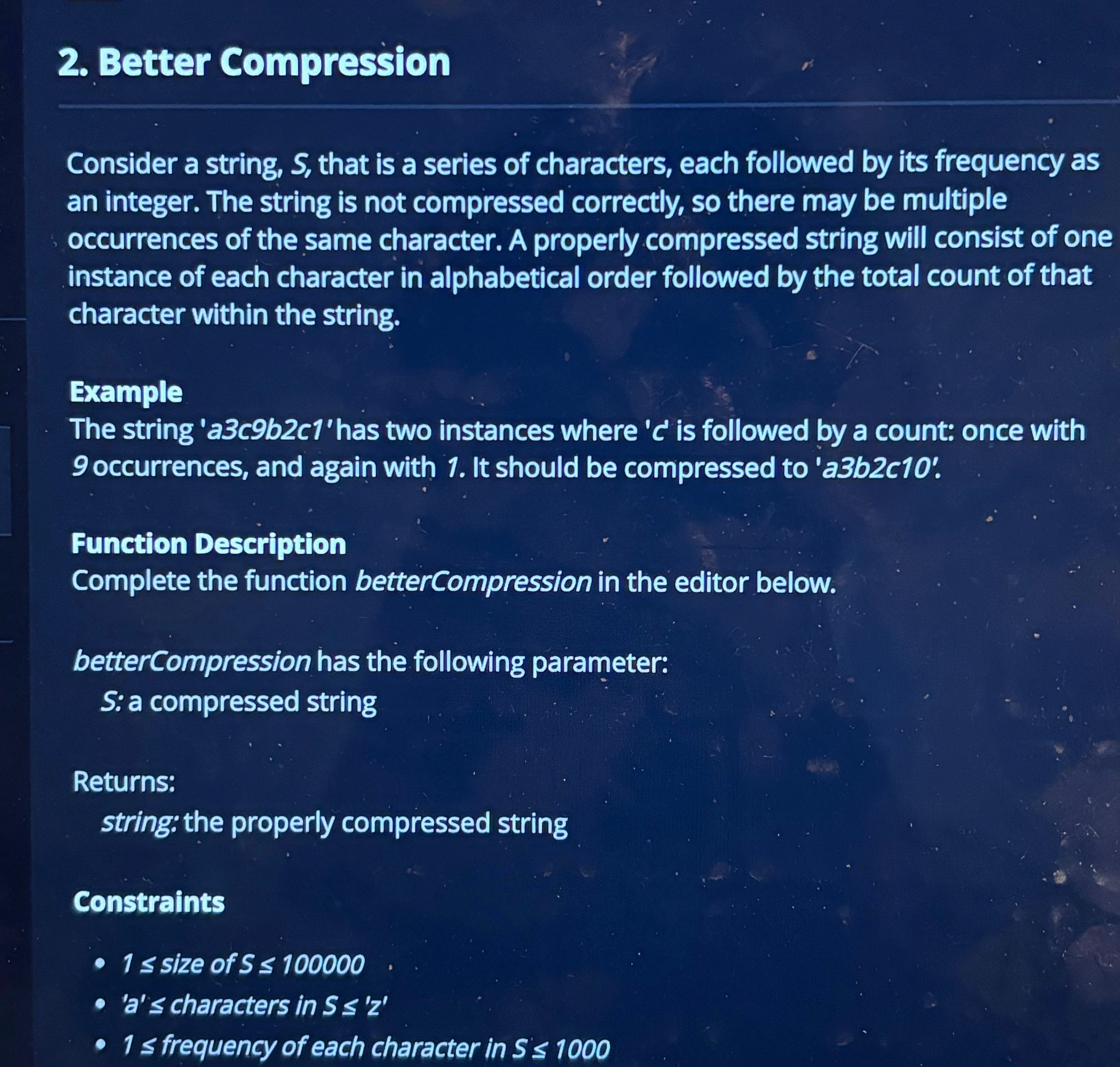
When I first looked at this problem, I noticed that characters might appear multiple times, so their counts needed to be combined and the final output sorted alphabetically.
First I needed to split the string into “character + frequency” segments, such as a3c9b2c1, and I had to pay attention because frequencies could be multi-digit numbers.
My approach was to iterate through the string and use a dictionary to accumulate each character’s total frequency.
When I encountered a character, I recorded it, then read all following digits as an integer and added it to the dictionary.
After all frequencies were collected, I sorted the characters alphabetically and concatenated each character with its total frequency.
For example, the total count for c is 10, and after sorting a, b, c, I produced a3b2c10.
Linkjob AI worked great and I got through my interview without a hitch. It’s also undetectable, I used it and didn't trigger any HackerRank detection.
Question 3: Flower Bouquets
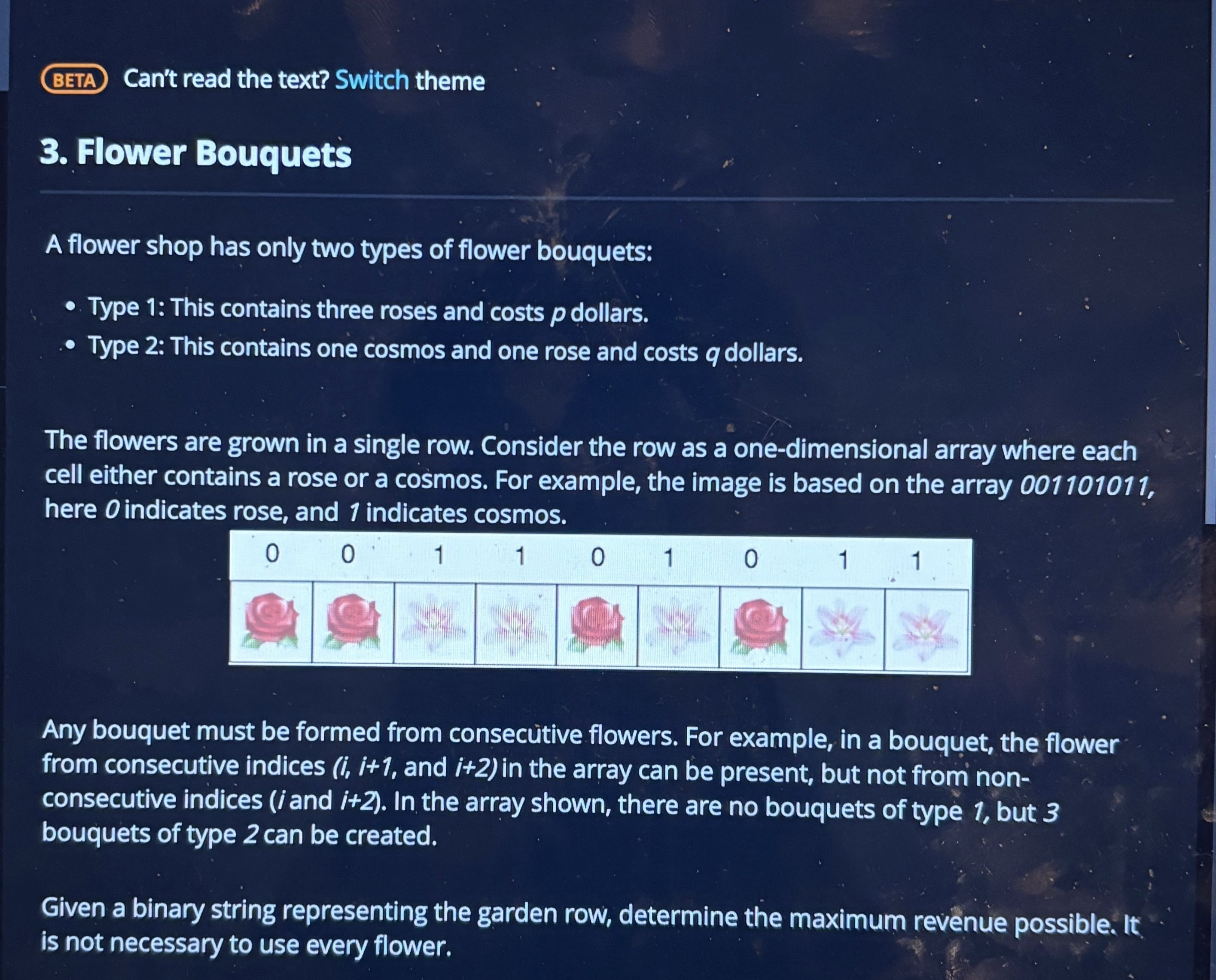
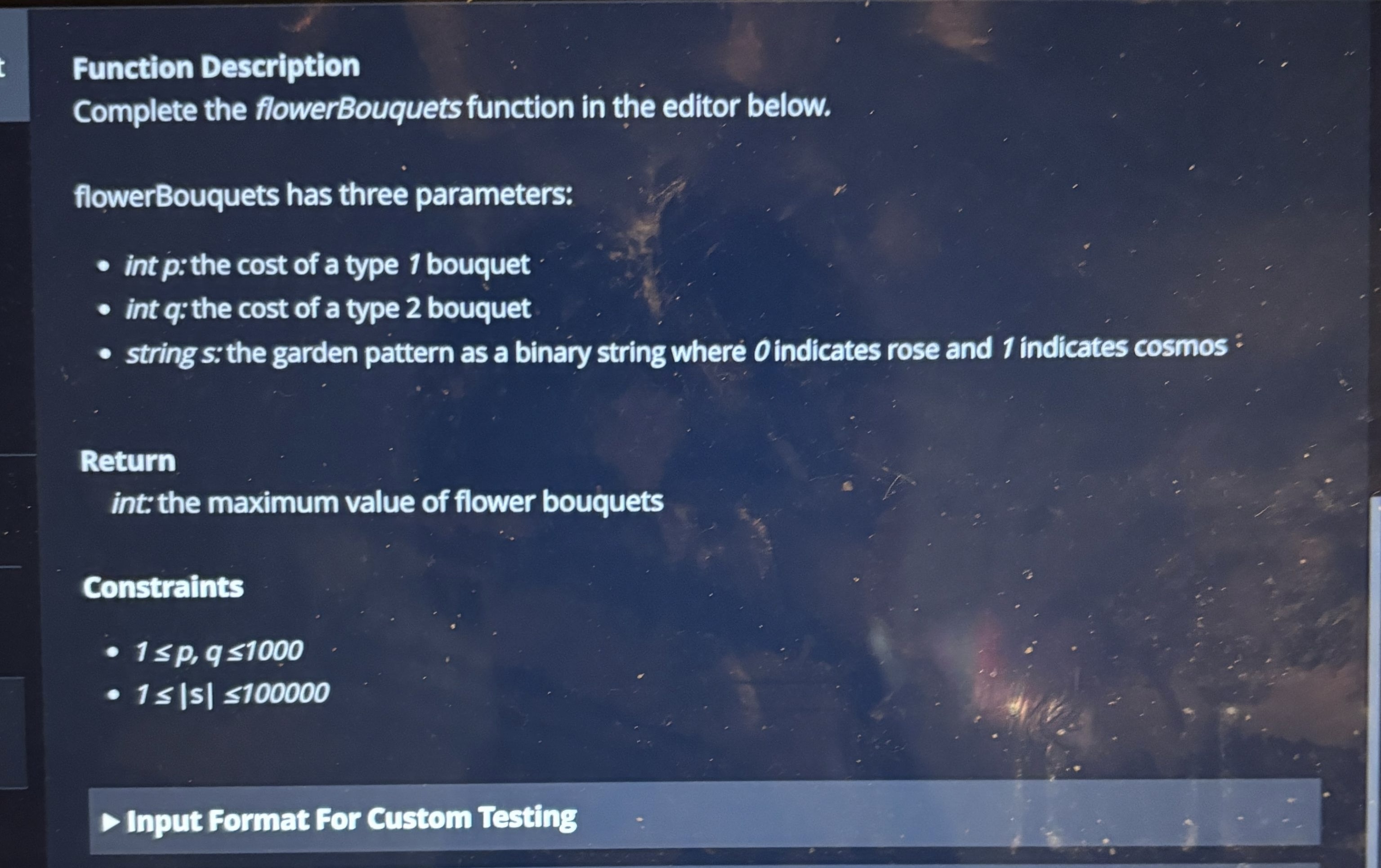
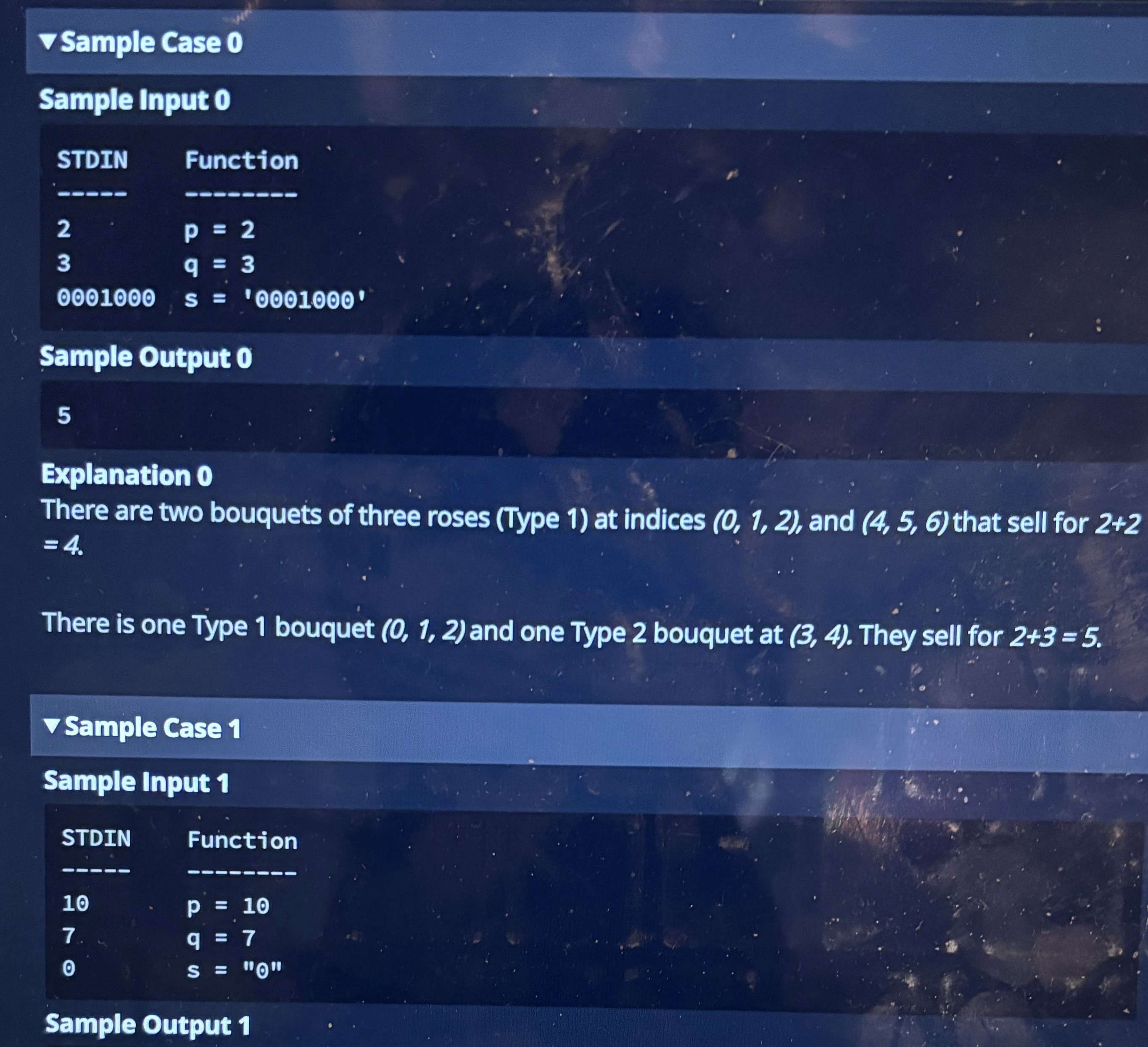
The key point I focused on was that flowers cannot be reused, and the goal is to calculate the maximum profit.
My approach was to use dynamic programming, defining dp[i] as the maximum profit for the first i flowers.
When iterating through the flowers, I considered multiple cases:
• Skipping the i-th flower: dp[i] = dp[i-1].
• Or I could check whether forming Type 1 or Type 2 was possible:
• Type 1: if i ≥ 3 and the last three flowers were all 0, I set dp[i] = dp[i-3] + p.
• Type 2: if i ≥ 2 and the last two flowers contained one 0 and one 1, I set dp[i] = dp[i-2] + q.
For example, in Sample Case 0, I took a Type 1 bouquet for the first three flowers (profit 2) and a Type 2 bouquet for flowers 4 and 5 (profit 3), resulting in a total profit of 5.
Atlassian Hackerrank Questions Overview
Core Assessment Areas
Atlassian’s HackerRank online assessments focus on fundamental programming and problem-solving skills, without involving obscure or highly complex algorithms. The core assessment areas are:
String Manipulation: Includes common scenarios such as format conversion, structured parsing, and data cleaning and optimization. The emphasis is on proficiency in splitting, concatenating, and traversing strings.
Basic Algorithmic Logic: Mainly involves linear traversal, greedy strategies, and simple dynamic programming, focusing on sequence optimization and rule-matching problems. Complex algorithm derivations are not required.
Basic Data Structure Usage: Centers on hash tables (for counting and aggregation), arrays (for linear processing), lists, and other basic containers. The focus is on matching data structures to the scenario, without involving deep nesting or uncommon structures.
These assessment points closely align with coding tasks in Atlassian’s daily work, prioritizing practical logic over theoretical depth.
Typical Question Characteristics
Atlassian HackerRank questions have consistent, practical characteristics:
Scenario-Based Context: Questions are framed within lightweight, realistic scenarios (such as data format conversion or resource allocation logic). The scenario serves only as background and does not affect the abstraction and solution of the core logic, which remains the main focus.
Stable Difficulty Range: Questions are generally between LeetCode Easy and Medium levels. They do not feature excessively tricky designs, but attention to detail is required, such as handling multi-digit numbers, non-overlapping constraints, and null compatibility.
Reasonable Time Allocation: Assessments typically include 2-3 questions, with sufficient time to complete them. The emphasis is on understanding the problem and outlining clear logic, ensuring correct and complete code rather than rushing for speed.
Core Design Principles
The design of Atlassian HackerRank assessments follows clear guiding principles:
Practicality First: All questions stem from basic problems in real programming scenarios. Skills tested are directly applicable to daily work, avoiding purely theoretical or competition-style questions.
Logic Over Performance: Unless a time complexity constraint is explicitly stated, the assessment prioritizes logical correctness and readability over extreme performance optimization. Solutions can be completed within reasonable complexity.
Boundary Case Coverage: Questions include standard boundary scenarios (such as empty inputs, extreme values, or duplicate elements) to test code robustness and ensure candidates consider common real-world cases.
Atlassian Hackerrank Preparation Tips and Skills
The core focus of Atlassian’s HackerRank assessment is not on obscure tricks but on testing the solidity of fundamental skills and the clarity of logic. Based on my preparation and problem-solving experience, I have compiled several genuinely useful directions for preparation. These techniques may seem basic, but they directly improve accuracy and efficiency in solving problems.
Strengthen Core Programming Skills
Focus on refining fundamental skills that align with the assessment’s core areas. For string manipulation, it is essential to be proficient in character traversal, splitting and concatenation, and multi-digit extraction to handle format conversion and data cleaning efficiently. For basic algorithms, emphasize linear traversal, greedy strategies, and simple dynamic programming, applying these core logics flexibly without delving into advanced algorithms. For example, dynamic programming can be used to quickly solve sequence optimization problems. Additionally, develop a solid understanding of basic data structures such as hash tables and arrays, and know how to choose the appropriate structure for different scenarios, for instance using hash tables for efficient counting and aggregation or arrays for linear data processing.
Enhance Scenario-Based Problem-Solving Skills
When facing scenario-based questions in the assessment, adopt a mindset of separating the scenario from the core problem. Upon reading a question, ignore extraneous background information and extract the essential logic, such as translating the scenario into basic models like counting, rule matching, or sequence decision-making. Then map these models to familiar solution methods. Focus on structuring the solution step by step, either mentally or on paper, by outlining input, output, key constraints, and core steps before coding. This approach prevents logical confusion caused by thinking and coding simultaneously.
Improve Code Robustness and Readability
In daily practice, cultivate sensitivity to edge cases by actively considering empty inputs, extreme values, duplicate elements, and unusual formats to ensure code covers all possible test cases. During coding, maintain clear naming conventions with meaningful variable and function names to reduce reliance on comments. Keep code structure simple, avoid redundant logic, and use modular functions to make the code more readable. For example, separate string parsing and data aggregation into independent functions to facilitate debugging and meet the assessment’s readability requirements.
Simulate Assessment Scenarios to Build Proficiency
Practice under conditions that mirror the assessment in terms of question quantity and time. Complete 2-3 Easy to Medium level questions in each session to simulate real test time pressure, improving the efficiency of reading, logical planning, and coding. After practice, review mistakes to identify whether they stem from knowledge gaps, logic errors, or missed edge cases. Summarize patterns for similar questions, such as common methods for multi-digit extraction in strings or typical state definitions in dynamic programming, to build a personal solution strategy library.
Common Mistakes to Avoid in Atlassian Hackerrank
Reflecting on my own experience and the issues encountered by friends preparing alongside me, I found that the points where candidates lose marks in the Atlassian HackerRank OA are actually quite concentrated. Many mistakes fall into the category of “knew how to solve it but made careless errors.”
Ignoring Question Constraints
A frequent mistake is overlooking key constraints, such as elements that cannot be reused, multi-digit frequencies, or sequences that must follow a specific order, resulting in logic that does not meet the requirements. For example, in string compression problems, failing to handle multi-digit frequencies and only extracting single digits can lead to incorrect results. In sequence optimization problems, ignoring non-overlapping constraints may cause the solution to exceed limits. The key to avoiding these errors is to mark critical constraints while reading the question and review them before coding to ensure every step respects the requirements.
Overemphasizing Performance Optimization
Atlassian assessments prioritize correctness and readability. Unless a time complexity requirement is explicitly stated, excessive focus on performance is unnecessary. Some candidates apply complex algorithms to simple problems to reduce time complexity, which can introduce logical errors or increase debugging time. Over-optimizing space usage can also reduce readability. The correct approach is to implement a clear and simple solution that passes all test cases first, then optimize only if required by the problem.
Neglecting Edge Cases
Many solutions pass standard test cases but fail on edge cases, such as empty inputs, single-element inputs, or extreme values. For instance, in the Roman numeral conversion problem, failing to account for minimum values like 0 or 1 can produce incorrect mappings. In dynamic programming problems, neglecting initial states, such as the first 0 or 1 elements, can lead to out-of-bounds errors or incorrect results. To avoid this, create test cases covering edge scenarios after coding to verify robustness.
Messy Code Logic and Poor Readability
Rushing to code without a clear logical plan can result in messy, deeply nested structures that are difficult to debug and fail to meet readability standards. For example, combining string parsing, data aggregation, and result concatenation in a single function makes errors hard to locate, while using vague variable names like a, b, or temp hinders understanding. To prevent this, establish a clear solution framework before coding, modularize functions, and follow naming conventions to ensure the code is clear and easy to read.
Misunderstanding Questions
Reading too quickly or carelessly can lead to misinterpreting the core requirements, such as treating “alphabetical order” as “input order” or “three consecutive elements” as “any three elements,” which causes the solution approach to fail. Such errors are hard to fix through debugging and often require complete recoding. To avoid this, read questions carefully, slow down when needed, and for scenario-based problems, extract the core issue and verify understanding with examples. Ensure that the sample inputs and outputs align with the understanding before starting to code.
FAQ
Can I use any programming language?
Yes. You can choose the programming language according to your preference.
Language | My Experience |
|---|---|
Python | Fast for coding |
Java | Good for system design |
SQL | Useful for data questions |
How long after finishing your OA did you receive the results?
It took about two weeks after my OA to get the results and move on to the next round. After the OA, there were still two more interview rounds. Once those two rounds were completed, I was informed of the results on the same day.
See Also
How to Cheat HackerRank Tests With AI: My 2026 Update
I Faced Real Atlassian System Design Interview Questions in 2026
How I Passed 2026 Microsoft HackerRank Test on My First Try
How I Passed 2026 JP Morgan HackerRank Assessment: Q&A
2026 Update: My Stripe HackerRank Online Assessment Questions
© Copyright 2025 Linkjob.ai - All Rights Reserved.