What My Real BNP Paribas HackerRank Test Was Like in 2026


I just completed the BNP Paribas Quantitative Finance OA. I’m really grateful to Linkjob.ai for helping me pass my interview, which is why I’m sharing my OA questions and experience here. Having an undetectable AI interview assistant indeed provides a significant edge.
The test was on HackerRank and allowed 90 minutes for completion. There were six questions in total, five focusing on math, probability, and algorithm complexity analysis, and one programming question. Overall, the questions were fairly basic and the time was sufficient. However, the programming question involved string manipulation, which was somewhat uncommon.
This article is part of the HackerRank series. If you're interested in other articles in this series, feel free to read: Microsoft HackerRank test, JP Morgan HackerRank test, Stripe HackerRank online assessment.
BNP Paribas Hackerrank Test Questions
Question 1: Blood Types in a Group
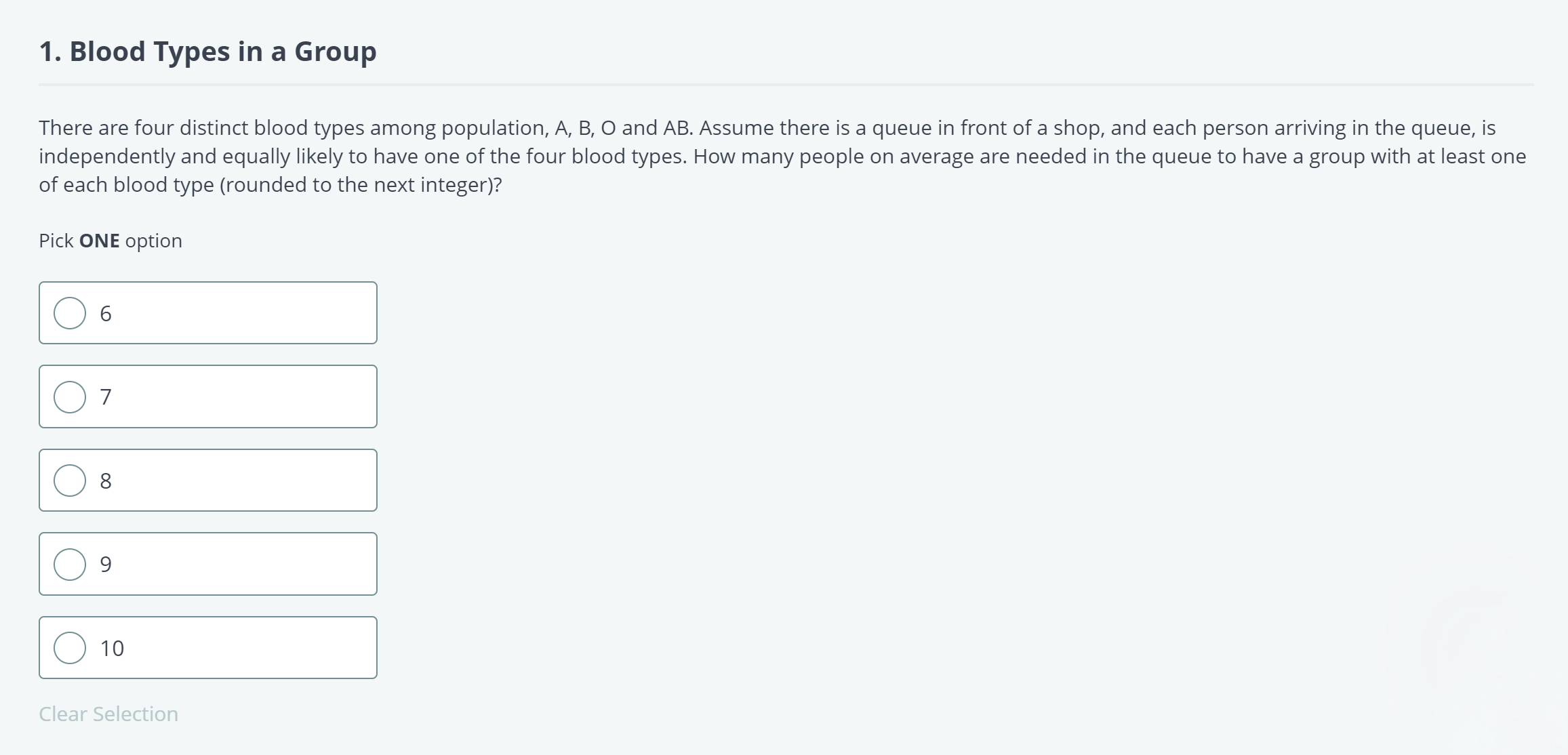
There are four blood types, each equally likely. The task is to find the expected number of people needed to collect all types.
Formula: E = n * (1 + 1/2 + 1/3 + ... + 1/n)
Here n = 4:
E = 4 * (1 + 1/2 + 1/3 + 1/4) = 4 * 25/12 ≈ 8.33
Round up → answer is 9.
Question 2: Integration of cosines
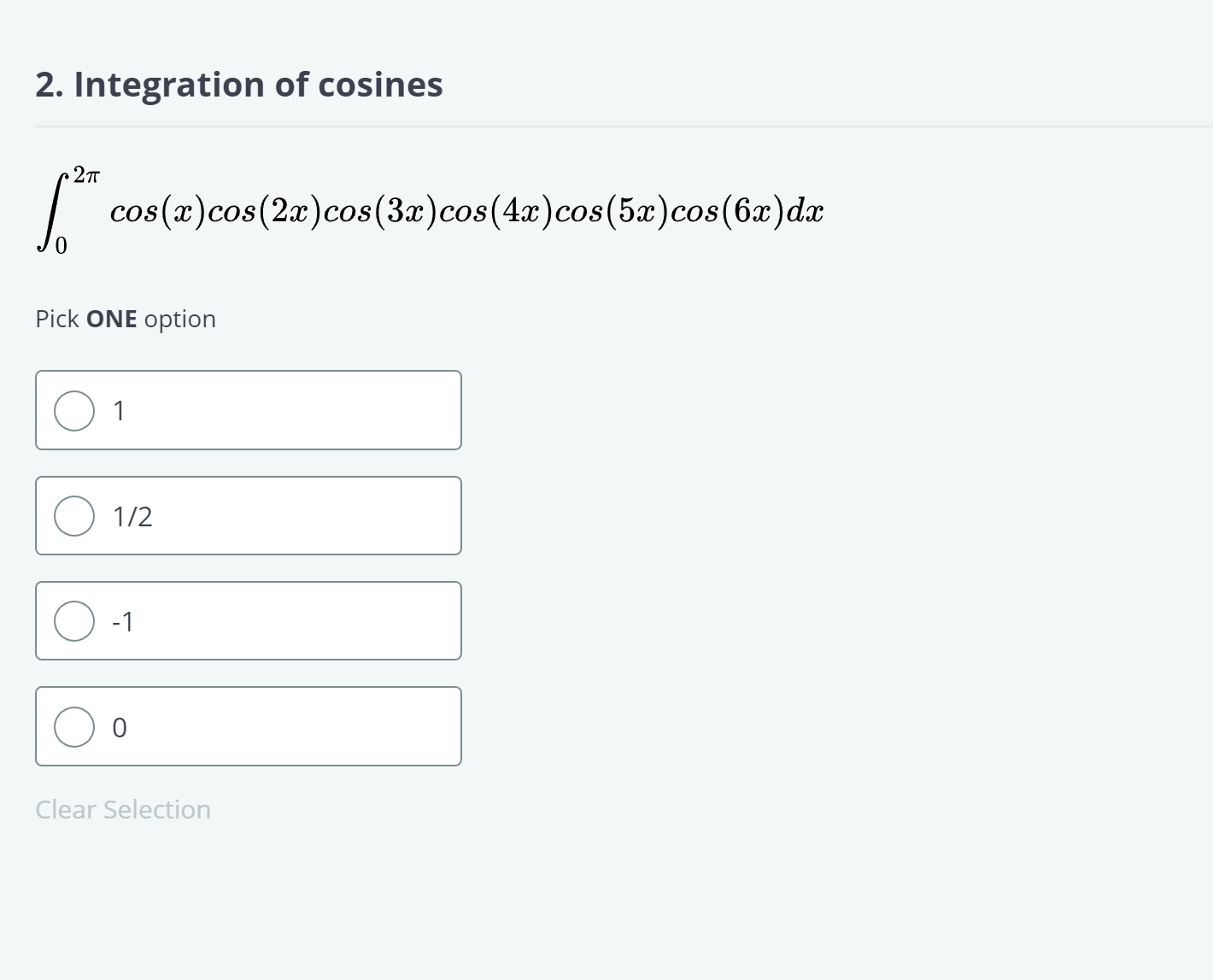
Compute the integral: ∫(0 to 2π) cos(x) * cos(2x) * cos(3x) * cos(4x) * cos(5x) * cos(6x) dx
Use the orthogonality property of cosines: for integer k ≠ 0, ∫(0 to 2π) cos(k*x) dx = 0; only when k = 0 is the integral 2π.
Expanding the product of cosines gives terms of the form cos(m*x) with m ≠ 0. Hence all terms integrate to 0. Final answer: 0.
Question 3: Determinant of a matrix
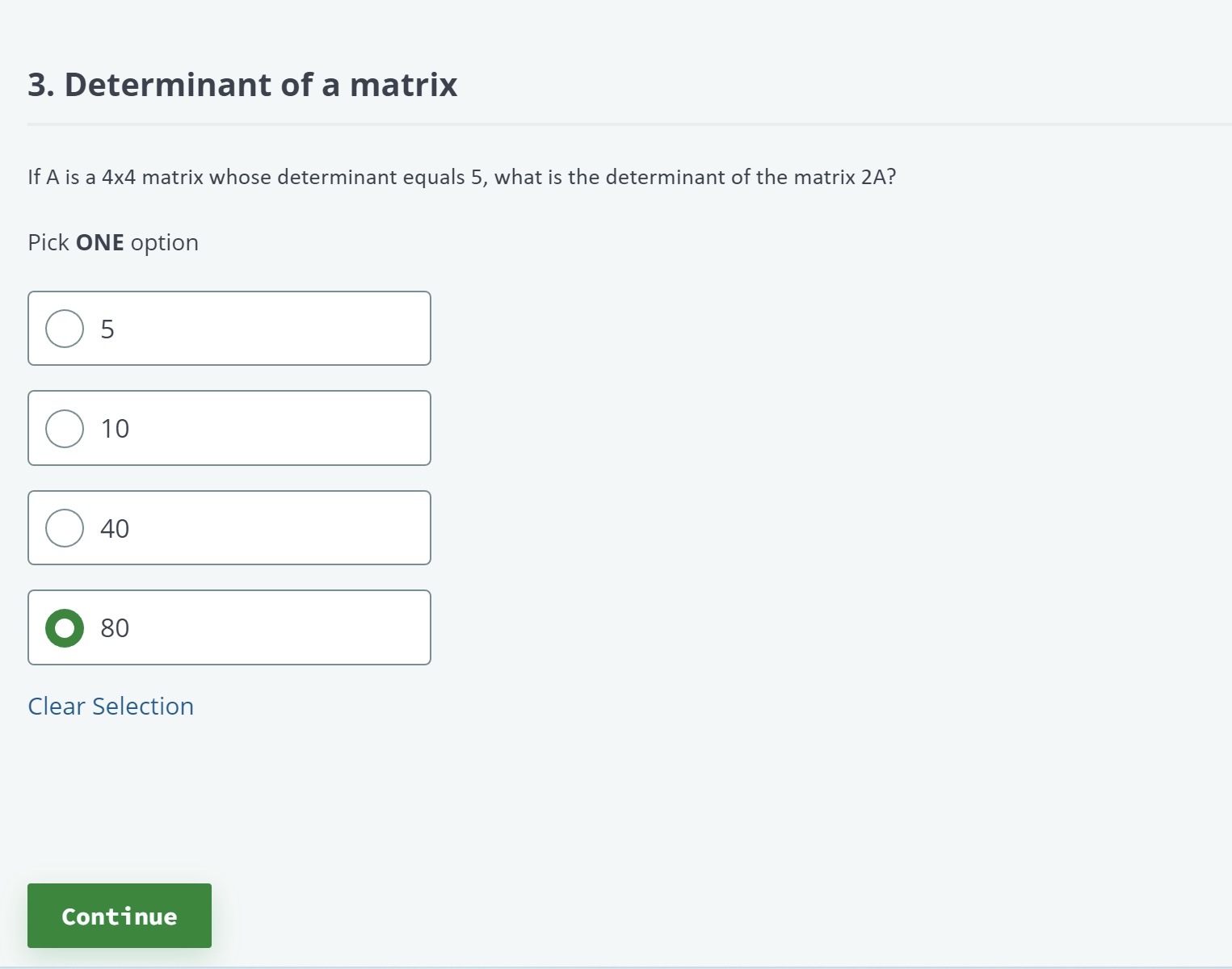
Given a 4x4 matrix A with det(A) = 5, find det(2A).
Property: for an n x n matrix, det(k*A) = k^n * det(A)
Here n = 4 and k = 2:
det(2A) = 2^4 * 5 = 16 * 5 = 80
Answer: 80.

Question 4
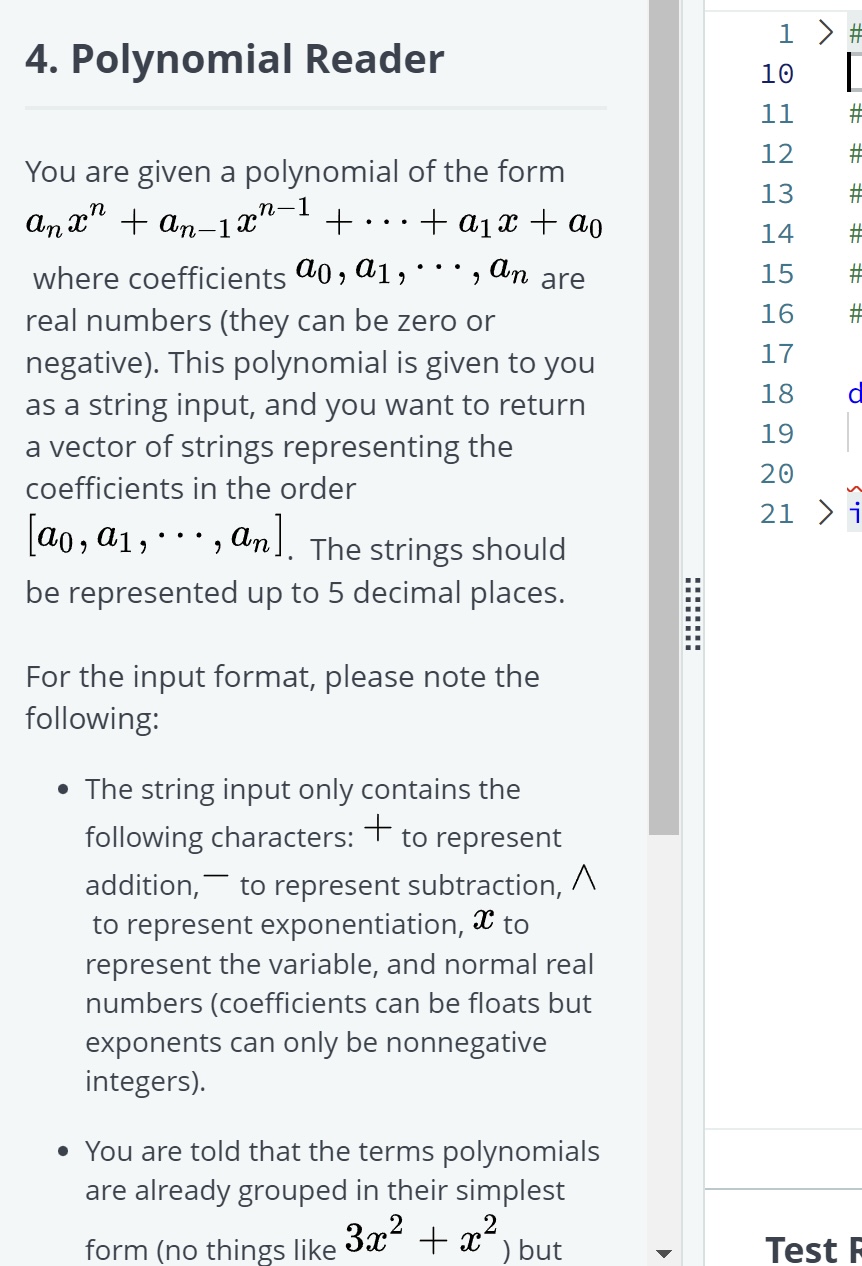
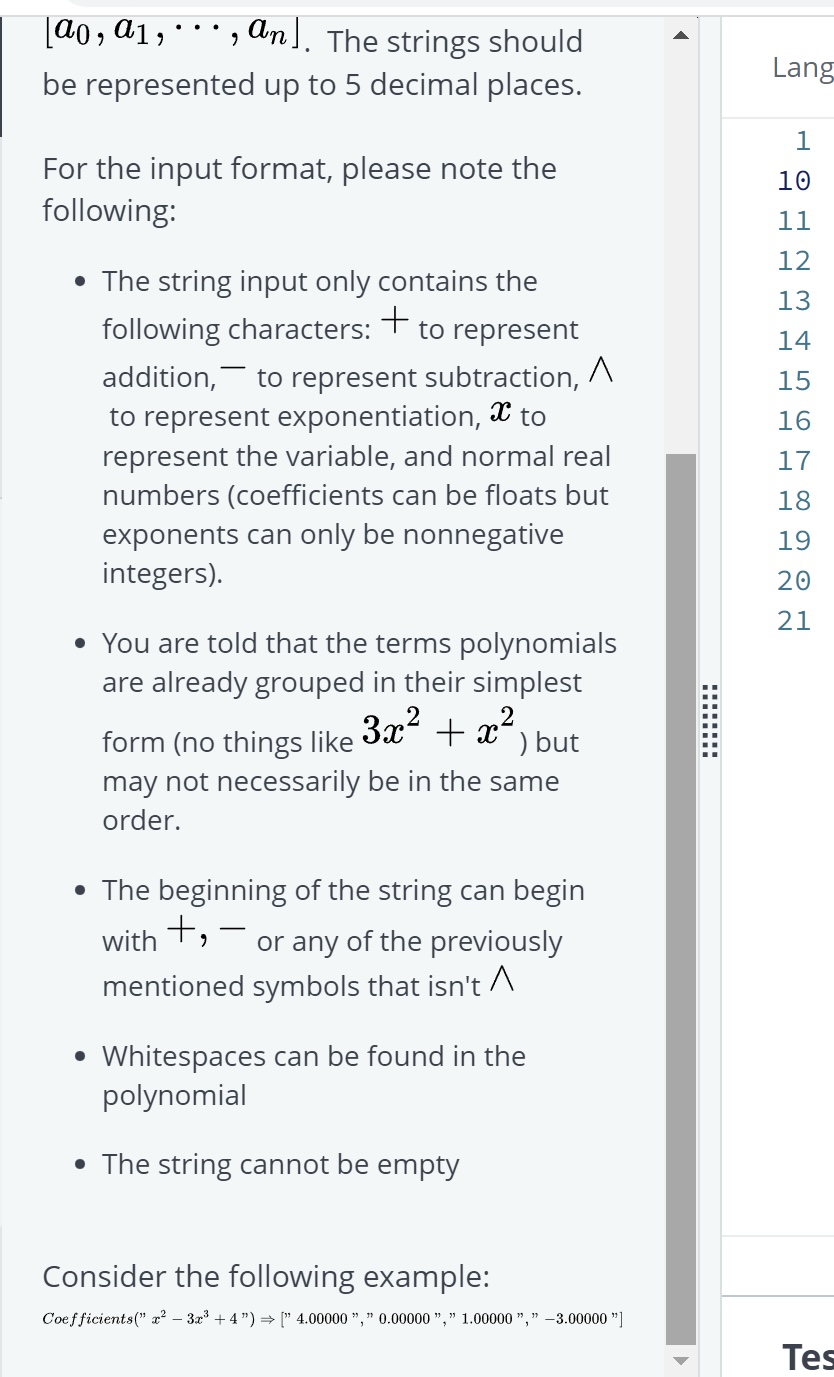
This is a string processing problem. Convert a polynomial string into a coefficient array [a0, a1, ..., an] with 5 decimal places.
My approach was:
Preprocess: remove spaces, fix signs (e.g., x^2 → 1x^2, -x^3 → -1x^3).
Split terms by + and - while keeping track of signs.
Parse each term into coefficient and exponent:
x^2 → coeff 1, exp 2
-3x^3 → coeff -3, exp 3
4 → coeff 4, exp 0
Build coefficient array of length (highest exponent + 1) and fill coefficients.
Format each value to 5 decimal places.
Example: input "x^2 - 3x^3 + 4" → array [4.00000, 0.00000, 1.00000, -3.00000].
I have to say, Linkjob AI is a very good tool, it really helped me with my HackerRank test. Despite HackerRank's stringent monitoring measures(page-switch detection, camera surveillance), Linkjob did not trigger HackerRank's detection system. Read the HackerRank cheating guide to get the answers you want.
Question 5: Code Fragments
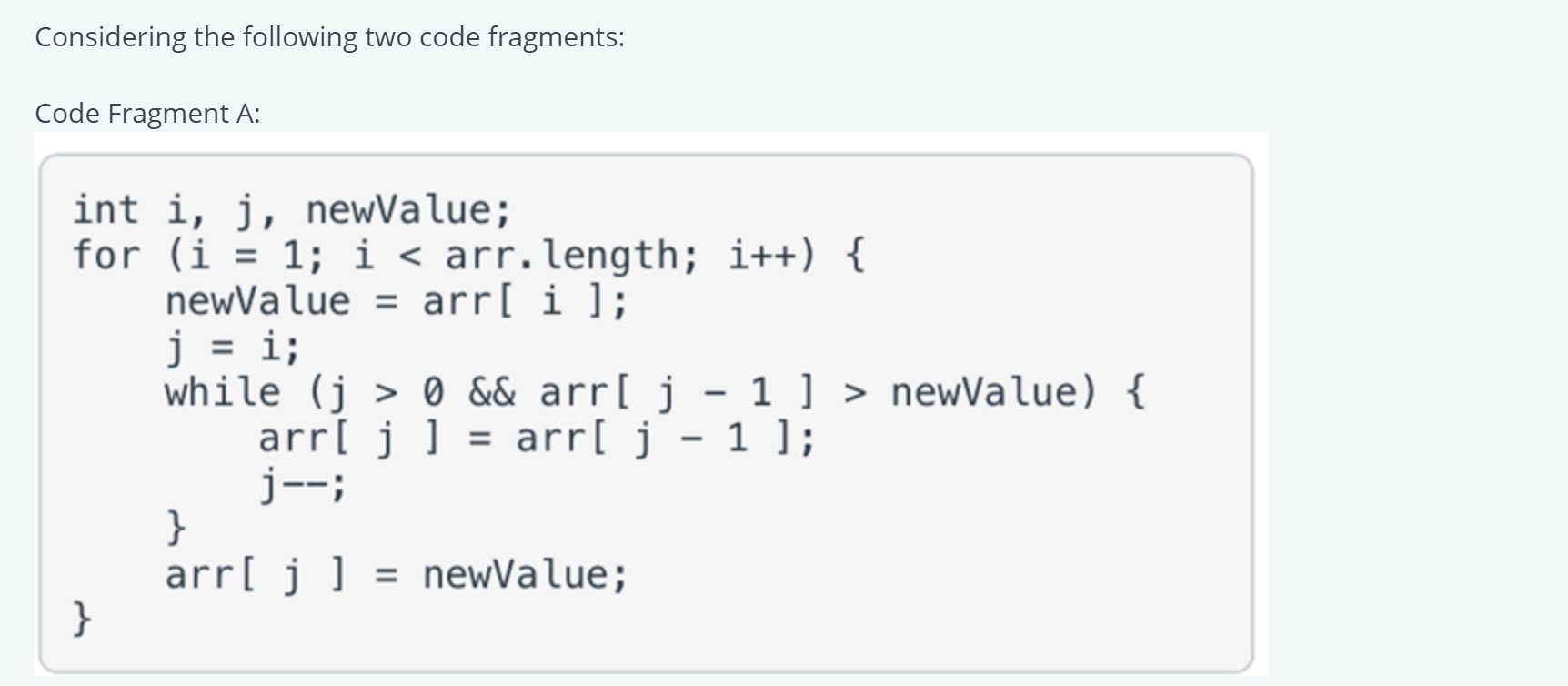
Code Fragment A: insertion sort. Worst case (reverse sorted array) → time complexity O(N^2).
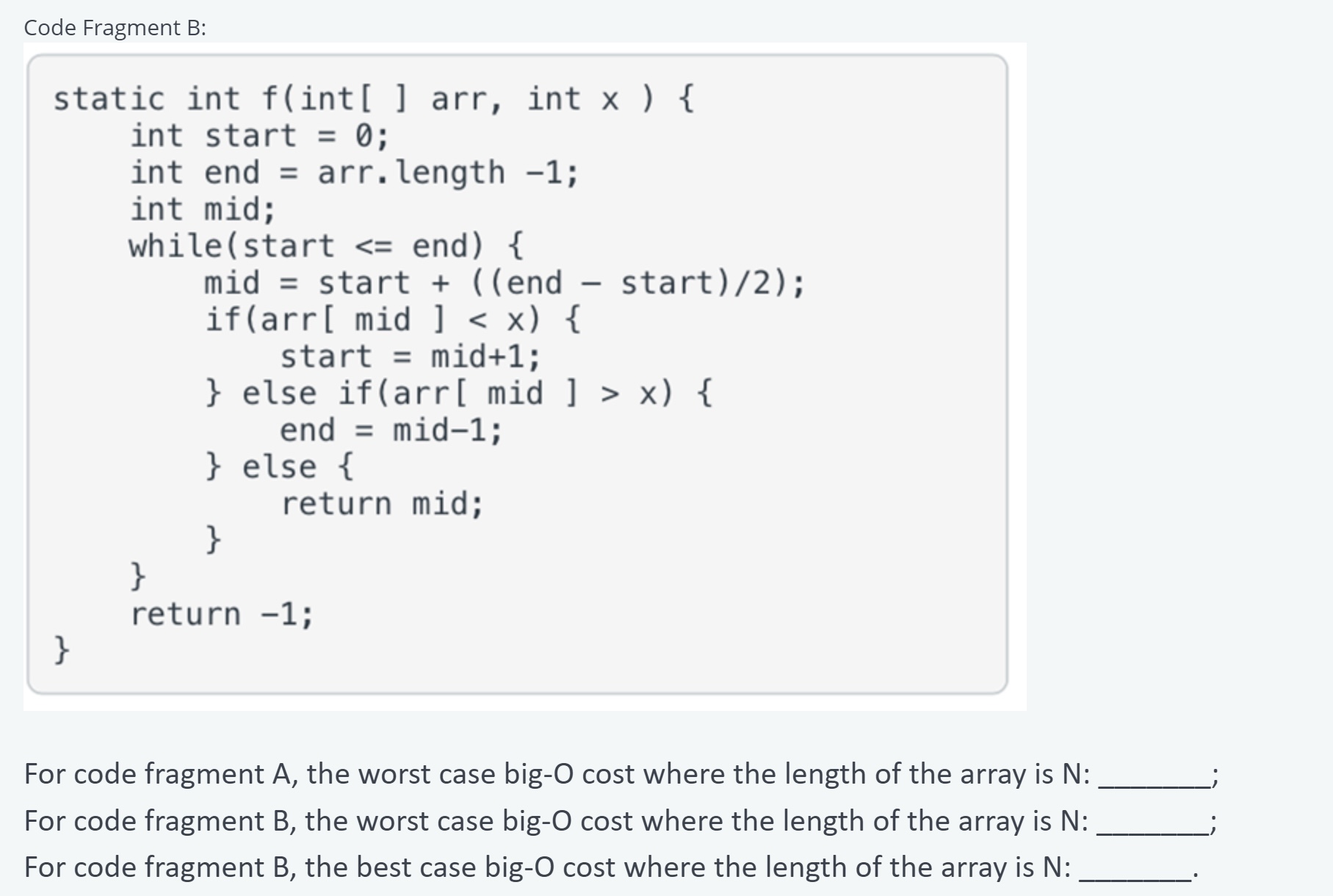
Code Fragment B: binary search.
Worst case → O(log N)
Best case → O(1)
Question 6
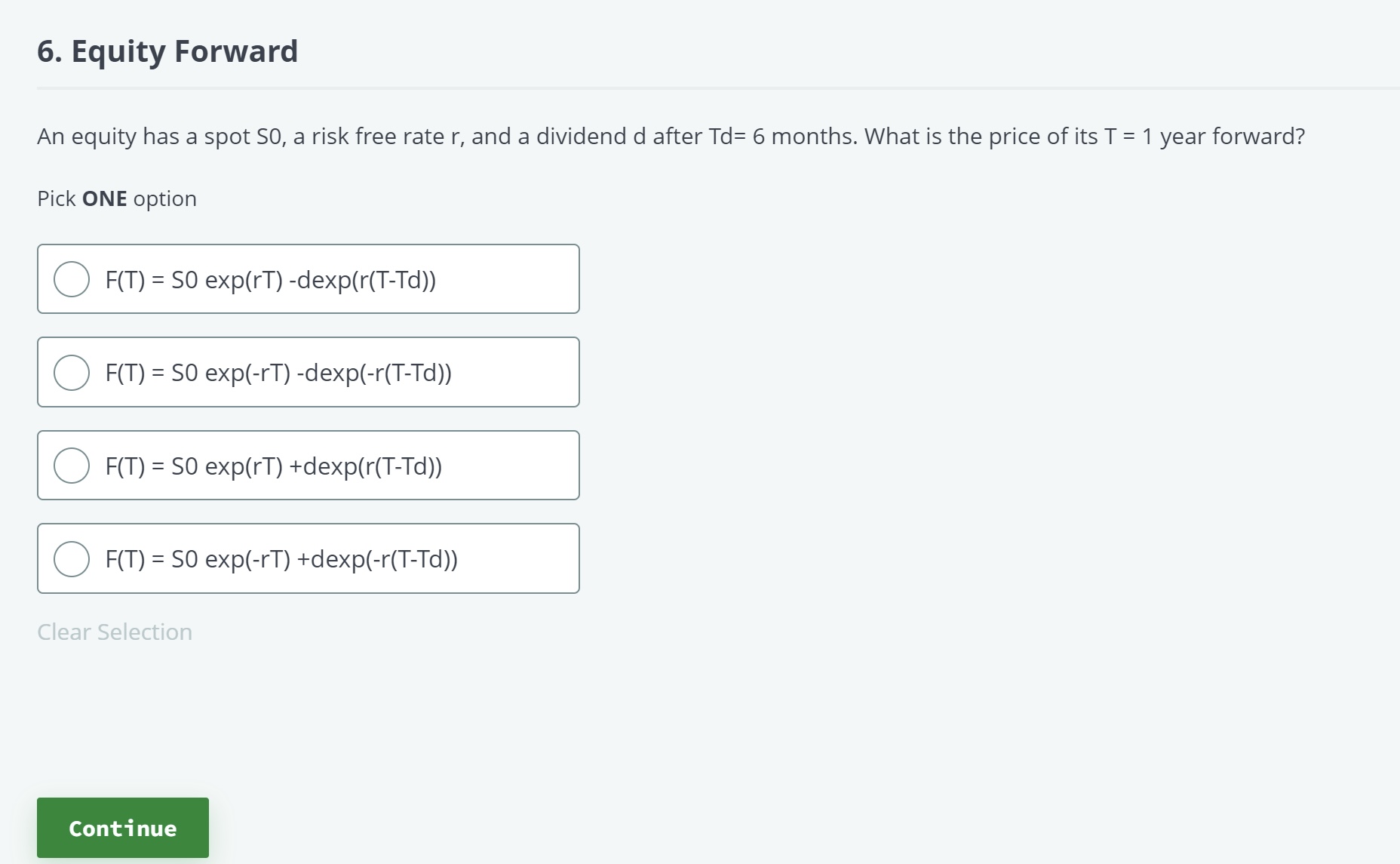
Calculate forward price of a stock with dividend.
Formula: Forward Price = FV of Spot - FV of Dividend
Given: Spot S0, risk-free rate r, dividend d after 6 months, forward term T = 1 year.
Spot FV: S0 * exp(r*T) (continuous compounding)
Dividend FV: d * exp(r*(T - Td)), here Td = 0.5 years
Forward price: F(T) = S0 * exp(r*T) - d * exp(r*(T - Td))
Answer: choose the first option.
BNP Paribas Hackerrank Test Format
Key Test Information
Test Duration
The total time is 90 minutes. There is no strict per-question time limit, and time can be freely allocated among the questions.
Test Platform
The test is conducted entirely on the HackerRank website with no additional software installation required. After receiving the invitation email, click the link to access the test page. It is recommended to log in 10 minutes early to check network stability and browser compatibility (Chrome or Firefox recommended) to avoid technical issues.
Number and Type of Questions
There are 6 questions in total, divided into three main types:
Objective Questions (4): probability and statistics, trigonometry/integration, matrix determinants, algorithm complexity analysis, and financial derivatives (choose 4 out of 5, covering math, finance, and basic algorithm knowledge).
Subjective Programming Question (1): string processing (e.g., extracting coefficients from a polynomial).
Mixed Question (1): code fragment analysis, including multiple-choice selections and complexity evaluation.
Programming Language Support
The programming question supports major languages. Python was chosen for the test, but options include Java, C++, JavaScript, C#, etc. Candidates can select the language they are most comfortable with. No additional environment setup is needed, as HackerRank provides an online editor and automated test cases.
Core Assessment Focus
The test does not emphasize “trick questions” or overly obscure problems. The focus is on three main abilities:
Fundamental Knowledge: mathematics (probability, integration, linear algebra) and basic financial derivatives (forwards, dividend adjustments).
Practical Programming Skills: string handling, edge case management, and debugging.
Algorithmic Thinking: identifying classic algorithms and analyzing time complexity (no complex algorithm design required, focus on fundamental application).
Preparation Tips for the BNP Paribas Hackerrank Test
Review Core Mathematics
Focus on probability, combinatorics, and basic statistics.
Practice integrals and trigonometric identities for common calculations.
Brush up on linear algebra concepts, including determinants and matrix operations.
Understand Financial Derivatives Basics
Learn forward pricing, dividend adjustments, and basic equity derivative calculations.
Focus on the underlying logic rather than complex formulas.
Practice String Processing and Coding Skills
Refresh skills in parsing and manipulating strings efficiently.
Pay attention to edge cases and input validation.
Practice implementing solutions in a chosen programming language (Python, Java, etc.) on HackerRank or similar online editors.
Time Management Strategy
Allocate time to each question according to familiarity and complexity.
Avoid spending too long on one question; ensure all questions receive attention.
For coding problems, aim to implement a working solution first, then optimize if time allows.
Algorithmic Thinking and Complexity Analysis
Review basic algorithm patterns: greedy, sorting, searching, and simulation.
Practice calculating time complexity for simple algorithms.
Focus on recognizing patterns rather than designing advanced algorithms.
Simulate Test Conditions
Take timed practice tests on HackerRank to become familiar with the interface.
Ensure comfort with the coding environment, compiling, and running test cases.
Avoid Common Pitfalls
Double-check for off-by-one errors or misinterpreted problem statements.
Handle large inputs carefully to avoid timeouts.
Verify formulas and calculations before submitting answers.
BNP Paribas HackerRank Test Strategies
Prioritize Easier Questions First
Scan all questions at the start.
Solve the ones with familiar concepts or straightforward calculations first to secure quick points.
Break Down Complex Problems
For probability or combinatorics questions, identify key variables and relationships.
Translate word problems into formulas step by step.
Use Efficient Coding Practices
For string or array manipulation, plan parsing logic before coding.
Test with small sample inputs before scaling to larger datasets.
Track Time and Progress
Allocate roughly equal time per question, leaving a buffer for the programming task.
If stuck, move on and return later with fresh perspective.
Check Edge Cases
Consider minimum, maximum, and unusual inputs.
For programming problems, include empty strings, zero values, and boundary numbers.
Document Thought Process
Write comments or pseudo-code for complex formulas.
Helps avoid mistakes and makes reviewing easier under time pressure.
Leverage Mathematical Shortcuts
For expected value, determinants, and integrals, use standard formulas or properties to simplify calculations.
Avoid unnecessary expansion or brute force approaches.
FAQ
Is Linkjob AI really undetectable on HackerRank?
Yes, it worked great on my HackerRank test.
How long did it take to get my BNP Paribas Hackerrank results?
I got my results about a week after I finished the test. If you do not hear back in a week, you can reach out to the recruiter.
Can I use any programming language for the coding questions?
Yes, I could choose from several languages like C++, Java, and Python. I suggest you use the language you feel most comfortable with. That helped me code faster and with fewer mistakes.
See Also
2026 Nvidia HackerRank Test: Questions I Got and How I Passed
How I Cracked 2026 Citadel HackerRank Assesment Questions
My IBM 2026 HackerRank Assessment: Real Questions & Insights
My 2026 MathWorks HackerRank Assessment Questions & Solutions
Questions I Encountered in 2026 Goldman Sachs HackerRank Test