My 2025 Dell HackerRank Experience and Questions I Got


I interviewed for the Dell Developer Intern position, and below I will share the two coding questions I encountered in the OA. The difficulty of these problems is between easy and medium. They focus on counting binary substrings and optimizing resource allocation.
I genuinely appreciate how much Linkjob.ai has helped me throughout the process, which is why I’m sharing all of my OA details here. Having an invisible AI interview assistant helping me solve coding questions really takes away a lot of stress.
Dell HackerRank Questions
Question 1: Count Binary Substrings
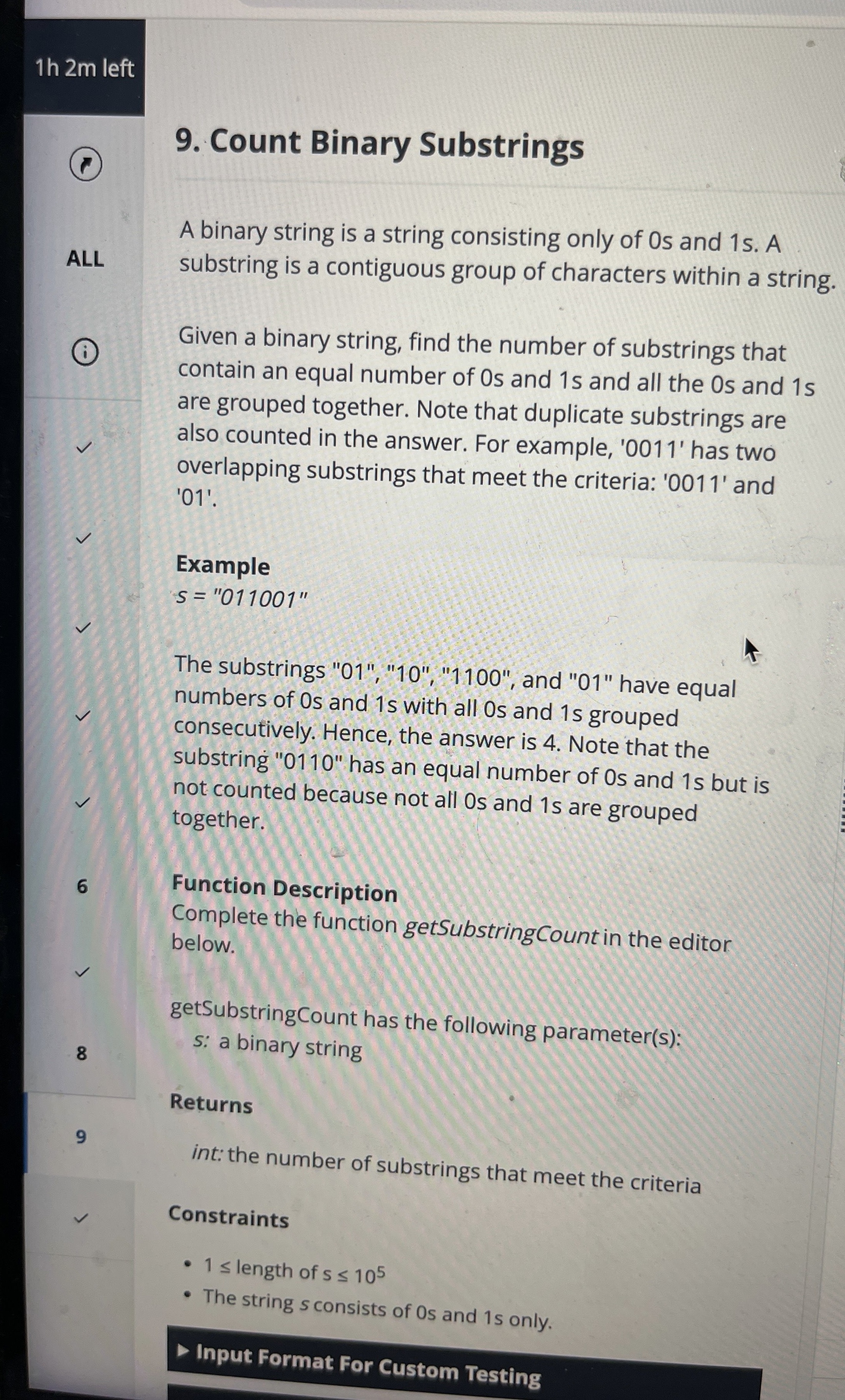
My Understanding & Strategy
The Core Pattern: The only valid substrings are those where the number of consecutive 0s equals the number of consecutive 1s, AND all the 0s come first or all the 1s come first.
The Insight: The total number of valid substrings is determined by adjacent groups of consecutive characters.
For example, in 00011: We have a group of three '0's and a group of two '1's. The possible matching substrings are 01 and 0011. The count is 2. Notice that 2 is the minimum of the two group sizes (minimum(3, 2)).
The Strategy: The most efficient way to solve this is a Grouping Approach.
My Step-by-Step Solution
Pre-processing/Grouping: I first traversed the input string s and created a list of the sizes of the consecutive groups.
For s = '011001':
'0' -> size 1
'11' -> size 2
'00' -> size 2
'1' -> size 1
My list of group lengths became: L = [1, 2, 2, 1].
Counting Pairs: Now the problem is simplified to traversing the list L and comparing adjacent elements.
I initialized a total_count to 0.
I looped from the second element of L (index i=1) up to the end, comparing L[i-1] and L[i].
For each adjacent pair, the number of valid substrings formed is the minimum of their two sizes.
Iteration 1: Compare L[0]=1 and L[1]=2. minimum(1, 2) = 1. (This accounts for substring '01'). total_count is now 1.
Iteration 2: Compare L[1]=2 and L[2]=2. minimum(2, 2) = 2. (This accounts for substrings '10', '1100'). total_count is now 1 + 2 = 3.
Iteration 3: Compare L[2]=2 and L[3]=1. minimum(2, 1) = 1. (This accounts for substring '01'). total_count is now 3 + 1 = 4.
Question 2: Optimizing Resource Allocation
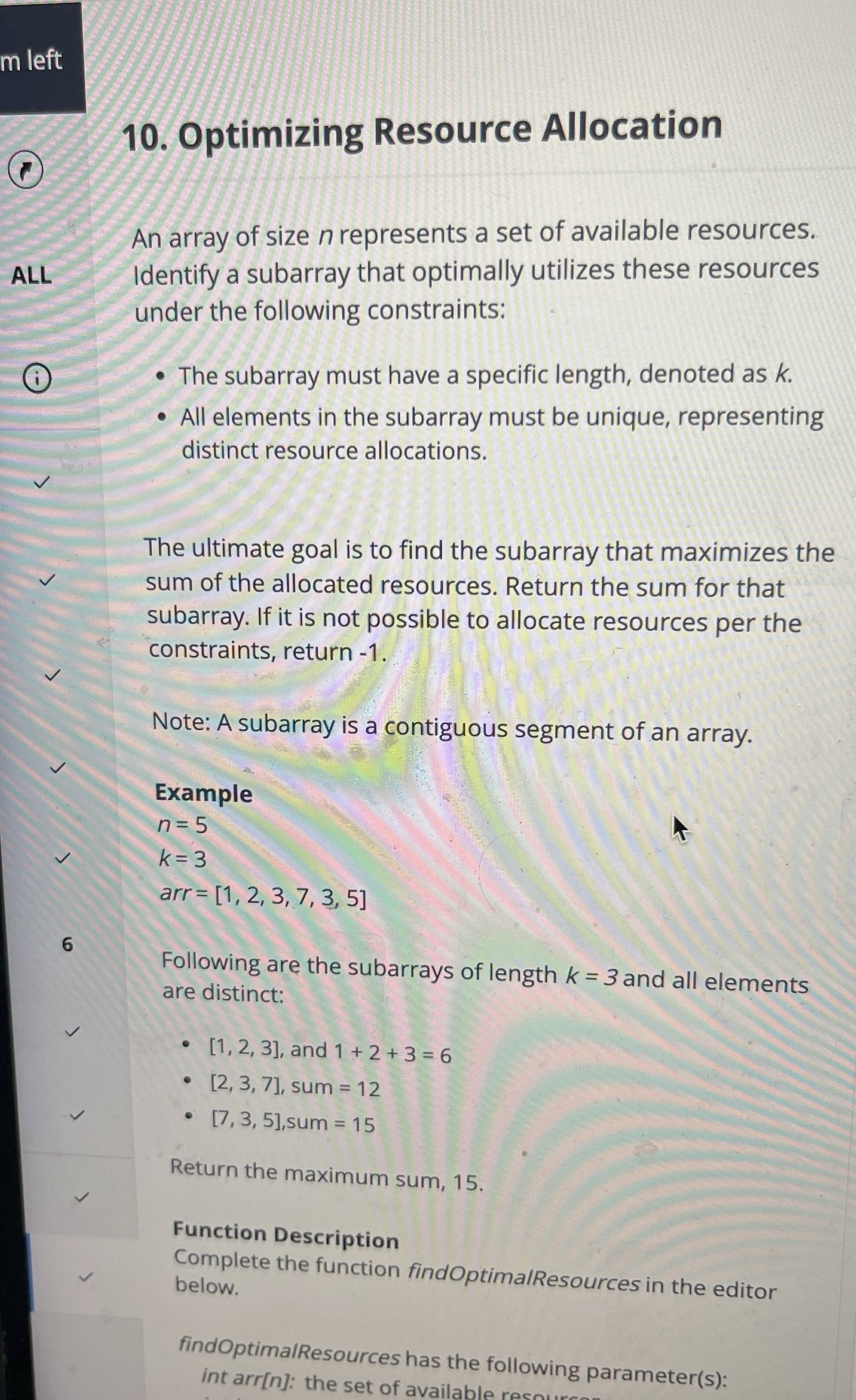
My Understanding & Strategy
The Core Goal: Find the subarray of length k that has the maximum possible sum.
The Critical Constraint: Every element within that subarray of length k must be unique (distinct resource allocations).
The Data Structure: A simple sliding window is not enough because we need to efficiently check for uniqueness every time the window moves. I realized the perfect tool for this is a Hash Set. A Hash Set gives us near O(1) lookups, insertions, and deletions, which is crucial for a smooth sliding window.
My Step-by-Step Solution
Initialization: I set up two variables: max_sum (initialized to -1, as per the failure condition) and a temporary current_sum. I also initialized my Hash Set, which I called window_elements.
The Initial Window (First k elements): I processed the first k elements of the array. As I iterated, I checked if the current element was already in window_elements. If I found a duplicate, I knew this segment was invalid. If no duplicates were found after processing k elements, the first window was valid. I calculated the initial current_sum and updated max_sum.
Sliding the Window (From index k to n-1): Now came the main loop. In each step, the window had two operations: add a new element and remove an old element.
Remove: The element leaving the window was arr[i - k]. I removed it from both the window_elements set and subtracted it from current_sum.
Add: The new element entering the window was arr[i].
Check and Add: I checked if arr[i] was already in the window_elements set.
If it was in the set (a duplicate), the new window is invalid. I didn't update max_sum.
If it was not in the set (unique), the new window is valid. I added arr[i] to the set, added it to current_sum, and then updated max_sum = maximum(max_sum, current_sum).
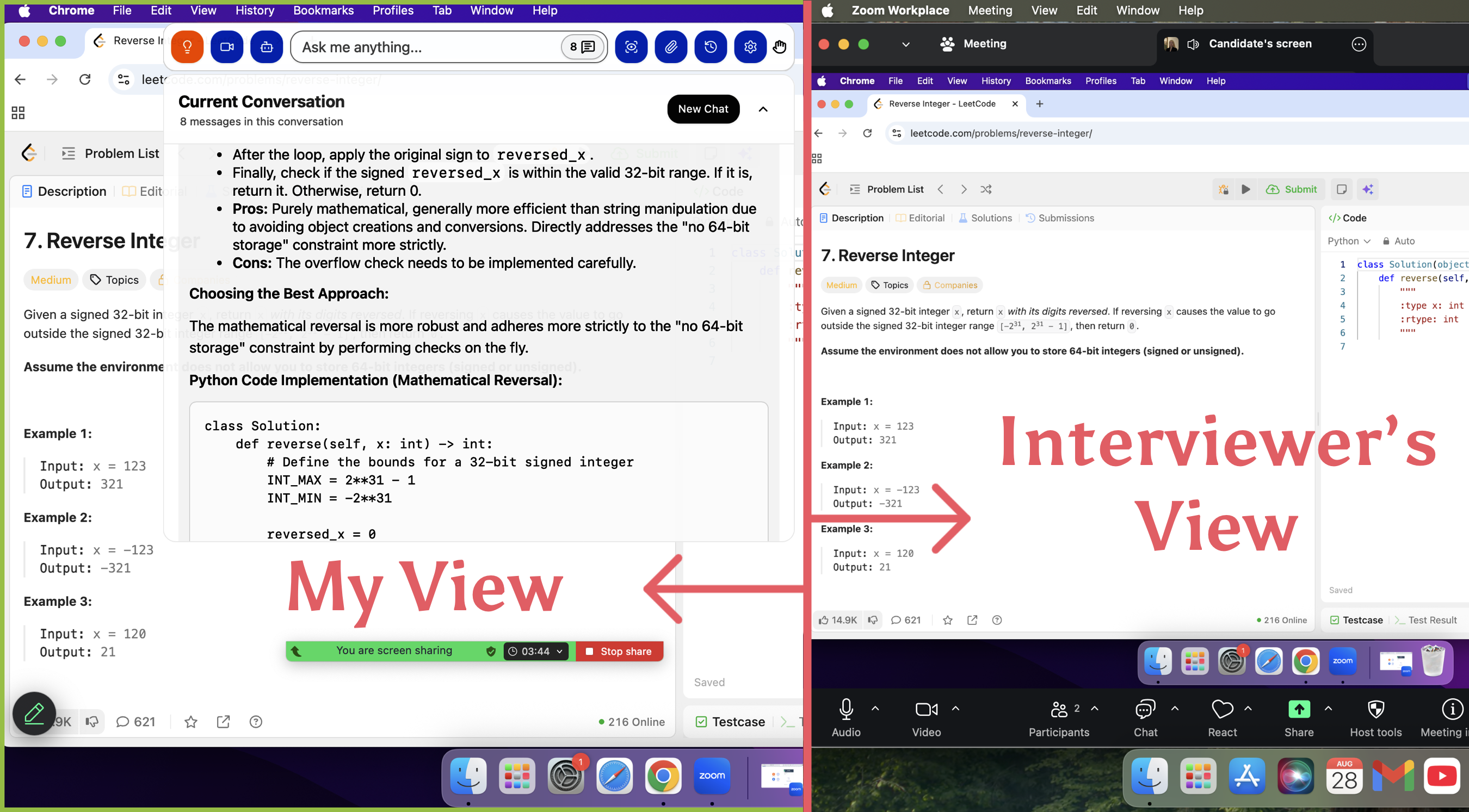
I have to say, Linkjob AI is really easy to use. I used it during the interview after testing its undetectable feature with a friend beforehand. With just a click of the screenshot button, the AI provided detailed solution frameworks and complete code answers for the coding problems on my screen. I’ve successfully passed the test, with the HackerRank platform not detecting me at all.
Dell HackerRank Assessment Format
Structure and Timing
Structurally, the Dell HackerRank test focused primarily on assessing my programming fundamentals and algorithmic ability. In practice, the problems covered common data structures and algorithm knowledge, such as array manipulation, string operations, and sliding window techniques. My goal was not just to write code that passed the few sample test cases provided by the platform, but more importantly, to ensure my code would run efficiently when processing larger, more complex datasets. This meant that when writing the code, I absolutely had to consider the time complexity and space complexity of the algorithm I chose.
I observed differences in difficulty among the problems. My strategy was to quickly scan all the questions, first tackle the easiest one that I was most confident in to quickly secure baseline points. Subsequently, I dedicated the majority of my effort to the more challenging problems that required deeper algorithmic thinking, such such as those potentially involving dynamic programming or complex optimization techniques. This was my personal method for effectively utilizing the time during the entire assessment.
Test Environment
The entire assessment was conducted on the HackerRank platform. The platform provided me with a browser-based integrated development environment, allowing me to choose my preferred programming language, such as Python, Java, or C++. The editor itself was feature-rich, but I still felt that becoming familiar with the platform's operation process beforehand was essential, as it helped me avoid wasting time adapting to the environment during the test.
The process for submitting code was critical for me. For each question, I could first use the sample test cases provided by the platform to run my code for initial debugging and verification. Once I confirmed that my logic was sound, I would submit my final solution. The platform would then automatically run my code and score it against a hidden, more comprehensive set of test cases. The overall environment ran very stably, but I also ensured that my internet connection was reliable throughout the entire process.
Dell HackerRank Questions Breakdown
Core Concepts Tested
Here are the key technical concepts I determined were under evaluation:
Sliding Window Technique: Applied for efficiently processing contiguous subarrays or substrings of a fixed or variable size, minimizing redundant calculations.
Hash Set / Frequency Mapping: Essential for maintaining and quickly verifying the uniqueness constraint within the sliding window problem (Resource Allocation).
Pattern Recognition and Abstraction: The ability to deconstruct a complex string counting problem (Binary Substrings) into a simpler problem involving comparing adjacent group sizes.
Time Complexity Optimization (O(n) efficiency): Crucial for passing the hidden test cases, confirming that my solutions were linear time and would not time out on large inputs.
Edge Case Handling: Specifically, ensuring that both solutions correctly handled arrays or strings containing all identical characters (e.g., '0000') or the failure condition (returning -1) in the resource allocation problem.
Challenges Faced and Resolved
Synchronizing Unique Constraint and Sliding Window: The main technical hurdle in the "Optimizing Resource Allocation" problem was the precise synchronization between the Hash Set, which enforced uniqueness, and the running sum. I had to ensure the exact sequence of adding or removing elements from the set and updating the total sum was correct for every window slide, especially when a duplicate was encountered.
Accurate Grouping for String Patterns: For the "Count Binary Substrings" problem, the difficulty lay in the preprocessing step: accurately translating the string into an array of consecutive group sizes. This required careful logic to handle the traversal and counting of groups, paying close attention to boundary conditions, as the accuracy of this initial array determined the correctness of the final counting algorithm.
Clean Boundary Handling in Fixed-Size Window: Implementing the fixed-length sliding window demanded focused attention on boundary management. I chose to isolate the initialization of the first $k$ elements from the main sliding loop to simplify the removal logic and guarantee that I did not attempt to access an out-of-bounds index (
i - k) during the array traversal.
Preparing for Dell HackerRank Questions
What to Practice
When I prepared for the Dell HackerRank assessment, I focused my practice on algorithms and data structures that are high-frequency in both daily work and technical evaluations. I specifically prioritized learning how to combine simple concepts to solve medium-difficulty problems and ensuring that my code was efficient.
Here are the topics I emphasized in my preparation, along with my assessment of their difficulty level:
Array & String Manipulation:
Difficulty Level: Easy to Medium
Focus: Two-Pointers technique, in-place operations, and character frequency counting.
Hash Tables & Sets:
Difficulty Level: Easy
Focus: Quick lookups, deduplication, and frequency counting, which are fundamental for solving uniqueness constraint problems.
Sliding Window Algorithm:
Difficulty Level: Medium
Focus: Handling fixed or variable-length subarray/substring problems, crucial for optimizing time complexity to O(n).
Basic Sorting & Searching:
Difficulty Level: Easy to Medium
Focus: Binary Search, and understanding the implementation logic of quick sort or merge sort.
Basic Linked Lists:
Difficulty Level: Easy
Focus: Node operations, reversing a linked list, and finding the middle node.
Recursion & Divide and Conquer:
Difficulty Level: Medium to Hard
Focus: Understanding the base case and recursive steps, which is foundational for solving more complex tree and graph problems.
Study Resources
During my preparation phase, I primarily relied on the following online platforms for practice and gap filling. Each platform offered me unique advantages:
LeetCode:
Pros: Its question bank is vast and well-structured. I mainly used its "Top Interview Questions" list to ensure I covered the core interview knowledge points. Its "Explore" cards were particularly helpful for systematic learning of specific algorithms like Sliding Window and Binary Search.
HackerRank:
Pros: Since the Dell assessment takes place on this platform, I used HackerRank extensively to familiarize myself with its IDE environment, input/output formats, and the pressure of the timer. This made me highly comfortable with the test interface and debugging process, preventing panic during the actual assessment.
GeeksforGeeks (GfG):
Pros: I primarily used GfG as my resource for theoretical knowledge and concept validation. It offers very detailed algorithm explanations, data structure tutorials, and code examples. This helped me deeply understand the principles behind complex algorithms, like dynamic programming or complex graph algorithms, effectively improving my thought depth and code robustness when tackling challenging assessment problems.
Test Strategies
To perform at my best during the limited assessment time, I strictly followed a set of personal strategies during the test:
Quickly Scan All Problems: I spent one to two minutes quickly reading the requirements and constraints of all the questions to gauge their relative difficulty and potential solution approaches.
Prioritize Easy-First for Max Score: I first targeted the simple problems I was most confident in, quickly implementing them and passing all sample tests. This helped me secure points fast and build confidence.
Analyze Time Complexity: Before writing any code for medium-to-hard problems, I would first note my O(n) or O(n log n) algorithm idea in the comments to ensure my approach would pass the hidden large dataset tests.
Use Sample Tests for Precise Debugging: I never submitted code blindly. I fully utilized the platform's sample test cases for meticulous debugging, ensuring the code worked correctly under various edge cases before making the final submission.
Avoid Perfectionism: If I hit a particularly complex point, I refused to spend more than 15 minutes stuck on one minor issue. I prioritized ensuring the core logic was functional and passed the tests, even if the code was not perfectly elegant.
Final Submission Check: Before the timer expired, I always allocated the last two minutes to quickly review the status of all submitted problems and confirm that I hadn't missed any critical submission steps.
FAQ
What is the format of the Dell HackerRank Assessment multiple-choice questions?
There are 8 multiple-choice questions in total, including both single-answer and multiple-answer questions. The multiple-choice and coding questions are completed together, with a total time of 90 minutes.
Can I get partial credit for incomplete answers?
Yes, partial credit is usually awarded for incomplete solutions. Your code can earn points for passing some of the test cases, even if it doesn’t pass them all.
See Also
How to Cheat HackerRank Tests With AI: My 2026 Update
My 2026 Dell Interview Experience: Process and Questions
How I Passed 2026 Microsoft HackerRank Test on My First Try
How I Passed 2026 JP Morgan HackerRank Assessment: Q&A
2026 Update: My Stripe HackerRank Online Assessment Questions

© Copyright 2025 Linkjob.ai - All Rights Reserved.