My 2026 Dropbox CodeSignal OA: Real Questions & Secrets to Success

My Dropbox CodeSignal OA Experience
I first heard about Dropbox’s CodeSignal online assessment (OA) when recruiting reached out after I applied. Compared to the typical “random LeetCode churn,” this felt like a paced, progressive challenge: several questions in one sitting, difficulty ramping up, and the freedom to switch between tasks. CodeSignal publicly documents that its General Coding Assessment (GCA) uses 4 questions in ~60 minutes with flexible time allocation and “best-score kept” across submissions.
Dropbox explicitly uses CodeSignal as the first step for many early-career SWE roles to fairly evaluate core coding skills before interviews. That’s stated on Dropbox’s own Emerging Talent page and echoed by recruiting videos and candidate reports. After the OA, candidates typically proceed to technical/behavioral rounds, sometimes including a code-review/debugging session. My timeline followed that playbook almost exactly.
I’m really grateful to Linkjob.ai for helping me pass my interview, and that's also why I'm sharing my entire interview experience here. Having an invisible AI interview assistant during the OA is indeed very convenient.
Assessment Structure
Dropbox uses this test to see how well you can code in real situations. The coding challenges connect to each other and finish one part then go to the next part.
Duration | Number of Questions |
|---|---|
60 minutes | Up to 4 questions |
I had one hour to answer up to four questions, the difficulty ramped up as I went, and I had to pass every test case on each part before I could move on.
Key Features
The dropbox codesignal test has many kinds of problems. The questions might like these:
Single-function
Progressive single-function
Database
DevOps
Quiz
Filesystem
Free-coding
Frontend
Writing
Flutter SDK
It allow use any popular programming language. The platform lets you pick from many languages, so I do not need to learn a new one for this test.
Dropbox CodeSignal Assessment Process
Dropbox CodeSignal OA Questions
The Dropbox CodeSignal assessment contained three coding problems ranging from easy to medium difficulty. The topics spanned backtracking, sliding‑window statistics and graph traversal. Below I explain the requirements, solution strategies and complexity analyses for each, along with snippets of my own code.
Question 1: Word Pattern II
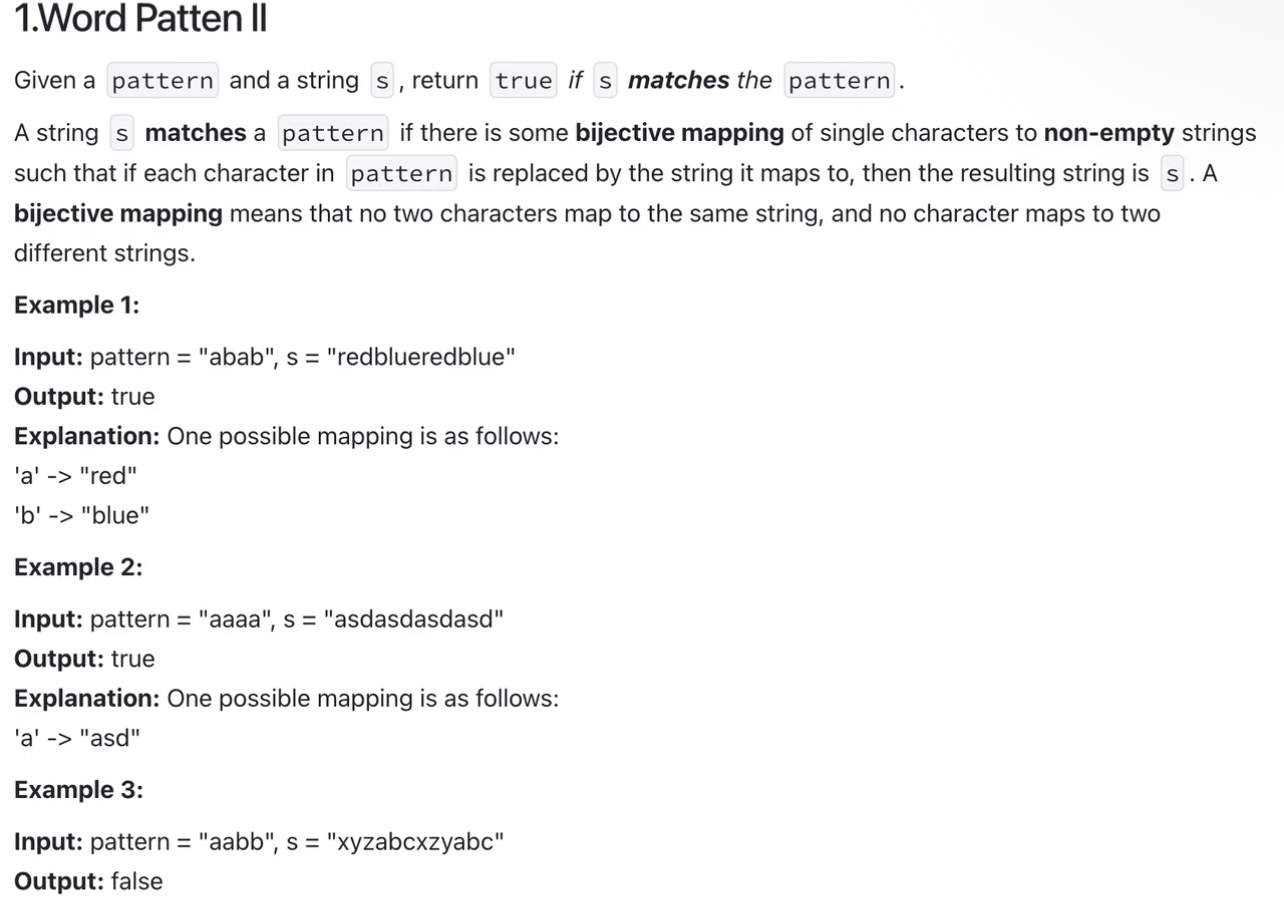
In this problem you’re given a pattern string and another string s, and you must decide if there is a bijective mapping between each character in the pattern and a non‑empty substring of s. The mapping is bijective: different pattern characters must map to different substrings, and vice versa. For example, the pattern "abab" can match "redblueredblue" if 'a'→"red" and 'b'→"blue".
Solution strategy
The natural approach is a depth‑first search with backtracking:
Track mappings and used substrings. Use a dictionary to map pattern characters to substrings and a set to keep track of which substrings are already taken. This enforces the one‑to‑one correspondence.
Recursive matching. For the current character in the pattern, if it is already in the map, check whether the next characters in
smatch the assigned substring; if so, recurse on the remainder of the pattern and string. If the character isn’t mapped yet, iterate over all possible non‑empty prefixes of the remaining string and try mapping the character to each candidate substring, skipping any substring that’s already in the set.Backtracking. If a mapping fails, undo it and try the next candidate substring. If both the pattern and the string are consumed at the same time, return
True; if one finishes before the other, returnFalse.
Complexity analysis
In the worst case, each character can map to many different substrings, so the search tree grows exponentially. Let n be the length of s and m the length of the pattern; then the time complexity is roughly $O(n^m)$. The space complexity comes from the recursion stack, the dictionary and the set, which is $O(m + n)$.
My implementation
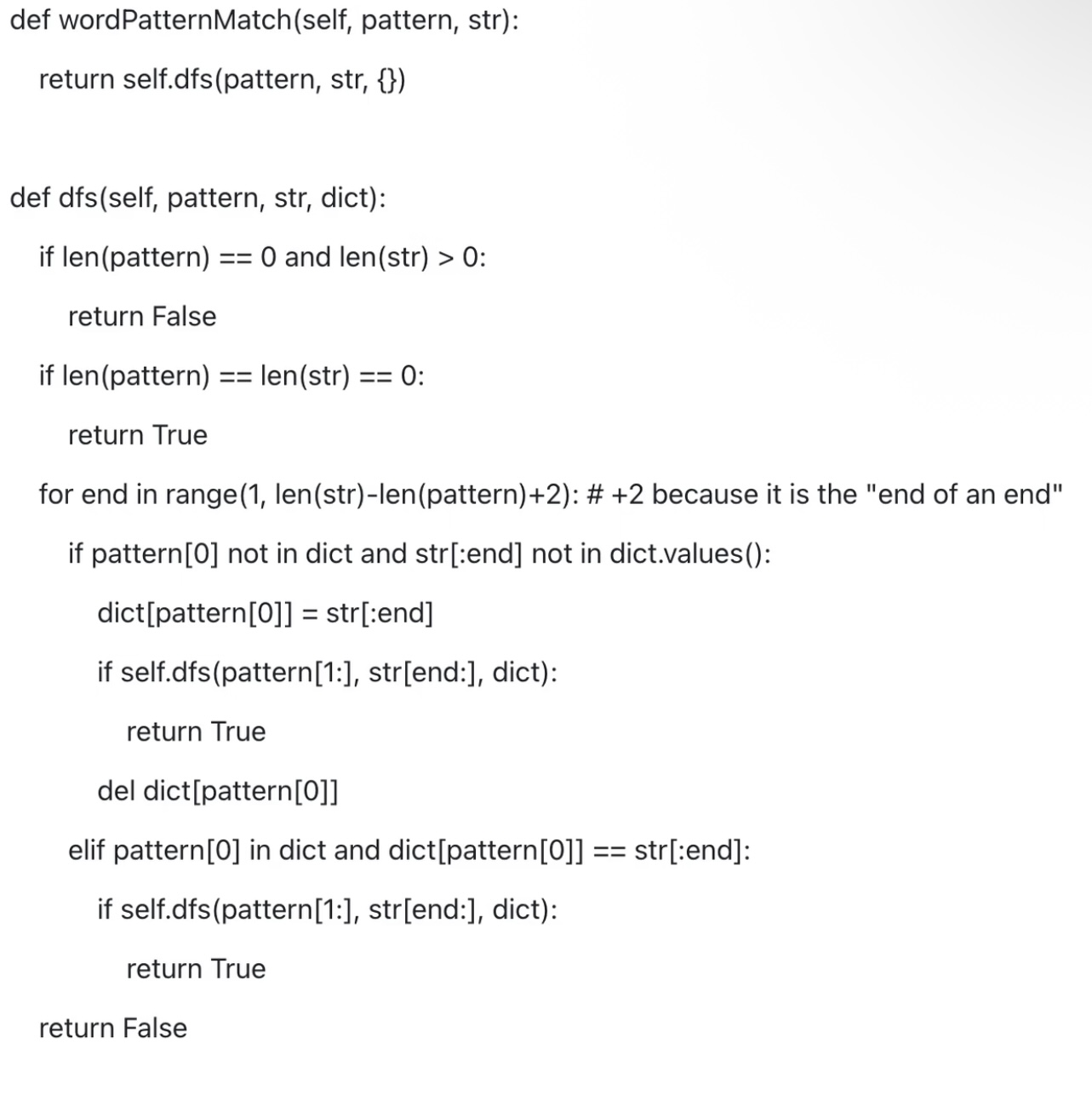
Below is my Python backtracking solution. It defines a dfs function that tries to assign a substring to each new pattern character and then recurses. Failed assignments are removed to backtrack. I used the Linkjob.ai tool, and this answer was generated in just a few seconds.
Linkjob AI worked great and I got through my interview without a hitch. It’s also undetectable, I used it and didn't trigger any CodeSignal detection.

Question 2: Design Hit Counter
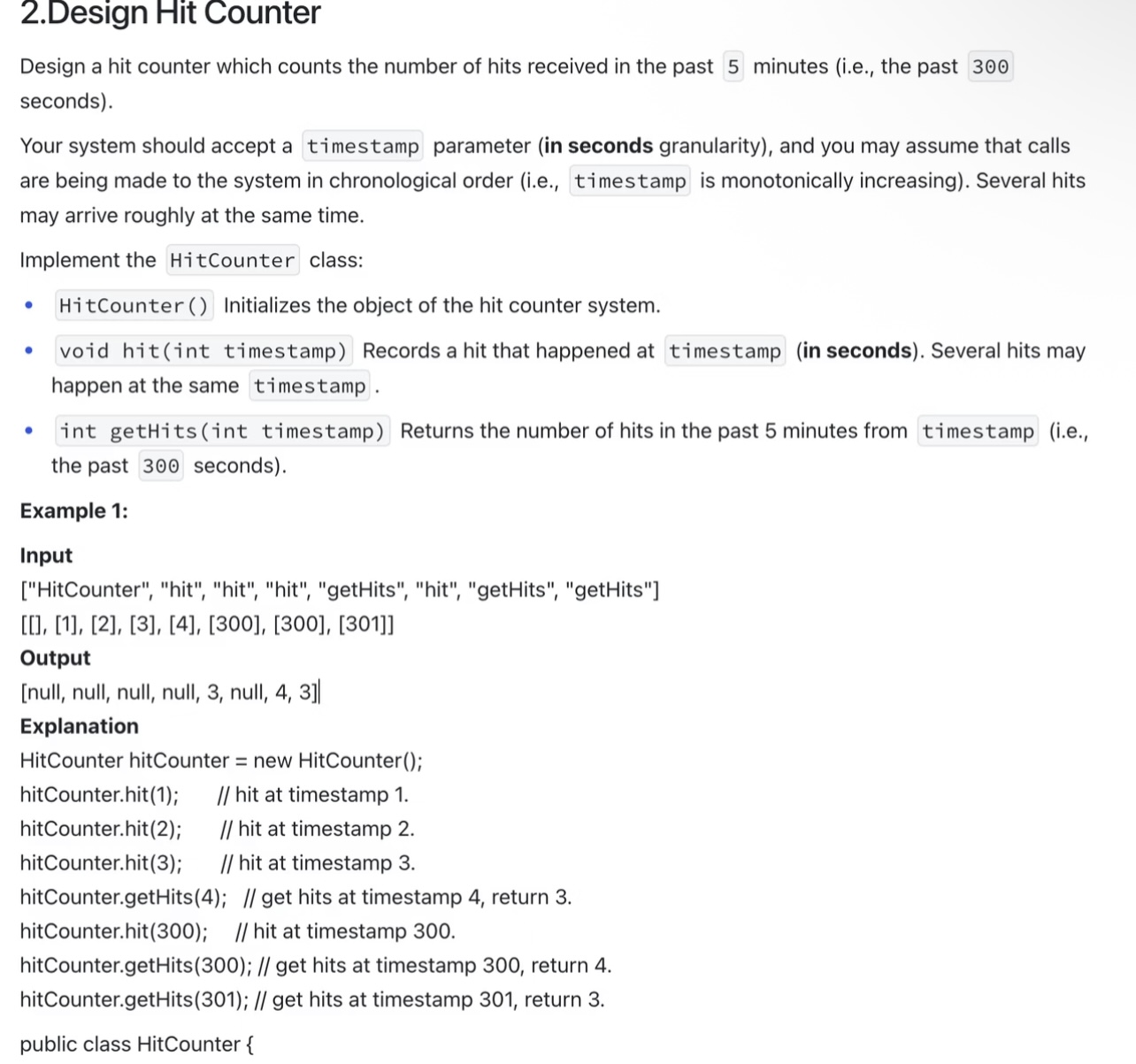
This question asks you to build a hit counter that records the number of hits received in the last five minutes (300 seconds). There are two methods: hit(timestamp) records a hit at the given second, and getHits(timestamp) returns how many hits occurred in the last 300 seconds. Timestamps are provided in non‑decreasing order.
Solution strategy
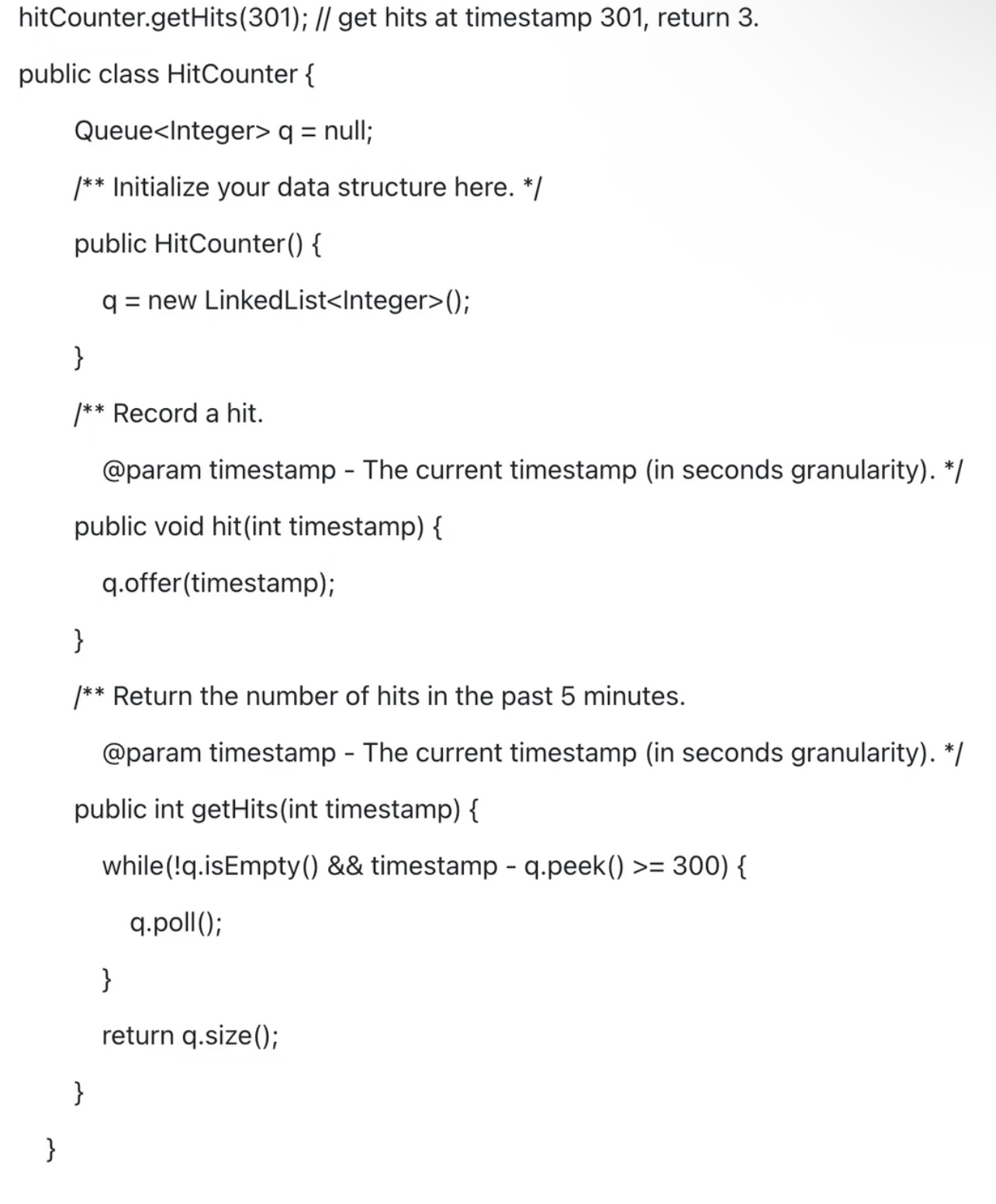
Queue as a sliding window. Because you only care about hits in the last 300 seconds, keep a queue of timestamps. When you call
hit(t), appendtto the end. When you callgetHits(t), remove timestamps from the front that are older thant − 299, then return the queue length.Why it’s efficient. Timestamps in the queue remain sorted; outdated entries are removed only during queries. Each timestamp is enqueued and dequeued at most once, so the amortized time per operation is $O(1)$.
Space usage. In the worst case, if there’s at least one hit every second, the queue holds at most 300 timestamps, so the space usage is O(300) – effectively constant.
My implementation
Here’s my Java implementation of a HitCounter class. It uses a LinkedList to store timestamps. The hit method enqueues the timestamp, and getHits discards outdated entries and returns the current size.
Question 3: Max Area of Island
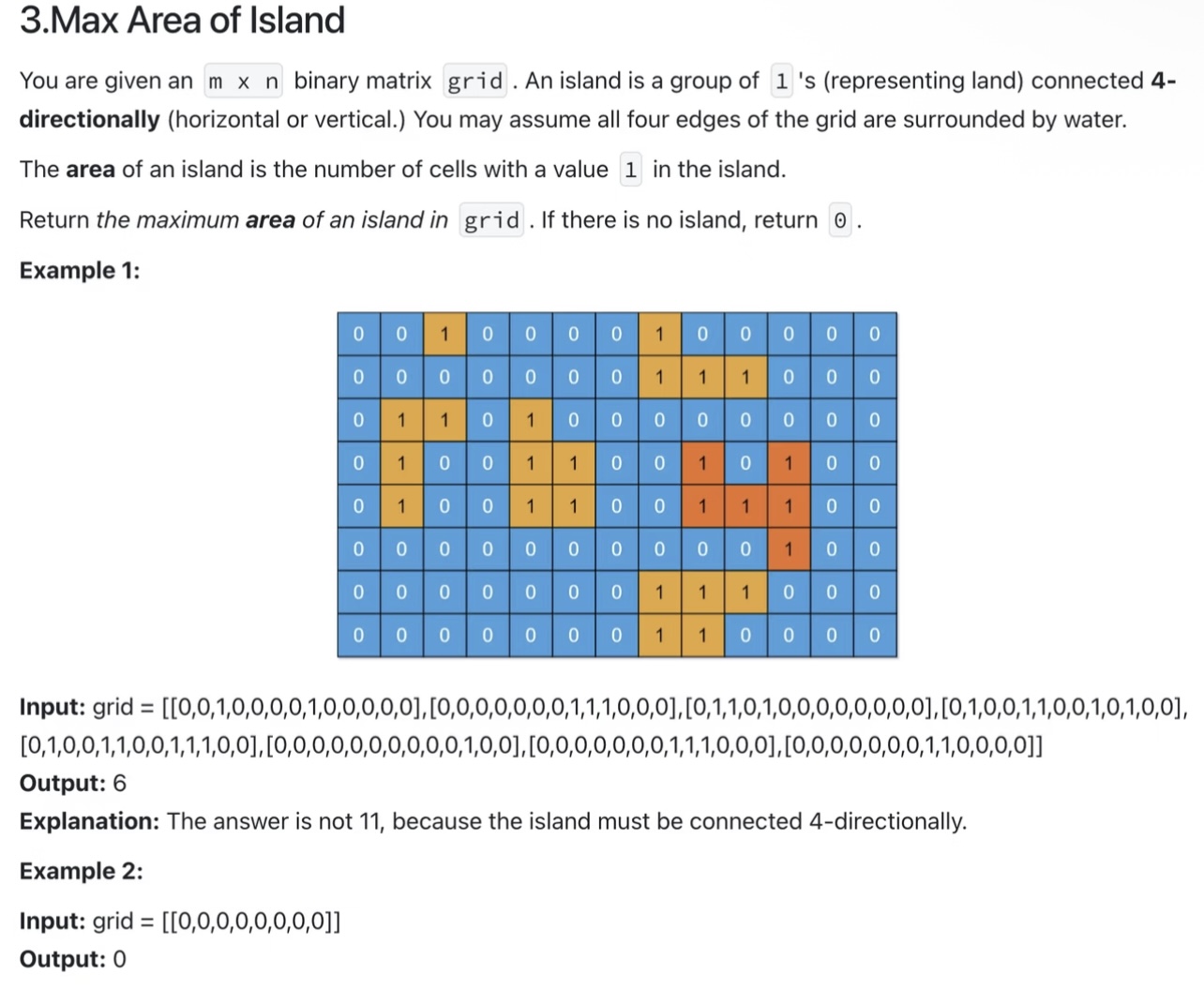
In this problem you’re given an m×n binary matrix grid of zeros (water) and ones (land). An island is a group of ones connected four‑directionally (up, down, left, right). You need to find the area (number of cells) of the largest island. If there are no islands, return 0.
Solution strategy
Traverse every cell. Iterate through each coordinate
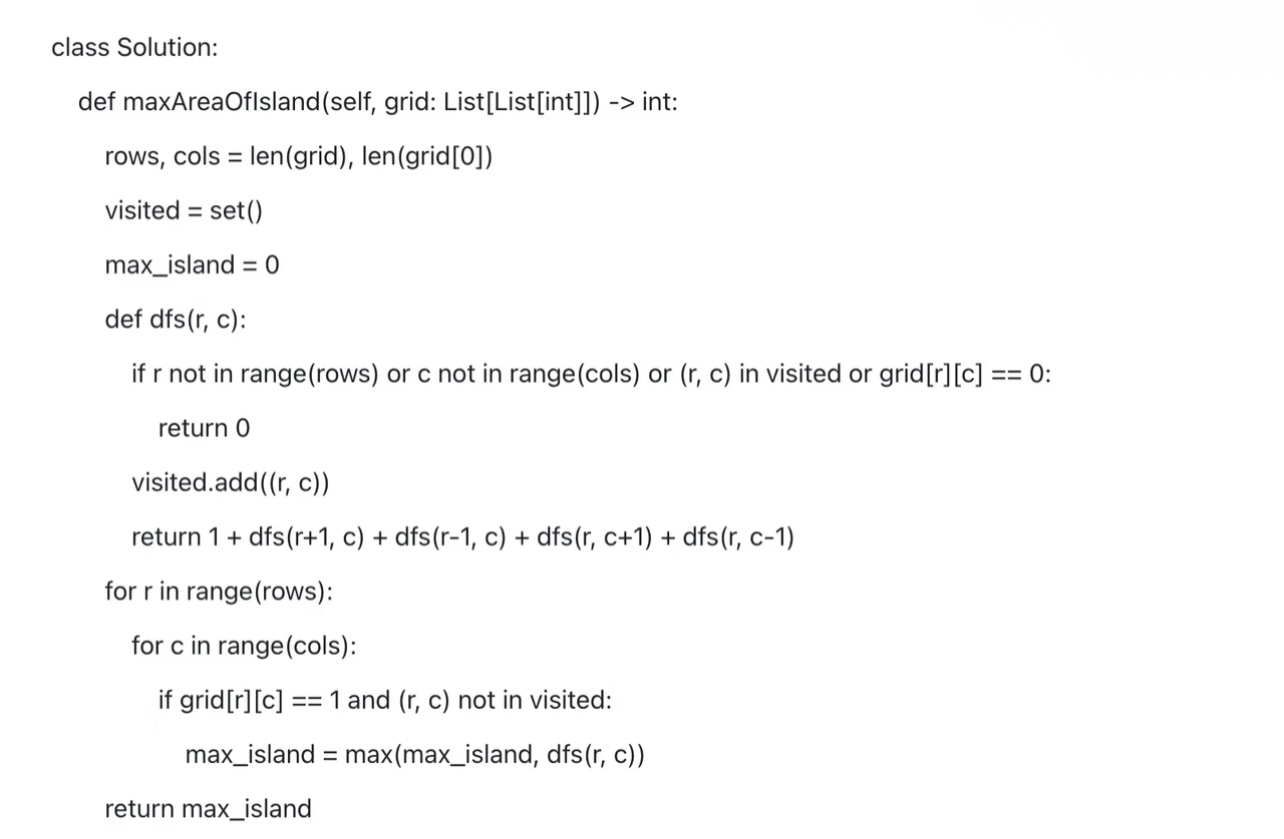
(r, c); whenevergrid[r][c] == 1, start a depth‑first search (DFS) from that cell to compute the island’s area.Depth‑first search. Visit the current cell, mark it as visited (by setting it to 0 or adding to a
visitedset), then recursively explore its four neighbors (up, down, left, right), adding one for each land cell encountered.Track the maximum. After each DFS call, update a global
max_areawith the maximum of its current value and the returned island size.
Complexity analysis
Every cell is visited at most once, so the time complexity is $O(m×n)$. The recursion stack can grow as large as the number of land cells in an island (up to m×n), giving a space complexity of $O(m×n)$.
My implementation
The following Python code uses DFS to compute the area of each island. It tracks visited cells in a set to avoid revisiting nodes; alternatively, you can mutate the grid in place to mark visited cells.
Practical Tips for the Dropbox CodeSignal OA
After working through the four‑level OA and the final interview, here are some lessons I’d share with other candidates:
Step‑by‑Step Debugging
In an online platform like CodeSignal, debugging time is precious. Break your program into small functions and print intermediate variables to validate each step. For DFS problems, for example, print the current coordinates and accumulated area to spot out‑of‑bounds or duplicate visits quickly.
Simplified Modeling Strategy
Many interview problems have elaborate backstories but simple cores. For the Hit Counter, you might think you need to tally every event, but a simple queue gives you everything you need. Word Pattern II feels open‑ended until you realize you can prune the search space aggressively by storing mappings and used substrings. When you read a problem, strip away the narrative to uncover the underlying algorithm.
Safety‑First Optimization
Under time pressure, always get a correct solution first. If you’re unsure about bounds in a binary search, choose a conservative upper limit. If your initial approach is slow but straightforward, implement it to pass the basic tests, then optimize if time remains. A working answer collects points and gives you a base to improve on.
Key Preparation Tips for Dropbox CodeSignal OA
Targeted Practice by Question Type
Backtracking and string mapping. Problems like Word Pattern II rely on recursive search with pruning. Practise similar pattern‑matching and permutation problems to become comfortable with building and backtracking from a mapping.
Queues and sliding windows. The Hit Counter is essentially a fixed‑window frequency query. Strengthen this skill by solving problems such as “sliding window maximum,” “moving average” or “longest substring without repeating characters.”
Graph traversal. Max Area of Island tests your ability to explore grids using DFS or BFS. Do related problems like “Number of Islands” and “Flood Fill” to master marking visited nodes and counting connected components.
Time Management Tips
You only get 60 minutes for the whole technical assessment. You need to use your time well. Read each question quickly, but do not rush. If you get stuck, move to the next part and come back later if you have time. Keep an eye on the clock. Try to finish each question in about 15 minutes.
Here is a simple plan:
Task | Time Limit |
|---|---|
Read instructions | 2 minutes |
Solve each problem | 15 minutes |
Review answers | 8 minutes |
Note: Save a few minutes at the end to check your code for mistakes.
Reading & Code Review Practice
Because Dropbox’s final interview includes a code‑review round, spend time reading other people’s code. Pick a few open‑source projects or LeetCode solutions, review them critically and write short comments on what they do well and what you would improve. In the interview, it’s more important to communicate your observations and trade‑offs clearly than to fix every minor issue.
FAQ
What happens after the OA?
In my round, passing the CodeSignal assessment led to a short HR call and then a final interview with three parts: a coding problem (medium‑difficulty LeetCode style), a code review (analyse and comment on someone else’s code) and a behavioural interview.
Which programming languages are allowed?
CodeSignal supports many popular languages, including Python, Java, C++, JavaScript and more. Use the language you’re most comfortable with to reduce the chance of syntax mistakes.
Which practice problems should I focus on?
For backtracking, try problems like “Permutation II” and “Word Pattern II.” For sliding windows, try “Moving Average” and “Longest Substring Without Repeating Characters.” For graph traversal, practise “Number of Islands” and “Flood Fill.” Also, complete practice questions on CodeSignal to familiarize yourself with their interface.
See Also
How to Use Technology to Cheat on CodeSignal Proctored Exams
How I Navigated the Visa CodeSignal Assessment and What I Learned
My Journey Through Capital One CodeSignal Questions: What I Learned
I Cracked the Coinbase CodeSignal Assessment: My Insider Guide
How I Cracked the Ramp CodeSignal Assessment and What You Can Learn
© Copyright 2025 Linkjob.ai - All Rights Reserved.